The Summer Camp Doctor's Handbook
Essential Wilderness Medicine and Emergency Protocols for Remote Pediatric Care
Imagine confidently managing a child with a suspected fracture, recognizing heat stroke before it becomes life-threatening, or making the critical decision to evacuate versus treat in the field—all while working in a remote camp setting with limited resources.
222 pages12 chaptersSep 13, 2026Wilderness Medicine
About this book
This handbook provides the practical protocols and decision-making frameworks you need to deliver exceptional emergency care to pediatric patients in wilderness environments. Drawing on wilderness medicine principles and pediatric-specific approaches, you'll master rapid field assessment techniques, learn systematic triage protocols, and develop the clinical judgment to distinguish minor injuries from emergencies requiring immediate evacuation. From recognizing dehydration and heat-related illnesses to managing allergic reactions, stabilizing fractures, and implementing infection control in remote settings, this guide covers the full spectrum of camp medicine challenges. Each chapter includes clear decision trees, assessment checklists, and evidence-based protocols designed for real-world application when advanced diagnostics and specialist consultation aren't available. Whether you're new to wilderness medicine or transitioning from traditional clinical practice, you'll find the tools to establish comprehensive camp health protocols and respond effectively to emergencies.
Table of contents
- IntroductionWilderness Medicine in the Camp Setting, Scope and Limitations of Camp Medicine, How to Use This HandbookRead below
- Chapter 1: Rapid Field Assessment and Triage FundamentalsWilderness Triage Protocols and Decision Trees, Rapid Field Assessment Techniques, Pediatric Vital Signs Baseline and Trending, Acute Injury Decision Making Framework
- Chapter 2: Heat-Related Illnesses and Environmental EmergenciesHeat Exhaustion Recognition and Field Management, Heat Stroke Emergency Response and Evacuation, Dehydration Assessment Methods and Indicators, Rehydration Protocols in Remote Settings
- Chapter 3: Musculoskeletal Injuries: Assessment and StabilizationSprain vs Fracture Differentiation, Pediatric Fracture Stabilization and Immobilization, Blister Prevention and Treatment
- Chapter 4: Allergic Reactions and Anaphylaxis ManagementAllergic Reaction Severity Grading and Triage, Anaphylaxis Emergency Protocol and Shock Recognition, Medication Administration Safety and Antibiotic Allergy Documentation
- Chapter 5: Wound Management and Infection ControlWound Closure Decision Making, Field Wound Infection Signs and Minor Infection Treatment, Infection Progression Monitoring and Warning Signs
- Chapter 6: Respiratory and Airway EmergenciesAcute Respiratory Distress Field Assessment, Pediatric Airway Management Basics, Asthma Attack Emergency Response, Upper Respiratory Infection Management
- Chapter 7: Common Pediatric Infections and IllnessesFever Assessment in Children, Ear Infection Field Diagnosis, Strep Throat Field Screening, Gastrointestinal Illness Triage and Management
- Chapter 8: Dermatologic Conditions and Insect-Related InjuriesRash Differentiation Guide, Dermatologic Condition Assessment, Insect Bite Complication Management, Tick Removal and Lyme Disease Prevention
- Chapter 9: Neurological Emergencies and Pain ManagementConcussion Recognition Protocol, Pediatric Seizure Management, Pediatric Headache Assessment, Pediatric Pain Assessment and Management
- Chapter 10: Abdominal Emergencies and Burn InjuriesAcute Abdominal Pain Assessment, Burn Injury Field Treatment and Evacuation
- Chapter 11: Pediatric Communication and Special ConsiderationsPediatric Communication Skills and Age-Appropriate Assessment, Pediatric Shock Indicators and Recognition, Basic Life Support Refresher for Pediatric Patients
- Chapter 12: Camp-Specific Protocols and DocumentationCamp-Specific Health Protocols and Medication Safety, Quarantine Protocol Implementation, Wilderness Medicine Documentation and Legal Considerations, Emergency Evacuation Procedures and Remote Care Decision Trees
- ConclusionIntegrating Protocols Into Practice, Continuous Preparation and Professional Development
Introduction
A twelve-year-old camper collapses on the archery field at 2 p.m. in July, skin hot and dry, mumbling words that don't quite connect. Within the next ten minutes, someone has to decide whether this is heat exhaustion that will resolve with shade and fluids, or heat stroke that needs an ambulance called immediately. That someone is often a physician who trained in an emergency department with imaging, labs, and specialist backup a phone call away, now standing on a dirt path with a first aid kit and a two-way radio. The gap between those two worlds is the reason this handbook exists.
Camp medicine sits in an unusual space between primary care, emergency medicine, and pediatrics, but it belongs fully to none of them. A camp physician sees far more insect bites, blisters, and homesickness-related stomachaches than cardiac events, yet must still be ready for the rare seizure or anaphylactic reaction with the same seriousness as an emergency department attending. The patient population is almost entirely pediatric, ranging from six-year-olds who cannot describe their symptoms in words an adult would recognize to sixteen-year-olds who may minimize pain to avoid missing an activity. Resources are limited by design: no imaging, often no lab work, and medications restricted to what fits in a locked cabinet.
This introduction sets the frame for everything that follows. It explains why wilderness medicine principles, originally built for backcountry travelers and expedition members, translate directly to the camp setting despite camps often being only a short drive from a hospital. It also draws a clear line around what camp medicine is meant to do and what it is not, because overreach in either direction, treating too much in the field or evacuating too readily, creates its own risks. Finally, it lays out how the rest of the handbook is organized so that in a moment of urgency, the right protocol can be found in seconds rather than minutes.
None of this replaces formal wilderness medicine training or local protocols set by camp administration and medical directors. It is a working reference, built to sit on a shelf next to the med kit and to be flipped open mid-crisis, not read once and filed away.
Wilderness Medicine in the Camp Setting
Wilderness medicine developed as a distinct discipline because standard clinical protocols assume resources that simply are not present once someone is more than an hour from definitive care. The field grew out of expedition and search-and-rescue medicine in the 1970s and 1980s, formalized through organizations like the Wilderness Medical Society, and built around a core question: what is the best care achievable with what is actually on hand, not what would be ideal in a hospital[1]. Summer camps rarely qualify as true wilderness in the expedition sense, but the underlying constraint is identical. A camp infirmary might be twenty minutes from a rural hospital or two hours from the nearest trauma center, and either way the physician on-site is the only medical decision-maker until transport arrives.
The core insight from wilderness medicine that matters most for camp work is the shift from diagnosis-driven to disposition-driven thinking. In a hospital, the natural question is "what is wrong with this patient?" In the field, the more urgent question is "does this patient need to leave right now, and if not, what do I do while they stay?" This is not a lesser form of medicine, it is a different discipline with its own skill set, built around the Wilderness Triage framework covered in the next chapter. A physician who tries to force a full differential diagnosis before acting will lose time that matters more in the field than it typically does in a fully resourced setting.
Camps add a pediatric layer on top of the resource-limited layer, and the two compound each other. A dehydrated adult hiker can usually report their own symptoms with reasonable accuracy. A dehydrated eight-year-old may simply say they feel "weird" and want to go swimming anyway, masking a problem that is progressing. Vital sign ranges, medication dosing, and pain communication all shift with age, and a physician transitioning from adult-focused emergency or family medicine practice needs to recalibrate instincts that were built around adult presentations. Pediatric Vital Signs Baselines and Pediatric Communication by Developmental Stage, both detailed in later chapters, exist specifically to close this gap.
Consider the difference in how heat illness presents across ages. An adult experiencing early heat exhaustion often self-reports dizziness or nausea well before the situation becomes dangerous. A younger camper may keep playing through the same physiological changes simply because they lack the interoceptive vocabulary to flag what they're feeling, or because they don't want to leave an activity they're enjoying. By the time a counselor notices something is wrong, the child may already be further along the heat illness spectrum than an equivalent adult case would be. This is one of many reasons Exertional Heat Illness ranks among the most common preventable emergencies in camp settings, a topic covered in full detail in the chapter on heat-related illnesses.
Environmental exposure is also structurally different at camp compared to a typical pediatric practice. Camps run programming outdoors for six to ten hours a day, often in direct sun, sometimes at elevation, frequently near water. This is precisely the setting wilderness medicine was built to address: sustained environmental exposure combined with physical exertion and limited real-time monitoring. A camp physician who treats every day as a controlled clinical encounter, rather than an ongoing environmental exposure that needs anticipatory management, will find themselves perpetually reacting instead of preventing.
The other structural feature of camp medicine is population density and turnover. A camp of 200 children generates a volume of minor complaints, splinters, bug bites, mild stomachaches, that would overwhelm a solo physician if each were treated as an individual diagnostic puzzle. Effective camp medicine requires pattern recognition across a population, not just case-by-case evaluation. If three campers from the same cabin present with similar gastrointestinal symptoms within a day, that is not three unrelated stomachaches, it's a potential outbreak requiring the Quarantine Protocol covered in the chapter on camp-specific protocols, not three individual prescriptions for rest and fluids.
Understanding this context reframes the physician's role at camp. It is not simply "be a doctor, but outdoors." It is a distinct practice combining triage-first thinking, pediatric-specific assessment, population-level pattern recognition, and comfort operating without the diagnostic infrastructure that shapes most clinical training. Every subsequent chapter builds on this foundation, and returning to it when a protocol feels unfamiliar or counterintuitive compared to hospital-based training will usually clarify why the field approach differs.
Scope and Limitations of Camp Medicine
Every camp physician needs a clear internal boundary between what can be safely managed on-site and what requires transfer to a higher level of care, and that boundary needs to be set before the season starts, not improvised in the moment. Wilderness and remote medicine literature refers to this boundary as Scope of Practice in Wilderness, and it differs meaningfully from scope of practice in a licensed clinical facility[2]. In a hospital, scope is largely defined by credentialing and available equipment. At camp, scope is defined by a combination of training, available supplies, distance to definitive care, and the acceptable risk tolerance set by camp leadership and medical direction in advance.
Setting this scope requires an honest inventory of three things: what equipment and medications are actually stocked in the infirmary, what transport time and options exist to the nearest appropriate facility, and what the physician's own comfort level is with procedures they may not have performed since residency. A physician who hasn't placed a splint since medical school should not be improvising fracture management for the first time on a distressed ten-year-old. Reviewing Improvised Splinting techniques and practicing them on a colleague before camp opens is a far better use of preparation time than discovering gaps mid-emergency.
The most common failure mode in camp medicine is not under-treatment, it is over-confidence in field management combined with delayed recognition of when a case has crossed into needing evacuation. A rolled ankle that looks like a sprain but has point tenderness over the growth plate, a headache that started as a simple concussion but is now accompanied by worsening confusion, a rash that seemed like a simple allergic reaction but is spreading rapidly with new swelling. Each of these scenarios has a decision point where continuing to manage in the field becomes the wrong call, and the handbook is structured so that these decision points are explicit, not left to individual judgment alone.
The opposite failure mode also carries real cost: reflexive over-evacuation. Calling an ambulance and initiating transport for every fever, every minor laceration, or every twisted ankle erodes trust with camp leadership, disrupts programming unnecessarily, and in remote settings can tie up scarce transport resources that a genuinely critical case might need later the same day. Emergency Evacuation Procedures, covered in the camp protocols chapter, exist precisely to give a structured, defensible basis for the decision to transport, rather than defaulting to either extreme out of anxiety or inexperience.
The goal of scope-setting is not to minimize liability by transferring every ambiguous case. It is to match the level of intervention to the actual risk, using structured criteria rather than gut instinct alone.
Legal and regulatory scope also varies by jurisdiction, and this handbook cannot substitute for jurisdiction-specific legal guidance. Some regions have specific statutes covering wilderness or camp medical practice, Good Samaritan protections that may or may not extend to a paid camp physician, and requirements around medication storage and administration by non-physician staff. Before relying on any protocol in this handbook, confirm it aligns with the medical director's standing orders, state or provincial regulations, and the camp's own liability insurance requirements. Wilderness Medicine Documentation, detailed later, is one part of managing this legal exposure, but it works alongside institutional policy, not in place of it.
Camp medicine also has a preventive dimension that differs from a walk-in clinic's reactive model. Because the same population is under continuous observation for weeks at a time, a camp physician has the opportunity, and arguably the obligation, to intervene before problems escalate. Reviewing hydration schedules before a heat wave, checking that epinephrine auto-injectors are not expired before the season starts, walking the property to identify hazards, these are all within scope even though they don't resemble traditional clinical encounters. Limiting the definition of "practicing medicine" strictly to hands-on patient encounters misses a substantial part of what keeps a camp safe.
The boundary of scope should be revisited whenever circumstances change mid-season. A camp that starts the summer with reliable cell coverage and a twenty-minute ambulance response time might lose both during a storm, effectively expanding the definition of "field management" for the duration of the disruption. Building flexibility into scope planning, rather than treating it as fixed on day one, is part of practicing wilderness medicine responsibly rather than mechanically.
How to Use This Handbook
This handbook is organized to be usable in two very different modes: calm pre-season preparation and urgent in-the-moment reference. During pre-season preparation, reading chapters in order builds a coherent mental model, starting with the Primary Survey and AVPU Scale in the first chapter and moving through body systems and special scenarios toward the administrative material in the final chapters. This sequence mirrors how information actually gets used in a real case: first stabilize and triage, then address the specific presenting problem, then document and decide on evacuation.
During an actual emergency, however, no one has time to read a chapter from the beginning. Each chapter is built around explicit decision points, so that a physician handling an active case can jump directly to the relevant subsection, find the assessment criteria and action steps, and move. The Wilderness Triage decision trees, checklists, and callout boxes scattered throughout are designed for exactly this kind of rapid lookup, not for narrative reading under pressure.
Consider building a simple tabbing or bookmarking system for the physical or digital copy of this handbook before camp opens, flagging the sections most likely to be needed urgently. A practical starting list:
Suggested Quick-Access Sections to Bookmark
- Primary Survey and AVPU Scale
- Heat Stroke Emergency Response and Evacuation
- Anaphylaxis Emergency Protocol and Shock Recognition
- Pediatric Seizure Management
- Pediatric Shock Indicators and Recognition
- Emergency Evacuation Procedures and Remote Care Decision Trees
Every chapter follows a consistent internal logic: recognition criteria first, field management steps second, and evacuation thresholds third. This structure is deliberate and mirrors the actual clinical reasoning sequence needed in the field. Resist the temptation to skip straight to "what do I do" without first confirming the recognition criteria actually match the case in front of you. Misidentifying heat exhaustion as simple fatigue, or a sprain as a fracture, changes every downstream decision, so the recognition step is never filler, it's the foundation the rest of the chapter depends on.
Cross-references between chapters are frequent and intentional, because real cases rarely respect chapter boundaries. A camper with a suspected fracture might also be showing early signs of shock, requiring a jump from the musculoskeletal chapter to Compensated vs Decompensated Shock in the pediatric communication and special considerations chapter. These links are called out explicitly in the text by the concept they reference, so following them should feel like a natural extension of the reasoning already in progress, not a detour.
The decision trees, checklists, and callout boxes throughout this handbook are meant to be used literally, not just read for general familiarity. When a decision tree lays out a branching path for, say, distinguishing a simple febrile illness from one requiring evacuation, work through the actual branches with the actual patient's data rather than pattern-matching from memory. Memory is exactly what fails under the adrenaline of an actual pediatric emergency, and the entire point of externalizing these frameworks onto the page is to reduce reliance on recall in a moment when it is least reliable.
Documentation habits described in the camp protocols chapter should be adopted from the very first day of camp, not introduced only after a serious incident makes their importance obvious. Waiting until a lawsuit or a difficult parent conversation to start documenting rigorously means the easy cases, the ones that would have built good habits with low stakes, are already gone. Treat every camper interaction, however minor, as documentation practice for the case that will eventually matter.
Finally, this handbook assumes a baseline of medical training and does not attempt to teach core clinical skills from scratch. It assumes familiarity with basic physical examination, standard resuscitation concepts, and general pharmacology, and focuses instead on how those skills apply differently in a resource-limited, pediatric-heavy, environmentally exposed setting. Where a protocol departs from standard hospital-based practice, an explanation of why is included, because understanding the reasoning behind a field adaptation makes it easier to apply correctly under pressure, and easier to adapt further if circumstances at a particular camp differ from what is assumed here.
The chapters that follow move from foundational assessment skills toward increasingly specific clinical scenarios, and finally toward the administrative scaffolding that supports everything else. Reading straight through once, then returning to individual chapters as situations arise throughout the season, is the intended use pattern. What matters most is that when the radio call comes in, the right page can be found fast enough to matter.
This is the end of the free sample. The full book has 12 chapters.
Want this book written for you?
Tell us your goals and background, and get your own version of this book, tailored by AI to you.


Benefits of AI-tailored books
- Read one book, not ten:
- all the Wilderness Medicine knowledge you need, gathered into a single book.
- Save days of learning:
- tell us your goals, choose your topics, and the whole book is built around them.
- Learn effortlessly:
- Wilderness Medicine book written for your specific background and expertise.
- Understand at a glance:
- includes charts, tables, timelines, checklists, decision trees, and more.
- Stay current:
- written the day you order it, not years ago.
- Trust what you read:
- every book is checked for accuracy, with real research when your subject needs it.
Create your unique book in 3 steps
- 1. Select your focus
Select the focus of your Wilderness Medicine book and share your background
- 2. Personalize your book
Specify your goals and choose sub-topics to include
- 3. Get your tailored book
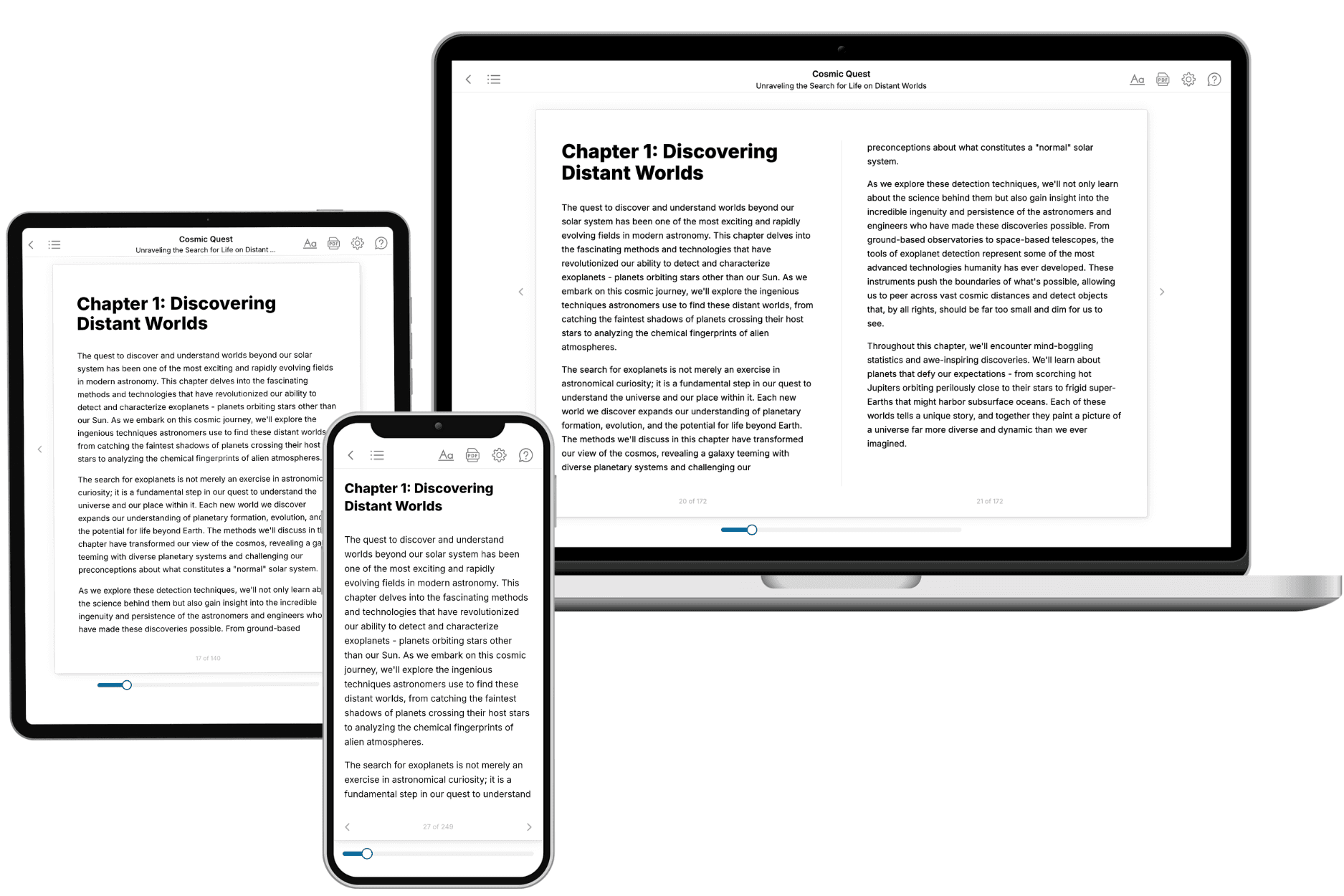
Your book is ready in 10 minutes. Read it online, download as EPUB or PDF, or send to Kindle.

Frequently asked questions
- What is TailoredRead?
TailoredRead creates complete, full-length nonfiction ebooks, written specifically for you. Tell us what you want to learn and why, and TailoredRead writes you a complete ebook on it, with charts, tables, and diagrams throughout. Read it online, on Kindle, or on any e-reader, or download it as a PDF or EPUB. Every book is written fresh the day you order it.
- How is the book tailored to me?
Before anything is written, you answer a few short questions about your goals, your background, and the topics you care about. Your book is then planned around your answers: written at your level, focused on your goals, and covering the topics you chose, instead of the one-size-fits-all book a store sells everyone.
- Will it read like generic AI content?
No. Your book isn't a chat transcript: it's planned chapter by chapter before a single word is written, told in a clear book voice, and explains ideas visually with charts, tables, and diagrams. After writing, every book goes through an editorial pass that polishes chapters so the book reads consistent from start to finish. Judge for yourself: browse thousands of sample books on our Explore Books page.
- How accurate is the content?
Our AI first checks whether your subject needs live research. Niche and fast-moving subjects are researched before writing, and the book plan and chapters are grounded in what it finds. After writing, every book goes through a quality pass that checks its facts and consistency, and researched books list their sources in a Notes section at the back.
- How long is the book?
You choose the length: Comprehensive (250-300 pages), Detailed (150-200 pages), Essential (70-100 pages), or Short (30-50 pages).
- Does the book include visuals?
Yes. Every book includes charts, tables, and diagrams: timelines, checklists, step-by-step guides, decision trees, comparison tables, matrices, and bar charts. A typical book includes dozens of these visual elements.
- Can I read it on Kindle? What formats can I download?
Yes. Every book can be read in our online reader or downloaded as a PDF or EPUB. The EPUB can be opened with Kindle, Apple Books, Kobo, and any e-reader. The Commercial and Author licenses also include an editable Word (DOCX) and Markdown download.
- How much does it cost?
About the price of a regular ebook. The exact price depends on your book's length and complexity, from $2 for the shortest books to $35 for the most comprehensive, and it's shown when you review your book, before you commit to anything. Each book is a one-time purchase, yours to keep, no subscription. Licenses that let you share, teach, or publish your book range from $35.99 to $49.99.
- Can I preview the book before purchasing?
Before you pay, you'll see what your book will cover: the title, a detailed description, the estimated length, and the complete chapter-by-chapter table of contents, so you know what you're getting before you decide. The full text itself is written after you purchase.
- How long does it take to create a book?
About 10 minutes. You can start reading the opening chapters while the rest is still being written.