The Synergistic Leader
Mastering Intrapersonal and Interpersonal Dynamics in Public Administration
Picture yourself at the helm of a thriving public administration office, where team members collaborate seamlessly, conflicts are resolved constructively, and innovative solutions to complex problems emerge naturally.
253 pages13 chaptersApr 13, 2025LeadershipCreated by Chris
About this book
Your leadership inspires trust, your communication resonates clearly, and your decisions are both ethical and effective. This isn't just a dream—it's the reality that awaits you. "The Synergistic Leader" is your comprehensive guide to elevating your leadership in public administration to unprecedented heights. Drawing from cutting-edge research in organizational behavior and proven techniques in emotional intelligence, this book offers a roadmap to transforming your workplace culture and optimizing your team's potential. You'll discover how to cultivate resilience in the face of challenges, implement feedback systems that drive continuous improvement, and master the art of adaptive leadership in an ever-changing public sector landscape. With each chapter, you'll gain practical tools to enhance your intrapersonal awareness and interpersonal skills, enabling you to navigate the complexities of public service with confidence and grace. Whether you're looking to streamline decision-making processes, foster inclusivity, or balance the demands of public service with personal well-being, "The Synergistic Leader" provides the strategies you need. Prepare to revolutionize your approach to leadership and create a more dynamic, effective, and harmonious work environment.
Table of contents
- IntroductionThe Evolving Landscape of Public Administration Leadership, The Synergistic Approach to Leadership, How to Use This Book for Maximum ImpactRead below
- Chapter 1: The Emotional Intelligence AdvantageUnderstanding Emotional Intelligence in Leadership, Cultivating Self-Awareness, Developing Empathy in Public Service, Mastering Emotional Regulation
- Chapter 2: Adaptive Leadership in Civil OperationsPrinciples of Adaptive Leadership, Navigating Change in Public Administration, Cultivating Flexibility in Decision-Making, Fostering Innovation in Traditional Structures
- Chapter 3: Effective Communication StrategiesThe Art of Active Listening, Crafting Clear and Impactful Messages, Understanding and Utilizing Nonverbal Cues, Mastering Digital Communication Channels
- Chapter 4: Building High-Performance TeamsUnderstanding Team Dynamics, Fostering Trust and Psychological Safety, Leveraging Diversity as a Strength, Promoting Collaboration and Synergy
- Chapter 5: Mastering Conflict ResolutionIdentifying Types of Workplace Conflicts, Effective Mediation Techniques, Negotiating Win-Win Solutions, Strategies for Conflict Prevention
- Chapter 6: Implementing Effective Feedback SystemsCreating a Culture of Continuous Feedback, Delivering Constructive Feedback, Revolutionizing Performance Reviews, Implementing 360-Degree Feedback
- Chapter 7: Fostering an Inclusive WorkplaceThe Benefits of Inclusivity in Public Administration, Recognizing and Mitigating Unconscious Bias, Developing Inclusive Policies and Practices, Leading Diverse Teams Effectively
- Chapter 8: Promoting Work-Life IntegrationUnderstanding the Importance of Work-Life Balance, Implementing Flexible Work Policies, Effective Stress Management Techniques, Preventing Burnout in Public Service
- Chapter 9: Ethical Leadership in Public AdministrationDeveloping an Ethical Decision-Making Framework, Promoting Transparency and Accountability, Building an Ethical Organizational Culture, Navigating Ethical Challenges in Civil Operations
- Chapter 10: Advanced Decision-Making ModelsEnhancing Analytical Thinking Skills, Implementing Data-Driven Decision Making, Facilitating Effective Group Decisions, Risk Assessment and Management
- Chapter 11: Building Resilient TeamsThe Importance of Resilience in Public Administration, Strategies for Developing Personal Resilience, Fostering Team Resilience, Resilience in Crisis Management
- Chapter 12: Effective Mentoring and Succession PlanningThe Benefits of Mentoring Programs, Developing Effective Mentoring Skills, Implementing Succession Planning Strategies, Facilitating Knowledge Transfer
- Chapter 13: Innovative Problem-Solving MethodsFostering Creative Thinking in Public Administration, Applying Design Thinking to Public Sector Challenges, Collaborative Problem-Solving Techniques, Leveraging Technology for Innovative Solutions
- ConclusionKey Takeaways for the Synergistic Leader, The Future of Leadership in Public Administration
- AppendixLeadership Assessment Tools, Additional Resources and Reading
Introduction
Welcome to "The Synergistic Leader: Mastering Intrapersonal and Interpersonal Dynamics in Public Administration." This book is designed to be your comprehensive guide to elevating your leadership skills in the complex and ever-evolving world of public administration. As a highly experienced Deputy of Civil Operations with a background in Biology, you are already well-versed in the intricacies of public service. However, the landscape of leadership is constantly changing, and this book aims to equip you with cutting-edge strategies to enhance your effectiveness, improve team dynamics, and create a more efficient and inclusive workplace.
In the pages that follow, you will embark on a journey of personal and professional growth. You'll explore the fundamental principles of emotional intelligence, adaptive leadership, and effective communication. You'll delve into advanced techniques for team building, conflict resolution, and fostering inclusivity. Moreover, you'll gain insights into balancing work-life integration, making ethical decisions, and implementing innovative problem-solving methods. Each chapter is crafted to provide you with practical, actionable advice that you can immediately apply to your role in public administration.
As we begin this journey together, it's important to recognize that leadership in public administration is not just about managing processes and policies. It's about inspiring and guiding people, navigating complex social and political landscapes, and making decisions that have far-reaching impacts on communities. The skills and strategies you'll learn in this book are designed to help you excel in these areas, transforming you into a synergistic leader who can bring out the best in yourself and others.
The Evolving Landscape of Public Administration Leadership
The field of public administration has undergone significant changes in recent years, driven by technological advancements, shifting societal expectations, and global challenges. Today's public sector leaders face a unique set of challenges that require a diverse skill set and a nuanced understanding of both human dynamics and organizational systems. The traditional hierarchical model of leadership is giving way to more collaborative and adaptive approaches, necessitating a shift in how we think about and practice leadership in public service.
One of the most significant changes in the leadership landscape is the increasing emphasis on emotional intelligence and interpersonal skills. While technical expertise and policy knowledge remain crucial, the ability to understand and manage emotions – both your own and those of others – has become a key differentiator for effective leaders. This shift recognizes that public administration is fundamentally about serving people, and that the most successful leaders are those who can connect with and inspire their teams and the public they serve.
Another critical evolution in public administration leadership is the need for adaptability and innovation. In an era of rapid change and complex challenges, leaders must be able to navigate uncertainty, embrace new ideas, and lead their organizations through transformation. This requires a mindset of continuous learning and a willingness to challenge established norms when they no longer serve the public interest. The most effective leaders in today's public sector are those who can balance the stability required for good governance with the flexibility needed to respond to emerging needs and opportunities.
Transparency and accountability have also taken center stage in the evolving landscape of public administration leadership. In an age of instant information and heightened public scrutiny, leaders must be prepared to communicate openly, admit mistakes, and demonstrate a commitment to ethical decision-making. This shift towards greater transparency not only builds trust with the public but also fosters a culture of integrity within organizations.
The digital transformation of government services has further reshaped the leadership landscape. Public administrators must now be tech-savvy, understanding how to leverage digital tools to improve service delivery, engage citizens, and make data-driven decisions. This technological shift has also changed the nature of workplace communication and collaboration, requiring leaders to adapt their management styles to both in-person and virtual environments.
Diversity and inclusion have become critical focus areas for public administration leaders. As communities become more diverse, leaders must ensure that their organizations reflect and respond to this diversity. This goes beyond mere representation to creating truly inclusive environments where all voices are heard and valued. Effective leaders in this new landscape must be skilled in fostering inclusive practices, addressing unconscious biases, and leveraging diverse perspectives to drive innovation and improve public services.
The concept of work-life balance has also evolved, with a growing recognition of the importance of work-life integration. Public sector leaders are now expected to model and support practices that promote employee well-being and prevent burnout. This shift acknowledges that the demands of public service can be intense, and that sustainable leadership requires attention to both professional effectiveness and personal resilience.
Collaboration and partnership have become increasingly important in the public administration landscape. Complex societal challenges often require cross-sector solutions, and leaders must be adept at building and maintaining partnerships with other government agencies, non-profit organizations, and private sector entities. This collaborative approach extends to internal operations as well, with a growing emphasis on breaking down silos and fostering interdepartmental cooperation.
Finally, the evolving landscape of public administration leadership places a premium on strategic thinking and long-term planning. While day-to-day operations remain important, leaders must also be able to anticipate future challenges, set ambitious goals, and guide their organizations towards a vision of improved public service. This forward-thinking approach requires a balance of pragmatism and idealism, grounded in a deep understanding of public needs and policy dynamics.
As we explore these evolving aspects of public administration leadership throughout this book, you'll gain insights and strategies to navigate this complex landscape effectively. The skills and approaches you'll learn will help you not only adapt to these changes but also lead the way in shaping the future of public service leadership.
The Synergistic Approach to Leadership
At the heart of this book lies the concept of the synergistic approach to leadership. This approach is founded on the principle that the whole is greater than the sum of its parts – that by fostering connections, encouraging collaboration, and aligning diverse strengths, a leader can create an environment where both individuals and the organization as a whole can thrive. The synergistic approach is particularly well-suited to the complexities of public administration, where multiple stakeholders, competing priorities, and limited resources often create challenging dynamics.
The synergistic leader understands that leadership is not about exerting control or authority, but about creating conditions where people can do their best work and where innovative solutions can emerge. This approach recognizes that in the interconnected world of public administration, no single individual has all the answers. Instead, the most effective solutions often arise from the collective wisdom and diverse perspectives of a well-functioning team. By adopting a synergistic approach, you can tap into the full potential of your organization, leveraging the unique strengths and insights of each team member to achieve outcomes that would be impossible through individual efforts alone.
Central to the synergistic approach is the idea of emotional intelligence. A synergistic leader must be acutely aware of their own emotions and motivations, as well as those of others. This self-awareness and empathy form the foundation for building strong relationships, fostering trust, and creating an environment where open communication and constructive feedback can flourish. By developing your emotional intelligence, you'll be better equipped to navigate the complex interpersonal dynamics that are inherent in public administration, from managing diverse teams to negotiating with stakeholders and addressing public concerns.
Adaptability is another key component of the synergistic approach. In the ever-changing landscape of public administration, rigid leadership styles and inflexible strategies quickly become obsolete. The synergistic leader must be able to pivot in response to new challenges, adjust strategies based on emerging data, and guide their team through periods of uncertainty and change. This adaptability extends to decision-making processes, where the synergistic leader recognizes that different situations may call for different approaches – from collaborative decision-making to quick, decisive action in times of crisis.
Effective communication lies at the core of the synergistic approach. A synergistic leader must be able to articulate a clear vision, provide constructive feedback, and facilitate open dialogue within their team and with external stakeholders. This communication is not just about transmitting information, but about creating shared understanding, aligning goals, and inspiring action. Through effective communication, the synergistic leader can break down silos, foster collaboration across departments, and ensure that all team members are working towards common objectives.
The synergistic approach also emphasizes the importance of continuous learning and growth. In a field as dynamic as public administration, stagnation is not an option. The synergistic leader must cultivate a culture of learning within their organization, encouraging professional development, promoting knowledge sharing, and creating opportunities for experimentation and innovation. This commitment to growth extends to the leader themselves, who must model a willingness to learn, adapt, and evolve in response to new challenges and opportunities.
Inclusivity is a fundamental principle of the synergistic approach. A truly synergistic leader recognizes the value of diverse perspectives and experiences, and actively works to create an environment where all voices are heard and respected. This goes beyond mere tokenism or surface-level diversity initiatives. It involves creating systems and cultures that genuinely value and leverage diversity, addressing unconscious biases, and ensuring that decision-making processes are inclusive and equitable. By fostering true inclusivity, the synergistic leader can tap into a wealth of ideas and insights that might otherwise go unheard, leading to more innovative and effective solutions to public administration challenges.
Ethical leadership is another crucial aspect of the synergistic approach. In public administration, where decisions can have far-reaching impacts on communities and individuals, maintaining high ethical standards is paramount. The synergistic leader must not only adhere to ethical principles themselves but also foster a culture of integrity within their organization. This involves creating clear ethical guidelines, promoting transparency in decision-making processes, and ensuring accountability at all levels of the organization. By prioritizing ethical leadership, the synergistic leader builds trust with both their team and the public they serve, creating a foundation for long-term success and positive impact.
The synergistic approach also recognizes the importance of resilience and well-being, both for the leader and their team. Public administration can be a high-stress field, with significant demands and often limited resources. A synergistic leader must be able to manage their own stress and maintain their well-being, while also creating an environment that supports the resilience and work-life integration of their team members. This involves implementing policies and practices that promote well-being, recognizing and addressing signs of burnout, and fostering a culture where self-care is valued and supported.
Finally, the synergistic approach emphasizes the importance of systems thinking. Public administration challenges are often complex and interconnected, requiring solutions that address multiple factors and consider long-term impacts. A synergistic leader must be able to see the big picture, understanding how different elements of their organization and the broader public sector ecosystem interact and influence each other. This systems perspective allows for more holistic and effective problem-solving, and helps the leader anticipate potential consequences of decisions and actions.
As you progress through this book, you'll explore each of these elements of the synergistic approach in depth, gaining practical strategies and insights to implement this approach in your own leadership practice. By embracing the synergistic approach, you'll be well-equipped to navigate the complexities of public administration leadership, create high-performing teams, and drive meaningful change in your organization and the communities you serve.
How to Use This Book for Maximum Impact
"The Synergistic Leader" is designed to be more than just a theoretical exploration of leadership principles. It's a practical guide that you can use to transform your leadership approach and enhance your effectiveness in public administration. To get the most out of this book, it's important to approach it with an open mind and a commitment to applying what you learn. This section will provide you with strategies for engaging with the material in a way that maximizes its impact on your leadership practice.
First and foremost, it's crucial to approach this book as an active learner. As you read, don't just passively absorb the information. Instead, engage critically with the concepts presented. Reflect on how they relate to your own experiences in public administration. Consider how the strategies and techniques discussed might apply to specific challenges you're facing in your role. Take notes, highlight key passages, and jot down questions or ideas that come to mind as you read. This active engagement will help you internalize the material and make it more relevant to your unique context.
Each chapter of this book is structured to provide a blend of theoretical foundations and practical applications. As you work through the chapters, pay particular attention to the case studies and real-world examples provided. These are not just illustrations – they're opportunities for you to analyze how the principles discussed play out in actual public administration scenarios. Consider how you might have handled similar situations, and what you might do differently in the future based on what you've learned. This process of analysis and reflection will help you develop your critical thinking skills and prepare you to apply the book's concepts in your own work.
Throughout the book, you'll find exercises and self-assessment tools designed to help you deepen your understanding of your own leadership style and areas for growth. Don't skip over these – they're valuable opportunities for self-reflection and personal development. Take the time to complete these exercises thoughtfully and honestly. The insights you gain from these self-assessments can be powerful catalysts for personal and professional growth. Consider keeping a separate journal to record your responses to these exercises and track your progress over time.
As you progress through the book, it's important to think about how you can apply what you're learning in your day-to-day work. After each chapter, take some time to identify one or two specific actions you can take to implement the concepts discussed. These don't have to be major initiatives – even small changes in your approach or behavior can have significant impacts over time. By consistently putting the book's principles into practice, you'll gradually transform your leadership style and see real improvements in your effectiveness as a public administrator.
Don't hesitate to revisit chapters or sections of the book as needed. Leadership development is an ongoing process, and you may find that certain concepts become more relevant or take on new meaning as you gain experience and face new challenges in your role. Keep this book as a reference that you can turn to when you need guidance or inspiration. The strategies and insights it contains will continue to be valuable throughout your leadership journey.
Consider forming a study group or book club with colleagues to discuss the concepts in this book. Leadership development is often most effective when it's a collaborative process. By sharing your insights and hearing different perspectives from your peers, you can deepen your understanding of the material and gain new ideas for applying it in your work. These discussions can also be a valuable opportunity to build relationships and foster a culture of continuous learning within your organization.
As you work through the book, pay attention to how the different concepts and strategies interconnect. While each chapter focuses on a specific aspect of leadership, the true power of the synergistic approach comes from integrating these various elements. Look for opportunities to combine different strategies or apply multiple concepts simultaneously in your leadership practice. This holistic approach will help you develop a more nuanced and effective leadership style.
Don't be afraid to experiment with the techniques and strategies presented in this book. Leadership is not a one-size-fits-all endeavor, and what works best for you may depend on your personal style, the nature of your team, and the specific challenges you face in your role. Be willing to try new approaches, assess their effectiveness, and adjust as needed. This process of experimentation and refinement is key to developing your own unique and effective leadership style.
Finally, remember that leadership development is a journey, not a destination. As you work through this book, celebrate your progress and the insights you gain, but also remain open to continued learning and growth. The field of public administration is constantly evolving, and effective leaders must evolve with it. Use this book as a foundation for ongoing development, seeking out additional resources, training opportunities, and mentorship to continue enhancing your leadership skills throughout your career.
By approaching "The Synergistic Leader" with dedication, openness, and a commitment to application, you'll be well-positioned to transform your leadership approach and make a lasting positive impact in your role as a public administrator. The journey ahead is exciting and full of potential – let's begin exploring the principles and strategies that will help you become a truly synergistic leader.
This is the end of the free sample. The full book has 13 chapters.
Want this book written for you?
Tell us your goals and background, and get your own version of this book, tailored by AI to you.


Benefits of AI-tailored books
- Read one book, not ten:
- all the Leadership knowledge you need, gathered into a single book.
- Save days of learning:
- tell us your goals, choose your topics, and the whole book is built around them.
- Learn effortlessly:
- Leadership book written for your specific background and expertise.
- Understand at a glance:
- includes charts, tables, timelines, checklists, decision trees, and more.
- Stay current:
- written the day you order it, not years ago.
- Trust what you read:
- every book is checked for accuracy, with real research when your subject needs it.
Create your unique book in 3 steps
- 1. Select your focus
Select the focus of your Leadership book and share your background
- 2. Personalize your book
Specify your goals and choose sub-topics to include
- 3. Get your tailored book
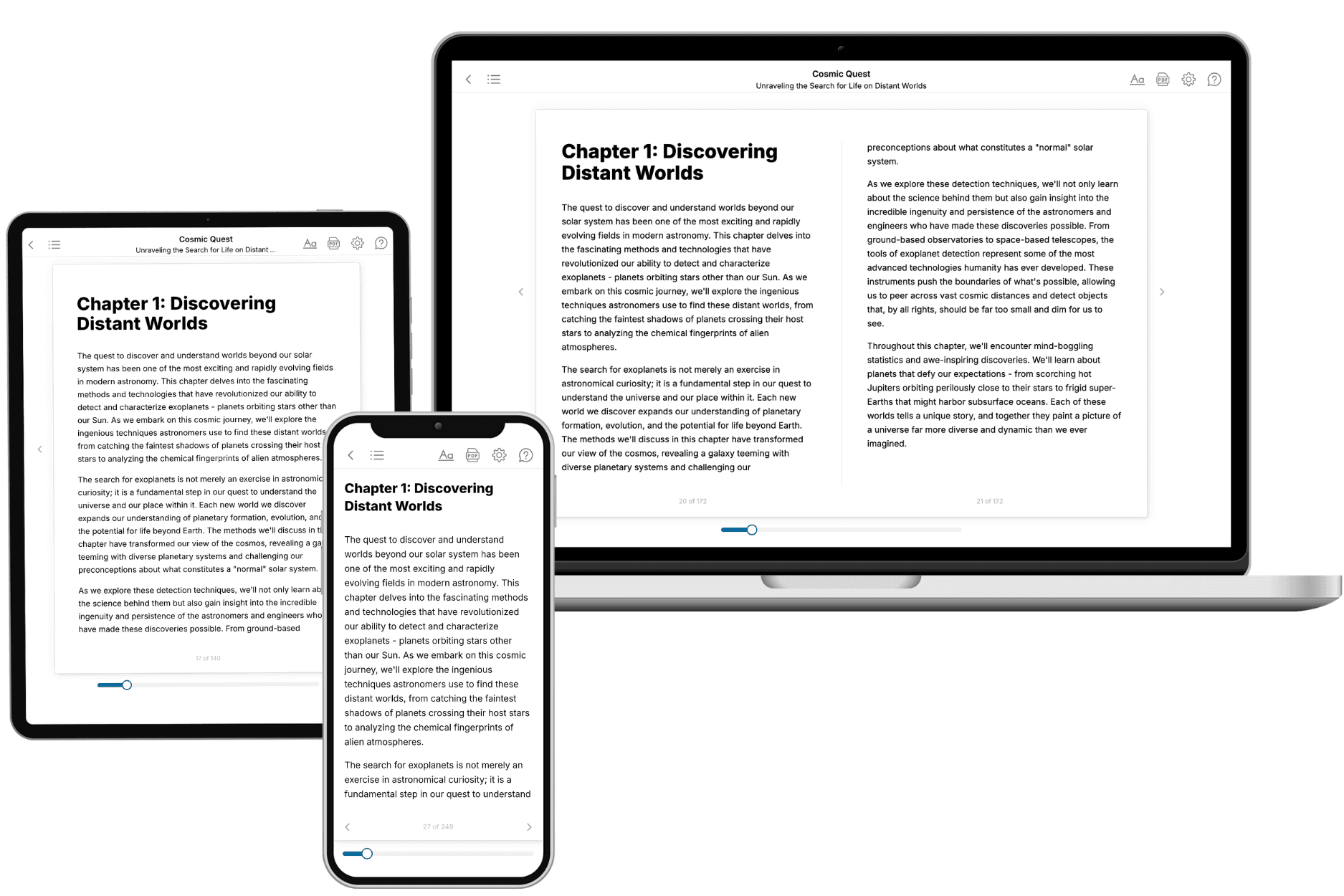
Your book is ready in 10 minutes. Read it online, download as EPUB or PDF, or send to Kindle.
Frequently asked questions
- What is TailoredRead?
TailoredRead creates complete, full-length nonfiction ebooks, written specifically for you. Tell us what you want to learn and why, and TailoredRead writes you a complete ebook on it, with charts, tables, and diagrams throughout. Read it online, on Kindle, or on any e-reader, or download it as a PDF or EPUB. Every book is written fresh the day you order it.
- How is the book tailored to me?
Before anything is written, you answer a few short questions about your goals, your background, and the topics you care about. Your book is then planned around your answers: written at your level, focused on your goals, and covering the topics you chose, instead of the one-size-fits-all book a store sells everyone.
- Will it read like generic AI content?
No. Your book isn't a chat transcript: it's planned chapter by chapter before a single word is written, told in a clear book voice, and explains ideas visually with charts, tables, and diagrams. After writing, every book goes through an editorial pass that polishes chapters so the book reads consistent from start to finish. Judge for yourself: browse thousands of sample books on our Explore Books page.
- How accurate is the content?
Our AI first checks whether your subject needs live research. Niche and fast-moving subjects are researched before writing, and the book plan and chapters are grounded in what it finds. After writing, every book goes through a quality pass that checks its facts and consistency, and researched books list their sources in a Notes section at the back.
- How long is the book?
You choose the length: Comprehensive (250-300 pages), Detailed (150-200 pages), Essential (70-100 pages), or Short (30-50 pages).
- Does the book include visuals?
Yes. Every book includes charts, tables, and diagrams: timelines, checklists, step-by-step guides, decision trees, comparison tables, matrices, and bar charts. A typical book includes dozens of these visual elements.
- Can I read it on Kindle? What formats can I download?
Yes. Every book can be read in our online reader or downloaded as a PDF or EPUB. The EPUB can be opened with Kindle, Apple Books, Kobo, and any e-reader. The Commercial and Author licenses also include an editable Word (DOCX) and Markdown download.
- How much does it cost?
About the price of a regular ebook. The exact price depends on your book's length and complexity, from $2 for the shortest books to $35 for the most comprehensive, and it's shown when you review your book, before you commit to anything. Each book is a one-time purchase, yours to keep, no subscription. Licenses that let you share, teach, or publish your book range from $35.99 to $49.99.
- Can I preview the book before purchasing?
Before you pay, you'll see what your book will cover: the title, a detailed description, the estimated length, and the complete chapter-by-chapter table of contents, so you know what you're getting before you decide. The full text itself is written after you purchase.
- How long does it take to create a book?
About 10 minutes. You can start reading the opening chapters while the rest is still being written.