Teaching Complex Ideas
Master the Art and Science of Making Difficult Concepts Clear and Memorable
Why do some teachers make complex topics feel simple while others leave students confused and frustrated?
191 pages9 chaptersMar 16, 2026Teaching
About this book
The difference isn't talent—it's strategy. This book reveals the evidence-based principles and practical techniques that transform how you teach difficult material. You'll discover how to deconstruct complex concepts into digestible pieces, design explanations that stick, and engage learners through multiple pathways to understanding. From cognitive science to classroom-tested methods, you'll learn to diagnose why students struggle, adapt your teaching in real-time, and build genuine comprehension rather than surface-level memorization. Whether you're teaching mathematics, programming, science, or any technical subject, these strategies work across disciplines. By the end, you'll have a complete toolkit for making even the most challenging topics accessible, engaging, and unforgettable.
Table of contents
- IntroductionWhy Teaching Complex Topics Matters, Common Teaching Mistakes and How to Avoid Them, What You'll Learn in This Book, How to Use This BookRead below
- Chapter 1: Understanding How People LearnCognitive Load Theory: Why Overload Prevents Learning, Working Memory Limitations and Practical Solutions, Building Mental Models Instead of Memorizing Facts
- Chapter 2: Deconstructing ComplexityIdentifying Core Concepts and Essential Knowledge, Chunking: Breaking Ideas Into Manageable Pieces, Sequencing: The Right Order for Building Understanding
- Chapter 3: Crafting Clear ExplanationsOvercoming Expert Blind Spot, Using Analogies and Metaphors Effectively, Layered Explanations: Simple to Complex
- Chapter 4: Engaging Multiple Learning ModalitiesVisual Representations and Diagrams, Auditory and Kinesthetic Engagement, Designing Lessons That Reach All Learners
- Chapter 5: Active Learning and Retrieval PracticeWhy Active Learning Beats Passive Listening, Retrieval Practice: Testing and Problem-Solving, Discussion and Collaborative Learning
- Chapter 6: Formative Assessment and Real-Time AdjustmentUsing Formative Assessment to Diagnose Misconceptions, Creating Feedback Loops for Continuous Improvement, Adapting Your Teaching in Real-Time
- Chapter 7: Designing Effective Lessons and CoursesStructuring Lessons for Maximum Impact, Pacing and Timing: When to Move Forward, Building Coherent Courses From Individual Lessons
- Chapter 8: Addressing Common MisconceptionsIdentifying What Students Believe Incorrectly, Confronting and Correcting Misconceptions, Preventing Misconceptions From Forming
- Chapter 9: Teaching Across Different ContextsIn-Person Classroom Teaching, Online and Remote Teaching, Hybrid and Self-Paced Learning Environments
- ConclusionKey Takeaways and Your Teaching Journey, Next Steps: Implementing What You've Learned
- Further Reading and Resources
Introduction
Think about the best teacher you've ever had. Not necessarily the one who knew the most about their subject, but the one who made you feel like you actually got it. The one who took something that seemed impossibly tangled and laid it out so clearly that you wondered why it ever seemed hard in the first place. Now think about the worst. Probably someone brilliant in their field, someone who clearly understood the material deeply, but who left you more confused after the lesson than before it. The gap between those two experiences isn't about intelligence or expertise. It's about strategy.
Teaching complex ideas is one of the most underestimated skills in professional and academic life. Across every field, from software engineering to medicine to finance to the sciences, there are brilliant experts who struggle to transfer what they know to others. And there are teachers with far less raw expertise who consistently produce learners who understand deeply, retain what they've learned, and can actually apply it. The difference comes down to a set of learnable, evidence-based techniques that most people have never been explicitly taught. That's exactly what this book is about.
The good news is that effective teaching of complex material is not a mysterious gift. Decades of research in cognitive science, educational psychology, and instructional design have produced a clear picture of how people learn, what gets in the way, and what actually works. This book translates that research into practical strategies you can use immediately, whether you're standing in front of a classroom, running a corporate training session, recording an online course, or mentoring a colleague one-on-one. The principles apply across all of those contexts, and across virtually every subject matter.
This introduction sets the stage for everything that follows. It explains why the ability to teach complex topics matters more than ever, walks through the most common mistakes that even experienced educators make, and gives you a clear map of what you'll find in the chapters ahead. By the time you finish reading it, you'll have a solid sense of where you currently stand as a teacher of complex material, and a clear picture of where this book will take you.
Why Teaching Complex Topics Matters
The world is getting more complex, not less. The technical knowledge required to participate meaningfully in modern workplaces, civic life, and even everyday decision-making has expanded dramatically over the past few decades. People need to understand data privacy, financial instruments, machine learning systems, medical research, climate science, and dozens of other fields that didn't exist in their current form a generation ago. The ability to make that knowledge accessible to others has never been more valuable or more urgently needed.
In professional settings, the cost of poor knowledge transfer is enormous. A 2019 study by IBM estimated that poor communication and knowledge-sharing costs businesses in the United States roughly $1.2 trillion per year in lost productivity.[1] Much of that loss comes not from a lack of expertise within organizations, but from the inability to move that expertise from the people who have it to the people who need it. When a senior engineer can't explain a system architecture to a junior team member, when a compliance officer can't make regulations understandable to frontline staff, or when a data scientist can't communicate findings to business leaders, the knowledge might as well not exist.
In educational settings, the stakes are just as high. Research consistently shows that students who don't develop genuine conceptual understanding in foundational subjects are far less likely to succeed in advanced coursework or in careers that require applying that knowledge.[2] Surface-level memorization, which is what happens when teaching fails to build real understanding, produces knowledge that evaporates quickly and can't be transferred to new situations. The goal of teaching isn't to get students through an exam. It's to build durable, flexible understanding that serves them for years.
There's also a deeper equity dimension to this. When complex topics are taught poorly, the learners who suffer most are those who don't have access to supplementary resources, tutors, or peer networks that can fill in the gaps. Clear, effective teaching of difficult material is one of the most powerful tools for leveling the playing field. When a teacher makes a hard concept genuinely accessible, they're not just helping the students who would have figured it out anyway. They're reaching the ones who wouldn't have.
For subject matter experts who find themselves in teaching roles, whether by choice or by circumstance, developing strong instructional skills is also a matter of professional credibility and impact. Being the person in your organization or field who can not only do the work but explain it clearly to others is a rare and highly valued capability. It shapes how colleagues, clients, and leadership perceive your expertise. It multiplies your influence far beyond what you could achieve working alone.
Finally, teaching complex ideas well is deeply satisfying. There's a particular kind of reward that comes from watching someone's face change when a concept clicks, when confusion gives way to clarity and then to genuine curiosity. That moment doesn't happen by accident. It happens because someone designed an explanation carefully, anticipated where confusion would arise, and built a path through the difficulty. This book is about learning to build those paths reliably, not just occasionally.
Common Teaching Mistakes and How to Avoid Them
Most teaching mistakes don't come from laziness or indifference. They come from a set of very understandable traps that experts fall into almost automatically. Recognizing these patterns is the first step toward breaking them. The following are the most common and most damaging mistakes that educators and trainers make when teaching complex material.
The curse of knowledge is probably the single most pervasive problem in expert teaching. Once you deeply understand something, it becomes genuinely difficult to remember what it was like not to understand it. You start skipping steps that feel obvious to you but are invisible to your learners. You use terms without defining them because the definitions feel self-evident. You make logical leaps that seem natural from your vantage point but leave learners stranded. Cognitive scientists call this the "expert blind spot," and research by Pamela Hinds at Stanford found that experts consistently and significantly underestimate how difficult their knowledge is for novices to acquire.[3]
Information overload is the second major trap. When you know a subject well, it's tempting to share everything you know about it. More information feels like more help. But cognitive load theory, developed by educational psychologist John Sweller, shows clearly that the human brain can only process a limited amount of new information at one time.[4] When that limit is exceeded, learning doesn't just slow down. It stops. Learners who are overwhelmed don't retain less. They retain almost nothing. The instinct to be thorough and comprehensive is one of the most counterproductive instincts a teacher can have.
Teaching to the wrong level is another common failure. This happens in two directions. Some teachers pitch their explanations too high, assuming background knowledge that learners don't have. Others pitch too low, over-explaining things learners already understand and wasting the limited time and attention available for the genuinely difficult parts. Both errors erode engagement and trust. Getting the level right requires actively diagnosing what learners already know, not just assuming.
Here's a quick summary of the most common mistakes and their practical antidotes:
- Skipping foundational steps: Always map out the prerequisite knowledge your explanation assumes, then check whether learners actually have it.
- Using jargon without definition: Introduce technical terms explicitly, with plain-language definitions and concrete examples before using them freely.
- Covering too much at once: Ruthlessly prioritize. Ask yourself what the three most important things are, then teach those well rather than covering ten things poorly.
- Lecturing without checking understanding: Build in regular, low-stakes checks throughout your teaching, not just at the end.
- Relying on a single explanation: If one explanation doesn't land, a different angle, analogy, or example often will. Have multiple approaches ready.
- Confusing familiarity with understanding: Learners who have heard something before often feel like they understand it. Real understanding means being able to apply and explain it. Test for application, not just recognition.
Passive teaching formats are also a significant problem. The traditional lecture, where an expert talks and learners listen, is one of the least effective formats for building deep understanding of complex material. Research by educational psychologist Richard Mayer consistently shows that learners who engage actively with material, through problem-solving, discussion, or application, retain significantly more and develop more flexible understanding than those who receive the same content passively.[5] Yet passive formats remain dominant in most educational and training contexts, largely because they're easier to plan and deliver.
Finally, many teachers make the mistake of treating assessment as a final event rather than an ongoing process. By the time a formal test or evaluation reveals that learners haven't understood something, it's often too late to address it within the current learning sequence. Formative assessment, the practice of checking understanding continuously throughout teaching, allows you to catch misconceptions early and adjust your approach before they solidify. This is one of the highest-leverage habits any teacher can develop, and it's covered in depth in Chapter 6.
The goal isn't to avoid all mistakes. Every teacher makes them. The goal is to develop the awareness to recognize them quickly and the toolkit to respond effectively when they happen.
What You'll Learn in This Book
This book is organized around the core challenges of teaching complex material, moving from the foundations of how learning works to the practical craft of designing and delivering effective instruction. Each chapter builds on the ones before it, but each also stands on its own as a practical resource you can return to when facing a specific challenge.
Chapter 1: Understanding How People Learn lays the cognitive science foundation for everything else in the book. You'll learn how working memory works and why it's the central bottleneck in learning complex material. You'll understand cognitive load theory in practical terms, and you'll see how learners build mental models rather than simply storing facts. This chapter gives you the "why" behind the strategies in every chapter that follows.
Chapter 2: Deconstructing Complexity tackles the first practical challenge: figuring out what to teach and in what order. You'll learn how to identify the core concepts in any complex topic, how to use chunking to break large ideas into manageable pieces, and how to sequence those pieces so that each one builds naturally on the last. This chapter includes a practical framework for mapping any complex subject before you begin teaching it.
Chapter 3: Crafting Clear Explanations goes deep on the craft of explanation itself. You'll learn how to overcome the expert blind spot, how to use analogies and metaphors effectively without creating misleading impressions, and how to build layered explanations that start simple and add complexity gradually. This chapter is particularly valuable for subject matter experts who are new to teaching roles.
Chapter 4: Engaging Multiple Learning Modalities addresses the reality that different learners process information in different ways. You'll learn how to use visual representations, diagrams, and spatial organization to make abstract concepts concrete. You'll explore auditory and kinesthetic engagement strategies, and you'll learn how to design lessons that reach learners through multiple pathways simultaneously, dramatically improving both comprehension and retention.
Chapter 5: Active Learning and Retrieval Practice makes the case for moving beyond passive instruction and provides concrete tools for doing so. You'll learn why retrieval practice, the act of actively recalling information rather than re-reading or re-listening to it, is one of the most powerful learning techniques known to cognitive science. You'll also get practical frameworks for using discussion and collaborative learning to deepen understanding of complex material.
The remaining chapters cover formative assessment and real-time adaptation (Chapter 6), lesson and course design (Chapter 7), addressing misconceptions (Chapter 8), and teaching across different contexts including online and hybrid environments (Chapter 9). Each chapter is grounded in research but focused on practical application, with specific techniques, examples, and frameworks you can implement immediately.
Throughout the book, you'll find examples drawn from a wide range of disciplines, including mathematics, programming, science, medicine, law, finance, and the social sciences. The principles are universal, but the examples are specific enough to be genuinely useful rather than abstractly illustrative. Whether your subject is quantum mechanics or contract law, database architecture or organic chemistry, the strategies in this book apply.
How to Use This Book
This book is designed to be both read cover-to-cover and used as a reference. If you're new to thinking systematically about teaching, reading it in order will give you the most coherent experience, since later chapters build on concepts introduced earlier. If you're an experienced educator looking to strengthen specific areas, you can navigate directly to the chapters most relevant to your current challenges. Each chapter is self-contained enough to be useful on its own.
As you read, keep a specific teaching challenge in mind. The strategies in this book are most useful when they're connected to real material you're actually trying to teach. Think about a topic you currently teach or plan to teach that you find difficult to explain clearly. Use that topic as your test case throughout the book. Apply each framework and technique to it as you encounter them. By the time you finish, you'll have worked through a real instructional challenge using the full toolkit this book provides.
Here are some practical suggestions for getting the most out of each chapter:
- Read actively, not passively. Pause after each major section and ask yourself how the concept applies to your own teaching context. Don't just absorb the ideas. Engage with them.
- Try one thing at a time. Each chapter introduces multiple strategies. Rather than trying to implement everything at once, pick one technique per chapter and apply it in your next teaching session before moving on.
- Take notes on your specific subject. When a framework or tool is introduced, immediately sketch out how it would apply to the topic you're currently teaching. Concrete application beats abstract understanding every time.
- Revisit chapters when you hit specific problems. If you're struggling with a particular challenge, such as learners who seem to understand in class but can't apply the knowledge later, go back to the relevant chapter and work through it with fresh eyes.
- Share what you're learning. Teaching others what you're learning is one of the most effective ways to deepen your own understanding. Discuss the ideas in this book with colleagues, try explaining the frameworks to a peer, or write brief reflections after each chapter.
It's also worth being honest about what this book is and isn't. It's a practical guide grounded in research, not a theoretical textbook. The goal throughout is to give you tools you can use, not just ideas to think about. At the same time, the tools are only as good as the effort you put into applying them. Reading about teaching strategies doesn't make you a better teacher. Practicing them, reflecting on what works, and adjusting based on what you observe in your learners does.
One more thing worth saying upfront: becoming a genuinely effective teacher of complex material is a long-term project. The strategies in this book will produce noticeable improvements quickly, but mastery develops over time through repeated practice and reflection. Don't expect perfection from your first attempts at any new technique. Expect progress. The teachers who get best at this are the ones who stay curious about their own practice, who treat every lesson as data about what's working and what isn't, and who keep refining their approach based on what they observe.
The fact that you're reading this book at all suggests you're already that kind of teacher. You're not satisfied with explanations that sort of work. You want to understand why some approaches succeed and others fail, and you want a reliable set of tools for making complex ideas genuinely clear. That's exactly the right starting point. Everything you need to develop that capability is in the pages that follow.
Complexity isn't a property of a topic. It's a property of the gap between what a learner currently knows and what they need to understand. Your job as a teacher is to build a bridge across that gap, one solid plank at a time.
That's the core idea this entire book is built around. Every strategy, framework, and technique in the chapters ahead is a different way of building that bridge more effectively. Let's get started.
Notes
Introduction
- 1. IBM, The Cost of Poor Communications, IBM Institute for Business Value, 2019
- 2. National Research Council, How People Learn, National Academy Press, 2000
- 3. P. J. Hinds, "The curse of expertise," Journal of Experimental Psychology: Applied, 1999
- 4. J. Sweller, "Cognitive load during problem solving," Cognitive Science, 1988
- 5. R. E. Mayer, Multimedia Learning (2nd ed.), Cambridge University Press, 2009
This is the end of the free sample. The full book has 9 chapters.
Want this book written for you?
Tell us your goals and background, and get your own version of this book, tailored by AI to you.


Benefits of AI-tailored books
- Read one book, not ten:
- all the Teaching knowledge you need, gathered into a single book.
- Save days of learning:
- tell us your goals, choose your topics, and the whole book is built around them.
- Learn effortlessly:
- Teaching book written for your specific background and expertise.
- Understand at a glance:
- includes charts, tables, timelines, checklists, decision trees, and more.
- Stay current:
- written the day you order it, not years ago.
- Trust what you read:
- every book is checked for accuracy, with real research when your subject needs it.
Create your unique book in 3 steps
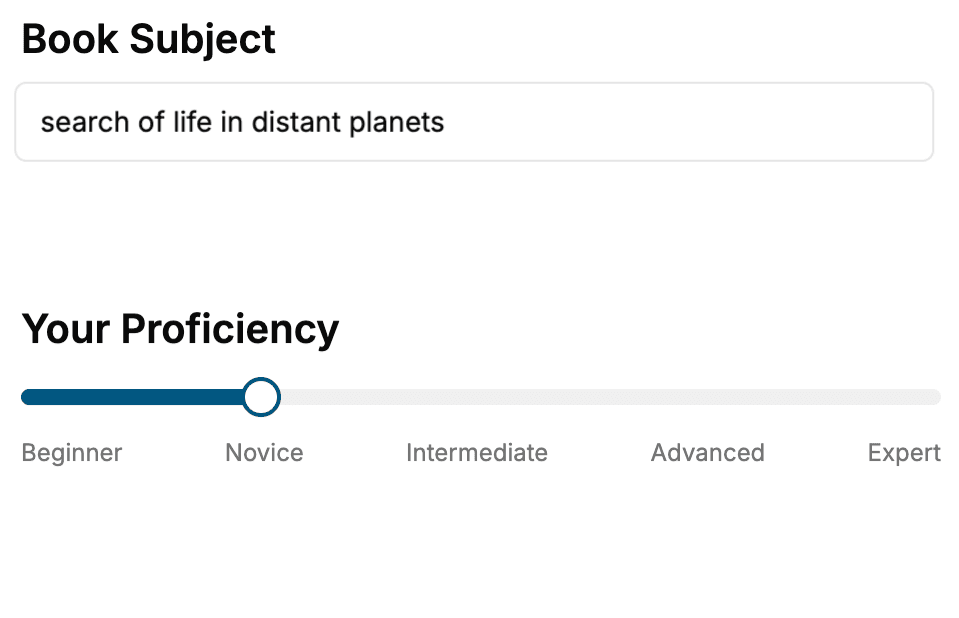
- 1. Select your focus
Select the focus of your Teaching book and share your background
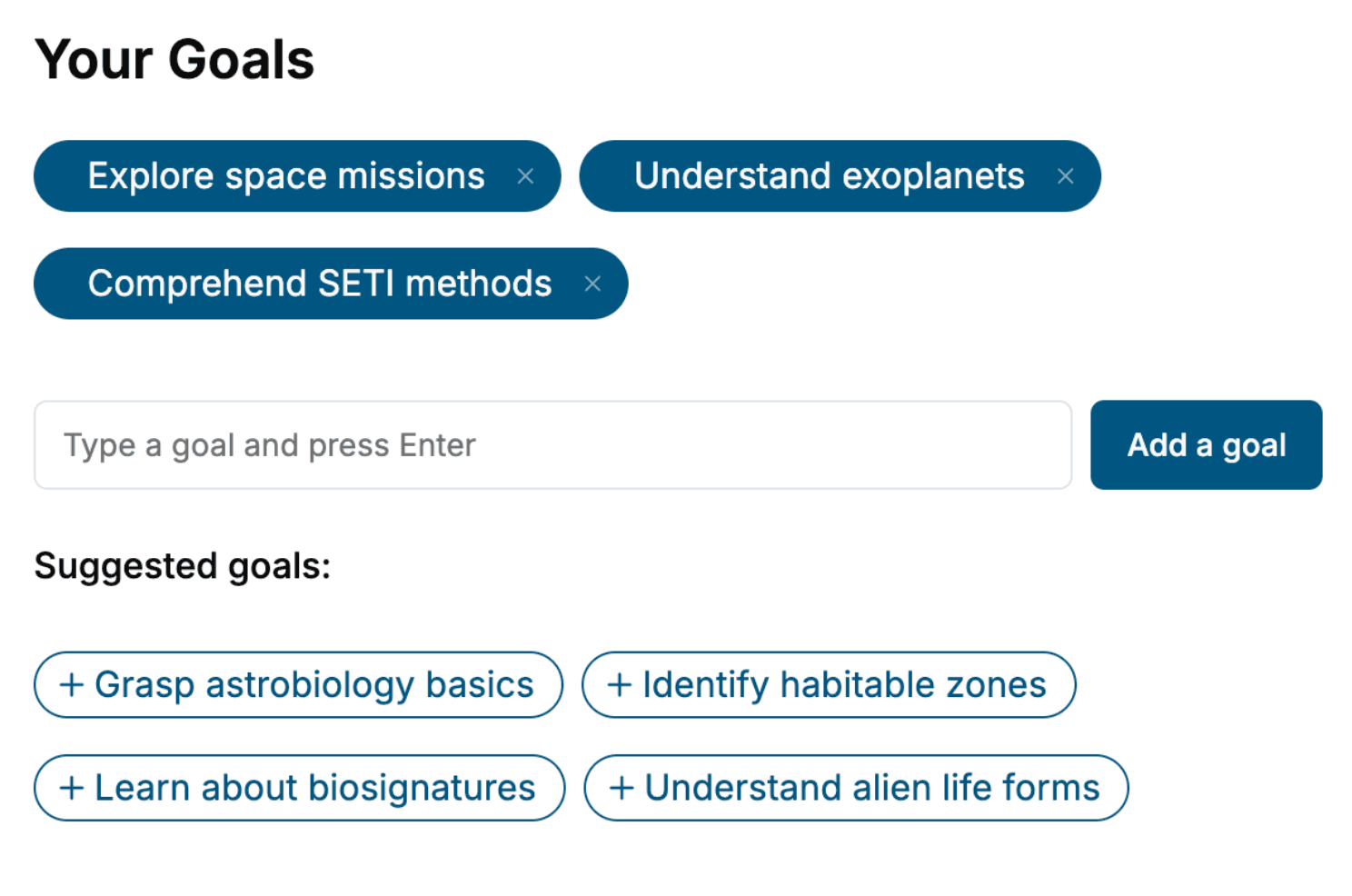
- 2. Personalize your book
Specify your goals and choose sub-topics to include
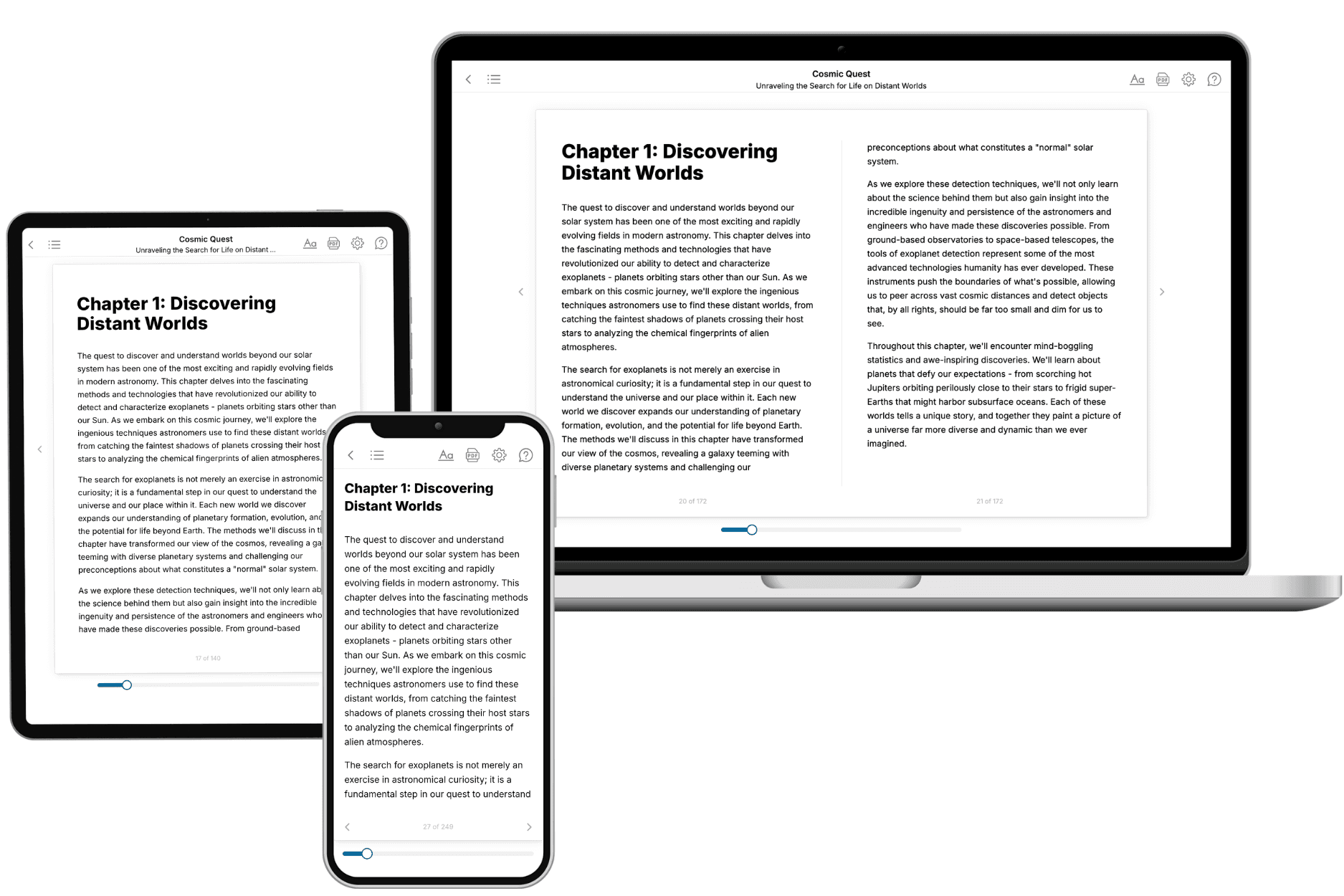
- 3. Get your tailored book
Your book is ready in 10 minutes. Read it online, download as EPUB or PDF, or send to Kindle.
Frequently asked questions
- What is TailoredRead?
TailoredRead creates complete, full-length nonfiction ebooks, written specifically for you. Tell us what you want to learn and why, and TailoredRead writes you a complete ebook on it, with charts, tables, and diagrams throughout. Read it online, on Kindle, or on any e-reader, or download it as a PDF or EPUB. Every book is written fresh the day you order it.
- How is the book tailored to me?
Before anything is written, you answer a few short questions about your goals, your background, and the topics you care about. Your book is then planned around your answers: written at your level, focused on your goals, and covering the topics you chose, instead of the one-size-fits-all book a store sells everyone.
- Will it read like generic AI content?
No. Your book isn't a chat transcript: it's planned chapter by chapter before a single word is written, told in a clear book voice, and explains ideas visually with charts, tables, and diagrams. After writing, every book goes through an editorial pass that polishes chapters so the book reads consistent from start to finish. Judge for yourself: browse thousands of sample books on our Explore Books page.
- How accurate is the content?
Our AI first checks whether your subject needs live research. Niche and fast-moving subjects are researched before writing, and the book plan and chapters are grounded in what it finds. After writing, every book goes through a quality pass that checks its facts and consistency, and researched books list their sources in a Notes section at the back.
- How long is the book?
You choose the length: Comprehensive (250-300 pages), Detailed (150-200 pages), Essential (70-100 pages), or Short (30-50 pages).
- Does the book include visuals?
Yes. Every book includes visual elements such as timelines, checklists, step-by-step guides, decision trees, comparison tables, and matrices, and many include bar charts. A typical book includes dozens of these visual elements.
- Can I read it on Kindle? What formats can I download?
Yes. Every book can be read in our online reader or downloaded as a PDF or EPUB. The EPUB can be opened with Kindle, Apple Books, Kobo, and any e-reader. The Commercial and Author licenses also include an editable Word (DOCX) and Markdown download.
- How much does it cost?
About the price of a regular ebook. The exact price depends on your book's length and complexity, from $2 for the shortest books to $35 for the most comprehensive, and it's shown when you review your book, before you commit to anything. Each book is a one-time purchase, yours to keep, no subscription. Licenses that let you share, teach, or publish your book range from $35.99 to $49.99.
- Can I preview the book before purchasing?
Before you pay, you'll see what your book will cover: the title, a detailed description, the estimated length, and the complete chapter-by-chapter table of contents, so you know what you're getting before you decide. The full text itself is written after you purchase.
- How long does it take to create a book?
About 10 minutes. You can start reading the opening chapters while the rest is still being written.