Teaching Intermediate Algebra
Proven Strategies to Help Your Students Master Equations, Functions, and Problem-Solving
Elevate your algebra instruction with evidence-based teaching methods that actually work.
176 pages8 chaptersJul 6, 2026Teaching
About this book
This practical guide shows you how to move beyond traditional lecture-and-practice approaches to create classrooms where students genuinely understand algebraic concepts rather than simply memorizing procedures. You'll discover how to identify and address the specific misconceptions that trip up most algebra students, use multiple representations to make abstract ideas concrete, and design assessments that reveal what students truly understand. The book provides ready-to-implement strategies for differentiating instruction, incorporating real-world applications, and fostering mathematical discourse that builds both competence and confidence. Whether you're teaching in-person or online, working with struggling learners or advanced students, you'll find actionable techniques grounded in learning science that transform how your students engage with algebra and develop lasting problem-solving skills.
Table of contents
- IntroductionWhy Algebra Matters and Why Teaching It Well Matters More, The Common Challenges Algebra Teachers Face, How to Use This Book, What Learning Science Tells Us About Math InstructionRead below
- Chapter 1: Understanding How Students Learn AlgebraCognitive Development and Abstract Thinking, Common Misconceptions in Algebra, Individual Differences in How Students Process Mathematical Ideas
- Chapter 2: Building Conceptual Understanding Through Multiple RepresentationsThe Four Essential Representations: Verbal, Visual, Numerical, and Algebraic, Teaching Students to Translate Between Representations, Using Graphs, Diagrams, and Manipulatives Effectively, Leveraging Technology to Explore Multiple Representations
- Chapter 3: Scaffolding and Differentiation StrategiesScaffolding Principles and Gradual Release of Responsibility, Designing Tiered Lessons for Mixed-Ability Classrooms, Supporting Struggling Learners Without Lowering Expectations, Challenging Advanced Learners with Depth and Complexity
- Chapter 4: Making Algebra Relevant Through Real-World ApplicationsProblem-Based Learning and Authentic Contexts, Designing Modeling Activities That Connect to Student Lives, Cross-Curricular Connections and Interdisciplinary Projects
- Chapter 5: Formative Assessment and Responsive TeachingTypes of Formative Assessment and When to Use Them, Analyzing Student Work to Identify Learning Gaps, Providing Feedback That Promotes Growth and Understanding, Using Assessment Data to Adjust Instruction in Real Time
- Chapter 6: Fostering Mathematical Discourse and CommunicationCreating a Culture Where Mathematical Thinking Is Valued, Asking Questions That Promote Deep Thinking, Structuring Collaborative Learning for Maximum Engagement, Encouraging Students to Explain and Justify Their Reasoning
- Chapter 7: Teaching Key Algebra Topics EffectivelyEquations and Inequalities: From Concrete to Abstract, Functions and Relationships: Building Functional Thinking, Polynomials and Factoring: Strategies for Procedural Fluency
- Chapter 8: Addressing Algebra Anxiety and Building ConfidenceUnderstanding the Roots of Math Anxiety, Cultivating a Growth Mindset in Your Classroom, Strategies for Building Student Confidence and Resilience
- ConclusionBringing It All Together: Your Teaching Transformation, Next Steps for Continuous Improvement
- AppendixSample Lesson Plans and Activities, Assessment Tools and Rubrics, Recommended Resources and Further Reading
Introduction
Every algebra teacher has experienced that moment. You explain a concept clearly, walk through a worked example step by step, and then watch as a student stares at a nearly identical problem and has no idea where to begin. It's not that the student wasn't paying attention. It's not that the explanation was poorly delivered. Something deeper is happening, something about the way algebraic thinking develops, the way abstract symbols connect to meaning, and the way students build understanding over time. That gap between teaching and learning is exactly what this book is designed to help you close.
Intermediate algebra sits at a critical crossroads in mathematics education. It's the point where arithmetic gives way to abstraction, where students must start thinking in variables instead of specific numbers, and where many learners either develop genuine mathematical confidence or begin to disengage from math entirely. The stakes are real. Research consistently shows that algebra proficiency is one of the strongest predictors of long-term academic success, college readiness, and career opportunity.[1] How students experience algebra in your classroom can shape their relationship with mathematics for years to come.
This book is built on a straightforward premise: effective algebra instruction is a learnable craft. It draws on decades of research in cognitive science, mathematics education, and classroom pedagogy to give you practical, evidence-based strategies that work across a wide range of learners and settings. Whether you're a veteran teacher looking to refresh your approach or someone newer to the classroom who wants to build strong habits from the start, you'll find concrete tools here that you can put to use immediately. The goal isn't to overhaul everything you do. It's to sharpen what's already working and fill in the gaps where students are still struggling.
Throughout these chapters, you'll encounter frameworks for understanding how students think about algebra, strategies for making abstract concepts tangible, and methods for assessing understanding in ways that actually inform your teaching. Each chapter is grounded in research but written for the classroom, not the academic journal. The examples are real, the challenges are honest, and the recommendations are practical. By the end, you'll have a richer toolkit for helping every student in your room move from confusion to competence, and from competence to genuine mathematical confidence.
Why Algebra Matters and Why Teaching It Well Matters More
Algebra is often described as a gatekeeper subject, and that description is accurate in ways that go beyond academic jargon. Students who successfully complete algebra are significantly more likely to pursue higher education, enter STEM fields, and access higher-paying careers than those who don't.[2] But the importance of algebra isn't just economic. It's cognitive. Learning to think algebraically means learning to reason abstractly, to identify patterns, to model situations with symbols, and to solve problems systematically. These are skills that transfer far beyond any math classroom.
The challenge is that algebra is also one of the most common points of failure in the K-12 mathematics pipeline. Many students arrive in an intermediate algebra course carrying years of procedural habits, fragile number sense, and a growing belief that they are simply "not math people." These aren't character flaws. They're the predictable result of instruction that prioritized memorization over understanding, speed over reasoning, and correct answers over mathematical thinking. The good news is that these patterns can be interrupted, and the classroom is exactly the right place to do it.
Teaching algebra well matters more than ever because the subject itself has become more demanding. Modern algebra courses are expected to develop not just procedural fluency but also conceptual understanding, mathematical reasoning, and the ability to apply algebraic thinking to novel problems. Standardized assessments, college placement tests, and workplace expectations all reflect this shift. Students who can only execute memorized procedures are increasingly underprepared for what comes next, regardless of how many correct answers they produced in class.
There's also a equity dimension that deserves direct acknowledgment. Access to high-quality algebra instruction is not evenly distributed. Students from under-resourced schools, students who are English language learners, and students from historically marginalized communities are disproportionately placed in lower-track courses with less experienced teachers and weaker instructional materials.[3] Every teacher who commits to improving their algebra instruction is, in a meaningful sense, working toward greater educational equity. The strategies in this book are designed to be accessible and effective for diverse learners, not just students who already arrive with strong mathematical foundations.
Consider what it means for a student to genuinely understand a linear equation versus simply knowing the steps to solve one. A student who understands can explain why the steps work, recognize when a situation calls for that kind of equation, translate a word problem into algebraic form, and check whether an answer makes sense in context. A student who only knows the steps can execute the procedure when it's clearly labeled but falls apart when the problem looks slightly different. The difference between these two students isn't raw ability. It's the quality of instruction they received.
This is why teaching algebra well matters more than algebra itself. The subject provides the content, but the instruction determines whether students develop durable understanding or fragile procedures. Every decision you make about how to introduce a concept, what questions to ask, how to respond to errors, and how to structure practice shapes the kind of mathematical thinkers your students become. That's a significant responsibility, and it's one worth taking seriously.
The Common Challenges Algebra Teachers Face
If you've taught intermediate algebra for any length of time, certain challenges probably feel familiar. Students who seemed to understand a concept during class practice completely blank on the same type of problem during a quiz. Students who can solve equations mechanically can't explain what a solution actually means. Students who disengage the moment a problem involves variables, even when the underlying arithmetic is well within their reach. These aren't random frustrations. They're patterns, and patterns have causes that can be understood and addressed.
One of the most persistent challenges is the gap between procedural fluency and conceptual understanding. Many students arrive in algebra having been trained to follow steps without understanding why those steps work. They can add fractions, but they can't explain what a fraction represents. They can compute with negative numbers, but the concept of a negative quantity feels arbitrary to them. When algebra asks them to extend these shaky foundations into abstract territory, the cracks become chasms. Addressing this gap requires going back to build meaning, not just re-teaching procedures more slowly.
Another common challenge is managing the wide range of readiness levels within a single classroom. In most intermediate algebra courses, you'll have students who are genuinely ready to engage with the content alongside students who are missing foundational skills from earlier grades. Designing instruction that meets everyone where they are, without boring the advanced students or overwhelming the struggling ones, is one of the most demanding aspects of the job. It requires intentional planning, flexible grouping, and a repertoire of differentiation strategies that go beyond simply giving some students easier problems.
Math anxiety is a third challenge that affects a significant portion of algebra students. Research estimates that roughly 25% of students in the United States experience some level of math anxiety, and the effects are measurable: anxiety impairs working memory, reduces problem-solving performance, and leads students to avoid mathematical tasks.[4] Students who are anxious about math often interpret their struggles as evidence of permanent inability rather than temporary confusion. Addressing anxiety isn't a soft add-on to algebra instruction. It's a prerequisite for learning.
Teachers also face structural challenges that have nothing to do with pedagogy. Pacing guides that move faster than students can consolidate understanding. Curriculum materials that emphasize procedures over concepts. Limited planning time for designing differentiated lessons. Large class sizes that make individualized feedback difficult. These constraints are real, and this book doesn't pretend otherwise. The strategies here are designed to be practical within real classroom conditions, not ideal ones. Many of them require no additional materials or technology, just a shift in how you structure instruction and interaction.
A common scenario: A teacher spends two full class periods on solving two-step equations. Students perform well on the practice problems. Then the unit test includes a word problem that requires setting up and solving a two-step equation, and most students leave it blank. The issue isn't that students forgot how to solve the equation. It's that they never learned to recognize when an equation was the right tool to use. This is the difference between teaching a procedure and teaching mathematical thinking.
Finally, there's the challenge of keeping students engaged with content that many of them have already decided is irrelevant to their lives. The classic student question, "When am I ever going to use this?" is often dismissed as an excuse for not trying. But it's actually a reasonable question that deserves a real answer. Students are more motivated to learn when they can see a genuine connection between the content and something they care about. Building those connections isn't just a motivational strategy. It's also good mathematics instruction, because contextual problems develop deeper understanding than abstract exercises alone.
Recognizing these challenges is the first step toward addressing them systematically. Each chapter of this book targets one or more of these persistent problems with specific, research-backed strategies. The goal isn't to eliminate difficulty from algebra instruction. Productive struggle is actually an important part of learning. The goal is to make sure the difficulty students experience is the kind that builds understanding, not the kind that builds frustration and disengagement.
How to Use This Book
This book is designed to be both a cover-to-cover read and a practical reference you return to throughout the school year. If you're new to teaching intermediate algebra, reading it sequentially will give you a coherent framework for thinking about instruction, assessment, and student learning. If you're an experienced teacher looking to address a specific challenge, you can navigate directly to the chapters most relevant to your current needs. Either approach works, because each chapter is designed to stand on its own while also connecting to the larger picture.
Here's a quick map of what each part of the book covers, so you can find what you need quickly:
- Chapter 1 explores how students develop algebraic thinking, including the cognitive shifts required and the most common misconceptions that derail learning.
- Chapter 2 focuses on multiple representations, showing how moving between verbal, visual, numerical, and algebraic forms builds deeper understanding.
- Chapter 3 covers scaffolding and differentiation, with practical strategies for supporting struggling learners and challenging advanced ones in the same classroom.
- Chapter 4 addresses real-world applications and problem-based learning, including how to design tasks that connect algebra to student experience.
- Chapter 5 dives into formative assessment, covering how to gather useful data about student understanding and use it to adjust instruction in real time.
- Chapter 6 examines mathematical discourse, including questioning techniques, collaborative structures, and strategies for getting students to explain their reasoning.
- Chapter 7 provides topic-specific guidance on teaching equations, functions, and polynomials with conceptual depth.
- Chapter 8 addresses math anxiety and confidence-building, with strategies grounded in both psychology and classroom practice.
As you read, you'll notice that certain themes appear repeatedly across chapters. Multiple representations, formative feedback, productive struggle, and mathematical discourse show up in different contexts throughout the book because they are genuinely foundational to effective algebra instruction. This repetition is intentional. Seeing how the same principle applies in different instructional situations helps you internalize it more deeply and apply it more flexibly in your own classroom.
Each chapter includes concrete examples, classroom scenarios, and specific strategies you can implement without needing special materials or extensive preparation. Some strategies require a shift in how you structure a lesson. Others require a shift in the kinds of questions you ask. A few require rethinking how you respond to student errors. None of them require you to abandon everything you currently do. The most effective approach is to try one or two new strategies at a time, observe how your students respond, and build from there.
The appendix at the back of the book includes sample lesson plans, assessment tools, and a curated list of resources for further reading. These are practical starting points, not prescriptions. Adapt them to fit your students, your curriculum, and your teaching context. The best lesson plan is always the one that's been thoughtfully adjusted for the specific learners in front of you.
One important note about how to approach the research cited throughout this book: the studies and frameworks referenced here come from mathematics education research, cognitive science, and learning psychology. Where possible, the citations point to peer-reviewed sources and meta-analyses that reflect broad patterns across many classrooms and students. Research findings describe what tends to work on average, across many contexts. Your professional judgment about your specific students and setting is always part of the equation. Use the research as a guide, not a script.
Finally, this book assumes that you care about your students' mathematical development and that you're willing to reflect honestly on your own practice. That combination, caring and reflective, is the foundation of excellent teaching. The strategies here will give you more tools to work with, but the commitment to using them thoughtfully is something you already bring to the classroom.
What Learning Science Tells Us About Math Instruction
Over the past few decades, cognitive science and educational psychology have produced a substantial body of research on how people learn. Some of this research confirms what experienced teachers already know intuitively. Some of it challenges common instructional practices in ways that are worth taking seriously. Understanding the key findings from learning science doesn't require a graduate degree in psychology. It requires a willingness to look at familiar classroom situations through a new lens.
One of the most important findings is the distinction between surface learning and deep learning. Surface learning involves memorizing facts, procedures, and formulas well enough to reproduce them on a test. Deep learning involves understanding why those procedures work, how concepts connect to each other, and how to apply knowledge in new situations. Both types of learning have a role in mathematics, but algebra instruction has historically over-emphasized surface learning at the expense of deep learning.[5] The result is students who can execute procedures in familiar contexts but struggle to transfer their knowledge to unfamiliar problems.
A second key finding involves the role of prior knowledge in new learning. Cognitive science is clear that new information is always interpreted through the lens of what a learner already knows. When students have accurate prior knowledge, new concepts can be connected to existing understanding and learned more efficiently. When students have inaccurate prior knowledge, those misconceptions actively interfere with new learning. This is why simply re-explaining a concept more clearly often doesn't help a student who has a deep-seated misconception. The misconception needs to be surfaced and directly addressed before new understanding can take root.
The concept of cognitive load is also highly relevant to algebra instruction. Working memory, the mental workspace where active thinking happens, has a limited capacity. When a task demands more cognitive resources than working memory can handle, learning breaks down. This is why students who are still struggling with basic arithmetic operations often can't focus on the algebraic reasoning a problem requires. They're using all their cognitive resources just to manage the arithmetic. Effective scaffolding reduces extraneous cognitive load so that students can focus their mental energy on the new concept being learned.[6]
Research on retrieval practice offers another powerful insight. Studies consistently show that the act of retrieving information from memory, rather than simply re-reading or re-watching it, significantly strengthens long-term retention.[7] In practical terms, this means that low-stakes quizzes, warm-up problems that revisit previous content, and asking students to recall concepts without looking at their notes are all more effective for long-term learning than additional re-teaching or review. Building retrieval practice into your regular classroom routine is one of the highest-leverage changes you can make with minimal additional planning time.
Spaced practice is closely related. Learning is more durable when practice is distributed over time rather than concentrated in a single session. The common pattern of teaching a topic, practicing it intensively for a week, and then moving on rarely produces lasting retention. Students who "mastered" a topic in October often can't recall it in March. Deliberately returning to earlier topics through warm-up problems, mixed practice sets, and cumulative assessments counteracts this forgetting and builds the kind of connected knowledge that supports later learning.
The research on feedback is equally instructive. Not all feedback is equally effective. Feedback that simply tells students whether an answer is right or wrong produces minimal learning gains. Feedback that explains why an answer is incorrect, points to the specific source of the error, and guides the student toward a correct approach produces significantly better outcomes.[8] This has direct implications for how you design assessments, respond to student work, and structure classroom discussion around errors. Errors aren't just wrong answers to be corrected. They're windows into student thinking that, when examined carefully, reveal exactly what instruction needs to address next.
Finally, learning science has a great deal to say about motivation and mindset. Carol Dweck's research on growth mindset has become widely known in education, and for good reason: students who believe that mathematical ability is fixed and innate approach challenges very differently than students who believe that ability develops through effort and effective strategies.[9] The classroom environment you create, including how you respond to mistakes, how you talk about difficulty, and what you communicate about who can succeed in mathematics, shapes the mindsets your students develop. This isn't about empty praise or lowering standards. It's about creating conditions where students believe that their effort and persistence will actually pay off.
These findings from learning science aren't abstract theories. They translate directly into classroom decisions about how to structure lessons, design practice, respond to errors, and communicate with students. Throughout this book, you'll see these principles applied to specific algebra topics and instructional situations. The goal is to help you build a teaching practice that's not just based on experience and intuition, valuable as those are, but also grounded in what research tells us about how mathematical understanding actually develops.
Notes
Introduction
- 1. C. Adelman, The Toolbox Revisited: Paths to Degree Completion From High School Through College, U.S. Department of Education, 2006
- 2. National Mathematics Advisory Panel, Foundations for Success: The Final Report of the National Mathematics Advisory Panel, U.S. Department of Education, 2008
- 3. J. Oakes, Keeping Track, Yale University Press, 2005
- 4. M. H. Ashcraft, "Math Anxiety," Current Directions in Psychological Science, 2002
- 5. J. Hattie and G. M. Donoghue, Learning strategies: A synthesis and conceptual model. npj Science of Learning, 2016
- 6. J. Sweller, "Cognitive load during problem solving," Cognitive Science, 1988
- 7. H. L. Roediger and J. D. Karpicke, "Test-enhanced learning," Psychological Science, 2006
- 8. J. Hattie and H. Timperley, "The power of feedback," Review of Educational Research, 2007
- 9. C. S. Dweck, Mindset: The New Psychology of Success, Random House, 2006
This is the end of the free sample. The full book has 8 chapters.
Want this book written for you?
Tell us your goals and background, and get your own version of this book, tailored by AI to you.


Benefits of AI-tailored books
- Read one book, not ten:
- all the Teaching knowledge you need, gathered into a single book.
- Save days of learning:
- tell us your goals, choose your topics, and the whole book is built around them.
- Learn effortlessly:
- Teaching book written for your specific background and expertise.
- Understand at a glance:
- includes charts, tables, timelines, checklists, decision trees, and more.
- Stay current:
- written the day you order it, not years ago.
- Trust what you read:
- every book is checked for accuracy, with real research when your subject needs it.
Create your unique book in 3 steps
- 1. Select your focus
Select the focus of your Teaching book and share your background
- 2. Personalize your book
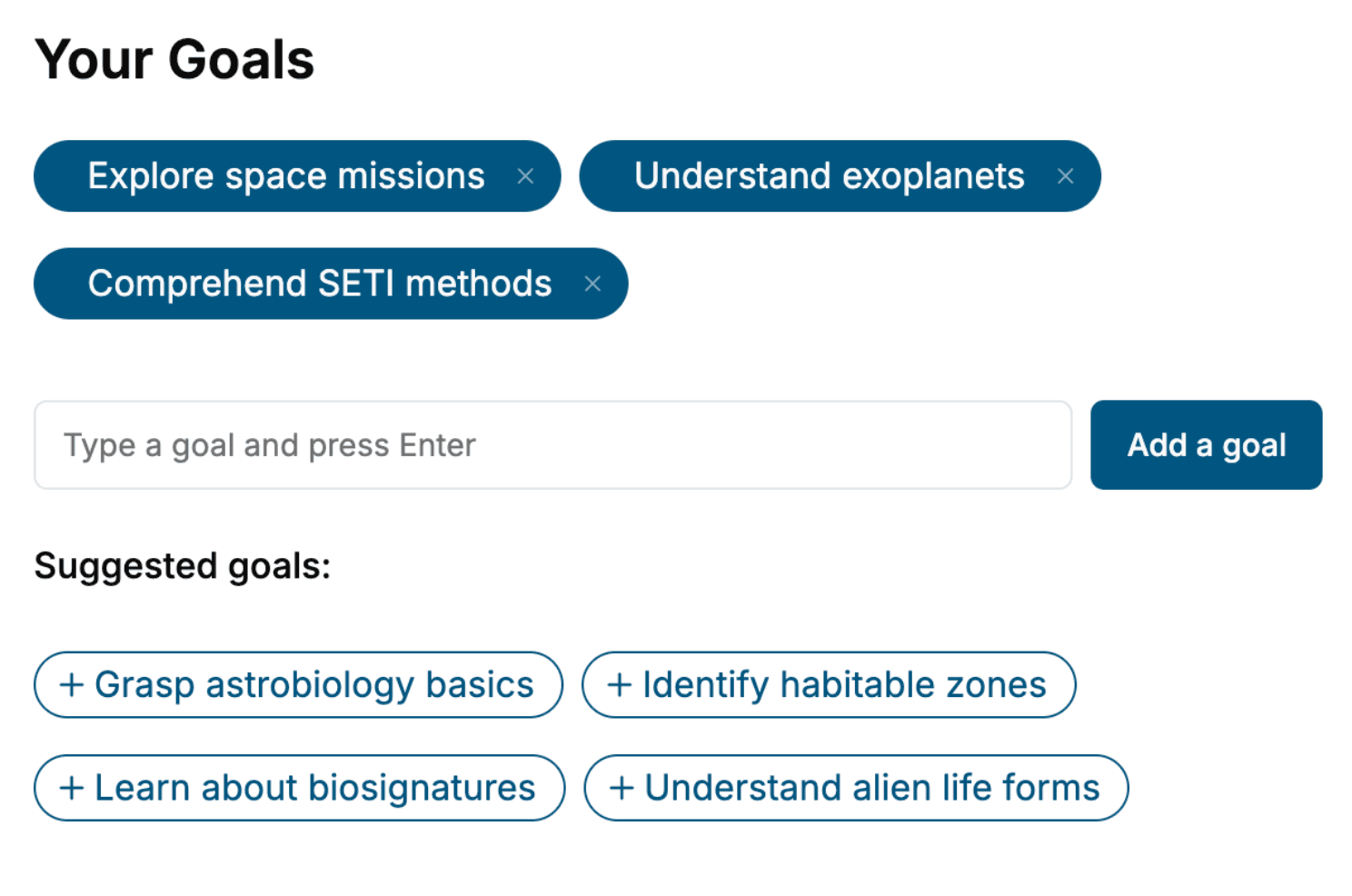
Specify your goals and choose sub-topics to include
- 3. Get your tailored book
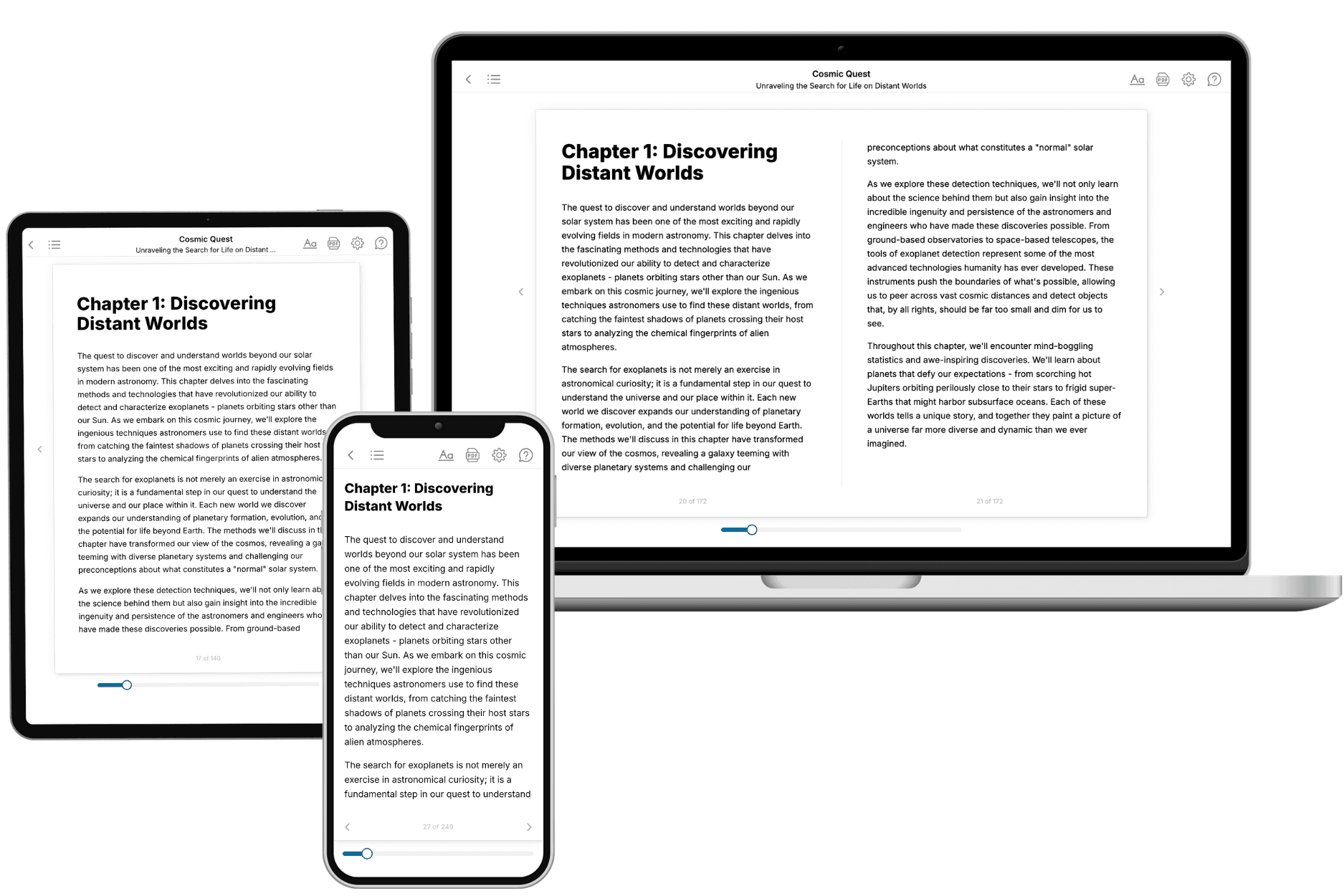
Your book is ready in 10 minutes. Read it online, download as EPUB or PDF, or send to Kindle.

Frequently asked questions
- What is TailoredRead?
TailoredRead creates complete, full-length nonfiction ebooks, written specifically for you. Tell us what you want to learn and why, and TailoredRead writes you a complete ebook on it, with charts, tables, and diagrams throughout. Read it online, on Kindle, or on any e-reader, or download it as a PDF or EPUB. Every book is written fresh the day you order it.
- How is the book tailored to me?
Before anything is written, you answer a few short questions about your goals, your background, and the topics you care about. Your book is then planned around your answers: written at your level, focused on your goals, and covering the topics you chose, instead of the one-size-fits-all book a store sells everyone.
- Will it read like generic AI content?
No. Your book isn't a chat transcript: it's planned chapter by chapter before a single word is written, told in a clear book voice, and explains ideas visually with charts, tables, and diagrams. After writing, every book goes through an editorial pass that polishes chapters so the book reads consistent from start to finish. Judge for yourself: browse thousands of sample books on our Explore Books page.
- How accurate is the content?
Our AI first checks whether your subject needs live research. Niche and fast-moving subjects are researched before writing, and the book plan and chapters are grounded in what it finds. After writing, every book goes through a quality pass that checks its facts and consistency, and researched books list their sources in a Notes section at the back.
- How long is the book?
You choose the length: Comprehensive (250-300 pages), Detailed (150-200 pages), Essential (70-100 pages), or Short (30-50 pages).
- Does the book include visuals?
Yes. Every book includes charts, tables, and diagrams: timelines, checklists, step-by-step guides, decision trees, comparison tables, matrices, and bar charts. A typical book includes dozens of these visual elements.
- Can I read it on Kindle? What formats can I download?
Yes. Every book can be read in our online reader or downloaded as a PDF or EPUB. The EPUB can be opened with Kindle, Apple Books, Kobo, and any e-reader. The Commercial and Author licenses also include an editable Word (DOCX) and Markdown download.
- How much does it cost?
About the price of a regular ebook. The exact price depends on your book's length and complexity, from $2 for the shortest books to $35 for the most comprehensive, and it's shown when you review your book, before you commit to anything. Each book is a one-time purchase, yours to keep, no subscription. Licenses that let you share, teach, or publish your book range from $35.99 to $49.99.
- Can I preview the book before purchasing?
Before you pay, you'll see what your book will cover: the title, a detailed description, the estimated length, and the complete chapter-by-chapter table of contents, so you know what you're getting before you decide. The full text itself is written after you purchase.
- How long does it take to create a book?
About 10 minutes. You can start reading the opening chapters while the rest is still being written.