Text Classification Mastery
From Raw Data to Intelligent Predictions Using Feature Extraction and Machine Learning
Imagine building a system that automatically understands and categorizes text with remarkable accuracy—whether it's filtering spam, detecting sentiment, or organizing content at scale.
222 pages10 chaptersDec 19, 2025Natural Language Processing
About this book
Text classification is the engine behind many of today's most impactful AI applications, yet many practitioners struggle to move beyond basic approaches. This book bridges the gap between theoretical understanding and practical mastery. You'll discover how to transform raw text into powerful numerical features, select the right algorithms for your specific challenges, and deploy systems that perform reliably in production. Whether you're working with traditional machine learning or cutting-edge deep learning approaches, you'll learn the principles and techniques that separate good classifiers from exceptional ones. Through clear explanations, practical examples, and real-world insights, you'll gain the confidence to tackle complex text classification problems and make informed decisions about feature extraction, model selection, and optimization strategies that actually work.
Table of contents
- IntroductionWhy Text Classification Matters in Modern AI, What You'll Learn in This Book, How to Use This Book for Maximum ImpactRead below
- Chapter 1: Foundations of Text ClassificationUnderstanding Classification as a Machine Learning Task, The Text Classification Pipeline: From Data to Predictions, Real-World Applications and Business Impact
- Chapter 2: Text Preprocessing and Data PreparationCleaning and Normalizing Raw Text Data, Tokenization: Breaking Text into Meaningful Units, Addressing Class Imbalance and Data Quality Issues
- Chapter 3: Traditional Feature Extraction MethodsBag-of-Words: Simple Yet Powerful Baseline, TF-IDF: Weighting Terms by Importance, N-Grams and Contextual Features
- Chapter 4: Word Embeddings and Dense RepresentationsWord2Vec: Learning Semantic Relationships, GloVe and FastText: Alternative Embedding Approaches, Leveraging Pre-trained Embeddings for Your Tasks
- Chapter 5: Contextual Embeddings and Transformer ModelsBERT and the Transformer Revolution, How Contextual Embeddings Capture Meaning, Fine-Tuning Pre-trained Models for Classification
- Chapter 6: Selecting and Training Classification ModelsChoosing the Right Model for Your Problem, Traditional Classifiers: Naive Bayes, SVM, and Logistic Regression, Neural Network Approaches: CNNs and RNNs for Text
- Chapter 7: Evaluation, Metrics, and ValidationBeyond Accuracy: Precision, Recall, and F1-Score, Cross-Validation and Proper Train-Test Splitting, Interpreting Results and Avoiding Common Pitfalls
- Chapter 8: Optimization and Hyperparameter TuningUnderstanding Hyperparameters and Their Impact, Grid Search, Random Search, and Bayesian Optimization, Regularization Techniques and Preventing Overfitting
- Chapter 9: Production Deployment and MonitoringMoving from Notebook to Production, Monitoring Model Performance and Data Drift, Continuous Improvement and Model Retraining
- Chapter 10: Advanced Topics and Emerging TechniquesMultilingual and Cross-Lingual Text Classification, Few-Shot Learning and Low-Resource Scenarios, Explainability and Interpreting Model Decisions
- ConclusionKey Takeaways and Your Path Forward, Staying Current in a Rapidly Evolving Field
- Glossary of Key Terms
- Further Reading and Resources
Introduction
Every day, billions of text messages, emails, social media posts, customer reviews, and documents flow through digital systems worldwide. This massive volume of unstructured text contains valuable insights, but extracting meaning from it manually is impossible at scale. Text classification—the task of automatically assigning predefined categories to text documents—has become one of the most practical and widely deployed applications of machine learning. From filtering spam in your inbox to detecting fraudulent reviews, from routing customer support tickets to analyzing market sentiment, text classification systems quietly power countless applications that shape your digital experience.
Despite its ubiquity and importance, many practitioners struggle to build text classifiers that perform reliably in real-world conditions. The challenge isn't just understanding algorithms or frameworks—it's knowing how to transform raw, messy text into meaningful numerical representations that capture the essence of language. It's understanding which feature extraction technique suits your specific problem, when traditional methods outperform deep learning approaches, and how to navigate the countless decisions that separate a prototype from a production-ready system. The gap between theoretical knowledge and practical mastery often leaves even experienced developers frustrated when their models fail to generalize or perform poorly on new data.
This book bridges that gap by focusing on the critical intersection of feature extraction and machine learning for text classification. You'll discover not just what different techniques do, but when and why to use them. You'll learn to make informed decisions about preprocessing strategies, feature engineering approaches, model selection, and optimization techniques. Most importantly, you'll gain the practical knowledge needed to build systems that work reliably in production environments, where data is messy, requirements change, and performance matters. Whether you're working with thousands or millions of documents, building your first classifier or optimizing an existing system, this book provides the actionable guidance you need to succeed.
Why Text Classification Matters in Modern AI
Text classification sits at the foundation of natural language processing, serving as a building block for more complex language understanding tasks. Unlike generative tasks that create new content or question-answering systems that require deep reasoning, classification focuses on a deceptively simple goal: given a piece of text, assign it to one or more predefined categories. This simplicity makes it accessible and practical, yet the applications are remarkably diverse and impactful. Consider how email providers automatically filter spam with over 99% accuracy, saving users from wading through thousands of unwanted messages. Or how e-commerce platforms analyze millions of product reviews to identify quality issues, fake reviews, and customer sentiment trends that inform business decisions worth millions of dollars.
The business value of text classification extends far beyond these familiar examples. Financial institutions use it to categorize news articles and social media posts for market sentiment analysis, gaining early signals about stock movements and economic trends. Healthcare organizations classify medical records and clinical notes to identify patients at risk, support diagnosis, and improve treatment outcomes. Legal firms process thousands of documents during discovery, automatically identifying relevant materials and reducing costs by orders of magnitude. Content platforms moderate billions of user-generated posts, detecting hate speech, misinformation, and policy violations at a scale impossible for human moderators alone. Each of these applications represents not just technical achievement but tangible impact on efficiency, safety, and decision-making quality.
What makes text classification particularly valuable is its combination of practical utility and technical accessibility. Unlike some AI tasks that require massive computational resources or highly specialized expertise, effective text classifiers can be built with modest hardware and well-understood techniques. A well-designed traditional machine learning approach using TF-IDF features and logistic regression can often outperform a poorly implemented deep learning model, especially when training data is limited. This accessibility democratizes AI capabilities, allowing smaller organizations and individual practitioners to build systems that solve real problems. The key is understanding the principles and making informed choices rather than simply applying the latest trending technique.
The field has experienced remarkable evolution over the past decade, driven by advances in both feature extraction and model architectures. Traditional approaches like bag-of-words and TF-IDF, which treat text as collections of independent words, have been augmented by word embeddings that capture semantic relationships. More recently, contextual embeddings from transformer models like BERT have revolutionized the field by understanding words in context, dramatically improving performance on complex tasks. Yet this evolution hasn't made older techniques obsolete—it has expanded your toolkit. Understanding when a simple TF-IDF approach suffices versus when you need the power of transformers is crucial for building efficient, cost-effective systems that meet your specific requirements.
Text classification also serves as an excellent entry point for understanding broader machine learning principles. The challenges you encounter—handling imbalanced datasets, preventing overfitting, selecting appropriate evaluation metrics, and deploying models in production—are universal across machine learning domains. By mastering text classification, you develop transferable skills and intuitions that apply to image classification, time series prediction, and other supervised learning tasks. The feedback loop is relatively quick: you can preprocess data, train a model, and evaluate results in minutes or hours rather than days, making it an ideal domain for experimentation and learning.
Perhaps most importantly, text classification addresses a fundamental challenge in our information-rich world: making sense of unstructured data at scale. While structured data in databases and spreadsheets is relatively easy to analyze, the vast majority of human knowledge and communication exists as unstructured text. Text classification provides a bridge, transforming this unstructured information into structured categories that enable analysis, automation, and insight. As the volume of text data continues to grow exponentially, the ability to build effective classification systems becomes increasingly valuable across virtually every industry and domain.
The democratization of pre-trained models and open-source tools has lowered barriers to entry, but it has also created new challenges. With so many options available—from classical machine learning libraries like scikit-learn to deep learning frameworks like TensorFlow and PyTorch, from pre-trained embeddings to massive language models—knowing which tools to use and how to use them effectively requires deeper understanding than ever. This book helps you navigate these choices by focusing on principles and practical considerations rather than chasing the latest trends. You'll learn to evaluate trade-offs between accuracy, speed, interpretability, and resource requirements, making decisions that align with your specific constraints and objectives.
What You'll Learn in This Book
This book takes you on a comprehensive journey through text classification, from foundational concepts to advanced techniques and production deployment. You'll start by understanding classification as a machine learning task and the complete pipeline from raw text to predictions. This foundation ensures you grasp not just individual techniques but how they fit together into a coherent system. You'll learn to think about text classification problems systematically, identifying the key decisions and potential pitfalls at each stage. This holistic perspective is essential for building systems that work reliably rather than just achieving good results on a test set.
The core of the book focuses on feature extraction—the critical process of transforming text into numerical representations that machine learning models can process. You'll master traditional methods including bag-of-words, TF-IDF, and n-grams, understanding their strengths, limitations, and appropriate use cases. These techniques remain highly relevant because they're interpretable, computationally efficient, and often surprisingly effective. You'll learn practical implementation details that textbooks often omit, such as:
- How to choose vocabulary size and handle out-of-vocabulary words effectively
- When to use character-level versus word-level n-grams for different languages and domains
- How to implement custom preprocessing pipelines that preserve important information while reducing noise
- Techniques for handling domain-specific terminology and abbreviations
You'll then progress to word embeddings, learning how Word2Vec, GloVe, and FastText capture semantic relationships between words in dense vector spaces. Rather than just explaining the mathematics, you'll discover practical strategies for using pre-trained embeddings effectively, fine-tuning them for your domain, and combining them with traditional features for improved performance. You'll understand when embeddings provide significant advantages over simpler approaches and when the added complexity isn't justified. This includes hands-on guidance for common challenges like handling out-of-vocabulary words, choosing embedding dimensions, and aggregating word vectors into document representations.
The book dedicates substantial attention to modern contextual embeddings and transformer models, which have fundamentally changed what's possible in text classification. You'll learn how BERT and similar models capture context and meaning in ways that static embeddings cannot, and more importantly, how to leverage these powerful models practically. This includes:
- Understanding the architecture and training process of transformers without getting lost in mathematical details
- Selecting appropriate pre-trained models for your language, domain, and computational constraints
- Fine-tuning strategies that achieve strong performance with limited labeled data
- Techniques for reducing model size and inference time while maintaining accuracy
- When to use full fine-tuning versus feature extraction approaches
Model selection and training receive thorough treatment, covering both traditional machine learning algorithms and neural network approaches. You'll learn the strengths and weaknesses of Naive Bayes, Support Vector Machines, logistic regression, random forests, and neural architectures including CNNs and RNNs for text. Rather than presenting these as competing alternatives, you'll understand how to choose based on your specific requirements for accuracy, interpretability, training time, and inference speed. You'll discover that the "best" model depends entirely on your context—a lesson that saves countless hours of unproductive experimentation.
Evaluation and validation are covered in depth because choosing appropriate metrics and validation strategies is crucial for building systems that perform well in production. You'll learn why accuracy is often misleading, especially with imbalanced datasets, and how to select metrics that align with your business objectives. The book provides practical guidance on cross-validation strategies, handling temporal dependencies in text data, and interpreting confusion matrices to identify specific failure modes. You'll also learn to recognize and avoid common pitfalls like data leakage and overfitting that can make models appear successful in development but fail in production.
Optimization and hyperparameter tuning are demystified with practical strategies that go beyond brute-force grid search. You'll learn efficient approaches including random search and Bayesian optimization, understanding when each is appropriate. More importantly, you'll develop intuition about which hyperparameters matter most for different model types, allowing you to focus tuning efforts where they'll have the greatest impact. The book also covers regularization techniques and strategies for preventing overfitting, helping you build models that generalize well to new data rather than merely memorizing training examples.
The final chapters address production deployment and advanced topics that separate academic exercises from real-world systems. You'll learn how to move from notebook experiments to production services, including considerations for latency, scalability, and monitoring. The book covers model versioning, A/B testing, handling data drift, and continuous improvement strategies. Advanced topics include multilingual classification, few-shot learning for low-resource scenarios, and explainability techniques that help you understand and trust model predictions. These chapters ensure you're prepared not just to build models but to deploy and maintain them successfully over time.
How to Use This Book for Maximum Impact
This book is designed for intermediate practitioners who already have foundational machine learning knowledge and want to deepen their expertise in text classification specifically. You should be comfortable with basic Python programming, familiar with fundamental machine learning concepts like training and test sets, and have some exposure to libraries like scikit-learn or similar frameworks. If you've built a simple classifier before but struggled to improve its performance or deploy it successfully, this book is for you. If you're working with text data professionally and want to make better decisions about feature extraction and model selection, you'll find immediately applicable guidance throughout.
The book is structured to be read sequentially, with each chapter building on concepts from previous ones. However, it's also designed to serve as a reference you can return to when facing specific challenges. If you're already familiar with traditional feature extraction methods, you might skim Chapter 3 and focus more deeply on Chapters 4 and 5 covering embeddings and transformers. If you're struggling with evaluation and metrics, Chapter 7 provides comprehensive guidance you can apply immediately. The key is to engage actively with the material rather than passively reading—consider how each concept applies to your specific problems and datasets.
To get maximum value from this book, approach it with specific projects or problems in mind. As you read about different feature extraction techniques, think about which might work best for your domain and data characteristics. When learning about model selection, consider the trade-offs that matter most in your context—do you need maximum accuracy regardless of computational cost, or is inference speed critical? This active engagement transforms abstract concepts into practical tools you can apply immediately. Keep notes about techniques you want to try and questions that arise, then experiment with your own data to validate your understanding.
The book includes numerous examples and practical guidance, but the most effective learning comes from hands-on experimentation. After reading each chapter, try implementing the techniques with your own datasets or publicly available benchmark datasets. Start simple—build a basic classifier using the techniques from early chapters before moving to more complex approaches. This progression helps you develop intuition about what works and why, rather than jumping directly to the most sophisticated methods. You'll often find that simpler approaches perform surprisingly well, and understanding their limitations helps you appreciate when more complex techniques are truly necessary.
Pay special attention to the sections on evaluation, validation, and common pitfalls. These topics might seem less exciting than learning about the latest transformer architectures, but they're often where practitioners struggle most. A sophisticated model with poor evaluation methodology is worse than a simple model evaluated properly, because you can't trust the results. Understanding how to set up proper train-test splits, choose appropriate metrics, and interpret results correctly is fundamental to building systems that work reliably. These skills transfer across all machine learning domains and will serve you throughout your career.
Consider forming a study group or finding a learning partner to discuss concepts and share experiences. Text classification problems vary widely across domains, and hearing how others approach similar challenges provides valuable perspective. You might discover that a technique you dismissed as too simple works remarkably well for someone else's problem, or that a challenge you're facing has a known solution in a different domain. The machine learning community is generally collaborative and supportive—don't hesitate to engage with others through forums, conferences, or local meetups.
As you progress through the book, maintain a balance between breadth and depth. It's tempting to focus exclusively on the techniques that seem most relevant to your immediate needs, but understanding the full landscape of options makes you a more effective practitioner. You'll make better decisions about when to use traditional methods versus deep learning, when to invest in custom feature engineering versus using pre-trained models, and how to allocate your time and computational resources most effectively. This broader perspective is what separates practitioners who can only apply cookbook solutions from those who can design effective systems for novel problems.
Finally, remember that text classification is a rapidly evolving field. While the fundamental principles in this book remain stable, new techniques and models emerge regularly. Use this book as a foundation for understanding these principles, then stay current by following research publications, attending conferences, and experimenting with new approaches as they become available. The goal isn't to learn a fixed set of techniques but to develop the understanding and judgment needed to evaluate new methods critically and adopt them when they offer genuine advantages for your specific problems. With this foundation, you'll be well-equipped to build effective text classification systems today and adapt as the field continues to evolve.
This is the end of the free sample. The full book has 10 chapters.
Want this book written for you?
Tell us your goals and background, and get your own version of this book, tailored by AI to you.


Benefits of AI-tailored books
- Read one book, not ten:
- all the Natural Language Processing knowledge you need, gathered into a single book.
- Save days of learning:
- tell us your goals, choose your topics, and the whole book is built around them.
- Learn effortlessly:
- Natural Language Processing book written for your specific background and expertise.
- Understand at a glance:
- includes charts, tables, timelines, checklists, decision trees, and more.
- Stay current:
- written the day you order it, not years ago.
- Trust what you read:
- every book is checked for accuracy, with real research when your subject needs it.
Create your unique book in 3 steps
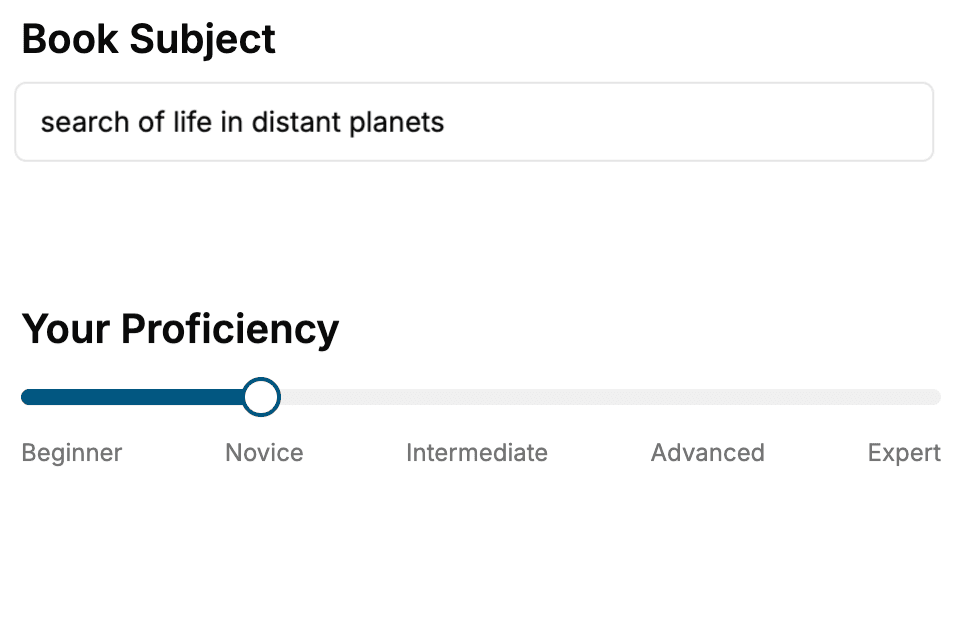
- 1. Select your focus
Select the focus of your Natural Language Processing book and share your background
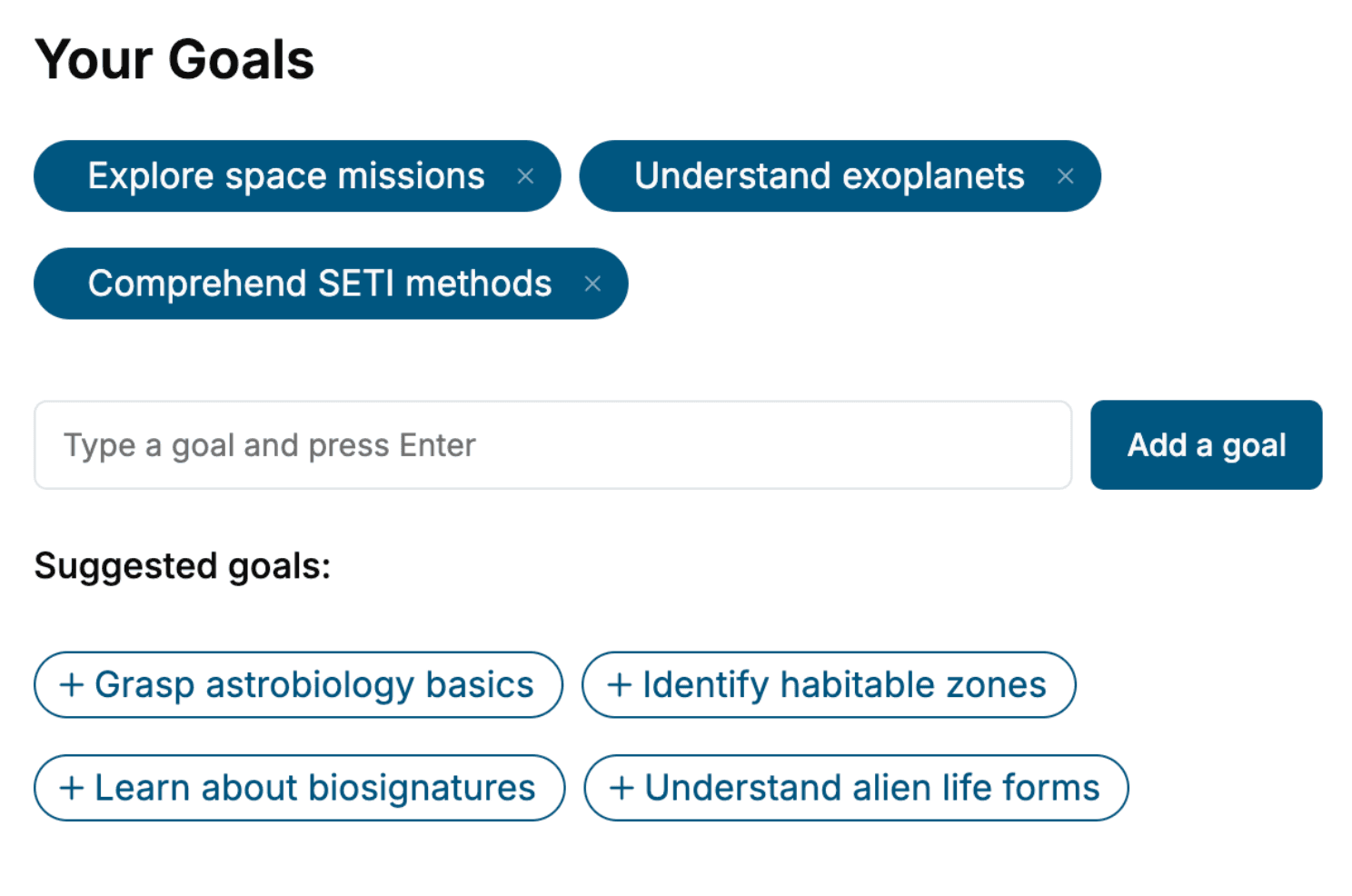
- 2. Personalize your book
Specify your goals and choose sub-topics to include
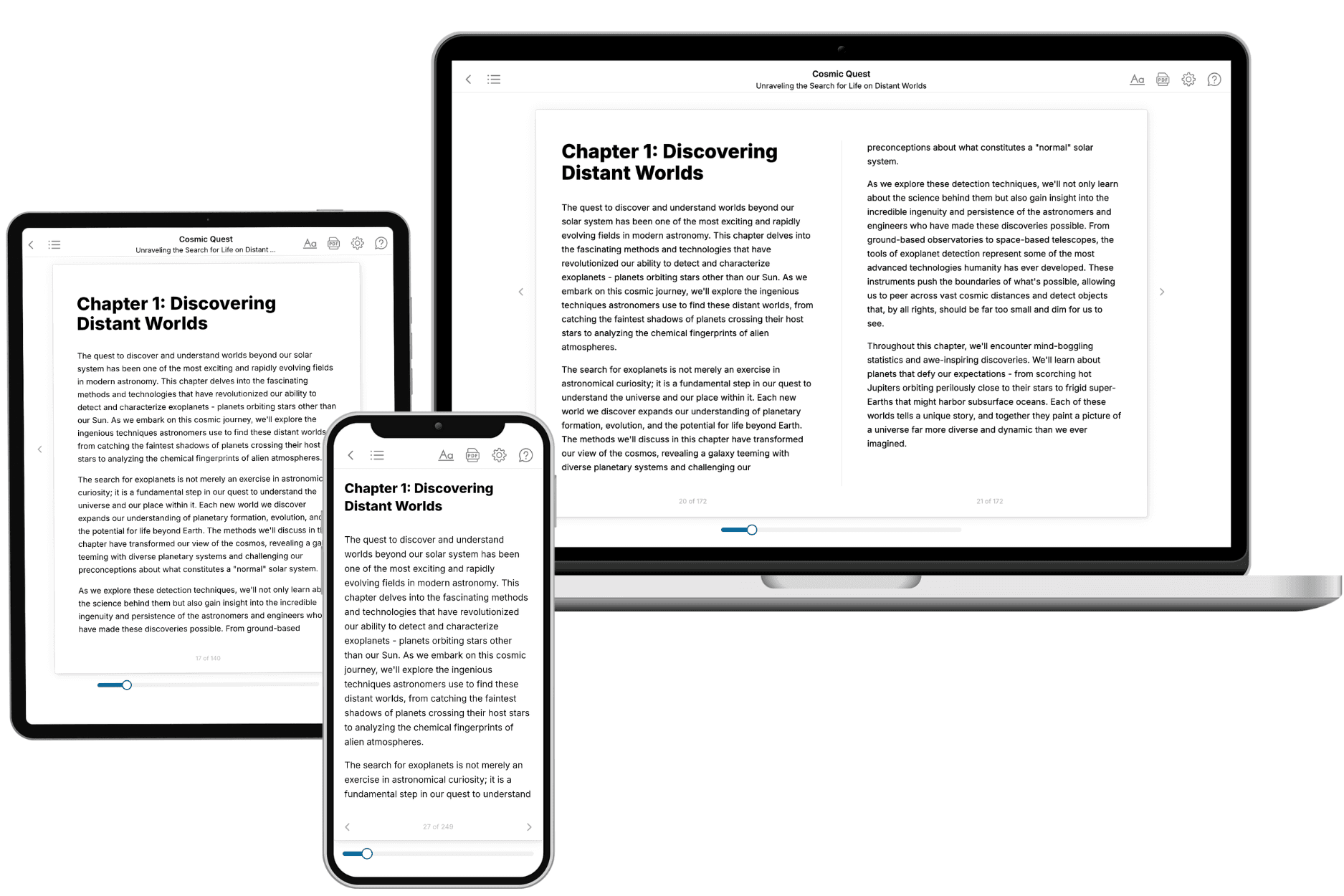
- 3. Get your tailored book
Your book is ready in 10 minutes. Read it online, download as EPUB or PDF, or send to Kindle.
Frequently asked questions
- What is TailoredRead?
TailoredRead creates complete, full-length nonfiction ebooks, written specifically for you. Tell us what you want to learn and why, and TailoredRead writes you a complete ebook on it, with charts, tables, and diagrams throughout. Read it online, on Kindle, or on any e-reader, or download it as a PDF or EPUB. Every book is written fresh the day you order it.
- How is the book tailored to me?
Before anything is written, you answer a few short questions about your goals, your background, and the topics you care about. Your book is then planned around your answers: written at your level, focused on your goals, and covering the topics you chose, instead of the one-size-fits-all book a store sells everyone.
- Will it read like generic AI content?
No. Your book isn't a chat transcript: it's planned chapter by chapter before a single word is written, told in a clear book voice, and explains ideas visually with charts, tables, and diagrams. After writing, every book goes through an editorial pass that polishes chapters so the book reads consistent from start to finish. Judge for yourself: browse thousands of sample books on our Explore Books page.
- How accurate is the content?
Our AI first checks whether your subject needs live research. Niche and fast-moving subjects are researched before writing, and the book plan and chapters are grounded in what it finds. After writing, every book goes through a quality pass that checks its facts and consistency, and researched books list their sources in a Notes section at the back.
- How long is the book?
You choose the length: Comprehensive (250-300 pages), Detailed (150-200 pages), Essential (70-100 pages), or Short (30-50 pages).
- Does the book include visuals?
Yes. Every book includes charts, tables, and diagrams: timelines, checklists, step-by-step guides, decision trees, comparison tables, matrices, and bar charts. A typical book includes dozens of these visual elements.
- Can I read it on Kindle? What formats can I download?
Yes. Every book can be read in our online reader or downloaded as a PDF or EPUB. The EPUB can be opened with Kindle, Apple Books, Kobo, and any e-reader. The Commercial and Author licenses also include an editable Word (DOCX) and Markdown download.
- How much does it cost?
About the price of a regular ebook. The exact price depends on your book's length and complexity, from $2 for the shortest books to $35 for the most comprehensive, and it's shown when you review your book, before you commit to anything. Each book is a one-time purchase, yours to keep, no subscription. Licenses that let you share, teach, or publish your book range from $35.99 to $49.99.
- Can I preview the book before purchasing?
Before you pay, you'll see what your book will cover: the title, a detailed description, the estimated length, and the complete chapter-by-chapter table of contents, so you know what you're getting before you decide. The full text itself is written after you purchase.
- How long does it take to create a book?
About 10 minutes. You can start reading the opening chapters while the rest is still being written.