The Theory of Everything Explained
How Quantum Gravity Bridges the Universe's Biggest Mysteries
You're about to discover why the greatest minds in physics have spent decades chasing a single equation that could explain everything.
238 pages11 chaptersJul 13, 2026Theoretical Physics
About this book
This book takes you through the fascinating landscape of quantum gravity—the frontier where Einstein's universe meets the quantum realm. You'll learn why our current physics breaks down at the smallest scales and highest energies, and explore the leading theories attempting to fix this cosmic puzzle. From string theory's extra dimensions to loop quantum gravity's discrete spacetime, you'll understand not just what these theories propose, but why physicists believe they might be on the right track. Along the way, you'll encounter black holes, the Big Bang, and the deepest questions about the nature of reality itself. Whether you're a science enthusiast or someone curious about the universe's fundamental rules, this exploration reveals how close—and how far—we remain from a complete understanding of nature.
Table of contents
- IntroductionWhy We Need a Theory of Everything, The Problem: Two Incompatible Theories, What This Book Will RevealRead below
- Chapter 1: The Foundation: Classical Physics and Its LimitsNewton's Revolution and the Clockwork Universe, Maxwell's Unification: Electricity Meets Magnetism, Cracks in the Foundation: When Classical Physics Fails
- Chapter 2: Einstein's Breakthroughs: Relativity and GravitySpecial Relativity: Space and Time Reimagined, General Relativity: Gravity as Curved Spacetime, Predictions Confirmed: Testing Einstein's Vision
- Chapter 3: The Quantum Revolution: A Different RealityQuantum Mechanics Fundamentals, The Uncertainty Principle and Quantum Weirdness, Why Quantum Mechanics Works So Well
- Chapter 4: The Incompatibility Crisis: Where Physics Breaks DownThe Planck Scale: Where Both Theories Matter, The Infinities Problem in Quantum Gravity, Black Holes and the Information Paradox
- Chapter 5: String Theory: Vibrating Strings and Extra DimensionsThe Basics of String Theory, Extra Dimensions and Compactification, Challenges and Criticisms of String Theory
- Chapter 6: Loop Quantum Gravity: Quantizing Spacetime ItselfThe Foundations of Loop Quantum Gravity, Discrete Spacetime and Quantum Geometry, Advantages and Open Questions in LQG
- Chapter 7: Alternative Approaches: Beyond Strings and LoopsSupergravity and Supersymmetry, Causal Sets and Asymptotic Safety, Other Promising Frameworks
- Chapter 8: Black Holes: Laboratories for Quantum GravityUnderstanding Black Holes, Hawking Radiation and Thermodynamics, Using Black Holes to Test Quantum Gravity
- Chapter 9: The Big Bang and the Universe's OriginWhat We Know About the Big Bang, Quantum Cosmology and the First Moments, Resolving the Singularity Problem
- Chapter 10: Experimental Clues and Future ObservationsCurrent Experimental Approaches, Gravitational Waves as a New Window, Future Experiments and Detection Methods
- Chapter 11: The Philosophical Implications: What It All MeansThe Nature of Space, Time, and Reality, Determinism, Free Will, and Quantum Mechanics, Ultimate Questions and the Limits of Science
- ConclusionWhere We Stand Today, The Path Forward
- Glossary of Key Terms
- Further Reading and Resources
Introduction
There is a question that has haunted physics for nearly a century, one that sits quietly beneath every experiment, every equation, and every Nobel Prize awarded in the field: Is there a single framework that can explain everything? Not just some things. Not just the very large or the very small. Everything. The motion of galaxies, the behavior of electrons, the birth of the universe, and the strange interior of a black hole. Physicists call this the Theory of Everything, and the search for it is arguably the most ambitious intellectual project in human history.
What makes this quest so remarkable is not just its scope, but its urgency. Physics today rests on two extraordinarily successful pillars. The first is general relativity, Albert Einstein's geometric description of gravity, which governs the behavior of massive objects, the curvature of spacetime, and the large-scale structure of the cosmos. The second is quantum mechanics, the framework that describes how matter and energy behave at the smallest scales, from atoms to subatomic particles. Both theories have been tested to extraordinary precision. Both work brilliantly within their own domains. And yet, when you try to apply them together, the mathematics collapses into nonsense. This is not a minor technical inconvenience. It is a fundamental crack in the foundation of modern physics.
This book is about that crack, and about the extraordinary efforts being made to repair it. You will encounter ideas that challenge intuition at every turn: spacetime that is not smooth but granular, dimensions curled up smaller than anything measurable, particles that are really tiny vibrating strings of energy, and a universe that may have had no true beginning in the classical sense. These are not science fiction concepts. They are serious proposals from serious scientists, backed by deep mathematics and decades of careful thought. Understanding them does not require a PhD, but it does require a willingness to let go of familiar assumptions about how reality works. That willingness is the only prerequisite for what follows.
The journey ahead is structured to build your understanding layer by layer. Before diving into the cutting edge, you will revisit the foundations: classical physics, relativity, and quantum mechanics. From there, the book moves into the heart of the problem, exploring why these two great theories refuse to cooperate. Then come the proposed solutions, the experimental tests, and finally the philosophical questions that emerge when you start asking what a Theory of Everything would actually mean for our understanding of space, time, and existence itself. By the end, you will have a clear picture of where physics stands today, how far it has come, and how far it still has to go.
Why We Need a Theory of Everything
The desire to unify seemingly separate phenomena into a single explanation is one of the oldest and most productive instincts in science. It is not merely an aesthetic preference, though physicists do tend to find elegant unified theories more satisfying than messy patchwork ones. Unification has a track record of producing genuine breakthroughs. When James Clerk Maxwell unified electricity and magnetism in the 1860s, he did not just tidy up two separate fields. He discovered that light itself is an electromagnetic wave, a revelation that nobody had anticipated and that transformed both physics and technology.[1] Unification, in other words, tends to reveal hidden truths that neither separate theory could have exposed on its own.
The same logic applies to the unification of quantum mechanics and gravity. Right now, physicists use two different toolkits depending on the situation. When studying the orbit of a planet or the bending of light around a star, they use general relativity. When studying the decay of a radioactive atom or the behavior of electrons in a semiconductor, they use quantum mechanics. This works fine in practice because the two domains rarely overlap in everyday physics. But there are places in the universe where both theories must apply simultaneously, and those are precisely the places where our current understanding breaks down completely.
Consider the center of a black hole. At that point, called a singularity, the density of matter becomes infinite according to general relativity. The equations simply stop making sense. Similarly, at the very first instant of the Big Bang, the entire observable universe was compressed into a region so small and so hot that quantum effects on spacetime itself would have been unavoidable. In both cases, general relativity alone cannot tell the full story, and quantum mechanics alone cannot handle the extreme gravitational conditions. A Theory of Everything is not a luxury. It is a necessity for understanding these extreme corners of reality.
There is also a deeper philosophical motivation. Science has always moved toward greater unity. The history of physics is, in many ways, a history of discovering that things that looked different were actually the same thing in disguise. Electricity and magnetism turned out to be two faces of one force. Later, the electromagnetic force and the weak nuclear force were unified into the electroweak force, a triumph confirmed by experiments at CERN in the 1980s.[2] The strong nuclear force was brought into a broader framework called the Standard Model. Gravity alone remains stubbornly outside this picture. Its exclusion feels less like a natural boundary and more like an unfinished sentence.
Practically speaking, a Theory of Everything would not immediately change daily life the way a new smartphone does. But the history of physics shows that fundamental discoveries have a habit of producing unexpected applications decades later. Maxwell's equations led to radio, television, and wireless communication. Quantum mechanics led to transistors, lasers, and MRI machines. Nobody predicted these applications at the time of the original discoveries. A working theory of quantum gravity might open doors to technologies and understandings that are currently unimaginable, from new ways of thinking about computation to entirely new materials or energy sources.
Perhaps most importantly, the search for a Theory of Everything is a test of whether science can answer its own deepest questions. Can human reasoning, guided by mathematics and experiment, reach all the way down to the bedrock of reality? That question is not just scientific. It is profoundly human. The drive to understand where everything comes from, what the universe is made of at its most fundamental level, and why the laws of nature are the way they are, is one of the things that defines us as a thinking species. The Theory of Everything is, in that sense, the ultimate expression of scientific ambition.
It is worth being honest about what a Theory of Everything would and would not accomplish. It would not explain everything in the colloquial sense. It would not tell you why people fall in love, how consciousness works, or what makes a piece of music beautiful. What it would do is provide a complete and consistent description of all the fundamental forces and particles in nature, a single set of equations from which, in principle, all physical phenomena could be derived. That is an extraordinary goal, and it is the one this book is about.
The Problem: Two Incompatible Theories
To appreciate why quantum gravity is so difficult, you need to understand just how different general relativity and quantum mechanics are, not just in their content, but in their fundamental assumptions about how reality works. These two theories do not merely disagree on details. They disagree on the nature of space, time, and the very meaning of a physical measurement. Reconciling them is not like adjusting two clocks that are slightly out of sync. It is more like trying to merge two operating systems built on completely different architectures.
General relativity describes gravity as the curvature of spacetime. In Einstein's picture, spacetime is a smooth, continuous fabric. Massive objects like stars and planets warp this fabric, and other objects follow the curves created by that warping. This is what we experience as gravitational attraction. The key word here is smooth. General relativity assumes that spacetime can be divided into arbitrarily small pieces, and that at every point, the geometry is well-defined and continuous. The theory is also fundamentally deterministic: given the state of the universe at one moment, the equations tell you exactly what will happen next.
Quantum mechanics operates on entirely different principles. At the quantum level, nature is inherently probabilistic. You cannot know both the position and momentum of a particle with perfect precision at the same time. This is not a limitation of measurement technology. It is a fundamental feature of reality, encoded in Heisenberg's uncertainty principle. Furthermore, quantum mechanics describes fields and particles that fluctuate constantly, even in a vacuum. Empty space, in the quantum picture, is not truly empty. It seethes with virtual particles popping in and out of existence, a phenomenon called quantum vacuum fluctuations.
The conflict becomes acute when you try to apply quantum mechanics to gravity. In quantum field theory, forces are carried by particles. The electromagnetic force is carried by photons. The strong nuclear force is carried by gluons. The weak nuclear force is carried by W and Z bosons. By analogy, gravity should be carried by a particle called the graviton. But when physicists try to calculate what happens when gravitons interact, the mathematics produces infinities. Not large numbers. Actual infinities, which are physically meaningless and mathematically unworkable.
This problem has a technical name: non-renormalizability. In quantum electrodynamics, the theory of electromagnetic interactions, infinities also appear in calculations, but physicists developed a technique called renormalization to absorb them into measurable quantities and extract finite, meaningful predictions. This approach earned Richard Feynman, Julian Schwinger, and Sin-Itiro Tomonaga the Nobel Prize in 1965.[3] The same trick does not work for gravity. When you try to renormalize quantum gravity, you generate an infinite series of new infinities, each requiring its own correction, with no end in sight. The theory is, in the technical sense, sick.
To make the incompatibility concrete, consider what happens at the Planck scale. This is the regime of energy and distance where both quantum effects and gravitational effects become equally important. The Planck length is approximately 1.6 × 10⁻³⁵ meters, which is about twenty orders of magnitude smaller than a proton. At this scale, the smooth spacetime of general relativity should be replaced by something else entirely, something that incorporates quantum uncertainty. But neither theory can tell you what that something is. General relativity simply assumes spacetime is smooth and breaks down when that assumption fails. Quantum mechanics has no mechanism for describing a fluctuating, uncertain spacetime geometry.
The incompatibility also shows up in a famous thought experiment involving black holes. In 1974, Stephen Hawking showed that black holes should emit radiation due to quantum effects near the event horizon, a phenomenon now called Hawking radiation.[4] This was a stunning result, but it created a new problem. If a black hole slowly evaporates by emitting this radiation, what happens to all the information about the matter that originally fell in? General relativity says it is lost forever. Quantum mechanics says information cannot be destroyed. This contradiction, known as the black hole information paradox, has no resolution within either theory alone. It is one of the clearest signs that a deeper theory is needed.
The situation can be summarized simply. General relativity is the best theory of gravity ever devised, confirmed by everything from the precession of Mercury's orbit to the detection of gravitational waves. Quantum mechanics is the most precisely tested theory in all of science, with predictions confirmed to more than ten decimal places. Both are right. Both are incomplete. And they cannot both be right in the same universe without a deeper framework that contains them both as special cases. Finding that framework is the central challenge of theoretical physics today.
The core problem in one sentence: General relativity treats spacetime as a smooth, deterministic continuum, while quantum mechanics treats everything as probabilistic and granular, and no one has yet found a consistent way to make both descriptions true at the same time.
What This Book Will Reveal
This book is designed to take you from the foundations of modern physics all the way to the frontier of current research, without losing you in mathematical formalism along the way. The goal is not to turn you into a theoretical physicist. The goal is to give you a genuine, substantive understanding of what the problem is, why it matters, and what the most promising attempts at a solution look like. By the time you finish, you will be able to follow conversations about string theory, loop quantum gravity, and black hole thermodynamics with real comprehension, not just familiarity with the buzzwords.
The book is organized into three broad phases. The first phase, covering Chapters 1 through 3, builds the foundation. You will revisit classical physics and understand why it was so successful, then see how Einstein's relativity transformed our understanding of space, time, and gravity, and finally explore the quantum revolution that upended everything physicists thought they knew about the nature of matter and energy. Even if you have some background in these topics, these chapters are worth reading carefully. The specific details emphasized here are chosen to set up the incompatibility problem that follows.
The second phase, Chapters 4 through 7, is the heart of the book. Chapter 4 lays out the incompatibility crisis in full detail, explaining exactly where and why physics breaks down. Then the book turns to the proposed solutions:
- String theory (Chapter 5): the idea that fundamental particles are not point-like objects but tiny one-dimensional strings, whose different vibrational modes produce different particles, including the graviton.
- Loop quantum gravity (Chapter 6): the proposal that spacetime itself is quantized, built from discrete chunks of geometry at the Planck scale, with no need for extra dimensions.
- Alternative approaches (Chapter 7): a survey of other serious contenders, including supergravity, causal set theory, and asymptotic safety, each offering a different angle on the same fundamental problem.
Each of these chapters explains not just what the theory proposes, but why physicists find it compelling, what its successes have been, and what obstacles it still faces. No single approach has yet been confirmed by experiment, and the book is honest about that. Understanding why each theory is promising, and why none has yet won, is itself a crucial part of understanding where physics stands today.
The third phase, Chapters 8 through 11, explores the testing grounds and implications of quantum gravity. Black holes (Chapter 8) and the Big Bang (Chapter 9) are the two places in the universe where quantum gravity effects are not optional extras but unavoidable necessities. Chapter 10 surveys the experimental landscape: what current and near-future experiments might tell us about quantum gravity, from gravitational wave observatories to high-energy particle colliders to observations of the cosmic microwave background. Chapter 11 steps back to consider the philosophical implications: what a Theory of Everything would mean for our understanding of space, time, determinism, and the nature of reality itself.
Throughout the book, several key themes will recur. Watch for them, because they connect ideas across chapters in ways that deepen understanding:
- The power of symmetry: Almost every major advance in fundamental physics has involved recognizing a new symmetry in nature. Symmetry is not just a mathematical tool. It is a window into the deep structure of reality.
- The role of mathematics: Quantum gravity research often advances through mathematical consistency before experimental confirmation. Understanding why physicists trust mathematical beauty as a guide is essential for following the field.
- The limits of intuition: At the Planck scale, human intuition built from everyday experience becomes actively misleading. Learning to think in terms of abstract structures rather than familiar pictures is part of what makes this physics so challenging and so rewarding.
- The interplay of theory and experiment: Even in a field where direct experiments are currently out of reach, the relationship between theoretical prediction and observational constraint is alive and productive. Quantum gravity is not pure speculation.
One thing this book will not do is pretend that any of these questions are settled. The honest answer to "which theory of quantum gravity is correct?" is that nobody knows yet. String theory has produced remarkable mathematics and unexpected connections between different areas of physics, but it has not yet made a confirmed experimental prediction unique to itself. Loop quantum gravity has a compelling conceptual framework, but it faces serious challenges in recovering the smooth spacetime of general relativity at large scales. The other approaches are even less developed. This is not a failure of physics. It is a reflection of how genuinely hard the problem is, and how much remains to be discovered.
What makes this moment in physics so exciting is that the tools available to researchers are improving rapidly. Gravitational wave detectors like LIGO and Virgo have opened an entirely new observational window on the universe. The Event Horizon Telescope has produced the first images of black hole shadows. Next-generation experiments are being planned that could detect subtle signatures of quantum gravity effects in the cosmic microwave background or in the behavior of gamma-ray bursts. The theoretical landscape is also shifting, with new mathematical tools and unexpected connections between string theory, quantum information theory, and condensed matter physics suggesting that the pieces of the puzzle may be closer to fitting together than they appear.[5]
The Theory of Everything may still be decades away. It may require conceptual breakthroughs that nobody has yet imagined. But the search for it is already producing profound insights into the nature of space, time, information, and the quantum structure of reality. Every chapter of this book is a step deeper into that search. The questions are hard, the answers are incomplete, and the journey is one of the most extraordinary intellectual adventures in human history. That is exactly why it is worth taking.
Notes
Introduction
- 1. Basil Mahon, The Man Who Changed Everything, Wiley, 2003
- 2. Steven Weinberg, "Conceptual Foundations of the Unified Theory of Weak and Electromagnetic Interactions," Nobel Lecture, 1979
- 3. Richard P. Feynman, "The Development of the Space-Time View of Quantum Electrodynamics," Nobel Lecture, 1965
- 4. S. W. Hawking, "Black hole explosions?," Nature, 1974
- 5. Juan Maldacena, "The Large N Limit of Superconformal Field Theories and Supergravity," International Journal of Theoretical Physics, 1997
This is the end of the free sample. The full book has 11 chapters.
Want this book written for you?
Tell us your goals and background, and get your own version of this book, tailored by AI to you.


Benefits of AI-tailored books
- Read one book, not ten:
- all the Theoretical Physics knowledge you need, gathered into a single book.
- Save days of learning:
- tell us your goals, choose your topics, and the whole book is built around them.
- Learn effortlessly:
- Theoretical Physics book written for your specific background and expertise.
- Understand at a glance:
- includes charts, tables, timelines, checklists, decision trees, and more.
- Stay current:
- written the day you order it, not years ago.
- Trust what you read:
- every book is checked for accuracy, with real research when your subject needs it.
Create your unique book in 3 steps
- 1. Select your focus
Select the focus of your Theoretical Physics book and share your background
- 2. Personalize your book
Specify your goals and choose sub-topics to include
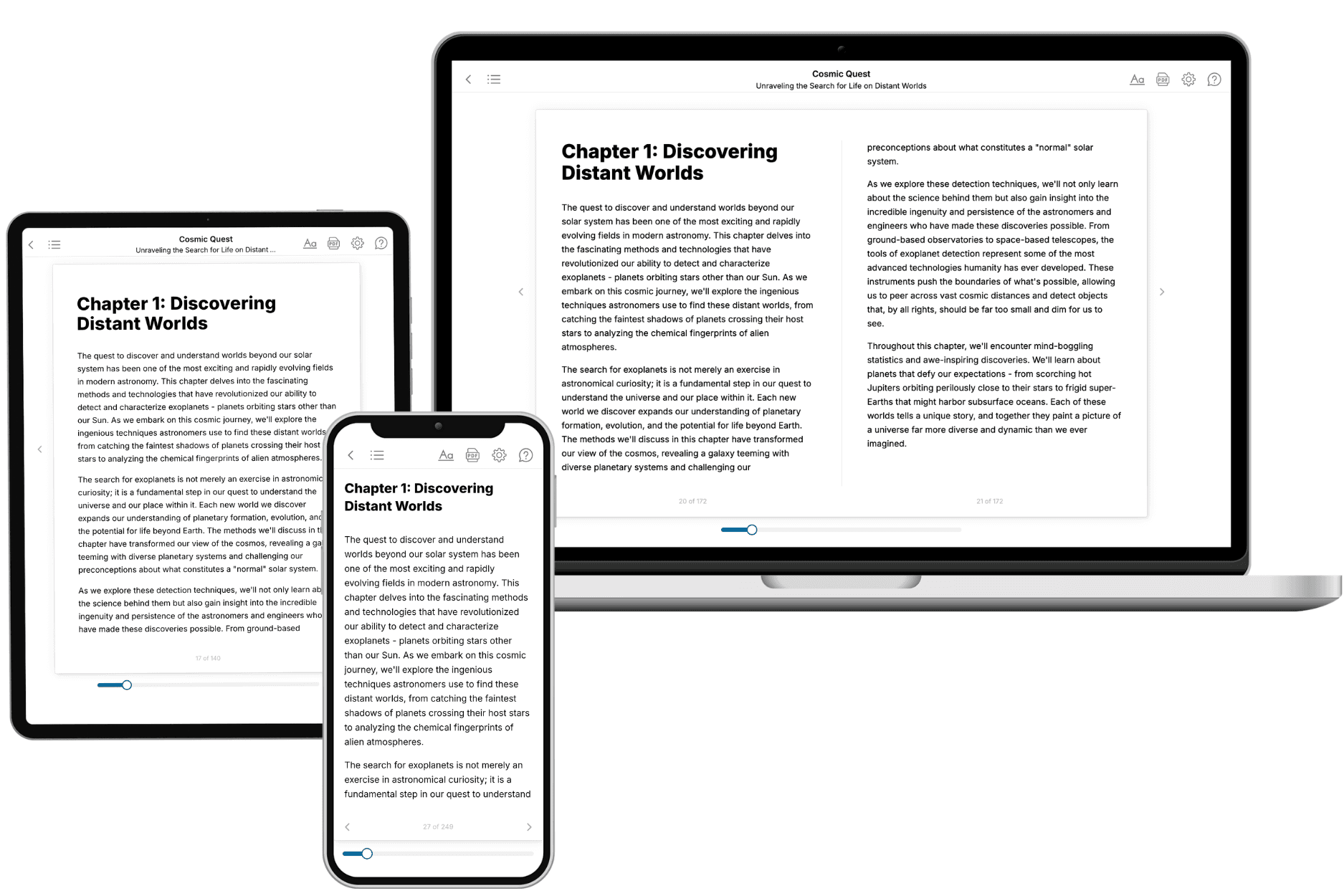
- 3. Get your tailored book
Your book is ready in 10 minutes. Read it online, download as EPUB or PDF, or send to Kindle.
Frequently asked questions
- What is TailoredRead?
TailoredRead creates complete, full-length nonfiction ebooks, written specifically for you. Tell us what you want to learn and why, and TailoredRead writes you a complete ebook on it, with charts, tables, and diagrams throughout. Read it online, on Kindle, or on any e-reader, or download it as a PDF or EPUB. Every book is written fresh the day you order it.
- How is the book tailored to me?
Before anything is written, you answer a few short questions about your goals, your background, and the topics you care about. Your book is then planned around your answers: written at your level, focused on your goals, and covering the topics you chose, instead of the one-size-fits-all book a store sells everyone.
- Will it read like generic AI content?
No. Your book isn't a chat transcript: it's planned chapter by chapter before a single word is written, told in a clear book voice, and explains ideas visually with charts, tables, and diagrams. After writing, every book goes through an editorial pass that polishes chapters so the book reads consistent from start to finish. Judge for yourself: browse thousands of sample books on our Explore Books page.
- How accurate is the content?
Our AI first checks whether your subject needs live research. Niche and fast-moving subjects are researched before writing, and the book plan and chapters are grounded in what it finds. After writing, every book goes through a quality pass that checks its facts and consistency, and researched books list their sources in a Notes section at the back.
- How long is the book?
You choose the length: Comprehensive (250-300 pages), Detailed (150-200 pages), Essential (70-100 pages), or Short (30-50 pages).
- Does the book include visuals?
Yes. Every book includes visual elements such as timelines, checklists, step-by-step guides, decision trees, comparison tables, and matrices, and many include bar charts. A typical book includes dozens of these visual elements.
- Can I read it on Kindle? What formats can I download?
Yes. Every book can be read in our online reader or downloaded as a PDF or EPUB. The EPUB can be opened with Kindle, Apple Books, Kobo, and any e-reader. The Commercial and Author licenses also include an editable Word (DOCX) and Markdown download.
- How much does it cost?
About the price of a regular ebook. The exact price depends on your book's length and complexity, from $2 for the shortest books to $35 for the most comprehensive, and it's shown when you review your book, before you commit to anything. Each book is a one-time purchase, yours to keep, no subscription. Licenses that let you share, teach, or publish your book range from $35.99 to $49.99.
- Can I preview the book before purchasing?
Before you pay, you'll see what your book will cover: the title, a detailed description, the estimated length, and the complete chapter-by-chapter table of contents, so you know what you're getting before you decide. The full text itself is written after you purchase.
- How long does it take to create a book?
About 10 minutes. You can start reading the opening chapters while the rest is still being written.