The Tick Identifier's Guide
Master the Art of Recognizing and Understanding Ticks in the Wild
Discover how to confidently identify ticks and protect yourself during outdoor adventures.
222 pages10 chaptersAug 18, 2026Insect
About this book
Whether you're hiking through forests, camping in tick-prone regions, or simply spending time in nature, knowing how to recognize different tick species is essential for your safety and peace of mind. This guide walks you through the anatomical features that distinguish ticks from one another, teaches you to recognize species common to your region, and explains the behaviors and life cycles that make ticks such persistent outdoor hazards. You'll learn practical identification techniques using visual characteristics, understand where ticks hide and when they're most active, and gain the knowledge to take swift, effective action if you encounter one. From understanding disease risks to implementing prevention strategies, this comprehensive resource empowers you to enjoy the outdoors with confidence, knowing you can identify potential threats and respond appropriately.
Table of contents
- IntroductionWhy Tick Identification Matters, How to Use This Guide, Safety First: Understanding the StakesRead below
- Chapter 1: Tick Basics: What You Need to KnowWhat Are Ticks?, Hard Ticks vs. Soft Ticks, Essential Anatomy for Identification, Why Ticks Matter to Outdoor Enthusiasts
- Chapter 2: Anatomy and Visual IdentificationUnderstanding Body Structure and Shape, Color Patterns and Markings, The Scutum: Your Key Identification Feature, Leg Characteristics and Positioning
- Chapter 3: The Tick Life CycleThe Egg Stage, The Larval Stage: Tiny but Dangerous, The Nymph Stage: The Hardest to Spot, The Adult Stage and Reproduction
- Chapter 4: Identifying Common Tick SpeciesThe Deer Tick (Ixodes scapularis), The Lone Star Tick (Amblyomma americanum), The American Dog Tick (Dermacentor variabilis), Other Notable Species in North America
- Chapter 5: Geographic Distribution and HabitatsWhich Species Live in Your Region, Preferred Habitats and Microhabitats, Seasonal Activity and Peak Months, Elevation and Climate Influences
- Chapter 6: Tick Behavior and Host-SeekingQuesting: How Ticks Find Hosts, Sensory Detection and Host Location, Attachment and Feeding Behavior, Daily Activity Patterns and Peak Times
- Chapter 7: Diseases Transmitted by TicksLyme Disease and Its Indicators, Rocky Mountain Spotted Fever, Anaplasmosis and Ehrlichiosis, Other Tick-Borne Illnesses
- Chapter 8: Prevention and Protection StrategiesClothing and Protective Gear, Repellents and Clothing Treatments, Pre-Activity Preparation, Post-Activity Tick Checks
- Chapter 9: Tick Removal and ResponseSafe Removal Techniques, Common Mistakes to Avoid, Care After Removal, Preserving Ticks for Identification
- Chapter 10: Managing Ticks Around Your HomeAssessing Your Yard for Tick Habitat, Environmental Management Techniques, Protecting Pets from Ticks, Monitoring and Control Methods
- ConclusionKey Takeaways for Confident Identification, Continuing Your Tick Identification Journey
- Glossary
- Further Reading and Resources
Introduction
A hiker on a trail in western Wisconsin brushes a fleck off her sleeve, assumes it is a bit of bark, and keeps walking. Ten days later she develops a bullseye rash and a fever that feels like the flu. That fleck was a nymph, roughly the size of a poppy seed, and it carried Borrelia burgdorferi, the bacterium behind Lyme disease. Nothing about the encounter looked dramatic. No swarm, no bite she felt, no moment of alarm. This is the ordinary way most tick encounters unfold, and it is exactly why the skill of identification matters more than instinct or luck.
This guide exists to close the gap between casual awareness and working knowledge. Plenty of outdoor enthusiasts know that ticks exist, that they carry disease, and that a body check after a hike is a good idea. Far fewer can look at a tick on their skin and say with confidence what species it is, what stage of life it is in, or how long it has likely been attached. That specific knowledge changes decisions. It determines whether a bite warrants a call to a doctor, whether antibiotics might be appropriate within a narrow window, and whether a family member should watch for a particular set of symptoms over the coming weeks.
The chapters ahead build that knowledge in layers, starting with anatomy and life cycle, moving through species-level identification, and ending with practical prevention, removal, and property management. Each layer depends on the one before it. Anatomy without species context is trivia. Species identification without an understanding of geography and season leads to false confidence. None of this replaces medical care, but it sharpens the observations you bring to a doctor, which often speeds diagnosis and treatment.
Think of this introduction as orientation before the trailhead. It explains why identification carries real weight, how the rest of the book is organized so you can use it efficiently, and what is actually at stake when a tick attaches. None of it requires prior entomology training. It does require a willingness to look closely at small, unglamorous creatures and take them seriously.
Why Tick Identification Matters
Not all ticks carry the same risks, and this single fact is the foundation for everything else in this guide. A bite from one species might carry a meaningful chance of Lyme disease, while a bite from another, occurring in the same backyard, carries almost none but raises the possibility of a red meat allergy instead. Treating every tick as an interchangeable threat leads to two bad outcomes: unnecessary panic over low-risk bites, and dangerous complacency toward high-risk ones. Identification is the tool that separates the two, and it is learnable within a few hours of focused study.
Consider two common encounters side by side. A small, dark tick with no visible markings, found in the leaf litter of a hardwood forest in the northeastern United States, is very likely an Ixodes scapularis nymph, the primary vector of Lyme disease in that region. A larger tick with a white dot on its back, encountered in a brushy field in Texas, is almost certainly an Amblyomma americanum, associated with a different set of concerns including alpha-gal syndrome. Neither identification requires a microscope. Both require knowing what to look for and where.
Medical response depends heavily on this kind of specificity. A doctor evaluating a possible tick bite will ask what the tick looked like, how long it was attached, and where the exposure happened. Vague answers, such as it was small and brown,
give a physician very little to work with. Specific answers, such as it had a distinct scutum pattern and was attached in wooded terrain in Minnesota during late spring,
allow a clinician to weigh probabilities and decide whether prophylactic treatment makes sense. Identification, in other words, becomes part of the medical record you can offer.
There is also a practical financial and emotional cost to misidentification. Every year, people rush to emergency rooms over ticks that pose minimal risk, sometimes because they cannot distinguish a harmless species from a known disease vector. Others delay care because they assume a tick looked "too small to matter," not realizing that nymphs, the tiniest stage, are responsible for a large share of Lyme disease transmissions precisely because they go unnoticed. Correct identification prevents both overreaction and underreaction, saving stress, money, and in some cases, health outcomes.
Beyond personal health, identification skill supports better decisions about where and when to spend time outdoors. Knowing that a particular trail sits inside a known Ixodes scapularis range during its peak seasonal activity window might not cancel a hike, but it will change how that hike is prepared for. Long pants, permethrin-treated clothing, and a planned body check afterward become obvious choices rather than afterthoughts. The chapters on habitat and seasonal patterns build directly on this logic, turning general caution into targeted, evidence-based preparation.
Finally, tick identification connects to a larger pattern recognized in public health: vector-borne disease surveillance depends on citizen observation as much as laboratory work. Early recognition of unusual tick species in a new area, for instance, has historically alerted researchers to expanding ranges before formal surveys caught up[1]. An outdoor enthusiast who can accurately describe or photograph an unfamiliar tick contributes, in a small way, to that larger picture of shifting tick ranges tied to climate and land use change.
How to Use This Guide
This guide is built to be read in order once, and then returned to selectively as a reference. The early chapters establish vocabulary and anatomy that later chapters assume you already know. Terms such as scutum, capitulum, and idiosoma appear repeatedly once introduced, so skipping ahead to the species profiles without reading the anatomy chapter first will make those profiles harder to parse. A single careful read-through, cover to cover, is the most efficient way to absorb the full system before using individual sections as lookup tools in the field.
After that first read, the book is designed to function like a field manual. If a tick shows up on a dog after a walk in the woods, the fastest path is not to reread the whole book but to jump straight to the species identification chapter and cross-reference with the anatomy chapter for any unfamiliar terms. Each species profile is written to stand largely on its own, listing distinguishing features, typical habitat, and disease associations in a consistent format so that comparisons across species are quick and direct.
A recommended approach for building competence looks like this:
- Read the anatomy and life cycle chapters first, since every later identification depends on this shared vocabulary.
- Study the species profiles for whichever ticks are documented in your home region, using the geographic distribution chapter as a filter.
- Practice comparing photographs of ticks you find, or images from a reliable extension service, against the descriptions in the species chapter.
- Keep the prevention and removal chapters bookmarked for quick access before and after outdoor activities.
Because tick identification is fundamentally a visual skill, this guide leans heavily on descriptive detail: shape, color, proportion, and marking placement. It is worth supplementing the written descriptions with photographs from university extension websites or state health department resources, particularly for species with subtle variations between similar-looking ticks. The written word can describe a reddish-brown body with festoons along the rear margin, but a side-by-side photo comparison often cements the distinction faster than text alone.
The chapter on tick behavior and the chapter on disease risks are written to be read together, since host-seeking behavior and disease transmission are closely linked. Understanding how long a tick typically needs to remain attached before transmitting a given pathogen (the transmission window) depends on the same behavioral mechanics that explain how a tick clings to skin during questing. Reading these chapters back to back reinforces both concepts rather than treating them as separate silos of information.
Finally, treat the glossary as a working tool rather than an afterthought. Technical terms are used precisely throughout this guide, and small distinctions, for example between a larva and a nymph, carry real consequences for risk assessment. When a term feels unfamiliar or its exact meaning becomes fuzzy partway through a chapter, a quick check against the glossary will keep the more advanced material from becoming confusing later on.
Safety First: Understanding the Stakes
The public health burden of tick-borne disease in the United States has grown substantially over recent decades, driven by expanding tick ranges, suburban development into wooded areas, and improved disease surveillance. The Centers for Disease Control and Prevention has documented a marked rise in reported cases of tick-borne illness since national tracking began in earnest in the 1990s[2]. This is not a fringe concern reserved for deep wilderness backpackers. Suburban backyards, local parks, and even golf courses in endemic regions can harbor tick populations capable of transmitting serious illness.
What makes ticks particularly dangerous compared to many other biting insects is the mechanism of transmission itself. A mosquito can transmit certain pathogens within seconds of biting, but many tick-borne pathogens require sustained attachment, often many hours, before transmission risk becomes significant. This single fact underlies almost every prevention strategy in this book. A tick found and removed within a few hours of attachment carries a far lower risk of transmitting Borrelia burgdorferi than one left in place overnight, which is precisely why body checks and prompt removal appear as recurring themes rather than isolated tips.
The range of possible outcomes from a tick bite is wide, and this is a point often missed by outdoor enthusiasts. On one end sits a bite with no consequence at all, since the majority of tick bites, even from known vector species, do not result in disease transmission. On the other end sits a spectrum of conditions ranging from the flu-like symptoms of anaplasmosis to the potentially life-threatening progression of Rocky Mountain Spotted Fever if untreated. Understanding this spectrum, rather than treating every tick bite as either nothing or an emergency, allows for a measured, appropriate response.
Early warning signs deserve particular attention here, since they form the bridge between a bite and effective treatment. Erythema migrans, the expanding red rash sometimes associated with Lyme disease, is the most recognized indicator, though it does not appear in every case. Fever, headache, muscle aches, and fatigue following a tick bite, even without a rash, warrant medical attention, particularly if the exposure occurred in a region known for tick-borne disease. The disease chapter later in this book expands on these signs species by species, but the underlying principle introduced here is simple: any unusual symptom following a known or suspected tick bite deserves a conversation with a healthcare provider, not a wait-and-see approach.
Certain groups face elevated stakes and deserve specific mention. Children tend to explore low vegetation and leaf litter, the exact microhabitat where nymphs quest, putting them at proportionally higher exposure. Pets roam through brush and tall grass that humans might avoid, then bring ticks indoors on their fur. Outdoor workers, including landscapers, surveyors, and forestry personnel, accumulate repeated exposure over an entire season rather than a single hike. None of these groups need to avoid the outdoors. They do need the layered prevention approach detailed later in this book, built around clothing choices, repellents, and consistent body checks, tailored to their specific level of exposure.
The goal of taking these stakes seriously is not to induce fear of the outdoors, but to replace vague anxiety with concrete competence. A hiker who can identify a tick, understands roughly how long it may have been attached, and knows what symptoms to watch for over the following weeks is operating from a position of control rather than dread. That shift, from uncertainty to informed action, is the practical outcome this entire guide is built to deliver, one chapter and one skill at a time.
Notes
Introduction
- 1. Andrea Springer and others, ""Distribution and Diversity of Tick-Borne Pathogens in Ticks Collected from Companion Animals Across the United States," Veterinary Parasitology, 2020
- 2. Centers for Disease Control and Prevention, ""Surveillance for Lyme Disease, United States," Morbidity and Mortality Weekly Report, 2008
This is the end of the free sample. The full book has 10 chapters.
Want this book written for you?
Tell us your goals and background, and get your own version of this book, tailored by AI to you.


Benefits of AI-tailored books
- Read one book, not ten:
- all the Insect knowledge you need, gathered into a single book.
- Save days of learning:
- tell us your goals, choose your topics, and the whole book is built around them.
- Learn effortlessly:
- Insect book written for your specific background and expertise.
- Understand at a glance:
- includes charts, tables, timelines, checklists, decision trees, and more.
- Stay current:
- written the day you order it, not years ago.
- Trust what you read:
- every book is checked for accuracy, with real research when your subject needs it.
Create your unique book in 3 steps
- 1. Select your focus
Select the focus of your Insect book and share your background
- 2. Personalize your book
Specify your goals and choose sub-topics to include
- 3. Get your tailored book
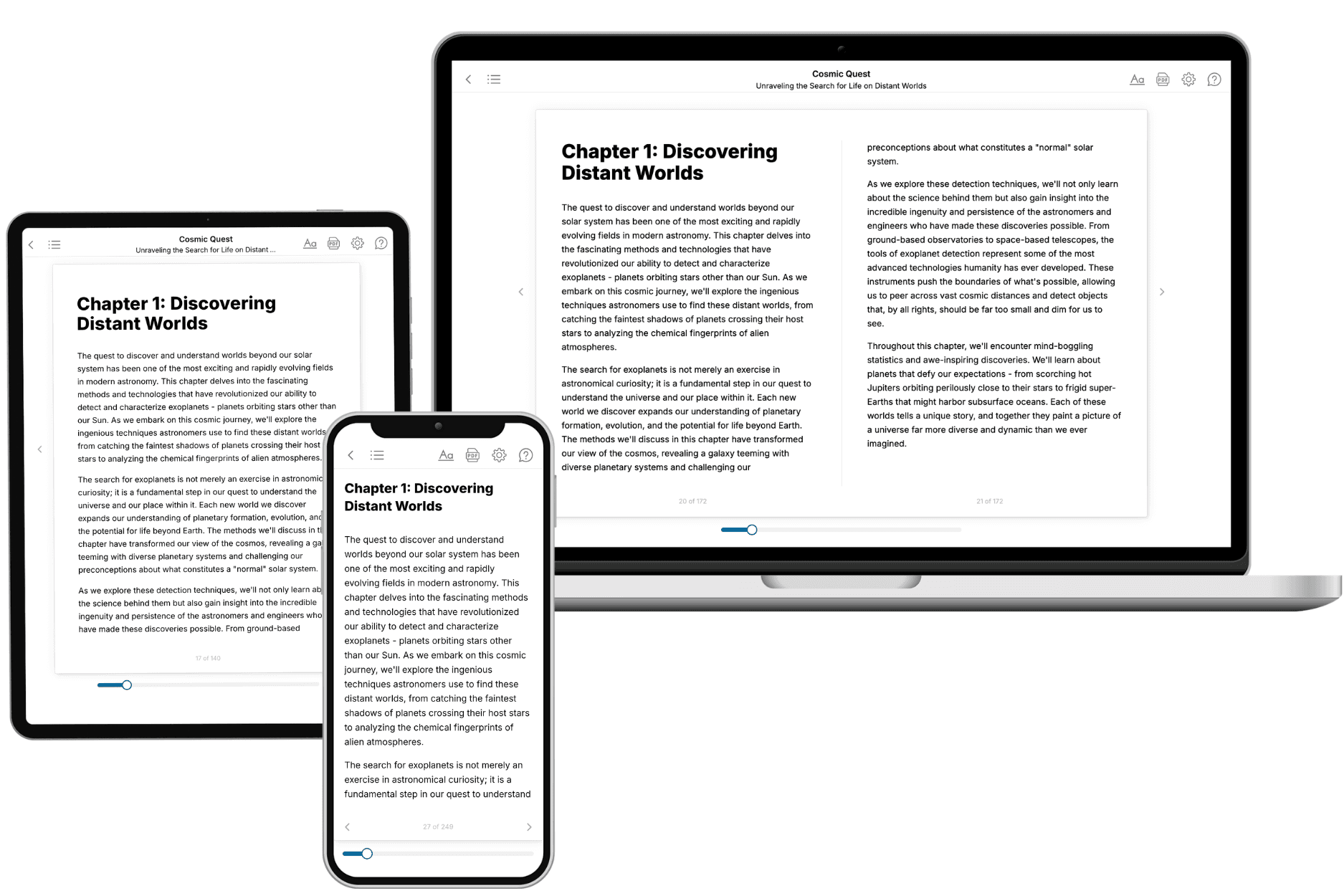
Your book is ready in 10 minutes. Read it online, download as EPUB or PDF, or send to Kindle.

Frequently asked questions
- What is TailoredRead?
TailoredRead creates complete, full-length nonfiction ebooks, written specifically for you. Tell us what you want to learn and why, and TailoredRead writes you a complete ebook on it, with charts, tables, and diagrams throughout. Read it online, on Kindle, or on any e-reader, or download it as a PDF or EPUB. Every book is written fresh the day you order it.
- How is the book tailored to me?
Before anything is written, you answer a few short questions about your goals, your background, and the topics you care about. Your book is then planned around your answers: written at your level, focused on your goals, and covering the topics you chose, instead of the one-size-fits-all book a store sells everyone.
- Will it read like generic AI content?
No. Your book isn't a chat transcript: it's planned chapter by chapter before a single word is written, told in a clear book voice, and explains ideas visually with charts, tables, and diagrams. After writing, every book goes through an editorial pass that polishes chapters so the book reads consistent from start to finish. Judge for yourself: browse thousands of sample books on our Explore Books page.
- How accurate is the content?
Our AI first checks whether your subject needs live research. Niche and fast-moving subjects are researched before writing, and the book plan and chapters are grounded in what it finds. After writing, every book goes through a quality pass that checks its facts and consistency, and researched books list their sources in a Notes section at the back.
- How long is the book?
You choose the length: Comprehensive (250-300 pages), Detailed (150-200 pages), Essential (70-100 pages), or Short (30-50 pages).
- Does the book include visuals?
Yes. Every book includes charts, tables, and diagrams: timelines, checklists, step-by-step guides, decision trees, comparison tables, matrices, and bar charts. A typical book includes dozens of these visual elements.
- Can I read it on Kindle? What formats can I download?
Yes. Every book can be read in our online reader or downloaded as a PDF or EPUB. The EPUB can be opened with Kindle, Apple Books, Kobo, and any e-reader. The Commercial and Author licenses also include an editable Word (DOCX) and Markdown download.
- How much does it cost?
About the price of a regular ebook. The exact price depends on your book's length and complexity, from $2 for the shortest books to $35 for the most comprehensive, and it's shown when you review your book, before you commit to anything. Each book is a one-time purchase, yours to keep, no subscription. Licenses that let you share, teach, or publish your book range from $35.99 to $49.99.
- Can I preview the book before purchasing?
Before you pay, you'll see what your book will cover: the title, a detailed description, the estimated length, and the complete chapter-by-chapter table of contents, so you know what you're getting before you decide. The full text itself is written after you purchase.
- How long does it take to create a book?
About 10 minutes. You can start reading the opening chapters while the rest is still being written.