Tigrinya Essentials
Master the Language of the Horn of Africa
Elevate your Tigrinya skills from basic competency to genuine fluency with this comprehensive guide to one of Africa's most spoken Semitic languages.
222 pages10 chaptersJun 5, 2026Learning African Languages
About this book
You'll move beyond simple phrases to understand the intricate grammar, rich phonetics, and cultural nuances that make Tigrinya a living bridge between ancient Ge'ez traditions and modern East African communication. This book combines linguistic analysis with practical conversation strategies, cultural insights, and immersion techniques used by successful language learners. Whether you're reconnecting with heritage, pursuing professional opportunities, or deepening your appreciation for African languages, you'll gain the tools to navigate complex grammatical structures, master authentic pronunciation, and engage meaningfully with Tigrinya-speaking communities. Each chapter builds systematically on previous knowledge, offering clear explanations, real-world examples, and actionable exercises that transform theoretical understanding into practical ability. Discover how Tigrinya's unique features reflect the history and identity of Eritrea and Ethiopia while developing the confidence to communicate authentically in this vibrant language.
Table of contents
- IntroductionWhy Tigrinya Matters in the Modern World, How to Use This Book for Maximum Learning, Your Path from Intermediate to Advanced ProficiencyRead below
- Chapter 1: The Tigrinya Language in ContextTigrinya's Semitic Roots and Historical Evolution, Geographic Distribution and Speaker Communities, Tigrinya's Place in the African Language Family
- Chapter 2: Mastering the Ge'ez ScriptFidel Fundamentals: Characters and Pronunciation, The Seven-Vowel System and Diacritical Marks, Building Fluency in Reading and Writing, Modern Adaptations and Digital Representations
- Chapter 3: Phonetics and Pronunciation MasteryTigrinya's Unique Phonetic Inventory, Emphatic Consonants and Glottal Stops, Stress Patterns and Intonation for Natural Speech
- Chapter 4: Noun Systems and Gender AgreementMasculine and Feminine Gender Classification, Plural Formation and Irregular Patterns, Definite and Indefinite Articles, Gender Agreement Across Sentences
- Chapter 5: Verb Conjugation and Tense SystemsTriliteral Roots and Verb Formation, Perfect and Imperfect Tenses, Subject Pronouns and Conjugation Patterns, Derived Verb Forms and Causatives
- Chapter 6: Sentence Structure and Word OrderSubject-Object-Verb Word Order Patterns, Prepositional Phrases and Case Relationships, Building Complex Sentences with Conjunctions
- Chapter 7: Conversational Tigrinya and DialectsFormal Written Tigrinya vs. Spoken Vernacular, Regional Variations and Dialect Differences, Code-Switching in Diaspora Communities, Colloquial Expressions and Idiomatic Language
- Chapter 8: Practical Communication SkillsNavigating Daily Conversations and Social Interactions, Professional and Business Communication, Cultural Etiquette and Respectful Communication
- Chapter 9: Cultural Context and Literary HeritageThe Ge'ez Connection: Ancient Texts and Modern Language, Tigrinya Literature, Poetry, and Oral Traditions, Cultural Significance in Eritrean and Ethiopian Identity
- Chapter 10: Advanced Learning Strategies and ImmersionImmersion Techniques and Language Exposure, Engaging with Native Speakers and Communities, Leveraging Media, Music, and Digital Resources, Maintaining Momentum and Tracking Progress
- ConclusionYour Ongoing Journey to Fluency, Next Steps and Continued Growth
- Glossary of Key Terms
- Further Reading and Resources
Introduction
There is a moment that many Tigrinya learners describe in almost identical terms. It happens when you are sitting across from a native speaker, and instead of reaching for a translation app or stumbling through a phrase you memorized weeks ago, the words simply come. The conversation flows. The other person smiles, not out of polite encouragement, but because you said something real, something that landed the way it was meant to. That moment is what this book is designed to help you reach.
Tigrinya is spoken by more than seven million people across Eritrea, the Tigray region of northern Ethiopia, and diaspora communities spread across Europe, North America, and the Middle East.[1] It is a Semitic language with deep roots in the ancient Ge'ez tradition, and it carries within it centuries of history, literature, and cultural identity. For anyone who wants to connect meaningfully with the Horn of Africa, whether for personal, professional, or heritage reasons, Tigrinya is not just useful. It is essential.
This book is written for intermediate learners. That means you already have some foundation. You may know basic greetings, a handful of nouns, and perhaps a rough sense of how sentences are put together. What you are looking for now is the next level: the grammar that makes complex ideas possible, the phonetic precision that makes you sound natural, the cultural knowledge that makes your words land with real meaning. This book covers all of that, systematically and practically, without overwhelming you with academic jargon or leaving you stranded in abstract theory.
Each chapter in this book builds on the one before it. The structure moves from historical and cultural context through the script, phonetics, grammar, and conversation, and finally into advanced learning strategies. You do not need to read every chapter in strict order, but the sequence is intentional. Understanding where Tigrinya comes from makes the grammar easier to absorb. Mastering the script makes reading and listening more rewarding. And all of it together builds the kind of deep familiarity that separates functional competence from genuine fluency.
What makes this book different from a standard language textbook is its commitment to practical, real-world application. Every grammatical concept is illustrated with examples drawn from actual usage. Every cultural note is grounded in the lived experience of Tigrinya-speaking communities. The goal is not to turn you into a linguist, though you will come away with a solid understanding of how the language works. The goal is to give you the tools to communicate authentically, confidently, and with genuine respect for the people and culture behind the language.
Why Tigrinya Matters in the Modern World
Tigrinya is not a minor or obscure language. It is the primary language of Eritrea, one of the official working languages of the Tigray regional government in Ethiopia, and a vital thread in the cultural fabric of one of the world's oldest civilizations. The Aksumite Empire, which flourished in the region from roughly the first to the seventh century CE, left behind a linguistic legacy that flows directly into modern Tigrinya.[2] When you speak Tigrinya, you are participating in a tradition that stretches back more than a thousand years.
In practical terms, Tigrinya matters because its speaker communities are growing and increasingly visible on the global stage. Eritrean and Ethiopian diaspora populations have established significant communities in cities like Washington D.C., Stockholm, London, Toronto, and Tel Aviv. These communities maintain strong linguistic and cultural ties to their homelands. For healthcare workers, social workers, educators, journalists, and humanitarian professionals working with these populations, Tigrinya proficiency is a genuine professional asset that opens doors and builds trust in ways that interpreters simply cannot replicate.
There is also a strategic linguistic argument for learning Tigrinya. As a Semitic language, it shares structural features with Arabic, Hebrew, and Amharic. Learners who develop strong Tigrinya skills often find that related languages become significantly more accessible. The triliteral root system, the consonant-heavy phonology, and the verb-final sentence structure are all features that transfer across the Semitic family. In this sense, investing in Tigrinya is investing in a broader set of linguistic capabilities.
For heritage learners, the stakes are even more personal. Many second-generation Eritreans and Ethiopians grow up hearing Tigrinya at home but never develop full literacy or conversational fluency. This creates a painful gap between cultural identity and linguistic ability. Reclaiming that language is not just a practical skill. It is a way of reconnecting with family history, understanding cultural practices more deeply, and participating fully in a community that has preserved its identity through extraordinary circumstances.
The cultural richness that Tigrinya unlocks is also worth emphasizing. Tigrinya literature, poetry, and music carry a depth and beauty that simply cannot be fully appreciated in translation. The oral traditions of the Tigrinya-speaking highlands, the religious texts preserved in Ge'ez, the contemporary music scene centered in Asmara and Mekelle, all of these become genuinely accessible when you can engage with them in the original language. Translation always loses something. Fluency gives it back.
Finally, learning Tigrinya is an act of intellectual curiosity about African linguistic diversity. Africa is home to more than 2,000 languages, representing extraordinary variety in grammar, phonology, and structure.[3] Tigrinya, with its ancient script, complex verb system, and unique phonetic inventory, is one of the most linguistically fascinating of these. Engaging with it seriously deepens your understanding of how human language works and challenges assumptions shaped by Indo-European language learning.
A note on motivation: Research consistently shows that learners who connect language study to meaningful personal or professional goals make faster and more durable progress. Before moving forward, take a moment to identify your specific reason for learning Tigrinya. Whether it is family connection, professional need, cultural curiosity, or linguistic challenge, keeping that reason visible will sustain you through the harder stretches of the learning process.
How to Use This Book for Maximum Learning
This book is organized to take you through Tigrinya systematically, but it is also designed to be flexible. If you are already comfortable with the Ge'ez script, for example, you can move through Chapter 2 quickly and spend more time on the phonetics and grammar chapters. If your primary goal is conversational fluency, you might read the cultural and dialect chapters earlier than the sequence suggests. The structure is a recommendation, not a rigid requirement.
That said, there are a few chapters where the sequential logic is especially important. The grammar chapters (Chapters 4, 5, and 6) build on each other in a deliberate way. Noun gender and agreement (Chapter 4) directly affects how you understand verb conjugation (Chapter 5), and both of those feed into sentence construction (Chapter 6). Jumping ahead in this section without the earlier foundation will make the later material harder to absorb. Think of these three chapters as a single extended unit.
Here is a practical framework for getting the most out of each chapter:
- Read actively, not passively. Keep a notebook or digital document open as you read. Write down new vocabulary, grammar rules, and example sentences in your own words. The act of writing reinforces retention significantly more than reading alone.
- Practice each concept before moving on. Every chapter introduces concepts that appear in later chapters. If a grammar rule feels unclear, spend extra time with it before continuing. Confusion that is not resolved early tends to compound.
- Use the examples as templates. When you encounter an example sentence, try substituting different words to create new sentences. This kind of productive practice builds flexibility and fluency faster than memorization.
- Return to earlier chapters regularly. Language learning is not linear. Revisiting earlier material after you have learned more often reveals connections and nuances you missed the first time.
- Engage with real Tigrinya alongside this book. Listen to Tigrinya music, watch Eritrean or Ethiopian news broadcasts, or find a language exchange partner. This book provides the framework; real-world exposure fills it in.
The exercises and examples throughout this book are drawn from everyday Tigrinya usage. You will encounter vocabulary and sentence structures that appear in real conversations, not just textbook scenarios. This is intentional. The gap between classroom language and street language is one of the most common frustrations for intermediate learners, and this book works to close that gap from the beginning.
One important note about the script: this book uses the Ge'ez script (Fidel) as the primary writing system for Tigrinya, with romanized transliterations provided where helpful. If you are not yet fully comfortable reading Fidel, Chapter 2 will give you the foundation you need. However, even as you work through earlier chapters, try to engage with the script as much as possible. Relying too heavily on transliteration is a common habit that slows down long-term reading fluency. The script is not as difficult as it looks at first, and the sooner you start reading it directly, the faster your overall progress will be.
Throughout the book, you will find several recurring features designed to support your learning:
- Key Terms: Important vocabulary and grammatical terms are highlighted when first introduced and collected in the glossary at the back of the book.
- Examples in Context: Grammar rules and vocabulary are always illustrated with full sentences drawn from realistic situations.
- Cultural Notes: Short explanations of cultural practices, historical context, and social norms that affect how language is used in real life.
- Practice Prompts: Suggestions for exercises you can do independently or with a language partner to reinforce each chapter's content.
Finally, be patient with yourself. Tigrinya is genuinely challenging for speakers of Indo-European languages. The phonetic inventory includes sounds that do not exist in English. The grammar operates on principles that feel unfamiliar at first. The script requires a different kind of visual processing than the Latin alphabet. All of this is normal, and all of it is manageable with consistent practice. Progress in language learning is rarely smooth or linear, but it is always cumulative. Every hour you invest builds on the last.
Your Path from Intermediate to Advanced Proficiency
Moving from intermediate to advanced proficiency in any language requires a shift in how you think about learning. At the beginner stage, the goal is acquisition: picking up vocabulary, learning basic structures, and building enough competence to handle simple interactions. At the intermediate stage, you already have that foundation. The challenge now is integration: learning to use what you know more fluidly, accurately, and naturally, while expanding into more complex territory.
Research in second language acquisition identifies a well-documented phenomenon called the intermediate plateau. This is the stage where learners feel stuck, where progress seems to slow down even though they are putting in the same effort as before.[4] The plateau happens because the easy gains of early learning (basic vocabulary, simple sentences) have already been made, and the next level of improvement requires deeper, more nuanced work. Understanding this dynamic helps you approach the intermediate stage with realistic expectations and the right strategies.
The path through the intermediate plateau in Tigrinya involves several specific areas of focus:
- Grammar depth over grammar breadth. At the intermediate level, you do not need to learn entirely new grammatical categories. You need to understand the ones you already know more precisely. Tigrinya verb conjugation, for example, has layers of nuance around aspect, mood, and derived forms that most intermediate learners have only partially grasped. Going deeper into familiar territory is often more valuable than rushing to new material.
- Vocabulary consolidation. Intermediate learners often have a large passive vocabulary (words they recognize) but a smaller active vocabulary (words they can produce spontaneously). Focused practice on activating passive vocabulary, through speaking, writing, and retrieval exercises, is one of the highest-return activities at this stage.
- Phonetic refinement. Pronunciation errors that were acceptable at the beginner stage become more noticeable and potentially confusing at higher levels of conversation. Tigrinya's emphatic consonants and pharyngeal sounds require deliberate practice to produce correctly, and getting them right makes a significant difference in how native speakers perceive your fluency.
- Cultural and pragmatic competence. Advanced language use is not just grammatically correct. It is also socially appropriate. Understanding when to use formal versus informal registers, how to express politeness and respect, and how to navigate culturally specific conversational norms is a key part of moving from intermediate to advanced.
To give you a concrete sense of what progress looks like, consider the following benchmarks. At the intermediate level, you can handle predictable conversations on familiar topics, understand the main points of straightforward texts, and produce sentences that are mostly grammatically correct. At the advanced level, you can discuss abstract topics, understand nuanced or idiomatic language, handle unexpected conversational turns, and produce extended, coherent speech or writing with relatively few errors. The chapters in this book are designed to move you systematically from the first set of capabilities to the second.
A realistic timeline for this progression depends heavily on how much time you invest and how you invest it. Research on language learning suggests that moving from intermediate to advanced proficiency in a language like Tigrinya typically requires several hundred hours of focused study and practice.[5] That sounds like a lot, but it breaks down into manageable daily practice. An hour a day of focused, varied practice (reading, listening, speaking, writing) adds up to more than 350 hours in a year. That is a meaningful amount of progress.
The word focused is important here. Passive exposure, such as having Tigrinya music playing in the background while you do other things, has some value but is not a substitute for active engagement. Active practice means paying attention, making decisions, producing language, and getting feedback. The most effective learners combine structured study (grammar, vocabulary, reading) with communicative practice (conversation, writing, listening to authentic content) in roughly equal measure.
One of the most powerful things you can do at the intermediate stage is find a language partner or tutor who is a native Tigrinya speaker. Conversation with a native speaker provides something no book can fully replicate: real-time feedback, authentic input, and the social motivation that comes from genuine communication. Platforms like iTalki, Tandem, and community organizations in diaspora cities are good places to find Tigrinya-speaking conversation partners. Chapter 10 covers this in more detail, including specific strategies for making those conversations as productive as possible.
It is also worth thinking about your learning environment. Language acquisition is supported by consistent, low-stress exposure to the target language. This means creating small habits that bring Tigrinya into your daily life: changing your phone's language settings, following Tigrinya-language social media accounts, listening to Eritrean or Ethiopian radio during your commute, or keeping a short daily journal in Tigrinya. These habits do not replace structured study, but they create a linguistic environment that reinforces and extends what you learn in more formal sessions.
The chapters ahead cover a lot of ground, from the ancient roots of the Ge'ez script to the contemporary slang of diaspora communities. Each one is designed to give you not just information but practical tools: frameworks for understanding grammar, strategies for building vocabulary, cultural context that makes the language come alive. The goal throughout is the same: to move you closer to that moment when the words simply come, when the conversation flows, and when Tigrinya feels not like a foreign language you are studying but like a living part of how you communicate with the world.
Before you begin: Take five minutes to write down three specific situations where you want to be able to use Tigrinya fluently. These might be conversations with family members, professional interactions, travel scenarios, or engagement with Tigrinya media. Keep these situations in mind as you work through the book. They will help you prioritize what to practice and give you concrete goals to work toward.
Notes
Introduction
- 1. Ethnologue: Languages of the World, 26th Edition. SIL International. Tigrinya language entry.
- 2. Stuart Munro-Hay, Aksum: An African Civilisation of Late Antiquity, Edinburgh University Press, 1991
- 3. Heine, Bernd and Derek Nurse, eds. (2000). African Languages: An Introduction. Cambridge University Press.
- 4. I. S. P. Nation and Jonathan Newton, Teaching ESL/EFL Listening and Speaking, Routledge, 2009
- 5. Foreign Service Institute (FSI) Language Difficulty Rankings. U.S. Department of State. Semitic language category estimates.
This is the end of the free sample. The full book has 10 chapters.
Want this book written for you?
Tell us your goals and background, and get your own version of this book, tailored by AI to you.


Benefits of AI-tailored books
- Read one book, not ten:
- all the Learning African Languages knowledge you need, gathered into a single book.
- Save days of learning:
- tell us your goals, choose your topics, and the whole book is built around them.
- Learn effortlessly:
- Learning African Languages book written for your specific background and expertise.
- Understand at a glance:
- includes charts, tables, timelines, checklists, decision trees, and more.
- Stay current:
- written the day you order it, not years ago.
- Trust what you read:
- every book is checked for accuracy, with real research when your subject needs it.
Create your unique book in 3 steps
- 1. Select your focus
Select the focus of your Learning African Languages book and share your background
- 2. Personalize your book
Specify your goals and choose sub-topics to include
- 3. Get your tailored book
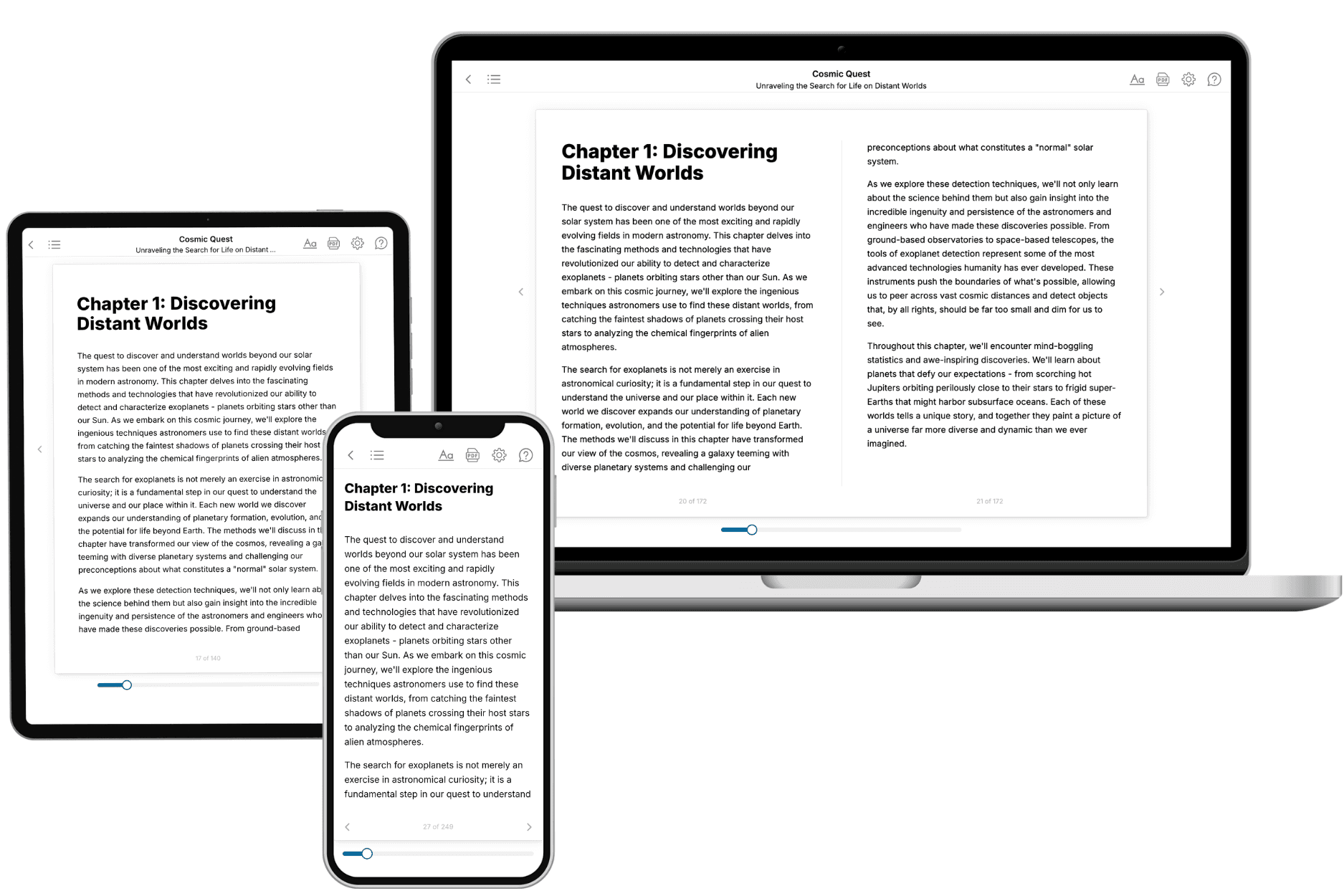
Your book is ready in 10 minutes. Read it online, download as EPUB or PDF, or send to Kindle.
Frequently asked questions
- What is TailoredRead?
TailoredRead creates complete, full-length nonfiction ebooks, written specifically for you. Tell us what you want to learn and why, and TailoredRead writes you a complete ebook on it, with charts, tables, and diagrams throughout. Read it online, on Kindle, or on any e-reader, or download it as a PDF or EPUB. Every book is written fresh the day you order it.
- How is the book tailored to me?
Before anything is written, you answer a few short questions about your goals, your background, and the topics you care about. Your book is then planned around your answers: written at your level, focused on your goals, and covering the topics you chose, instead of the one-size-fits-all book a store sells everyone.
- Will it read like generic AI content?
No. Your book isn't a chat transcript: it's planned chapter by chapter before a single word is written, told in a clear book voice, and explains ideas visually with charts, tables, and diagrams. After writing, every book goes through an editorial pass that polishes chapters so the book reads consistent from start to finish. Judge for yourself: browse thousands of sample books on our Explore Books page.
- How accurate is the content?
Our AI first checks whether your subject needs live research. Niche and fast-moving subjects are researched before writing, and the book plan and chapters are grounded in what it finds. After writing, every book goes through a quality pass that checks its facts and consistency, and researched books list their sources in a Notes section at the back.
- How long is the book?
You choose the length: Comprehensive (250-300 pages), Detailed (150-200 pages), Essential (70-100 pages), or Short (30-50 pages).
- Does the book include visuals?
Yes. Every book includes visual elements such as timelines, checklists, step-by-step guides, decision trees, comparison tables, and matrices, and many include bar charts. A typical book includes dozens of these visual elements.
- Can I read it on Kindle? What formats can I download?
Yes. Every book can be read in our online reader or downloaded as a PDF or EPUB. The EPUB can be opened with Kindle, Apple Books, Kobo, and any e-reader. The Commercial and Author licenses also include an editable Word (DOCX) and Markdown download.
- How much does it cost?
About the price of a regular ebook. The exact price depends on your book's length and complexity, from $2 for the shortest books to $35 for the most comprehensive, and it's shown when you review your book, before you commit to anything. Each book is a one-time purchase, yours to keep, no subscription. Licenses that let you share, teach, or publish your book range from $35.99 to $49.99.
- Can I preview the book before purchasing?
Before you pay, you'll see what your book will cover: the title, a detailed description, the estimated length, and the complete chapter-by-chapter table of contents, so you know what you're getting before you decide. The full text itself is written after you purchase.
- How long does it take to create a book?
About 10 minutes. You can start reading the opening chapters while the rest is still being written.