Time Series Classification Mastery
A Practical Guide to Binary Classification in Machine Learning
Most machine learning practitioners treat time series classification like any other classification problem—and that's where they go wrong.
238 pages11 chaptersAug 1, 2026Machine Learning
About this book
Time series data has a hidden dimension: time itself. This book reveals why standard classification approaches fail on sequential data and shows you exactly how to build models that actually work. You'll discover practical techniques for engineering temporal features, selecting the right algorithms for your data, and validating models without accidentally leaking information from the future. Whether you're predicting equipment failures, detecting anomalies, or classifying sensor patterns, this guide walks you through real-world challenges and proven solutions. From traditional statistical methods to cutting-edge deep learning approaches, you'll learn when to use each technique and how to combine them for maximum accuracy. Every concept is grounded in practical examples and actionable strategies you can implement immediately in your projects.
Table of contents
- IntroductionWhy Time Series Classification Matters, The Binary Classification Focus, How to Use This BookRead below
- Chapter 1: Fundamentals of Time Series DataUnderstanding Temporal Characteristics, Time Series vs. Static Data Classification, Binary Classification Fundamentals
- Chapter 2: Data Preparation and PreprocessingHandling Missing Values in Sequences, Normalization and Scaling Strategies, Managing Variable-Length Time Series, Addressing Class Imbalance in Time Series
- Chapter 3: Feature Engineering for Time SeriesStatistical and Descriptive Features, Temporal Pattern Features, Domain-Specific Feature Creation, Feature Selection and Dimensionality Reduction
- Chapter 4: Traditional Machine Learning ApproachesDistance-Based Classification Methods, Decision Trees and Random Forests, Support Vector Machines and Logistic Regression
- Chapter 5: Deep Learning for Time Series ClassificationLSTM and Recurrent Neural Networks, Convolutional Neural Networks for Sequences, Hybrid and Advanced Architectures, Transfer Learning and Pre-trained Models
- Chapter 6: Ensemble Methods and Model CombinationEnsemble Strategies for Time Series, Stacking and Blending Approaches, Voting and Averaging Techniques
- Chapter 7: Validation and Evaluation StrategiesTime-Aware Cross-Validation, Metrics for Binary Classification, Preventing Data Leakage in Time Series, Statistical Significance Testing
- Chapter 8: Hyperparameter Optimization and TuningGrid Search and Random Search, Bayesian Optimization Techniques, Early Stopping and Regularization
- Chapter 9: Model Interpretability and ExplainabilityUnderstanding Model Predictions, Attention Mechanisms and Saliency Maps, SHAP and LIME for Time Series
- Chapter 10: Real-World Applications and Case StudiesAnomaly Detection in Sensor Data, Predictive Maintenance and Equipment Failure, Financial Time Series Classification, Healthcare and Biomedical Applications
- Chapter 11: Deployment and Production ConsiderationsServing Models in Production, Monitoring and Handling Model Drift, Scalability and Performance Optimization
- ConclusionKey Takeaways and Best Practices, Future Directions in Time Series Classification
- Glossary of Terms
- Further Reading and Resources
Introduction
A turbine sensor streams thousands of readings per second. A hospital monitor records a patient's heart rhythm across hours. A fraud detection system watches transaction sequences unfold in real time. In each case, the question is binary: failure or normal, arrhythmia or healthy, fraud or legitimate. The data is not a table of independent rows. It is a sequence, and the order of that sequence carries meaning that no static snapshot can capture. Getting that distinction right is what separates a model that works in production from one that looks good in a notebook and fails in the field.
Time Series Classification is one of the fastest-growing specializations in applied machine learning, driven by the explosion of sensor networks, wearable devices, financial data feeds, and industrial monitoring systems. Yet most introductory machine learning curricula treat it as a footnote, folding it into generic classification tutorials that ignore the temporal structure entirely. The result is practitioners who know how to build a Random Forest or a neural network but reach for the wrong tools when the data arrives as a sequence. This book exists to close that gap directly and practically.
The focus here is deliberately narrow: Binary Classification on Time Series data. That narrowness is a feature, not a limitation. Binary outcomes are the most common decision structure in real-world deployments. Is this machine about to fail? Did this patient experience an adverse event? Is this network traffic malicious? Answering those questions well requires understanding Temporal Dependency, managing Data Leakage, choosing the right validation strategy, and selecting models that respect the sequential nature of the input. Each of those topics gets the depth it deserves in the chapters that follow.
The approach throughout is practical and grounded. Concepts are introduced with concrete examples, not abstract definitions. Code patterns, frameworks, and decision heuristics appear alongside the theory so you can apply ideas immediately. The progression moves from data fundamentals through preprocessing, feature engineering, classical methods, deep learning, ensemble strategies, evaluation, tuning, interpretability, real-world case studies, and finally production deployment. That arc mirrors the actual workflow of building a time series classifier from scratch and shipping it to a live system.
Why Time Series Classification Matters
The volume of sequentially ordered data being generated today is staggering. Industrial IoT sensors, electronic health records, satellite telemetry, financial tick data, and network logs all produce streams where the relationship between consecutive observations carries as much information as the observations themselves. A single vibration reading from a motor bearing means almost nothing in isolation. The same reading, placed in the context of the 500 readings that preceded it, can signal the early onset of mechanical failure days before a breakdown occurs. That contextual dependency is the defining characteristic of Time Series data, and it demands a different analytical mindset.
Standard classification algorithms assume that each row in a dataset is independent of every other row. That assumption is reasonable for many problems: predicting whether a loan applicant will default based on their credit profile, or classifying an image as a cat or a dog. But it breaks down completely when the input is a sequence. Feeding raw time series data into a logistic regression model without accounting for Temporal Dependency is like reading every sentence of a novel in random order and then trying to summarize the plot. The words are all there, but the meaning is lost.
The practical stakes are high. Consider Predictive Maintenance in manufacturing. A classifier that correctly identifies impending equipment failure 48 hours in advance allows a maintenance team to schedule a controlled shutdown, replace a part, and resume production. A classifier that misses the signal, or raises too many false alarms, either causes catastrophic unplanned downtime or erodes operator trust until the alerts are ignored entirely. The difference between those outcomes often comes down to whether the model was built with proper temporal awareness or not.
Healthcare offers equally compelling examples. Classifying electrocardiogram sequences to detect atrial fibrillation, identifying sepsis onset from vital sign trends, or flagging abnormal fetal heart rate patterns during labor are all Binary Classification problems on Time Series data where errors carry direct clinical consequences. Research has shown that early detection of sepsis using sequential vital sign data can significantly reduce mortality, but only when the classification model is designed to capture the temporal progression of physiological deterioration rather than treating each measurement as an independent snapshot.[1]
Financial markets generate some of the most challenging time series classification problems. Detecting fraudulent transaction sequences, classifying market regimes, or identifying whether a price movement pattern signals a breakout or a false alarm all require models that understand sequential context. The difficulty is compounded by non-Stationarity: the statistical properties of financial time series shift over time, meaning a model trained on last year's data may perform poorly on this year's market conditions. That challenge of Concept Drift appears repeatedly throughout this book because it is one of the most practically important problems in deployed time series classifiers.
Anomaly Detection in network security is another domain where time series classification has become essential. A single unusual packet might be noise. A sequence of packets following a specific temporal pattern might be a coordinated intrusion attempt. Classifying network traffic as malicious or benign requires models that can recognize those sequential signatures, often in near real time, across millions of events per hour. The scale and latency requirements of that problem push time series classification into territory where both algorithmic efficiency and deployment architecture matter as much as raw accuracy.
What unites all of these domains is the same core challenge: the data has a temporal structure that must be respected at every stage of the machine learning pipeline, from how you split your data for validation to how you engineer features, select models, and monitor performance after deployment. Ignoring that structure at any stage introduces errors that compound downstream. Respecting it consistently is what makes a time series classifier reliable in the real world.
A concrete illustration: Imagine building a classifier to detect whether a manufacturing machine will fail within the next 24 hours. If you randomly shuffle all sensor readings before splitting into train and test sets, your model will appear to achieve high accuracy during evaluation. But in production, it will fail badly. The reason is Data Leakage: readings from just before a failure event ended up in the training set, giving the model access to future information it would never have in a real deployment. Walk-Forward Validation, covered in the chapter on validation strategies, prevents exactly this problem by ensuring the model is always evaluated on data that comes strictly after its training window.
The good news is that the field of time series classification has matured rapidly. Algorithms like Dynamic Time Warping with k-Nearest Neighbors, Shapelet-based classifiers, Long Short-Term Memory networks, 1-D Convolutional Neural Networks, and ensemble systems like HIVE-COTE have been benchmarked extensively on public datasets, giving practitioners a solid empirical foundation for choosing methods.[2] Libraries like tsfresh automate large portions of feature extraction. Frameworks for Bayesian Optimization make hyperparameter search tractable. The tools are there. This book shows you how to use them together, in the right order, for the right reasons.
The Binary Classification Focus
Multi-class time series classification is a legitimate and interesting problem. So is regression on sequential data. But binary classification deserves its own dedicated treatment because it is the most common decision structure in high-stakes real-world applications, and because the specific challenges it presents, including Class Imbalance, threshold selection, and asymmetric error costs, require focused attention that gets diluted in a more general treatment. Every domain mentioned in the previous section frames its core question as a binary one: fail or not fail, fraud or legitimate, anomaly or normal.
Binary Classification on time series data introduces a specific set of tensions that do not appear in static binary classification. The first is the imbalance problem. In Predictive Maintenance, equipment failures are rare events. A dataset might contain 10,000 hours of normal operation and only 50 failure events. That 200-to-1 imbalance means a naive classifier that always predicts "normal" achieves 99.5% accuracy while being completely useless. Techniques like SMOTE, cost-sensitive learning, and careful metric selection using AUC-ROC and Matthews Correlation Coefficient become essential tools rather than optional refinements.
The second tension is the cost asymmetry of errors. In most binary time series classification problems, false negatives and false positives carry very different costs. Missing a failure event (false negative) might mean a catastrophic breakdown costing hundreds of thousands of dollars. Raising a false alarm (false positive) might mean an unnecessary maintenance check costing a few hundred dollars. That asymmetry should drive every decision about threshold selection, model choice, and evaluation strategy. A model optimized purely for accuracy will almost always make the wrong trade-off in these situations.
Consider a concrete example from healthcare. A classifier trained to detect atrial fibrillation from electrocardiogram sequences must balance sensitivity against specificity. A missed detection (false negative) could mean a patient goes untreated and suffers a stroke. A false alarm (false positive) might mean an unnecessary cardiology referral. The right operating point on the AUC-ROC curve depends on the clinical context, the downstream cost of each error type, and the prevalence of the condition in the population being screened. No single threshold is universally correct, and understanding how to navigate that trade-off is a core skill this book develops.
The Rolling Window approach is central to how binary classification gets applied to streaming time series data. Rather than classifying an entire sequence at once, a classifier typically operates on a fixed-length window of recent observations, producing a binary prediction at each step. The window length, stride, and aggregation strategy all affect both accuracy and latency. A window that is too short misses slow-developing patterns. A window that is too long introduces unnecessary lag and may mix data from different operational states. Choosing the right window configuration is as important as choosing the right algorithm, and it is a decision that must be made with domain knowledge, not just cross-validation scores.
Binary classification also creates specific opportunities for interpretability. When a model produces a single binary output, the question "why did the model predict failure?" is more tractable than in multi-class settings. Tools like SHAP and LIME can be applied to identify which time steps and features contributed most to a positive prediction. Saliency Maps and Class Activation Maps can highlight the regions of a sequence that drove a neural network's decision. That interpretability is not just academically interesting. In regulated industries like healthcare and finance, it is often a legal or compliance requirement. A model that cannot explain its predictions may not be deployable, regardless of its accuracy.
The binary framing also simplifies the ensemble design problem. When combining multiple classifiers through Soft Voting or Stacking, binary probability outputs are straightforward to aggregate. Each model produces a probability between 0 and 1, and those probabilities can be averaged, weighted, or fed into a meta-learner. The chapter on ensemble methods explores how systems like HIVE-COTE leverage this property to combine diverse time series classifiers into a single, more robust predictor. The diversity of the component models, each capturing different aspects of temporal structure, is what makes the ensemble more reliable than any individual classifier.
One practical framework for thinking about binary time series classification problems before writing any code is the following checklist:
- Define the positive class precisely. What exactly constitutes a "failure," "fraud," or "anomaly" in your domain? Ambiguous labels produce ambiguous models.
- Measure the class ratio. How imbalanced is your dataset? A ratio above 10:1 requires explicit handling strategies.
- Quantify error costs. What is the relative cost of a false negative versus a false positive? This drives threshold selection.
- Determine the prediction horizon. How far in advance does the prediction need to be made to be actionable? This constrains your feature engineering.
- Identify the temporal resolution. At what frequency is data collected, and at what frequency do predictions need to be made?
- Check for Concept Drift. Are the statistical properties of your data stable over time, or do they shift in ways that will degrade model performance?
Working through that checklist before touching any data or code prevents the most common and costly mistakes in time series binary classification projects. It forces clarity about the problem structure that shapes every subsequent decision.
How to Use This Book
This book is structured to follow the natural workflow of a time series classification project, from raw data to deployed model. Each chapter builds on the concepts introduced before it, but the chapters are also designed to be useful as standalone references when you need to revisit a specific topic. If you are already comfortable with time series fundamentals and want to jump directly to deep learning architectures, you can do that. If you are debugging a production model that seems to be degrading over time, the chapter on monitoring and Concept Drift will be immediately relevant without requiring you to re-read everything that precedes it.
The chapter on fundamentals of Time Series data establishes the vocabulary and conceptual framework that the rest of the book depends on. It covers Temporal Dependency, Autocorrelation, Stationarity, and the critical differences between time series classification and static data classification. If any of those terms are unfamiliar, starting there is strongly recommended. If they are already part of your working vocabulary, a quick skim will confirm that the definitions used here match your understanding before you move on.
Data preparation and preprocessing comes next, because no algorithm can compensate for poorly prepared data. That chapter covers Missing Value Imputation strategies that respect temporal order, Normalization approaches that prevent information leakage, Padding strategies for variable-length sequences, and techniques for addressing Class Imbalance including SMOTE adapted for sequential data. These are not glamorous topics, but they are where most real-world time series projects succeed or fail. Spending time here pays dividends in every subsequent stage.
Feature engineering occupies its own dedicated chapter because it remains one of the most impactful levers available to a practitioner, even in the era of end-to-end deep learning. The chapter covers statistical and descriptive features, temporal pattern features including outputs from the Fourier Transform and Wavelet Transform, domain-specific feature creation, and feature selection using Dimensionality Reduction techniques. The tsfresh library gets practical attention as a tool for automating large portions of this process. The chapter also explains when to invest in hand-crafted features versus when to let a neural network learn representations directly from raw sequences.
The two chapters on classical machine learning and deep learning present complementary approaches to the same problem. Classical methods, including Dynamic Time Warping with k-Nearest Neighbors, Random Forest, Support Vector Machine, and Shapelet-based classifiers, are interpretable, data-efficient, and often competitive with deep learning on shorter sequences or smaller datasets. Deep learning architectures, including Long Short-Term Memory networks, Gated Recurrent Units, 1-D Convolutional Neural Networks, Transformer-based models, and hybrid architectures, excel when data is abundant and temporal patterns are complex. Transfer Learning strategies for adapting pre-trained models to new domains are also covered. The practical guidance throughout both chapters focuses on when to use each approach, not just how.
Ensemble methods bring together the outputs of multiple diverse classifiers to produce more robust predictions. The chapter on this topic covers Stacking, Soft Voting, and the HIVE-COTE framework, which was specifically designed for time series classification and consistently ranks among the top performers on benchmark datasets. The key insight is that diversity among component models matters more than the raw performance of any individual model. A Random Forest and an LSTM that make different types of errors on the same data will combine into a stronger ensemble than two LSTMs that make similar errors.
Validation and evaluation strategies are where many practitioners make their most consequential mistakes. Standard k-fold cross-validation is inappropriate for time series data because it allows future information to leak into the training set. Walk-Forward Validation and Purged Cross-Validation are the correct alternatives, and the chapter explains exactly how to implement them. The evaluation metrics section covers AUC-ROC and Matthews Correlation Coefficient in depth, explaining why accuracy alone is misleading on imbalanced datasets and how to choose the right operating threshold for your specific error cost structure.
Hyperparameter optimization covers Grid Search, Random Search, and Bayesian Optimization using the Tree-structured Parzen Estimator. The chapter pays particular attention to Early Stopping and Regularization strategies for neural networks, which are essential for preventing overfitting on time series data where the number of parameters can easily exceed the effective number of independent training examples. Practical guidance on search space design and budget allocation makes the difference between a tuning process that converges quickly and one that wastes compute without improving results.
Model interpretability addresses SHAP, LIME, Saliency Maps, and Class Activation Maps in the context of time series binary classification. The chapter explains not just how to compute these explanations but how to interpret them meaningfully. A SHAP value plot for a time series model looks different from one for a tabular model, and reading it correctly requires understanding what the temporal axis represents. This chapter also addresses the practical question of how to present model explanations to domain experts who may not have a machine learning background.
The real-world applications chapter presents four end-to-end case studies covering Anomaly Detection in sensor data, Predictive Maintenance and equipment failure prediction, financial time series classification, and healthcare and biomedical applications. Each case study walks through the full pipeline from problem framing through data preparation, model selection, evaluation, and deployment considerations. These are not toy examples. They reflect the actual complexity and constraints of production systems, including messy data, shifting distributions, and stakeholder requirements that do not always align with what is technically optimal.
The final chapter on deployment and production covers model serving architectures, monitoring strategies for detecting Concept Drift using tools like ADWIN, Feature Store design for efficient real-time feature computation, and scalability considerations for high-throughput classification systems. A model that performs well in a notebook but cannot be served reliably at production scale, or that degrades silently after deployment without triggering any alerts, is not a finished product. This chapter treats deployment as a first-class engineering problem, not an afterthought.
A few practical notes on getting the most from this material. Code examples throughout the book use Python, with references to libraries including scikit-learn, tensorflow, pytorch, tsfresh, and sktime. The examples are written to be readable and adaptable rather than production-optimized, so you can focus on understanding the concept before worrying about performance tuning. Mathematical notation is used where it adds precision, but always accompanied by a plain-language explanation. The goal is understanding, not formalism. Every concept introduced is connected to a practical decision you will face when building a real system, because that connection between theory and practice is what makes the difference between knowing something and being able to use it.
This is the end of the free sample. The full book has 11 chapters.
Want this book written for you?
Tell us your goals and background, and get your own version of this book, tailored by AI to you.


Benefits of AI-tailored books
- Read one book, not ten:
- all the Machine Learning knowledge you need, gathered into a single book.
- Save days of learning:
- tell us your goals, choose your topics, and the whole book is built around them.
- Learn effortlessly:
- Machine Learning book written for your specific background and expertise.
- Understand at a glance:
- includes charts, tables, timelines, checklists, decision trees, and more.
- Stay current:
- written the day you order it, not years ago.
- Trust what you read:
- every book is checked for accuracy, with real research when your subject needs it.
Create your unique book in 3 steps
- 1. Select your focus
Select the focus of your Machine Learning book and share your background
- 2. Personalize your book
Specify your goals and choose sub-topics to include
- 3. Get your tailored book
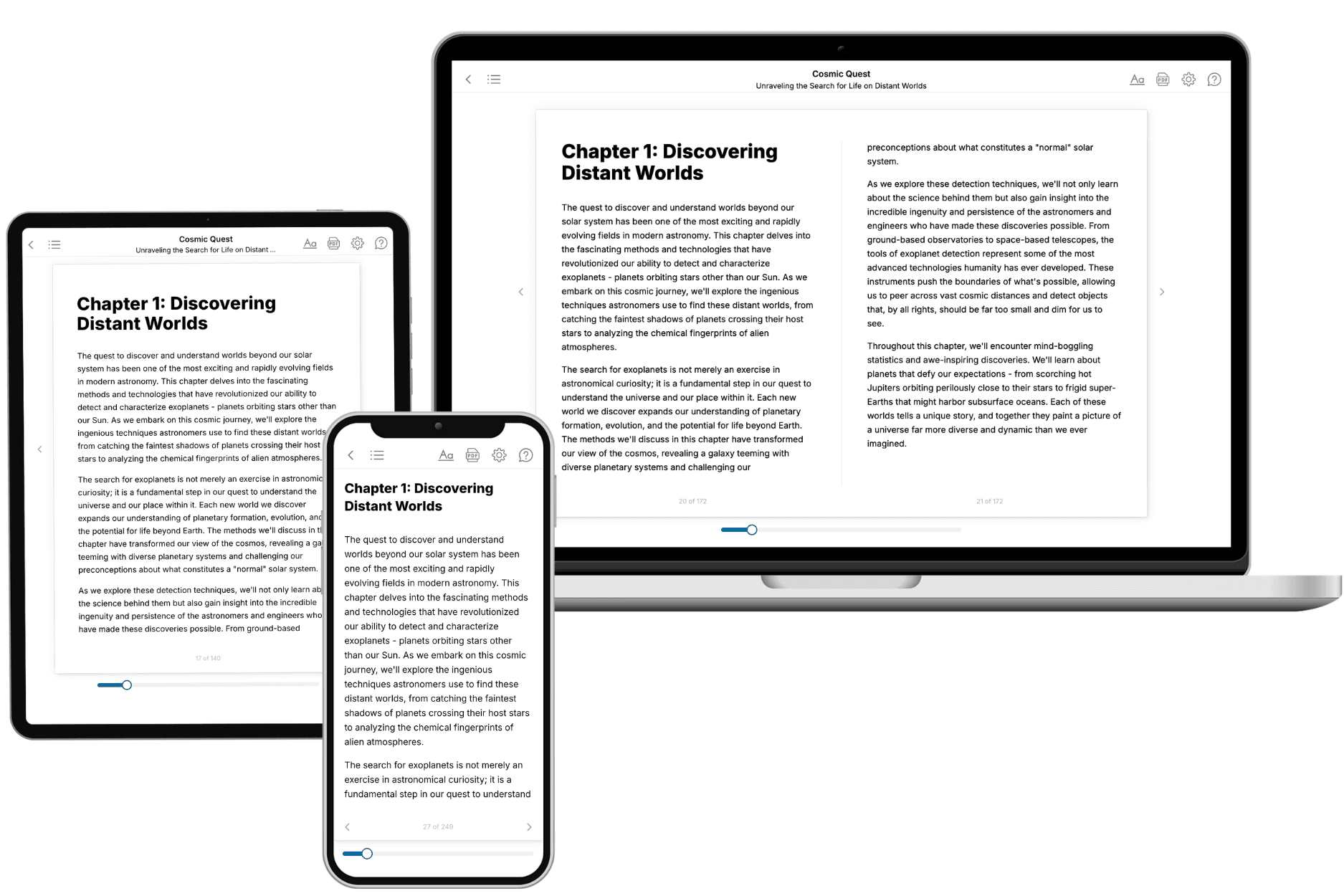
Your book is ready in 10 minutes. Read it online, download as EPUB or PDF, or send to Kindle.

Frequently asked questions
- What is TailoredRead?
TailoredRead creates complete, full-length nonfiction ebooks, written specifically for you. Tell us what you want to learn and why, and TailoredRead writes you a complete ebook on it, with charts, tables, and diagrams throughout. Read it online, on Kindle, or on any e-reader, or download it as a PDF or EPUB. Every book is written fresh the day you order it.
- How is the book tailored to me?
Before anything is written, you answer a few short questions about your goals, your background, and the topics you care about. Your book is then planned around your answers: written at your level, focused on your goals, and covering the topics you chose, instead of the one-size-fits-all book a store sells everyone.
- Will it read like generic AI content?
No. Your book isn't a chat transcript: it's planned chapter by chapter before a single word is written, told in a clear book voice, and explains ideas visually with charts, tables, and diagrams. After writing, every book goes through an editorial pass that polishes chapters so the book reads consistent from start to finish. Judge for yourself: browse thousands of sample books on our Explore Books page.
- How accurate is the content?
Our AI first checks whether your subject needs live research. Niche and fast-moving subjects are researched before writing, and the book plan and chapters are grounded in what it finds. After writing, every book goes through a quality pass that checks its facts and consistency, and researched books list their sources in a Notes section at the back.
- How long is the book?
You choose the length: Comprehensive (250-300 pages), Detailed (150-200 pages), Essential (70-100 pages), or Short (30-50 pages).
- Does the book include visuals?
Yes. Every book includes charts, tables, and diagrams: timelines, checklists, step-by-step guides, decision trees, comparison tables, matrices, and bar charts. A typical book includes dozens of these visual elements.
- Can I read it on Kindle? What formats can I download?
Yes. Every book can be read in our online reader or downloaded as a PDF or EPUB. The EPUB can be opened with Kindle, Apple Books, Kobo, and any e-reader. The Commercial and Author licenses also include an editable Word (DOCX) and Markdown download.
- How much does it cost?
About the price of a regular ebook. The exact price depends on your book's length and complexity, from $2 for the shortest books to $35 for the most comprehensive, and it's shown when you review your book, before you commit to anything. Each book is a one-time purchase, yours to keep, no subscription. Licenses that let you share, teach, or publish your book range from $35.99 to $49.99.
- Can I preview the book before purchasing?
Before you pay, you'll see what your book will cover: the title, a detailed description, the estimated length, and the complete chapter-by-chapter table of contents, so you know what you're getting before you decide. The full text itself is written after you purchase.
- How long does it take to create a book?
About 10 minutes. You can start reading the opening chapters while the rest is still being written.