The Transatlantic Slave Trade
How Commerce, Ideology, and Resistance Shaped the Modern World
What if the wealth that built the modern world was constructed on the suffering of millions?
191 pages9 chaptersDec 21, 2025Slavery
About this book
The transatlantic slave trade stands as one of history's most consequential yet often misunderstood phenomena. This book examines how a commercial enterprise that forcibly transported over 12 million Africans across the Atlantic fundamentally transformed global economics, politics, and society. You'll discover the intricate networks of merchants, financiers, and planters who profited from human bondage, the sophisticated resistance strategies employed by enslaved people, and how the ideologies created to justify slavery continue to shape our world today. By exploring the trade's origins in 15th-century Portugal, its explosive growth in the 18th century, and its eventual abolition, you'll gain critical insight into how historical injustices created the inequalities we see today. This is not merely a story of the past—it's essential context for understanding contemporary global power dynamics and the ongoing work of racial justice.
Table of contents
- IntroductionWhy This History Matters Today, Understanding the Scope and Scale, How to Read This BookRead below
- Chapter 1: Origins and FoundationsMedieval Slavery and Early European Expansion, Portuguese Exploration and the First Encounters, The Birth of Racial Ideology
- Chapter 2: The Triangular Trade SystemHow the System Worked, European Merchants and Trading Companies, African Participation and Complex Dynamics, American Plantation Economies and Demand
- Chapter 3: The Middle PassageConditions Aboard Slave Ships, Mortality, Disease, and Survival, Resistance During Transport
- Chapter 4: Slavery in the AmericasPlantation Systems and Forced Labor, Daily Life and Systems of Control, Family, Community, and Cultural Survival
- Chapter 5: Economic Impact and the Wealth of NationsProfits and Capital Accumulation, Financing European Industrialization, Global Economic Integration and Inequality
- Chapter 6: Resistance and RebellionForms of Everyday Resistance, Major Slave Rebellions and Uprisings, Intellectual and Cultural Resistance
- Chapter 7: The Abolition MovementsEarly Abolitionists and Religious Movements, Enslaved People as Abolitionists, Political and Economic Shifts Enabling Abolition
- Chapter 8: Legal Abolition and Its AftermathAbolition Across the Atlantic World, The Transition to Freedom and Reconstruction, Persistence of Exploitation and Inequality
- Chapter 9: Legacy and ConsequencesRacial Hierarchies and Institutional Systems, Economic Disparities and Global Inequality, Cultural and Social Impact Across Generations
- ConclusionUnderstanding Our Present Through This History, Moving Forward with Historical Awareness
- Further Reading and Resources
Introduction
The transatlantic slave trade represents one of the most consequential forced migrations in human history, yet its full significance often remains obscured by distance, discomfort, and incomplete narratives. Between the early 16th century and the late 19th century, European and American traders forcibly transported more than 12 million Africans across the Atlantic Ocean. These individuals were not abstract statistics but people with names, families, skills, and dreams—people who were violently torn from their communities and subjected to unimaginable brutality. The wealth generated from their labor built cities, financed industrial revolutions, and established economic systems that continue to shape global power dynamics today. Understanding this history is not an academic exercise in examining distant events, but rather an essential foundation for comprehending the world we inhabit now.
This book approaches the transatlantic slave trade as a complex system rather than a simple narrative of victimization. You'll encounter the economic incentives that drove merchants and planters, the political structures that enabled the trade's expansion, the ideological frameworks constructed to justify human bondage, and the persistent resistance strategies employed by enslaved people themselves. The trade was not inevitable—it resulted from specific decisions made by identifiable people and institutions pursuing profit and power. By examining these choices and their consequences, we can better understand how historical injustices created the inequalities that persist across the Atlantic world. This understanding carries profound implications for contemporary debates about reparations, racial justice, economic development, and international relations.
The story of the transatlantic slave trade is simultaneously a story of unimaginable cruelty and remarkable resilience. Enslaved Africans did not passively accept their bondage but actively resisted through rebellion, escape, cultural preservation, intellectual production, and countless acts of everyday defiance. Their descendants continued this resistance through abolition movements, civil rights struggles, and ongoing efforts to achieve genuine equality. By centering the experiences and agency of enslaved people alongside the structural analysis of the trade itself, this book aims to provide a comprehensive understanding that honors both the suffering endured and the strength demonstrated. The chapters that follow will equip you with the historical knowledge necessary to engage thoughtfully with one of humanity's most challenging legacies.
Why This History Matters Today
The transatlantic slave trade is not merely a historical event confined to the past—it is a foundational experience that continues to structure contemporary society in profound ways. The racial hierarchies constructed to justify the enslavement of Africans persist in modern institutions, from criminal justice systems to educational disparities to wealth gaps that span generations. When we examine current statistics showing that Black families in the United States hold approximately one-tenth the wealth of white families, or that formerly colonized nations in Africa and the Caribbean face systematic disadvantages in global trade, we are observing the direct consequences of decisions made centuries ago.[1] These disparities did not emerge naturally or accidentally—they were deliberately created through the slave trade and the systems it established.
Understanding this history provides essential context for contemporary social movements and political debates. When activists call for reparations, they are not making abstract moral claims but pointing to specific, measurable wealth transfers that occurred through slavery and were never remedied. When communities protest police violence, they are responding to control systems with direct lineages to slave patrols and plantation discipline. When nations in the Global South demand fairer trade relationships, they are addressing economic structures established during the era of slavery and colonialism. Without knowledge of the transatlantic slave trade, these movements can appear to be making excessive demands or dwelling unnecessarily on the past. With this knowledge, they emerge as reasonable responses to ongoing injustices with clear historical origins.
The history of the slave trade also challenges comfortable narratives about progress and enlightenment. The same European societies that produced the scientific revolution, democratic ideals, and philosophical treatises on human rights simultaneously constructed the largest system of human trafficking in history. The United States was founded on principles of liberty while enslaving millions. This contradiction was not accidental or incidental—the wealth generated by slavery directly financed the institutions we associate with progress. Universities, museums, banks, and industrial enterprises across Europe and the Americas were built with profits from human bondage. Recognizing this reality does not diminish genuine achievements but provides a more complete and honest accounting of how they were made possible.
For individuals seeking to understand contemporary racial dynamics, this history offers crucial insights into how racial categories themselves were constructed. Race as we understand it today is not a biological reality but a social invention created and refined during the era of the slave trade. Before the 15th century, Europeans did not conceive of themselves as "white" in opposition to "Black" Africans. These categories emerged specifically to justify the enslavement of Africans while maintaining that Europeans were civilized and enlightened. The pseudoscientific theories, religious justifications, and cultural stereotypes developed during this period continue to influence perceptions and policies today. Understanding their origins helps us recognize them as historical constructions rather than natural facts.
The transatlantic slave trade also provides important lessons about human capacity for both cruelty and resistance. The trade required the active participation of thousands of individuals—ship captains, merchants, plantation owners, government officials, and ordinary citizens who benefited from slave-produced goods. Most of these people did not consider themselves evil but rather practical businesspeople operating within accepted norms. This reality raises uncomfortable questions about how ordinary people participate in extraordinary injustices, questions that remain relevant when we consider contemporary issues like climate change, labor exploitation, or refugee crises. Simultaneously, the persistent resistance of enslaved people demonstrates human resilience and the universal desire for freedom, offering inspiration for contemporary struggles against oppression.
Finally, this history matters because it reveals the interconnected nature of the modern world. The transatlantic slave trade was perhaps the first truly global economic system, linking Africa, Europe, and the Americas in complex networks of exchange. The cotton picked by enslaved people in Mississippi was processed in Manchester, England, and sold in markets across Europe and Asia. The sugar produced in Caribbean plantations sweetened tea in London drawing rooms and generated profits for banks in Amsterdam. Understanding these connections helps us recognize that the wealth and poverty of different regions are not independent phenomena but rather interconnected outcomes of historical processes. The prosperity of some nations and the underdevelopment of others are two sides of the same coin, minted during the era of the slave trade.
Understanding the Scope and Scale
The sheer magnitude of the transatlantic slave trade challenges comprehension. Over approximately 350 years, European and American traders forcibly transported more than 12.5 million Africans across the Atlantic Ocean. Of these, approximately 10.7 million survived the brutal Middle Passage to reach the Americas.[2] These numbers represent individual human beings—each with a name, a family, a community, and a life violently interrupted. To put this in perspective, imagine the entire current population of Belgium or Greece being forcibly relocated across an ocean under conditions designed to maximize profit rather than human welfare. The scale becomes even more staggering when we consider that for every person successfully transported, many others died during capture, the march to the coast, or while awaiting shipment in coastal barracoons.
The geographic scope of the trade encompassed three continents and countless regions within them. In Africa, the trade affected areas from Senegambia in the north to Angola in the south, with particularly intense activity along the Gold Coast, the Bight of Benin, and the Bight of Biafra. European participation included Portugal, Spain, the Netherlands, France, Britain, Denmark, and Sweden, with merchants operating from ports including Lisbon, Seville, Amsterdam, Nantes, Liverpool, Bristol, and Copenhagen. In the Americas, enslaved Africans were transported to destinations ranging from Brazil (which received approximately 46% of all enslaved Africans) to the Caribbean islands, Spanish America, and North America. This geographic distribution created a truly Atlantic world, with cultural, economic, and political connections spanning vast distances.
The temporal scope of the trade reveals important patterns in its development and decline. The trade began in the early 16th century with Portuguese shipments to Brazil and Spanish America, expanded dramatically in the 17th century as Dutch, French, and English traders entered the market, reached its peak in the 18th century when British and French traders dominated, and continued into the 19th century despite increasing legal prohibitions. The volume of the trade varied considerably across these periods:
- 1501-1600: Approximately 277,000 Africans transported, primarily by Portuguese traders to Spanish America and Brazil
- 1601-1700: Approximately 1,875,000 Africans transported, with Dutch, English, and French traders joining Portuguese operations
- 1701-1800: Approximately 6,494,000 Africans transported, representing the peak period of the trade
- 1801-1866: Approximately 3,873,000 Africans transported, despite legal abolition in many nations
Understanding the scale also requires examining the economic dimensions of the trade. The value of enslaved people represented enormous capital investments. In the 18th century, a healthy adult male might sell for £20-30 in Africa and £40-60 in the Caribbean, representing substantial profits for traders. Plantation owners in the Americas held wealth in enslaved people that often exceeded the value of their land. In 1860, on the eve of the American Civil War, the total value of enslaved people in the United States was approximately $3 billion—more than all the capital invested in railroads and manufacturing combined.[3] When adjusted for inflation and economic growth, this represents trillions of dollars in today's terms, wealth that was never compensated when slavery ended.
The human cost extended far beyond those directly enslaved. In Africa, the slave trade disrupted societies, fueled warfare, and redirected economic activity toward capturing and selling people rather than developing productive capacity. Entire regions were depopulated, with demographic consequences that persisted for generations. The trade also created political instability as states competed for control of trade routes and access to European goods. Some African societies were fundamentally transformed, with military slavery and predatory state formation becoming dominant patterns. The long-term economic impact on Africa was profound, as the trade extracted human capital—the most valuable resource any society possesses—while providing primarily consumable goods like alcohol, textiles, and weapons rather than productive technologies.
In the Americas, the scale of slavery shaped entire societies and economies. In many Caribbean islands and parts of Brazil, enslaved Africans and their descendants constituted 80-90% of the population. These were not societies with slaves but rather slave societies, where the institution of slavery defined social relations, political structures, and cultural norms. Even in regions where enslaved people were a smaller proportion of the population, such as the northern United States, the economic connections to slavery were extensive. Northern merchants, shipbuilders, insurers, and manufacturers profited from the slave trade and slave-produced commodities. The entire Atlantic economy was structured around slavery, making it impossible to separate "slave" regions from "free" regions in any meaningful economic sense.
The demographic impact on the Americas was equally profound. The forced migration of Africans was substantially larger than European migration to the Americas until the 19th century. Before 1820, approximately 8.4 million Africans arrived in the Americas compared to only 2.4 million Europeans.[4] This means that the Americas were built primarily by African labor, a fact often obscured in popular narratives that emphasize European settlement. The cultural contributions of Africans and their descendants—in music, language, religion, cuisine, and countless other domains—reflect this demographic reality. Understanding the scale of African presence in the Americas fundamentally changes how we understand the development of American societies and cultures.
How to Read This Book
This book is structured to provide both chronological narrative and thematic analysis of the transatlantic slave trade. You can read it sequentially from beginning to end for a comprehensive understanding, or you can focus on specific chapters that address particular aspects of the trade that interest you most. Each chapter is designed to stand alone while also contributing to the larger argument about how the slave trade shaped the modern world. The early chapters establish the origins and mechanisms of the trade, the middle chapters examine its operation and impact, and the later chapters explore resistance, abolition, and legacy. This structure allows you to understand both how the system worked and how it was challenged and eventually dismantled.
The book employs several analytical frameworks that will help you understand the complexity of the slave trade. First, it examines the trade as an economic system, analyzing the incentives, institutions, and mechanisms that made it profitable and sustainable. Second, it considers the trade as a political phenomenon, exploring how governments, laws, and power structures enabled and regulated it. Third, it investigates the trade as an ideological project, examining how ideas about race, civilization, and human nature were constructed to justify enslavement. Fourth, it centers the trade as a human experience, focusing on the lives, suffering, and resistance of enslaved people themselves. These frameworks are not separate but rather interconnected dimensions of the same historical reality.
Throughout the book, you'll encounter specific examples and case studies that illustrate broader patterns. These examples are not merely anecdotal but rather representative instances that reveal how the system operated in practice. For instance, when examining the Middle Passage, the book discusses specific voyages with documented conditions and outcomes. When analyzing plantation economies, it explores particular plantations with detailed records. When investigating resistance, it examines specific rebellions and their consequences. These concrete examples make abstract concepts tangible and help you understand the lived reality behind historical processes. Pay attention to these examples, as they often reveal complexities and contradictions that general statements might obscure.
The book also incorporates multiple perspectives on the slave trade, recognizing that different groups experienced and understood it differently. You'll encounter the perspectives of:
- Enslaved Africans: Through autobiographies, interviews, and historical records documenting their experiences and resistance
- European traders and planters: Through business records, correspondence, and published accounts revealing their motivations and justifications
- African traders and rulers: Through diplomatic correspondence and oral histories showing their complex participation in the trade
- Abolitionists: Through pamphlets, speeches, and organizational records documenting their campaigns against slavery
- Contemporary scholars: Through historical research that synthesizes evidence and offers interpretations of the trade's significance
As you read, you'll notice that the book challenges several common misconceptions about the slave trade. It demonstrates that slavery in the Americas was not a continuation of ancient practices but rather a distinctly modern institution tied to capitalism and racial ideology. It shows that enslaved people were not passive victims but active agents who resisted their bondage in countless ways. It reveals that abolition resulted not from moral enlightenment alone but from the combination of enslaved people's resistance, abolitionist activism, and changing economic interests. It establishes that the legacy of slavery is not a matter of historical interest but rather a living reality that shapes contemporary society. Be prepared to have comfortable assumptions questioned and to encounter a more complex and challenging history than popular narratives typically present.
The book includes footnotes and references that allow you to explore topics in greater depth. These citations serve multiple purposes: they document the evidence for claims made in the text, they direct you to sources for further reading, and they acknowledge the scholarly work on which this book builds. The transatlantic slave trade has been the subject of extensive historical research, and this book synthesizes insights from hundreds of scholars working across multiple disciplines and national traditions. The "Further Reading and Resources" section at the end provides guidance for continuing your education on this topic, including primary sources, scholarly monographs, documentary films, and digital archives.
A note on language and terminology: This book uses terms like "enslaved people" rather than "slaves" to emphasize that slavery was a condition imposed on people, not an inherent identity. It uses "enslaver" rather than "master" to avoid terminology that implies legitimacy or authority. It refers to "the transatlantic slave trade" rather than "the Atlantic slave trade" to emphasize the forced nature of the migration. These linguistic choices reflect current scholarly consensus about how to discuss slavery in ways that center human dignity and historical accuracy. You may encounter different terminology in primary sources and older scholarship, which reflects the language conventions of those periods.
Finally, be aware that this book contains descriptions of violence, suffering, and dehumanization that may be disturbing. These descriptions are not included for shock value but rather because understanding the reality of slavery requires confronting its brutality honestly. The book strives to present this material with appropriate gravity while respecting the dignity of those who suffered. If you find certain sections difficult to read, that discomfort is appropriate—the history of slavery should disturb us. However, the book also emphasizes resistance, resilience, and the ongoing struggle for justice, providing a more complete picture that honors both the suffering endured and the strength demonstrated by enslaved people and their descendants.
Notes
Introduction
- 1. William A. Darity and A. Kirsten Mullen, From Here to Equality, University of North Carolina Press, 2020
- 2. David Eltis and David Richardson, Atlas of the Transatlantic Slave Trade, Yale University Press, 2010
- 3. Edward E. Baptist, The Half Has Never Been Told, Basic Books, 2014
- 4. David Eltis, The Rise of African Slavery in the Americas, Cambridge University Press, 2000
This is the end of the free sample. The full book has 9 chapters.
Want this book written for you?
Tell us your goals and background, and get your own version of this book, tailored by AI to you.


Benefits of AI-tailored books
- Read one book, not ten:
- all the Slavery knowledge you need, gathered into a single book.
- Save days of learning:
- tell us your goals, choose your topics, and the whole book is built around them.
- Learn effortlessly:
- Slavery book written for your specific background and expertise.
- Understand at a glance:
- includes charts, tables, timelines, checklists, decision trees, and more.
- Stay current:
- written the day you order it, not years ago.
- Trust what you read:
- every book is checked for accuracy, with real research when your subject needs it.
Create your unique book in 3 steps
- 1. Select your focus
Select the focus of your Slavery book and share your background
- 2. Personalize your book
Specify your goals and choose sub-topics to include
- 3. Get your tailored book
Your book is ready in 10 minutes. Read it online, download as EPUB or PDF, or send to Kindle.

Frequently asked questions
- What is TailoredRead?
TailoredRead creates complete, full-length nonfiction ebooks, written specifically for you. Tell us what you want to learn and why, and TailoredRead writes you a complete ebook on it, with charts, tables, and diagrams throughout. Read it online, on Kindle, or on any e-reader, or download it as a PDF or EPUB. Every book is written fresh the day you order it.
- How is the book tailored to me?
Before anything is written, you answer a few short questions about your goals, your background, and the topics you care about. Your book is then planned around your answers: written at your level, focused on your goals, and covering the topics you chose, instead of the one-size-fits-all book a store sells everyone.
- Will it read like generic AI content?
No. Your book isn't a chat transcript: it's planned chapter by chapter before a single word is written, told in a clear book voice, and explains ideas visually with charts, tables, and diagrams. After writing, every book goes through an editorial pass that polishes chapters so the book reads consistent from start to finish. Judge for yourself: browse thousands of sample books on our Explore Books page.
- How accurate is the content?
Our AI first checks whether your subject needs live research. Niche and fast-moving subjects are researched before writing, and the book plan and chapters are grounded in what it finds. After writing, every book goes through a quality pass that checks its facts and consistency, and researched books list their sources in a Notes section at the back.
- How long is the book?
You choose the length: Comprehensive (250-300 pages), Detailed (150-200 pages), Essential (70-100 pages), or Short (30-50 pages).
- Does the book include visuals?
Yes. Every book includes visual elements such as timelines, checklists, step-by-step guides, decision trees, comparison tables, and matrices, and many include bar charts. A typical book includes dozens of these visual elements.
- Can I read it on Kindle? What formats can I download?
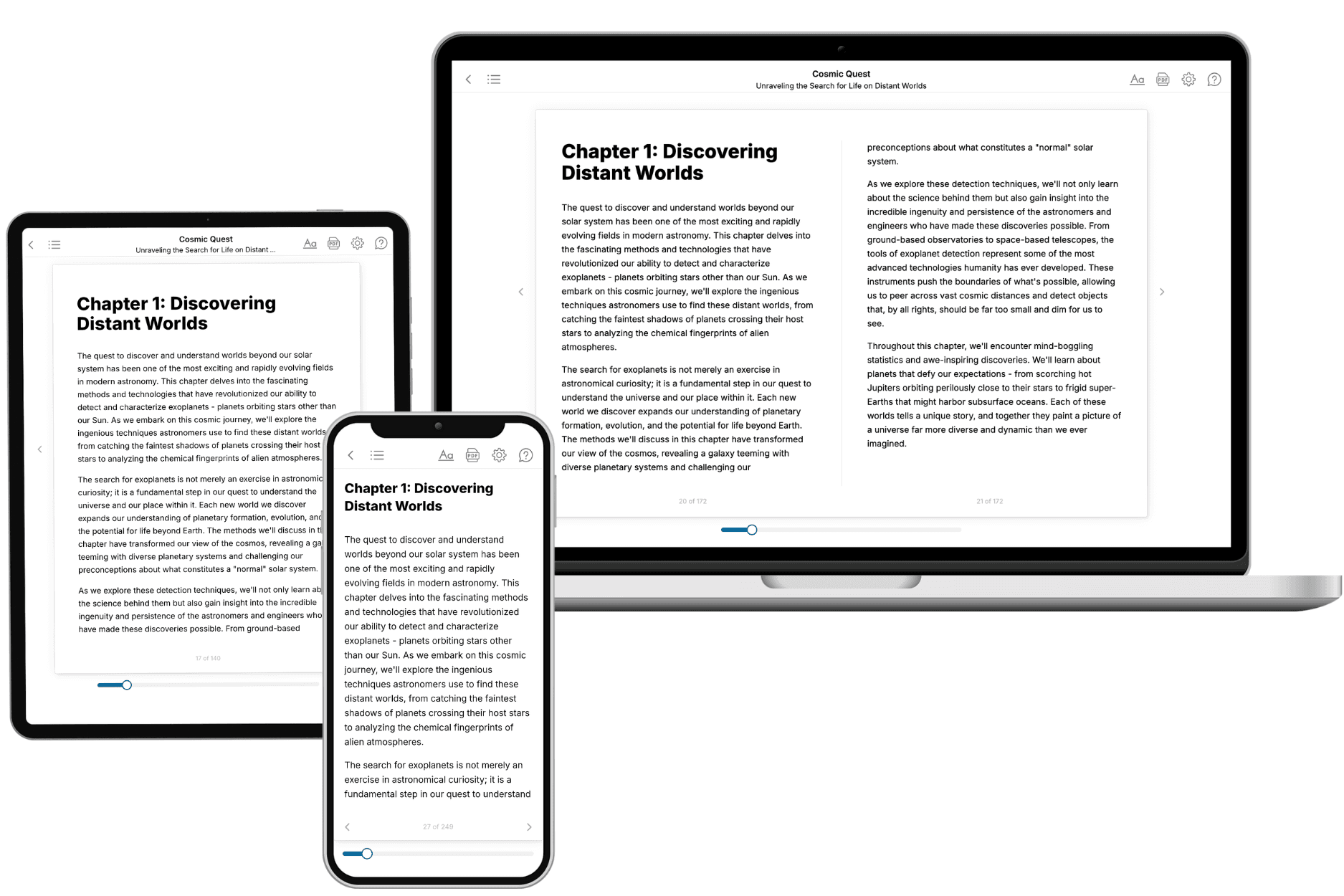
Yes. Every book can be read in our online reader or downloaded as a PDF or EPUB. The EPUB can be opened with Kindle, Apple Books, Kobo, and any e-reader. The Commercial and Author licenses also include an editable Word (DOCX) and Markdown download.
- How much does it cost?
About the price of a regular ebook. The exact price depends on your book's length and complexity, from $2 for the shortest books to $35 for the most comprehensive, and it's shown when you review your book, before you commit to anything. Each book is a one-time purchase, yours to keep, no subscription. Licenses that let you share, teach, or publish your book range from $35.99 to $49.99.
- Can I preview the book before purchasing?
Before you pay, you'll see what your book will cover: the title, a detailed description, the estimated length, and the complete chapter-by-chapter table of contents, so you know what you're getting before you decide. The full text itself is written after you purchase.
- How long does it take to create a book?
About 10 minutes. You can start reading the opening chapters while the rest is still being written.