Transfer Learning Mastery
Leveraging Thompson Sampling and AI to Build Smarter, Faster Machine Learning Systems
You're about to discover how to build machine learning systems that learn faster, adapt smarter, and make better decisions with less data.
222 pages10 chaptersNov 2, 2025Machine Learning
About this book
This book guides you through the intersection of transfer learning and Thompson Sampling—two powerful techniques that, when combined, create AI systems capable of solving new problems efficiently while continuously improving through intelligent exploration. You'll start by understanding the core principles behind transfer learning, from basic feature reuse to advanced domain adaptation strategies. Then you'll explore Thompson Sampling's elegant approach to balancing exploration and exploitation, learning why it outperforms simpler alternatives in real-world scenarios. Through practical examples and clear explanations, you'll see how these techniques work independently and how they amplify each other when integrated. Whether you're building recommendation systems, optimizing A/B tests, or developing adaptive models for new domains, you'll gain the knowledge and confidence to apply these methods effectively. By the end, you'll understand not just how to implement these techniques, but when to use them and how to diagnose problems when they don't work as expected.
Table of contents
- IntroductionWhy Transfer Learning Matters in Modern AI, Thompson Sampling: A New Way to Make Decisions, What You'll Learn in This BookRead below
- Chapter 1: Transfer Learning FundamentalsWhat Is Transfer Learning and Why It Works, Understanding Source and Target Domains, Types of Transfer Learning: Inductive, Transductive, and Unsupervised, When Transfer Learning Fails and How to Recognize It
- Chapter 2: Feature Extraction and Knowledge ReuseHow Neural Networks Learn Transferable Representations, Practical Feature Extraction Strategies, Leveraging Pre-trained Models for Your Tasks, Measuring and Evaluating Feature Quality
- Chapter 3: Fine-Tuning and Domain AdaptationFine-Tuning Fundamentals: When and How to Retrain, Understanding Domain Shift and Distribution Mismatch, Advanced Domain Adaptation Techniques, Avoiding Negative Transfer and Catastrophic Forgetting
- Chapter 4: Thompson Sampling: Theory and PrinciplesThe Exploration-Exploitation Tradeoff, How Thompson Sampling Works: The Core Algorithm, Bayesian Foundations and Posterior Distributions, Thompson Sampling vs. Epsilon-Greedy and UCB
- Chapter 5: Thompson Sampling in PracticeMulti-Armed Bandits and Thompson Sampling, Contextual Bandits: Adding Context to Decisions, Implementing Thompson Sampling: From Theory to Code, Real-World Applications: Recommendations, A/B Testing, and Optimization
- Chapter 6: Combining Transfer Learning and Thompson SamplingHow Transfer Learning and Thompson Sampling Complement Each Other, Using Transfer Learning to Accelerate Thompson Sampling Convergence, Transferring Uncertainty Estimates Across Domains, Building Integrated Systems: Architecture and Design Patterns
- Chapter 7: Building Production SystemsSystem Design for Transfer Learning and Thompson Sampling, Data Pipelines and Feature Management, Deploying and Monitoring Adaptive Models, Measuring Success: Key Metrics and Evaluation Frameworks
- Chapter 8: Case Studies and Real-World ExamplesCase Study 1: Personalized Recommendation Systems, Case Study 2: A/B Testing and Conversion Optimization, Case Study 3: Cross-Domain Learning in Computer Vision, Case Study 4: Adaptive Natural Language Processing
- Chapter 9: Troubleshooting and OptimizationCommon Pitfalls and How to Avoid Them, Debugging Transfer Learning Issues, Debugging Thompson Sampling Convergence Problems, Performance Tuning and Hyperparameter Optimization
- Chapter 10: Advanced Topics and Future DirectionsMeta-Learning: Learning How to Learn, Continual Learning and Lifelong Adaptation, Federated Learning and Distributed Transfer, Emerging Trends and Research Directions
- ConclusionKey Takeaways and Your Next Steps, Building Intuition for When to Apply These Techniques
- Glossary
- Further Reading and Resources
Introduction
Machine learning has transformed how we solve problems, but a fundamental challenge remains: building effective models typically requires massive amounts of labeled data and computational resources. Every time you face a new problem, the traditional approach demands starting from scratch—collecting thousands or millions of examples, training for hours or days, and hoping you have enough data to achieve acceptable performance. This approach works, but it's inefficient and often impractical. Consider how humans learn: when you learn to ride a motorcycle after mastering a bicycle, you don't start from zero. You transfer knowledge about balance, steering, and spatial awareness. Your brain reuses existing skills and adapts them to the new context. Machine learning can work the same way.
This book explores two powerful techniques that address these limitations: transfer learning and Thompson Sampling. Transfer learning allows your models to leverage knowledge gained from one task to accelerate learning on another, dramatically reducing the data and time required to achieve strong performance. Thompson Sampling provides an elegant, probabilistic framework for making decisions under uncertainty, ensuring your models explore intelligently while exploiting what they already know. When combined, these techniques create adaptive systems that learn efficiently from limited data while continuously improving through smart exploration. You'll discover how to build models that don't just perform well—they learn faster, adapt better, and make smarter decisions with less.
Throughout this book, you'll gain both theoretical understanding and practical skills. You'll learn when transfer learning works and when it fails, how to diagnose domain mismatch problems, and which adaptation strategies to apply in different scenarios. You'll understand why Thompson Sampling outperforms simpler exploration strategies and how to implement it effectively in production systems. Most importantly, you'll see how these techniques amplify each other: transfer learning provides strong initial knowledge that accelerates Thompson Sampling's convergence, while Thompson Sampling's uncertainty estimates guide intelligent exploration during adaptation. Whether you're building recommendation systems, optimizing experiments, or developing models for new domains, you'll finish this book with the knowledge and confidence to apply these methods effectively in your own work.
Why Transfer Learning Matters in Modern AI
The traditional supervised learning paradigm assumes you have abundant labeled data for your specific task. In reality, this assumption rarely holds. Labeling data is expensive, time-consuming, and sometimes impossible at the scale required for deep learning. A medical imaging startup might need to classify rare diseases but only have access to dozens of examples. An e-commerce company launching in a new market might have years of user behavior data from one country but almost nothing from another. A robotics company might have simulated data but limited real-world examples. Transfer learning addresses these challenges by allowing models to reuse knowledge learned from data-rich domains and apply it to data-scarce problems.
The success of transfer learning stems from a fundamental insight: many tasks share underlying structure. Consider computer vision models trained on ImageNet, a dataset containing millions of labeled images across thousands of categories. These models learn hierarchical representations where early layers detect edges and textures, middle layers recognize shapes and patterns, and later layers identify specific objects. These low and mid-level features—edges, textures, shapes—are useful for almost any visual task, not just ImageNet classification. When you fine-tune such a model for medical imaging, you're not teaching it what edges are; you're adapting its high-level understanding to recognize tumors instead of cats. This reuse of learned representations is what makes transfer learning so powerful.
The practical benefits of transfer learning are substantial and measurable. Research has consistently shown that models initialized with pre-trained weights converge faster, require less data, and often achieve better final performance than models trained from scratch[1]. In natural language processing, models like BERT and GPT demonstrated that pre-training on massive text corpora creates representations that transfer effectively to dozens of downstream tasks with minimal fine-tuning. In computer vision, models pre-trained on ImageNet have become the default starting point for virtually every image-related task. The pattern is clear: transfer learning has shifted from an interesting research technique to a fundamental best practice in modern machine learning.
Beyond efficiency gains, transfer learning enables entirely new applications. Tasks that would be impossible with traditional supervised learning become feasible when you can leverage knowledge from related domains. Consider these scenarios:
- Few-shot learning: Classifying new categories with only a handful of examples by transferring knowledge from similar categories
- Domain adaptation: Applying models trained on synthetic or simulated data to real-world scenarios without collecting massive real-world datasets
- Cross-lingual transfer: Building natural language systems for low-resource languages by transferring from high-resource languages
- Rapid prototyping: Testing whether machine learning can solve a problem before investing in large-scale data collection
However, transfer learning is not automatic or guaranteed to work. The relationship between source and target domains determines success or failure. When domains are too dissimilar, transfer can actually hurt performance—a phenomenon called negative transfer. A model trained on natural photographs might not transfer well to medical X-rays because the visual statistics differ fundamentally. A language model trained on formal text might struggle with social media posts filled with slang and abbreviations. Understanding when and why transfer works requires grasping concepts like domain shift, distribution mismatch, and feature transferability. These aren't just theoretical concerns; they're practical considerations that determine whether your transfer learning project succeeds or wastes resources.
The modern machine learning landscape has embraced transfer learning as a default approach. Pre-trained models are now widely available through model zoos and repositories, making it easier than ever to start with strong foundations. Frameworks like TensorFlow and PyTorch provide built-in support for loading pre-trained weights and fine-tuning. Cloud platforms offer pre-trained models as services. This democratization means you don't need massive computational resources or datasets to build effective models—but you do need to understand how to use these tools effectively. Knowing which layers to freeze, how much to fine-tune, and when to use feature extraction versus full fine-tuning makes the difference between a model that works and one that doesn't.
Transfer learning also changes how you think about model development. Instead of viewing each task as isolated, you start seeing connections between problems. You begin asking questions like: What related tasks have abundant data? Which pre-trained models might provide useful features? How similar is my target domain to available source domains? This shift in perspective leads to more efficient development cycles and better resource allocation. Rather than immediately collecting thousands of labeled examples, you might first experiment with transfer learning to establish a baseline and understand what's possible. This iterative, knowledge-reuse approach aligns better with how humans solve problems and how organizations should allocate their machine learning resources.
Thompson Sampling: A New Way to Make Decisions
Every machine learning system faces a fundamental dilemma: should it exploit what it already knows to maximize immediate performance, or should it explore uncertain options that might lead to better long-term outcomes? This exploration-exploitation tradeoff appears everywhere in AI applications. A recommendation system must decide whether to suggest items it knows users like or try new items that might be even better. An A/B testing platform must balance showing the current best variant against testing new variants that could improve conversion rates. A reinforcement learning agent must choose between actions it knows are good and actions it's uncertain about. How you resolve this tradeoff fundamentally determines your system's ability to learn and adapt.
Thompson Sampling offers an elegant, principled solution to this dilemma. Unlike simpler strategies that explore randomly or according to fixed schedules, Thompson Sampling maintains probability distributions over possible outcomes and samples from these distributions to make decisions. The algorithm is beautifully simple: for each option, sample a value from your current belief distribution about that option's quality, then choose the option with the highest sampled value. This approach naturally balances exploration and exploitation—options you're uncertain about have wider distributions, so they occasionally sample high values and get selected, while options you're confident are good consistently sample high values and get selected frequently. The result is exploration that's neither too aggressive nor too conservative, but proportional to uncertainty.
The theoretical foundations of Thompson Sampling lie in Bayesian statistics. You start with prior beliefs about each option's quality, represented as probability distributions. As you gather data by selecting options and observing outcomes, you update these beliefs using Bayes' rule to compute posterior distributions. These posteriors capture both your current estimate of each option's quality and your uncertainty about that estimate. Thompson Sampling leverages this uncertainty directly: when you're very uncertain about an option, your posterior distribution is wide, leading to occasional high samples that trigger exploration. As you gather more data, your posteriors narrow, and the algorithm naturally shifts toward exploitation of the best options. This Bayesian framework provides both a principled decision-making strategy and a natural way to quantify and track uncertainty.
Compared to alternative exploration strategies, Thompson Sampling demonstrates superior performance across a wide range of scenarios. Consider epsilon-greedy, a common baseline where you exploit the best option with probability (1-ε) and explore randomly with probability ε. This approach is simple but crude—it explores uniformly across all options regardless of what you've learned, and the exploration rate is fixed rather than adaptive. Upper Confidence Bound (UCB) algorithms improve on this by computing confidence intervals and selecting options with high upper bounds, but they require careful tuning of confidence parameters. Thompson Sampling, by contrast, requires minimal tuning, adapts naturally to the amount of data collected, and has strong theoretical guarantees about long-term performance[2].
The practical applications of Thompson Sampling extend far beyond academic bandit problems. In online advertising, Thompson Sampling helps allocate ad impressions across campaigns to maximize click-through rates while discovering which ads perform best. In clinical trials, it enables adaptive designs that assign more patients to promising treatments while still exploring alternatives. In recommendation systems, it balances showing users items they're likely to enjoy against discovering new preferences. In hyperparameter optimization, it guides the search toward promising configurations while avoiding premature convergence. These applications share common characteristics: they involve sequential decision-making under uncertainty, they benefit from adaptive exploration, and they require balancing short-term performance against long-term learning.
Implementing Thompson Sampling requires choosing appropriate probability distributions for your problem. For binary outcomes like clicks or conversions, Beta distributions work well because they're conjugate to the Bernoulli likelihood, making Bayesian updates simple and efficient. For continuous outcomes, Gaussian distributions are common choices. For count data, Gamma or Poisson distributions might be appropriate. The choice of distribution affects both the computational efficiency of your implementation and how well the algorithm captures uncertainty in your specific domain. Understanding these choices and their implications is crucial for effective implementation, and you'll learn the details throughout this book.
One of Thompson Sampling's most valuable properties is its ability to handle contextual information. In contextual bandit problems, the best action depends on the current context—which user is visiting your website, what time of day it is, what device they're using. Thompson Sampling extends naturally to these scenarios by maintaining distributions over model parameters rather than just action values. This contextual variant, often called Contextual Thompson Sampling, combines the exploration benefits of Thompson Sampling with the predictive power of supervised learning. You can use linear models, neural networks, or any other function approximator to map contexts to action values, then apply Thompson Sampling to the model parameters. This flexibility makes Thompson Sampling applicable to complex, real-world problems where simple multi-armed bandits would be insufficient.
The connection between Thompson Sampling and transfer learning might not be immediately obvious, but it's profound. Both techniques deal with learning efficiently from limited data. Transfer learning provides strong initial knowledge by reusing learned representations, while Thompson Sampling ensures you explore intelligently to refine that knowledge. When you transfer a model to a new domain, you're uncertain about how well it will perform and which aspects need adaptation. Thompson Sampling's uncertainty-aware exploration helps you discover where the transferred knowledge works well and where it needs refinement. This synergy—strong initialization from transfer learning combined with intelligent exploration from Thompson Sampling—creates systems that adapt quickly and effectively to new domains with minimal data.
What You'll Learn in This Book
This book is structured to build your understanding progressively, starting with fundamentals and advancing to sophisticated integration techniques. The first half focuses on transfer learning, covering the theoretical foundations, practical implementation strategies, and common pitfalls. You'll learn what makes features transferable, how to evaluate domain similarity, and when to use feature extraction versus fine-tuning. The second half explores Thompson Sampling in depth, from basic multi-armed bandits to contextual variants and real-world applications. The final chapters bring these techniques together, showing you how to build integrated systems that leverage both approaches. Each chapter includes concrete examples, implementation guidance, and troubleshooting advice to ensure you can apply these concepts in your own work.
Chapters 1-3 establish your transfer learning foundation. Chapter 1 introduces the core concepts: what transfer learning is, why it works, and the taxonomy of different transfer learning approaches. You'll understand the distinction between inductive, transductive, and unsupervised transfer, and learn to recognize when transfer is likely to succeed or fail. Chapter 2 dives into feature extraction and knowledge reuse, explaining how neural networks learn hierarchical representations and how to leverage pre-trained models effectively. You'll learn practical strategies for extracting features, evaluating their quality, and deciding which layers to reuse. Chapter 3 covers fine-tuning and domain adaptation, addressing the critical challenge of domain shift. You'll learn advanced adaptation techniques, how to avoid negative transfer, and strategies for preventing catastrophic forgetting when updating pre-trained models.
The middle section, Chapters 4-5, provides comprehensive coverage of Thompson Sampling. Chapter 4 establishes the theoretical foundations: the exploration-exploitation tradeoff, Bayesian inference, and how Thompson Sampling works at a fundamental level. You'll understand why Thompson Sampling outperforms alternatives like epsilon-greedy and UCB, and gain intuition for when to apply it. Chapter 5 focuses on practical implementation, covering multi-armed bandits, contextual bandits, and real-world applications. You'll see concrete code examples, learn how to choose appropriate probability distributions, and understand how to apply Thompson Sampling to recommendation systems, A/B testing, and optimization problems. These chapters provide both the theoretical understanding and practical skills needed to implement Thompson Sampling effectively.
Chapter 6 represents the book's conceptual core: combining transfer learning and Thompson Sampling. You'll discover how these techniques complement each other, with transfer learning providing strong initialization and Thompson Sampling enabling intelligent adaptation. This chapter covers:
- How transferred knowledge accelerates Thompson Sampling convergence by providing informative priors
- Techniques for transferring uncertainty estimates across domains, not just point predictions
- Architectural patterns for building integrated systems that leverage both approaches
- Case studies demonstrating the synergy between transfer learning and Thompson Sampling in practice
Chapters 7-8 focus on production implementation and real-world applications. Chapter 7 covers system design, data pipelines, deployment strategies, and monitoring approaches for adaptive models. You'll learn how to structure your code for maintainability, manage feature pipelines efficiently, and measure success using appropriate metrics. Chapter 8 presents detailed case studies across different domains: personalized recommendations, A/B testing optimization, cross-domain computer vision, and adaptive natural language processing. Each case study walks through the problem setup, design decisions, implementation details, and results, giving you concrete examples to learn from and adapt to your own applications.
The final chapters, 9-10, address advanced topics and troubleshooting. Chapter 9 provides systematic guidance for debugging and optimizing your systems. You'll learn to recognize common pitfalls, diagnose transfer learning failures, debug Thompson Sampling convergence issues, and tune hyperparameters effectively. This chapter serves as a practical reference when things don't work as expected—and they often don't on the first try. Chapter 10 explores cutting-edge topics and future directions: meta-learning (learning to learn), continual learning, federated transfer learning, and emerging research trends. These advanced topics prepare you to stay current as the field evolves and point you toward areas for deeper exploration.
Throughout the book, you'll find several recurring elements designed to reinforce learning and provide practical value. Concrete examples illustrate abstract concepts with specific scenarios and data. Code snippets demonstrate implementation details in Python, using popular libraries like TensorFlow, PyTorch, and scikit-learn. Blockquotes highlight key insights and important warnings. Lists and structured breakdowns make complex processes easier to follow and reference later. Footnotes provide citations to research papers and additional resources for deeper exploration. This multi-layered approach ensures you gain both conceptual understanding and practical implementation skills.
The book assumes you have intermediate machine learning knowledge. You should be comfortable with supervised learning concepts, familiar with neural networks at a basic level, and have some experience training models using frameworks like TensorFlow or PyTorch. You don't need to be an expert in Bayesian statistics or advanced deep learning—those concepts are explained as needed. The goal is to meet you where you are and build your expertise systematically. If you're a data scientist looking to build more efficient models, a machine learning engineer seeking to reduce training costs, or a researcher exploring adaptive systems, this book provides the knowledge you need.
By the end of this book, you'll have developed several key capabilities. You'll understand when transfer learning is appropriate and which strategies to apply in different scenarios. You'll be able to implement Thompson Sampling for various decision-making problems and explain why it outperforms simpler alternatives. You'll know how to combine these techniques to build adaptive systems that learn efficiently from limited data. Most importantly, you'll have developed intuition for diagnosing problems and making informed decisions about which approaches to use. This intuition—knowing not just how to implement techniques but when and why to use them—is what separates effective practitioners from those who simply follow tutorials. Your journey toward that expertise begins now.
This is the end of the free sample. The full book has 10 chapters.
Want this book written for you?
Tell us your goals and background, and get your own version of this book, tailored by AI to you.


Benefits of AI-tailored books
- Read one book, not ten:
- all the Machine Learning knowledge you need, gathered into a single book.
- Save days of learning:
- tell us your goals, choose your topics, and the whole book is built around them.
- Learn effortlessly:
- Machine Learning book written for your specific background and expertise.
- Understand at a glance:
- includes charts, tables, timelines, checklists, decision trees, and more.
- Stay current:
- written the day you order it, not years ago.
- Trust what you read:
- every book is checked for accuracy, with real research when your subject needs it.
Create your unique book in 3 steps
- 1. Select your focus
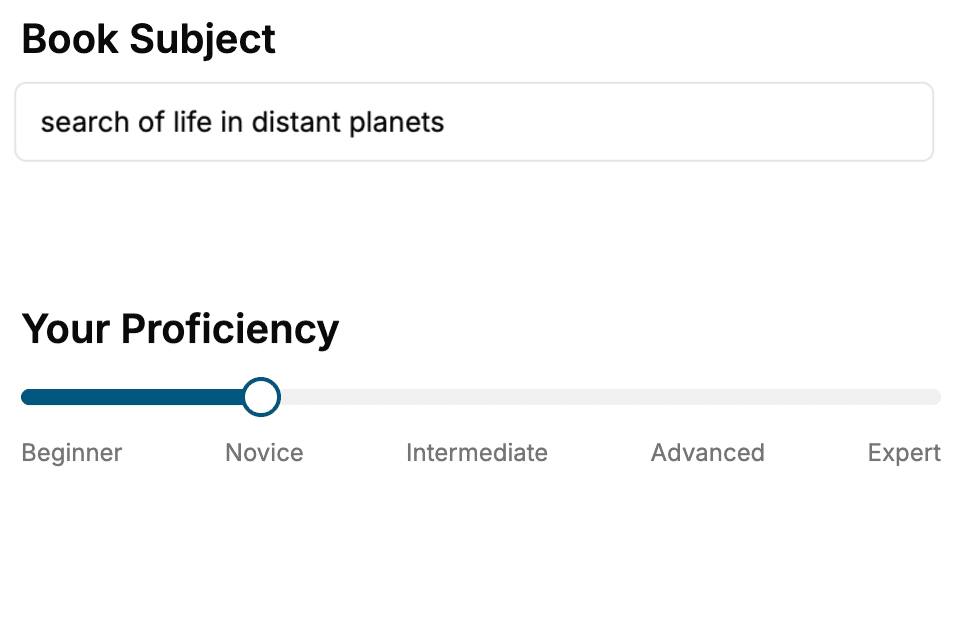
Select the focus of your Machine Learning book and share your background
- 2. Personalize your book
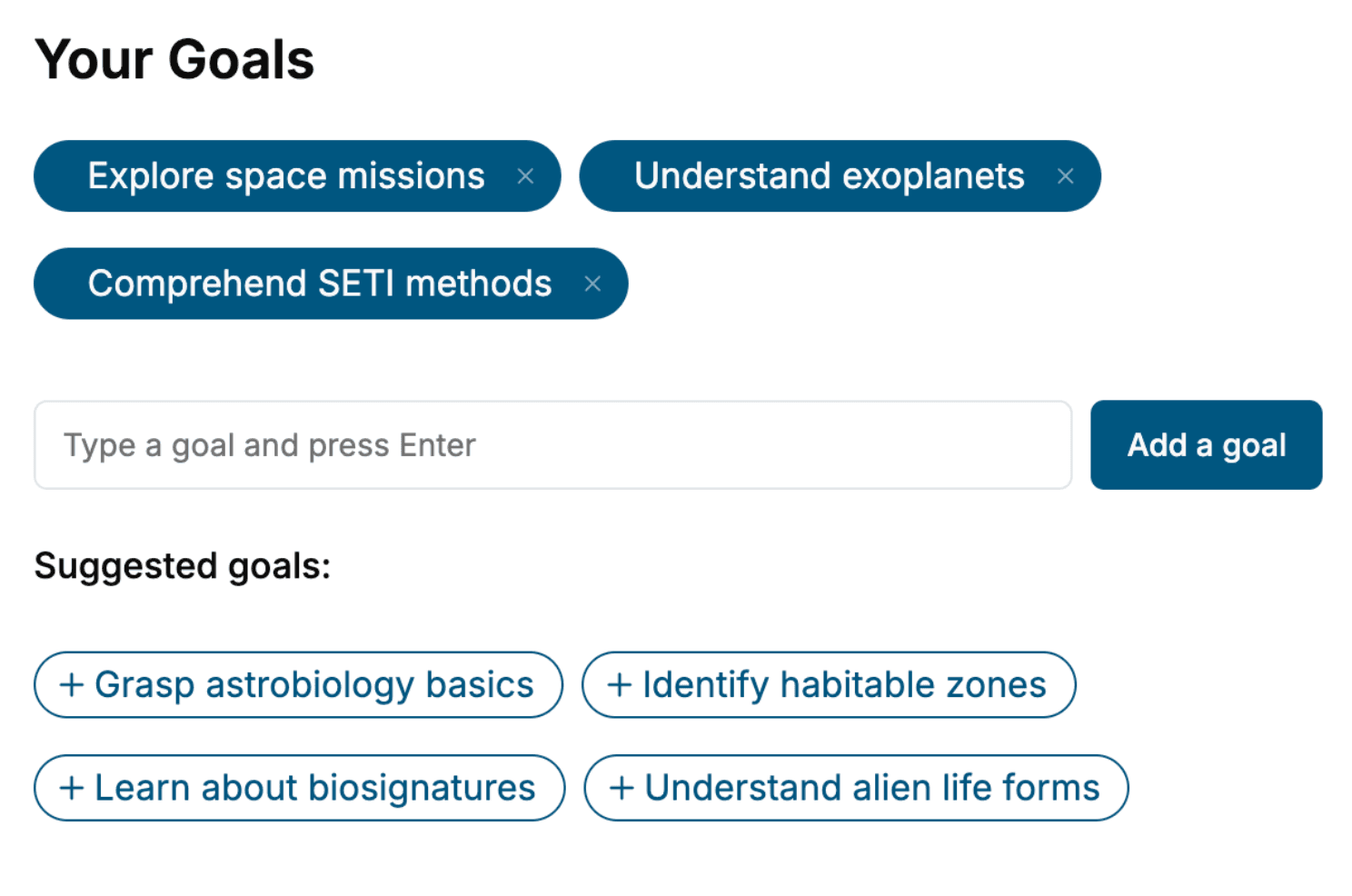
Specify your goals and choose sub-topics to include
- 3. Get your tailored book
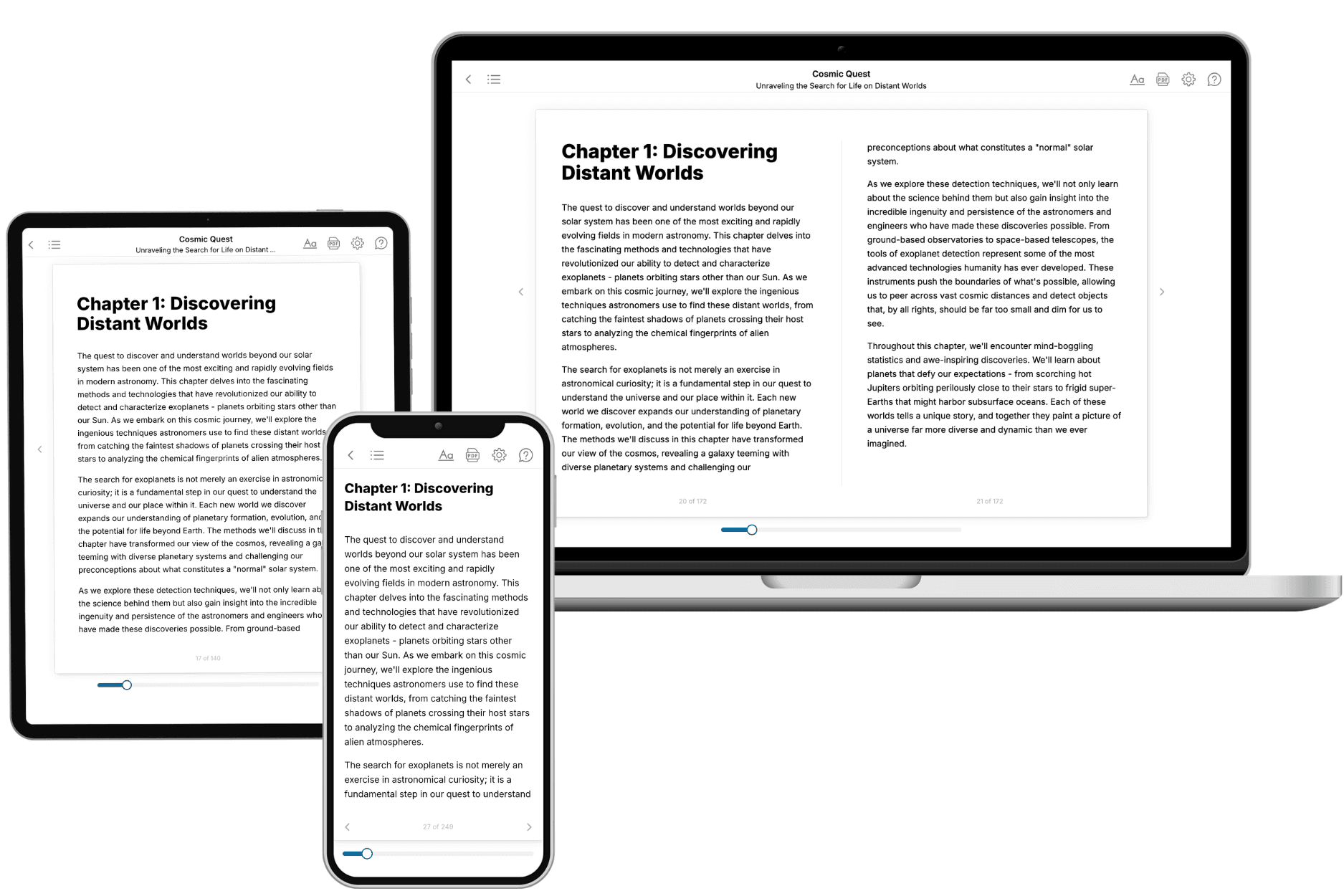
Your book is ready in 10 minutes. Read it online, download as EPUB or PDF, or send to Kindle.
Frequently asked questions
- What is TailoredRead?
TailoredRead creates complete, full-length nonfiction ebooks, written specifically for you. Tell us what you want to learn and why, and TailoredRead writes you a complete ebook on it, with charts, tables, and diagrams throughout. Read it online, on Kindle, or on any e-reader, or download it as a PDF or EPUB. Every book is written fresh the day you order it.
- How is the book tailored to me?
Before anything is written, you answer a few short questions about your goals, your background, and the topics you care about. Your book is then planned around your answers: written at your level, focused on your goals, and covering the topics you chose, instead of the one-size-fits-all book a store sells everyone.
- Will it read like generic AI content?
No. Your book isn't a chat transcript: it's planned chapter by chapter before a single word is written, told in a clear book voice, and explains ideas visually with charts, tables, and diagrams. After writing, every book goes through an editorial pass that polishes chapters so the book reads consistent from start to finish. Judge for yourself: browse thousands of sample books on our Explore Books page.
- How accurate is the content?
Our AI first checks whether your subject needs live research. Niche and fast-moving subjects are researched before writing, and the book plan and chapters are grounded in what it finds. After writing, every book goes through a quality pass that checks its facts and consistency, and researched books list their sources in a Notes section at the back.
- How long is the book?
You choose the length: Comprehensive (250-300 pages), Detailed (150-200 pages), Essential (70-100 pages), or Short (30-50 pages).
- Does the book include visuals?
Yes. Every book includes charts, tables, and diagrams: timelines, checklists, step-by-step guides, decision trees, comparison tables, matrices, and bar charts. A typical book includes dozens of these visual elements.
- Can I read it on Kindle? What formats can I download?
Yes. Every book can be read in our online reader or downloaded as a PDF or EPUB. The EPUB can be opened with Kindle, Apple Books, Kobo, and any e-reader. The Commercial and Author licenses also include an editable Word (DOCX) and Markdown download.
- How much does it cost?
About the price of a regular ebook. The exact price depends on your book's length and complexity, from $2 for the shortest books to $35 for the most comprehensive, and it's shown when you review your book, before you commit to anything. Each book is a one-time purchase, yours to keep, no subscription. Licenses that let you share, teach, or publish your book range from $35.99 to $49.99.
- Can I preview the book before purchasing?
Before you pay, you'll see what your book will cover: the title, a detailed description, the estimated length, and the complete chapter-by-chapter table of contents, so you know what you're getting before you decide. The full text itself is written after you purchase.
- How long does it take to create a book?
About 10 minutes. You can start reading the opening chapters while the rest is still being written.