Unraveling Infinity
A Practical Guide to Taylor and Maclaurin Series in Basic Calculus
Embark on a fascinating journey through the world of mathematical approximations with "Unraveling Infinity: A Practical Guide to Taylor and Maclaurin Series in Basic Calculus." This engaging book demystifies the powerful concepts of Taylor and Maclaurin series, making them accessible and applicable to your everyday mathematical endeavors.
269 pages13 chaptersNov 27, 2024Mathematics
About this book
You'll discover how these series can be used to represent complex functions as infinite sums of simpler terms, opening up a new realm of problem-solving techniques. From the foundations of power series to the intricacies of error estimation, this book guides you through each concept with clarity and precision. Whether you're looking to excel in your calculus course or seeking to apply these techniques in scientific computing or engineering, "Unraveling Infinity" provides the tools you need. With numerous examples, intuitive explanations, and practical exercises, you'll gain not just knowledge, but the confidence to tackle advanced mathematical challenges. Prepare to see the beauty of mathematics unfold as you master the art of approximation and series expansion.
Table of contents
- IntroductionOverview of Taylor and Maclaurin Series, Historical Context and Importance, Structure of the Book, Prerequisites and NotationRead below
- Chapter 1: Foundations of SeriesSequences and Their Limits, Definition of a Series, Introduction to Convergence, Geometric Series: A Motivating Example
- Chapter 2: Power SeriesDefinition and Basic Properties, Radius of Convergence, Term-by-Term Operations, Examples of Power Series
- Chapter 3: Taylor SeriesDefinition of Taylor Series, Taylor's Theorem, The Remainder Term, Examples of Taylor Series Expansions
- Chapter 4: Maclaurin SeriesDefinition and Relation to Taylor Series, Common Maclaurin Series, Deriving Maclaurin Series, Applications of Maclaurin Series
- Chapter 5: Convergence AnalysisThe Ratio Test, The Root Test, Comparison Tests, Absolute and Conditional Convergence
- Chapter 6: Error EstimationTruncation Error, Lagrange Remainder, Error Bounds and Estimates, Practical Error Considerations
- Chapter 7: Function ApproximationPolynomial Approximations, Local Behavior of Functions, From Local to Global Approximation, Examples of Function Approximation
- Chapter 8: Operations on SeriesAddition and Subtraction, Multiplication of Series, Composition of Series, Inversion of Series
- Chapter 9: Applications in PhysicsClassical Mechanics, Electromagnetism, Quantum Mechanics, Thermodynamics
- Chapter 10: Applications in EngineeringSignal Processing, Control Systems, Fluid Dynamics, Structural Analysis
- Chapter 11: Computational AspectsNumerical Methods for Series, Computer Algebra Systems, Programming with Series, Visualization Tools
- Chapter 12: Advanced TopicsAsymptotic Series, Connection to Fourier Series, Laurent Series, Multivariable Taylor Series
- Chapter 13: Problem-Solving StrategiesIdentifying Appropriate Series, Selecting the Number of Terms, Error Analysis in Practice, Tackling Real-World Problems
- ConclusionThe Importance of Series in Mathematics, Future Directions and Open Problems
- AppendixTable of Common Series, Selected Proofs
- Glossary
Introduction
Welcome to the fascinating world of Taylor and Maclaurin series, a realm where the infinite and the finite intertwine to unlock the secrets of mathematical functions. As you embark on this journey through "Unraveling Infinity: A Practical Guide to Taylor and Maclaurin Series in Basic Calculus," you are about to discover powerful tools that will transform your understanding of mathematical approximation and open new doors in your analytical capabilities. This introduction serves as your gateway to the expansive landscape of series expansions, setting the stage for the in-depth exploration that lies ahead.
Taylor and Maclaurin series are not just abstract mathematical concepts; they are practical instruments that bridge the gap between complex functions and their polynomial approximations. These series allow us to represent intricate functions as infinite sums of simpler terms, providing a means to analyze, compute, and understand functions that might otherwise be impenetrable. As you progress through this book, you will come to appreciate how these series form a cornerstone of advanced mathematics, with applications spanning from pure mathematical theory to practical problem-solving in physics, engineering, and computer science.
The journey you are about to undertake is one of discovery and enlightenment. You will learn to see functions in a new light, breaking them down into their constituent parts and rebuilding them with increasing accuracy. This process not only enhances your mathematical skills but also cultivates a deeper intuition about the nature of functions and their behavior. Whether you are a student seeking to excel in your calculus courses or a professional looking to apply these techniques in your work, this book will equip you with the knowledge and tools to tackle a wide array of mathematical challenges.
Overview of Taylor and Maclaurin Series
At their core, Taylor and Maclaurin series are methods of representing functions as infinite sums of terms. These series are not just mathematical curiosities; they are powerful tools that allow us to approximate complex functions with polynomials, making them more manageable for analysis and computation. The fundamental idea behind these series is to capture the behavior of a function near a particular point by using the function's derivatives at that point.
A Taylor series is an expansion of a function f(x) about a point a, represented as an infinite sum of terms calculated from the values of the function's derivatives at a. The general form of a Taylor series is:
This expansion allows us to approximate the function's value for x near a, with each term providing a more accurate approximation[1].f(x) = f(a) + f'(a)(x-a) + (f''(a)/2!)(x-a)² + (f'''(a)/3!)(x-a)³ + ...
A Maclaurin series is simply a special case of a Taylor series where the point a is chosen to be 0. This simplification often leads to more elegant and easily computed series expansions for many common functions. The Maclaurin series takes the form:
This series is particularly useful for functions that are well-behaved near the origin[2].f(x) = f(0) + f'(0)x + (f''(0)/2!)x² + (f'''(0)/3!)x³ + ...
The power of these series lies in their ability to approximate functions with arbitrary precision. By including more terms in the series, we can achieve increasingly accurate representations of the original function. This property makes Taylor and Maclaurin series invaluable in numerous fields, from pure mathematics to applied sciences.
In mathematics, these series serve as a bridge between different areas of study. They connect differential calculus (through the use of derivatives) with algebra (in the form of polynomial approximations) and analysis (in the study of infinite series and their convergence). This interconnection provides a deeper understanding of function behavior and opens up new avenues for solving complex problems.
In physics and engineering, Taylor and Maclaurin series find extensive applications. They are used to solve differential equations, analyze wave propagation, study quantum mechanics, and model complex systems. The ability to approximate complicated functions with simpler polynomial expressions makes these series indispensable in situations where exact solutions are difficult or impossible to obtain.
Computer science and numerical analysis also benefit greatly from these series. They form the basis for many algorithms used in scientific computing, allowing for efficient calculation of function values, numerical integration, and solution of differential equations. The concept of truncating an infinite series to a finite number of terms is fundamental to many computational methods, balancing accuracy with computational efficiency.
As you delve deeper into this book, you will explore not only the theoretical foundations of Taylor and Maclaurin series but also their practical applications. You will learn how to derive these series for various functions, understand their convergence properties, and apply them to solve real-world problems. The journey will take you from the basics of series construction to advanced topics like error estimation and multivariable expansions.
By mastering Taylor and Maclaurin series, you will gain a powerful set of tools for mathematical analysis and problem-solving. These techniques will enhance your ability to understand and manipulate functions, providing insights that go beyond what is possible with elementary calculus alone. As you progress, you will develop an intuition for when and how to apply these series, becoming adept at choosing the right approach for different types of problems.
Remember, the study of Taylor and Maclaurin series is not just about memorizing formulas or procedures. It's about developing a new way of thinking about functions and their representations. As you work through the examples and exercises in this book, strive to understand the underlying principles and visualize what these series mean geometrically and analytically. This deeper understanding will serve you well in your future mathematical endeavors.
Historical Context and Importance
The development of Taylor and Maclaurin series represents a significant milestone in the history of mathematics, marking a pivotal point in the transition from classical to modern mathematical analysis. These series are named after their developers, Brook Taylor (1685-1731) and Colin Maclaurin (1698-1746), two prominent British mathematicians of the 18th century. However, the roots of these concepts can be traced back even further, highlighting the cumulative nature of mathematical discovery.
The idea of approximating functions with polynomials has ancient origins, with early forms appearing in the works of Indian mathematicians as far back as the 14th century. Madhava of Sangamagrama (c. 1350-1425) developed infinite series approximations for trigonometric functions, which were precursors to the modern Taylor series[3]. These early developments laid the groundwork for the more formalized approaches that would emerge centuries later.
In Europe, the groundwork for Taylor series was laid by mathematicians like Isaac Newton and James Gregory in the late 17th century. Newton's work on binomial series and his method of fluxions (an early form of calculus) provided essential tools for series expansions. Gregory, working independently, derived series expansions for several trigonometric functions, including the arctangent series, which is closely related to the Taylor series for arctangent.
Brook Taylor formally introduced what we now call the Taylor series in his 1715 work "Methodus Incrementorum Directa et Inversa" (Direct and Reverse Methods of Incrementation). Taylor's insight was to generalize previous work on specific functions to a method applicable to a wide class of functions. His formulation allowed for the expansion of a function about any point, not just zero, which was a significant advancement[4].
Colin Maclaurin, a contemporary of Taylor, further developed these ideas in his "Treatise of Fluxions" (1742). While Maclaurin worked extensively with series expansions centered at zero (now known as Maclaurin series), it's worth noting that he did not claim this as a novel discovery. Instead, he viewed it as a special case of Taylor's more general work. The naming of the Maclaurin series came later, as mathematicians recognized the particular usefulness of expansions about zero.
The importance of Taylor and Maclaurin series in the development of mathematics cannot be overstated. These series provided a bridge between the discrete world of polynomials and the continuous world of more complex functions. This connection allowed mathematicians to apply algebraic techniques to a much broader range of problems, opening up new avenues for both theoretical and applied mathematics.
In the realm of analysis, Taylor series played a crucial role in the rigorous development of calculus. They provided a means to define transcendental functions like exponentials and trigonometric functions in terms of more elementary algebraic operations. This algebraic representation of functions was instrumental in proving many fundamental theorems of calculus and in developing the theory of complex analysis.
The impact of these series extended far beyond pure mathematics. In physics, Taylor series became an indispensable tool for approximating solutions to differential equations, which are fundamental to describing physical phenomena. The ability to represent complex functions as series expansions allowed physicists to make predictions and develop theories in areas where exact solutions were unattainable.
In the field of engineering, Taylor series found applications in areas such as control theory, signal processing, and structural analysis. The ability to approximate complex functions with polynomials made many calculations more tractable, leading to advancements in design and analysis techniques.
The advent of computer technology in the 20th century brought renewed importance to Taylor and Maclaurin series. These series form the basis for many numerical methods used in scientific computing and computer-aided design. The concept of truncating an infinite series to a finite number of terms is fundamental to many algorithms, balancing computational efficiency with accuracy.
Today, Taylor and Maclaurin series continue to be essential tools in mathematics and its applications. They are fundamental in areas such as asymptotic analysis, perturbation theory, and the study of differential equations. In more advanced mathematics, these series serve as a stepping stone to more general concepts like Fourier series and functional analysis.
As you delve deeper into the study of Taylor and Maclaurin series, it's important to appreciate the historical context in which these ideas developed. The concepts you will learn are the result of centuries of mathematical thought, refined and formalized over time. Understanding this history not only provides context for your studies but also illustrates the evolving nature of mathematical knowledge.
Moreover, the story of Taylor and Maclaurin series exemplifies how mathematical ideas often emerge from practical problems but then take on a life of their own, leading to unforeseen developments and applications. As you work through this book, keep in mind that you are engaging with ideas that have shaped the course of mathematics and science for centuries, and continue to be at the forefront of mathematical research and application.
Structure of the Book
"Unraveling Infinity: A Practical Guide to Taylor and Maclaurin Series in Basic Calculus" is structured to provide a comprehensive and accessible exploration of Taylor and Maclaurin series. The book is designed to guide you through the concepts progressively, building your understanding from foundational principles to advanced applications. This structure ensures that you can grasp each concept thoroughly before moving on to more complex ideas.
The book begins with this introduction, which sets the stage for your journey into the world of series expansions. Following this, the content is organized into thirteen main chapters, each focusing on a specific aspect of Taylor and Maclaurin series. These chapters are designed to be both self-contained and interconnected, allowing you to either read the book sequentially or focus on specific topics of interest.
Chapter 1, "Foundations of Series," lays the groundwork for understanding Taylor and Maclaurin series. It introduces the fundamental concepts of sequences and series, including their definitions, basic properties, and the crucial concept of convergence. This chapter also explores geometric series as a motivating example, providing a concrete foundation for the more abstract concepts to come.
Chapter 2 delves into "Power Series," a broader category that includes Taylor and Maclaurin series. This chapter covers the definition and basic properties of power series, introduces the important concept of radius of convergence, and explores term-by-term operations on series. Understanding power series is crucial for grasping the more specific Taylor and Maclaurin series.
Chapters 3 and 4 focus on "Taylor Series" and "Maclaurin Series" respectively. These chapters form the core of the book, providing detailed explanations of how these series are constructed, their properties, and their relationships to the functions they represent. You'll learn about Taylor's Theorem, the remainder term, and see numerous examples of series expansions for common functions.
Chapter 5, "Convergence Analysis," dives deeper into the critical topic of series convergence. It covers various tests for convergence, including the ratio test and root test, and explores the concepts of absolute and conditional convergence. This chapter provides the tools necessary for determining when a series representation is valid and useful.
Chapter 6 addresses the crucial topic of "Error Estimation." When using Taylor or Maclaurin series in practical applications, it's essential to understand the accuracy of your approximations. This chapter covers truncation error, the Lagrange remainder, and practical considerations for error analysis.
Chapter 7, "Function Approximation," explores how Taylor and Maclaurin series are used to approximate functions. It covers polynomial approximations, the local behavior of functions, and the process of extending local approximations to global ones. This chapter bridges the gap between theoretical understanding and practical application.
Chapter 8, "Operations on Series," delves into more advanced topics, showing how series can be manipulated through addition, subtraction, multiplication, composition, and inversion. These techniques are essential for solving complex problems and deriving new series from known ones.
Chapters 9 and 10 focus on applications, with "Applications in Physics" and "Applications in Engineering" respectively. These chapters demonstrate how Taylor and Maclaurin series are used in various scientific and engineering disciplines, from classical mechanics to signal processing.
Chapter 11, "Computational Aspects," addresses the practical implementation of series in computational settings. It covers numerical methods, the use of computer algebra systems, and programming techniques for working with series.
Chapter 12, "Advanced Topics," introduces more sophisticated concepts related to series, including asymptotic series, Fourier series, Laurent series, and multivariable Taylor series. This chapter provides a glimpse into the broader landscape of series in advanced mathematics.
Chapter 13, "Problem-Solving Strategies," ties everything together by providing practical guidance on how to approach problems using Taylor and Maclaurin series. It covers strategies for identifying appropriate series, selecting the number of terms, and analyzing errors in real-world applications.
The book concludes with a reflection on the importance of series in mathematics and a look at future directions and open problems in the field. This conclusion aims to inspire further exploration and highlight the ongoing relevance of these mathematical tools.
Throughout the book, you'll find numerous examples, exercises, and practical applications. These are designed to reinforce your understanding and help you develop the skills to apply Taylor and Maclaurin series in various contexts. The book also includes visualizations and diagrams to aid in conceptual understanding, as well as historical notes to provide context and enrich your appreciation of the subject.
Appendices at the end of the book provide additional resources, including a table of common series expansions and selected proofs of key theorems. A comprehensive glossary is also included to help you quickly reference important terms and concepts.
This structure is designed to take you on a journey from the basics of series to advanced applications, providing a solid foundation in the theory and practice of Taylor and Maclaurin series. Whether you're a student looking to excel in your calculus courses or a professional seeking to apply these techniques in your work, this book aims to equip you with the knowledge and tools to master these powerful mathematical concepts.
Prerequisites and Notation
Before diving into the rich world of Taylor and Maclaurin series, it's important to establish the mathematical foundation required to fully engage with and appreciate the content of this book. While "Unraveling Infinity" is designed to be accessible to a wide range of readers, a certain level of mathematical background is assumed to ensure a smooth and productive learning experience.
The primary prerequisite for this book is a solid understanding of basic calculus. You should be comfortable with the following concepts:
- Functions and their properties, including continuity and differentiability
- Limits and their properties
- Derivatives, including the product rule, chain rule, and higher-order derivatives
- Integrals, including definite and indefinite integrals
- Basic trigonometric, exponential, and logarithmic functions
Additionally, a basic understanding of mathematical proof techniques will be beneficial. While this book is not heavily focused on rigorous proofs, the ability to follow logical arguments and understand the structure of mathematical reasoning will enhance your comprehension of the material. Concepts from basic algebra and trigonometry will also be frequently used throughout the text.
For those who feel they need a refresher on these topics, a brief review of key concepts is provided in the appendix. However, if you find yourself struggling with these fundamental ideas, it may be beneficial to revisit a basic calculus text before proceeding with this book.
Throughout "Unraveling Infinity," we will use standard mathematical notation to express concepts clearly and concisely. Here's an overview of the key notation you'll encounter:
- f(x): Denotes a function f of the variable x
- f'(x), f''(x), f'''(x), ...: Represent the first, second, third, and higher derivatives of f(x)
- ∑ (sigma): Used for summation notation
- ∫ (integral): Used for integration
- lim (limit): Used to express limits
- ≈ : Approximately equal to
- ∞ : Infinity
- ∈ : Element of (belongs to)
- ∀ : For all
- ∃ : There exists
In addition to these standard notations, we will introduce specific notation related to Taylor and Maclaurin series as we progress through the book. These will include:
- T_n(x): The nth degree Taylor polynomial of a function
- R_n(x): The remainder term for a Taylor series
- a_n: The nth coefficient in a power series
- r: The radius of convergence for a power series
Throughout the book, we will strive to maintain a balance between formal mathematical rigor and intuitive understanding. While precise definitions and theorems are important, equal emphasis will be placed on developing a conceptual grasp of the ideas. To this end, we will make extensive use of examples, visualizations, and real-world applications to illustrate the concepts being discussed.
It's worth noting that while this book focuses on Taylor and Maclaurin series in the context of real-valued functions of a single variable, the concepts you'll learn have extensions to complex analysis and multivariable calculus. These advanced topics are briefly touched upon in later chapters, providing a glimpse into the broader applications of series expansions.
As you work through "Unraveling Infinity," you're encouraged to actively engage with the material. Solve the provided exercises, work through the examples independently before checking the solutions, and try to visualize the concepts being described. Mathematics is not a spectator sport; active participation is key to developing a deep understanding of these powerful analytical tools.
Remember, the goal of this book is not just to teach you how to mechanically derive and manipulate Taylor and Maclaurin series, but to help you develop an intuition for when and how to apply these tools in various mathematical and practical contexts. By the end of this journey, you should feel confident in your ability to use series expansions as a powerful technique in your mathematical toolbox.
With these prerequisites and notational conventions in mind, you are now prepared to embark on your exploration of Taylor and Maclaurin series. As you progress through the chapters, you'll find that your understanding of functions and their representations will deepen, opening up new ways of approaching mathematical problems and analyzing the world around you.
Notes
Introduction
- 1. Tom M. Apostol, Calculus, Volume 1, John Wiley & Sons, 1967
- 2. James Stewart, Calculus: Early Transcendentals, Cengage Learning, 2015
- 3. George Gheverghese Joseph, The Crest of the Peacock, Princeton University Press, 2011
- 4. Morris Kline, Mathematical Thought from Ancient to Modern Times, Oxford University Press, 1972
- 5. George B. Thomas and others, Thomas' Calculus, Pearson, 2018
- 6. Steven G. Krantz, A Primer of Mathematical Writing, American Mathematical Society, 2016
This is the end of the free sample. The full book has 13 chapters.
Want this book written for you?
Tell us your goals and background, and get your own version of this book, tailored by AI to you.


Benefits of AI-tailored books
- Read one book, not ten:
- all the Mathematics knowledge you need, gathered into a single book.
- Save days of learning:
- tell us your goals, choose your topics, and the whole book is built around them.
- Learn effortlessly:
- Mathematics book written for your specific background and expertise.
- Understand at a glance:
- includes charts, tables, timelines, checklists, decision trees, and more.
- Stay current:
- written the day you order it, not years ago.
- Trust what you read:
- every book is checked for accuracy, with real research when your subject needs it.
Create your unique book in 3 steps
- 1. Select your focus
Select the focus of your Mathematics book and share your background
- 2. Personalize your book
Specify your goals and choose sub-topics to include
- 3. Get your tailored book
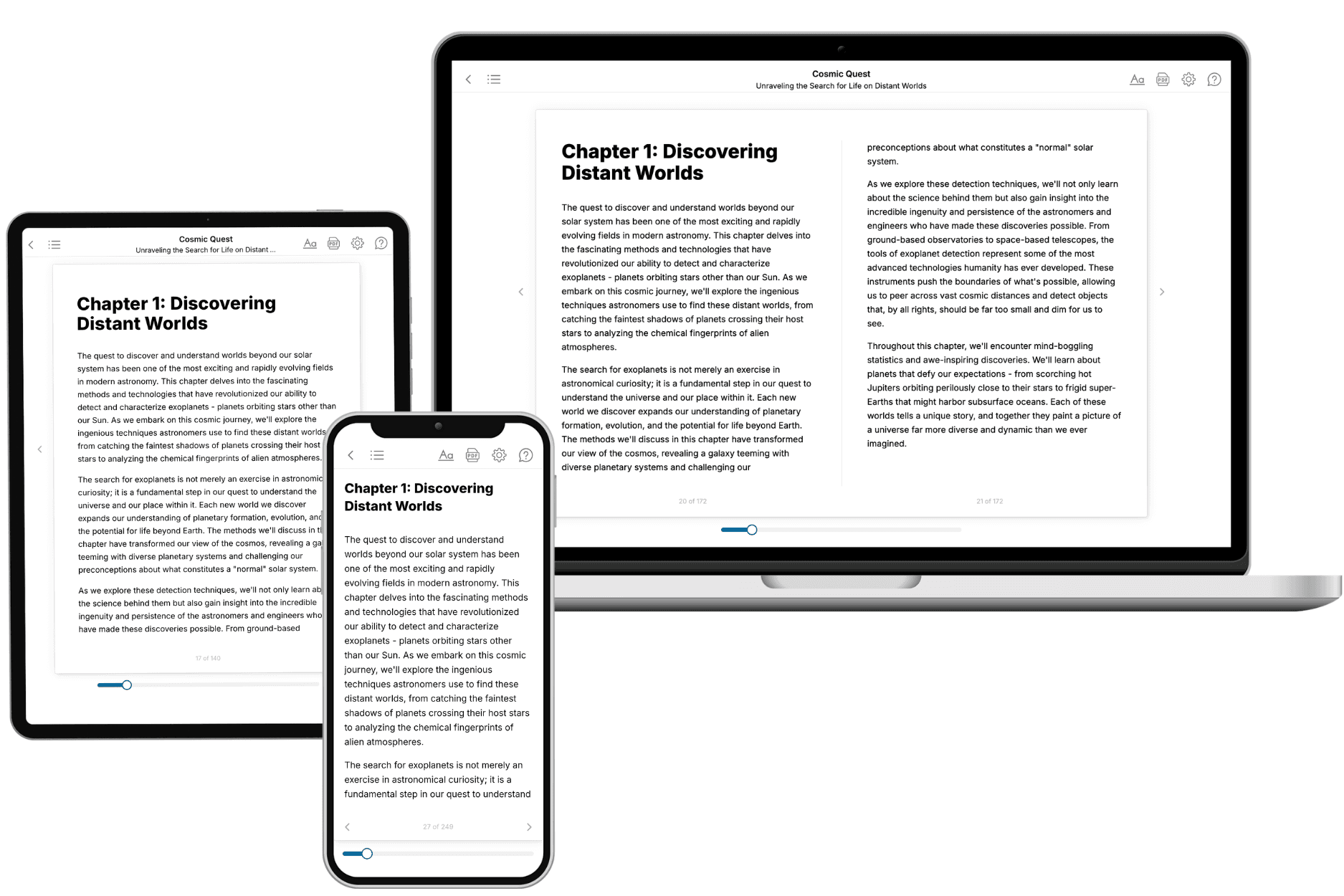
Your book is ready in 10 minutes. Read it online, download as EPUB or PDF, or send to Kindle.
Frequently asked questions
- What is TailoredRead?
TailoredRead creates complete, full-length nonfiction ebooks, written specifically for you. Tell us what you want to learn and why, and TailoredRead writes you a complete ebook on it, with charts, tables, and diagrams throughout. Read it online, on Kindle, or on any e-reader, or download it as a PDF or EPUB. Every book is written fresh the day you order it.
- How is the book tailored to me?
Before anything is written, you answer a few short questions about your goals, your background, and the topics you care about. Your book is then planned around your answers: written at your level, focused on your goals, and covering the topics you chose, instead of the one-size-fits-all book a store sells everyone.
- Will it read like generic AI content?
No. Your book isn't a chat transcript: it's planned chapter by chapter before a single word is written, told in a clear book voice, and explains ideas visually with charts, tables, and diagrams. After writing, every book goes through an editorial pass that polishes chapters so the book reads consistent from start to finish. Judge for yourself: browse thousands of sample books on our Explore Books page.
- How accurate is the content?
Our AI first checks whether your subject needs live research. Niche and fast-moving subjects are researched before writing, and the book plan and chapters are grounded in what it finds. After writing, every book goes through a quality pass that checks its facts and consistency, and researched books list their sources in a Notes section at the back.
- How long is the book?
You choose the length: Comprehensive (250-300 pages), Detailed (150-200 pages), Essential (70-100 pages), or Short (30-50 pages).
- Does the book include visuals?
Yes. Every book includes visual elements such as timelines, checklists, step-by-step guides, decision trees, comparison tables, and matrices, and many include bar charts. A typical book includes dozens of these visual elements.
- Can I read it on Kindle? What formats can I download?
Yes. Every book can be read in our online reader or downloaded as a PDF or EPUB. The EPUB can be opened with Kindle, Apple Books, Kobo, and any e-reader. The Commercial and Author licenses also include an editable Word (DOCX) and Markdown download.
- How much does it cost?
About the price of a regular ebook. The exact price depends on your book's length and complexity, from $2 for the shortest books to $35 for the most comprehensive, and it's shown when you review your book, before you commit to anything. Each book is a one-time purchase, yours to keep, no subscription. Licenses that let you share, teach, or publish your book range from $35.99 to $49.99.
- Can I preview the book before purchasing?
Before you pay, you'll see what your book will cover: the title, a detailed description, the estimated length, and the complete chapter-by-chapter table of contents, so you know what you're getting before you decide. The full text itself is written after you purchase.
- How long does it take to create a book?
About 10 minutes. You can start reading the opening chapters while the rest is still being written.