Unraveling Patterns
A Comprehensive Guide to Sequences and Series in Intermediate Algebra
Math anxiety often stems from a lack of understanding, especially when it comes to complex topics like sequences and series.
269 pages13 chaptersJan 8, 2025Mathematics
About this book
You might feel overwhelmed by the seemingly endless patterns and formulas, wondering how they all fit together. But what if there was a way to make sense of it all? Unraveling Patterns: A Comprehensive Guide to Sequences and Series in Intermediate Algebra is your key to demystifying these fundamental concepts. This book breaks down the complexities of sequences and series into digestible, easy-to-understand chunks, allowing you to build your knowledge step by step. From arithmetic and geometric sequences to infinite series and convergence tests, this guide covers it all. You'll discover how to identify patterns, derive formulas, and apply your knowledge to solve real-world problems. With clear explanations, numerous examples, and practice exercises, you'll gain the confidence to tackle any sequence or series problem that comes your way. Whether you're a student looking to excel in your math classes or simply someone who wants to understand the beauty of mathematical patterns, this book will equip you with the tools and insights you need. Get ready to see the world of sequences and series in a whole new light!
Table of contents
- IntroductionThe Importance of Sequences and Series in Mathematics, Overview of the Book's Contents, How to Use This Book Effectively, Prerequisites and Assumed KnowledgeRead below
- Chapter 1: Foundations of SequencesDefinition and Notation of Sequences, Terms and Elements of a Sequence, Explicit and Recursive Definitions, Examples of Common Sequences
- Chapter 2: Arithmetic SequencesDefinition and Properties of Arithmetic Sequences, Finding the Common Difference, The nth Term Formula, Real-world Applications of Arithmetic Sequences
- Chapter 3: Geometric SequencesDefinition and Properties of Geometric Sequences, Identifying the Common Ratio, The nth Term Formula for Geometric Sequences, Practical Applications of Geometric Sequences
- Chapter 4: Other Types of SequencesThe Fibonacci Sequence, Harmonic Sequences, Quadratic Sequences, Recursive Sequences
- Chapter 5: Operations on SequencesAdding and Subtracting Sequences, Multiplying Sequences by a Constant, Combining Different Types of Sequences, Limits of Sequences
- Chapter 6: Introduction to SeriesDefinition and Notation of Series, Finite vs. Infinite Series, Partial Sums and Their Significance, Examples of Common Series
- Chapter 7: Arithmetic SeriesDefinition of Arithmetic Series, The Sum Formula for Arithmetic Series, Deriving the Sum Formula, Applications of Arithmetic Series
- Chapter 8: Geometric SeriesDefinition of Geometric Series, The Sum Formula for Finite Geometric Series, Infinite Geometric Series, Real-world Applications of Geometric Series
- Chapter 9: Convergence and DivergenceDefinition of Convergence and Divergence, Basic Convergence Tests, The Ratio Test, The Root Test
- Chapter 10: Power SeriesDefinition of Power Series, Radius of Convergence, Introduction to Taylor Series, Applications of Power Series
- Chapter 11: Problem-Solving StrategiesIdentifying Patterns in Sequences and Series, Choosing the Right Formula, Step-by-Step Problem-Solving Approach, Common Pitfalls and How to Avoid Them
- Chapter 12: Real-World ApplicationsApplications in Physics, Applications in Biology, Applications in Computer Science, Sequences and Series in Everyday Life
- Chapter 13: Advanced Topics in Sequences and SeriesTelescoping Series, The Binomial Theorem, Introduction to Fourier Series, Generating Functions
- ConclusionKey Takeaways, Areas for Further Exploration
- Glossary
- Further Reading
Introduction
Welcome to the fascinating world of sequences and series! As you embark on this mathematical journey, you're about to discover a realm of patterns, formulas, and infinite possibilities that will transform your understanding of mathematics. This introduction serves as your gateway to the captivating concepts that lie ahead, setting the stage for an exploration that will not only enhance your mathematical skills but also reveal the intricate beauty of numbers and their relationships.
Throughout history, mathematicians and scientists have been captivated by the elegance and power of sequences and series. From the ancient Greeks' study of geometric progressions to modern applications in computer algorithms and financial modeling, these mathematical constructs have played a pivotal role in advancing our understanding of the world around us. As you delve into this book, you'll join the ranks of those who have unraveled the mysteries of patterns, unlocking a toolset that will serve you well in your mathematical endeavors and beyond.
Whether you're a student looking to excel in your algebra courses or simply someone with a curiosity for mathematical concepts, this book is designed to guide you through the intricacies of sequences and series with clarity and precision. By the time you reach the final pages, you'll have gained not just knowledge, but also a new appreciation for the way mathematics can describe and predict patterns in nature, technology, and everyday life.
So, prepare to embark on an intellectual adventure that will challenge your mind, spark your curiosity, and ultimately reward you with a deeper understanding of one of mathematics' most fundamental and fascinating areas. Let's begin our journey into the world of sequences and series, where each step builds upon the last, creating a progression of knowledge that is both beautiful and powerful.
The Importance of Sequences and Series in Mathematics
Sequences and series stand as pillars in the grand edifice of mathematics, their significance reaching far beyond the confines of textbooks and classrooms. These mathematical constructs serve as fundamental tools for describing patterns, modeling growth and decay, and understanding the behavior of complex systems. Their importance cannot be overstated, as they provide a framework for tackling a wide array of problems in pure and applied mathematics, as well as in numerous scientific and practical fields.
At their core, sequences are ordered lists of numbers that follow specific patterns. They allow mathematicians to represent iterative processes, describe natural phenomena, and model discrete changes over time. From the simple counting numbers to more complex patterns like the Fibonacci sequence, sequences provide a way to encapsulate mathematical relationships in a concise and powerful form. Series, on the other hand, represent the sum of the terms in a sequence, offering insights into accumulation, convergence, and the limits of infinite processes. Together, sequences and series form a dynamic duo that enables us to analyze and predict patterns in ways that would otherwise be impossible.
The study of sequences and series is crucial for developing mathematical reasoning and problem-solving skills. As you work with these concepts, you'll find yourself honing your ability to recognize patterns, make logical deductions, and apply abstract thinking to concrete problems. These skills are not only valuable in mathematics but are also highly transferable to other disciplines and real-world situations. The analytical mindset developed through the study of sequences and series can be applied to everything from scientific research to business strategy.
In the realm of pure mathematics, sequences and series play a vital role in various branches, including calculus, analysis, and number theory. They form the foundation for understanding limits, continuity, and infinite processes, concepts that are essential for advanced mathematical study. For instance, the concept of a limit, which is fundamental to calculus, is often introduced through the behavior of sequences. Similarly, many important mathematical constants, such as π and e, can be defined and calculated using infinite series.
The applications of sequences and series extend far beyond theoretical mathematics. In physics, they are used to describe motion, oscillations, and wave phenomena. Engineers employ them in signal processing and control systems. Biologists use them to model population growth and genetic patterns. In the world of finance, geometric sequences and series are fundamental to understanding compound interest and present value calculations. Computer scientists rely on sequences and series for algorithm analysis and in the development of efficient computational methods.
Moreover, sequences and series provide a bridge between discrete and continuous mathematics. Many continuous functions can be approximated or represented exactly by infinite series, a fact that has profound implications in fields such as numerical analysis and computational mathematics. This connection allows for the solution of problems that would be intractable using purely continuous or purely discrete methods.
The importance of sequences and series is also evident in their role in developing mathematical intuition. As you work with these concepts, you'll begin to develop a sense for how mathematical processes behave over time or through iteration. This intuition is invaluable when tackling new problems or exploring unfamiliar mathematical territories. It allows you to make educated guesses, formulate conjectures, and approach complex problems with a well-informed perspective.
Furthermore, sequences and series offer a historical perspective on the development of mathematical thought. Many of the greatest mathematicians throughout history have grappled with problems related to sequences and series, leading to breakthroughs that have shaped the field. By studying these concepts, you're not just learning mathematical techniques; you're also engaging with a rich intellectual tradition that spans centuries.
As you progress through this book, you'll discover that sequences and series are not just abstract mathematical constructs, but powerful tools for understanding and describing the world around us. They provide a language for expressing complex ideas simply and elegantly, allowing us to uncover hidden patterns and make predictions about future behavior. Whether you're analyzing data, designing algorithms, or exploring theoretical concepts, a solid understanding of sequences and series will prove invaluable.
In conclusion, the importance of sequences and series in mathematics cannot be overstated. They are essential building blocks that support a wide range of mathematical concepts and applications. By mastering these fundamental ideas, you'll not only enhance your mathematical abilities but also gain insights that can be applied across various disciplines. As you embark on this journey through the world of sequences and series, remember that you're acquiring tools and perspectives that will serve you well throughout your mathematical studies and beyond.
Overview of the Book's Contents
This book is designed to take you on a comprehensive journey through the world of sequences and series, starting from the fundamental concepts and progressing to more advanced topics. Each chapter builds upon the knowledge gained in the previous ones, creating a logical and coherent learning path. The content is structured to provide a balance between theoretical understanding and practical application, ensuring that you not only grasp the concepts but also learn how to apply them in various contexts.
We begin our exploration with the foundations of sequences in Chapter 1. Here, you'll learn the basic definitions and notations used to describe sequences. You'll discover how to identify terms and elements of a sequence, and understand the difference between explicit and recursive definitions. This chapter lays the groundwork for all that follows, introducing you to common sequences that will serve as building blocks for more complex ideas.
Chapters 2 and 3 delve into two of the most important types of sequences: arithmetic and geometric sequences, respectively. In these chapters, you'll learn to recognize the unique properties of each type, understand the concept of common difference and common ratio, and master the formulas for finding the nth term. Real-world applications are presented to illustrate how these sequences manifest in practical situations, bridging the gap between abstract mathematics and tangible scenarios.
Chapter 4 broadens your horizons by introducing other types of sequences, including the famous Fibonacci sequence, harmonic sequences, quadratic sequences, and recursive sequences. This chapter showcases the diversity of mathematical sequences and provides insight into their unique properties and applications. You'll begin to appreciate the wide range of patterns that can be described using sequence notation.
In Chapter 5, we explore operations on sequences, teaching you how to manipulate and combine sequences mathematically. You'll learn techniques for adding, subtracting, and multiplying sequences, as well as how to work with limits of sequences. This chapter enhances your toolkit for working with sequences and prepares you for the transition to series.
Chapter 6 marks the beginning of our exploration into series, providing a comprehensive introduction to this crucial concept. You'll learn the definition and notation of series, understand the distinction between finite and infinite series, and grasp the importance of partial sums. This chapter sets the stage for the more detailed study of specific types of series in the following chapters.
Chapters 7 and 8 focus on arithmetic and geometric series, respectively. These chapters build upon your knowledge of arithmetic and geometric sequences, showing how the sum of their terms leads to powerful formulas and interesting properties. You'll learn to derive and apply sum formulas, and explore real-world applications that demonstrate the practical utility of these concepts.
Chapter 9 introduces the critical concepts of convergence and divergence in infinite series. This chapter is crucial for understanding the behavior of series as they extend indefinitely. You'll learn various tests for determining whether a series converges or diverges, including the ratio test and the root test. These tools are essential for analyzing the long-term behavior of series and are fundamental to many advanced mathematical concepts.
In Chapter 10, we venture into the realm of power series, a type of infinite series with wide-ranging applications in mathematics and physics. You'll learn about the radius of convergence and get an introduction to Taylor series, powerful tools for approximating functions. This chapter bridges the gap between discrete mathematics and continuous functions, showcasing the versatility of series in mathematical analysis.
Chapter 11 is dedicated to problem-solving strategies, equipping you with practical techniques for tackling sequence and series problems. You'll learn how to identify patterns, choose the appropriate formulas, and approach problems systematically. This chapter also addresses common pitfalls and how to avoid them, enhancing your ability to solve complex problems with confidence.
Chapter 12 brings sequences and series into the real world, exploring their applications across various fields. From physics and biology to computer science and everyday life, you'll see how the concepts you've learned are applied to solve practical problems and model real-world phenomena. This chapter reinforces the relevance and importance of sequences and series beyond the realm of pure mathematics.
For those seeking to push their understanding further, Chapter 13 introduces advanced topics in sequences and series. Here, you'll encounter concepts like telescoping series, the binomial theorem, an introduction to Fourier series, and generating functions. While these topics are more challenging, they offer a glimpse into the depth and breadth of sequences and series in higher mathematics.
The book concludes with a comprehensive glossary of terms, ensuring that you have a quick reference for key concepts, and a list of further reading suggestions to guide your continued exploration of the subject. Throughout the book, you'll find numerous examples, practice problems, and real-world applications to reinforce your learning and help you develop a deep, intuitive understanding of sequences and series.
By the time you reach the end of this book, you'll have gained a solid foundation in sequences and series, developed strong problem-solving skills, and acquired an appreciation for the beauty and utility of these mathematical concepts. Whether you're preparing for advanced mathematics courses, looking to apply these concepts in your field of study or work, or simply satisfying your curiosity, this book will provide you with the knowledge and tools you need to succeed.
How to Use This Book Effectively
To maximize your learning experience and get the most out of this book, it's important to approach it with a strategic mindset. This section will provide you with practical tips and techniques to help you navigate the content effectively, retain information, and develop a deep understanding of sequences and series. By following these guidelines, you'll be well-equipped to tackle the material and achieve your learning goals.
First and foremost, it's crucial to read actively rather than passively. This means engaging with the text, asking questions, and reflecting on the concepts as you encounter them. Don't simply skim through the pages; instead, take the time to digest each section thoroughly. As you read, try to summarize key points in your own words. This process of paraphrasing helps reinforce your understanding and makes the information more memorable. Additionally, consider keeping a notebook or digital document where you can jot down important concepts, formulas, and your own insights. This personal reference will be invaluable as you progress through the book and review material later.
One effective strategy is to preview each chapter before diving into the details. Start by reading the chapter title and section headings to get an overview of what you'll be learning. This creates a mental framework that helps you organize new information as you encounter it. Pay special attention to the learning objectives or key points often presented at the beginning of each chapter. These serve as guideposts for what you should focus on and understand by the end of the chapter.
As you work through each chapter, take advantage of the examples provided. Don't just read through them passively; instead, try to work through the solutions on your own before looking at the book's explanation. This active problem-solving approach helps reinforce your understanding and builds your confidence in applying the concepts. When you do review the book's solution, compare it to your own approach. If there are differences, try to understand why the book's method might be more efficient or elegant. This comparative analysis can lead to valuable insights and improve your problem-solving skills.
Practice problems are an essential component of learning mathematics, and this book provides numerous opportunities for you to test your understanding. Make a commitment to attempt all practice problems, even if they seem challenging at first. Remember, struggling with a problem is often where the most significant learning occurs. If you find yourself stuck, resist the temptation to immediately look up the answer. Instead, review the relevant sections of the chapter, consult your notes, or try to break the problem down into smaller, more manageable steps. When you do consult the solutions, use them as a learning tool rather than a shortcut. Analyze the problem-solving process, not just the final answer.
Visualization can be a powerful aid in understanding sequences and series. Whenever possible, try to create visual representations of the concepts you're learning. This could involve sketching graphs, drawing diagrams, or using online graphing tools to plot sequences and series. Visual aids can help you grasp abstract concepts more intuitively and often reveal patterns or relationships that might not be immediately apparent from formulas alone.
Don't hesitate to use additional resources to supplement your learning. While this book is designed to be comprehensive, you may find it helpful to explore online tutorials, video lectures, or interactive simulations that cover specific topics. These diverse learning materials can provide alternative explanations or perspectives that might resonate with your learning style. However, be sure to use these resources as supplements rather than replacements for the core content of the book.
Consistency is key when studying mathematics. Try to establish a regular study routine, setting aside dedicated time to work through the book. Short, frequent study sessions are often more effective than long, infrequent ones. This approach allows for better retention and gives your mind time to process and internalize new concepts. Consider using techniques like the Pomodoro method, where you study intensively for 25-minute intervals followed by short breaks, to maintain focus and prevent burnout.
As you progress through the book, make connections between new material and concepts you've already learned. Sequences and series build upon each other, and understanding these relationships will deepen your comprehension of the subject as a whole. Look for patterns and similarities across different types of sequences and series, and try to articulate these connections in your own words.
Don't be afraid to revisit earlier chapters or sections as needed. Mathematics is cumulative, and a solid understanding of foundational concepts is crucial for grasping more advanced topics. If you encounter a concept that seems unclear, take the time to go back and review the relevant material. This iterative approach to learning can help solidify your understanding and fill in any gaps in your knowledge.
Finally, remember that learning mathematics is a process that requires patience and persistence. You may encounter concepts that don't click immediately, and that's perfectly normal. Embrace the challenges as opportunities for growth rather than obstacles. Celebrate your progress, no matter how small, and maintain a positive attitude towards your learning journey. With consistent effort and the right approach, you'll find yourself mastering the intricacies of sequences and series and developing a deep appreciation for their beauty and power.
By following these strategies and approaching this book with dedication and curiosity, you'll be well on your way to developing a strong foundation in sequences and series. Remember, the goal is not just to memorize formulas and procedures, but to develop a genuine understanding of the concepts and the ability to apply them flexibly to a wide range of problems. Enjoy the journey of discovery that lies ahead, and let this book be your guide to unraveling the fascinating patterns of sequences and series.
Prerequisites and Assumed Knowledge
Before diving into the rich world of sequences and series, it's important to understand the foundational knowledge that this book assumes you possess. While the content is designed to be accessible to students at a high school or early college level, having a solid grasp of certain mathematical concepts will greatly enhance your ability to understand and apply the material presented. This section outlines the key prerequisites and assumed knowledge, helping you assess your readiness and identify any areas you may need to review before proceeding.
First and foremost, a strong foundation in basic algebra is essential. You should be comfortable working with variables, solving linear and quadratic equations, and manipulating algebraic expressions. This includes skills such as factoring, simplifying fractions, and working with exponents and radicals. The ability to rearrange equations and isolate variables is particularly important, as many sequence and series problems involve deriving formulas or solving for specific terms.
A fundamental understanding of functions is also crucial. You should be familiar with the concept of a function as a relationship between inputs and outputs, and be able to work with function notation. Knowledge of common functions such as linear, quadratic, exponential, and logarithmic functions will be helpful, as these often appear in the context of sequences and series. Additionally, being able to graph functions and interpret their behavior from graphs will aid in visualizing sequence and series concepts.
Familiarity with basic geometric concepts is beneficial, particularly when dealing with geometric sequences and series. This includes understanding properties of triangles, circles, and other common shapes, as well as basic trigonometric functions (sine, cosine, tangent). While not all chapters heavily rely on geometry, having this background will help you appreciate certain applications and derivations.
A grasp of basic set theory and logic will support your understanding of sequence definitions and series convergence. This includes concepts such as set notation, union and intersection of sets, and logical operators (and, or, not). The ability to understand and construct mathematical proofs, while not strictly necessary, will enhance your appreciation of certain derivations and theorems presented in the book.
Some exposure to limits and basic calculus concepts can be advantageous, especially when dealing with infinite series and convergence tests. While the book will introduce these ideas as needed, prior familiarity with the concept of a limit and basic differentiation and integration techniques can provide a helpful context for more advanced topics.
Comfort with mathematical notation is important. You should be familiar with summation notation (Σ) and be able to interpret and manipulate expressions involving this symbol. Understanding of inequality symbols (<, >, ≤, ≥) and their use in expressing ranges and conditions is also essential.
Basic number theory concepts, such as prime numbers, factors, and divisibility rules, will be helpful in certain sections, particularly when dealing with number sequences and some advanced topics. While these concepts will be reviewed as needed, prior exposure will facilitate a deeper understanding.
Problem-solving skills and mathematical reasoning abilities are perhaps the most important prerequisites. This includes the capacity to approach problems systematically, break complex issues into smaller parts, and apply logical thinking to mathematical situations. The ability to recognize patterns, make conjectures, and verify or disprove statements is crucial for success in studying sequences and series.
Familiarity with mathematical software or calculators can be beneficial, although not strictly necessary. While the book focuses on developing conceptual understanding and analytical skills, knowing how to use tools like graphing calculators or software packages (e.g., Desmos, GeoGebra) can aid in visualization and verification of results.
If you find that your knowledge in any of these areas is rusty or incomplete, don't be discouraged. The book is designed to provide reminders and brief reviews of key concepts as they become relevant. However, taking the time to brush up on these fundamentals before or as you encounter them will greatly enhance your learning experience and comprehension of the material.
Remember, mathematics is a cumulative discipline, and each new concept builds upon previous knowledge. If you encounter topics or terms that are unfamiliar as you progress through the book, don't hesitate to pause and review the necessary background material. Online resources, textbooks, or educational videos can be valuable supplements for refreshing your understanding of prerequisite topics.
Ultimately, the most important prerequisite is a willingness to learn and engage with the material actively. Approach the content with curiosity, persistence, and a readiness to practice. Even if some of the assumed knowledge feels challenging at first, consistent effort and engagement with the material will help you develop the necessary skills and understanding as you progress through the book.
By ensuring you have a solid grasp of these prerequisites, you'll be well-prepared to embark on your journey through the fascinating world of sequences and series. This foundation will allow you to focus on the new concepts and techniques presented in the book, building upon your existing knowledge to develop a comprehensive understanding of this important area of mathematics.
This is the end of the free sample. The full book has 13 chapters.
Want this book written for you?
Tell us your goals and background, and get your own version of this book, tailored by AI to you.


Benefits of AI-tailored books
- Read one book, not ten:
- all the Mathematics knowledge you need, gathered into a single book.
- Save days of learning:
- tell us your goals, choose your topics, and the whole book is built around them.
- Learn effortlessly:
- Mathematics book written for your specific background and expertise.
- Understand at a glance:
- includes charts, tables, timelines, checklists, decision trees, and more.
- Stay current:
- written the day you order it, not years ago.
- Trust what you read:
- every book is checked for accuracy, with real research when your subject needs it.
Create your unique book in 3 steps
- 1. Select your focus
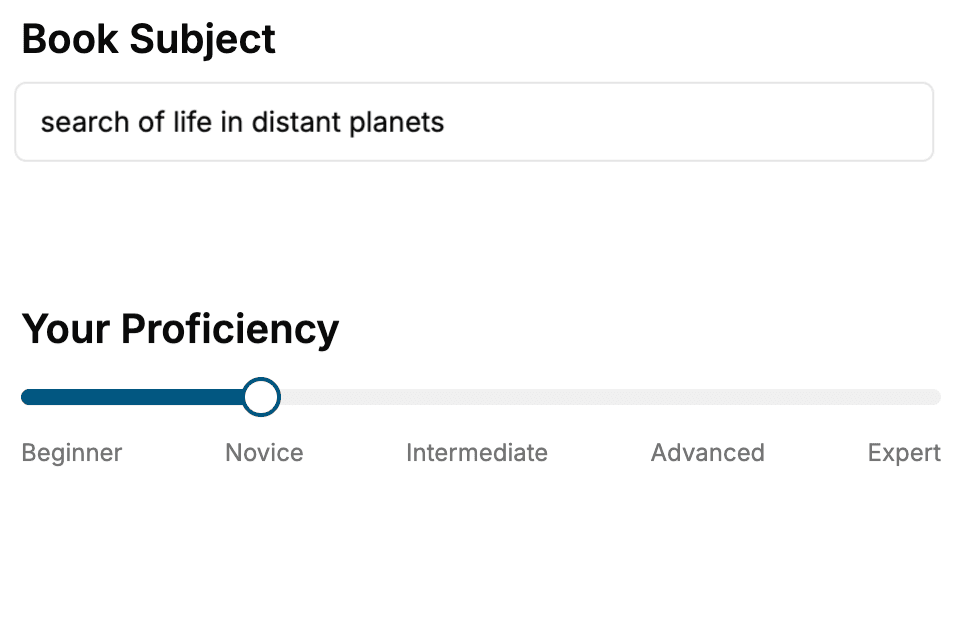
Select the focus of your Mathematics book and share your background
- 2. Personalize your book
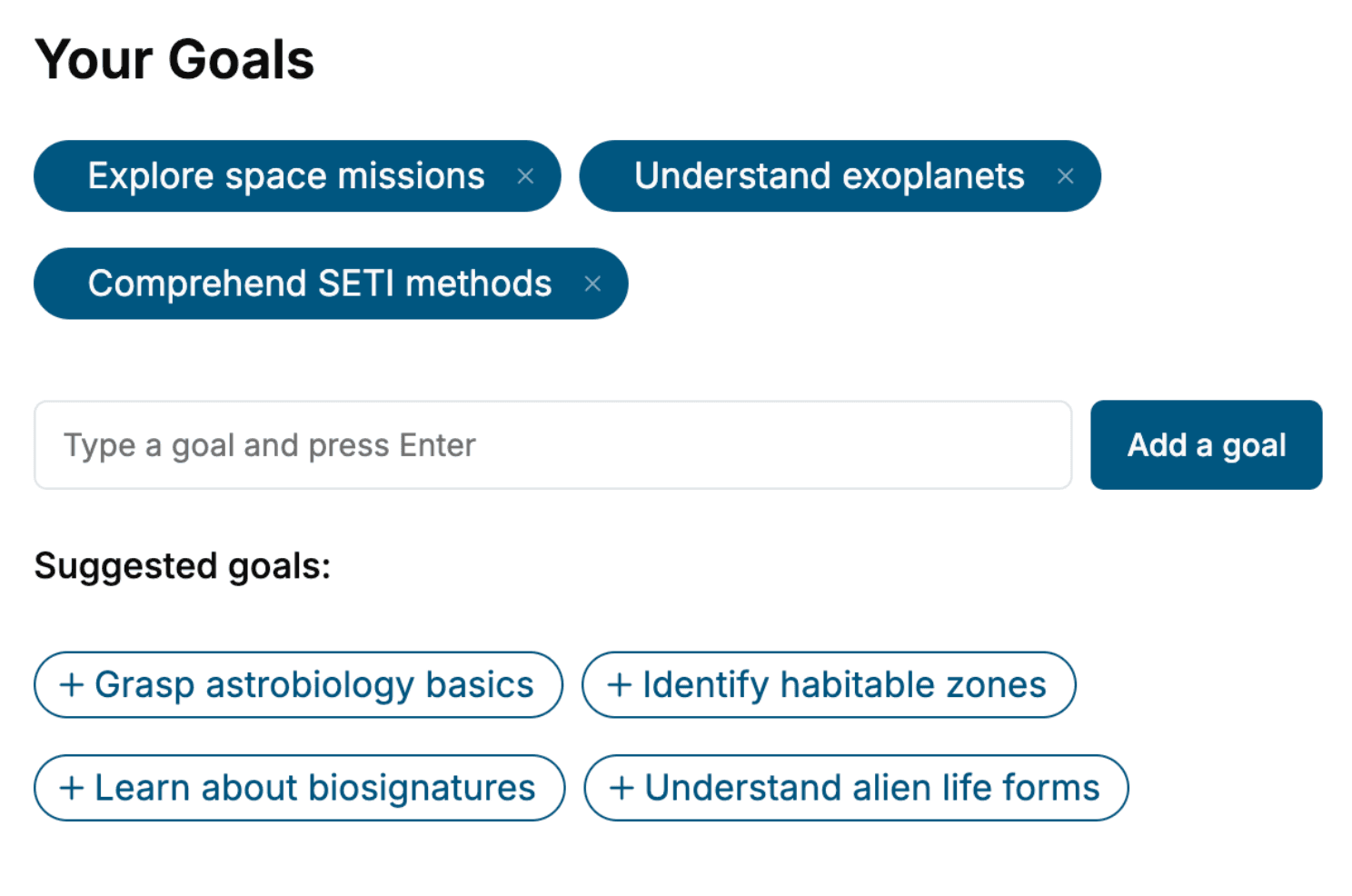
Specify your goals and choose sub-topics to include
- 3. Get your tailored book
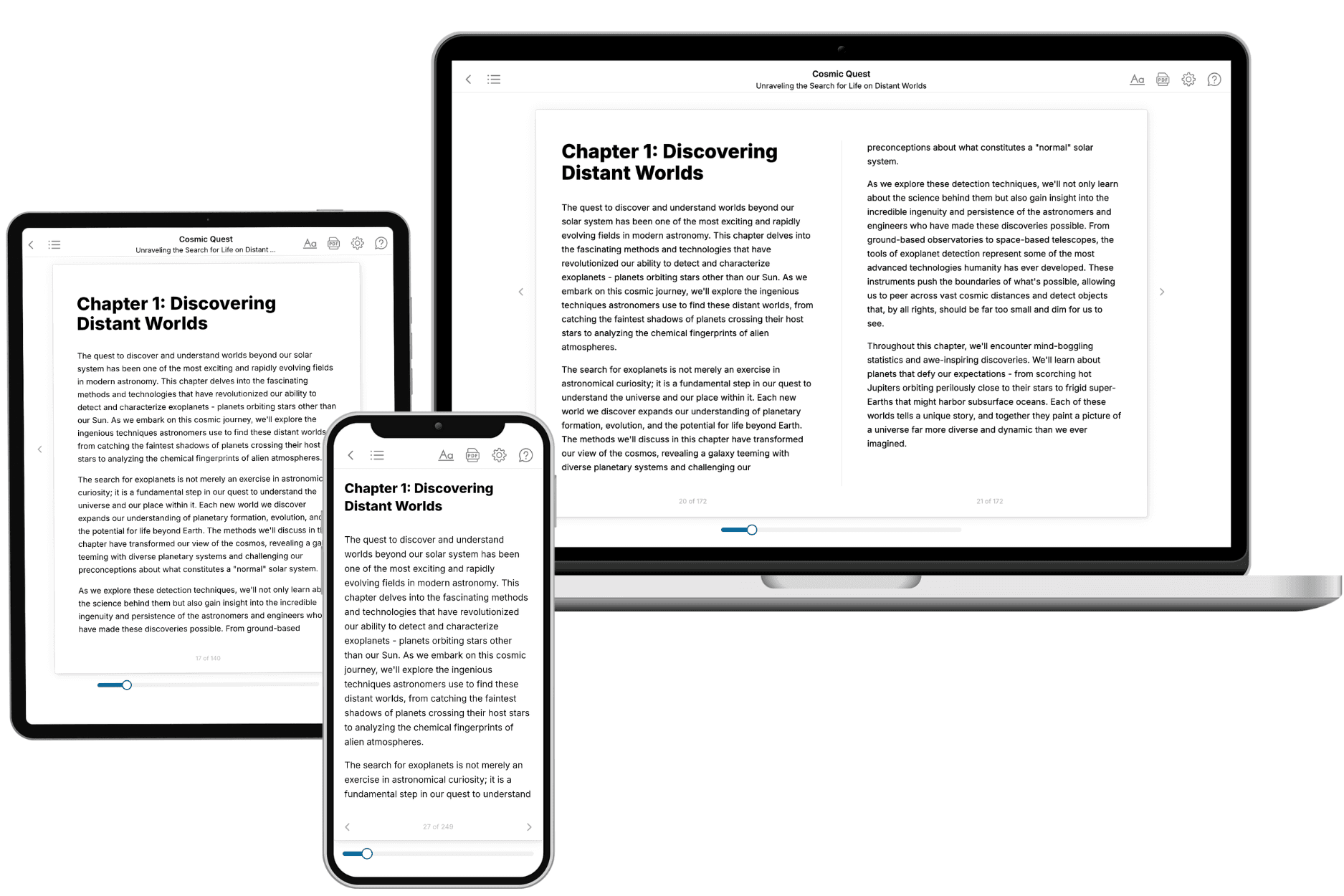
Your book is ready in 10 minutes. Read it online, download as EPUB or PDF, or send to Kindle.
Frequently asked questions
- What is TailoredRead?
TailoredRead creates complete, full-length nonfiction ebooks, written specifically for you. Tell us what you want to learn and why, and TailoredRead writes you a complete ebook on it, with charts, tables, and diagrams throughout. Read it online, on Kindle, or on any e-reader, or download it as a PDF or EPUB. Every book is written fresh the day you order it.
- How is the book tailored to me?
Before anything is written, you answer a few short questions about your goals, your background, and the topics you care about. Your book is then planned around your answers: written at your level, focused on your goals, and covering the topics you chose, instead of the one-size-fits-all book a store sells everyone.
- Will it read like generic AI content?
No. Your book isn't a chat transcript: it's planned chapter by chapter before a single word is written, told in a clear book voice, and explains ideas visually with charts, tables, and diagrams. After writing, every book goes through an editorial pass that polishes chapters so the book reads consistent from start to finish. Judge for yourself: browse thousands of sample books on our Explore Books page.
- How accurate is the content?
Our AI first checks whether your subject needs live research. Niche and fast-moving subjects are researched before writing, and the book plan and chapters are grounded in what it finds. After writing, every book goes through a quality pass that checks its facts and consistency, and researched books list their sources in a Notes section at the back.
- How long is the book?
You choose the length: Comprehensive (250-300 pages), Detailed (150-200 pages), Essential (70-100 pages), or Short (30-50 pages).
- Does the book include visuals?
Yes. Every book includes charts, tables, and diagrams: timelines, checklists, step-by-step guides, decision trees, comparison tables, matrices, and bar charts. A typical book includes dozens of these visual elements.
- Can I read it on Kindle? What formats can I download?
Yes. Every book can be read in our online reader or downloaded as a PDF or EPUB. The EPUB can be opened with Kindle, Apple Books, Kobo, and any e-reader. The Commercial and Author licenses also include an editable Word (DOCX) and Markdown download.
- How much does it cost?
About the price of a regular ebook. The exact price depends on your book's length and complexity, from $2 for the shortest books to $35 for the most comprehensive, and it's shown when you review your book, before you commit to anything. Each book is a one-time purchase, yours to keep, no subscription. Licenses that let you share, teach, or publish your book range from $35.99 to $49.99.
- Can I preview the book before purchasing?
Before you pay, you'll see what your book will cover: the title, a detailed description, the estimated length, and the complete chapter-by-chapter table of contents, so you know what you're getting before you decide. The full text itself is written after you purchase.
- How long does it take to create a book?
About 10 minutes. You can start reading the opening chapters while the rest is still being written.