Venus Figurines
Unlocking the Mysteries of Upper Paleolithic Art and Symbolism
Discover the fascinating world of Venus figurines—ancient carved figures that challenge everything we thought we knew about prehistoric human creativity and culture.
207 pages10 chaptersMay 13, 2026Upper Paleolithic Age
About this book
These remarkable artifacts, created between 40,000 and 20,000 years ago, represent some of humanity's earliest artistic achievements and offer profound insights into the minds and societies of our Upper Paleolithic ancestors. Through careful examination of these small but powerful sculptures, you'll explore the mysteries of early human symbolism, the role of women in prehistoric communities, and the sophisticated cognitive abilities that allowed our ancestors to create abstract art. This book guides you through the discovery history of Venus figurines, the various theories about their meaning and purpose, and what modern scientific techniques are revealing about their creation and use. Whether you're fascinated by archaeology, human evolution, or the origins of art itself, Venus figurines provide a tangible connection to our deep past and demonstrate that the human impulse to create, symbolize, and express meaning is as old as our species itself.
Table of contents
- IntroductionWhy Venus Figurines Matter Today, What You Will Discover in This Book, How to Use This GuideRead below
- Chapter 1: The Upper Paleolithic WorldTimeline and Geography of the Upper Paleolithic, Climate, Environment, and Human Adaptation, Daily Life and Social Organization
- Chapter 2: Discovery and DocumentationThe First Discoveries: From Willendorf to Beyond, Major Archaeological Sites and Collections, How Archaeologists Catalog and Classify Venus Figurines
- Chapter 3: Physical Characteristics and VariationsSize, Shape, and Form Across Regions, Materials and Craftsmanship Techniques, Stylistic Evolution Over Time
- Chapter 4: Theories of Meaning and PurposeThe Fertility Hypothesis: Origins and Critiques, Spiritual and Ritual Functions, Alternative Interpretations and Emerging Theories
- Chapter 5: Geographic Distribution and Cultural NetworksVenus Figurines Across Europe, Asian and Siberian Examples, Evidence of Trade and Cultural Exchange
- Chapter 6: Women in Upper Paleolithic SocietyFemale Imagery in Upper Paleolithic Art, What Venus Figurines Reveal About Gender Roles and Status, Evidence for Female Artists and Creators
- Chapter 7: Modern Scientific Analysis and TechnologyDating Methods and Chronological Frameworks, Chemical Composition and Material Analysis, 3D Imaging and Digital Reconstruction
- Chapter 8: Experimental Archaeology and ReplicationRecreating Ancient Carving Techniques, Understanding Tool Use and Skill Requirements, What Replication Studies Teach Us
- Chapter 9: Scholarly Debates and ControversiesHow Interpretations Have Shifted Over Decades, Current Scholarly Disagreements and Debates, The Importance of Avoiding Modern Bias in Interpretation
- Chapter 10: Venus Figurines and Human CognitionSymbolic Thinking and Abstract Representation, Artistic Expression and Creative Capacity, What Venus Figurines Reveal About Cognitive Evolution
- ConclusionSynthesizing What We Know, Future Research Directions and Unanswered Questions
- Further Reading and Resources
Introduction
Somewhere in Europe, roughly 25,000 years ago, a person sat down with a small piece of limestone and began to carve. The figure that emerged from that stone was compact, rounded, and unmistakably female. It had no face to speak of, no feet, and arms so slender they barely registered. But the torso was full and carefully shaped, the hips wide, the breasts heavy and detailed. Whoever made it understood the human body and chose to represent it in a very specific way. That carved stone, now known as the Venus of Willendorf, sits today in a museum in Vienna and continues to provoke questions that archaeologists, anthropologists, and curious minds have been wrestling with for well over a century.
Venus figurines are among the oldest known examples of representational art in human history. Carved from stone, ivory, bone, and even fired clay, these small sculptures of female figures were created across a vast stretch of time and geography. They appear from western France all the way to Siberia, spanning a period from roughly 40,000 to 10,000 years ago. That kind of reach, both in time and space, is extraordinary. It tells us that something about these objects mattered deeply to the people who made them, even if we are still working out exactly what that something was.
What makes Venus figurines so compelling is not just their age or their distribution. It is the questions they raise about the people who created them. These were not simple, instinct-driven creatures scraping by in a brutal world. They were fully modern humans with complex social lives, sophisticated tools, and, as these figurines demonstrate, a rich inner world of symbols and meaning. The impulse to carve a human figure, to give it weight and form and intention, is not a basic survival behavior. It is something more. It points to minds capable of abstraction, of representation, of art. And that changes how we think about our own origins.
This book is an invitation to explore that world. It takes the Venus figurines as its starting point and uses them as a lens through which to examine Upper Paleolithic culture, society, and cognition. Along the way, you will encounter the archaeologists who first dug these figures from the earth, the theories that have been built and dismantled around them, and the cutting-edge scientific tools now being used to learn more about how they were made and what they meant. The story of Venus figurines is, in many ways, the story of how we came to be the kind of creatures who need to make meaning out of the world around us.
Why Venus Figurines Matter Today
It might seem strange to spend serious intellectual energy on objects that fit in the palm of your hand and were made by people who left no written records. But Venus figurines matter for reasons that go well beyond their novelty as ancient curiosities. They are, in a very real sense, evidence of the birth of the human mind as we know it. The capacity for symbolic thought, for creating objects that stand in for ideas rather than just things, is one of the defining features of our species. These figurines are among the earliest physical proof that this capacity existed and was being actively exercised.
Consider what it takes to carve a figurine. You need to look at a raw material and see something that is not yet there. You need to plan, to work toward a mental image, to make dozens of small decisions about shape and proportion and detail. You need tools and the skill to use them. And you need a reason, some purpose or meaning that makes the effort worthwhile. All of that cognitive machinery was running in the minds of Upper Paleolithic people, and the figurines are the proof. They are not accidental. They are intentional, skilled, and in many cases, beautiful.
Venus figurines also matter because they force us to confront our assumptions about prehistoric life. For much of the history of archaeology, the dominant image of early humans was one of brute survival: hunting, gathering, sheltering, and little else. The existence of sophisticated art, including these figurines, complicates that picture in productive ways. It suggests that Upper Paleolithic people had leisure time, social structures that supported artistic production, and cultural traditions that were passed down and developed over generations. That is a very different picture from the one many people carry around in their heads.
There is also a more personal dimension to why these objects matter. Venus figurines represent some of the earliest known depictions of the human body, and specifically the female body, in art. That makes them relevant to ongoing conversations about gender, representation, and the role of women in early human societies. Scholars have debated for decades whether these figures were made by men or women, for men or women, and what their existence tells us about how female identity and experience were understood in the deep past. These are not idle academic questions. They connect to broader questions about human nature and social organization that remain very much alive today.
From a purely scientific standpoint, Venus figurines are also invaluable data points. Each one carries information about the materials available in a given region, the tools and techniques used by its maker, and the stylistic conventions of its time and place. When you look at dozens or hundreds of these figures together, patterns emerge that reveal trade networks, cultural connections, and the spread of ideas across vast distances. In this sense, the figurines function almost like a prehistoric communication system, encoding information about the societies that produced them in ways we are only beginning to fully decode.
Finally, Venus figurines matter because they are genuinely mysterious, and mystery is one of the most powerful drivers of human inquiry. Despite more than 150 years of study, we still do not know with certainty what these objects were for. Were they fertility charms? Spiritual icons? Portraits? Teaching tools? Toys? The honest answer is that we do not know, and that uncertainty is not a failure of archaeology. It is an invitation to keep asking questions, to keep developing new methods, and to keep approaching the past with humility and curiosity. That spirit of inquiry is what this book is built on.
The Venus figurines are not just objects from the past. They are mirrors held up to the present, reflecting our assumptions about gender, art, religion, and what it means to be human back at us with uncomfortable clarity.
Understanding why these figurines were made requires understanding the world that made them. That means grappling with ice age climates, nomadic lifestyles, and social structures that left almost no direct trace. It means reading the archaeological record carefully and resisting the temptation to fill in the gaps with modern assumptions. It is challenging work, but it is also deeply rewarding. Every new discovery, every new analysis, brings us a little closer to the people who sat down with a piece of stone and decided to make something that would last.
What You Will Discover in This Book
This book is organized to take you on a journey that moves from the broad to the specific and back again. It begins with the world in which Venus figurines were created, then zooms in on the objects themselves, and finally pulls back to consider what they mean for our understanding of human history and cognition. Each chapter builds on the ones before it, so by the time you reach the end, you will have a layered and nuanced picture of these remarkable artifacts and the people who made them.
The first chapter sets the stage by describing the Upper Paleolithic world. This was a period of dramatic climate change, with ice sheets covering much of northern Europe and human populations adapting to environments that shifted dramatically over thousands of years. Understanding this context is essential for making sense of the figurines. The people who carved them were not living in a stable, comfortable world. They were navigating real challenges, and the objects they created reflect that reality in ways that are not always immediately obvious.
From there, the book moves into the history of discovery. The story of how Venus figurines came to the attention of the modern world is itself a fascinating one, full of chance finds, colonial-era assumptions, and the gradual development of professional archaeology as a discipline. You will learn about the key sites where figurines have been found, from the famous Willendorf site in Austria to the remarkable Gravettian deposits of Russia and the Czech Republic, and about how archaeologists have worked to document and classify these objects over time.
The physical characteristics of the figurines get their own dedicated chapter, because the details matter enormously. Size, material, posture, the presence or absence of facial features, the treatment of hands and feet: all of these vary across time and geography in ways that carry meaning. Some figurines are highly naturalistic; others are so abstract they barely read as human. Understanding this range of variation is key to understanding the figurines as a category of objects rather than a single, uniform type.
The heart of the book deals with theories of meaning and purpose. This is where the real intellectual action is, and it is also where the most significant scholarly disagreements live. You will encounter the classic fertility hypothesis, which dominated interpretation for most of the twentieth century, along with the many critiques that have been leveled against it. You will also explore alternative theories, including the idea that figurines served as portable identity markers, as spiritual objects, as self-portraits made by women looking down at their own bodies, and as teaching tools for midwifery or childbirth. No single theory has won the day, and this book presents the evidence for each one honestly and without prejudice.
Later chapters explore the geographic distribution of Venus figurines and what it tells us about cultural networks in the Upper Paleolithic. The fact that similar figurines appear across thousands of miles of territory raises profound questions about how ideas traveled in a world without writing, roads, or permanent settlements. The evidence for trade and cultural exchange is examined carefully, along with what it suggests about the social lives of Upper Paleolithic people.
The book also dedicates significant attention to modern scientific methods. Techniques like radiocarbon dating, isotope analysis, X-ray fluorescence, and 3D digital scanning have transformed what we can learn from these objects without damaging them. Experimental archaeology, in which researchers attempt to recreate ancient carving techniques using period-appropriate tools, has added another layer of understanding about the skill and time required to produce these figurines. These chapters show that the study of Venus figurines is very much a living field, with new discoveries and new methods constantly reshaping the picture.
Throughout the book, the question of women in Upper Paleolithic society runs as a consistent thread. The prominence of female imagery in the art of this period is striking, and it demands explanation. What did it mean to these communities to represent the female body so frequently and with such care? What roles did women play in social, spiritual, and artistic life? These questions do not have simple answers, but the figurines provide important evidence that helps frame the discussion in productive ways.
The final chapters zoom out to consider the broader implications of Venus figurines for our understanding of human cognition and evolution. The capacity for symbolic thought that these objects represent is not a minor footnote in human history. It is one of the most significant developments in the story of our species, and the figurines are among its earliest and most tangible expressions. By the time you finish this book, you will have a much richer appreciation for what these small carved figures tell us about the deep roots of human creativity, spirituality, and social life.
How to Use This Guide
This book is designed to be read from beginning to end, but it is also structured so that individual chapters can stand on their own if you have a particular area of interest. If you are already familiar with the basics of Upper Paleolithic archaeology, you might choose to move quickly through the first two chapters and spend more time on the later ones dealing with interpretation and scientific analysis. If you are new to the subject, reading in order will give you the strongest foundation for understanding the more complex material that comes later.
Throughout the book, key terms are introduced and explained as they appear. Archaeology and anthropology have their own specialized vocabularies, and some of that vocabulary is genuinely useful for talking precisely about these objects and the world that produced them. Terms like Gravettian, lithic, and assemblage will come up regularly, and each one is explained in context the first time it appears. There is no need to memorize these terms, but becoming comfortable with them will help you engage more deeply with the material and with other sources you might explore afterward.
The book draws on a wide range of scholarly sources, from classic works of twentieth-century archaeology to the most recent peer-reviewed research. Where scholars disagree, those disagreements are presented fairly, with the evidence for each position laid out clearly. The goal is not to tell you what to think about Venus figurines, but to give you the tools to think about them well. Archaeology is a discipline built on interpretation, and interpretation is always provisional. New discoveries can and do change the picture, sometimes dramatically.
You will find footnotes throughout the text pointing to specific studies, excavation reports, and scholarly articles. These are included for two reasons. First, they allow you to verify claims and dig deeper into topics that interest you. Second, they model the kind of evidence-based reasoning that good archaeology depends on. Every significant claim in this book is grounded in actual research, and the footnotes make that grounding visible. If a particular figurine or site captures your imagination, the footnotes will point you toward the primary sources where you can learn more.
At the end of the book, you will find a curated list of further reading and resources. This includes both academic texts and more accessible works, as well as online databases and museum collections where you can view high-quality images of Venus figurines from around the world. Several major museums, including the Naturhistorisches Museum in Vienna and the Musée de l'Homme in Paris, have digitized significant portions of their collections, making it possible to examine these objects in remarkable detail without leaving your home.
A few practical notes are worth keeping in mind as you read. First, dates in this book are given in years before present (BP) or in calendar years BCE, depending on the context. The distinction matters because radiocarbon dates and calendar dates do not always align perfectly, and the text will make clear which system is being used in each case. Second, the term Venus figurine
is itself a scholarly convention, not a term that the people who made these objects would have recognized. It was applied by nineteenth-century archaeologists drawing on classical mythology, and it carries assumptions that many modern scholars find problematic. The term is used throughout this book because it is the standard one in the field, but its limitations are acknowledged and discussed in detail in the chapter on scholarly debates.
Most importantly, approach this material with an open mind. The temptation when studying prehistoric art is to reach for familiar frameworks, to see these figurines through the lens of modern religion, modern gender politics, or modern aesthetics. That temptation is understandable, but it can lead us badly astray. The people who made Venus figurines lived in a world profoundly different from our own, and understanding them requires a genuine effort to set aside modern assumptions and follow the evidence wherever it leads. That is not always comfortable, but it is always worthwhile.
The best approach to Venus figurines is the same approach that serves all good historical inquiry: hold your conclusions lightly, follow the evidence carefully, and never stop asking questions.
One of the most rewarding aspects of studying Venus figurines is the way they connect the very distant past to the very immediate present. These objects were made by people who were, in biological terms, identical to us. They had the same brains, the same emotional range, the same capacity for love, fear, curiosity, and creativity. When you look at a Venus figurine, you are looking at something made by a mind like yours, working with very different tools in a very different world, but driven by impulses that are recognizably human. That connection across 25,000 or 40,000 years is one of the most remarkable things archaeology has to offer, and it is at the heart of everything this book explores.
The chapters ahead are dense with evidence, debate, and discovery. They cover ground that ranges from the technical details of lithic analysis to the broad sweep of human cognitive evolution. But they are all organized around a single animating question: what do these small, ancient, carefully carved figures tell us about who we are and where we came from? That question does not have a simple answer. But the search for it is one of the most fascinating journeys in all of human inquiry, and this book is your guide for that journey.
This is the end of the free sample. The full book has 10 chapters.
Want this book written for you?
Tell us your goals and background, and get your own version of this book, tailored by AI to you.


Benefits of AI-tailored books
- Read one book, not ten:
- all the Upper Paleolithic Age knowledge you need, gathered into a single book.
- Save days of learning:
- tell us your goals, choose your topics, and the whole book is built around them.
- Learn effortlessly:
- Upper Paleolithic Age book written for your specific background and expertise.
- Understand at a glance:
- includes charts, tables, timelines, checklists, decision trees, and more.
- Stay current:
- written the day you order it, not years ago.
- Trust what you read:
- every book is checked for accuracy, with real research when your subject needs it.
Create your unique book in 3 steps
- 1. Select your focus
Select the focus of your Upper Paleolithic Age book and share your background
- 2. Personalize your book
Specify your goals and choose sub-topics to include
- 3. Get your tailored book
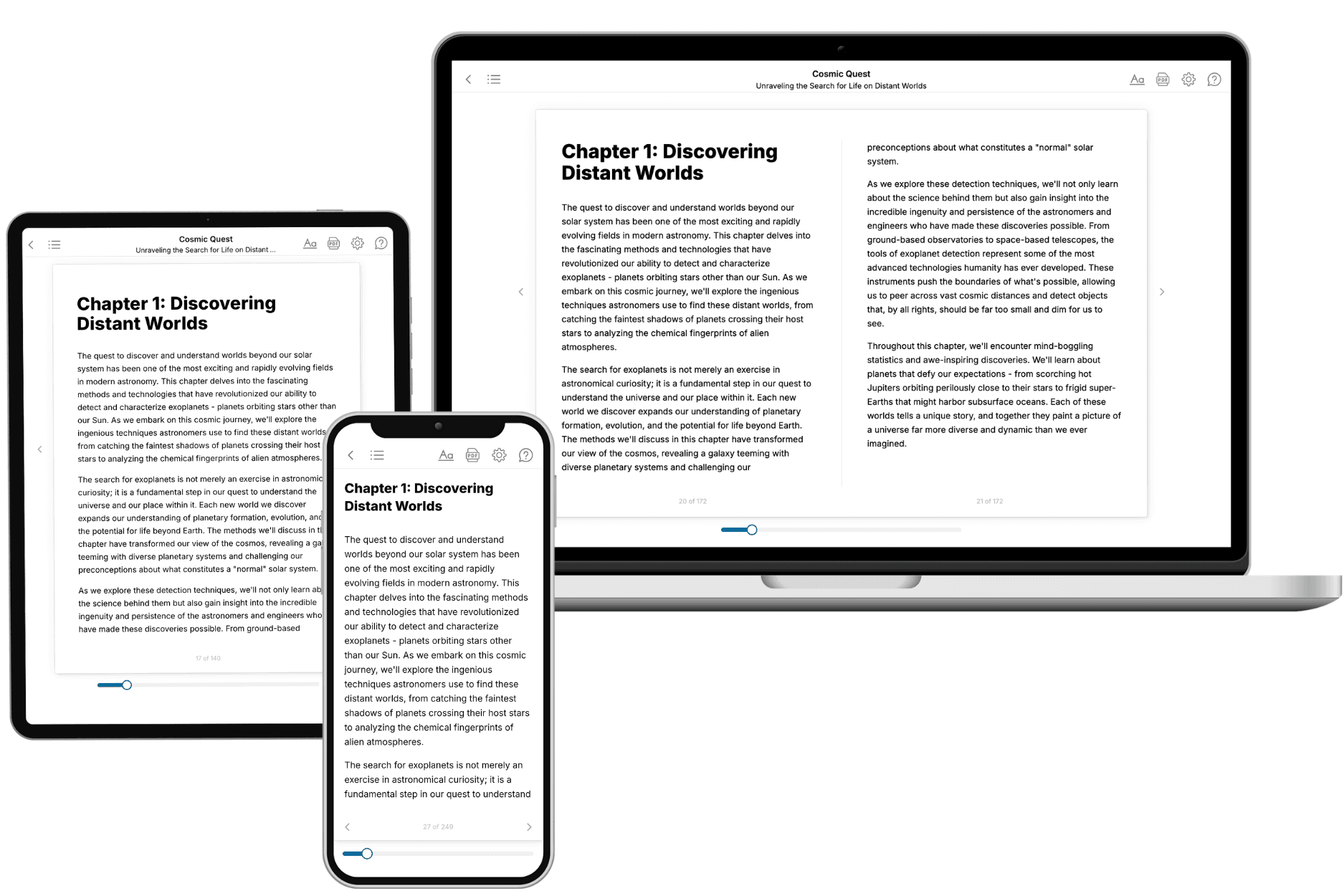
Your book is ready in 10 minutes. Read it online, download as EPUB or PDF, or send to Kindle.

Frequently asked questions
- What is TailoredRead?
TailoredRead creates complete, full-length nonfiction ebooks, written specifically for you. Tell us what you want to learn and why, and TailoredRead writes you a complete ebook on it, with charts, tables, and diagrams throughout. Read it online, on Kindle, or on any e-reader, or download it as a PDF or EPUB. Every book is written fresh the day you order it.
- How is the book tailored to me?
Before anything is written, you answer a few short questions about your goals, your background, and the topics you care about. Your book is then planned around your answers: written at your level, focused on your goals, and covering the topics you chose, instead of the one-size-fits-all book a store sells everyone.
- Will it read like generic AI content?
No. Your book isn't a chat transcript: it's planned chapter by chapter before a single word is written, told in a clear book voice, and explains ideas visually with charts, tables, and diagrams. After writing, every book goes through an editorial pass that polishes chapters so the book reads consistent from start to finish. Judge for yourself: browse thousands of sample books on our Explore Books page.
- How accurate is the content?
Our AI first checks whether your subject needs live research. Niche and fast-moving subjects are researched before writing, and the book plan and chapters are grounded in what it finds. After writing, every book goes through a quality pass that checks its facts and consistency, and researched books list their sources in a Notes section at the back.
- How long is the book?
You choose the length: Comprehensive (250-300 pages), Detailed (150-200 pages), Essential (70-100 pages), or Short (30-50 pages).
- Does the book include visuals?
Yes. Every book includes visual elements such as timelines, checklists, step-by-step guides, decision trees, comparison tables, and matrices, and many include bar charts. A typical book includes dozens of these visual elements.
- Can I read it on Kindle? What formats can I download?
Yes. Every book can be read in our online reader or downloaded as a PDF or EPUB. The EPUB can be opened with Kindle, Apple Books, Kobo, and any e-reader. The Commercial and Author licenses also include an editable Word (DOCX) and Markdown download.
- How much does it cost?
About the price of a regular ebook. The exact price depends on your book's length and complexity, from $2 for the shortest books to $35 for the most comprehensive, and it's shown when you review your book, before you commit to anything. Each book is a one-time purchase, yours to keep, no subscription. Licenses that let you share, teach, or publish your book range from $35.99 to $49.99.
- Can I preview the book before purchasing?
Before you pay, you'll see what your book will cover: the title, a detailed description, the estimated length, and the complete chapter-by-chapter table of contents, so you know what you're getting before you decide. The full text itself is written after you purchase.
- How long does it take to create a book?
About 10 minutes. You can start reading the opening chapters while the rest is still being written.