Voices of Change: The Essential Black Historians Who Shaped America
Discover the Scholars, Stories, and Scholarship That Transformed How We Understand African-American History
Discover how Black historians transformed American scholarship and reshaped our understanding of the past.
191 pages8 chaptersMar 7, 2026African-American and Black Biography
About this book
This book introduces you to the pioneering scholars who challenged dominant narratives, established new methodologies, and created spaces for African-American voices in historical discourse. You'll explore the lives and legacies of historians from George Washington Williams to contemporary scholars, understanding not just what they wrote, but why their work matters. Learn how these historians navigated institutional barriers, developed innovative research methods, and connected scholarship to social change. By examining their contributions, you'll gain deeper insight into how history is constructed, interpreted, and contested. This exploration reveals that historical truth is multifaceted and that Black historians continue to be essential guides in understanding America's complex past and its ongoing implications for today.
Table of contents
- IntroductionWhy Black Historians Matter, History Is Interpretation, Not Just Facts, What You'll Discover in This BookRead below
- Chapter 1: The Foundations: Early Black Historians and the Birth of a FieldBefore the Field Existed: The Barriers Black Scholars Faced, George Washington Williams: The First Major Black Historian, Carter G. Woodson and the Institutionalization of Black History
- Chapter 2: The Harlem Renaissance and Intellectual AwakeningThe Cultural and Intellectual Context of the 1920s-1930s, Historians as Activists: Scholarship and Social Change, Key Figures: Arthur Schomburg, Benjamin Quarles, and Others
- Chapter 3: Methodologies and Approaches: How Black Historians Do Their WorkOral History and Community Archives, Challenging Traditional Sources and Finding Hidden Narratives, Interdisciplinary Approaches: Combining History with Other Fields
- Chapter 4: The Civil Rights Era and Beyond: Historians in a Changing AmericaHistory and the Civil Rights Movement, John Hope Franklin: Bridging Scholarship and Activism, Expanding the Narrative: New Voices and Perspectives
- Chapter 5: Women Historians and Intersectional PerspectivesOverlooked Contributions: Women in Black Historical Scholarship, Gender, Race, and History: Intersectional Approaches, Contemporary Women Historians Reshaping the Field
- Chapter 6: Reframing American History: How Black Historians Changed the NarrativeCentering Black Agency and Resistance, New Interpretations of Slavery, Freedom, and Reconstruction, Challenging Myths and Correcting the Record
- Chapter 7: From Academy to Community: Making History AccessiblePublic History and Museums: Bringing History to Life, Digital Humanities and Online Archives, Historians as Public Intellectuals and Educators
- Chapter 8: Contemporary Voices: The Future of Black Historical ScholarshipEmerging Scholars and New Research Directions, Global Perspectives: African Diaspora and Transnational History, Addressing Current Debates and Contested Histories
- ConclusionThe Ongoing Legacy of Black Historians, Your Role as a Reader and Learner of History
- Glossary of Key Terms and Concepts
- Further Reading and Resources
Introduction
Think about the history you learned in school. Who wrote the textbooks? Whose stories were told in detail, and whose were reduced to a paragraph or skipped entirely? For most of American history, the people who decided what counted as important, what got preserved, and what got taught were overwhelmingly white, male, and working within institutions that had little interest in centering African-American experiences. That is not a small oversight. It is a fundamental distortion of the historical record, and it shaped how generations of Americans understood their country and themselves.
Black historians recognized this distortion early and worked against it with remarkable determination. They built archives when institutions refused to preserve Black records. They wrote books when publishers showed little interest. They created professional organizations, academic journals, and community programs to ensure that African-American history would not simply disappear. Their work was not just about adding new names to an existing story. It was about challenging the entire framework through which American history was being told, and offering something more honest and more complete in its place.
This book is an introduction to those historians and their contributions. It covers scholars from the late nineteenth century through the present day, tracing how the field of African-American history developed, matured, and expanded over time. Along the way, you will encounter not just biographical details but the actual ideas these historians advanced, the methods they developed, and the debates they sparked. Understanding their work means understanding something essential about how history itself functions as a discipline and why the question of who gets to tell the story always matters.
You are coming to this book with some existing knowledge of African-American history, which means you already have a foundation to build on. What this book offers is a different angle of entry. Rather than focusing primarily on events, it focuses on the people who studied and interpreted those events, and on the intellectual traditions they created. That shift in perspective opens up new questions. How do historians decide what evidence to trust? How do they reconstruct lives that were deliberately excluded from official records? How does a scholar's own identity and experience shape the history they write? These are questions that Black historians have grappled with directly, and their answers have enriched the entire discipline.
Why Black Historians Matter
The simplest answer to why Black historians matter is that they documented what would otherwise have been lost. In the decades following the Civil War, there was no shortage of historical writing about slavery, Reconstruction, and the African-American experience. The problem was that most of it was written by people who had a vested interest in minimizing Black humanity and agency. Historians like William Dunning at Columbia University produced influential scholarship that portrayed Reconstruction as a catastrophic failure caused by incompetent Black politicians and corrupt Northern opportunists.[1] That interpretation dominated American historical thinking for decades and directly shaped public policy, popular culture, and the legal structures of Jim Crow.
Black historians pushed back against this narrative with evidence and argument. They did not simply assert that the Dunning School was wrong. They went into archives, collected testimonies, analyzed legislation, and produced scholarship that demonstrated the actual achievements of Reconstruction governments and the deliberate violence used to dismantle them. This was not just an academic exercise. The historical record was being used to justify ongoing oppression, and correcting it was a form of resistance with real consequences for living people.
Beyond correction, Black historians also created entirely new areas of inquiry. They asked questions that mainstream scholarship had never thought to ask, or had actively avoided. What was the internal social structure of enslaved communities? How did free Black communities in the antebellum North organize themselves politically and economically? What were the intellectual traditions of African civilizations before the transatlantic slave trade? These questions required new methods, new sources, and new frameworks, and the historians who pursued them expanded what history as a discipline could do.
There is also a representational dimension that goes beyond scholarship. When Black students, in segregated schools or integrated ones, encountered history that acknowledged their ancestors as full human beings with complex inner lives, political ambitions, and cultural achievements, it changed something. Carter G. Woodson understood this when he founded Negro History Week in 1926, the precursor to Black History Month. He believed that historical knowledge was inseparable from self-respect and civic participation. The historians in this book shared that conviction, even when they expressed it in very different ways.
It is also worth being direct about something that is sometimes left implicit. Black historians matter not just to Black readers or to the study of African-American history specifically. They matter to anyone who wants to understand the United States accurately. A history of America that marginalizes the experiences of people who were central to its economic development, its political conflicts, and its cultural life is simply an incomplete and misleading history. The work of Black historians is not a supplement to American history. It is a correction that makes the whole picture more truthful.
Those who have no record of what their forebears have accomplished lose the inspiration which comes from the teaching of biography and history.— Carter G. Woodson, The Mis-Education of the Negro (1933)
The stakes of this work have never been purely academic. Throughout American history, debates about what gets taught in schools, what gets preserved in archives, and what gets recognized as legitimate scholarship have been deeply political. Black historians have operated in that contested space, often at personal and professional cost. Understanding their contributions means understanding not just what they wrote, but the conditions under which they wrote it and the resistance they faced in doing so.
History Is Interpretation, Not Just Facts
One of the most important things Black historians have taught the broader discipline is that history is never simply a neutral recording of facts. Every historical account involves choices: which sources to consult, which events to emphasize, which questions to ask, and which frameworks to use when making sense of the evidence. Those choices are shaped by the historian's own perspective, training, and social position. Acknowledging this does not mean that all historical accounts are equally valid or that facts do not matter. It means that the process of historical interpretation is always situated, always partial, and always worth examining critically.
Consider a concrete example. The same set of historical facts about the Haitian Revolution can be told in very different ways depending on the framework the historian brings to them. A historian focused on European diplomatic history might emphasize the impact of the revolution on Napoleon's decision to sell Louisiana. A historian centered on African-American freedom struggles might emphasize the revolution's influence on enslaved people in the American South and the terror it inspired among slaveholders. Neither account is fabricating facts, but they are telling very different stories with different implications. The choice of framework is itself an interpretive act.
Black historians have been particularly attentive to this dynamic because they have so often been on the receiving end of interpretive frameworks that distorted or erased their history. They developed what scholars sometimes call a critical historical consciousness, an awareness that the questions historians ask are as important as the answers they find. This awareness pushed them to develop new methodologies and to be explicit about their own standpoints in ways that were unusual in mainstream historical writing for much of the twentieth century.
This does not mean that Black historians have been less rigorous than their counterparts. In many cases, they have been more rigorous, precisely because they could not rely on institutional prestige or established narratives to lend their work credibility. They had to build their arguments carefully, document their sources meticulously, and anticipate skeptical audiences. The result was often scholarship of exceptional quality that also happened to challenge comfortable assumptions about American history.
Understanding history as interpretation also helps explain why the same historical periods keep getting reexamined and rewritten. Reconstruction has been interpreted and reinterpreted multiple times over the past 150 years, and each major reinterpretation reflects both new evidence and new questions shaped by the present moment. The civil rights movement prompted historians to look at Reconstruction differently. The rise of social history in the 1970s prompted new attention to ordinary people's experiences rather than just political leaders. Each generation of historians brings new concerns to old material and finds things that previous generations missed or ignored.
For you as a reader, this means approaching historical claims with a productive kind of skepticism. Not the cynical skepticism that says nothing can be known, but the engaged skepticism that asks: Who wrote this? What sources did they use? What questions were they trying to answer? What might they have missed? The historians in this book modeled exactly that kind of critical engagement, and their example is one of the most valuable things their work offers.
There is a practical dimension to this as well. When you encounter debates about history in public life, whether about school curricula, museum exhibits, or historical monuments, you are watching interpretive conflicts play out in real time. Understanding that history is interpretation does not make those debates easier to resolve, but it does make them easier to understand. It helps you see what is actually at stake and why people care so deeply about how the past is represented.
The historians covered in this book were not passive observers of these debates. Many of them were active participants, testifying before legislatures, advising museums, writing for general audiences, and engaging directly with public controversies about history. Their scholarship and their public engagement were inseparable, and that combination is part of what makes their work so significant.
What You'll Discover in This Book
This book is organized to take you through the development of Black historical scholarship in roughly chronological order, while also pausing to examine specific themes and methodologies in depth. Each chapter builds on the previous ones, so by the time you reach the contemporary scholars in the later chapters, you will have a rich context for understanding how their work connects to and departs from earlier traditions. Here is a brief map of what lies ahead.
Chapter 1 covers the foundational period of Black historical scholarship, focusing on the late nineteenth and early twentieth centuries. You will learn about the institutional barriers that Black scholars faced and how they worked around them. The chapter profiles George Washington Williams, whose 1882 History of the Negro Race in America is widely considered the first major work of African-American historical scholarship, and Carter G. Woodson, who almost single-handedly built the institutional infrastructure for the field through the Association for the Study of Negro Life and History and the Journal of Negro History.
Chapter 2 moves into the Harlem Renaissance period of the 1920s and 1930s, a moment of extraordinary intellectual and cultural productivity. You will see how historians of this era connected their scholarship to broader movements for racial justice and cultural affirmation. The chapter examines figures like Arthur Schomburg, whose personal archive became the foundation of one of the most important collections of African-American and African diaspora materials in the world, and Benjamin Quarles, whose careful, evidence-based scholarship helped establish African-American history as a legitimate academic field.
Chapter 3 steps back from biography to examine methodology. This chapter explores the specific tools and approaches that Black historians developed to do their work, including:
- Oral history collection and analysis
- Community-based archiving and preservation
- Critical reading of hostile or biased primary sources
- Interdisciplinary methods drawing on sociology, anthropology, and literary studies
Understanding these methods helps you appreciate not just what Black historians found, but how they found it and why those methods were necessary given the gaps in official archives.
Chapter 4 examines the civil rights era and its aftermath, a period when the relationship between historical scholarship and political activism became especially intense. The chapter gives extended attention to John Hope Franklin, whose 1947 book From Slavery to Freedom became the standard survey text for African-American history and went through multiple editions over five decades. Franklin's career illustrates how a Black historian could achieve mainstream recognition while continuing to challenge the assumptions of mainstream scholarship.
Chapter 5 addresses a significant gap in earlier historical writing: the contributions of women historians. Black women scholars were often doubly marginalized, excluded from both white academic institutions and from the male-dominated spaces of Black intellectual life. This chapter recovers their contributions and examines how feminist and intersectional approaches transformed the field by insisting that race cannot be understood in isolation from gender, class, and other dimensions of social experience.
Chapter 6 focuses on the substantive historical arguments that Black historians have made, particularly around slavery, Reconstruction, and the long history of Black resistance. This chapter examines how specific interpretive frameworks, like centering Black agency rather than white oppression, changed what historians looked for and what they found. It also addresses the ongoing work of correcting historical myths that continue to circulate in popular culture and public discourse.
Chapters 7 and 8 bring the story into the present. Chapter 7 examines how Black historians have worked to make their scholarship accessible beyond academic audiences, through public history projects, museum work, digital archives, and media engagement. Chapter 8 looks at contemporary scholars and the new directions they are pursuing, including transnational and diaspora frameworks that situate African-American history within a global context.
Throughout the book, you will find several recurring features designed to deepen your engagement with the material:
- Profiles of key historians that go beyond biography to examine the specific arguments and methods that made their work significant
- Concrete examples of how historical interpretation works, drawn from actual debates in the field
- Connections between scholarship and social context, showing how historical writing responds to and shapes the world around it
- Suggestions for further reading at the end of the book for those who want to go deeper into any of the topics covered
One thing this book does not do is pretend that the field of Black historical scholarship is monolithic or free of internal disagreement. Black historians have debated each other vigorously about methodology, interpretation, and the relationship between scholarship and activism. Those debates are part of the story, and they are worth understanding because they show the field as a living intellectual tradition rather than a fixed set of conclusions. Where significant debates exist, this book tries to represent them honestly rather than smoothing them over.
By the time you finish this book, you should have a much richer sense of who the major figures in Black historical scholarship are and what they contributed. More than that, you should have a deeper understanding of how history works as a discipline, why representation in that discipline matters, and how the ongoing project of recovering and reinterpreting African-American history continues to reshape our understanding of the United States. That understanding is not just intellectually valuable. In a moment when debates about history, memory, and identity are as heated as they have been in generations, it is genuinely useful for making sense of the world.
The historians in this book spent their careers arguing that the past is not simply behind us. It lives in institutions, in laws, in cultural assumptions, and in the stories we tell about who we are and where we came from. Engaging seriously with their work is one way of taking that argument seriously, and of honoring the extraordinary effort they put into making the historical record more complete, more honest, and more just.
Notes
Introduction
- 1. Eric Foner, Reconstruction: America's Unfinished Revolution, 1863-1877, Harper & Row, 1988
This is the end of the free sample. The full book has 8 chapters.
Want this book written for you?
Tell us your goals and background, and get your own version of this book, tailored by AI to you.


Benefits of AI-tailored books
- Read one book, not ten:
- all the African-American and Black Biography knowledge you need, gathered into a single book.
- Save days of learning:
- tell us your goals, choose your topics, and the whole book is built around them.
- Learn effortlessly:
- African-American and Black Biography book written for your specific background and expertise.
- Understand at a glance:
- includes charts, tables, timelines, checklists, decision trees, and more.
- Stay current:
- written the day you order it, not years ago.
- Trust what you read:
- every book is checked for accuracy, with real research when your subject needs it.
Create your unique book in 3 steps
- 1. Select your focus
Select the focus of your African-American and Black Biography book and share your background
- 2. Personalize your book
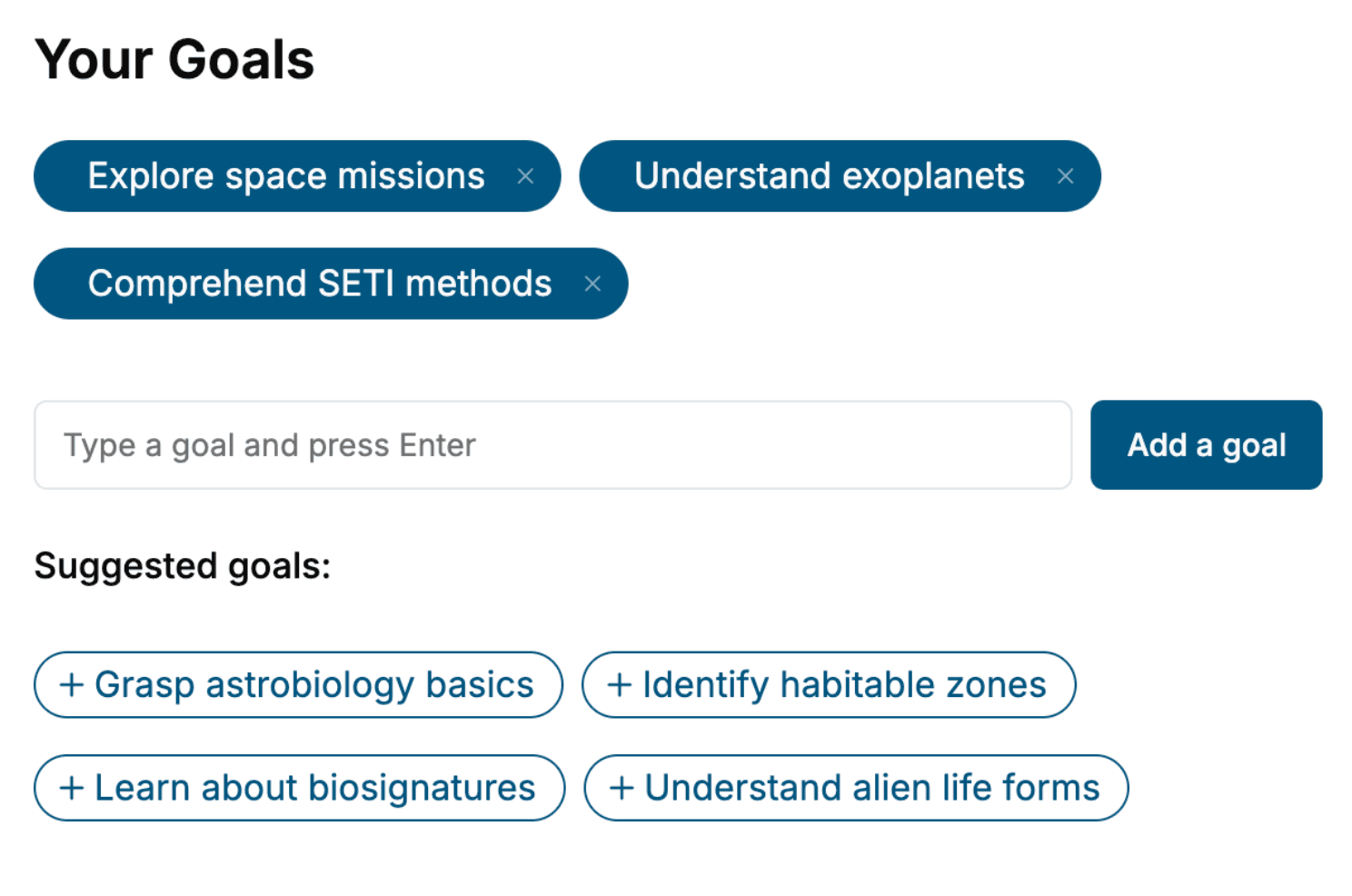
Specify your goals and choose sub-topics to include
- 3. Get your tailored book
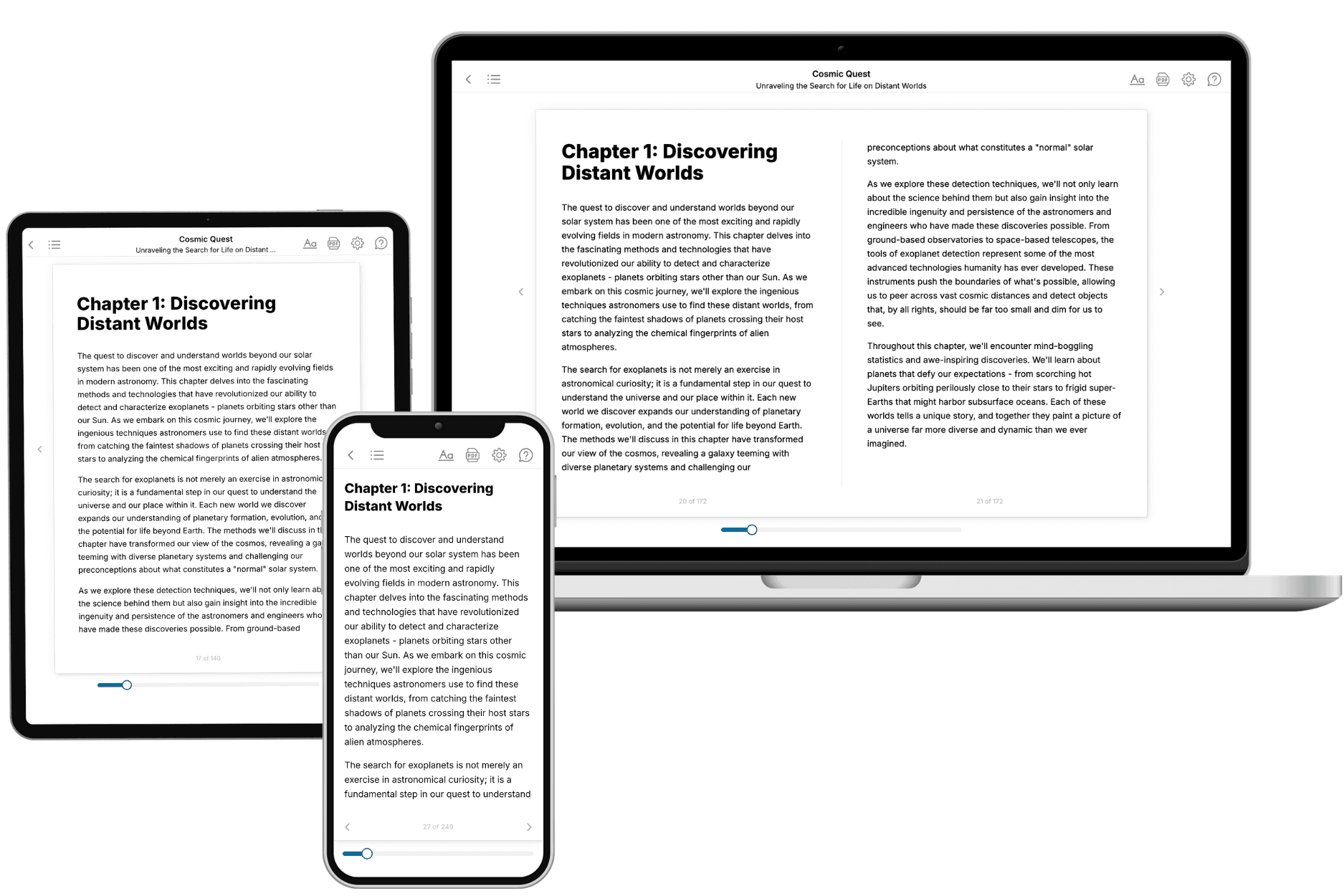
Your book is ready in 10 minutes. Read it online, download as EPUB or PDF, or send to Kindle.

Frequently asked questions
- What is TailoredRead?
TailoredRead creates complete, full-length nonfiction ebooks, written specifically for you. Tell us what you want to learn and why, and TailoredRead writes you a complete ebook on it, with charts, tables, and diagrams throughout. Read it online, on Kindle, or on any e-reader, or download it as a PDF or EPUB. Every book is written fresh the day you order it.
- How is the book tailored to me?
Before anything is written, you answer a few short questions about your goals, your background, and the topics you care about. Your book is then planned around your answers: written at your level, focused on your goals, and covering the topics you chose, instead of the one-size-fits-all book a store sells everyone.
- Will it read like generic AI content?
No. Your book isn't a chat transcript: it's planned chapter by chapter before a single word is written, told in a clear book voice, and explains ideas visually with charts, tables, and diagrams. After writing, every book goes through an editorial pass that polishes chapters so the book reads consistent from start to finish. Judge for yourself: browse thousands of sample books on our Explore Books page.
- How accurate is the content?
Our AI first checks whether your subject needs live research. Niche and fast-moving subjects are researched before writing, and the book plan and chapters are grounded in what it finds. After writing, every book goes through a quality pass that checks its facts and consistency, and researched books list their sources in a Notes section at the back.
- How long is the book?
You choose the length: Comprehensive (250-300 pages), Detailed (150-200 pages), Essential (70-100 pages), or Short (30-50 pages).
- Does the book include visuals?
Yes. Every book includes charts, tables, and diagrams: timelines, checklists, step-by-step guides, decision trees, comparison tables, matrices, and bar charts. A typical book includes dozens of these visual elements.
- Can I read it on Kindle? What formats can I download?
Yes. Every book can be read in our online reader or downloaded as a PDF or EPUB. The EPUB can be opened with Kindle, Apple Books, Kobo, and any e-reader. The Commercial and Author licenses also include an editable Word (DOCX) and Markdown download.
- How much does it cost?
About the price of a regular ebook. The exact price depends on your book's length and complexity, from $2 for the shortest books to $35 for the most comprehensive, and it's shown when you review your book, before you commit to anything. Each book is a one-time purchase, yours to keep, no subscription. Licenses that let you share, teach, or publish your book range from $35.99 to $49.99.
- Can I preview the book before purchasing?
Before you pay, you'll see what your book will cover: the title, a detailed description, the estimated length, and the complete chapter-by-chapter table of contents, so you know what you're getting before you decide. The full text itself is written after you purchase.
- How long does it take to create a book?
About 10 minutes. You can start reading the opening chapters while the rest is still being written.