Washington State Parks
Your Complete Guide to Exploring Nature's Best-Kept Secrets
Imagine spending your next weekend surrounded by towering old-growth forests, pristine alpine lakes, or dramatic coastal cliffs—all within a few hours of home.
207 pages10 chaptersMar 13, 2026Washington Travel Guide
About this book
Washington State harbors some of the Pacific Northwest's most spectacular natural treasures, yet many remain undiscovered by casual visitors. This comprehensive guide reveals the best parks across all regions of Washington, from the Cascades to the coast, providing everything you need to plan unforgettable outdoor experiences. You'll learn how to choose parks that match your interests and fitness level, discover hidden gems that rival famous destinations, understand seasonal patterns that affect accessibility and wildlife viewing, and master practical skills for safe, responsible park exploration. Whether you're seeking solitude in pristine wilderness, family-friendly adventures, or challenging backcountry expeditions, this guide equips you with insider knowledge, detailed logistics, and inspiration to experience Washington's natural diversity like never before.
Table of contents
- IntroductionWhy Washington State Parks Matter, How to Use This Guide, Understanding Washington's Park System, Planning Your Perfect Park AdventureRead below
- Chapter 1: Cascades and Mountain ParksThe Cascade Range: Peaks, Lakes, and Alpine Meadows, North Cascades National Park and Surrounding Areas, Central Cascades: Mount Rainier and Beyond, Southern Cascades: Hidden Alpine Gems
- Chapter 2: Coastal and Beach ParksUnderstanding Washington's Coastal Ecosystems, Olympic Peninsula: Rainforests and Rocky Shores, Puget Sound Beaches and Waterfront Parks, Southwest Washington Coastal Treasures
- Chapter 3: Eastern Washington ParksEastern Washington's Diverse Landscapes, Columbia River Gorge and Scenic Areas, Desert and Semi-Arid Parks, Northeast Washington: Mountains and Lakes
- Chapter 4: Water-Based AdventuresWater Safety and Preparation, Kayaking, Canoeing, and Paddling, Fishing and Boating Opportunities, Swimming, Diving, and Beach Activities
- Chapter 5: Hiking and Trail ExplorationChoosing the Right Trail for Your Ability, Day Hikes: From Easy Walks to Challenging Summits, Backpacking and Multi-Day Treks, Trail Safety and Navigation Skills
- Chapter 6: Wildlife and Nature ObservationWildlife Viewing: What to Expect and How to Observe, Bird Watching and Avian Hotspots, Seasonal Wildlife Patterns and Migration, Nature Photography and Documentation
- Chapter 7: Family-Friendly Park ExperiencesPlanning Parks Visits with Children, Accessible Parks and Easy-Access Trails, Educational and Interpretive Programs, Camping and Overnight Stays with Families
- Chapter 8: Seasonal Planning and TimingSpring: Wildflowers, Waterfalls, and Renewal, Summer: Peak Season and Avoiding Crowds, Fall: Colors, Solitude, and Comfortable Hiking, Winter: Snow Sports and Quiet Landscapes
- Chapter 9: Practical Essentials and PreparationEssential Gear and Smart Packing, Permits, Regulations, and Park Rules, Weather Preparation and Forecasting, Emergency Preparedness and First Aid
- Chapter 10: Hidden Gems and Lesser-Known ParksHow to Discover Hidden Gems, Underrated Parks Worth Exploring, Local Favorites and Insider Recommendations
- ConclusionBeginning Your Washington Parks Journey, Conservation and Responsible Stewardship
- AppendixPark Contacts and Resources, Useful Websites and Planning Tools, Glossary of Outdoor and Park Terms
Introduction
Washington State is one of the most geographically diverse places in North America. Within a single day's drive, you can stand in a temperate rainforest where trees tower 200 feet overhead, walk along a wild Pacific coastline where sea stacks rise from the surf, or hike through alpine meadows with volcanic peaks on the horizon. Few states can match that kind of variety, and fewer still pack it into such a compact and accessible area. That diversity is exactly what makes Washington's parks so extraordinary and so worth exploring.
Yet for all its natural wealth, Washington remains surprisingly underexplored by many of its own residents. The famous destinations get their share of visitors: Mount Rainier draws over two million people a year, and the Olympic Peninsula is well known to Pacific Northwest travelers.[1] But beyond those headline parks lies an enormous network of state parks, recreation areas, wilderness zones, and scenic corridors that most people never discover. Some of the most rewarding outdoor experiences in the entire Pacific Northwest are hiding in plain sight, just a few hours from major cities.
This guide exists to change that. Whether you're a weekend hiker looking for your next trail, a family planning a camping trip, or an experienced adventurer ready to push into backcountry terrain, this book gives you the practical knowledge and inspiration to make the most of Washington's parks. You'll find regional breakdowns, seasonal guidance, activity-specific chapters, and honest recommendations that go well beyond the standard tourist brochure. The goal is simple: help you spend less time guessing and more time actually outside, doing what you came here to do.
Before diving into specific parks and regions, this introduction covers the essential foundation. You'll learn why Washington's park system is genuinely special, how to navigate this guide efficiently, how the state and federal park systems are structured, and how to approach the planning process so your trips go smoothly from the start. Think of this section as your orientation before the adventure begins.
Why Washington State Parks Matter
Washington's parks aren't just pretty places to visit. They represent something larger: a commitment to preserving wild and natural spaces in a state that has experienced enormous population growth and economic development over the past century. The greater Seattle metro area alone has grown by more than 20% since 2010.[2] As cities expand, the parks that surround them become more valuable, not just ecologically, but as places where people can reconnect with something quieter and more enduring than urban life.
Washington State Parks manages over 100 parks covering more than 120,000 acres of land and 36 miles of ocean shoreline.[3] That's before you count the national parks, national forests, wilderness areas, and wildlife refuges that add millions more acres to the total. The sheer scale of protected land in Washington is remarkable. From the Okanogan Highlands in the northeast to the Long Beach Peninsula in the southwest, the state has made a serious investment in keeping its natural landscapes intact.
The ecological significance of these parks is hard to overstate. Washington's forests store enormous amounts of carbon, its rivers support some of the last healthy wild salmon runs in the continental United States, and its coastal zones provide critical habitat for marine mammals, seabirds, and intertidal species. When you visit a Washington park, you're not just enjoying scenery. You're stepping into a functioning ecosystem that scientists, conservationists, and land managers work hard to protect.
Beyond ecology, these parks carry deep cultural and historical meaning. Many sites within the park system hold significance for Indigenous nations who have lived in the Pacific Northwest for thousands of years. The Quinault, Makah, Yakama, Spokane, and dozens of other tribes have ancestral connections to lands that are now managed as parks and recreation areas. Understanding that history adds depth to any park visit and reminds you that these landscapes have been valued and cared for long before the modern conservation movement began.
On a more personal level, the research on outdoor recreation and human wellbeing is compelling. Studies consistently show that time spent in natural settings reduces stress hormones, improves mood, lowers blood pressure, and enhances cognitive function.[4] Washington's parks aren't a luxury. For many people, they're a genuine resource for physical and mental health. The accessibility of so many parks within a short drive of major population centers makes that benefit available to a wide range of people, regardless of income or experience level.
Finally, Washington's parks matter because they're genuinely world-class. The Hoh Rain Forest in Olympic National Park is one of only a handful of temperate rainforests on Earth. The Enchantments in the Alpine Lakes Wilderness is considered one of the most spectacular backcountry destinations in North America. The Columbia River Gorge offers a geological story that spans millions of years. These aren't regional curiosities. They're places that belong on any serious outdoor traveler's list, and they happen to be right here in Washington.
How to Use This Guide
This guide is designed to be flexible. You don't need to read it cover to cover before your first trip. Instead, think of it as a reference you'll return to repeatedly as your interests and experience evolve. The chapters are organized so you can jump directly to what's most relevant to your current plans, then explore other sections as your curiosity grows.
Here's a quick map of how the book is structured:
- Chapters 1 through 3 cover Washington's three main geographic regions: the Cascades and mountain parks, the coastal and beach parks, and the parks of Eastern Washington. If you're trying to decide where to go, start here.
- Chapters 4 through 6 focus on specific activities: water-based adventures, hiking and trail exploration, and wildlife and nature observation. If you already know what you want to do, these chapters help you find the best places to do it.
- Chapter 7 is dedicated to family-friendly experiences, covering accessible parks, educational programs, and camping with children.
- Chapter 8 breaks down the year by season, helping you understand what each time of year offers and how to plan accordingly.
- Chapter 9 covers practical essentials: gear, permits, weather, and emergency preparedness.
- Chapter 10 reveals hidden gems and lesser-known parks that often deliver better experiences than the crowded headliners.
A few practical notes on how to get the most from this guide. When a park or trail is mentioned, pay attention to the seasonal notes and permit requirements. Washington's most popular destinations fill up fast, especially in summer, and showing up without a reservation or required pass can mean turning around at the trailhead. The practical chapters near the end of the book address this in detail, but it's worth keeping in mind from the start.
The difficulty ratings and time estimates throughout this guide are based on average adult fitness levels. If you're hiking with children, older adults, or anyone with mobility considerations, add extra time and consider dropping one difficulty level in your planning. A trail rated "moderate" for a fit adult might be genuinely challenging for a family with young kids. Chapter 7 addresses this specifically, but the principle applies everywhere in the book.
You'll also notice that this guide doesn't try to cover every single park in Washington. There are hundreds of parks, recreation areas, and natural sites across the state, and a truly exhaustive list would be more overwhelming than useful. Instead, the focus is on parks that offer the best combination of accessibility, scenery, activity variety, and overall experience quality. Where lesser-known parks are highlighted, it's because they genuinely deserve more attention, not just because they're obscure.
A practical tip before you start: Download the Washington State Parks app and bookmark the Washington Trails Association website (wta.org) before your first trip. Both are free, regularly updated, and contain current trail conditions, permit availability, and recent trip reports from other hikers. No guidebook, including this one, can match the real-time accuracy of those resources for day-of planning.
Finally, treat this guide as a starting point rather than a final word. Washington's parks change with the seasons, with weather events, and with ongoing management decisions. Trails get rerouted, campgrounds close for restoration, and new areas open up. The best park visitors combine solid background knowledge with current information, and this guide gives you the foundation to do exactly that.
Understanding Washington's Park System
One of the most confusing things for new visitors is figuring out who manages what. Washington's protected lands are overseen by several different agencies, each with its own rules, fee structures, and permit systems. Understanding the basic structure saves you time and prevents unpleasant surprises at the entrance gate.
Here are the main categories of protected land you'll encounter in Washington:
- Washington State Parks: Managed by the Washington State Parks and Recreation Commission. These parks require a Discover Pass for vehicle access, which costs $30 per year or $10 per day as of 2024. The Discover Pass covers most state parks and recreation lands.
- National Parks: Olympic, Mount Rainier, and North Cascades are managed by the National Park Service. They have their own entrance fees, typically $35 per vehicle for a 7-day pass. The America the Beautiful annual pass ($80) covers all national parks and is excellent value if you plan multiple visits.
- National Forests: Managed by the U.S. Forest Service, national forests cover enormous areas of Washington and contain many of the state's best hiking trails. Some areas require a Northwest Forest Pass ($30/year or $5/day) for trailhead parking.
- Wilderness Areas: Found within national forests and national parks, these are the most strictly protected lands. No motorized vehicles, no mountain bikes, and often permit systems for overnight stays.
- State Department of Natural Resources (DNR) Lands: Washington DNR manages millions of acres of state trust lands, many of which are open for recreation. These are often less crowded than state parks and don't always require a pass.
- Wildlife Areas: Managed by the Washington Department of Fish and Wildlife, these areas are primarily for hunting and fishing but often have excellent wildlife viewing and hiking as well.
The pass situation can feel complicated, but there's a practical shortcut. If you plan to visit parks more than two or three times a year, buy both the Discover Pass and the America the Beautiful pass. Together they cover the vast majority of Washington's protected lands and cost less than a handful of day passes. Many serious outdoor enthusiasts in Washington consider both passes essential annual purchases.
Permit systems are a separate matter from passes. Some of the most popular destinations in Washington require advance permits for day hiking, not just overnight camping. The Enchantments in Leavenworth, for example, uses a lottery system that opens months in advance and is extremely competitive.[5] Mount Rainier's Paradise area requires timed entry reservations during peak summer weekends. Knowing which parks require permits, and when those permits become available, is one of the most important pieces of planning knowledge you can have.
Washington also has a strong network of state park campgrounds, ranging from primitive tent sites to full hookup RV sites with electricity and water. Reservations open up to nine months in advance for popular campgrounds and fill quickly for summer weekends. The Washington State Parks reservation system (washington.goingtocamp.com) is the primary booking platform. For national park campgrounds, Recreation.gov handles reservations. Both systems allow you to set up alerts for cancellations, which is useful when your preferred dates are already booked.
One more thing worth knowing: Washington has a strong Leave No Trace culture, and park rangers take it seriously. Pack out all trash, stay on designated trails, camp only in designated sites, and follow fire regulations carefully. Campfire restrictions change frequently based on fire danger, especially in summer and fall. Always check current fire conditions before your trip through the Washington Department of Natural Resources fire information page or the relevant park's website. Respecting these rules isn't just about following the law. It's about keeping these places worth visiting for everyone who comes after you.
Planning Your Perfect Park Adventure
Good planning is what separates a frustrating park experience from a genuinely memorable one. This doesn't mean over-scheduling every minute of your trip. It means doing enough preparation that the logistics don't get in the way of the experience. A few hours of planning before a weekend trip can make the difference between arriving at a trailhead with a full parking lot and no backup plan, versus having a great day because you knew exactly where to go and what to expect.
Start with these four planning questions before any park trip:
- What do you want to do? Hiking, wildlife viewing, kayaking, camping, photography, or just relaxing in a beautiful setting? Different parks excel at different activities, and knowing your priority helps narrow the options quickly.
- Who is coming? A solo trip, a couple, a group of friends, or a family with kids all have different needs. Physical fitness levels, age ranges, and experience matter when choosing trails and parks.
- When are you going? Season dramatically affects what's accessible and what's enjoyable. Some parks are best in spring, others in fall. Some high-elevation areas are only accessible from July through September. Chapter 8 covers this in depth.
- How much time do you have? A half-day trip, a full day, a weekend, or a week all call for different destinations and different levels of preparation.
Once you've answered those questions, the research process becomes much more focused. Use the regional chapters in this guide to identify two or three candidate parks that fit your criteria. Then check current conditions through the Washington Trails Association trip reports, the relevant park's official website, and weather forecasts for the specific area. Mountain weather in Washington can be dramatically different from what's happening in Seattle or Spokane, so always check the forecast for the park's elevation, not just the nearest city.
Timing your arrival is often overlooked but critically important. Popular trailheads at parks like Mount Rainier and Olympic fill their parking lots by 8 or 9 a.m. on summer weekends. Arriving at 10 a.m. often means parking a mile or more from the trailhead or being turned away entirely. The solution is simple: arrive early. Most experienced Washington hikers aim to be at the trailhead by 7 a.m. on busy weekends. That early start also means cooler temperatures, better wildlife activity, and softer morning light for photography.
Example: Planning a summer weekend at Mount Rainier. A family of four wants to visit Paradise for wildflower season in late July. Smart planning looks like this: Reserve a campsite at Cougar Rock Campground six months in advance. Check the timed entry reservation system in spring when it opens. Plan to arrive at Paradise by 7:30 a.m. to secure parking. Identify two backup trails in case the main Skyline Trail is too crowded. Pack layers for afternoon weather changes. Bring the America the Beautiful pass to cover the entrance fee. That's roughly two hours of advance planning that prevents a dozen potential problems.
Gear preparation is another area where a little forethought pays off significantly. Washington's weather is famously unpredictable, and the gap between a comfortable hike and a miserable one often comes down to whether you packed a rain layer and an extra insulating layer. Chapter 9 covers gear in detail, but the core principle is simple: always be prepared for conditions to be worse than the forecast suggests. This is especially true in the mountains, where afternoon thunderstorms can develop quickly even on clear mornings.
For multi-day trips and backpacking, the planning complexity increases, but so does the reward. Backcountry permits, bear canister requirements, water filtration, and navigation skills all become relevant. Chapter 5 covers backpacking preparation thoroughly. For now, the key point is that overnight trips in Washington's wilderness require more lead time than day trips, often months of advance planning for popular areas. If you're new to backpacking, starting with a well-established route in a state park or national forest is a smart way to build skills before tackling more remote terrain.
One of the most valuable planning habits you can develop is building flexibility into your itinerary. Washington's weather, trail conditions, and permit systems mean that your original plan will sometimes need to change. Having a backup park or trail in mind before you leave home means that a road closure or a full parking lot doesn't ruin your day. The best outdoor adventurers aren't the ones with the most rigid plans. They're the ones who know their options well enough to adapt on the fly and still have a great experience.
Finally, consider the social dimension of your planning. Sharing your itinerary with someone who isn't on the trip is a basic safety practice that's easy to overlook. Before any backcountry trip, tell a friend or family member where you're going, which trail you're taking, and when you expect to return. If you're going solo into remote terrain, consider registering with the park's self-registration system at the trailhead. These small steps don't take much time, but they matter enormously if something goes wrong. Washington's wilderness is genuinely wild in places, and that's part of what makes it so rewarding. Respecting that wildness means preparing for it honestly.
Notes
Introduction
- 1. National Park Service Visitor Use Statistics, 2022 Annual Summary Report, nps.gov/aboutus/visitation-numbers.htm
- 2. U.S. Census Bureau, Washington State Population Estimates, 2020-2023, census.gov
- 3. Washington State Parks and Recreation Commission, 2023 Annual Report, parks.wa.gov
- 4. G. N. Bratman and others, "Nature and mental health," Science Advanceseaax0903, 2019
- 5. Recreation.gov, Enchantments Permit Area, recreation.gov/permits/4675311
This is the end of the free sample. The full book has 10 chapters.
Want this book written for you?
Tell us your goals and background, and get your own version of this book, tailored by AI to you.


Benefits of AI-tailored books
- Read one book, not ten:
- all the Washington Travel Guide knowledge you need, gathered into a single book.
- Save days of learning:
- tell us your goals, choose your topics, and the whole book is built around them.
- Learn effortlessly:
- Washington Travel Guide book written for your specific background and expertise.
- Understand at a glance:
- includes charts, tables, timelines, checklists, decision trees, and more.
- Stay current:
- written the day you order it, not years ago.
- Trust what you read:
- every book is checked for accuracy, with real research when your subject needs it.
Create your unique book in 3 steps
- 1. Select your focus
Select the focus of your Washington Travel Guide book and share your background
- 2. Personalize your book
Specify your goals and choose sub-topics to include
- 3. Get your tailored book
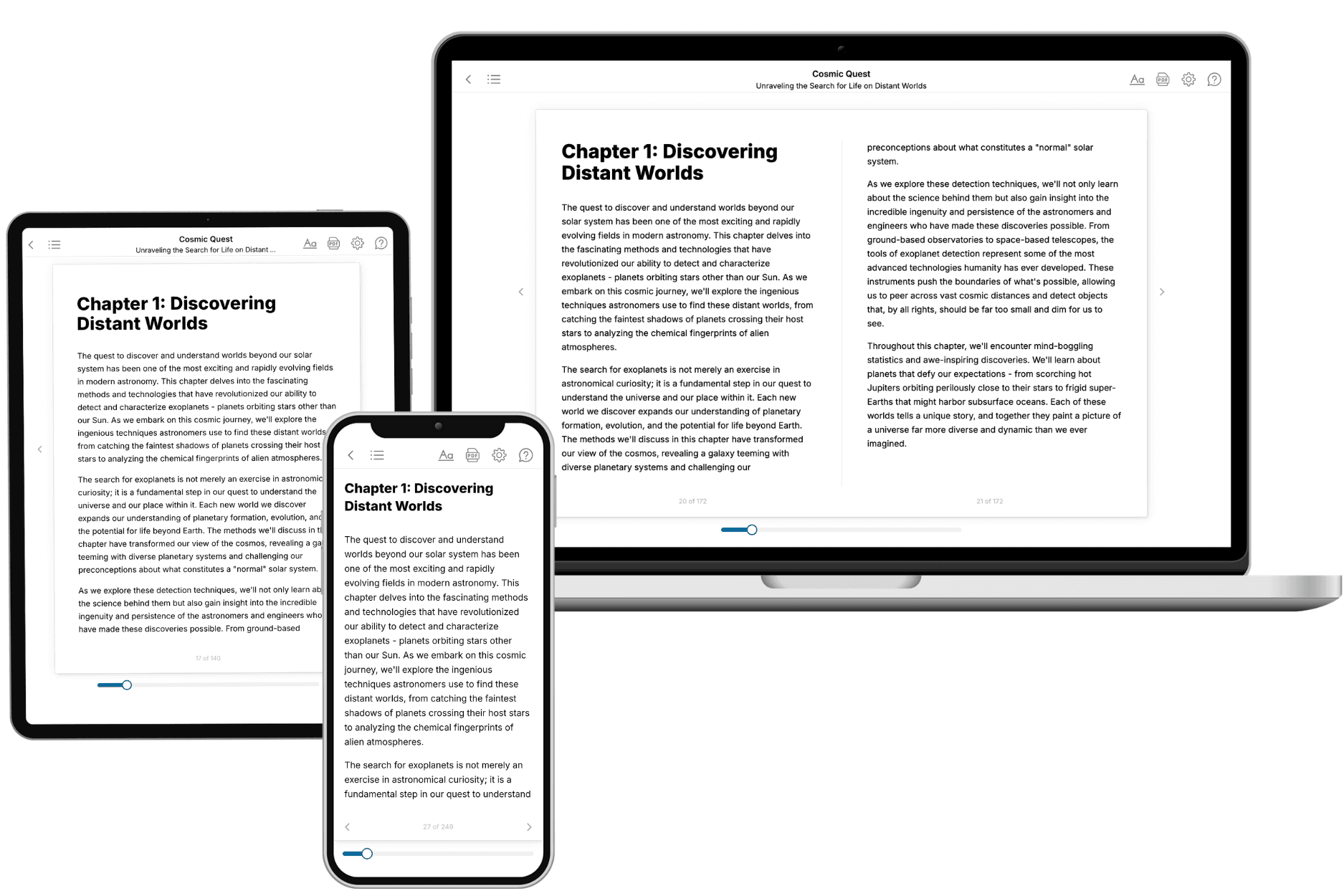
Your book is ready in 10 minutes. Read it online, download as EPUB or PDF, or send to Kindle.
Frequently asked questions
- What is TailoredRead?
TailoredRead creates complete, full-length nonfiction ebooks, written specifically for you. Tell us what you want to learn and why, and TailoredRead writes you a complete ebook on it, with charts, tables, and diagrams throughout. Read it online, on Kindle, or on any e-reader, or download it as a PDF or EPUB. Every book is written fresh the day you order it.
- How is the book tailored to me?
Before anything is written, you answer a few short questions about your goals, your background, and the topics you care about. Your book is then planned around your answers: written at your level, focused on your goals, and covering the topics you chose, instead of the one-size-fits-all book a store sells everyone.
- Will it read like generic AI content?
No. Your book isn't a chat transcript: it's planned chapter by chapter before a single word is written, told in a clear book voice, and explains ideas visually with charts, tables, and diagrams. After writing, every book goes through an editorial pass that polishes chapters so the book reads consistent from start to finish. Judge for yourself: browse thousands of sample books on our Explore Books page.
- How accurate is the content?
Our AI first checks whether your subject needs live research. Niche and fast-moving subjects are researched before writing, and the book plan and chapters are grounded in what it finds. After writing, every book goes through a quality pass that checks its facts and consistency, and researched books list their sources in a Notes section at the back.
- How long is the book?
You choose the length: Comprehensive (250-300 pages), Detailed (150-200 pages), Essential (70-100 pages), or Short (30-50 pages).
- Does the book include visuals?
Yes. Every book includes charts, tables, and diagrams: timelines, checklists, step-by-step guides, decision trees, comparison tables, matrices, and bar charts. A typical book includes dozens of these visual elements.
- Can I read it on Kindle? What formats can I download?
Yes. Every book can be read in our online reader or downloaded as a PDF or EPUB. The EPUB can be opened with Kindle, Apple Books, Kobo, and any e-reader. The Commercial and Author licenses also include an editable Word (DOCX) and Markdown download.
- How much does it cost?
About the price of a regular ebook. The exact price depends on your book's length and complexity, from $2 for the shortest books to $35 for the most comprehensive, and it's shown when you review your book, before you commit to anything. Each book is a one-time purchase, yours to keep, no subscription. Licenses that let you share, teach, or publish your book range from $35.99 to $49.99.
- Can I preview the book before purchasing?
Before you pay, you'll see what your book will cover: the title, a detailed description, the estimated length, and the complete chapter-by-chapter table of contents, so you know what you're getting before you decide. The full text itself is written after you purchase.
- How long does it take to create a book?
About 10 minutes. You can start reading the opening chapters while the rest is still being written.