Waterfall Hikes of the North Cascades
Your Complete Guide to the Region's Most Spectacular Cascades and Hidden Gems
Imagine standing before a thundering cascade of water, mist rising around you, surrounded by ancient forest and towering peaks.
207 pages10 chaptersFeb 19, 2026Hiking
About this book
The North Cascades region offers some of the Pacific Northwest's most breathtaking waterfall experiences, yet many remain unknown to casual visitors. This guide reveals where to find them, how to reach them safely, and when to visit for the most spectacular views. Whether you're seeking a gentle walk to a roadside waterfall or planning a challenging backcountry adventure, you'll discover detailed trail descriptions, difficulty ratings, seasonal insights, and insider tips from local experts. Learn how to read water conditions, prepare for changing weather, and respect these natural wonders while exploring them responsibly. From the famous falls that draw crowds to secret cascades known only to locals, this comprehensive guide transforms you from a casual hiker into a confident explorer of the North Cascades' most stunning waterfall destinations.
Table of contents
- IntroductionWhy Waterfalls Matter: The Magic of Cascading Water, The North Cascades: A Waterfall Paradise, How to Use This Guide, Safety First: What You Need to KnowRead below
- Chapter 1: Understanding the North Cascades LandscapeGeology and Waterfall Formation, Climate Patterns and Seasonal Changes, Ecosystems and Biodiversity
- Chapter 2: Planning Your Waterfall AdventureChoosing the Right Hike for Your Level, Seasonal Timing and Water Flow Conditions, Permits, Regulations, and Access Information
- Chapter 3: Essential Gear and PreparationFootwear and Clothing for Wet Conditions, Safety Equipment and Navigation Tools, Physical Conditioning and Training
- Chapter 4: Water Safety and Risk ManagementReading Water Conditions and Flow Dynamics, Recognizing and Avoiding Common Hazards, Emergency Response and First Aid Essentials
- Chapter 5: Easy Waterfall Hikes: Perfect Starting PointsAccessible Waterfall Destinations, Family-Friendly Routes and Viewpoints, Roadside Waterfalls and Quick Stops
- Chapter 6: Moderate Waterfall Hikes: Building Your SkillsClassic Day Hikes with Rewarding Views, Multi-Waterfall Routes and Loop Trails, Hikes with Significant Elevation Gain
- Chapter 7: Challenging Waterfall Hikes: Advanced AdventuresBackcountry Waterfall Destinations, Technical Terrain and Scrambling Routes, Remote Hidden Gems and Off-Trail Discoveries
- Chapter 8: Seasonal Waterfall ExperiencesSpring: Peak Water Flow and Snowmelt Magic, Summer: Optimal Conditions and Extended Access, Fall and Winter: Solitude and Unique Perspectives
- Chapter 9: Photography and AppreciationCapturing Waterfall Photography, Finding the Best Viewpoints and Angles, Mindful Appreciation and Environmental Respect
- Chapter 10: Leave No Trace and ConservationUnderstanding Your Environmental Impact, Trail Stewardship and Responsible Hiking, Protecting Waterfall Ecosystems for the Future
- ConclusionYour Waterfall Journey Begins
- Appendix: Quick Reference ResourcesTrail Difficulty and Distance Chart, Contact Information and Resources
Introduction
There is a moment that every waterfall hiker knows. You've been walking through dense forest for an hour, the trail damp beneath your boots, the air carrying that particular coolness that hints at something ahead. Then you hear it: a low, steady roar building through the trees. The sound grows with each step until you round a bend and suddenly there it is, a wall of white water crashing down ancient rock, mist drifting across your face, the sheer force of it filling your chest. That moment never gets old, no matter how many times you've experienced it.
The North Cascades region of Washington State is one of the most waterfall-rich landscapes in North America. Glaciers, snowfields, and some of the heaviest precipitation in the continental United States combine to feed hundreds of cascades across this rugged terrain. Some of these falls are famous, drawing thousands of visitors each year. Others sit quietly in remote valleys, visited by only a handful of people each season. This guide exists to help you find both kinds, and everything in between.
Whether you've been hiking for years or you're just starting to explore the outdoors, this book is built around one core idea: the right preparation makes all the difference. A waterfall hike that feels overwhelming without proper planning becomes deeply rewarding when you know what to expect. The North Cascades can be demanding, but it rewards those who approach it with respect, curiosity, and a solid plan. The chapters ahead will give you exactly that foundation, from understanding the landscape to choosing the right trail for your fitness level, from reading water conditions to capturing stunning photographs.
This introduction sets the stage for everything that follows. It explains why waterfalls hold such a powerful draw for hikers and nature lovers, gives you a broad picture of what makes the North Cascades so exceptional, walks you through how to get the most from this guide, and covers the essential safety principles that should inform every trip you take into this landscape. Think of it as your orientation before the adventure begins.
Why Waterfalls Matter: The Magic of Cascading Water
Waterfalls have fascinated humans across every culture and throughout recorded history. Ancient peoples built shrines near them. Painters and poets have returned to them again and again as subjects. Today, waterfall destinations consistently rank among the most visited natural attractions in national parks and wilderness areas worldwide. There's clearly something deep at work here, something that goes beyond simple scenery.
Part of the appeal is sensory and immediate. A large waterfall engages all five senses at once. You hear the roar before you see it. You feel the mist on your skin and the vibration in the ground beneath your feet. The smell of cold, clean water and wet stone is distinct and memorable. Visually, the movement of falling water is endlessly dynamic, never the same from one second to the next. Few natural features deliver this kind of full-body experience.
There's also growing scientific evidence that spending time near moving water has measurable benefits for mental health and wellbeing. Researchers have found that natural water environments reduce stress hormones, lower blood pressure, and improve mood.[1] The concept of blue space, natural environments featuring water, has become an active area of study in environmental psychology. Waterfalls, with their combination of sound, movement, and negative ions released by crashing water, may represent one of the most potent forms of blue space available.
Beyond the personal experience, waterfalls play a critical ecological role in the landscapes they inhabit. They oxygenate streams, create unique microhabitats for specialized plant and animal species, and regulate water temperature in ways that support cold-water fish populations like salmon and steelhead. The spray zones around large falls support mosses, ferns, and wildflowers that can't survive in drier conditions. When you visit a waterfall, you're stepping into one of the most biologically active zones in the entire watershed.
Waterfalls also serve as powerful markers of a landscape's health. A waterfall running clear and strong in its natural season signals a healthy upstream watershed with intact snowpack, healthy forests, and functioning soils. Changes in flow, color, or timing can indicate problems ranging from drought to upstream disturbance. Learning to read waterfalls as indicators of landscape health adds a whole new layer of meaning to every visit.
Finally, there's the simple fact that reaching a waterfall feels earned. Unlike a roadside viewpoint, most waterfall destinations require effort to reach. That effort creates a sense of investment and reward that makes the destination feel genuinely special. The hike itself becomes part of the experience, not just a means to an end. This is why waterfall hiking, as a specific pursuit, has grown so dramatically in popularity over the past two decades. It combines physical activity, natural beauty, and a clear, satisfying goal in a way that few other outdoor activities can match.
The North Cascades: A Waterfall Paradise
The North Cascades stretch across the northern portion of Washington State, running from the Cascade foothills east of Puget Sound all the way to the Okanogan Highlands near the Canadian border. This is one of the most topographically complex regions in the lower 48 states, with over 300 glaciers, peaks exceeding 9,000 feet, and valleys that drop to near sea level within just a few miles of horizontal distance.[2] That dramatic vertical relief is the engine that drives the region's extraordinary waterfall density.
The numbers are genuinely staggering. Conservative estimates place the number of named and unnamed waterfalls in the broader North Cascades region at well over 300, with many researchers suggesting the true count is significantly higher when seasonal and ephemeral falls are included. The region receives between 80 and 110 inches of precipitation annually in its western valleys, much of it falling as snow at higher elevations. When that snowpack melts each spring and summer, it feeds a network of streams and rivers that cascade down steep terrain in spectacular fashion.
The region is divided into several distinct management areas, each with its own character and access conditions:
- North Cascades National Park Complex: The core wilderness area, including Ross Lake and Lake Chelan National Recreation Areas, with some of the most remote and dramatic waterfall destinations in the region.
- Mount Baker-Snoqualmie National Forest: The western slopes, featuring heavily visited trails near the Nooksack River drainage and the flanks of Mount Baker, one of the snowiest places on Earth.
- Okanogan-Wenatchee National Forest: The drier eastern slopes, where waterfalls tend to be more seasonal but often more accessible and less crowded.
- State Parks and DNR Lands: A patchwork of state-managed areas, including Rainy Pass, Washington Pass, and numerous smaller parcels that protect key waterfall corridors.
What makes the North Cascades particularly special compared to other waterfall regions is the sheer variety of fall types on offer. You'll find tall, single-drop plunge falls where water free-falls over a cliff edge. You'll find tiered cascades that tumble down a series of rock steps over hundreds of feet. There are wide, fan-shaped horsetail falls that maintain contact with the rock face as they descend, and narrow, powerful chutes that concentrate enormous water volume through tight channels. Each type creates a completely different visual and auditory experience.
The region's geology also creates unusual waterfall settings. Ancient metamorphic and igneous rocks, shaped by repeated glaciation, produce the dramatic cliff faces and polished bedrock channels that give North Cascades waterfalls their distinctive character. Glacially carved hanging valleys, where tributary valleys sit high above the main valley floor, create conditions for some of the most spectacular high-drop falls in the region. Understanding a little of this geology, covered in depth in Chapter 1, will help you appreciate what you're seeing when you stand before these features.
Access to the North Cascades varies enormously by location and season. The North Cascades Highway (State Route 20), which crosses the range through Washington Pass, is closed by snow from roughly November through April each year, cutting off access to many eastern-slope destinations. Western-slope trailheads near Bellingham and the Nooksack Valley remain accessible year-round, though winter conditions require appropriate preparation. This seasonal rhythm shapes everything about how and when you can explore the region's waterfalls, and it's a central theme throughout this guide.
One of the most exciting aspects of the North Cascades for waterfall hunters is how much remains undiscovered by the general public. While falls like Ladder Creek Falls in Newhalem and Twin Falls near North Bend draw large crowds, dozens of equally spectacular cascades see only a handful of visitors each year. Local hiking clubs, backcountry rangers, and dedicated explorers continue to document new finds. This guide includes a selection of these lesser-known destinations alongside the classics, giving you a genuine mix of accessible highlights and off-the-beaten-path adventures.
How to Use This Guide
This book is designed to work as both a planning resource and a field companion. You can read it cover to cover before your first trip to build a comprehensive understanding of the region, or you can jump directly to the chapters most relevant to your immediate needs. Either approach works, though reading the foundational chapters first will make the trail-specific content in later chapters much more useful.
The book is organized in a logical progression. The early chapters build your knowledge base: understanding the landscape, planning your trips, assembling the right gear, and managing safety and risk. The middle chapters present the actual hike destinations, organized by difficulty level from easy to challenging. The later chapters cover photography, conservation, and seasonal considerations. The appendix provides quick-reference tools you can use in the field without needing to flip through the full text.
Each hike description in Chapters 5 through 7 follows a consistent format to make comparison and planning straightforward:
- Distance and elevation gain: Round-trip mileage and total elevation change, so you can assess physical demands at a glance.
- Difficulty rating: Rated Easy, Moderate, or Challenging, with specific notes on what drives that rating (terrain type, exposure, navigation complexity).
- Best season: The optimal window for visiting, with notes on what changes outside that window.
- Trailhead access: Road conditions, parking information, and any permit requirements.
- Trail description: A detailed narrative of the route, including key landmarks, navigation notes, and what to expect at the waterfall itself.
- Insider tips: Specific advice from local knowledge, including lesser-known viewpoints, timing recommendations, and common mistakes to avoid.
The difficulty ratings in this guide are calibrated for intermediate hikers with moderate experience, which reflects the core audience this book is written for. If you're newer to hiking, trails rated Easy here will feel comfortable and achievable. Trails rated Moderate will require solid fitness and some experience with uneven terrain. Trails rated Challenging are intended for experienced hikers who are comfortable with route-finding, significant elevation gain, and potentially exposed terrain. These ratings are not arbitrary; they're based on a combination of distance, elevation gain, trail surface quality, and navigation complexity.
Throughout the book, you'll find several recurring features designed to add depth and practical value:
- Safety callouts: Highlighted warnings about specific hazards associated with particular trails or conditions.
- Seasonal notes: Reminders about how conditions change across the year for specific destinations.
- Photography tips: Practical advice for capturing each waterfall at its best, tied to specific viewpoints and lighting conditions.
- Conservation notes: Reminders about responsible behavior at sensitive locations.
One important note about using any printed guide for trail navigation: conditions change. Trails wash out, trailheads move, permit systems get updated, and access roads close unexpectedly. Always verify current conditions before heading out by checking with the relevant land management agency. The contact information for all relevant agencies is listed in the appendix. This guide provides the foundation; current agency websites and ranger stations provide the real-time updates that keep your plans accurate and safe.
Finally, this guide is not exhaustive. The North Cascades contains more waterfall destinations than any single book could cover comprehensively. The selection here represents a curated mix of the region's best-known falls, its most rewarding moderate hikes, and a carefully chosen set of lesser-known gems that offer exceptional experiences with less crowd pressure. Think of this as a starting point for your own exploration, not a complete inventory. The best discoveries are often the ones you make yourself, building on the foundation this guide provides.
Safety First: What You Need to Know
Waterfall hiking is one of the most rewarding outdoor pursuits available in the Pacific Northwest, and it's also one of the most consistently underestimated in terms of risk. Every year, search and rescue teams in the North Cascades respond to incidents at or near waterfall destinations. The majority of these incidents share a common thread: the victim underestimated the hazard, often because the setting looked beautiful and approachable rather than dangerous. Understanding the specific risks associated with waterfall environments is the single most important thing you can do before your first trip.
The most significant hazard at waterfall destinations is slippery rock surfaces. Rock near waterfalls is almost always wet, and wet rock covered in algae, moss, or mineral deposits can be as slick as ice. This is true even when the rock looks dry from a distance. The spray zone around a large waterfall extends much farther than most people expect, and rocks that appear safe to stand on can send you off your feet instantly. Waterproof hiking boots with aggressive rubber soles are essential, but even the best footwear has limits on wet, algae-covered rock. The safest approach is to treat all rock near a waterfall as potentially slippery and move accordingly.
Flash flooding is a serious and underappreciated risk in the North Cascades. The region's steep terrain and high precipitation create conditions where stream levels can rise dramatically in a very short time, even when skies appear clear at your location. A rainstorm miles upstream, or a sudden warm spell accelerating snowmelt, can send a wall of water down a canyon with little warning. Before hiking any trail that follows a stream corridor or requires creek crossings, check the weather forecast for the entire watershed, not just your immediate location. If you hear a sudden increase in stream noise or notice the water changing color to a muddy brown, move to high ground immediately.
Water temperature in the North Cascades is another hazard that catches people off guard. Even in midsummer, water fed by glaciers and high snowfields is dangerously cold, often between 40 and 50 degrees Fahrenheit. Falling into water at these temperatures triggers cold shock, which can cause involuntary gasping, hyperventilation, and rapid loss of swimming ability within minutes.[3] This makes any unplanned water entry at a waterfall site potentially life-threatening, even for strong swimmers. Never wade into pools below waterfalls without understanding the depth, current, and exit options. Many waterfall pools have powerful recirculating currents that make self-rescue extremely difficult.
Here is a practical safety checklist to review before every waterfall hike:
- Check the weather forecast for the full watershed, not just the trailhead location.
- Tell someone your planned route, trailhead, and expected return time.
- Carry a paper map and compass as backup to any digital navigation tools.
- Wear footwear with aggressive rubber soles rated for wet conditions.
- Bring a first aid kit that includes blister treatment, wound care, and an emergency space blanket.
- Carry more water than you think you need; stream water in the North Cascades requires treatment before drinking.
- Know the signs of hypothermia and how to respond if a member of your group gets wet and cold.
- Respect all posted barriers and warning signs at waterfall viewpoints; they exist because people have been injured at those exact spots.
Cell phone coverage in the North Cascades is unreliable and often nonexistent in the backcountry. Do not rely on your phone as your primary safety tool. A personal locator beacon (PLB) or satellite communicator device is a worthwhile investment for any hike that takes you more than a mile from a trailhead. These devices allow you to send an emergency signal and, in the case of two-way satellite communicators, maintain contact with the outside world regardless of cell coverage. Chapter 3 covers gear selection in detail, including specific recommendations for communication devices at different price points.
Group dynamics matter more than most hikers realize. The pace of any group should be set by its least experienced or least fit member, not its strongest. Peer pressure to push past a safe turnaround point, to cross a sketchy log bridge, or to scramble closer to a waterfall for a better view is responsible for a significant proportion of waterfall-related accidents. Before you set out, agree as a group on turnaround criteria: a specific time, a specific weather threshold, or a specific terrain feature beyond which you won't proceed. Having that conversation before you're standing at the edge of a tempting but risky viewpoint makes it much easier to make the right call.
Chapter 4 of this guide is dedicated entirely to water safety and risk management, covering these topics in much greater depth with specific guidance on reading water conditions, recognizing hazards, and responding to emergencies. Reading that chapter before your first waterfall hike is strongly recommended, regardless of your experience level. The North Cascades is a generous and spectacular landscape, but it demands respect. The hikers who have the best experiences here are the ones who prepare thoroughly, stay alert, and know when to turn back. That combination of preparation and judgment is what this entire guide is designed to help you develop.
Notes
Introduction
- 1. M. P. White and others, Spending at least 120 minutes a week in nature is associated with good health and wellbeing, Scientific Reports, 2020
- 2. North Cascades National Park Service, Park Statistics and Natural Features Overview, U.S. Department of the Interior, 2023
- 3. M. J. Tipton and others, "Cold water immersion," Experimental Physiology, 2014
This is the end of the free sample. The full book has 10 chapters.
Want this book written for you?
Tell us your goals and background, and get your own version of this book, tailored by AI to you.


Benefits of AI-tailored books
- Read one book, not ten:
- all the Hiking knowledge you need, gathered into a single book.
- Save days of learning:
- tell us your goals, choose your topics, and the whole book is built around them.
- Learn effortlessly:
- Hiking book written for your specific background and expertise.
- Understand at a glance:
- includes charts, tables, timelines, checklists, decision trees, and more.
- Stay current:
- written the day you order it, not years ago.
- Trust what you read:
- every book is checked for accuracy, with real research when your subject needs it.
Create your unique book in 3 steps
- 1. Select your focus
Select the focus of your Hiking book and share your background
- 2. Personalize your book
Specify your goals and choose sub-topics to include
- 3. Get your tailored book
Your book is ready in 10 minutes. Read it online, download as EPUB or PDF, or send to Kindle.


Frequently asked questions
- What is TailoredRead?
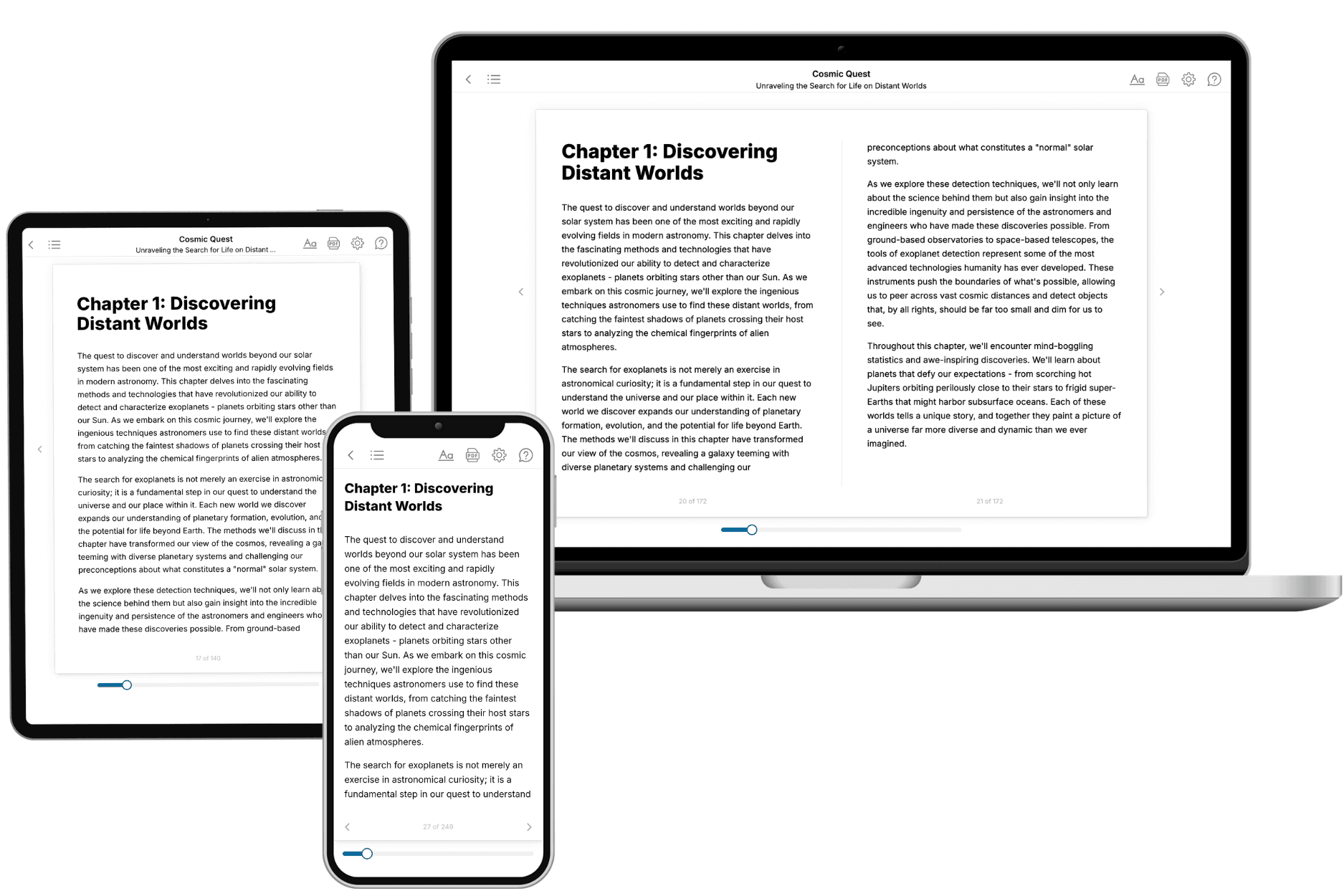
TailoredRead creates complete, full-length nonfiction ebooks, written specifically for you. Tell us what you want to learn and why, and TailoredRead writes you a complete ebook on it, with charts, tables, and diagrams throughout. Read it online, on Kindle, or on any e-reader, or download it as a PDF or EPUB. Every book is written fresh the day you order it.
- How is the book tailored to me?
Before anything is written, you answer a few short questions about your goals, your background, and the topics you care about. Your book is then planned around your answers: written at your level, focused on your goals, and covering the topics you chose, instead of the one-size-fits-all book a store sells everyone.
- Will it read like generic AI content?
No. Your book isn't a chat transcript: it's planned chapter by chapter before a single word is written, told in a clear book voice, and explains ideas visually with charts, tables, and diagrams. After writing, every book goes through an editorial pass that polishes chapters so the book reads consistent from start to finish. Judge for yourself: browse thousands of sample books on our Explore Books page.
- How accurate is the content?
Our AI first checks whether your subject needs live research. Niche and fast-moving subjects are researched before writing, and the book plan and chapters are grounded in what it finds. After writing, every book goes through a quality pass that checks its facts and consistency, and researched books list their sources in a Notes section at the back.
- How long is the book?
You choose the length: Comprehensive (250-300 pages), Detailed (150-200 pages), Essential (70-100 pages), or Short (30-50 pages).
- Does the book include visuals?
Yes. Every book includes charts, tables, and diagrams: timelines, checklists, step-by-step guides, decision trees, comparison tables, matrices, and bar charts. A typical book includes dozens of these visual elements.
- Can I read it on Kindle? What formats can I download?
Yes. Every book can be read in our online reader or downloaded as a PDF or EPUB. The EPUB can be opened with Kindle, Apple Books, Kobo, and any e-reader. The Commercial and Author licenses also include an editable Word (DOCX) and Markdown download.
- How much does it cost?
About the price of a regular ebook. The exact price depends on your book's length and complexity, from $2 for the shortest books to $35 for the most comprehensive, and it's shown when you review your book, before you commit to anything. Each book is a one-time purchase, yours to keep, no subscription. Licenses that let you share, teach, or publish your book range from $35.99 to $49.99.
- Can I preview the book before purchasing?
Before you pay, you'll see what your book will cover: the title, a detailed description, the estimated length, and the complete chapter-by-chapter table of contents, so you know what you're getting before you decide. The full text itself is written after you purchase.
- How long does it take to create a book?
About 10 minutes. You can start reading the opening chapters while the rest is still being written.