When Lightning Strikes Twice
Understanding and Navigating Secondary Infertility
Imagine finally holding the child you've been longing for—the one you thought would come naturally, just as it did before.
207 pages10 chaptersMay 12, 2026Reproductive Health
About this book
Secondary infertility can feel like a cruel twist of fate, especially when you've already experienced the joy of parenthood. This book is written for those navigating the unexpected challenge of not being able to conceive again. You'll discover what causes secondary infertility, how it differs from primary infertility, and why your previous pregnancy doesn't guarantee another. Learn about the medical evaluations that can pinpoint the problem, explore treatment options tailored to your situation, and understand the emotional landscape you're traversing. This comprehensive guide addresses both the science and the soul of secondary infertility—acknowledging the unique guilt, isolation, and grief that often accompany this journey. Whether you're just beginning to suspect a problem or deep in treatment decisions, you'll find practical strategies for managing relationships, building support systems, and maintaining hope while staying grounded in reality. This is your roadmap through secondary infertility, written with compassion and clarity.
Table of contents
- IntroductionYour Story Matters: Why Secondary Infertility Is Different, What to Expect from This Book, You Are Not Alone: The Prevalence of Secondary InfertilityRead below
- Chapter 1: Understanding Secondary InfertilityDefining Secondary Infertility: Medical and Personal Perspectives, How Secondary Infertility Differs from Primary Infertility, The Unique Emotional Landscape of Secondary Infertility
- Chapter 2: The Biology Behind Secondary InfertilityAge and Fertility: Why Time Changes Everything, Female Factors: Ovulation, Hormones, and Structural Issues, Male Factors: Sperm Quality and Reproductive Health, When Causes Remain Unexplained: Navigating Uncertainty
- Chapter 3: Medical Evaluation and DiagnosisWhen to Seek Help: Timing and Triggers, Essential Diagnostic Tests and What They Reveal, Finding the Right Fertility Specialist for Your Needs
- Chapter 4: Lifestyle Factors and Natural ApproachesNutrition and Fertility: Foods That Support Conception, Exercise, Weight, and Reproductive Health, Stress Management and Sleep: Foundations for Fertility, Environmental Toxins and Lifestyle Modifications
- Chapter 5: Medical Treatment OptionsFertility Medications: How They Work and What to Expect, Surgical Options: When and Why They May Help, Intrauterine Insemination (IUI): A Step-by-Step Overview
- Chapter 6: Assisted Reproductive TechnologiesIn Vitro Fertilization (IVF): The Complete Process, Understanding IVF Success Rates and Your Chances, Advanced Techniques: PGD, ICSI, and Emerging Options
- Chapter 7: The Emotional JourneyProcessing Grief, Guilt, and Unexpected Emotions, Identity, Motherhood, and Self-Worth During Infertility, Mental Health Support: Therapy and Counseling Options
- Chapter 8: Relationships and CommunicationCommunicating with Your Partner: Navigating Differences, Intimacy and Sexuality During Fertility Treatment, Managing Relationships with Family and Friends
- Chapter 9: Building Your Support SystemFinding Community: Support Groups and Online Networks, Professional Resources: Counselors, Coaches, and Advocates, Self-Care Practices That Sustain You Through Treatment
- Chapter 10: Making Treatment DecisionsClarifying Your Values and Fertility Goals, Financial Planning and Insurance Navigation, Creating a Decision-Making Framework for Your Journey
- Conclusion: Moving Forward with Hope and ClarityYour Unique Path Forward, Hope, Resilience, and What Comes Next
- Resources and Further Reading
Introduction
There is a particular kind of disbelief that comes with secondary infertility. You have done this before. You have felt the flutter of a positive pregnancy test, navigated the months of anticipation, and held a child in your arms. You know what it feels like to conceive, and so the assumption was reasonable: it would happen again. When it doesn't, the confusion can be just as sharp as the grief. Something that once felt natural and almost inevitable has become uncertain, medically complicated, and emotionally exhausting in ways you never anticipated.
Secondary infertility is defined as the inability to conceive or carry a pregnancy to term after previously giving birth to a child. It affects a surprisingly large number of families, yet it remains one of the least discussed fertility challenges in both medical settings and everyday conversation. Many people who experience it feel caught between two worlds: they are not childless, so they hesitate to claim the language of infertility, yet they are struggling deeply with something that has a real medical name and real medical causes. That in-between space can feel profoundly isolating.
This book exists to close that gap. It is written for anyone who has been through the joy of a first pregnancy or birth and is now facing the unexpected difficulty of trying to conceive again. Whether you are just beginning to wonder if something might be wrong, or you are already deep into diagnostic testing and treatment decisions, the pages ahead are designed to give you clear information, honest perspective, and genuine support. The goal is not to offer false reassurance, but to help you understand what is happening, what your options are, and how to take care of yourself and your relationships throughout this process.
The chapters that follow cover the full landscape of secondary infertility: the biology behind it, the medical evaluations that can identify its causes, the treatment options available, and the emotional terrain that so many people navigate quietly and alone. Each chapter is built around practical, specific information rather than vague encouragement. You will find frameworks for making decisions, guidance for difficult conversations, and strategies for sustaining your mental health when the process feels overwhelming. This is not a book that asks you to simply stay positive. It is a book that takes your experience seriously and gives you the tools to move through it with clarity.
Your Story Matters: Why Secondary Infertility Is Different
Secondary infertility is not simply a repeat of what someone with primary infertility experiences. The circumstances are fundamentally different, and those differences shape everything: the medical picture, the emotional response, the social dynamics, and even the way healthcare providers sometimes respond. Understanding why secondary infertility is its own distinct experience is the first step toward navigating it with the clarity it deserves.
One of the most significant differences is the presence of a living child. That child is a source of enormous love and gratitude, and most parents experiencing secondary infertility feel that love deeply. But the child's presence also creates a complicated emotional layer. There is often guilt about wanting more, a sense that longing for another child is somehow ungrateful for what you already have. Friends and family may reinforce this feeling, sometimes without meaning to, by saying things like at least you have one
or you should be grateful.
These comments, however well-intentioned, can make it harder to acknowledge the real pain of the situation.
The medical picture is also genuinely different. A previous successful pregnancy does not protect against the biological changes that can affect fertility over time. Age is one of the most significant factors: a woman who conceived easily at 28 may face a very different hormonal and ovarian landscape at 34 or 36. Conditions like endometriosis, uterine fibroids, or polycystic ovary syndrome (PCOS) can develop or worsen between pregnancies. A previous pregnancy or delivery can sometimes cause structural changes, such as uterine scarring, that affect future conception. Male fertility can also decline over time due to age, health changes, or lifestyle factors.
There is also a psychological dimension that is unique to secondary infertility. Having conceived before creates a specific kind of expectation, and when that expectation is not met, the gap between what you assumed would happen and what is actually happening can feel particularly jarring. Research has shown that people with secondary infertility often report feeling less entitled to grieve or seek support than those with primary infertility, which can delay both emotional processing and medical help-seeking.[1] That delay can have real consequences, both emotionally and medically.
Your story matters because it is specific. It is not the same as someone who has never conceived, and it is not the same as someone who has never wanted children. It sits in its own category, with its own causes, its own grief, and its own path forward. This book honors that specificity. Rather than treating secondary infertility as a footnote to the broader conversation about fertility, it places your experience at the center and builds outward from there.
Consider the experience of a couple who conceived their first child without difficulty at age 30 and then spent two years trying to conceive a second child starting at age 33. The medical workup eventually revealed diminished ovarian reserve, a condition that had developed in the intervening years. Nothing about their first pregnancy predicted this outcome. Their story is not unusual. It reflects a pattern that reproductive endocrinologists see regularly: the biology of fertility is not static, and a previous pregnancy is not a guarantee of future fertility. Understanding this is not meant to be discouraging. It is meant to be clarifying, because clarity is what makes it possible to take the right next steps.
Secondary infertility is a legitimate medical condition with identifiable causes and effective treatments. Acknowledging it as such is not a betrayal of gratitude for the child you already have. It is simply an honest recognition of what is happening in your body and your life.
One more thing worth naming here: secondary infertility can affect people across a wide range of circumstances. It affects those who conceived their first child naturally and those who used assisted reproduction. It affects those who had uncomplicated pregnancies and those who experienced loss. It affects people at 28 and people at 42. The specifics of your situation will shape which parts of this book are most relevant to you, but the core experience of unexpected difficulty conceiving again is something this book addresses directly and without judgment.
What to Expect from This Book
This book is organized to take you through the full arc of secondary infertility, from understanding what it is and why it happens, to navigating diagnosis and treatment, to managing the emotional and relational dimensions of the journey. You do not need to read it cover to cover in order. If you are in the middle of a diagnostic workup, you might start with Chapter 3. If you are struggling emotionally and need support right now, Chapter 7 is written for that moment. The structure is designed to be flexible and responsive to where you actually are.
Here is a brief overview of what each section covers:
- Chapters 1 and 2 lay the medical and emotional foundation. They define secondary infertility, explain how it differs from primary infertility, and walk through the biological factors that most commonly cause it, including age-related changes, hormonal conditions, structural issues, and male-factor causes.
- Chapter 3 covers the diagnostic process: when to seek help, what tests are typically ordered, and how to find a fertility specialist who is the right fit for your needs.
- Chapters 4 and 5 address treatment options, starting with lifestyle modifications and natural approaches, then moving through fertility medications and surgical interventions.
- Chapter 6 goes deeper into assisted reproductive technologies, including IVF, ICSI, and preimplantation genetic testing, with clear explanations of how each works and what success rates actually mean.
- Chapters 7, 8, and 9 focus on the human side of the journey: processing grief and guilt, maintaining your relationship with your partner, managing family and social dynamics, and building a support system that sustains you.
- Chapter 10 provides a practical framework for making treatment decisions, including how to think about financial considerations and how to align your choices with your values and goals.
Throughout the book, you will find concrete examples, practical frameworks, and specific guidance rather than general encouragement. The goal is to give you information you can actually use. Where relevant, research and clinical data are cited so you can evaluate the evidence for yourself. Where the science is uncertain or evolving, that uncertainty is named honestly rather than papered over with optimism.
It is also worth being clear about what this book is not. It is not a substitute for medical care. The information here is meant to help you understand your situation, ask better questions, and make more informed decisions, but it cannot replace the individualized guidance of a reproductive endocrinologist or other qualified healthcare provider. Every person's fertility picture is different, and the right treatment path depends on a specific diagnosis that only a medical evaluation can provide.
This book also does not promise a particular outcome. Secondary infertility is a complex medical condition, and while many people do go on to have additional children with appropriate treatment, outcomes vary significantly depending on the underlying cause, age, and other factors. What this book does promise is honest, compassionate, and practical guidance for navigating the journey, whatever the outcome turns out to be. That includes guidance for those who ultimately decide to stop treatment, explore adoption or other paths to family building, or find peace with the family they already have.
One practical suggestion: as you read, keep a notebook or use a notes app to jot down questions that arise, terms you want to look up, or points you want to discuss with your doctor. The information in these chapters is most useful when it becomes part of an active conversation with your healthcare team. Think of this book as preparation for those conversations, a way of walking into appointments with more knowledge, more confidence, and better questions.
Knowledge does not eliminate uncertainty, but it does change your relationship to it. When you understand what is happening and why, you move from feeling like something is happening to you to feeling like someone who is actively navigating a challenge. That shift matters enormously.
Finally, the language in this book is intentionally inclusive. Secondary infertility affects people of all genders, relationship structures, and family configurations. While some sections address specific biological factors that apply to particular bodies, the emotional and relational content is written to be relevant across a wide range of experiences. Where specific terminology is used for clarity, it is used with care and without the assumption that every reader's situation looks the same.
You Are Not Alone: The Prevalence of Secondary Infertility
One of the most important things to understand about secondary infertility is how common it actually is. The numbers are striking, and yet the condition remains significantly underrepresented in public conversations about fertility. According to data from the Centers for Disease Control and Prevention (CDC), secondary infertility accounts for roughly half of all infertility cases in the United States.[2] That means the experience you are having is shared by millions of people, even if it rarely comes up in conversation.
In the United States alone, approximately 3.3 million women of childbearing age have experienced secondary infertility.[3] Globally, the numbers are even larger, with secondary infertility representing a significant proportion of fertility challenges across diverse populations and healthcare systems. Despite this prevalence, secondary infertility receives far less research funding, media attention, and clinical focus than primary infertility. This gap has real consequences for the people living with it, including delayed diagnosis, limited access to targeted support resources, and a persistent sense that their struggle is somehow less legitimate.
Part of why secondary infertility stays so invisible is that people experiencing it often do not talk about it. The guilt of wanting more when you already have a child, combined with the fear of being judged as ungrateful, creates a powerful incentive to stay silent. Many people describe going through months or even years of trying, testing, and treatment without telling anyone outside their immediate household. That silence compounds the isolation and makes it harder to find community with others who understand the experience.
The silence also affects how healthcare providers respond. Some people report that their concerns were initially dismissed by doctors who pointed to their previous pregnancy as evidence that there was nothing to worry about. This is a medically problematic response. A previous successful pregnancy does not rule out the development of new fertility-affecting conditions, and the standard clinical guideline is that couples under 35 who have been trying to conceive for 12 months without success, or couples over 35 who have been trying for 6 months, should seek a fertility evaluation regardless of prior pregnancy history.[4]
Understanding the prevalence of secondary infertility is not just a statistical exercise. It is a reminder that the experience you are having is real, recognized, and shared by a large community of people who know exactly what it feels like to be in this position. You are not imagining the difficulty. You are not being dramatic. You are not failing at something that should be easy. You are navigating a genuine medical challenge that affects millions of families, and you deserve the same quality of information, care, and support as anyone else dealing with a fertility issue.
There is also something worth noting about the demographics of secondary infertility. Because many people are choosing to have children later in life, the gap between a first and second pregnancy often spans years during which age-related fertility changes can become significant. The average age of first-time mothers in the United States has risen steadily over the past several decades, meaning that more people are attempting a second pregnancy at an age when fertility is naturally declining.[5] This demographic shift is one reason why secondary infertility is becoming more common, not less.
Support communities for secondary infertility have grown significantly in recent years, both online and in person. Organizations like RESOLVE: The National Infertility Association offer resources specifically for people experiencing secondary infertility, including support groups, educational materials, and advocacy tools. Online communities on platforms like Reddit, Facebook, and dedicated fertility forums have created spaces where people can share their experiences, ask questions, and find solidarity with others who understand the specific texture of this challenge. These communities are not a replacement for medical care or professional mental health support, but they can be a powerful antidote to the isolation that so many people describe.
The point of naming all of this at the start of the book is simple: you are not alone in this experience, even when it feels that way. The path through secondary infertility is not always straightforward, and it does not always end the way people hope. But it is a path that many people have walked before you, and there is a great deal of knowledge, support, and community available to help you navigate it. That is what this book is here to offer, one chapter at a time.
Secondary infertility is not a rare or unusual condition. It is a common, medically recognized challenge that affects millions of families. Naming it, understanding it, and seeking help for it is not an overreaction. It is exactly the right response.
As you move into the chapters ahead, carry with you the knowledge that your experience has a name, a medical framework, and a community. The confusion and grief you may be feeling are not signs of weakness. They are signs that you are human, that you care deeply, and that you are dealing with something genuinely hard. This book is here to help you deal with it as clearly, practically, and compassionately as possible.
Notes
Introduction
- 1. E. S. Glazer, The Long-Awaited Stork: A Guide to Parenting After Infertility, Jossey-Bass, 2011
- 2. Centers for Disease Control and Prevention, "Infertility FAQs," 2023
- 3. A. Chandra and others, Infertility and impaired fecundity in the United States, 1982-2010, National Health Statistics Reports, 2013
- 4. Practice Committee of the American Society for Reproductive Medicine, "Definitions of infertility and recurrent pregnancy loss," Fertility and Sterility, 2020
- 5. T. J. Matthews and B. E. Hamilton, Mean age of mothers is on the rise: United States, 2000-2014, NCHS Data Brief, 232. National Center for Health Statistics, 2016
This is the end of the free sample. The full book has 10 chapters.
Want this book written for you?
Tell us your goals and background, and get your own version of this book, tailored by AI to you.


Benefits of AI-tailored books
- Read one book, not ten:
- all the Reproductive Health knowledge you need, gathered into a single book.
- Save days of learning:
- tell us your goals, choose your topics, and the whole book is built around them.
- Learn effortlessly:
- Reproductive Health book written for your specific background and expertise.
- Understand at a glance:
- includes charts, tables, timelines, checklists, decision trees, and more.
- Stay current:
- written the day you order it, not years ago.
- Trust what you read:
- every book is checked for accuracy, with real research when your subject needs it.
Create your unique book in 3 steps
- 1. Select your focus
Select the focus of your Reproductive Health book and share your background
- 2. Personalize your book
Specify your goals and choose sub-topics to include
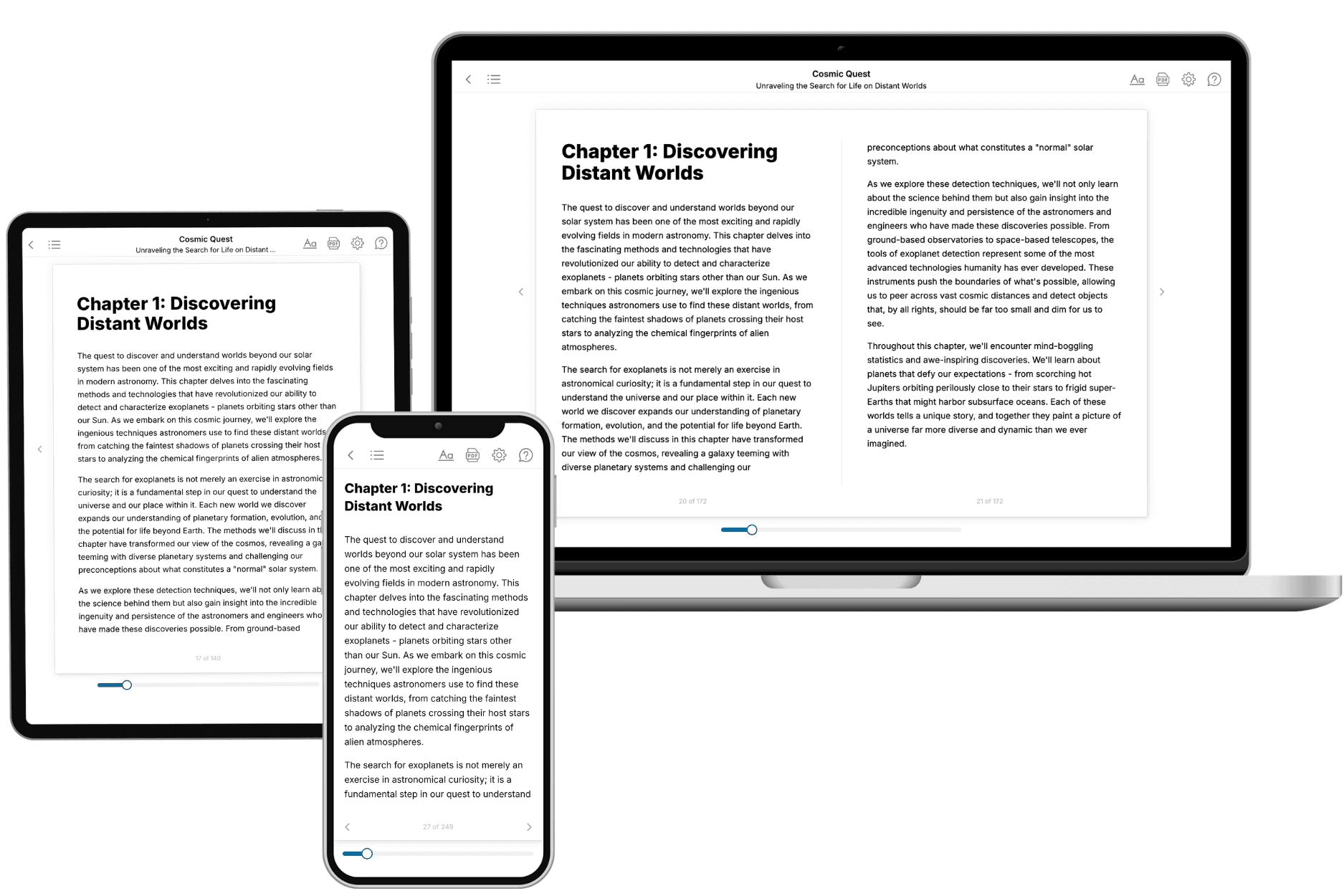
- 3. Get your tailored book
Your book is ready in 10 minutes. Read it online, download as EPUB or PDF, or send to Kindle.
Frequently asked questions
- What is TailoredRead?
TailoredRead creates complete, full-length nonfiction ebooks, written specifically for you. Tell us what you want to learn and why, and TailoredRead writes you a complete ebook on it, with charts, tables, and diagrams throughout. Read it online, on Kindle, or on any e-reader, or download it as a PDF or EPUB. Every book is written fresh the day you order it.
- How is the book tailored to me?
Before anything is written, you answer a few short questions about your goals, your background, and the topics you care about. Your book is then planned around your answers: written at your level, focused on your goals, and covering the topics you chose, instead of the one-size-fits-all book a store sells everyone.
- Will it read like generic AI content?
No. Your book isn't a chat transcript: it's planned chapter by chapter before a single word is written, told in a clear book voice, and explains ideas visually with charts, tables, and diagrams. After writing, every book goes through an editorial pass that polishes chapters so the book reads consistent from start to finish. Judge for yourself: browse thousands of sample books on our Explore Books page.
- How accurate is the content?
Our AI first checks whether your subject needs live research. Niche and fast-moving subjects are researched before writing, and the book plan and chapters are grounded in what it finds. After writing, every book goes through a quality pass that checks its facts and consistency, and researched books list their sources in a Notes section at the back.
- How long is the book?
You choose the length: Comprehensive (250-300 pages), Detailed (150-200 pages), Essential (70-100 pages), or Short (30-50 pages).
- Does the book include visuals?
Yes. Every book includes charts, tables, and diagrams: timelines, checklists, step-by-step guides, decision trees, comparison tables, matrices, and bar charts. A typical book includes dozens of these visual elements.
- Can I read it on Kindle? What formats can I download?
Yes. Every book can be read in our online reader or downloaded as a PDF or EPUB. The EPUB can be opened with Kindle, Apple Books, Kobo, and any e-reader. The Commercial and Author licenses also include an editable Word (DOCX) and Markdown download.
- How much does it cost?
About the price of a regular ebook. The exact price depends on your book's length and complexity, from $2 for the shortest books to $35 for the most comprehensive, and it's shown when you review your book, before you commit to anything. Each book is a one-time purchase, yours to keep, no subscription. Licenses that let you share, teach, or publish your book range from $35.99 to $49.99.
- Can I preview the book before purchasing?
Before you pay, you'll see what your book will cover: the title, a detailed description, the estimated length, and the complete chapter-by-chapter table of contents, so you know what you're getting before you decide. The full text itself is written after you purchase.
- How long does it take to create a book?
About 10 minutes. You can start reading the opening chapters while the rest is still being written.