Working the Problem
Advanced Mathematics Learned Through Worked Examples
Picture yourself working through a difficult integral, a stubborn boundary value problem, or a contour calculation and arriving at an answer you can trust, understand, and explain to someone else.
222 pages10 chaptersNov 13, 2026
About this book
This book is built for readers who already command the core of advanced calculus and physics and want to sharpen that command. Rather than presenting theory in the abstract, it moves through carefully chosen worked examples in real analysis, complex analysis, differential equations, linear algebra, and mathematical physics. Each example shows not only the solution but the reasoning that leads to it, the traps that catch even experienced practitioners, and the choices that make a method efficient. Along the way you will connect pure mathematics to the physical problems that motivated it, from quantum operators and Lagrangian mechanics to heat conduction and wave propagation. By the final chapter you will have a method for designing worked examples of your own and a growing personal library of solutions you can return to, extend, and teach from.
Table of contents
- IntroductionWhy Worked Examples Teach Advanced Mathematics, How to Read and Work These ExamplesRead below
- Chapter 1: Limits, Convergence, and Epsilon-Delta ProofsConstructing Epsilon-Delta Proofs for Limits, Cauchy Sequences and Completeness of the Reals, Uniform Versus Pointwise Convergence Examples
- Chapter 2: Riemann and Lebesgue Integration in PracticeWhere the Riemann Integral Breaks Down, Lebesgue Integration Through Concrete Examples, Sobolev Spaces and Weak Derivatives
- Chapter 3: Complex Analysis and Contour MethodsEvaluating Real Integrals by Contour Methods, Residue Theorem in Action, Applying the Cauchy Integral Formula
- Chapter 4: Analytic Continuation and Conformal MappingExtending Functions Beyond Their Original Domain, Solving Potential Problems With Conformal Maps, Working Through Gamma Function Identities
- Chapter 5: Transform Methods for Differential EquationsSolving Initial Value Problems With Laplace Transforms, Fourier Series and Their Convergence Behavior, Bessel Functions in Cylindrical Physics
- Chapter 6: Boundary Value Problems and Spectral TheorySturm-Liouville Eigenproblems Step by Step, Separation of Variables for the Heat Equation, Building Green's Functions for Boundary Problems
- Chapter 7: Linear Algebra in Applied MathematicsEigenvalue Decomposition in Physical Systems, Singular Value Decomposition for Data and Operators, Orthogonalization With the Gram-Schmidt Process
- Chapter 8: Dynamical Systems, Stability, and OscillatorsReading Phase Portraits of Two-Dimensional Systems, Establishing Stability With Lyapunov Functions, Bifurcations and Qualitative Change in Systems
- Chapter 9: Variational and Hamiltonian MechanicsLagrangian Mechanics as a Calculus Problem, Hamiltonian Formulation Through Worked Cases, Calculus of Variations and Extremal Paths
- Chapter 10: Approximation, Asymptotics, and Modeling ToolsPerturbation Methods for Weakly Nonlinear Problems, Asymptotic Expansions and Their Validity, Monte Carlo Methods and Stochastic Estimates
- ConclusionBuilding Your Own Library of Worked Solutions
- Further Reading and Resources
- Glossary
Introduction
A graduate student once spent three days trying to evaluate ∫0∞ sin(x)/x dx by expanding the integrand in a power series and integrating term by term. The series approach produced a divergent mess, no matter how the terms were grouped. A single contour, a semicircle in the upper half plane with a small detour around the origin, delivers the answer π/2 in four lines. The difference between three wasted days and four clean lines was not raw talent. It was having seen this exact kind of problem solved before, recognizing the shape of it, and knowing which tool fits. That recognition is what this book is built to give.
Every topic listed in the outline, from the epsilon-delta definition through Monte Carlo method estimates, is standard material covered in graduate texts. What those texts rarely do is show the false starts. A textbook proves the residue theorem and then applies it to three integrals chosen because they work cleanly. It does not show the integral that almost works, where the contour needs modification because a pole sits exactly on the real axis, or where the arc contribution refuses to vanish unless a particular lemma is invoked. Real problem-solving lives in that gap between the clean theorem and the messy instance. This book lives there too, on purpose.
The reader this book has in mind already knows the vocabulary. A background in physics and mathematics at the graduate level means terms like Hamiltonian, Sobolev space, and singular value decomposition are not new words to look up, they are old friends that have perhaps gone a little quiet from disuse. The purpose here is not to reintroduce these ideas from scratch but to reactivate the muscle memory of using them under pressure, the way a retired pilot might return to a flight simulator not to learn aerodynamics again but to rebuild the reflexes.
Ten chapters follow this one, moving from the foundations of rigorous limits through complex analysis, differential equations, linear algebra, dynamical systems, variational mechanics, and finally approximation methods. The order is deliberate. Early chapters build the language of rigor that later chapters lean on without re-explaining it. A chapter on contour integration assumes comfort with uniform convergence. A chapter on Sturm-Liouville problems assumes the reader can already diagonalize an operator in the eigenvalue decomposition sense. The chapters can be read out of order by a reader chasing a specific technique, but the worked examples inside each one are easiest to absorb in sequence.
What ties the whole book together is a conviction stated plainly here so it does not need repeating later: a worked example is worth more than a theorem statement, because a theorem tells you what is true and an example tells you how to find out. The two subsections that follow explain why this is true in more detail and give a concrete method for extracting the most value from every example in the chapters ahead.
Why Worked Examples Teach Advanced Mathematics
Mathematical education at the graduate level tends to separate theory from practice into different courses, sometimes different semesters. A course on real analysis proves the dominated convergence theorem and moves on. A course on partial differential equations uses it implicitly, three chapters later, without reminding anyone why it applies. The seam between the two courses is where understanding often falls apart, because the student never saw the theorem deployed against a specific obstacle. Working through examples stitches that seam back together by forcing the abstract statement to answer a concrete question: can this limit be exchanged with this integral, and if so, why exactly.
Consider a textbook paragraph that states, with full rigor, the conditions under which a Fourier series converges pointwise to the function that generated it. The paragraph is correct and complete, citing Dirichlet's conditions on monotonicity and boundedness. But reading it leaves a gap: what actually happens at a jump discontinuity, and why does the partial sum overshoot the true value by a fixed percentage no matter how many terms are added? That overshoot, known as the Gibbs phenomenon, is invisible in the convergence theorem itself. It only becomes vivid when you compute partial sums for a square wave and watch the spike refuse to shrink[1]. The worked example reveals a feature the theorem's hypotheses do not advertise.
This pattern repeats across every branch of the subject. The epsilon-delta definition of a limit is a short, precise sentence. Applying it to prove that limx→2 x2 = 4 requires choosing a relationship between δ and ε that is not unique and not obvious on first attempt. Most students pick a bound that is too loose, discover the algebra does not close, and have to backtrack. That backtracking, repeated across a dozen examples of increasing difficulty, is what teaches the skill of bounding an expression tightly enough to finish a proof. No amount of reading the definition alone produces that skill, because the definition does not contain the strategy for applying it.
A second reason worked examples matter more than theorem statements: they are where pitfalls live, and pitfalls are where expertise is actually tested. Anyone can state the residue theorem. Correctly identifying which integrals satisfy Jordan's lemma, so that an arc contribution vanishes as the radius grows, separates a working command of complex analysis from a textbook-only acquaintance with it. Examples that are chosen specifically because the naive approach fails, and then show how to repair the approach, teach a transferable diagnostic sense. The reader learns to ask, before committing to a contour, whether the integrand decays fast enough, whether there is a branch cut to worry about, whether a pole sits inconveniently on the contour itself.
Physical intuition supplies a check that pure algebra cannot, and the best worked examples make this check explicit rather than leaving it implicit. A calculation in classical mechanics that produces a Hamiltonian with units of inverse energy has made an arithmetic error somewhere, and dimensional analysis catches it before the detailed algebra is even reviewed line by line. A perturbation expansion for an oscillator frequency that grows without bound as the perturbation parameter shrinks toward zero is almost certainly missing a secular term that needs to be removed by a resonance condition. These sanity checks are second nature to an experienced physicist, but they are easy to forget under the pressure of a long calculation. Seeing them applied consistently across worked examples keeps the habit sharp.
There is also a structural reason examples outperform theory for retention over time. A theorem statement is compact and abstract, which makes it easy to forget the exact hypotheses after a few months away from the material. A worked example, by contrast, is a small story: here is the problem, here is the obstacle, here is the resolution, here is the answer. Human memory holds onto stories far better than it holds onto quantified logical statements[2]. A reader who has internalized ten worked examples of contour integration will recall, a year later, roughly how to approach an eleventh problem of the same family, even if the precise statement of Jordan's lemma has faded. The example becomes a retrievable template, and the theorem rides along inside it.
A worked example also teaches something theorems cannot teach at all: the order in which to try things. Faced with a boundary value problem, an expert does not run through every available method, Laplace transform, separation of variables, Green's function construction, and pick the one that happens to work. The expert reads the structure of the equation and the boundary conditions and narrows the choice almost immediately. A problem on an infinite domain with decaying boundary conditions suggests a transform method. A problem on a finite interval with a self-adjoint operator suggests an eigenfunction expansion. This triage skill is exactly what a well-sequenced set of worked examples can train, by presenting enough variety that patterns in problem structure become visible.
None of this is an argument against rigor. Every worked example in this book is built on rigorous foundations and aims to state precisely which hypotheses are in force. The claim is narrower: rigor alone, presented as a sequence of definitions and theorems, does not automatically produce the ability to solve a new problem. That ability comes from practice against varied, carefully chosen instances, ideally instances that include near misses and dead ends alongside the clean successes. A reader who has only ever seen integrals that work out neatly will be disoriented the first time a real integral refuses to behave, which happens often outside of textbooks.
One useful way to think about this is the distinction between knowing a fact and having a skill. Knowing that the singular value decomposition always exists for any real or complex matrix is a fact, provable in a page. Being able to look at a noisy dataset, recognize that its dominant structure can be extracted by truncating the singular value decomposition to the few largest singular values, and then carry out that truncation correctly, is a skill. Skills are built through repetition with feedback, not through reading a single clean derivation. Worked examples supply that repetition, and the explanations of why each step works supply the feedback a reader would otherwise need a mentor to provide.
The callout below captures this distinction as a standing principle for the rest of the book, worth returning to whenever a chapter feels like it is moving quickly through familiar-looking theory toward an unfamiliar application.
Key takeaway: Fact versus skill
A theorem tells you what is true. A worked example trains you to notice when and how it applies, including the cases where it almost applies but needs a modification first. Read every example in this book for the second kind of knowledge, not just the first.
A further reason worked examples suit this particular readership is the connection to physical modeling. A theorem in Lebesgue integration theory, stated purely as analysis, can feel disconnected from any question a physicist would ask. The same theorem, applied to justify exchanging a derivative and an infinite sum in a quantum mechanical perturbation series, suddenly matters. Each chapter in this book tries to locate at least one worked example that makes this connection explicit, linking a piece of pure mathematics to the physical question that originally motivated mathematicians to develop it. Fourier series were developed to solve the heat equation. The gamma function arose from the search for a continuous interpolation of the factorial, later found indispensable in quantum field theory and statistical mechanics.
It is also worth being honest about what worked examples cannot replace. They cannot replace the discipline of writing out a complete epsilon-delta proof on your own, from a blank page, without consulting the model answer first. Reading a worked solution gives the illusion of understanding that only dissolves when you try to reproduce the argument independently and discover which step you cannot reconstruct. The next subsection addresses exactly this concern, describing how to engage with each example so that reading becomes active practice rather than passive consumption.
A brief case study illustrates the stakes. Consider a physicist estimating the ground state energy of an anharmonic oscillator using a perturbation expansion in the strength of the quartic term. A naive application of perturbation theory produces a series that appears to converge for small perturbation strength, but a closer look at the coefficients shows they grow factorially, meaning the series is actually only asymptotic and diverges for any fixed nonzero coupling[3]. A reader who has only memorized the formal machinery of perturbation expansions would trust the series and get a wrong numerical answer at strong coupling. A reader who has worked through an example exposing this exact divergence learns to check the growth rate of the coefficients before trusting any truncated sum, and knows to reach for resummation techniques or numerical methods instead.
This same lesson, that a formally correct procedure can produce a practically wrong answer, recurs throughout applied mathematics. Numerical integration schemes that are formally convergent can still be catastrophically inaccurate for stiff differential equations unless the step size respects a stability condition. Eigenvalue algorithms that are mathematically guaranteed to converge can take an impractical number of iterations if the matrix is poorly conditioned. None of these cautions appear in the one-line theorem that guarantees convergence in principle. They appear only when someone has actually run the calculation, watched it misbehave, and documented why. That documentation, collected across many fields, is the core content of the chapters that follow.
The reader's own professional background in physics gives an advantage worth naming directly. Many of the mathematical structures covered here, Hamiltonian mechanics, Green's functions, eigenvalue problems, were not developed by mathematicians working in isolation. They emerged from physical questions and were later polished into rigorous mathematical form. A reader who has used a Green's function to solve a diffusion problem, even informally, already has an intuition for what the final rigorous construction should look like, and can use that intuition to sanity check the mathematics as it develops. This book tries to activate that cross-checking repeatedly, treating physical reasoning as a genuine form of mathematical evidence rather than a mere illustration tacked on afterward.
Symmetry arguments deserve particular mention as a category of physical reasoning with direct mathematical payoff. A differential equation that is invariant under a rescaling of its variables often admits a self-similar solution, reducing a partial differential equation to an ordinary one. A potential problem with cylindrical symmetry naturally produces Bessel functions as the angular and radial parts separate. Recognizing these symmetries before starting a detailed calculation frequently shortens the path to a solution by an order of magnitude, and several worked examples in later chapters are chosen specifically to demonstrate this shortcut in action, contrasting the symmetry-aware approach against the brute-force alternative.
Finally, worked examples build something that neither a theorem nor an isolated fact can build: a personal library. Every example solved carefully, with its pitfalls and its resolution documented, becomes a template available for the next similar problem that arises in independent work or further study. This book is explicitly designed with that library-building goal in mind, and the closing chapter returns to the question of how to organize and extend such a library once the ten technical chapters have been worked through. The immediate task, covered next, is how to get the most out of each individual example along the way.
How to Read and Work These Examples
The single most important habit for using this book well is resisting the temptation to read a worked example the way one reads a novel, straight through from problem statement to final answer without pausing. A far more productive approach treats each example as a puzzle to attempt first, with the written solution available only as a check or a hint after a genuine attempt has been made. This mirrors how the material will actually be used later, when a new problem arrives with no worked solution attached at all. Building the habit of attempting before reading is what makes the difference between recognizing a technique and merely having seen it once.
A practical way to enforce this discipline is to cover the solution with a sheet of paper, or close the book after reading only the problem statement, and set a fixed amount of time, perhaps fifteen or twenty minutes, to make genuine progress before looking further. If the method is not found in that time, read only the first step of the solution, then return to independent work. This staged revealing keeps the exercise active rather than passive, and it closely resembles how collaborative problem-solving actually proceeds between colleagues, where a hint moves the work forward without handing over the entire argument at once.
Each worked example in the chapters ahead follows a consistent internal structure, and recognizing that structure in advance makes it easier to extract the reusable strategy rather than just the specific numbers. The steps below describe this common shape.
The anatomy of a worked example in this book
- State the problem precisely - Identify exactly what is given, what is asked for, and any implicit assumptions (domain, boundary conditions, regularity) that the statement relies on.
- Identify the governing structure - Classify the problem: is the equation separable, self-adjoint, linear, or does the integral have symmetry that suggests a contour or substitution?
- Choose a representation - Select the basis, contour, coordinate system, or transform that makes the structure identified in the previous step easy to exploit.
- Carry out the calculation, flagging each justification - Perform the algebra or analysis, explicitly noting every point where a limit, an integral, or a sum is exchanged, and why that exchange is valid.
- Check the answer against an independent criterion - Verify using dimensional analysis, a limiting case, a symmetry, or a numerical estimate before accepting the result.
- Extract the transferable lesson - State in one or two sentences what feature of this problem made the chosen method work, so the same recognition can be applied to a different problem later.
Step four in that sequence, flagging every justification for an exchange of limits, deserves special attention because it is the step most often skipped in casual problem-solving and the step most likely to hide a genuine error. Swapping a derivative with an infinite sum, or an integral with a limit, is only valid under specific conditions, typically uniform convergence or a bound supplied by the dominated convergence theorem. A worked example that silently performs such a swap without comment is teaching a bad habit, even if the final numerical answer happens to be correct. Every chapter in this book tries to name the justification explicitly at the moment it is used, so that the habit of checking becomes automatic.
Step six, extracting the transferable lesson, is where the long-term value of the book accumulates. A reader who finishes an example on evaluating a real integral by closing a contour in the upper half plane should walk away with something more portable than the specific numerical answer. The portable lesson might be stated as: when an integrand is a rational function of
That sentence, written down and kept, is more valuable six months later than the memory of the specific integral that was solved.x that decays faster than 1/x at infinity, and has no poles on the real axis, a semicircular contour in the upper half plane reduces the integral to a sum of residues.
Keeping a running notebook of these transferable lessons, separate from the detailed calculations, is a practice worth starting from the very first worked example in the next chapter. The notebook does not need to be formal. A single sentence per example, written in your own words immediately after finishing it, is enough to build a genuinely useful reference over the course of the ten technical chapters. By the time the book reaches its concluding chapter on building a personal library of solutions, this notebook will already be a substantial asset, and the advice there on organizing it will have something real to organize.
Exercises accompany many worked examples throughout the book, and they are deliberately designed to require a small variation on the method just demonstrated rather than a mechanical repetition of it. An exercise following a contour integration example might change the integrand from a rational function to one involving a trigonometric factor, forcing a reconsideration of which contour and which version of Jordan's lemma applies. Attempting these exercises immediately after each example, rather than postponing them, reinforces the method while the reasoning is still fresh, and exposes gaps in understanding before they compound across later chapters that build on the same technique.
A second habit worth adopting from the outset concerns units and limiting cases, especially in chapters that connect to physical modeling. Whenever a worked example produces a formula, check it in at least one limiting case where the answer is already known by other means. A formula for the energy levels of a quantum system should reduce to the classical result in the appropriate limit, or reduce to a simpler known system when a parameter is set to zero. A formula for a Green's function should reduce to the free-space result when boundaries are pushed to infinity. This checking habit catches a surprising number of algebraic slips, and several worked examples in the book demonstrate it directly so the technique itself is visible, not just its result.
The decision tree below offers a compact way to approach a differential equation before diving into a specific method, summarizing a triage process that recurs across several chapters and that is worth internalizing early, since it saves time on every problem that follows this shape for the rest of the book.
A first triage for an unfamiliar differential equation
- Is the equation linear?
- Yes, with constant coefficients or separable structure Can variables be separated?
- Infinite or semi-infinite domain Try a Laplace or Fourier transform
- Finite domain with boundary conditions Try eigenfunction expansion (Sturm-Liouville)
- No Check for a conserved quantity or symmetry
- Small parameter present Consider a perturbation expansion if a small parameter exists
- No small parameter or symmetry found Fall back to a numerical or Monte Carlo estimate
- Yes, with constant coefficients or separable structure Can variables be separated?
Notation across the ten technical chapters is kept as consistent as the subject allows, following the canonical terms used throughout mathematical physics: the epsilon-delta definition, Cauchy sequence, eigenvalue decomposition, and so on. Where a chapter introduces a genuinely new symbol, it is defined at first use and generally reused in the same sense afterward. A reader who keeps a personal glossary alongside the book's own glossary, noting any notational choice that differs from a preferred convention learned elsewhere, will avoid the small frictions that come from switching between sources that use, for instance, different sign conventions in the Fourier transform or different orderings in the definition of the Laplace transform.
The chapters are also written to be consulted out of sequence once a first pass through the book is complete. A reader facing a specific problem involving a boundary value problem, for instance, might return directly to the chapter on Sturm-Liouville theory and Green's function construction without rereading everything before it. To make this kind of targeted return effective, each chapter is reasonably self-contained in its notation and reminds the reader, briefly, of any prerequisite result it depends on from an earlier chapter, rather than assuming perfect recall of material covered months earlier.
Several chapters include a table or chart summarizing when one method is preferable to another, and these are worth treating as quick-reference tools rather than material to memorize outright. A table comparing the Laplace transform against the Fourier transform for different classes of boundary and initial conditions, for example, condenses a judgment that would otherwise require working through several examples to internalize. Returning to such a table before starting a new problem, as a first filter on which method to try, is a legitimate and efficient use of the book, not a shortcut that undermines the deeper learning the worked examples are meant to provide.
It helps to set realistic expectations about pace. A worked example in complex analysis involving a contour with multiple poles and a branch cut can take as long to absorb fully, including an honest independent attempt, as forty-five minutes to an hour. This is normal and expected. The value of the book comes from depth of engagement with a smaller number of examples, not speed through a larger number. A reader who works through three examples per sitting, each time attempting the problem independently before reading the solution and then writing the one-sentence transferable lesson into a personal notebook, will retain far more than a reader who reads twenty examples passively in the same amount of time.
Finally, treat disagreement with the book's approach as useful information rather than an error to suppress. If an alternative method, perhaps one learned during earlier training in physics, solves a given worked example more directly than the method presented here, work through that alternative fully and compare the two. Understanding why two different methods reach the same answer, and under what circumstances one is more efficient than the other, is itself one of the deepest forms of mathematical understanding available, and it is exactly the kind of insight that a static theorem statement can never provide on its own. The first technical chapter, on limits and convergence, is the natural place to begin putting this approach into practice.
This is the end of the free sample. The full book has 10 chapters.
Want this book written for you?
Tell us your goals and background, and get your own version of this book, tailored by AI to you.


Benefits of AI-tailored books
- Read one book, not ten:
- all the knowledge you need, gathered into a single book.
- Save days of learning:
- tell us your goals, choose your topics, and the whole book is built around them.
- Learn effortlessly:
- a book written for your specific background and expertise.
- Understand at a glance:
- includes charts, tables, timelines, checklists, decision trees, and more.
- Stay current:
- written the day you order it, not years ago.
- Trust what you read:
- every book is checked for accuracy, with real research when your subject needs it.

Create your unique book in 3 steps
- 1. Pick a subject
Select what you want to learn and share your background
- 2. Personalize your book
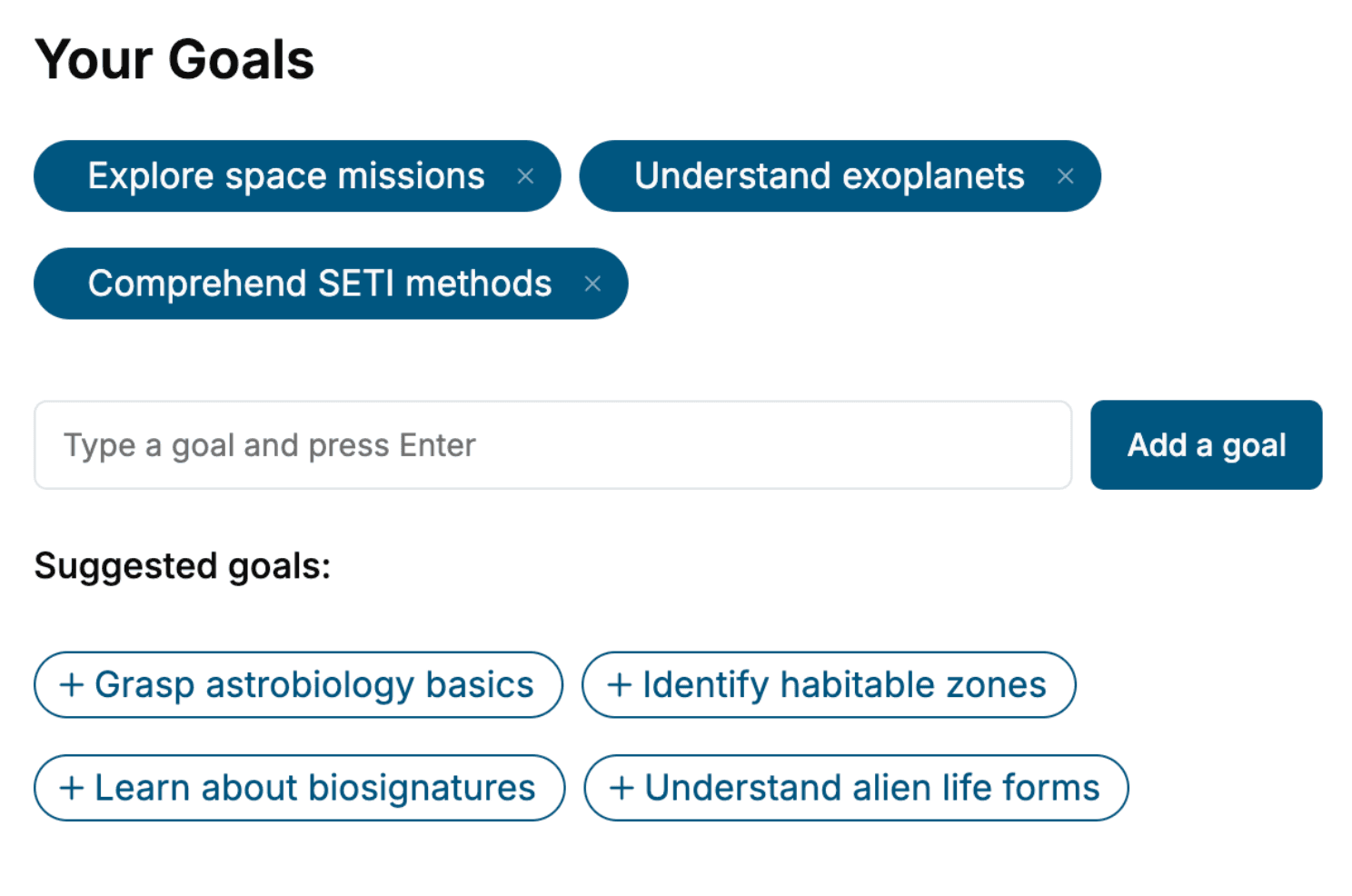
Specify your goals and choose sub-topics to include
- 3. Get your tailored book
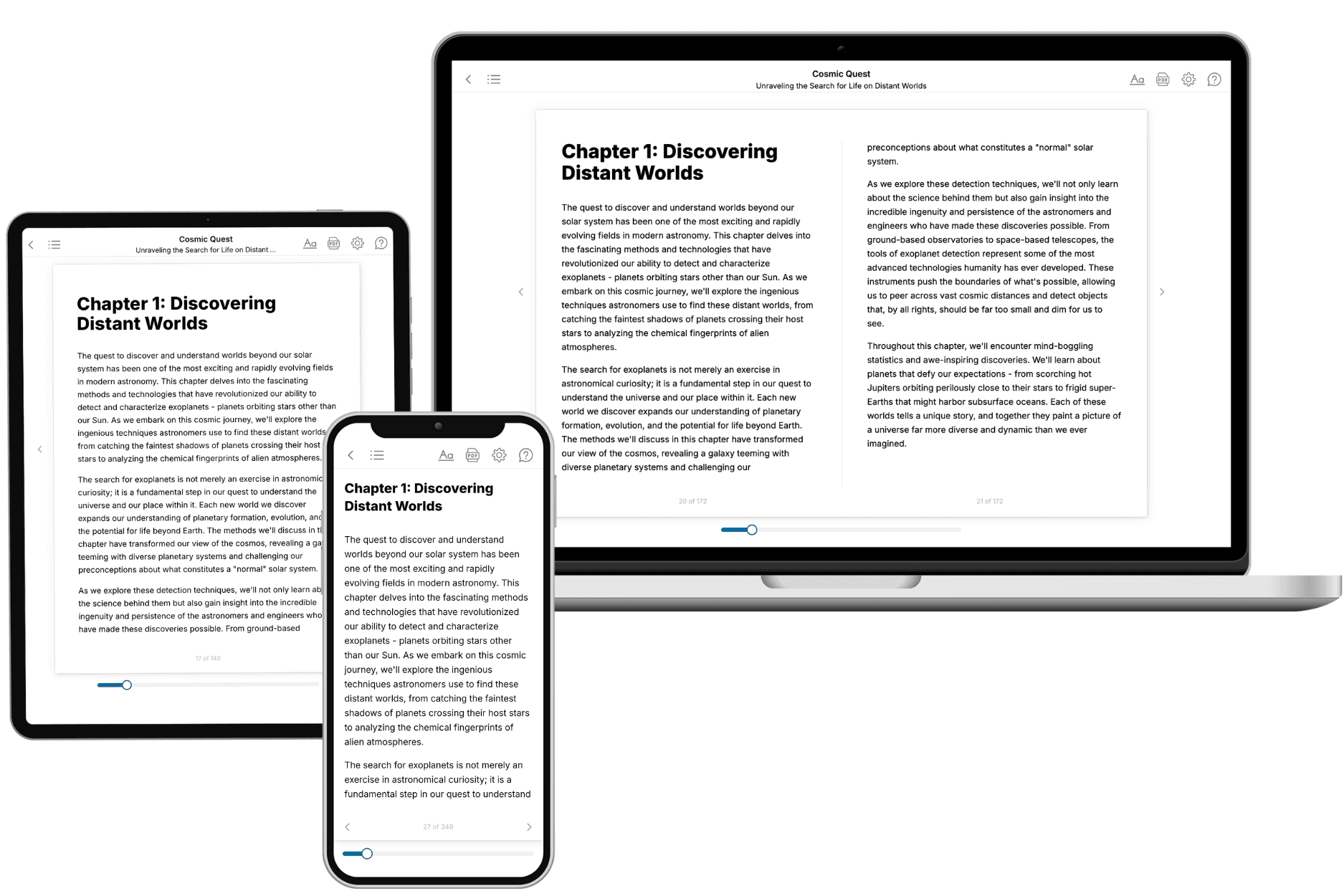
Your book is ready in 10 minutes. Read it online, download as EPUB or PDF, or send to Kindle.

Frequently asked questions
- What is TailoredRead?
TailoredRead creates complete, full-length nonfiction ebooks, written specifically for you. Tell us what you want to learn and why, and TailoredRead writes you a complete ebook on it, with charts, tables, and diagrams throughout. Read it online, on Kindle, or on any e-reader, or download it as a PDF or EPUB. Every book is written fresh the day you order it.
- How is the book tailored to me?
Before anything is written, you answer a few short questions about your goals, your background, and the topics you care about. Your book is then planned around your answers: written at your level, focused on your goals, and covering the topics you chose, instead of the one-size-fits-all book a store sells everyone.
- Will it read like generic AI content?
No. Your book isn't a chat transcript: it's planned chapter by chapter before a single word is written, told in a clear book voice, and explains ideas visually with charts, tables, and diagrams. After writing, every book goes through an editorial pass that polishes chapters so the book reads consistent from start to finish. Judge for yourself: browse thousands of sample books on our Explore Books page.
- How accurate is the content?
Our AI first checks whether your subject needs live research. Niche and fast-moving subjects are researched before writing, and the book plan and chapters are grounded in what it finds. After writing, every book goes through a quality pass that checks its facts and consistency, and researched books list their sources in a Notes section at the back.
- How long is the book?
You choose the length: Comprehensive (250-300 pages), Detailed (150-200 pages), Essential (70-100 pages), or Short (30-50 pages).
- Does the book include visuals?
Yes. Every book includes charts, tables, and diagrams: timelines, checklists, step-by-step guides, decision trees, comparison tables, matrices, and bar charts. A typical book includes dozens of these visual elements.
- Can I read it on Kindle? What formats can I download?
Yes. Every book can be read in our online reader or downloaded as a PDF or EPUB. The EPUB can be opened with Kindle, Apple Books, Kobo, and any e-reader. The Commercial and Author licenses also include an editable Word (DOCX) and Markdown download.
- How much does it cost?
About the price of a regular ebook. The exact price depends on your book's length and complexity, from $2 for the shortest books to $35 for the most comprehensive, and it's shown when you review your book, before you commit to anything. Each book is a one-time purchase, yours to keep, no subscription. Licenses that let you share, teach, or publish your book range from $35.99 to $49.99.
- Can I preview the book before purchasing?
Before you pay, you'll see what your book will cover: the title, a detailed description, the estimated length, and the complete chapter-by-chapter table of contents, so you know what you're getting before you decide. The full text itself is written after you purchase.
- How long does it take to create a book?
About 10 minutes. You can start reading the opening chapters while the rest is still being written.