You: The Power of Second Person Narrative
Master the Most Intimate and Engaging Narrative Technique in Modern Writing
Most writers avoid second person narrative, assuming it's too risky or too difficult to pull off.
191 pages9 chaptersEnglishJun 5, 2026Creative Writing
About this book
But this assumption costs them one of the most powerful tools in their storytelling arsenal. Second person narrative—the technique of addressing the reader directly as "you"—creates an intimacy and immediacy that other narrative perspectives simply cannot match. It transforms passive readers into active participants, making them feel like they're living the story rather than observing it from a distance. This book reveals why second person works so effectively, how to use it across different genres and contexts, and how to avoid the common mistakes that derail most attempts. Whether you're writing literary fiction, memoir, interactive stories, or experimental work, you'll discover practical techniques for crafting compelling second person narratives that resonate deeply with your audience. Learn how to maintain consistency, develop authentic voice, and harness the psychological power of direct address to create stories that linger long after the final page.
Table of contents
- IntroductionWhy Second Person Matters in Modern Writing, Common Misconceptions About Second Person Narrative, What You'll Learn in This Book, How to Use This GuideRead below
- Chapter 1: Understanding Second Person NarrativeDefining Second Person: Beyond the Basics, Second Person in Literary History, Why Readers and Writers Resist Second Person, The Psychology of 'You': How Direct Address Affects the Brain
- Chapter 2: The Mechanics of Second Person VoiceEstablishing Narrator Identity in Second Person, Maintaining Consistency and Perspective, Tone and Register: Finding Your Voice, Techniques for Addressing the Reader Authentically
- Chapter 3: Second Person in Literary FictionCreating Intimacy Through Direct Address, Using Second Person to Explore Identity and Self, Case Studies: Masterful Uses of Second Person in Literature, Blending Second Person with Other Narrative Perspectives
- Chapter 4: Second Person in Memoir and Personal NarrativeWhy Memoir Writers Choose Second Person, Creating Distance and Reflection Through 'You', Ethical Considerations in Second Person Memoir, Examples and Techniques from Published Memoirs
- Chapter 5: Second Person in Genre Fiction and BeyondInteractive Fiction and Choose-Your-Own-Adventure Narratives, Second Person in Mystery, Thriller, and Crime Fiction, Experimental Forms: Poetry, Flash Fiction, and Hybrid Work, Genre-Specific Challenges and Solutions
- Chapter 6: The Emotional and Psychological ImpactHow Second Person Deepens Reader Engagement, Creating Vulnerability and Emotional Connection, The Psychological Effects of Direct Address on Readers, Measuring and Evaluating Emotional Impact
- Chapter 7: Common Pitfalls and How to Avoid ThemOveruse and Reader Fatigue, The Unclear Narrator Problem, Tonal Inconsistency and Voice Drift, Overcoming Reader Resistance and Skepticism
- Chapter 8: Crafting Your Second Person NarrativePlanning and Preparation: Before You Write, Drafting Strategies and Techniques, Revision and Refinement: Making It Work, Getting Feedback and Testing Your Narrative
- Chapter 9: Advanced Techniques and ExperimentationThe Unreliable Second Person Narrator, Multiple 'Yous': Addressing Different Readers, Playing with Time and Perspective in Second Person, Pushing Boundaries: Experimental Approaches
- ConclusionYour Second Person Journey Begins, Final Thoughts and Encouragement
- Further Reading and Resources
Introduction
Picture this: you open a book, read the first sentence, and realize the narrator is talking directly to you. Not to some fictional character you're meant to follow from a safe distance, but to you, the person holding the pages. Something shifts. Your pulse quickens slightly. You lean in. Suddenly, you're not watching a story unfold from the outside. You're inside it, moving through it, making choices, feeling consequences. That's the power of second person narrative, and it's one of the most underused tools in a writer's entire toolkit.
Second person narrative is the technique of addressing the reader directly using the word you.
Instead of writing She walked into the room and felt the cold air hit her face,
you write You walk into the room and feel the cold air hit your face.
It sounds like a small change. In practice, it transforms the entire relationship between the story and the person reading it. The reader stops being a spectator and becomes a participant. The story stops being something that happened to someone else and starts feeling like something happening right now, to them, in real time.
Most writers avoid second person entirely. They've heard it's risky, or they've tried it once and felt it fall flat, or they simply assume it only works in choose-your-own-adventure books from childhood. These assumptions are understandable, but they're also wrong. Second person narrative has powered some of the most celebrated literary fiction of the past several decades. It's the backbone of interactive storytelling. It shows up in memoir, in poetry, in experimental essays, and in genre fiction that wants to create an unusually intense reading experience. The writers who understand how to use it well have access to a level of intimacy and immediacy that first and third person simply cannot replicate.
This book exists to close that gap. Whether you've never attempted second person or you've tried it and struggled to make it work, what follows is a practical, thorough guide to understanding, crafting, and refining second person narratives across a wide range of genres and contexts. The goal isn't to convince you to write everything in second person. The goal is to give you genuine command of the technique so that when second person is the right choice, you can execute it with confidence and skill.
Why Second Person Matters in Modern Writing
The literary landscape has changed dramatically over the past few decades. Readers today are accustomed to interactive media, video games, social media feeds written in direct address, and content that speaks to them personally rather than at them generically. This cultural shift has made readers more receptive to second person narrative than at almost any previous point in literary history. The technique feels native to how modern audiences already consume stories and information.
Consider the video game industry, where second person is the default mode of storytelling. When you play a role-playing game, the narrative addresses you directly, places you inside the protagonist's body, and asks you to make decisions that shape the outcome. Millions of people engage with this format daily without finding it strange or alienating. That same instinct, that same appetite for immersive, participatory storytelling, is present in your readers when they pick up a book.[1]
Second person also matters because of what it does to emotional stakes. When a story says she was afraid,
you process that as information about a character. When a story says you are afraid,
your nervous system responds differently. Research in cognitive psychology suggests that second person address activates a more embodied, self-referential mode of processing in readers, making the emotional content of a narrative feel more immediate and personally relevant.[2] This isn't a trick. It's a feature of how human brains process language and identity.
In literary fiction specifically, second person has been used to explore some of the most complex and uncomfortable aspects of human experience. Mohsin Hamid's How to Get Filthy Rich in Rising Asia uses second person to create a satirical distance that makes its critique of capitalism and ambition land with unusual force. Junot Díaz deploys second person in sections of This Is How You Lose Her to create a confessional intimacy that feels almost unbearably honest. These aren't gimmicks. These are writers using the right tool for the specific emotional and thematic work they needed to do.
Beyond literary fiction, second person is experiencing a genuine renaissance in memoir and personal essay. Writers who need to examine painful or complicated personal experiences sometimes find that you
creates a productive distance, allowing them to look at their own past with more clarity than I
would permit. It's a way of simultaneously owning an experience and examining it from the outside, which is exactly what the best memoir writing requires.
The bottom line is that second person narrative matters in modern writing because it solves specific problems that other perspectives cannot solve as elegantly. It creates intimacy, immediacy, and participation. It collapses the distance between reader and character. It opens up emotional and psychological territory that first and third person can only approach indirectly. Understanding it isn't optional for a serious writer. It's part of the complete toolkit.
Common Misconceptions About Second Person Narrative
The most persistent misconception about second person narrative is that it's a novelty, a stylistic trick that draws attention to itself and ultimately gets in the way of the story. This belief is so widespread that many writing workshops actively discourage students from attempting it. The irony is that this warning, while well-intentioned, often prevents writers from developing a skill that could genuinely elevate their work. Any narrative technique becomes a distraction when it's executed poorly. Second person is no different from first or third person in that regard.
A second common misconception is that second person forces readers to identify with a character they may not relate to, and that this creates an uncomfortable or alienating experience. The assumption here is that readers need to see themselves in a protagonist to engage with a story. But that's not how fiction works. Readers engage with characters who are radically different from themselves all the time. What second person actually does is invite a different kind of engagement, one that's more active and participatory rather than more restrictive. The discomfort some readers feel is often the point, not a failure of the technique.
A common workshop warning: "Second person is too risky for sustained narrative. Readers will resist being told what they're doing and feeling." In practice, readers resist bad second person writing. They embrace second person that's purposeful, consistent, and emotionally honest.
Another misconception is that second person only works in short pieces. It's true that many celebrated examples of second person are short stories or novellas. But this is partly a reflection of publishing trends and partly a result of the fact that fewer writers have attempted sustained second person novels. Hamid's How to Get Filthy Rich in Rising Asia runs to over 200 pages and maintains second person throughout without losing its grip on the reader. The length of a piece doesn't determine whether second person will work. The quality of the execution does.
Some writers also believe that second person is inherently suited only to experimental or avant-garde writing, and that it has no place in commercial or genre fiction. This is demonstrably false. The entire choose-your-own-adventure genre, which has sold hundreds of millions of copies worldwide, is built on second person.[3] Contemporary interactive fiction platforms like Twine and Inkle have brought second person to entirely new audiences. Mystery and thriller writers have used it to create unusually tense, claustrophobic narratives. Second person is as versatile as the writer using it.
There's also a misconception that second person is easier to write than first or third person because it requires less character development. In reality, second person often demands more careful thought about character, voice, and reader relationship than other perspectives. You have to decide who the you
is, what they know, what they feel, and how they relate to the narrator. You have to maintain that construction consistently across the entire piece. Done carelessly, second person collapses. Done thoughtfully, it creates something genuinely extraordinary.
Finally, many writers assume that readers simply don't like second person and will put down a book that uses it. Reader surveys and sales data tell a more complicated story. Readers who encounter second person that works tend to describe it as one of the most immersive reading experiences they've had. The resistance isn't to second person itself. It's to second person that hasn't been handled with care. That's a craft problem, not a perspective problem, and craft problems are entirely solvable.
What You'll Learn in This Book
This book is organized to take you from foundational understanding through to advanced experimentation. It doesn't assume you've never thought about narrative perspective before, but it also doesn't assume you have deep technical knowledge of second person specifically. What it does assume is that you're a writer who takes your craft seriously and wants to expand what you're capable of doing on the page.
The early chapters establish the groundwork. You'll develop a clear, precise understanding of what second person narrative actually is, how it differs from first and third person in both mechanics and effect, and where it sits in the history of literature. You'll also explore the psychology behind why second person works the way it does, which will give you a principled basis for making decisions about when and how to use it rather than just following rules by rote.
The middle chapters get into the specific mechanics of voice, consistency, and tone. These are the areas where most second person attempts break down, and they're also the areas where the most practical, actionable guidance is available. You'll learn:
- How to establish and maintain a clear narrator identity in second person
- How to handle tense, perspective shifts, and temporal complexity
- How to find the right tone and register for your specific story and audience
- How to address the reader in ways that feel authentic rather than forced
From there, the book moves into genre-specific applications. Literary fiction, memoir, interactive fiction, mystery, thriller, experimental poetry, and hybrid forms all use second person differently, and each context comes with its own set of opportunities and challenges. You'll look at real published examples in each genre, analyze what makes them work, and extract techniques you can apply directly to your own writing.
The later chapters address the emotional and psychological dimensions of second person narrative in depth. Understanding why second person creates the effects it does gives you much more control over those effects. You'll also work through the most common pitfalls in detail, with specific strategies for avoiding each one. And the final chapters on advanced techniques will push you toward more ambitious, experimental uses of the perspective that can genuinely distinguish your work.
Throughout the book, you'll find concrete examples, writing exercises, frameworks for decision-making, and revision checklists. The goal at every stage is to give you tools you can use immediately, not just ideas to think about abstractly. By the time you reach the conclusion, you should be able to look at any writing project and make an informed, confident decision about whether second person is the right choice, and if it is, how to execute it well.
How to Use This Guide
This book is designed to be read in order, at least the first time through. Each chapter builds on the concepts introduced in the chapters before it, and the progression from foundational mechanics to advanced experimentation is intentional. If you skip ahead to the chapter on experimental techniques without reading the chapters on voice and consistency first, you'll likely find the advanced material harder to apply than it needs to be.
That said, once you've read through the book once, it's designed to work as a reference you return to at specific points in your writing process. The chapters on common pitfalls and revision, for example, are most useful when you have a draft in front of you that you're trying to improve. The genre-specific chapters are most useful when you're planning a project in a particular form. The index and chapter structure are organized to make it easy to find what you need when you need it.
Each chapter includes writing exercises at the end. These aren't optional extras. They're an integral part of how this book works. Reading about second person narrative will give you knowledge. Actually writing in second person, even in short, low-stakes exercises, will give you skill. The two are not the same thing, and skill is what you're ultimately after. Treat the exercises as seriously as you treat the reading.
You'll also notice that the book uses second person in its own prose at various points, including right now. This is deliberate. The best way to understand how second person works is to experience it as a reader while simultaneously studying it as a writer. Pay attention to how it feels when the text addresses you directly. Notice when it creates intimacy and when it creates distance. Notice when it feels natural and when it feels slightly strange. That awareness is itself a form of craft education.
If you're working on a specific project right now, consider keeping a notebook alongside this book. As you read, you'll encounter ideas, techniques, and examples that are directly relevant to what you're writing. Capture those connections in real time. The most effective way to learn any craft skill is to immediately connect new knowledge to a concrete creative problem you're trying to solve. This book gives you the knowledge. Your current project gives you the problem. The notebook is where those two things meet.
A few practical notes on what this book is and isn't. It's a craft guide, not a prescriptive rulebook. Second person narrative is a technique, and like all techniques, it exists to serve the story. There are no absolute rules about when you must or must not use it. What this book offers instead are principles, frameworks, and examples that will help you develop your own informed judgment. The goal is to make you a more capable, more confident writer, not to hand you a formula. Formulas produce forgettable writing. Judgment produces work that lasts.
Finally, approach this material with a spirit of genuine experimentation. Some of the exercises will feel awkward. Some of your early attempts at second person will fall flat. That's not a sign that you're doing it wrong. It's a sign that you're learning. Every writer who has ever produced a compelling second person narrative started exactly where you are now, uncertain about the technique and unsure whether they could make it work. The difference between those who eventually mastered it and those who gave up is simply that the masters kept writing. So keep writing. The page is waiting for you.
Notes
Introduction
- 1. Marie-Laure Ryan, Narrative as Virtual Reality, Johns Hopkins University Press, 2001
- 2. Raymond A. Mar and Keith Oatley, "The Function of Fiction is the Abstraction and Simulation of Social Experience," Perspectives on Psychological Science, 2008
- 3. Edward Packard, The Cave of Time, Bantam Books. (Original Choose Your Own Adventure series, which sold over 250 million copies globally.), 1979
This is the end of the free sample. The full book has 9 chapters.
Want this book written for you?
Tell us your goals and background, and get your own version of this book, tailored by AI to you.


Benefits of AI-tailored books
- Read one book, not ten:
- all the Creative Writing knowledge you need, gathered into a single book.
- Save days of learning:
- tell us your goals, choose your topics, and the whole book is built around them.
- Learn effortlessly:
- Creative Writing book written for your specific background and expertise.
- Understand at a glance:
- includes charts, tables, timelines, checklists, decision trees, and more.
- Stay current:
- written the day you order it, not years ago.
- Trust what you read:
- every book is checked for accuracy, with real research when your subject needs it.
Create your unique book in 3 steps
- 1. Select your focus
Select the focus of your Creative Writing book and share your background
- 2. Personalize your book
Specify your goals and choose sub-topics to include
- 3. Get your tailored book
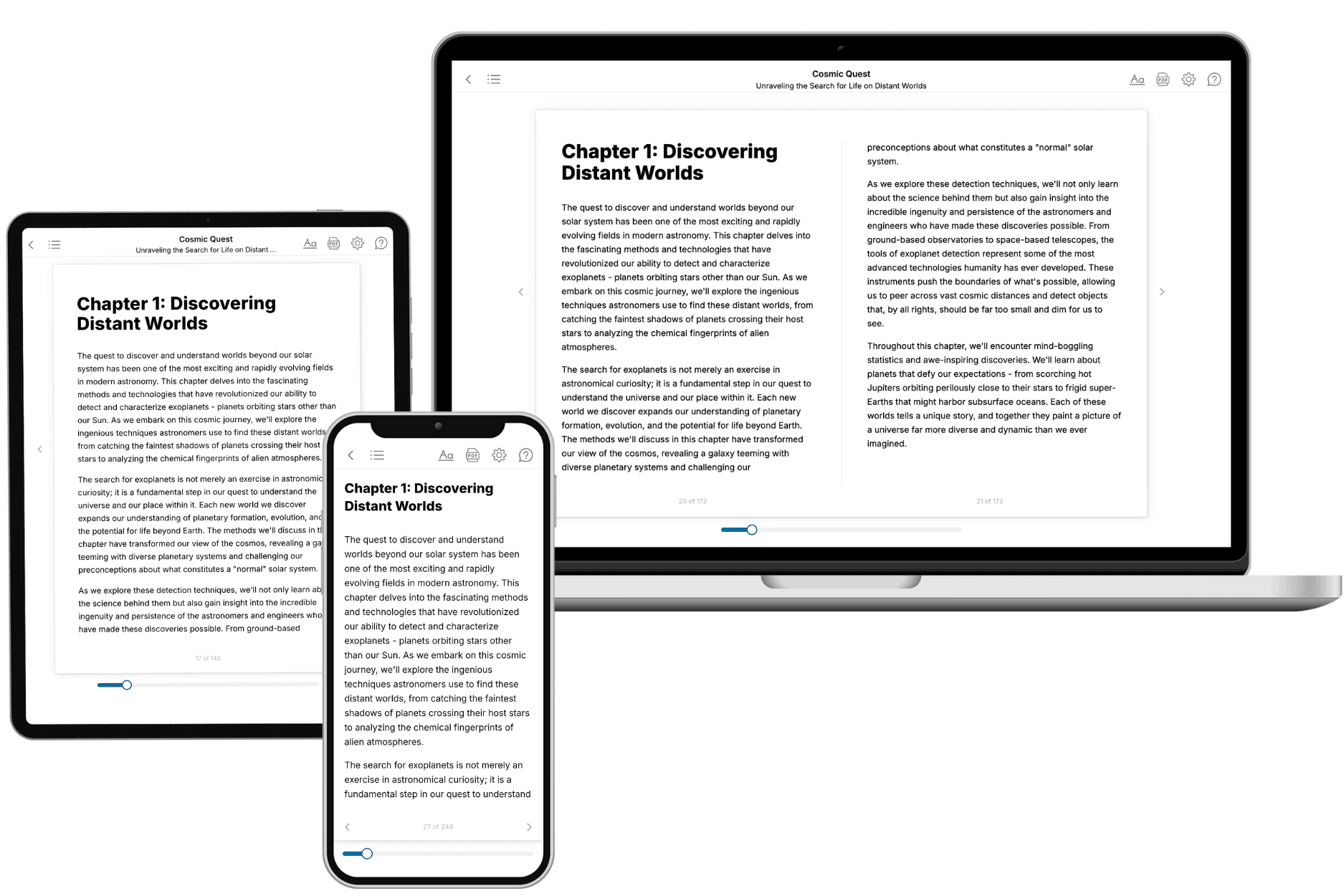
Your book is ready in 10 minutes. Read it online, download as EPUB or PDF, or send to Kindle.
Frequently asked questions
- What is TailoredRead?
TailoredRead creates complete, full-length nonfiction ebooks, written specifically for you. Tell us what you want to learn and why, and TailoredRead writes you a complete ebook on it, with charts, tables, and diagrams throughout. Read it online, on Kindle, or on any e-reader, or download it as a PDF or EPUB. Every book is written fresh the day you order it.
- How is the book tailored to me?
Before anything is written, you answer a few short questions about your goals, your background, and the topics you care about. Your book is then planned around your answers: written at your level, focused on your goals, and covering the topics you chose, instead of the one-size-fits-all book a store sells everyone.
- Will it read like generic AI content?
No. Your book isn't a chat transcript: it's planned chapter by chapter before a single word is written, told in a clear book voice, and explains ideas visually with charts, tables, and diagrams. After writing, every book goes through an editorial pass that polishes chapters so the book reads consistent from start to finish. Judge for yourself: browse thousands of sample books on our Explore Books page.
- How accurate is the content?
Our AI first checks whether your subject needs live research. Niche and fast-moving subjects are researched before writing, and the book plan and chapters are grounded in what it finds. After writing, every book goes through a quality pass that checks its facts and consistency, and researched books list their sources in a Notes section at the back.
- How long is the book?
You choose the length: Comprehensive (250-300 pages), Detailed (150-200 pages), Essential (70-100 pages), or Short (30-50 pages).
- Does the book include visuals?
Yes. Every book includes charts, tables, and diagrams: timelines, checklists, step-by-step guides, decision trees, comparison tables, matrices, and bar charts. A typical book includes dozens of these visual elements.
- Can I read it on Kindle? What formats can I download?
Yes. Every book can be read in our online reader or downloaded as a PDF or EPUB. The EPUB can be opened with Kindle, Apple Books, Kobo, and any e-reader. The Commercial and Author licenses also include an editable Word (DOCX) and Markdown download.
- How much does it cost?
About the price of a regular ebook. The exact price depends on your book's length and complexity, from $2 for the shortest books to $35 for the most comprehensive, and it's shown when you review your book, before you commit to anything. Each book is a one-time purchase, yours to keep, no subscription. Licenses that let you share, teach, or publish your book range from $35.99 to $49.99.
- Can I preview the book before purchasing?
Before you pay, you'll see what your book will cover: the title, a detailed description, the estimated length, and the complete chapter-by-chapter table of contents, so you know what you're getting before you decide. The full text itself is written after you purchase.
- How long does it take to create a book?
About 10 minutes. You can start reading the opening chapters while the rest is still being written.