Your Moon Sign Revealed
Discover Your Emotional Nature and Inner Self Through Lunar Astrology
What drives your deepest emotional needs, and why do certain situations trigger reactions you don't fully understand?
191 pages9 chaptersMay 29, 2026Astrology
About this book
Your moon sign holds the answers. While your sun sign represents the self you show the world, your moon sign is the private, emotional core that shapes how you love, grieve, celebrate, and connect with others. This guide explores the profound influence of lunar astrology on your inner landscape, moving beyond surface-level interpretations to reveal how your moon sign shapes your relationships, decision-making, and personal growth. Whether you're an astrology enthusiast or simply curious about yourself, you'll discover practical insights into your emotional patterns and learn how to honor your authentic needs. By understanding the twelve moon signs and their unique characteristics, you'll gain clarity about your reactions, improve your relationships, and align your life with your true emotional nature. This isn't about predicting the future—it's about understanding yourself more deeply and living with greater authenticity and self-compassion.
Table of contents
- IntroductionBeyond Your Sun Sign: The Hidden Emotional Self, What Is Your Moon Sign and Why It Matters, How to Use This Book for Maximum InsightRead below
- Chapter 1: The Foundations of Lunar AstrologyThe Moon's Role in Your Birth Chart, Your Emotional Blueprint: How the Moon Works, Moon Sign vs. Sun Sign: Understanding the Difference
- Chapter 2: The Four Elements and Emotional NatureFire Moon Signs: Passionate and Expressive, Earth Moon Signs: Grounded and Practical, Air Moon Signs: Intellectual and Communicative, Water Moon Signs: Intuitive and Sensitive
- Chapter 3: Moon in Aries Through GeminiMoon in Aries: The Courageous Protector, Moon in Taurus: The Steadfast Nurturer, Moon in Gemini: The Curious Communicator
- Chapter 4: Moon in Cancer Through VirgoMoon in Cancer: The Devoted Caregiver, Moon in Leo: The Generous Heart, Moon in Virgo: The Thoughtful Helper
- Chapter 5: Moon in Libra Through SagittariusMoon in Libra: The Harmonious Diplomat, Moon in Scorpio: The Intense Transformer, Moon in Sagittarius: The Optimistic Explorer
- Chapter 6: Moon in Capricorn Through PiscesMoon in Capricorn: The Responsible Achiever, Moon in Aquarius: The Independent Visionary, Moon in Pisces: The Empathetic Dreamer
- Chapter 7: Moon Signs in Love and RelationshipsUnderstanding Your Emotional Needs in Relationships, Moon Sign Compatibility: Beyond Sun Sign Matching, How Your Moon Sign Shapes Your Attachment Style
- Chapter 8: Lunar Cycles and Personal GrowthLunar Phases and Your Emotional Rhythms, Moon Transits: Navigating Emotional Shifts, Lunar Returns: Your Personal Emotional New Year
- Chapter 9: Integrating Your Moon Sign WisdomBuilding Self-Awareness Through Moon Sign Understanding, Shadow Work: Embracing Your Moon Sign's Challenges, Daily Practices to Honor Your Emotional Nature
- ConclusionLiving Authentically With Your Moon Sign
- Glossary of Astrological Terms
Introduction
Have you ever had a moment where your reaction to something surprised even you? Maybe a small comment from a friend sent you spiraling into hurt feelings that lasted for days, or a sudden change in plans left you feeling far more anxious than the situation seemed to warrant. You might have looked at your sun sign for answers and found that the description only partially fit. That's because your sun sign tells only part of your story. The deeper, more private layer of who you are lives somewhere else entirely, in the placement of the moon at the exact moment you were born.
Astrology has been practiced across cultures for thousands of years, and for most of that time, the moon has held a central place in how people understood themselves and the world around them.[1] Ancient Babylonian, Egyptian, and Greek traditions all recognized the moon as a powerful force connected to cycles, emotion, and the inner life. Yet in modern popular astrology, the moon sign is often treated as a footnote to the sun sign. This book is here to change that. Your moon sign deserves to be understood on its own terms, with the depth and nuance it genuinely carries.
This introduction will walk you through three essential ideas before you dive into the rest of the book. First, you'll explore why the sun sign alone is an incomplete picture of who you are. Second, you'll get a clear, grounded explanation of what the moon sign actually is and why it matters so much for emotional self-understanding. Third, you'll find practical guidance on how to use this book in a way that gives you the most meaningful insight. Whether you already know your moon sign or you're about to look it up for the first time, what follows is designed to meet you exactly where you are.
Beyond Your Sun Sign: The Hidden Emotional Self
Most people discover astrology through their sun sign. You find out you're a Scorpio or a Libra, read a description that resonates in some ways and misses the mark in others, and either become fascinated or walk away unconvinced. The sun sign is a real and meaningful part of your astrological identity. It describes the core of your conscious self, the personality you develop and project as you move through the world. But it was never meant to be the whole picture. Treating it as the complete story is a bit like reading only the first chapter of a novel and thinking you understand the entire plot.
The sun moves through all twelve zodiac signs over the course of a year, spending roughly a month in each sign. That means everyone born within the same four-week window shares the same sun sign. When you consider how different two people born in the same month can be, especially in how they handle emotions, conflict, intimacy, and stress, it becomes clear that something else must be at work. That something else is largely the moon sign, along with other chart placements that this book will touch on as context.
Think about the difference between how you behave at work versus how you behave at home with people you completely trust. Your sun sign tends to govern the public-facing version of yourself, the identity you consciously build and present. Your moon sign governs the private version, the one that shows up when your guard is down, when you're tired, when you're in love, or when you're grieving. It's the part of you that reacts before you have time to think. Understanding this distinction is the first step toward genuine self-knowledge through astrology.
Consider a concrete example. Two people are both born under Capricorn sun. One has a moon in Cancer and the other has a moon in Aries. On the surface, both might appear disciplined, goal-oriented, and composed. But in their private emotional lives, they are remarkably different. The Cancer moon Capricorn craves deep emotional security, tends to hold onto the past, and nurtures others as a way of feeling connected. The Aries moon Capricorn processes feelings quickly, needs independence even in close relationships, and can become frustrated when emotions slow down their forward momentum. Same sun sign, completely different inner worlds.
This hidden emotional self is not a flaw or a weakness. It's actually the most authentic part of who you are. The reactions, needs, and patterns governed by your moon sign developed early in life, often before you had the language to describe them. They are deeply ingrained, which is exactly why understanding them can be so transformative. When you recognize a pattern in yourself, you gain the ability to work with it rather than against it. You stop being confused by your own reactions and start responding to yourself with the same compassion you might offer a close friend.
Popular culture has made the sun sign the star of the show, but professional astrologers have long understood that the moon sign is equally, if not more, important for understanding a person's inner life.[2] This book is an invitation to shift your focus inward, to move past the surface-level personality traits and into the emotional architecture that shapes your most intimate experiences. That shift begins with a simple but powerful question: what does your moon sign actually say about you?
It's also worth noting that understanding your hidden emotional self is not about labeling yourself or putting yourself in a box. Astrology works best as a mirror, not a cage. The goal is to use the moon sign as a tool for reflection, a way of asking better questions about why you feel what you feel and what you genuinely need. The insights you'll find in this book are starting points for self-exploration, not final verdicts about who you are or who you can become.
What Is Your Moon Sign and Why It Matters
Your moon sign is determined by the position of the moon in the zodiac at the exact time and place of your birth. Unlike the sun, which stays in one sign for about thirty days, the moon moves much faster. It travels through all twelve signs of the zodiac in approximately twenty-eight days, spending roughly two to two-and-a-half days in each sign.[3] This is why knowing your birth time matters so much for moon sign accuracy. If you were born near the time the moon was changing signs, even a few hours can make a difference in your placement.
If you don't already know your moon sign, finding it is straightforward. You'll need your date of birth, your birth time (as precise as possible), and your place of birth. With those three pieces of information, you can use any reputable online birth chart calculator to find your moon sign instantly. Astro.com is one of the most widely used and trusted free resources for this purpose. Once you have your moon sign, you're ready to use this book fully.
In astrological tradition, the moon is associated with a specific set of themes that have remained remarkably consistent across different schools of thought and cultural traditions. These themes include:
- Emotions and emotional responses, including how you feel things and how quickly or slowly you process them
- Instincts and gut reactions, the automatic responses that happen before conscious thought kicks in
- Comfort and security needs, what you need to feel safe and at ease in your environment and relationships
- Memory and the past, including how you relate to your childhood and early emotional experiences
- Nurturing patterns, both how you care for others and how you need to be cared for
- The subconscious mind, the inner world that operates beneath your everyday awareness
The moon's rulership over these areas means that your moon sign acts as a kind of emotional operating system. It's the underlying software running in the background of your personality, influencing how you interpret experiences, what triggers your defenses, and what makes you feel genuinely at home. Two people can go through the same event and have completely different emotional responses, not because one is more sensitive or more rational, but because their emotional operating systems are built differently.
Why does this matter in practical terms? Because so much of what causes confusion, conflict, and dissatisfaction in life comes from a mismatch between what we consciously want and what we emotionally need. You might consciously want a relationship that's exciting and adventurous, but if your moon sign craves stability and routine, you'll feel chronically unsettled no matter how thrilling your partner is. You might tell yourself you're fine with a fast-paced, high-pressure career, but if your moon sign needs quiet and emotional depth, you'll burn out in ways that seem mysterious until you understand the root cause.
The moon sign also plays a central role in how you relate to the people closest to you. In romantic relationships, friendships, and family dynamics, it's the moon sign that tends to drive the emotional undercurrents. Research in psychology consistently shows that emotional needs, attachment styles, and comfort-seeking behaviors are among the most powerful predictors of relationship satisfaction.[4] While astrology approaches this from a different angle than clinical psychology, the moon sign maps onto these same emotional territories in ways that many people find remarkably accurate and useful.
It's also worth understanding what the moon sign is not. It is not a prediction of your fate or a fixed limitation on who you can be. It describes tendencies and patterns, not certainties. A person with a moon in Scorpio is not doomed to be jealous or secretive. A person with a moon in Gemini is not incapable of emotional depth. The moon sign describes the default settings of your emotional nature, and like any default setting, it can be understood, adjusted, and worked with consciously. That's precisely what this book is designed to help you do.
One more important point: your moon sign exists in relationship to the rest of your birth chart. It interacts with your sun sign, your rising sign, and the positions of other planets in ways that create a unique and complex picture. This book focuses primarily on the moon sign as a standalone influence, because that focus is where the most immediate and accessible self-understanding lives. But as you read, keep in mind that you are always more than any single placement. The moon sign is a powerful lens, not the only one.
How to Use This Book for Maximum Insight
This book is organized to take you from foundational concepts to detailed sign-by-sign exploration, and then into practical application. You don't have to read it cover to cover in order, though doing so will give you the richest understanding. If you're eager to jump straight to your moon sign's chapter, that's completely valid. But spending time with the early chapters on lunar astrology foundations and the four elements will give you a much stronger framework for interpreting what you find about your specific sign.
Here's a suggested approach depending on where you're starting from:
- If you're new to moon signs: Read Chapters 1 and 2 first. They'll give you the conceptual grounding to understand why your moon sign behaves the way it does, and how the element it belongs to shapes its emotional style.
- If you already have intermediate astrology knowledge: You might skim Chapters 1 and 2 as a refresher, then go directly to your moon sign's chapter in Chapters 3 through 6.
- If you're focused on relationships: Chapter 7 on moon signs in love and compatibility is essential reading, ideally after you've read your own moon sign's chapter.
- If you're interested in timing and cycles: Chapter 8 on lunar phases and transits will show you how to work with the moon's ongoing movement in real time.
- If you want practical integration: Chapter 9 brings everything together with shadow work, self-awareness practices, and daily rituals aligned with your moon sign.
As you read about your moon sign, you'll likely encounter descriptions that feel immediately and almost uncomfortably accurate. You might also find aspects that don't seem to fit at all. Both responses are useful information. When something resonates strongly, pay attention to it. That recognition is your emotional self being seen, possibly for the first time in a clear and articulate way. When something doesn't fit, consider whether it might describe a pattern you've worked hard to move away from, or whether another chart placement is modifying that tendency in your specific case.
Journaling alongside your reading can significantly deepen the experience. After reading your moon sign's chapter, try responding to prompts like these:
- Which descriptions felt most accurate, and why do you think that is?
- What emotional patterns in your life does this help explain?
- What needs described here have you been ignoring or suppressing?
- How does this information change how you understand a specific relationship or recurring conflict?
You might also find it valuable to read the chapters for the moon signs of people close to you. Understanding that your partner's moon in Taurus means they need consistency and physical comfort to feel loved, or that your mother's moon in Aquarius means she expresses care through ideas and independence rather than emotional closeness, can be genuinely relationship-changing. Empathy becomes much easier when you understand the emotional logic behind someone else's behavior.
Throughout the book, you'll find specific examples, practical frameworks, and reflection prompts designed to make the material concrete and personally relevant. Astrology is most useful when it moves from the abstract to the specific, from this is what Virgo moon people are like
to this is how this pattern shows up in my actual life and what I can do about it.
That translation from general principle to personal application is the heart of what this book is trying to support.
A note on the language used throughout: astrology carries its own vocabulary, and some terms may be unfamiliar even to readers with intermediate knowledge. A glossary at the back of the book defines all key astrological terms used throughout the chapters. When a term appears for the first time in the text, it will be introduced with enough context to make its meaning clear. The goal is always accessibility without sacrificing depth.
Finally, approach this material with curiosity rather than judgment. The moon sign describes emotional patterns that developed for reasons, often as adaptations to early experiences and environments. None of the twelve moon signs is better or worse than the others. Each has genuine strengths and real challenges. The Scorpio moon's intensity is the same quality that makes them capable of profound loyalty and transformation. The Gemini moon's emotional variability is the same quality that makes them adaptable and intellectually alive. Every pattern has two sides, and this book will honor both.
What you're about to explore is not a personality test or a horoscope. It's a map of your inner emotional world, drawn from one of the oldest symbolic languages humans have ever developed. Used thoughtfully, it can help you understand yourself more clearly, relate to others more compassionately, and live in closer alignment with who you actually are at your core. That's a worthwhile journey by any measure, and it begins right here.
Notes
Introduction
- 1. Nicholas Campion, The Dawn of Astrology, Continuum International Publishing Group, 2008
- 2. Stephen Arroyo, Astrology, Psychology, and the Four Elements, CRCS Publications, 1978
- 3. Steven Forrest, The Inner Sky: How to Make Wiser Choices for a More Fulfilling Life, ACS Publications, 1988
- 4. C. Hazan and P. Shaver, "Romantic love conceptualized as an attachment process," Journal of Personality and Social Psychology, 1987
This is the end of the free sample. The full book has 9 chapters.
Want this book written for you?
Tell us your goals and background, and get your own version of this book, tailored by AI to you.


Benefits of AI-tailored books
- Read one book, not ten:
- all the Astrology knowledge you need, gathered into a single book.
- Save days of learning:
- tell us your goals, choose your topics, and the whole book is built around them.
- Learn effortlessly:
- Astrology book written for your specific background and expertise.
- Understand at a glance:
- includes charts, tables, timelines, checklists, decision trees, and more.
- Stay current:
- written the day you order it, not years ago.
- Trust what you read:
- every book is checked for accuracy, with real research when your subject needs it.
Create your unique book in 3 steps
- 1. Select your focus
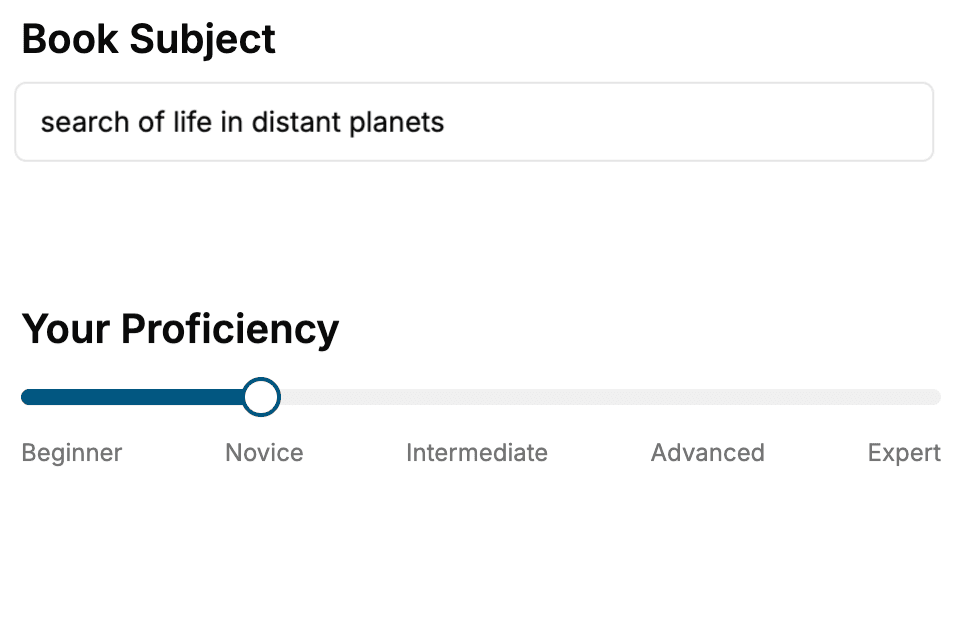
Select the focus of your Astrology book and share your background
- 2. Personalize your book
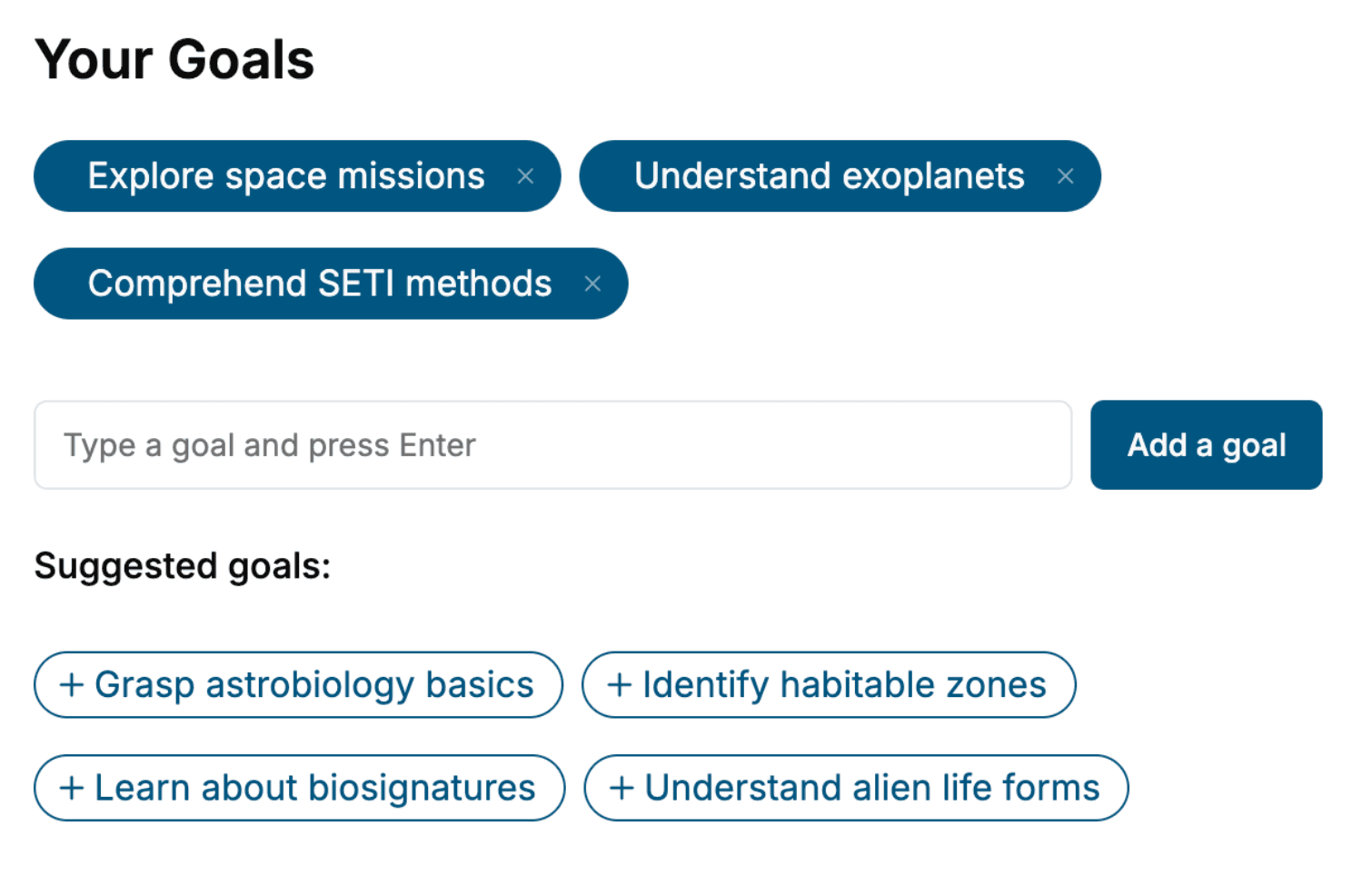
Specify your goals and choose sub-topics to include
- 3. Get your tailored book
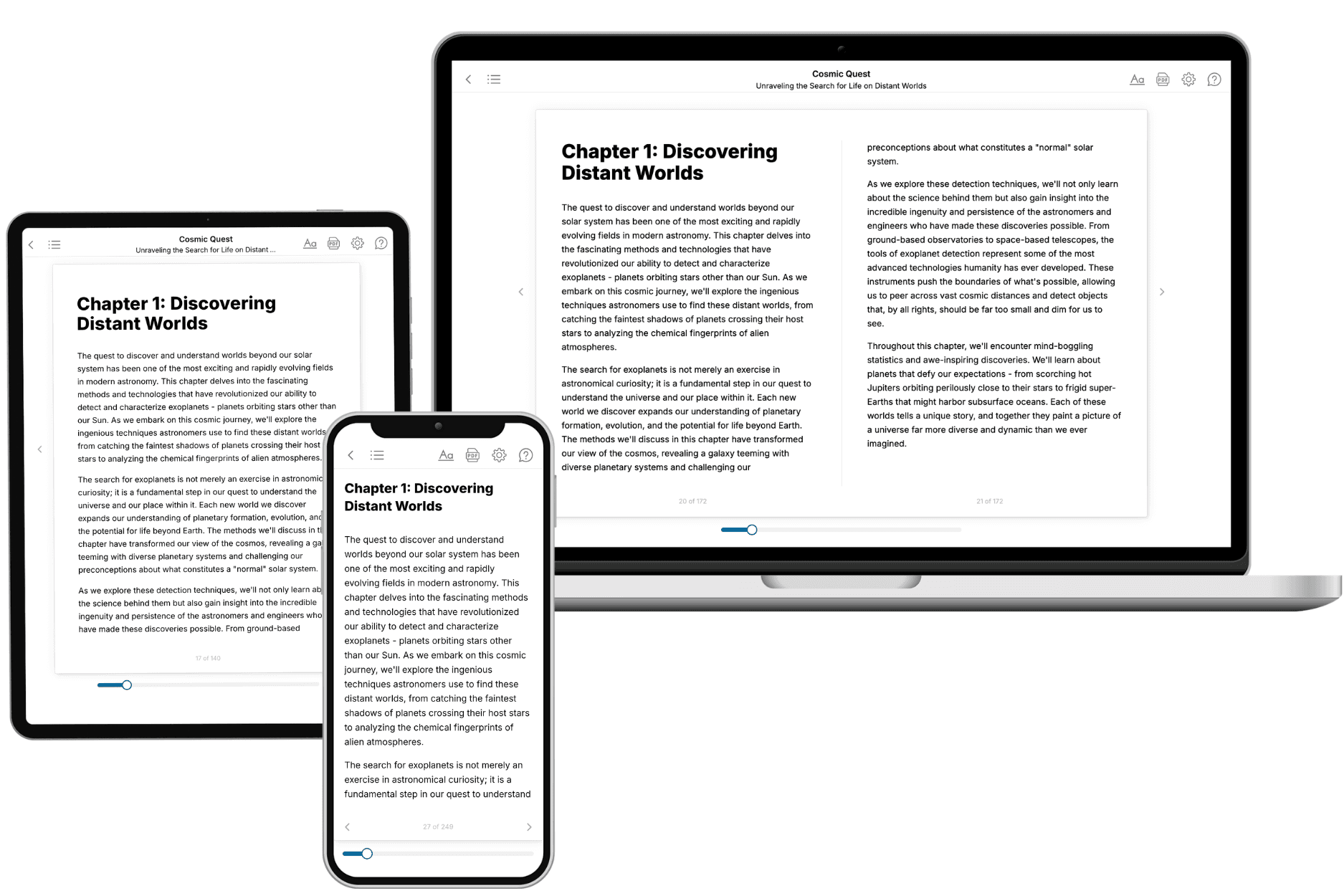
Your book is ready in 10 minutes. Read it online, download as EPUB or PDF, or send to Kindle.
Frequently asked questions
- What is TailoredRead?
TailoredRead creates complete, full-length nonfiction ebooks, written specifically for you. Tell us what you want to learn and why, and TailoredRead writes you a complete ebook on it, with charts, tables, and diagrams throughout. Read it online, on Kindle, or on any e-reader, or download it as a PDF or EPUB. Every book is written fresh the day you order it.
- How is the book tailored to me?
Before anything is written, you answer a few short questions about your goals, your background, and the topics you care about. Your book is then planned around your answers: written at your level, focused on your goals, and covering the topics you chose, instead of the one-size-fits-all book a store sells everyone.
- Will it read like generic AI content?
No. Your book isn't a chat transcript: it's planned chapter by chapter before a single word is written, told in a clear book voice, and explains ideas visually with charts, tables, and diagrams. After writing, every book goes through an editorial pass that polishes chapters so the book reads consistent from start to finish. Judge for yourself: browse thousands of sample books on our Explore Books page.
- How accurate is the content?
Our AI first checks whether your subject needs live research. Niche and fast-moving subjects are researched before writing, and the book plan and chapters are grounded in what it finds. After writing, every book goes through a quality pass that checks its facts and consistency, and researched books list their sources in a Notes section at the back.
- How long is the book?
You choose the length: Comprehensive (250-300 pages), Detailed (150-200 pages), Essential (70-100 pages), or Short (30-50 pages).
- Does the book include visuals?
Yes. Every book includes charts, tables, and diagrams: timelines, checklists, step-by-step guides, decision trees, comparison tables, matrices, and bar charts. A typical book includes dozens of these visual elements.
- Can I read it on Kindle? What formats can I download?
Yes. Every book can be read in our online reader or downloaded as a PDF or EPUB. The EPUB can be opened with Kindle, Apple Books, Kobo, and any e-reader. The Commercial and Author licenses also include an editable Word (DOCX) and Markdown download.
- How much does it cost?
About the price of a regular ebook. The exact price depends on your book's length and complexity, from $2 for the shortest books to $35 for the most comprehensive, and it's shown when you review your book, before you commit to anything. Each book is a one-time purchase, yours to keep, no subscription. Licenses that let you share, teach, or publish your book range from $35.99 to $49.99.
- Can I preview the book before purchasing?
Before you pay, you'll see what your book will cover: the title, a detailed description, the estimated length, and the complete chapter-by-chapter table of contents, so you know what you're getting before you decide. The full text itself is written after you purchase.
- How long does it take to create a book?
About 10 minutes. You can start reading the opening chapters while the rest is still being written.