Z-Transform: A Computer Scientist's Guide
Filters, system analysis and Fourier links explained clearly
Struggling to grasp the complexities of the Z-Transform and its applications in computer science?
284 pages14 chaptersDec 22, 2024Signal Processing
About this book
You're not alone. Many students and professionals find themselves overwhelmed by this powerful mathematical tool, often missing out on its immense potential in digital signal processing and algorithm design. Z-Transform Demystified: A Practical Guide for Computer Scientists and Engineers bridges the gap between abstract mathematical concepts and real-world applications. This book takes you on a step-by-step journey through the Z-Transform, unraveling its mysteries and demonstrating its practical significance in the fields of computer science and engineering. From the foundations of complex analysis to advanced applications in digital filter design, this guide equips you with the knowledge and skills to harness the power of the Z-Transform. You'll discover how this mathematical technique relates to the Fourier Transform and learn to apply it confidently in various computational scenarios. With clear explanations, practical examples, and hands-on exercises, you'll develop a deep understanding of the Z-Transform and its role in modern digital systems.
Table of contents
- IntroductionThe Importance of the Z-Transform in Computer Science and Engineering, Overview of the Book's Contents, Prerequisites and Mathematical Background, How to Use This Book EffectivelyRead below
- Chapter 1: Foundations of the Z-TransformDiscrete-Time Signals and Systems, Review of Complex Numbers and Complex Analysis, Definition and Notation of the Z-Transform, The Z-Plane and Its Significance
- Chapter 2: Properties of the Z-TransformLinearity and Superposition, Time-Shifting and Scaling, Convolution and Multiplication, Differentiation and Integration in the Z-Domain
- Chapter 3: Common Z-Transforms and Their ApplicationsUnit Impulse and Step Functions, Exponential and Sinusoidal Sequences, Polynomial and Rational Functions, Periodic Sequences and Their Z-Transforms
- Chapter 4: The Inverse Z-TransformDefinition and Importance of the Inverse Z-Transform, Partial Fraction Expansion Method, Power Series Expansion Method, Contour Integration Method
- Chapter 5: Relationship Between Z-Transform and Fourier TransformIntroduction to the Discrete-Time Fourier Transform (DTFT), The Connection Between Z-Transform and DTFT, Frequency Response Analysis Using Z-Transform, The Sampling Theorem and Its Implications
- Chapter 6: System Analysis Using Z-TransformTransfer Functions and System Representation, Pole-Zero Analysis and System Stability, Frequency Response Analysis, Transient Response Analysis
- Chapter 7: Digital Filter Design Using Z-TransformTypes of Digital Filters: FIR and IIR, Filter Specifications and Design Criteria, FIR Filter Design Techniques, IIR Filter Design Techniques
- Chapter 8: State-Space Analysis and the Z-TransformIntroduction to State-Space Representation, Z-Domain State-Space Equations, Controllability and Observability, State Feedback and Control System Design
- Chapter 9: Z-Transform in Algorithm AnalysisSolving Recurrence Relations, Analyzing Algorithm Time Complexity, Generating Functions and Z-Transform, Algorithm Optimization Using Z-Transform Techniques
- Chapter 10: Advanced Signal Processing ApplicationsMultirate Systems and Polyphase Decomposition, Adaptive Filtering and the Z-Transform, Spectral Analysis Techniques, Signal Compression and Coding
- Chapter 11: Z-Transform in Image ProcessingThe 2D Z-Transform and Its Properties, Image Filtering and Enhancement, Image Compression Techniques, Feature Extraction and Pattern Recognition
- Chapter 12: Digital Control Systems and the Z-TransformDiscrete-Time Control System Modeling, Stability Analysis in the Z-Domain, Digital Controller Design Techniques, Optimal Control and the Z-Transform
- Chapter 13: Practical Implementation and Software ToolsNumerical Considerations and Finite Precision Effects, Software Packages for Z-Transform Analysis, Hardware Implementation of Z-Transform Algorithms, Real-Time Signal Processing Considerations
- Chapter 14: Future Directions and Emerging ApplicationsZ-Transform in Machine Learning and AI, Quantum Computing and the Z-Transform, Big Data Analysis and the Z-Transform, Current Research and Future Opportunities
- Conclusion
- Glossary
- Further Reading
Introduction
Welcome to "Z-Transform Demystified: A Practical Guide for Computer Scientists and Engineers." This book is designed to be your comprehensive companion in understanding and mastering the Z-Transform, a powerful mathematical tool that has become indispensable in the fields of digital signal processing, control systems, and algorithm analysis. Whether you're a computer science student looking to deepen your understanding of signal processing concepts, or an engineering professional seeking to enhance your skills in digital system design, this book will provide you with the knowledge and practical insights you need to effectively apply the Z-Transform in your work and studies.
The Z-Transform, named after its use of the complex variable z, is a fundamental concept that extends the principles of the Laplace transform to discrete-time signals and systems. Its importance in modern digital signal processing and computer science cannot be overstated. By transforming time-domain signals into the z-domain, complex operations such as convolution become simple algebraic manipulations, greatly simplifying the analysis and design of discrete-time systems. Moreover, the Z-Transform provides a unified framework for understanding the behavior of digital filters, control systems, and even certain classes of algorithms, making it an essential tool in the toolkit of any computer scientist or engineer working with digital systems.
Throughout this book, you will embark on a journey that begins with the foundational concepts of the Z-Transform and progresses to advanced applications in various domains of computer science and engineering. Each chapter is carefully crafted to build upon the previous ones, ensuring a logical and comprehensive learning experience. By the end of this book, you will not only have a solid theoretical understanding of the Z-Transform but also the practical skills to apply it confidently in real-world scenarios.
As we delve into the world of the Z-Transform, remember that this mathematical tool is not just an abstract concept, but a practical instrument that has revolutionized digital signal processing and continues to play a crucial role in the development of new technologies. From the digital filters in your smartphone to the complex algorithms powering machine learning systems, the principles of the Z-Transform are at work, shaping the digital world around us.
So, prepare to embark on an enlightening journey through the realm of discrete-time signal processing. Whether you're looking to excel in your studies, enhance your professional skills, or simply satisfy your curiosity about the mathematical foundations of our digital world, this book will serve as your trusted guide. Let's begin our exploration of the Z-Transform, unraveling its mysteries and harnessing its power to solve complex problems in computer science and engineering.
The Importance of the Z-Transform in Computer Science and Engineering
The Z-Transform stands as a cornerstone in the fields of computer science and engineering, particularly in areas related to digital signal processing, control systems, and algorithm analysis. Its significance stems from its ability to simplify complex operations on discrete-time signals and systems, providing a powerful analytical tool that bridges the gap between continuous-time and discrete-time domains. To truly appreciate the importance of the Z-Transform, it's essential to understand its role in various aspects of modern technology and its impact on the development of digital systems.
At its core, the Z-Transform provides a means to represent discrete-time signals and systems in the complex frequency domain. This transformation allows engineers and computer scientists to analyze and manipulate discrete sequences with remarkable ease and efficiency. One of the primary advantages of working in the z-domain is the simplification of complex time-domain operations. For instance, convolution, which is a fundamental operation in signal processing but can be computationally intensive in the time domain, becomes a simple multiplication in the z-domain. This property alone makes the Z-Transform an invaluable tool for designing and analyzing digital filters, a crucial component in numerous applications ranging from audio processing to image enhancement[1].
In the realm of control systems, the Z-Transform plays a pivotal role in the analysis and design of discrete-time control systems. As modern control systems increasingly rely on digital computers for implementation, the ability to model and analyze systems in the discrete-time domain has become essential. The Z-Transform provides a framework for converting continuous-time system models to their discrete-time equivalents, enabling engineers to design digital controllers that can be implemented on microprocessors or digital signal processors. This capability has revolutionized fields such as robotics, aerospace, and industrial automation, where precise control of complex systems is paramount[2].
For computer scientists, the Z-Transform offers powerful techniques for algorithm analysis, particularly in the study of recursive algorithms and data structures. Many algorithms in computer science can be described by recurrence relations, which define the behavior of the algorithm in terms of smaller instances of the same problem. The Z-Transform provides a systematic method for solving these recurrence relations, allowing analysts to derive closed-form expressions for the time complexity or space requirements of algorithms. This application extends to the analysis of various data structures and algorithms, including sorting algorithms, tree traversals, and dynamic programming solutions[3].
In the field of digital communications, the Z-Transform is instrumental in the design and analysis of digital modulation schemes, channel equalization techniques, and error correction codes. It provides a mathematical foundation for understanding the spectral characteristics of digital signals and the effects of various channel impairments. This understanding is crucial for developing robust communication systems that can reliably transmit data over noisy channels, a fundamental requirement in our increasingly connected world[4].
The importance of the Z-Transform extends to emerging fields such as machine learning and artificial intelligence. While not always explicitly used, the principles underlying the Z-Transform inform many techniques in signal processing and time series analysis that are fundamental to these fields. For instance, the concept of transfer functions, which is central to the Z-Transform analysis, has analogues in the design of certain types of neural networks, particularly those dealing with sequential data or time series prediction[5].
Moreover, the Z-Transform's ability to analyze discrete-time systems makes it particularly relevant in the age of big data and Internet of Things (IoT). As we collect and process vast amounts of discrete data from sensors and digital devices, the tools provided by the Z-Transform become increasingly valuable for extracting meaningful information and designing efficient processing algorithms. This application extends to areas such as predictive maintenance in industrial settings, smart grid management in power systems, and even in financial modeling for analyzing discrete-time series data[6].
In the realm of image and video processing, the two-dimensional Z-Transform provides a powerful framework for analyzing and manipulating digital images. It enables the design of sophisticated image enhancement techniques, compression algorithms, and feature extraction methods. These applications have far-reaching implications, from improving medical imaging technologies to enabling advanced computer vision systems used in autonomous vehicles and facial recognition systems[7].
The Z-Transform also plays a crucial role in the development of digital audio systems. From the design of digital audio effects to the implementation of advanced speech recognition algorithms, the Z-Transform provides the mathematical foundation for manipulating and analyzing digital audio signals. This has revolutionized the music industry, enabled high-quality voice communication over digital networks, and paved the way for voice-controlled interfaces that are becoming increasingly prevalent in our daily lives[8].
In conclusion, the importance of the Z-Transform in computer science and engineering cannot be overstated. Its ability to simplify complex operations, provide insights into system behavior, and bridge the gap between continuous and discrete domains makes it an indispensable tool in the digital age. As technology continues to evolve, with an increasing emphasis on digital systems and discrete data processing, the principles of the Z-Transform will undoubtedly continue to play a crucial role in shaping the future of technology. By mastering this powerful mathematical tool, you are equipping yourself with knowledge that will be valuable across a wide range of applications and industries, positioning yourself at the forefront of technological innovation.
Overview of the Book's Contents
"Z-Transform Demystified: A Practical Guide for Computer Scientists and Engineers" is structured to provide a comprehensive and logical progression through the theory and applications of the Z-Transform. The book is designed to cater to both students and professionals, offering a blend of theoretical foundations and practical applications. Each chapter builds upon the knowledge gained in previous sections, ensuring a coherent learning experience. Here's an overview of what you can expect to find in the chapters ahead:
The book begins with Chapter 1, "Foundations of the Z-Transform," which lays the groundwork for your understanding. This chapter introduces the concept of discrete-time signals and systems, providing a refresher on complex numbers and complex analysis. It then delves into the formal definition and notation of the Z-Transform, explaining its significance and introducing the crucial concept of the z-plane. This foundational chapter ensures that you have a solid grasp of the basic principles before moving on to more advanced topics[9].
Chapter 2, "Properties of the Z-Transform," explores the mathematical properties that make the Z-Transform such a powerful tool. You'll learn about linearity, time-shifting, scaling, and the important concepts of convolution and multiplication in the z-domain. This chapter also covers differentiation and integration in the z-domain, providing you with a comprehensive toolkit for manipulating Z-Transforms. Understanding these properties is crucial for effectively applying the Z-Transform to real-world problems[10].
In Chapter 3, "Common Z-Transforms and Their Applications," you'll encounter frequently used Z-Transforms and learn how to apply them. This chapter covers transforms of fundamental sequences such as the unit impulse and step functions, as well as more complex sequences like exponential and sinusoidal functions. You'll also explore Z-Transforms of polynomial and rational functions, and learn how to handle periodic sequences. This knowledge will prove invaluable when you encounter these common transforms in various applications throughout your studies or career.
Chapter 4 focuses on "The Inverse Z-Transform," a critical concept for moving from the z-domain back to the time domain. You'll learn different methods for performing the inverse Z-Transform, including partial fraction expansion, power series expansion, and contour integration. This chapter emphasizes the practical aspects of these techniques, providing you with the skills to solve real-world problems that require converting z-domain expressions back to discrete-time sequences[11].
Chapter 5, "Relationship Between Z-Transform and Fourier Transform," bridges the gap between these two fundamental transforms. You'll be introduced to the Discrete-Time Fourier Transform (DTFT) and explore its connection to the Z-Transform. This chapter also covers frequency response analysis using the Z-Transform and delves into the sampling theorem and its implications. Understanding this relationship is crucial for a comprehensive grasp of digital signal processing[12].
In Chapter 6, "System Analysis Using Z-Transform," you'll learn how to apply the Z-Transform to analyze discrete-time systems. This chapter covers transfer functions, pole-zero analysis, system stability, frequency response analysis, and transient response analysis. These techniques are fundamental in understanding and designing digital filters and control systems[13].
Chapter 7, "Digital Filter Design Using Z-Transform," takes a deep dive into one of the most important applications of the Z-Transform. You'll learn about different types of digital filters, including Finite Impulse Response (FIR) and Infinite Impulse Response (IIR) filters. The chapter covers filter specifications, design criteria, and various techniques for designing both FIR and IIR filters. This knowledge is essential for anyone working in signal processing or communications[14].
Chapter 8 introduces "State-Space Analysis and the Z-Transform," providing a different perspective on system analysis. You'll learn about state-space representation, z-domain state-space equations, and concepts like controllability and observability. The chapter also covers state feedback and control system design, bridging the gap between classical and modern control theory[15].
In Chapter 9, "Z-Transform in Algorithm Analysis," you'll explore how the Z-Transform can be applied to analyze algorithms. This chapter covers solving recurrence relations, analyzing algorithm time complexity, and the connection between generating functions and the Z-Transform. You'll also learn about algorithm optimization techniques that leverage Z-Transform principles[16].
Chapter 10 delves into "Advanced Signal Processing Applications," covering topics such as multirate systems, polyphase decomposition, adaptive filtering, spectral analysis techniques, and signal compression and coding. This chapter demonstrates the versatility of the Z-Transform in addressing complex signal processing challenges[17].
Chapter 11 explores "Z-Transform in Image Processing," introducing the two-dimensional Z-Transform and its properties. You'll learn about image filtering, enhancement, compression techniques, and feature extraction methods that utilize the Z-Transform. This chapter highlights the transform's applicability beyond one-dimensional signals[18].
Chapter 12 focuses on "Digital Control Systems and the Z-Transform," covering discrete-time control system modeling, stability analysis in the z-domain, digital controller design techniques, and optimal control. This chapter is particularly relevant for those interested in robotics, automation, and other fields requiring precise digital control[19].
Chapter 13, "Practical Implementation and Software Tools," addresses the practical aspects of working with the Z-Transform. It covers numerical considerations, finite precision effects, software packages for Z-Transform analysis, hardware implementation of Z-Transform algorithms, and real-time processing considerations. This chapter bridges the gap between theory and practice, preparing you for real-world applications[20].
Finally, Chapter 14 looks at "Future Directions and Emerging Applications," exploring the role of the Z-Transform in machine learning and AI, quantum computing, big data analysis, and current research trends. This chapter provides insight into the ongoing relevance of the Z-Transform and potential areas for further study and innovation.
By progressing through these chapters, you'll gain a comprehensive understanding of the Z-Transform, its properties, applications, and implementation techniques. The book is designed to be both a learning tool and a reference, allowing you to revisit specific topics as needed in your studies or professional work. Each chapter includes practical examples, exercises, and references to deepen your understanding and provide avenues for further exploration.
Prerequisites and Mathematical Background
To make the most of this book and fully grasp the concepts of the Z-Transform, it's important to have a solid foundation in certain mathematical and engineering principles. While the book is designed to be as self-contained as possible, familiarity with specific prerequisites will greatly enhance your learning experience and enable you to more readily understand and apply the advanced concepts presented. This section outlines the key areas of knowledge that will serve as a strong foundation for your journey into the world of Z-Transforms.
First and foremost, a strong grasp of calculus is essential. You should be comfortable with concepts from both differential and integral calculus. This includes understanding limits, derivatives, and integrals, as well as their applications. Series expansions, particularly Taylor and Maclaurin series, are also important as they play a role in certain Z-Transform techniques. Multivariable calculus, while not strictly necessary for the basics, will be beneficial when dealing with more advanced topics, especially in the later chapters dealing with multidimensional transforms[21].
Linear algebra forms another crucial pillar of the prerequisite knowledge. You should be familiar with matrix operations, determinants, eigenvalues, and eigenvectors. These concepts are particularly important when dealing with state-space representations and system analysis. Understanding vector spaces and linear transformations will also provide valuable insights into the nature of the Z-Transform itself[22].
A solid understanding of complex numbers and complex analysis is indispensable for working with Z-Transforms. You should be comfortable with the concept of complex numbers, their representation in both Cartesian and polar forms, and operations involving complex numbers. Familiarity with complex functions, including the concepts of analyticity and contour integration, will be particularly useful when dealing with inverse Z-Transforms and more advanced applications[23].
Basic knowledge of differential equations, both ordinary and partial, is beneficial. While the Z-Transform often deals with difference equations rather than differential equations, the underlying principles and solution methods share many similarities. Understanding how to solve first and second-order differential equations will provide a good foundation for working with difference equations in the discrete domain[24].
Familiarity with probability theory and random processes is advantageous, particularly for chapters dealing with signal processing applications. Concepts such as expected value, correlation, and power spectral density are often encountered in the analysis of random signals using Z-Transforms. While not strictly necessary for understanding the core principles of the Z-Transform, this knowledge will be valuable when dealing with practical applications involving noise and stochastic processes[25].
A basic understanding of signals and systems theory is highly beneficial. This includes concepts such as linearity, time-invariance, causality, and stability. Familiarity with continuous-time signals and systems, including the Laplace transform, will provide a useful analogy for understanding the Z-Transform in the discrete domain. Knowledge of Fourier series and the Fourier transform is also valuable, as these concepts are closely related to the Z-Transform and are often used in conjunction with it[26].
For the chapters dealing with digital filter design and signal processing applications, a basic understanding of analog filter concepts and frequency domain analysis is helpful. This includes familiarity with concepts such as magnitude and phase response, cutoff frequency, and filter types (lowpass, highpass, bandpass, etc.). While the book will cover these topics in the context of digital systems, prior exposure to these concepts in the analog domain can aid in understanding their digital counterparts[27].
Some programming experience, particularly in a scientific computing environment like MATLAB, Python (with NumPy and SciPy), or similar tools, can be extremely beneficial. While not strictly necessary for understanding the theoretical concepts, practical implementation and visualization of Z-Transform techniques often involve computational tools. Familiarity with basic programming constructs and the ability to implement mathematical algorithms will greatly enhance your ability to apply the concepts learned in this book[28].
For the chapters dealing with control systems, a basic understanding of feedback systems and classical control theory is helpful. This includes concepts such as transfer functions, block diagrams, and stability criteria. While the book will cover these topics in the context of discrete-time systems, prior exposure to these concepts in continuous-time systems can provide a useful foundation[29].
Lastly, for the chapters on algorithm analysis, a basic understanding of data structures and algorithms is beneficial. This includes familiarity with concepts such as time complexity, space complexity, and common algorithmic paradigms (e.g., divide-and-conquer, dynamic programming). While the book will introduce these concepts as needed, prior exposure will allow for a deeper understanding of how the Z-Transform can be applied in algorithm analysis[30].
It's important to note that while these prerequisites are recommended, the book is designed to be accessible to a wide range of readers. Key concepts will be reviewed and explained as needed, and efforts have been made to provide intuitive explanations alongside mathematical rigor. If you find that you need to strengthen your understanding in any of these areas, don't be discouraged. Many excellent resources are available for review, and the process of learning these foundational concepts alongside the Z-Transform can lead to a deeper, more integrated understanding of both.
How to Use This Book Effectively
"Z-Transform Demystified: A Practical Guide for Computer Scientists and Engineers" is designed to be a comprehensive resource that caters to various learning styles and needs. To help you make the most of this book and effectively absorb its content, here are some strategies and tips for using it to its full potential:
First and foremost, approach the book with a mindset of active learning. The Z-Transform is a complex topic that requires engagement and practice to master. As you read through each chapter, take notes, summarize key concepts in your own words, and try to relate new information to what you already know. This active engagement will help solidify your understanding and make the material more memorable[31].
The book is structured to build knowledge progressively, so it's recommended to read the chapters in order, especially if you're new to the topic. Each chapter builds upon concepts introduced in previous ones, creating a coherent learning path. However, if you're already familiar with certain aspects of the Z-Transform, feel free to jump to specific chapters that interest you or align with your current needs. The table of contents and index can help you locate specific topics quickly.
Pay close attention to the examples provided throughout the book. These are carefully chosen to illustrate key concepts and demonstrate practical applications of the Z-Transform. Work through these examples step-by-step, ensuring you understand each stage of the solution process. Don't hesitate to revisit examples as you progress through the book; you may find that your understanding deepens with repeated exposure and increased context[32].
Each chapter concludes with a set of exercises. These are not mere afterthoughts but an integral part of the learning process. Attempt these exercises diligently, as they are designed to reinforce your understanding, challenge your thinking, and help you apply the concepts in various scenarios. If you struggle with an exercise, revisit the relevant sections of the chapter before looking at the solutions. Remember, the process of working through a problem, even if you don't immediately arrive at the correct answer, is a valuable learning experience.
Make use of the additional resources provided. The book includes references to further reading materials, online resources, and software tools that can enhance your learning. Explore these resources to gain different perspectives on the topics and to see how the Z-Transform is applied in real-world scenarios. The bibliography at the end of the book can serve as a roadmap for deeper exploration of specific areas that interest you.
If you're using this book as part of a course or study group, engage in discussions with your peers and instructors. Explaining concepts to others and hearing different perspectives can significantly enhance your understanding. Consider forming study groups to work through challenging problems together and to discuss the practical applications of the Z-Transform in your field of study or work[33].
For those with access to computational tools like MATLAB, Python, or similar software, try to implement the concepts and algorithms discussed in the book. Practical implementation can provide valuable insights and reinforce your understanding. The chapter on "Practical Implementation and Software Tools" provides guidance on using these tools effectively for Z-Transform analysis and applications.
As you progress through the book, try to make connections between different chapters and concepts. The Z-Transform has wide-ranging applications, and understanding how it links various areas of signal processing, control systems, and algorithm analysis can provide a more holistic view of its importance and versatility.
Don't rush through the material. The Z-Transform is a rich and complex topic that rewards careful study and reflection. Take the time to fully grasp each concept before moving on. If you find a particular section challenging, it's often helpful to take a break and return to it with a fresh perspective. Sometimes, concepts that seem difficult at first become clearer after you've had time to process them subconsciously[34].
Keep in mind the practical applications of the Z-Transform as you study. Try to relate the concepts to real-world problems or systems you're familiar with. This approach can make the material more engaging and help you see its relevance to your studies or work. The case studies and practical examples throughout the book are designed to help with this, but don't hesitate to think of your own examples as well.
Finally, remember that mastering the Z-Transform is a journey, not a destination. Even after completing the book, continue to explore and apply these concepts in your work or studies. The field of signal processing and its applications are constantly evolving, and the Z-Transform remains a fundamental tool in this landscape. Stay curious, keep practicing, and don't hesitate to revisit sections of the book as needed in your future endeavors.
By following these guidelines and approaching the book with dedication and curiosity, you'll be well-equipped to gain a deep understanding of the Z-Transform and its applications. Remember, the goal is not just to memorize formulas and procedures, but to develop a intuitive grasp of the concepts that will allow you to apply them creatively and effectively in your work. Embrace the challenges, celebrate your progress, and enjoy the journey of discovery that this book offers.
Notes
Introduction
- 1. A. V. Oppenheim and R. W. Schafer, Discrete-Time Signal Processing, Pearson, 2014
- 2. G. F. Franklin and others, Digital Control of Dynamic Systems, Addison-Wesley, 1998
- 3. R. Sedgewick and P. Flajolet, An Introduction to the Analysis of Algorithms, Addison-Wesley, 2013
- 4. J. G. Proakis and M. Salehi, Digital Communications, McGraw-Hill, 2008
- 5. I. Goodfellow and others, Deep Learning, MIT Press, 2016
- 6. Madisetti and V. (Ed.), The Digital Signal Processing Handbook, CRC Press, 2017
- 7. R. C. Gonzalez and R. E. Woods, Digital Image Processing, Pearson, 2018
- 8. U. Zölzer, Digital Audio Signal Processing, John Wiley & Sons, 2011
- 9. A. V. Oppenheim and A. S. Willsky, Signals and Systems, Prentice-Hall, 1997
- 10. J. G. Proakis and D. G. Manolakis, Digital Signal Processing, Pearson, 2006
- 11. E. I. Jury, Theory and Application of the Z-Transform Method, Wiley, 1964
- 12. L. R. Rabiner and B. Gold, Theory and Application of Digital Signal Processing, Prentice-Hall, 1975
- 13. B. C. Kuo and F. Golnaraghi, Automatic Control Systems, John Wiley & Sons, 2002
- 14. S. K. Mitra, Digital Signal Processing, McGraw-Hill, 2006
- 15. K. Ogata, Discrete-Time Control Systems, Prentice-Hall, 1995
- 16. T. H. Cormen and others, Introduction to Algorithms, MIT Press, 2009
- 17. P. P. Vaidyanathan, Multirate Systems and Filter Banks, Prentice-Hall, 1993
- 18. A. K. Jain, Fundamentals of Digital Image Processing, Prentice-Hall, 1989
- 19. Åström and others, Computer-Controlled Systems: Theory and Design, Prentice-Hall, 1997
- 20. S. W. Smith, The Scientist and Engineer's Guide to Digital Signal Processing, California Technical Publishing, 1997
- 21. J. Stewart, Calculus: Early Transcendentals, Cengage Learning, 2015
- 22. G. Strang, Introduction to Linear Algebra, Wellesley-Cambridge Press, 2016
- 23. J. W. Brown and R. V. Churchill, Complex Variables and Applications, McGraw-Hill Education, 2013
- 24. W. E. Boyce and R. C. DiPrima, Elementary Differential Equations and Boundary Value Problems, Wiley, 2012
- 25. A. Papoulis and S. U. Pillai, Probability, Random Variables, and Stochastic Processes, McGraw-Hill, 2002
- 26. B. P. Lathi, Signal Processing and Linear Systems, Oxford University Press, 2009
- 27. R. Schaumann and others, Design of Analog Filters, Oxford University Press, 2001
- 28. D. M. Etter, Introduction to MATLAB, Pearson, 2017
- 29. N. S. Nise, Control Systems Engineering, Wiley, 2015
- 30. J. Kleinberg and E. Tardos, Algorithm Design, Pearson, 2006
- 31. P. C. Brown and others, Make It Stick, Harvard University Press, 2014
- 32. G. Polya, How to Solve It, Princeton University Press, 2014
- 33. E. F. Barkley and others, Collaborative Learning Techniques, John Wiley & Sons, 2014
- 34. B. Oakley, A Mind for Numbers: How to Excel at Math and Science (Even If You Flunked Algebra), TarcherPerigee, 2014
This is the end of the free sample. The full book has 14 chapters.
Want this book written for you?
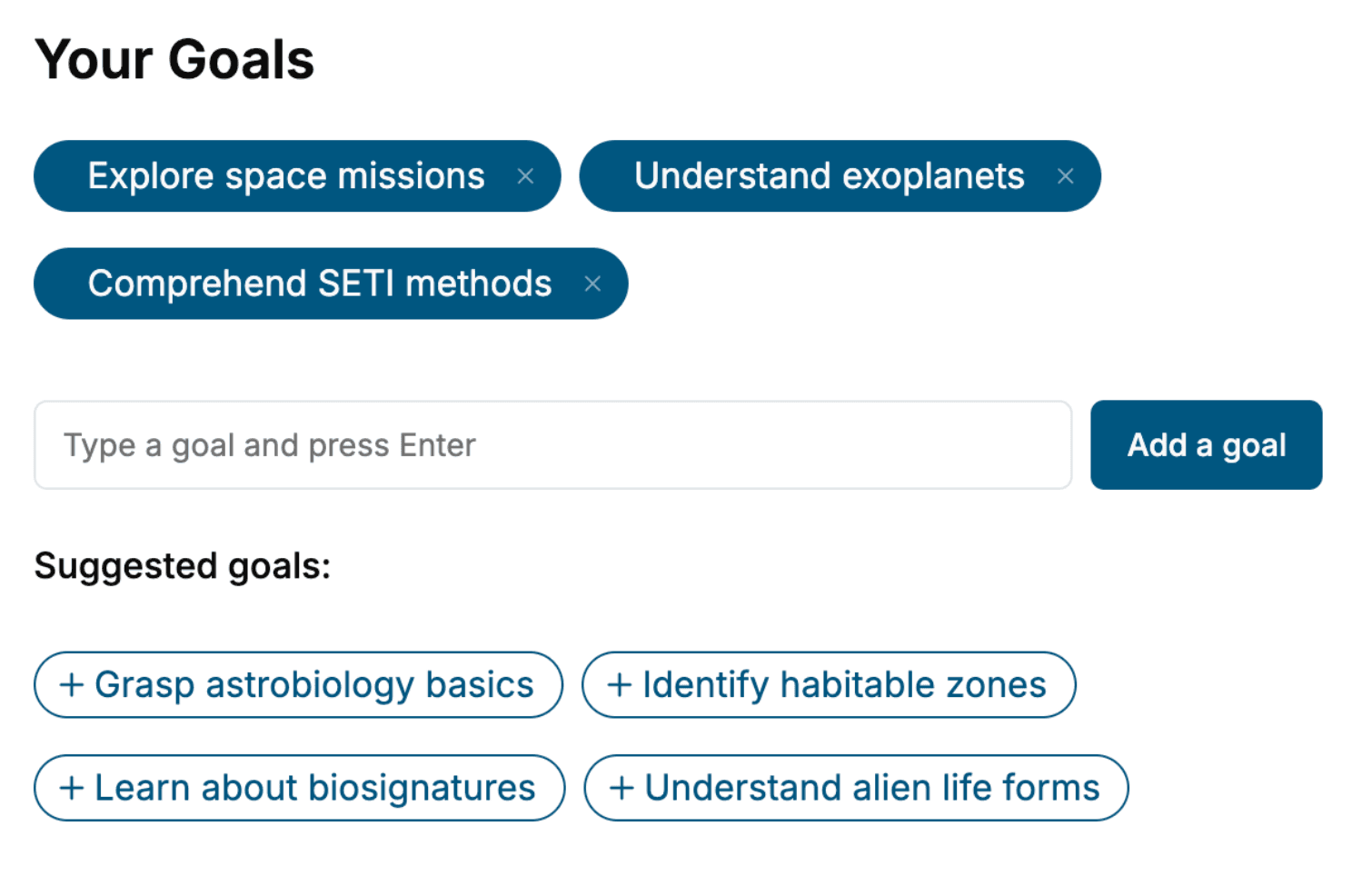
Tell us your goals and background, and get your own version of this book, tailored by AI to you.


Benefits of AI-tailored books
- Read one book, not ten:
- all the Signal Processing knowledge you need, gathered into a single book.
- Save days of learning:
- tell us your goals, choose your topics, and the whole book is built around them.
- Learn effortlessly:
- Signal Processing book written for your specific background and expertise.
- Understand at a glance:
- includes charts, tables, timelines, checklists, decision trees, and more.
- Stay current:
- written the day you order it, not years ago.
- Trust what you read:
- every book is checked for accuracy, with real research when your subject needs it.
Create your unique book in 3 steps
- 1. Select your focus
Select the focus of your Signal Processing book and share your background
- 2. Personalize your book
Specify your goals and choose sub-topics to include
- 3. Get your tailored book
Your book is ready in 10 minutes. Read it online, download as EPUB or PDF, or send to Kindle.

Frequently asked questions
- What is TailoredRead?
TailoredRead creates complete, full-length nonfiction ebooks, written specifically for you. Tell us what you want to learn and why, and TailoredRead writes you a complete ebook on it, with charts, tables, and diagrams throughout. Read it online, on Kindle, or on any e-reader, or download it as a PDF or EPUB. Every book is written fresh the day you order it.
- How is the book tailored to me?
Before anything is written, you answer a few short questions about your goals, your background, and the topics you care about. Your book is then planned around your answers: written at your level, focused on your goals, and covering the topics you chose, instead of the one-size-fits-all book a store sells everyone.
- Will it read like generic AI content?
No. Your book isn't a chat transcript: it's planned chapter by chapter before a single word is written, told in a clear book voice, and explains ideas visually with charts, tables, and diagrams. After writing, every book goes through an editorial pass that polishes chapters so the book reads consistent from start to finish. Judge for yourself: browse thousands of sample books on our Explore Books page.
- How accurate is the content?
Our AI first checks whether your subject needs live research. Niche and fast-moving subjects are researched before writing, and the book plan and chapters are grounded in what it finds. After writing, every book goes through a quality pass that checks its facts and consistency, and researched books list their sources in a Notes section at the back.
- How long is the book?
You choose the length: Comprehensive (250-300 pages), Detailed (150-200 pages), Essential (70-100 pages), or Short (30-50 pages).
- Does the book include visuals?
Yes. Every book includes visual elements such as timelines, checklists, step-by-step guides, decision trees, comparison tables, and matrices, and many include bar charts. A typical book includes dozens of these visual elements.
- Can I read it on Kindle? What formats can I download?
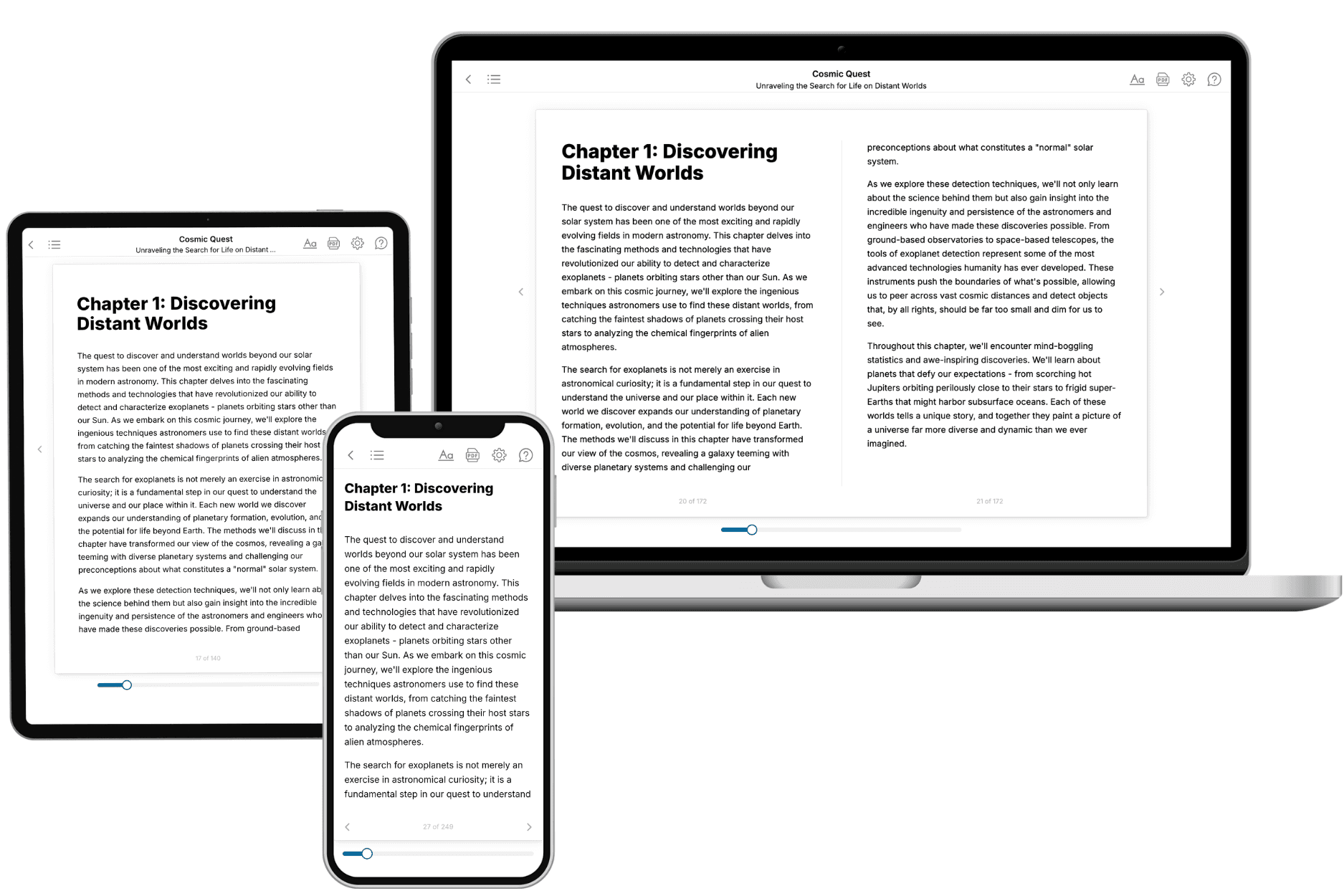
Yes. Every book can be read in our online reader or downloaded as a PDF or EPUB. The EPUB can be opened with Kindle, Apple Books, Kobo, and any e-reader. The Commercial and Author licenses also include an editable Word (DOCX) and Markdown download.
- How much does it cost?
About the price of a regular ebook. The exact price depends on your book's length and complexity, from $2 for the shortest books to $35 for the most comprehensive, and it's shown when you review your book, before you commit to anything. Each book is a one-time purchase, yours to keep, no subscription. Licenses that let you share, teach, or publish your book range from $35.99 to $49.99.
- Can I preview the book before purchasing?
Before you pay, you'll see what your book will cover: the title, a detailed description, the estimated length, and the complete chapter-by-chapter table of contents, so you know what you're getting before you decide. The full text itself is written after you purchase.
- How long does it take to create a book?
About 10 minutes. You can start reading the opening chapters while the rest is still being written.