Zero-Knowledge Proofs in Modern Cryptography
Master the Mathematics and Applications of Cipher Block Chaining and Cryptographic Verification
Discover how zero-knowledge proofs revolutionize cryptographic verification by enabling you to prove knowledge without revealing secrets.
222 pages10 chaptersApr 21, 2026Zero Knowledge Proofs
About this book
This comprehensive guide takes you from foundational concepts through advanced implementations, showing how these powerful techniques integrate with cipher block chaining and modern cryptographic systems. You'll explore the mathematical principles that make zero-knowledge proofs secure, understand interactive and non-interactive proof systems, and learn how to evaluate their practical applications in authentication, blockchain, and privacy-preserving technologies. Whether you're developing secure systems, implementing cryptographic protocols, or seeking to understand the cutting edge of verification technology, this book provides the knowledge and practical insights needed to work confidently with zero-knowledge proofs in real-world scenarios.
Table of contents
- IntroductionWhy Zero-Knowledge Proofs Matter Today, Your Roadmap Through This Book, What You Need to Know Before StartingRead below
- Chapter 1: Foundations of Cryptography and VerificationCore Cryptographic Concepts, Traditional Authentication Methods, Limitations of Conventional Verification, Introduction to Zero-Knowledge Proofs
- Chapter 2: Mathematical Foundations of Zero-Knowledge ProofsComplexity Theory and Computational Hardness, Interactive Proof Systems, Soundness, Completeness, and Zero-Knowledge Properties, Probabilistic Verification Methods
- Chapter 3: Cipher Block Chaining and Block Cipher ModesBlock Cipher Fundamentals, How Cipher Block Chaining Works, Security Properties and Vulnerabilities of CBC, Verification Challenges in CBC Systems
- Chapter 4: Interactive Zero-Knowledge ProofsThe Prover-Verifier Model, Challenge-Response Protocols, The Fiat-Shamir Identification Scheme, Practical Examples of Interactive Proofs
- Chapter 5: Non-Interactive Zero-Knowledge ProofsCryptographic Commitments and Hash Functions, The Fiat-Shamir Transform, Non-Interactive Zero-Knowledge Constructions, Advantages and Trade-offs of Non-Interactive Proofs
- Chapter 6: Integrating Zero-Knowledge Proofs with Cryptographic AlgorithmsZero-Knowledge Proofs in CBC Mode Systems, Enhanced Verification Without Information Disclosure, Designing Secure Hybrid Protocols, Common Integration Patterns and Best Practices
- Chapter 7: Advanced Zero-Knowledge Proof SystemsZero-Knowledge Succinct Non-Interactive Arguments of Knowledge, Scalable Transparent Arguments of Knowledge, Bulletproofs and Range Proofs, Comparing Advanced Systems
- Chapter 8: Real-World Applications and Case StudiesZero-Knowledge Proofs in Blockchain and Cryptocurrency, Privacy-Preserving Authentication Systems, Secure Multi-Party Computation Applications, Real-World Implementation Case Studies
- Chapter 9: Implementation Considerations and SecurityOptimizing Computational Efficiency, Selecting Appropriate Security Parameters, Common Implementation Pitfalls and How to Avoid Them, Testing and Validation Strategies
- Chapter 10: Future Directions and Emerging TrendsPost-Quantum Zero-Knowledge Proofs, Scalability and Performance Improvements, Emerging Applications and Use Cases
- ConclusionKey Takeaways and Core Principles, Your Next Steps in Mastering Zero-Knowledge Proofs
- Glossary of Terms
- Further Reading and Resources
Introduction
Imagine you need to prove to someone that you know a secret password without actually saying the password out loud. At first glance, this sounds impossible. How can you demonstrate knowledge of something without revealing what that something is? This puzzle sits at the heart of one of the most fascinating and practically important ideas in modern cryptography: zero-knowledge proofs. What once seemed like a theoretical curiosity has become a foundational technology powering privacy-preserving systems, blockchain networks, and secure authentication protocols used by millions of people every day.
The field of cryptography has always been about managing secrets. For decades, the dominant approach was straightforward: to prove you know something, you share it, or at least share enough of it to convince the other party. Password authentication works this way. Certificate verification works this way. Even many digital signature schemes work this way at some level. But sharing information creates risk. Every time a secret travels across a network or gets stored in a database, it becomes a potential target. Zero-knowledge proofs offer a fundamentally different approach, one where proof and disclosure are separated entirely.
This book is built for professionals and developers who already have a working understanding of cryptographic concepts and want to go deeper. You will not find a beginner's guide to encryption here. Instead, you will find a rigorous but accessible exploration of how zero-knowledge proofs work mathematically, how they connect to cryptographic systems like cipher block chaining, and how they are being deployed in real-world applications right now. The goal is to give you both the conceptual clarity and the practical grounding to work with these technologies confidently, whether you are designing a new protocol, evaluating an existing system, or simply trying to understand what the cryptographic community has been so excited about for the past decade.
The journey through this book moves from foundations to frontiers. You will start with the mathematical bedrock that makes zero-knowledge proofs possible, move through interactive and non-interactive proof systems, explore how these techniques integrate with cipher block chaining and other cryptographic primitives, and arrive at the cutting edge of systems like zk-SNARKs and zk-STARKs. Along the way, real-world case studies and concrete implementation guidance will keep the material grounded in practice. By the end, you will have a comprehensive map of this landscape and the tools to navigate it on your own.
Why Zero-Knowledge Proofs Matter Today
The digital world is experiencing a privacy crisis. Data breaches have become so routine that they barely make headlines anymore. In 2023 alone, billions of records were exposed across healthcare, finance, and government sectors.[1] Most of these breaches share a common thread: systems that required users to hand over sensitive information in order to prove who they were or what they were entitled to do. Zero-knowledge proofs attack this problem at its root by making it possible to verify claims without collecting the underlying data in the first place.
Consider a practical scenario that illustrates the stakes. A financial services company needs to verify that a customer's account balance exceeds a certain threshold before approving a transaction. The traditional approach requires the customer to disclose their exact balance, which then gets logged, stored, and potentially exposed. With a zero-knowledge proof, the customer can prove that their balance meets the threshold without revealing the actual number. The verifier learns exactly one bit of information: the claim is true or false. Nothing else leaks. This is not a minor improvement in privacy. It is a categorical shift in how verification can work.
The timing of zero-knowledge proofs' rise to prominence is not accidental. Several converging forces have made them both necessary and practical. Regulatory pressure around data minimization, particularly from frameworks like GDPR in Europe and CCPA in California, has pushed organizations to collect less data and prove more with less.[2] At the same time, advances in computational efficiency have made proof generation fast enough to be usable in real systems. What once required minutes of computation on specialized hardware can now run in milliseconds on a standard server.
Blockchain technology has been a particularly powerful driver of zero-knowledge proof adoption. Public blockchains are transparent by design, which creates a fundamental tension with financial privacy. Projects like Zcash demonstrated that zero-knowledge proofs could enable fully private transactions on a public ledger, proving that a transaction is valid without revealing the sender, receiver, or amount.[3] This breakthrough opened the door to a wave of applications across decentralized finance, identity management, and supply chain verification.
Authentication systems represent another domain where zero-knowledge proofs are changing the game. Traditional password-based authentication requires a server to store some representation of your password, whether hashed or otherwise. That stored representation is a liability. Zero-knowledge authentication schemes allow a user to prove they know their credentials without the server ever storing anything that could be used to impersonate them. This is not just theoretically appealing. It is a practical defense against one of the most common attack vectors in modern security.
The relevance of zero-knowledge proofs extends into secure computation, regulatory compliance, and even machine learning. Organizations are beginning to use these techniques to prove that a machine learning model was trained on compliant data without revealing the training set itself. Auditors can verify that a company's financial statements satisfy certain constraints without seeing the underlying books. The pattern is consistent: wherever sensitive information needs to be verified but not disclosed, zero-knowledge proofs offer a path forward. Understanding them is no longer optional for serious cryptography practitioners. It is essential.
The core promise of zero-knowledge proofs: You can convince someone that a statement is true without giving them any information beyond the truth of that statement itself. This property, when properly implemented, fundamentally changes the economics of trust in digital systems.
Your Roadmap Through This Book
This book is organized to build understanding progressively. Each chapter adds a layer of depth, and the concepts introduced early are referenced and extended throughout. You do not need to read every chapter in strict sequence if you already have strong background in certain areas, but the structure is designed so that reading front to back gives you the most coherent experience. Here is what each part of the journey covers.
Chapter 1: Foundations of Cryptography and Verification establishes the shared vocabulary and conceptual baseline for everything that follows. It covers core cryptographic concepts including symmetric and asymmetric encryption, hash functions, and digital signatures. It then examines how traditional authentication methods work and, critically, where they fall short. This chapter closes by introducing zero-knowledge proofs at a high level, framing the problem they solve and the intuition behind how they solve it. If you are already deeply familiar with cryptographic fundamentals, you can skim this chapter and use it as a reference.
Chapter 2: Mathematical Foundations of Zero-Knowledge Proofs is where the technical depth begins. This chapter covers complexity theory and computational hardness, which are the mathematical reasons why zero-knowledge proofs are secure. It introduces interactive proof systems, defines the three critical properties of zero-knowledge proofs (completeness, soundness, and zero-knowledge), and explains probabilistic verification methods. This chapter is dense but essential. The concepts here underpin every practical system discussed later in the book.
Chapter 3: Cipher Block Chaining and Block Cipher Modes provides a thorough treatment of CBC mode, one of the most widely deployed cryptographic constructions in history. Understanding how CBC works, what its security properties are, and where its vulnerabilities lie is important context for the integration chapters that follow. This chapter also examines the verification challenges that arise specifically in CBC-based systems, setting up the question that later chapters answer: how can zero-knowledge proofs help?
The next two chapters form a natural pair. Chapter 4 covers interactive zero-knowledge proofs, including the prover-verifier model, challenge-response protocols, and the classic Fiat-Shamir identification scheme. Chapter 5 then moves to non-interactive zero-knowledge proofs, explaining cryptographic commitments, the Fiat-Shamir transform (distinct from the identification scheme), and the constructions that make proofs work without real-time communication. Together, these chapters give you a complete picture of the two major families of zero-knowledge proof systems.
Chapter 6: Integrating Zero-Knowledge Proofs with Cryptographic Algorithms is where theory meets practice. This chapter shows specifically how zero-knowledge proofs can be layered onto CBC mode systems, how to design hybrid protocols that combine the strengths of both, and what the common integration patterns look like in real deployments. It includes concrete protocol design guidance and best practices drawn from production systems.
The final chapters push into advanced territory and real-world application. The structure looks like this:
- Chapter 7 covers advanced proof systems including zk-SNARKs, zk-STARKs, and Bulletproofs, comparing their trade-offs in terms of proof size, verification time, and trust assumptions.
- Chapter 8 examines real-world applications across blockchain, privacy-preserving authentication, and secure multi-party computation, with detailed case studies from deployed systems.
- Chapter 9 addresses implementation considerations including computational efficiency, security parameter selection, common pitfalls, and testing strategies.
- Chapter 10 looks at the future, covering post-quantum zero-knowledge proofs, scalability improvements, and emerging application domains.
Throughout the book, you will find concrete examples, worked scenarios, and implementation-level guidance. Abstract concepts are always grounded in specific cases. When a mathematical property is introduced, it is followed by an explanation of what that property means in practice and why it matters for the systems you build. The goal is not just to explain what zero-knowledge proofs are, but to give you the understanding needed to use them well.
A note on notation and terminology: this book uses standard cryptographic notation where it aids precision, but always explains notation when it is first introduced. Technical terms are defined in context and collected in the glossary at the back of the book. When a concept from one chapter is needed in another, a brief reminder is provided so you do not need to flip back constantly. The aim is a reading experience that is rigorous without being unnecessarily opaque.
What You Need to Know Before Starting
This book is written for intermediate-level professionals and developers. It assumes you have already spent time with cryptography and are comfortable with its core ideas. Being specific about what that means is important, because the right preparation will make the difference between finding this material illuminating and finding it frustrating. The following sections outline what background knowledge is expected, what is helpful but not required, and how to fill any gaps before diving in.
Essential background knowledge includes the following areas:
- Symmetric encryption: You should understand how symmetric ciphers work, including block ciphers like AES and stream ciphers. You should know what a key is, what plaintext and ciphertext mean, and how encryption and decryption relate to each other.
- Asymmetric encryption: You should be familiar with public-key cryptography, including RSA and elliptic curve cryptography at a conceptual level. Understanding why asymmetric encryption is computationally harder to break than symmetric encryption is important context for the hardness assumptions used in zero-knowledge proofs.
- Hash functions: You should know what a cryptographic hash function does, what properties like collision resistance and preimage resistance mean, and why these properties matter for security. Hash functions appear throughout this book as building blocks for commitment schemes and non-interactive proofs.
- Digital signatures: A working understanding of how digital signatures provide authentication and non-repudiation is expected. The relationship between signing and verification maps naturally onto the prover-verifier model in zero-knowledge proofs.
- Basic probability: Zero-knowledge proofs are probabilistic by nature. You should be comfortable with concepts like probability distributions, conditional probability, and the idea that a small but nonzero probability of error can be made negligible through repetition.
Beyond these essentials, some background in discrete mathematics will make the material in Chapter 2 significantly more accessible. Specifically, familiarity with modular arithmetic, prime numbers, and group theory at an introductory level will help you follow the mathematical constructions without getting lost. If you have worked through a course in number theory or abstract algebra, even at an undergraduate level, you are well prepared. If not, the book provides enough context to follow the key ideas, though some of the deeper mathematical details may require supplementary reading.
Programming experience is not strictly required to understand the concepts in this book, but it will help you engage with the implementation-focused sections in Chapters 6, 8, and 9. Most code examples and pseudocode in this book are written to be readable by anyone with general programming experience, regardless of specific language background. Where specific libraries or frameworks are referenced, they are explained in enough detail that you can understand what they do even if you have not used them before.
If you find that your background in any of these areas is weaker than you would like, here are some targeted resources to consider before or alongside reading this book:
- For cryptographic fundamentals: Introduction to Modern Cryptography by Jonathan Katz and Yehuda Lindell provides a rigorous but accessible treatment of the core concepts.[4]
- For discrete mathematics: Discrete Mathematics and Its Applications by Kenneth Rosen covers modular arithmetic, number theory, and graph theory at an appropriate level.[5]
- For a gentle introduction to zero-knowledge proofs specifically: the blog series by Matthew Green at Johns Hopkins provides an excellent conceptual overview before diving into the formal treatment here.[6]
One thing worth addressing directly: the mathematics in this book is real. Zero-knowledge proofs are built on serious mathematical foundations, and glossing over that mathematics would leave you with an incomplete and potentially misleading understanding. At the same time, the goal is always to connect the math to meaning. Every formal definition is followed by an explanation of what it means in plain terms. Every theorem is accompanied by an explanation of why it matters for the systems you care about. The mathematics is a tool for understanding, not an obstacle to it.
Finally, it is worth setting expectations about what this book does not cover. It is not a comprehensive survey of all cryptographic protocols. It does not cover network security, TLS configuration, or general security engineering in depth. It focuses specifically on zero-knowledge proofs, their mathematical foundations, their relationship to cipher block chaining, and their practical applications. That focus is intentional. The goal is depth over breadth, giving you a thorough understanding of a specific and important set of ideas rather than a shallow overview of a much larger field.
A practical self-assessment: Before starting Chapter 2, make sure you can answer these questions comfortably. What is the difference between a one-way function and a trapdoor function? What does it mean for a problem to be in the complexity class NP? What is a commitment scheme and why is binding important? If these questions feel unfamiliar, spending a few hours reviewing the relevant sections of a cryptography textbook will pay dividends throughout the rest of this book.
The field of zero-knowledge proofs is moving fast. New proof systems are being published regularly, and practical deployments are expanding into new domains every year. This book captures the state of the field as it stands today, with particular attention to the systems and concepts that have proven durable and widely applicable. Where the field is still evolving, that uncertainty is noted explicitly. The goal is to give you a foundation solid enough that you can continue learning as the field develops, not just a snapshot that will be outdated in two years. With that foundation in place, it is time to begin.
Notes
Introduction
- 1. Identity Theft Resource Center, 2023 Annual Data Breach Report, ITRC, San Diego, CA, 2023
- 2. European Parliament, General Data Protection Regulation (GDPR), Regulation (EU) 2016/679, 2016
- 3. E. Ben-Sasson and others, Zerocash: Decentralized Anonymous Payments from Bitcoin, IEEE Symposium on Security and Privacy, 2014
- 4. J. Katz and Y. Lindell, Introduction to Modern Cryptography (3rd ed.), CRC Press, 2020
- 5. K. H. Rosen, Discrete Mathematics and Its Applications (8th ed.), McGraw-Hill Education, 2018
- 6. M. Green, "Zero Knowledge Proofs: An Illustrated Primer," A Few Thoughts on Cryptographic Engineering, 2014
This is the end of the free sample. The full book has 10 chapters.
Want this book written for you?
Tell us your goals and background, and get your own version of this book, tailored by AI to you.


Benefits of AI-tailored books
- Read one book, not ten:
- all the Zero Knowledge Proofs knowledge you need, gathered into a single book.
- Save days of learning:
- tell us your goals, choose your topics, and the whole book is built around them.
- Learn effortlessly:
- Zero Knowledge Proofs book written for your specific background and expertise.
- Understand at a glance:
- includes charts, tables, timelines, checklists, decision trees, and more.
- Stay current:
- written the day you order it, not years ago.
- Trust what you read:
- every book is checked for accuracy, with real research when your subject needs it.
Create your unique book in 3 steps
- 1. Select your focus
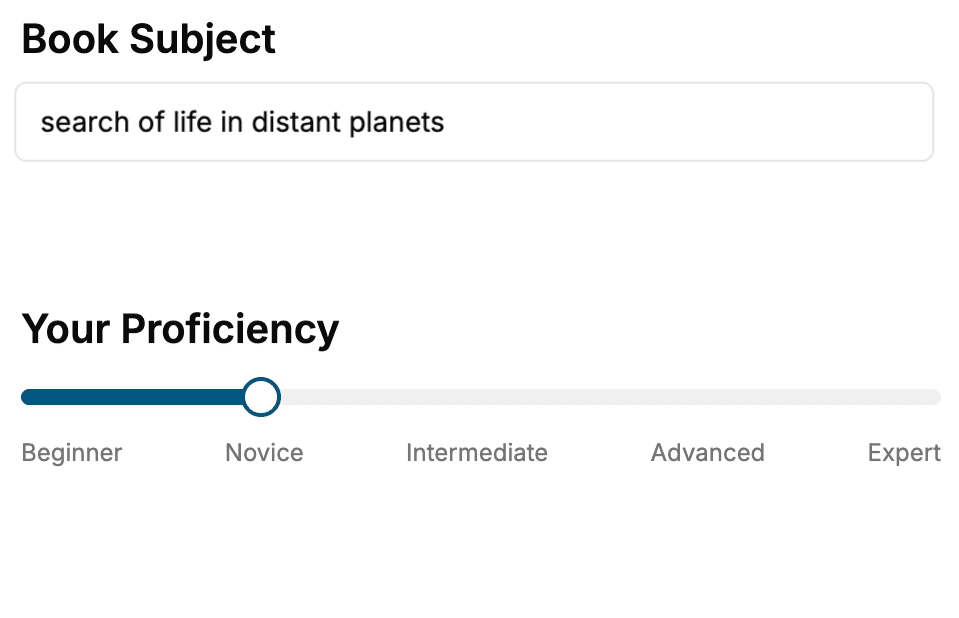
Select the focus of your Zero Knowledge Proofs book and share your background
- 2. Personalize your book
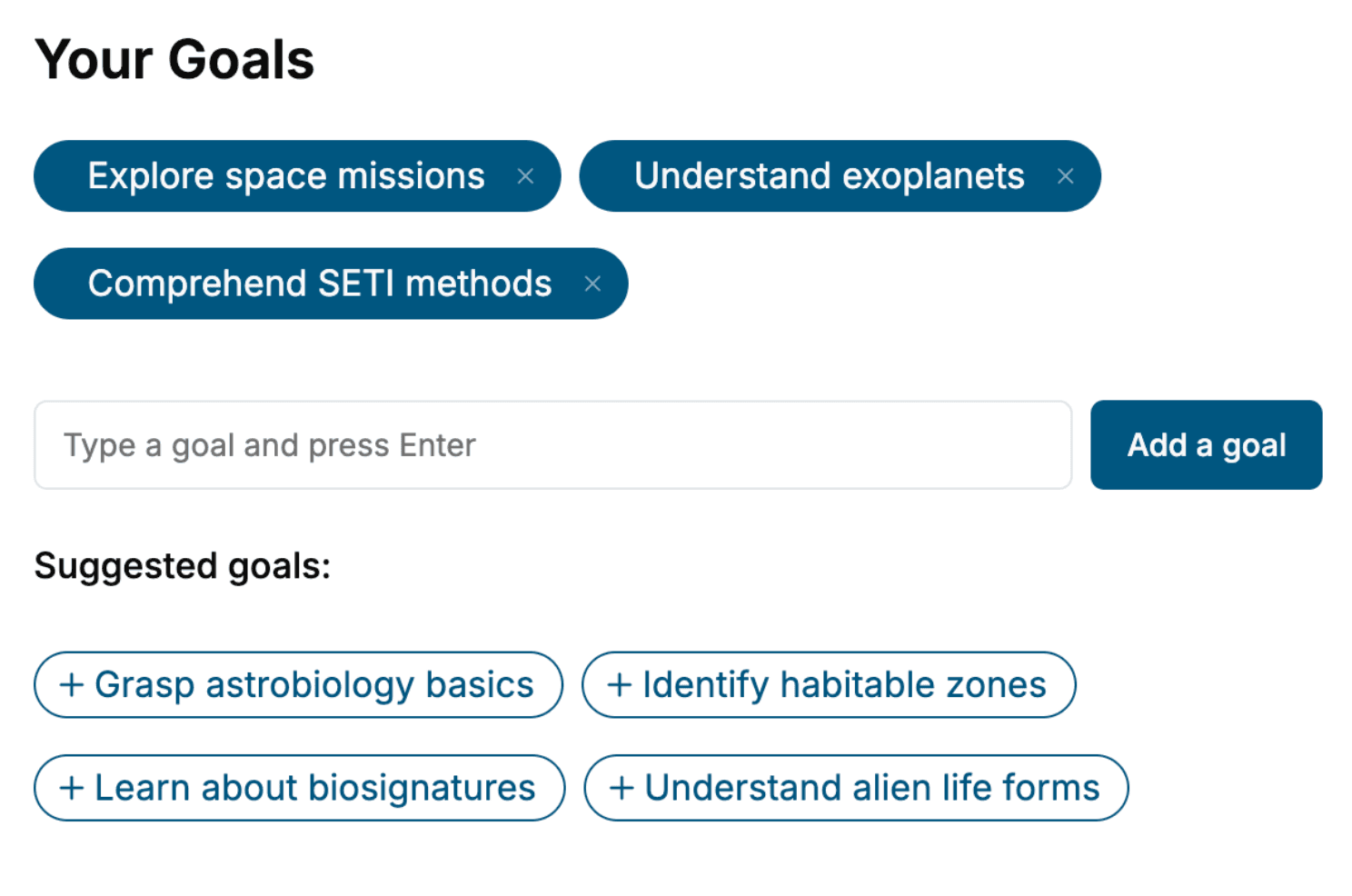
Specify your goals and choose sub-topics to include
- 3. Get your tailored book
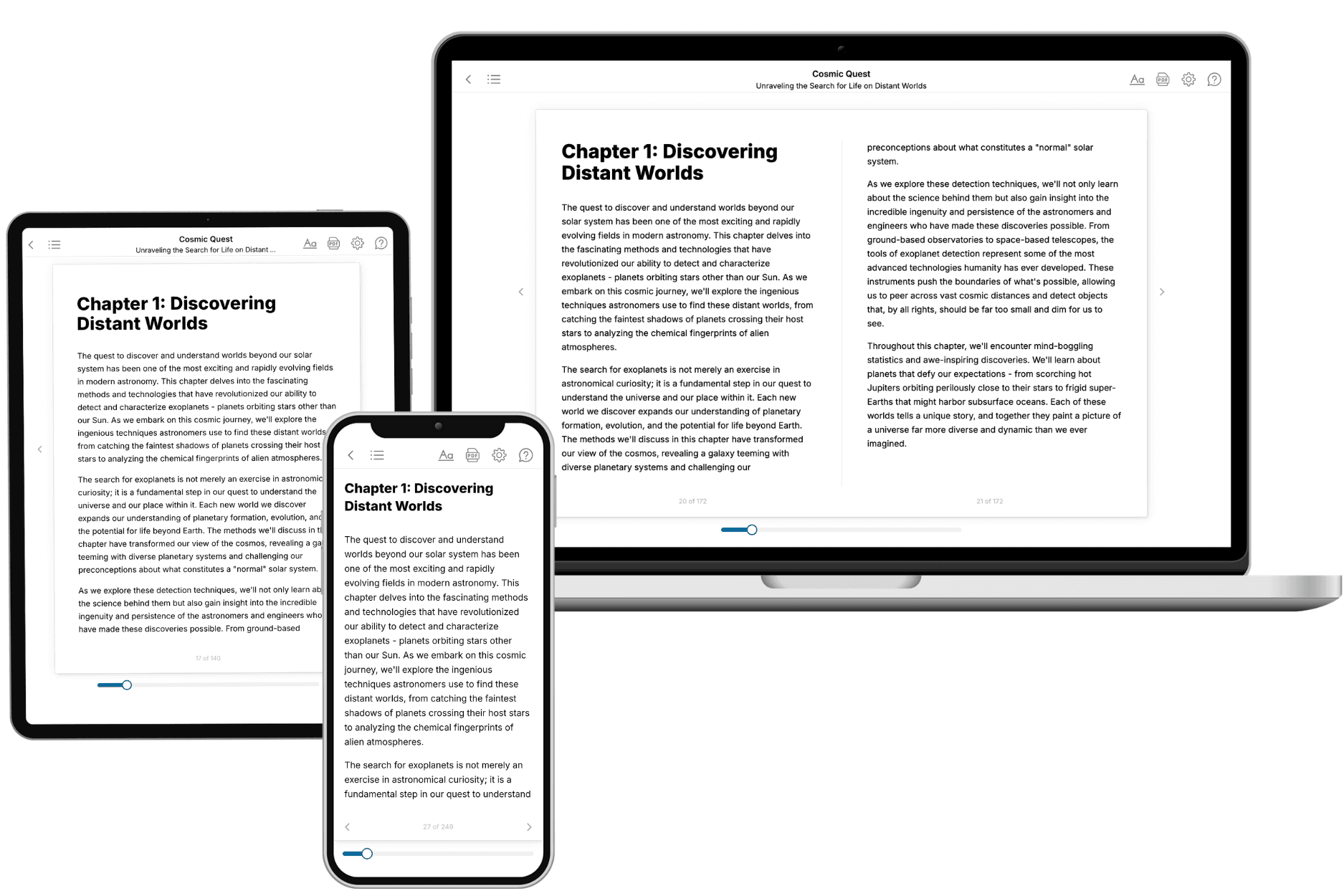
Your book is ready in 10 minutes. Read it online, download as EPUB or PDF, or send to Kindle.
Frequently asked questions
- What is TailoredRead?
TailoredRead creates complete, full-length nonfiction ebooks, written specifically for you. Tell us what you want to learn and why, and TailoredRead writes you a complete ebook on it, with charts, tables, and diagrams throughout. Read it online, on Kindle, or on any e-reader, or download it as a PDF or EPUB. Every book is written fresh the day you order it.
- How is the book tailored to me?
Before anything is written, you answer a few short questions about your goals, your background, and the topics you care about. Your book is then planned around your answers: written at your level, focused on your goals, and covering the topics you chose, instead of the one-size-fits-all book a store sells everyone.
- Will it read like generic AI content?
No. Your book isn't a chat transcript: it's planned chapter by chapter before a single word is written, told in a clear book voice, and explains ideas visually with charts, tables, and diagrams. After writing, every book goes through an editorial pass that polishes chapters so the book reads consistent from start to finish. Judge for yourself: browse thousands of sample books on our Explore Books page.
- How accurate is the content?
Our AI first checks whether your subject needs live research. Niche and fast-moving subjects are researched before writing, and the book plan and chapters are grounded in what it finds. After writing, every book goes through a quality pass that checks its facts and consistency, and researched books list their sources in a Notes section at the back.
- How long is the book?
You choose the length: Comprehensive (250-300 pages), Detailed (150-200 pages), Essential (70-100 pages), or Short (30-50 pages).
- Does the book include visuals?
Yes. Every book includes charts, tables, and diagrams: timelines, checklists, step-by-step guides, decision trees, comparison tables, matrices, and bar charts. A typical book includes dozens of these visual elements.
- Can I read it on Kindle? What formats can I download?
Yes. Every book can be read in our online reader or downloaded as a PDF or EPUB. The EPUB can be opened with Kindle, Apple Books, Kobo, and any e-reader. The Commercial and Author licenses also include an editable Word (DOCX) and Markdown download.
- How much does it cost?
About the price of a regular ebook. The exact price depends on your book's length and complexity, from $2 for the shortest books to $35 for the most comprehensive, and it's shown when you review your book, before you commit to anything. Each book is a one-time purchase, yours to keep, no subscription. Licenses that let you share, teach, or publish your book range from $35.99 to $49.99.
- Can I preview the book before purchasing?
Before you pay, you'll see what your book will cover: the title, a detailed description, the estimated length, and the complete chapter-by-chapter table of contents, so you know what you're getting before you decide. The full text itself is written after you purchase.
- How long does it take to create a book?
About 10 minutes. You can start reading the opening chapters while the rest is still being written.