The 30-Day Adoption Blueprint
Navigate Every Step with Confidence, Clarity, and Compassion
Adoption is one of life's most rewarding decisions—and one of its most complex.
191 pages9 chaptersMay 16, 2026Adoption
About this book
You'll navigate legal systems, emotional terrain, family dynamics, and your own expectations while preparing to welcome a child into your home. This book walks you through a proven 30-day system that transforms adoption from an overwhelming maze into a clear, actionable plan. You'll learn exactly what legal steps to take and in what order, how to prepare emotionally for the profound changes ahead, and how to ready your family for integration. You'll discover trauma-informed parenting strategies, build a support network before you need it, and establish systems for tracking milestones and documenting progress. Whether you're working with fertility clinics, surrogates, egg donors, or pursuing domestic or international adoption, this guide provides the daily actions, checklists, and frameworks you need. By day 30, you won't just understand the adoption process—you'll have a personalized roadmap, organized legal documents, emotional preparation strategies, and a support system ready to sustain your family through the beautiful, challenging journey ahead.
Table of contents
- IntroductionWhy Adoption Requires a Structured Approach, How This Book Works: Your 30-Day System, What You'll Accomplish in the Next 30 DaysRead below
- Chapter 1: Understanding Your Adoption PathTypes of Adoption: Domestic, International, Foster-to-Adopt, and Surrogacy, Assessing Your Family's Readiness and Motivations, Making Initial Decisions: Age, Special Needs, and Preferences
- Chapter 2: Legal Requirements and DocumentationNavigating the Legal Landscape: State and Federal Requirements, Organizing Your Legal Documents: A Complete Checklist, Working with Adoption Agencies and Legal Professionals, Understanding the Home Study Process
- Chapter 3: Fertility Clinics, Surrogates, and Egg DonorsNavigating Fertility Clinics: Questions to Ask and Red Flags, Coordinating with Surrogate Mothers: Legal and Emotional Considerations, Selecting an Egg Donor: Medical, Legal, and Ethical Factors
- Chapter 4: Emotional Preparation for Adoptive ParentsProcessing Grief and Loss in Your Adoption Journey, Aligning Expectations with Reality: Building Emotional Resilience, Building Parental Confidence Before Your Child Arrives
- Chapter 5: Understanding Trauma and AttachmentUnderstanding Adoption Trauma and Its Long-Term Effects, Attachment and Bonding: What Science Tells Us, Trauma-Informed Parenting Strategies and Techniques
- Chapter 6: Family Preparation and IntegrationPreparing Your Family: Siblings, Extended Family, and Household Changes, Cultural Sensitivity and Honoring Your Child's Heritage, Family Preparation Checklist: Practical Steps and Timelines
- Chapter 7: Child-Centered Communication and Behavioral UnderstandingDeveloping Child-Centered Communication Strategies, Understanding Child Behavior: Developmental and Trauma-Related, Age-Appropriate Conversations About Adoption and Identity
- Chapter 8: Building Your Support NetworkBuilding Your Adoption Support Community Before Day One, Accessing Adoption Counseling and Professional Resources, Finding Peer Support Groups and Mentorship
- Chapter 9: Post-Adoption Care and Milestone TrackingEstablishing Post-Adoption Support Systems and Services, Tracking Milestones: Documentation and Celebration, Long-Term Planning: Beyond the First 30 Days
- ConclusionYour Next Steps: From Planning to Action, Final Thoughts: The Adoption Journey Ahead
- Appendix: Tools and Resources30-Day Daily Action Checklist, Legal Document Organization Template, Support Resource Directory and Contact Information
Introduction
Adoption is one of the most profound decisions a person or couple can make. It is a choice rooted in love, hope, and a deep desire to build a family. But if you've spent any time researching the process, you already know that love and hope alone won't carry you through the paperwork, the legal requirements, the emotional weight, or the practical preparation that adoption demands. The journey is complex, and for most people stepping into it for the first time, it can feel genuinely overwhelming. That feeling is completely normal, and it doesn't mean you're not ready.
What most prospective adoptive parents discover quickly is that the adoption process doesn't come with a clear instruction manual. You'll find fragments of information scattered across agency websites, legal guides, parenting forums, and well-meaning advice from friends. Some of it is accurate. Some of it is outdated. Some of it applies to your specific situation, and some of it doesn't. Sorting through all of that while managing your own emotions, your relationship, your finances, and your daily life is a significant challenge. Many families stall not because they lack commitment, but because they lack a clear, organized path forward.
This book exists to solve that problem. It gives you a structured, day-by-day system that takes you from the earliest stages of adoption planning through legal preparation, emotional readiness, family integration, and post-adoption support. It doesn't replace the professionals you'll work with, including attorneys, social workers, and counselors. What it does is help you show up to every conversation, every appointment, and every milestone prepared, informed, and confident. Think of it as the roadmap that helps you navigate the terrain before you're standing in the middle of it.
The 30-day framework in this book is built around a simple but powerful idea: when you break a complex process into clear daily actions, it stops feeling impossible and starts feeling manageable. Each day builds on the last. Each week focuses on a different dimension of the adoption journey. By the time you reach day 30, you won't just understand the process in theory. You'll have completed real, meaningful work that moves your adoption forward and prepares your family for the road ahead.
Why Adoption Requires a Structured Approach
Adoption is not a single event. It is a process that unfolds across months or even years, involving multiple systems, multiple professionals, and multiple layers of emotional complexity. Legal requirements vary by state and country. Timelines shift. Agencies have different standards. Birth parents have rights that must be respected. Children come with histories that shape how they attach and how they heal. Without a structured approach, it's easy to lose track of where you are, what comes next, and what you might be missing.
Consider what a typical domestic adoption involves on the legal side alone. You'll need to complete a home study, gather background checks, compile financial records, obtain medical clearances, and work with an attorney or agency to navigate consent and termination of parental rights. Each of those steps has its own timeline, its own documentation requirements, and its own potential complications. Miss a step or submit an incomplete document, and you can face delays that push your timeline back by weeks or months. A structured approach keeps you from making those costly mistakes.
The emotional dimension adds another layer of complexity. Many adoptive parents are also processing grief, whether from infertility, previous failed adoptions, or the loss of the family-building path they originally imagined. At the same time, they're preparing to parent a child who may have experienced trauma, loss, or instability. Research consistently shows that adoptive parents who prepare emotionally before their child arrives are better equipped to respond with patience and attunement when challenges arise.[1] That preparation doesn't happen by accident. It requires intentional effort and a plan.
A structured approach also helps you manage the practical realities of adoption without letting them consume your entire life. Prospective adoptive parents often describe the process as a second full-time job. There are forms to complete, calls to make, meetings to attend, and decisions to research. When those tasks are organized into a clear system, you can work through them efficiently without burning out. Structure creates breathing room, and breathing room is something every adoptive family needs.
There's also the matter of family preparation. If you have other children at home, they need to be included in the process in age-appropriate ways. Extended family members may have questions, concerns, or biases that need to be addressed. Your home environment may need physical changes. Your routines will shift. None of these things happen smoothly without planning. A structured approach ensures that family readiness is treated as seriously as legal readiness, because both matter equally to your child's wellbeing.
Finally, structure builds confidence. When you know what you're doing and why, you feel more capable. When you can look at a checklist and see how much you've already accomplished, the remaining steps feel less daunting. Confidence isn't something you either have or don't have. It's something you build through preparation and action. This book is designed to help you build it, one day at a time.
A key insight from adoption research: Families who engage in structured pre-adoption preparation report significantly higher satisfaction with the adoption process and lower rates of adoption disruption compared to families who approach the process without a clear plan.[2]
The bottom line is this: adoption rewards preparation. The families who navigate it most successfully are not necessarily the ones with the most resources or the fewest challenges. They are the ones who approached the process with intention, organization, and a willingness to do the inner work alongside the outer work. That's exactly what this book will help you do.
How This Book Works: Your 30-Day System
This book is organized around a 30-day framework, but it's important to understand what that means in practice. The 30 days are not a rigid countdown where you must complete every task in exactly 24 hours. They are a structured sequence of focused effort, designed so that each phase builds logically on the one before it. Some days will take longer than others. Some tasks will require follow-up over several days. The framework is a guide, not a stopwatch.
The book is divided into nine core chapters, each covering a distinct dimension of the adoption journey. The chapters are designed to be read in order, because the concepts and actions in each chapter inform the ones that follow. Here's a quick overview of how the content is organized:
- Chapter 1 (Days 1–3): Understanding your adoption path, including the different types of adoption and how to assess your family's readiness.
- Chapter 2 (Days 4–7): Legal requirements and documentation, including how to organize your paperwork and work effectively with agencies and attorneys.
- Chapter 3 (Days 8–10): Fertility clinics, surrogates, and egg donors, for families pursuing those specific paths.
- Chapter 4 (Days 11–13): Emotional preparation for adoptive parents, including processing grief and building resilience.
- Chapter 5 (Days 14–17): Understanding trauma and attachment, including trauma-informed parenting strategies.
- Chapter 6 (Days 18–20): Family preparation and integration, including preparing siblings and honoring your child's cultural heritage.
- Chapter 7 (Days 21–23): Child-centered communication and behavioral understanding.
- Chapter 8 (Days 24–26): Building your support network before your child arrives.
- Chapter 9 (Days 27–30): Post-adoption care, milestone tracking, and long-term planning.
Each chapter contains practical frameworks, concrete examples, and specific action steps. You won't find vague advice like "take care of yourself" or "be patient." You'll find specific things to do, specific questions to ask, and specific tools to use. The appendix at the back of the book includes a full 30-day daily action checklist, a legal document organization template, and a support resource directory that you can use throughout the process.
Throughout the book, you'll also find key concepts highlighted for easy reference, along with real-world scenarios that illustrate how the principles apply in practice. These scenarios are drawn from common adoption experiences and are designed to help you recognize situations you might encounter and know how to respond. They are not case studies of specific individuals, but composite illustrations of patterns that adoption professionals and families commonly report.
One important note about scope: this book covers domestic adoption, international adoption, foster-to-adopt, and paths involving fertility clinics, surrogates, and egg donors. Not every chapter will apply equally to every reader. If you're pursuing a domestic infant adoption, Chapter 3 on fertility clinics may be less relevant to you. If you're pursuing foster-to-adopt, some of the legal timelines in Chapter 2 will look different than they would for a private domestic adoption. Use the book as a whole system, but apply it with awareness of your specific path. Where relevant, the text will flag which content applies to which adoption types.
The book is also designed to be used alongside professional guidance, not instead of it. Adoption law is complex and varies significantly by state and country. Nothing in this book constitutes legal advice, and you should always work with a licensed adoption attorney and a certified social worker for your specific situation. What this book provides is the knowledge and preparation that helps you work more effectively with those professionals, ask better questions, and avoid common pitfalls.
How to get the most from this book: Read each chapter before you begin the corresponding days. Complete the action steps at the end of each section before moving on. Use the 30-day checklist in the appendix to track your progress. And don't skip the emotional preparation chapters, even if they feel less urgent than the legal ones. They are equally important.
Finally, this book is written with the understanding that adoption journeys are not linear. You may hit delays. You may need to revisit earlier steps. You may encounter unexpected challenges that require you to pause and recalibrate. The 30-day system is designed to be flexible enough to accommodate that reality while still giving you the structure and momentum you need to keep moving forward.
What You'll Accomplish in the Next 30 Days
By the time you complete this 30-day system, you will have accomplished something genuinely significant. Not just in terms of paperwork and checklists, though those matter enormously. You will have done the deeper work of understanding what adoption truly requires, preparing yourself and your family emotionally and practically, and building the foundation that your child will need when they come home. That foundation is what makes the difference between an adoption that struggles and one that thrives.
Here is a concrete picture of what you'll have in place by day 30:
- A clear adoption path decision: You'll know which type of adoption is right for your family and why, based on a structured assessment of your readiness, preferences, and circumstances.
- An organized legal document system: You'll have a complete, organized file of the documents you need, a clear understanding of what's still outstanding, and a timeline for completing each remaining item.
- A working relationship with key professionals: You'll have identified and begun working with an adoption attorney, a licensed agency or social worker, and any other professionals relevant to your path.
- Emotional preparation strategies: You'll have tools for managing the emotional challenges of the adoption process, including grief, anxiety, and the uncertainty that comes with waiting.
- A trauma-informed parenting foundation: You'll understand the basics of adoption trauma and attachment science, and you'll have specific strategies ready to use when your child arrives.
- A prepared family environment: Your household, your other children if applicable, and your extended family will be better prepared for the changes ahead.
- A support network: You'll have identified and connected with the people and resources that will support your family through the adoption process and beyond.
- A post-adoption plan: You'll have a framework for tracking milestones, accessing support services, and planning for the long-term needs of your child and family.
That's a substantial amount of meaningful progress in 30 days. And it's achievable because the system breaks each of those outcomes into specific, manageable daily actions. You won't be trying to do everything at once. You'll be doing the right things in the right order, building momentum as you go.
It's also worth being honest about what 30 days won't accomplish. It won't complete your adoption. Most adoptions take months to finalize, and some take years. What these 30 days will do is ensure that you are as prepared as possible for that longer journey. Think of it as building the strongest possible foundation before the house goes up. The construction takes time, but a solid foundation makes everything that follows more stable.
You'll also develop something harder to quantify but equally important: a sense of agency. One of the most difficult aspects of adoption is how much of the process feels outside your control. Waiting periods, agency decisions, legal timelines, and birth parent choices are all things that happen to you rather than things you control. What you can control is your preparation, your knowledge, your emotional readiness, and your family's stability. Focusing your energy there doesn't eliminate uncertainty, but it does transform your relationship with it. You move from feeling like a passive participant to feeling like an active, capable partner in the process.
Research on adoptive family outcomes consistently points to preparation as one of the strongest predictors of long-term success.[3] Families who understand what to expect, who have processed their own emotional histories, and who have built strong support systems before their child arrives are significantly more likely to report positive outcomes for both the child and the family. This book is designed to help you become one of those families.
One more thing worth saying at the outset: this journey is worth it. The complexity, the paperwork, the emotional work, the waiting, all of it leads somewhere extraordinary. Children find families. Families are transformed. Lives are changed in ways that ripple forward for generations. The 30 days ahead are demanding, but they are also the beginning of something remarkable. Approach them with the seriousness they deserve, and with the knowledge that every step you take is an act of love for a child who needs exactly what you have to offer.
Let's get started.
Notes
Introduction
- 1. D. M. Brodzinsky and E. Pinderhughes, "Parenting and child development in adoptive families," M. H. Bornstein, Handbook of ParentingLawrence Erlbaum Associates, 2002
- 2. R. P. Barth and J. M. Miller, "Building effective post-adoption services," Family Relations, 2000
- 3. J. Palacios and D. Brodzinsky, "Adoption research," International Journal of Behavioral Development, 2010
This is the end of the free sample. The full book has 9 chapters.
Want this book written for you?
Tell us your goals and background, and get your own version of this book, tailored by AI to you.


Benefits of AI-tailored books
- Read one book, not ten:
- all the Adoption knowledge you need, gathered into a single book.
- Save days of learning:
- tell us your goals, choose your topics, and the whole book is built around them.
- Learn effortlessly:
- Adoption book written for your specific background and expertise.
- Understand at a glance:
- includes charts, tables, timelines, checklists, decision trees, and more.
- Stay current:
- written the day you order it, not years ago.
- Trust what you read:
- every book is checked for accuracy, with real research when your subject needs it.
Create your unique book in 3 steps
- 1. Select your focus
Select the focus of your Adoption book and share your background
- 2. Personalize your book
Specify your goals and choose sub-topics to include
- 3. Get your tailored book
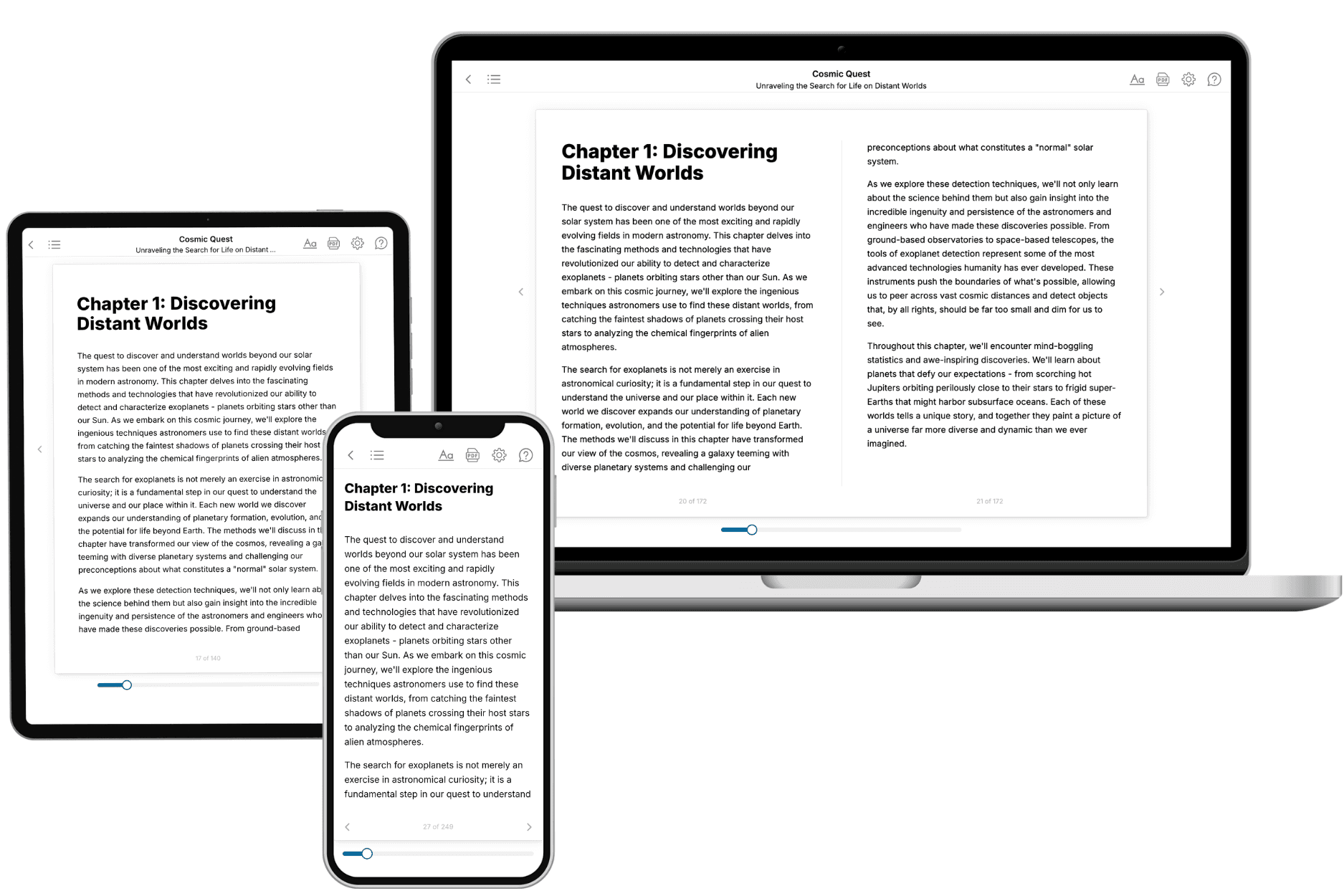
Your book is ready in 10 minutes. Read it online, download as EPUB or PDF, or send to Kindle.

Frequently asked questions
- What is TailoredRead?
TailoredRead creates complete, full-length nonfiction ebooks, written specifically for you. Tell us what you want to learn and why, and TailoredRead writes you a complete ebook on it, with charts, tables, and diagrams throughout. Read it online, on Kindle, or on any e-reader, or download it as a PDF or EPUB. Every book is written fresh the day you order it.
- How is the book tailored to me?
Before anything is written, you answer a few short questions about your goals, your background, and the topics you care about. Your book is then planned around your answers: written at your level, focused on your goals, and covering the topics you chose, instead of the one-size-fits-all book a store sells everyone.
- Will it read like generic AI content?
No. Your book isn't a chat transcript: it's planned chapter by chapter before a single word is written, told in a clear book voice, and explains ideas visually with charts, tables, and diagrams. After writing, every book goes through an editorial pass that polishes chapters so the book reads consistent from start to finish. Judge for yourself: browse thousands of sample books on our Explore Books page.
- How accurate is the content?
Our AI first checks whether your subject needs live research. Niche and fast-moving subjects are researched before writing, and the book plan and chapters are grounded in what it finds. After writing, every book goes through a quality pass that checks its facts and consistency, and researched books list their sources in a Notes section at the back.
- How long is the book?
You choose the length: Comprehensive (250-300 pages), Detailed (150-200 pages), Essential (70-100 pages), or Short (30-50 pages).
- Does the book include visuals?
Yes. Every book includes visual elements such as timelines, checklists, step-by-step guides, decision trees, comparison tables, and matrices, and many include bar charts. A typical book includes dozens of these visual elements.
- Can I read it on Kindle? What formats can I download?
Yes. Every book can be read in our online reader or downloaded as a PDF or EPUB. The EPUB can be opened with Kindle, Apple Books, Kobo, and any e-reader. The Commercial and Author licenses also include an editable Word (DOCX) and Markdown download.
- How much does it cost?
About the price of a regular ebook. The exact price depends on your book's length and complexity, from $2 for the shortest books to $35 for the most comprehensive, and it's shown when you review your book, before you commit to anything. Each book is a one-time purchase, yours to keep, no subscription. Licenses that let you share, teach, or publish your book range from $35.99 to $49.99.
- Can I preview the book before purchasing?
Before you pay, you'll see what your book will cover: the title, a detailed description, the estimated length, and the complete chapter-by-chapter table of contents, so you know what you're getting before you decide. The full text itself is written after you purchase.
- How long does it take to create a book?
About 10 minutes. You can start reading the opening chapters while the rest is still being written.