AI Agents in Manufacturing
Build Intelligent Systems for Smart Factories and Autonomous Operations
Imagine your manufacturing facility operating with unprecedented efficiency—where machines coordinate seamlessly, production bottlenecks are identified before they occur, and quality issues are prevented rather than detected.
207 pages9 chaptersJul 4, 2026Artificial IntelligenceCreated by alberto
About this book
This is the reality that AI agents make possible. This book provides you with a practical framework for implementing AI agent technologies in manufacturing environments. You'll learn how to architect smart factories where autonomous systems work together intelligently, deploy digital twins that mirror your physical operations, and leverage real-time analytics to drive continuous improvement. Whether you're optimizing robot coordination, implementing predictive maintenance, or building data-driven decision systems, you'll discover concrete strategies grounded in industrial engineering principles. Designed for consultants and engineers with manufacturing expertise, this guide bridges the gap between AI theory and factory floor reality. You'll explore proven patterns for agent design, integration approaches that work with existing systems, and methods for measuring the impact of AI implementations. By the end, you'll have the knowledge and confidence to lead smart factory transformations that deliver measurable improvements in efficiency, quality, and profitability.
Table of contents
- IntroductionWhy AI Agents Matter for Modern Manufacturing, What You'll Learn in This Book, How to Use This GuideRead below
- Chapter 1: AI Agent FundamentalsUnderstanding Autonomous Agents, Key Characteristics of Manufacturing Agents, Types of Agents in Manufacturing Systems
- Chapter 2: Smart Factory ArchitectureDesigning Intelligent Factory Systems, Integrating AI Agents with Existing Infrastructure, Data Flow and Information Architecture, Building Scalable and Resilient Systems
- Chapter 3: Factory Digital TwinsDigital Twin Fundamentals, Building and Maintaining Digital Twins, Using Twins for Simulation and Optimization
- Chapter 4: Autonomous Robot CoordinationMulti-Agent Coordination Principles, Agent Communication and Negotiation, Handling Conflicts and Dynamic Environments, Proven Coordination Patterns for Manufacturing
- Chapter 5: Manufacturing KPI AnalyticsSelecting and Defining Key Performance Indicators, Real-Time Performance Monitoring with AI Agents, Predictive Analytics for Process Optimization
- Chapter 6: Implementing AI Agent SolutionsPlanning Your AI Agent Implementation, Running Successful Pilot Projects, Scaling from Pilot to Full Deployment, Managing Organizational Change
- Chapter 7: Predictive Maintenance and Quality ControlAI-Driven Predictive Maintenance Systems, Intelligent Quality Control Agents, Detecting and Responding to Anomalies
- Chapter 8: Real-World Applications and Case StudiesOptimizing Assembly Line Operations, Intelligent Supply Chain Coordination, Energy and Resource Optimization
- Chapter 9: Overcoming Implementation ChallengesTechnical and Integration Challenges, Ensuring Data Quality and Reliability, Security, Safety, and Regulatory Compliance
- ConclusionThe Future of AI in Manufacturing, Your Path Forward
- Glossary
- Further Reading and Resources
Introduction
Manufacturing has always been a discipline defined by the relentless pursuit of efficiency. From the first assembly lines of the early twentieth century to the lean methodologies that reshaped factories in the 1980s and 1990s, every major industrial shift has been driven by one core question: how do we produce more, with less waste, at higher quality? Today, that question is being answered in a fundamentally new way. Artificial intelligence agents are transforming factory floors from reactive, human-supervised environments into proactive, self-optimizing systems that can sense, decide, and act with minimal human intervention.
The shift is not merely incremental. Traditional automation replaced human muscle with machines that followed fixed instructions. AI agents go further. They replace fixed instructions with adaptive decision-making. A conventional robot arm repeats the same motion thousands of times per day. An AI-driven system perceives changes in its environment, adjusts its behavior in response, and communicates with other systems to coordinate a better outcome. This distinction matters enormously for manufacturing consultants and engineers who are tasked with designing systems that must perform reliably across unpredictable, real-world conditions.
This book was written for industrial engineering consultants who already understand manufacturing systems and are now looking to integrate AI agent technologies into their practice. The assumption here is that you are comfortable with concepts like OEE (Overall Equipment Effectiveness), MES (Manufacturing Execution Systems), and process optimization. What this book adds is a practical, structured framework for understanding how AI agents work, how they fit into existing factory architectures, and how to deploy them in ways that deliver measurable results. The goal is not to introduce AI as an abstract concept but to give you the tools to implement it on the factory floor.
The chapters ahead cover everything from foundational agent theory to real-world case studies in assembly line optimization, supply chain coordination, and energy management. Along the way, you will find concrete frameworks, implementation checklists, and design patterns that you can apply directly to client engagements. Whether you are advising a mid-sized automotive supplier or a large-scale electronics manufacturer, the principles in this book are designed to translate across industries and facility sizes.
Why AI Agents Matter for Modern Manufacturing
Manufacturing environments are becoming more complex, not less. Shorter product lifecycles, increasing product variety, and growing customer expectations for on-time delivery have pushed traditional automation to its limits. A fixed automation system designed for high-volume, low-mix production struggles when a factory needs to switch between dozens of product variants in a single shift. This is precisely the gap that AI agents are built to fill. They bring adaptability to environments where rigid automation falls short.
Consider a concrete example. A consumer electronics manufacturer running a surface-mount technology (SMT) line faces a common challenge: component shortages that arrive with little warning. A traditional MES might flag the shortage and wait for a human planner to reschedule production. An AI agent-based system, by contrast, can detect the incoming shortage through supplier data feeds, evaluate alternative component options, simulate the impact of substitutions on product quality, and propose a revised production schedule, all within minutes. The human planner reviews and approves the recommendation rather than building it from scratch. The result is faster response and fewer lost production hours.
The business case for AI agents in manufacturing is increasingly well-supported by industry data. According to McKinsey Global Institute, AI-driven manufacturing applications could generate between $1.2 trillion and $2 trillion in annual value across the sector, with the largest gains coming from predictive maintenance, quality optimization, and supply chain management.[1] These are not theoretical projections. Early adopters in automotive, aerospace, and semiconductor manufacturing are already reporting OEE improvements of 10 to 20 percent and defect rate reductions of 30 to 50 percent after deploying AI agent systems.
Beyond efficiency gains, AI agents address a structural challenge that is growing more urgent across the industry: the skilled labor shortage. As experienced machinists, quality inspectors, and maintenance technicians retire, factories face a knowledge gap that is difficult to fill through traditional hiring. AI agents can encode expert knowledge into decision-making systems that operate consistently regardless of workforce turnover. A predictive maintenance agent, for example, can apply the diagnostic reasoning of a senior maintenance engineer to hundreds of machines simultaneously, something no human team can replicate at scale.
There is also a competitive dimension that consultants need to understand clearly. The factories that deploy AI agents effectively are not just improving their own operations. They are raising the performance baseline for their entire industry. A competitor that achieves 15 percent lower production costs through AI-driven optimization can undercut pricing, win contracts, and reinvest savings into further technology development. For your clients, the question is no longer whether to adopt AI agents but how quickly and how strategically to do so.
It is worth being direct about what AI agents are not. They are not magic solutions that eliminate the need for engineering judgment, process knowledge, or organizational discipline. Poorly designed agents operating on bad data in a disorganized factory will produce poor results, sometimes faster than a human team would. The value of AI agents is realized only when they are built on solid data infrastructure, integrated thoughtfully with existing systems, and supported by a workforce that understands how to work alongside them. This book addresses all of those dimensions.
Key insight: AI agents do not replace manufacturing expertise. They amplify it. The most successful implementations combine deep process knowledge with intelligent automation, creating systems that are both technically capable and operationally grounded.
For consultants, the opportunity is significant. Clients across manufacturing sectors are actively seeking guidance on AI agent implementation, and the field is still early enough that well-prepared consultants can establish genuine expertise and differentiation. The frameworks and methodologies in this book are designed to give you that foundation, grounded in industrial engineering principles and validated through real-world application patterns.
What You'll Learn in This Book
This book is organized to take you from foundational concepts to practical implementation in a logical sequence. Each chapter builds on the previous one, but the structure also allows you to navigate directly to the topics most relevant to a current engagement. Here is a clear picture of what each part of the book covers and what you will be able to do after reading it.
Chapter 1: AI Agent Fundamentals establishes the conceptual foundation. You will learn what distinguishes an AI agent from conventional software, what the core architectural components of an agent look like, and how different agent types map to different manufacturing functions. This chapter is essential reading even if you have prior exposure to AI concepts, because the manufacturing context introduces specific constraints and requirements that general AI literature does not address.
Chapter 2: Smart Factory Architecture moves from individual agents to system design. You will learn how to architect a factory environment where multiple agents operate across planning, execution, quality, and maintenance domains. The chapter covers integration patterns for connecting AI agents to existing systems like ERP, MES, and SCADA, and it addresses the data flow architecture that makes multi-agent coordination possible. By the end of this chapter, you will be able to sketch a credible smart factory architecture for a client engagement.
Chapter 3: Factory Digital Twins covers one of the most powerful tools in the AI agent toolkit. Digital twins are virtual replicas of physical manufacturing systems that allow agents to simulate scenarios, test decisions, and predict outcomes before acting in the real world. You will learn how to build and maintain digital twins, how to connect them to live sensor data, and how to use them for production optimization and what-if analysis. This chapter includes a practical framework for scoping a digital twin project from initial data audit to operational deployment.
Chapter 4: Autonomous Robot Coordination addresses the multi-agent coordination challenge that arises when multiple robots and automated systems must work together in a shared space. You will learn the principles of multi-agent systems, communication protocols that enable agents to negotiate and collaborate, and proven coordination patterns for common manufacturing scenarios like material handling, assembly, and inspection. The chapter also covers conflict resolution strategies for situations where agents have competing objectives or resource constraints.
The remaining chapters cover the following areas in depth:
- Chapter 5 focuses on KPI analytics, showing how AI agents can monitor production performance in real time, detect emerging issues, and drive continuous improvement through predictive analytics.
- Chapter 6 provides a complete implementation methodology, from initial planning and pilot project design through full-scale deployment and change management.
- Chapter 7 covers predictive maintenance and quality control, two of the highest-value AI agent applications in manufacturing, with detailed guidance on anomaly detection and response systems.
- Chapter 8 presents real-world case studies from assembly line optimization, supply chain coordination, and energy management, illustrating how the concepts from earlier chapters play out in practice.
- Chapter 9 addresses the implementation challenges that most projects encounter, including data quality issues, integration complexity, security requirements, and regulatory compliance.
After completing this book, you will be equipped to do the following with confidence:
- Assess a manufacturing client's readiness for AI agent implementation and identify the highest-value starting points.
- Design a smart factory architecture that integrates AI agents with existing systems and data infrastructure.
- Scope and manage a digital twin development project from concept to deployment.
- Select appropriate coordination patterns and communication protocols for multi-robot environments.
- Build a KPI monitoring framework powered by AI agents that delivers real-time operational visibility.
- Lead an AI agent implementation from pilot project through full-scale deployment, including the organizational change management required for success.
The book deliberately avoids deep dives into machine learning mathematics or software development specifics. Those topics are covered extensively elsewhere, and they are not the primary challenge facing manufacturing consultants. The harder challenge is knowing which AI agent approaches to apply in which manufacturing contexts, how to integrate them with the messy reality of existing factory systems, and how to build the organizational buy-in needed for successful deployment. That is what this book focuses on.
Throughout the chapters, you will find practical tools including assessment frameworks, architecture templates, implementation checklists, and evaluation criteria. These are designed to be adapted and used directly in client engagements. The goal is not just to inform your thinking but to accelerate your ability to deliver results.
How to Use This Guide
This book is designed to serve multiple reading modes depending on where you are in a project or engagement. Understanding how to navigate it effectively will help you get the most value from it, whether you are reading cover to cover or diving into a specific topic under time pressure.
If you are new to AI agents in manufacturing, the recommended approach is to read Chapters 1 and 2 before anything else. These chapters establish the vocabulary and conceptual framework that the rest of the book builds on. Skipping them can make later chapters harder to follow, particularly the sections on multi-agent coordination and digital twin integration. Think of Chapters 1 and 2 as the foundation layer. Everything else sits on top of them.
If you are preparing for a specific client engagement, the following navigation guide will help you find the most relevant content quickly:
- Client is evaluating AI agent feasibility: Start with Chapter 1 for foundational concepts, then jump to Chapter 6 (planning and pilot projects) for the readiness assessment framework.
- Client wants to improve predictive maintenance: Chapter 7 is your primary reference, supported by Chapter 5 for KPI monitoring and Chapter 3 for digital twin integration.
- Client is deploying or expanding robot automation: Chapter 4 covers multi-agent coordination in depth, with Chapter 2 providing the architectural context.
- Client is struggling with data quality or integration: Chapter 9 addresses these challenges directly, with Chapter 2 providing the data architecture framework.
- Client needs a business case for AI investment: Chapter 8 case studies provide concrete outcome data, and Chapter 5 covers the KPI framework needed to measure and communicate results.
Each chapter is structured to be self-contained enough for reference use. Key terms are bolded on first use and defined in the glossary at the back of the book. When a concept from an earlier chapter is important for understanding a later one, a brief recap is provided rather than assuming you remember every detail. This makes the book practical as a reference tool during active engagements, not just as a one-time read.
The case studies in Chapter 8 deserve special attention. They are not presented as templates to copy but as illustrations of how the principles from earlier chapters play out in real manufacturing environments. Each case study includes a description of the initial challenge, the agent architecture deployed, the integration approach used, and the outcomes achieved. Reading them with specific client situations in mind will help you identify which patterns are most applicable to your work.
A note on technology specifics: this book deliberately avoids recommending specific software vendors or platforms. The AI agent landscape is evolving rapidly, and any vendor-specific guidance would risk becoming outdated quickly. Instead, the focus is on architectural principles, integration patterns, and evaluation criteria that remain valid regardless of which specific tools you or your clients choose to use. Where specific technologies are mentioned, they are used as illustrative examples rather than endorsements.
The glossary at the end of the book covers all key technical terms used throughout the chapters. If you encounter an unfamiliar term while reading, the glossary is the fastest place to find a clear, manufacturing-specific definition. The further reading section provides curated references for topics where you want to go deeper, organized by chapter so you can find relevant resources for any specific area of interest.
Finally, approach this material as a practitioner, not a student. The frameworks and methodologies here are starting points, not rigid prescriptions. Every manufacturing environment is different, and the best implementations are always adapted to the specific context of the facility, the workforce, and the business objectives at hand. Use the tools in this book as a foundation, then apply your own engineering judgment and client knowledge to shape them into solutions that actually work on the factory floor. That combination of structured methodology and practical judgment is what separates effective AI agent implementations from expensive experiments.
A practical note on terminology: Throughout this book, the terms AI agent, autonomous agent, and intelligent agent are used interchangeably to refer to software systems that perceive their environment, make decisions, and take actions to achieve defined objectives. Where distinctions between agent types matter, they are called out explicitly. Chapter 1 provides a full taxonomy of agent types relevant to manufacturing contexts.
Manufacturing is at an inflection point. The technologies covered in this book are no longer experimental. They are being deployed in production environments across the globe, delivering real improvements in efficiency, quality, and resilience. The consultants and engineers who develop deep expertise in AI agent implementation now will be the ones leading the next generation of smart factory transformations. This book is your starting point for that journey.
Notes
Introduction
- 1. McKinsey Global Institute, Notes from the AI Frontier: Applications and Value of Deep Learning, McKinsey & Company, 2018
This is the end of the free sample. The full book has 9 chapters.
Want this book written for you?
Tell us your goals and background, and get your own version of this book, tailored by AI to you.


Benefits of AI-tailored books
- Read one book, not ten:
- all the Artificial Intelligence knowledge you need, gathered into a single book.
- Save days of learning:
- tell us your goals, choose your topics, and the whole book is built around them.
- Learn effortlessly:
- Artificial Intelligence book written for your specific background and expertise.
- Understand at a glance:
- includes charts, tables, timelines, checklists, decision trees, and more.
- Stay current:
- written the day you order it, not years ago.
- Trust what you read:
- every book is checked for accuracy, with real research when your subject needs it.
Create your unique book in 3 steps
- 1. Select your focus
Select the focus of your Artificial Intelligence book and share your background
- 2. Personalize your book
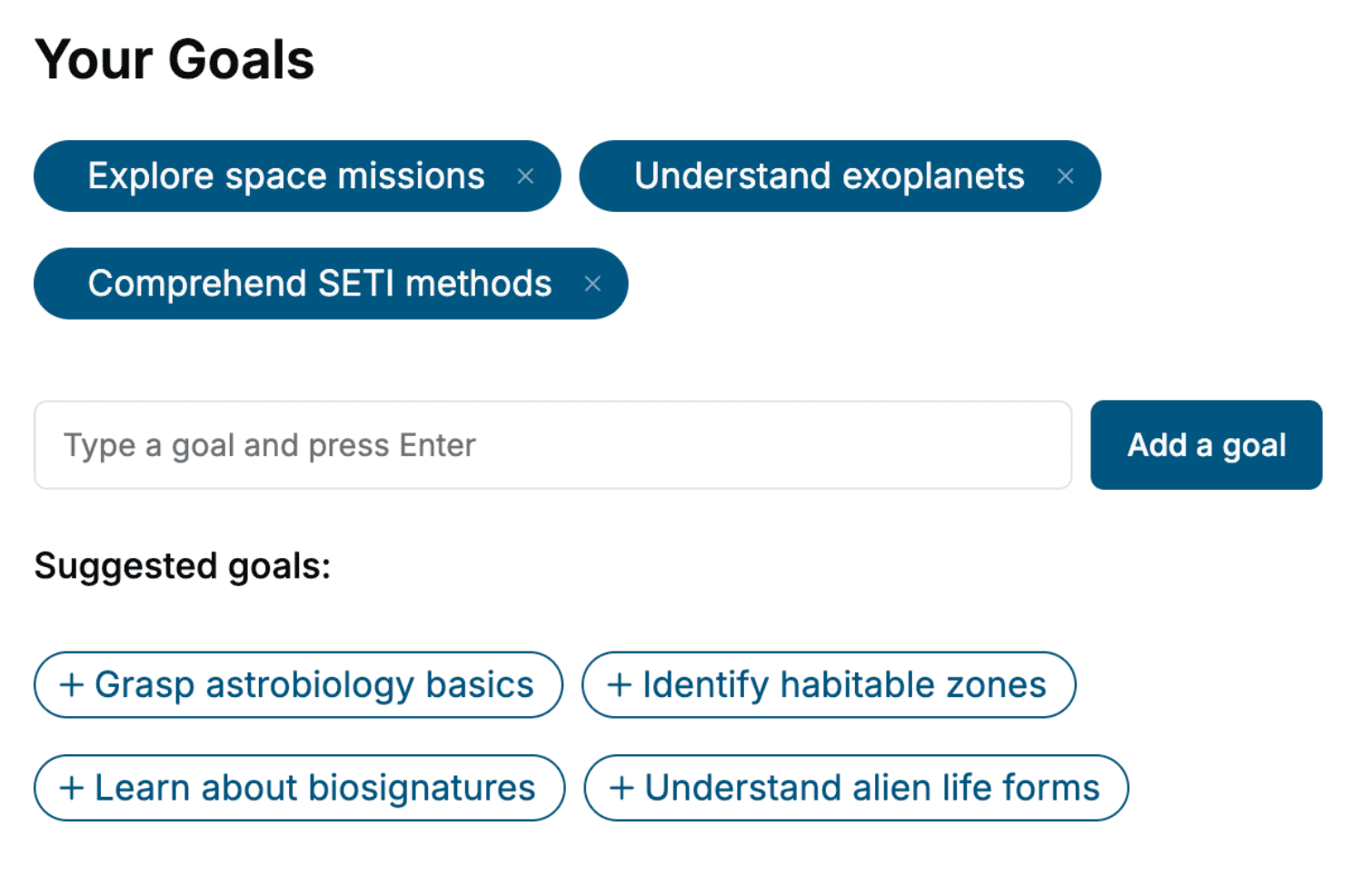
Specify your goals and choose sub-topics to include
- 3. Get your tailored book
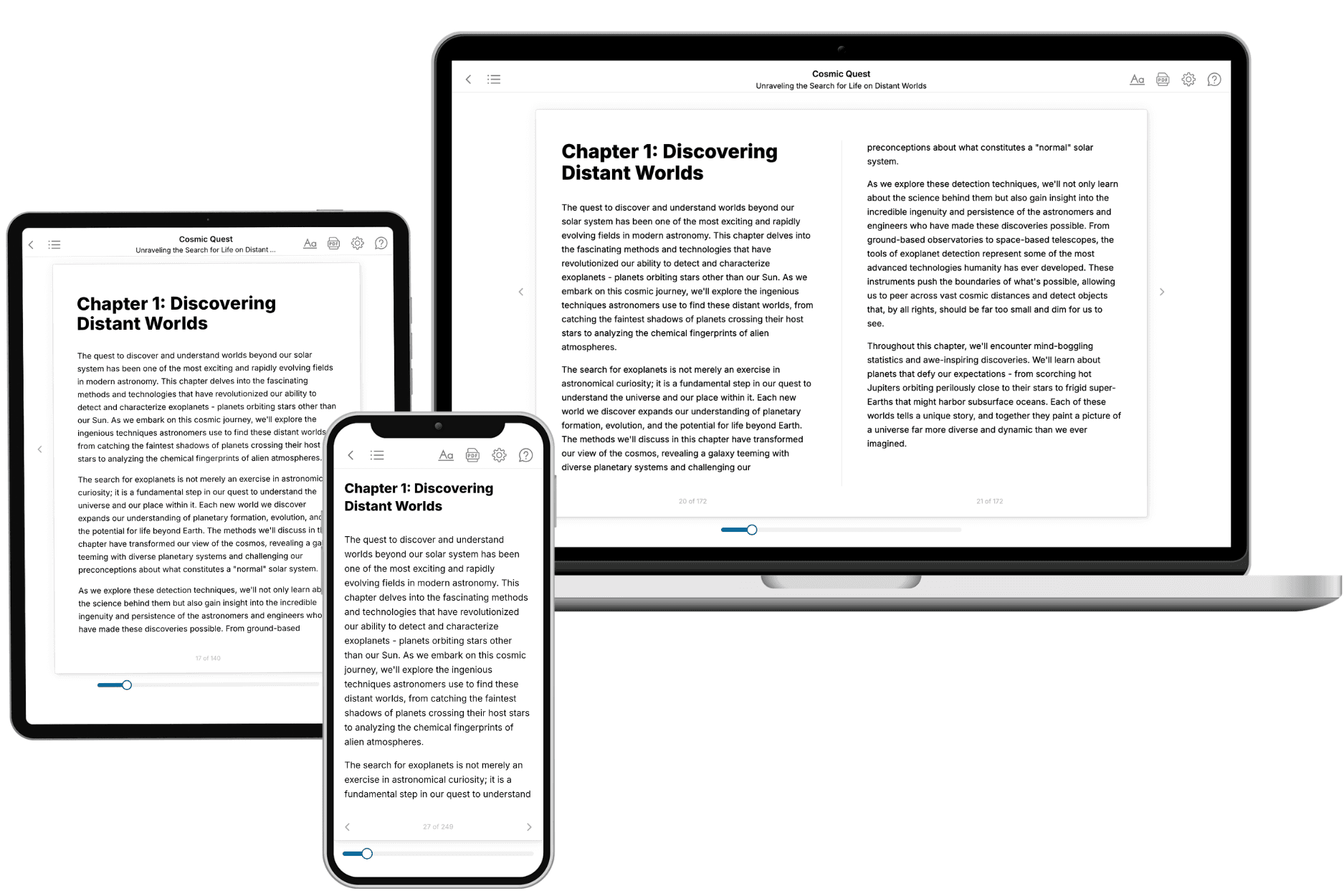
Your book is ready in 10 minutes. Read it online, download as EPUB or PDF, or send to Kindle.

Frequently asked questions
- What is TailoredRead?
TailoredRead creates complete, full-length nonfiction ebooks, written specifically for you. Tell us what you want to learn and why, and TailoredRead writes you a complete ebook on it, with charts, tables, and diagrams throughout. Read it online, on Kindle, or on any e-reader, or download it as a PDF or EPUB. Every book is written fresh the day you order it.
- How is the book tailored to me?
Before anything is written, you answer a few short questions about your goals, your background, and the topics you care about. Your book is then planned around your answers: written at your level, focused on your goals, and covering the topics you chose, instead of the one-size-fits-all book a store sells everyone.
- Will it read like generic AI content?
No. Your book isn't a chat transcript: it's planned chapter by chapter before a single word is written, told in a clear book voice, and explains ideas visually with charts, tables, and diagrams. After writing, every book goes through an editorial pass that polishes chapters so the book reads consistent from start to finish. Judge for yourself: browse thousands of sample books on our Explore Books page.
- How accurate is the content?
Our AI first checks whether your subject needs live research. Niche and fast-moving subjects are researched before writing, and the book plan and chapters are grounded in what it finds. After writing, every book goes through a quality pass that checks its facts and consistency, and researched books list their sources in a Notes section at the back.
- How long is the book?
You choose the length: Comprehensive (250-300 pages), Detailed (150-200 pages), Essential (70-100 pages), or Short (30-50 pages).
- Does the book include visuals?
Yes. Every book includes charts, tables, and diagrams: timelines, checklists, step-by-step guides, decision trees, comparison tables, matrices, and bar charts. A typical book includes dozens of these visual elements.
- Can I read it on Kindle? What formats can I download?
Yes. Every book can be read in our online reader or downloaded as a PDF or EPUB. The EPUB can be opened with Kindle, Apple Books, Kobo, and any e-reader. The Commercial and Author licenses also include an editable Word (DOCX) and Markdown download.
- How much does it cost?
About the price of a regular ebook. The exact price depends on your book's length and complexity, from $2 for the shortest books to $35 for the most comprehensive, and it's shown when you review your book, before you commit to anything. Each book is a one-time purchase, yours to keep, no subscription. Licenses that let you share, teach, or publish your book range from $35.99 to $49.99.
- Can I preview the book before purchasing?
Before you pay, you'll see what your book will cover: the title, a detailed description, the estimated length, and the complete chapter-by-chapter table of contents, so you know what you're getting before you decide. The full text itself is written after you purchase.
- How long does it take to create a book?
About 10 minutes. You can start reading the opening chapters while the rest is still being written.