Algebra in Action
Mastering Operations Research Applications in Elementary Mathematics
You're about to take your mathematical skills to the next level.
284 pages14 chaptersMay 6, 2025Math
About this book
"Algebra in Action" is your gateway to mastering the fascinating world of operations research applications in elementary mathematics. This book bridges the gap between abstract algebraic concepts and real-world problem-solving, providing you with the tools to tackle complex challenges with confidence. Dive into a world where algebra comes alive through practical applications. You'll discover how mathematical models can optimize decision-making, streamline processes, and uncover hidden patterns in data. From supply chain management to resource allocation, you'll see how algebraic thinking drives innovation across industries. Whether you're a student looking to excel in your studies or a professional seeking to enhance your analytical toolkit, "Algebra in Action" offers a clear, engaging approach to operations research. With hands-on examples, step-by-step explanations, and thought-provoking exercises, you'll develop a deeper understanding of how algebra shapes the world around us. Get ready to see mathematics in a whole new light and become a more versatile problem-solver.
Table of contents
- IntroductionWhat is Operations Research?, The Connection Between Operations Research and Elementary Algebra, Overview of the Book, How to Use This BookRead below
- Chapter 1: Foundations of Operations ResearchA Brief History of Operations Research, Key Concepts and Terminology, The Operations Research Process, Algebraic Thinking in Operations Research
- Chapter 2: Problem Formulation and ModelingIdentifying the Problem, Defining Variables and Parameters, Setting Objectives and Constraints, Creating a Mathematical Model, Model Validation and Refinement
- Chapter 3: Linear Programming: The Cornerstone of ORIntroduction to Linear Programming, Graphical Method for Two Variables, The Simplex Method, Sensitivity Analysis, Duality Theory
- Chapter 4: Integer and Mixed-Integer ProgrammingIntroduction to Integer Programming, Branch and Bound Method, Cutting Plane Techniques, Applications of Mixed-Integer Programming
- Chapter 5: Network Models and Graph TheoryBasics of Graph Theory, Shortest Path Problems, Maximum Flow Problems, Minimum Spanning Tree, Real-world Applications of Network Models
- Chapter 6: Dynamic ProgrammingPrinciples of Dynamic Programming, Formulating Recursive Equations, Forward and Backward Induction, Applications in Resource Allocation and Scheduling
- Chapter 7: Queuing Theory and AnalysisBasic Concepts of Queuing Systems, Markov Chains in Queuing, M/M/1 and M/M/k Queuing Models, Optimizing Queuing Systems
- Chapter 8: Inventory Models and Supply Chain OptimizationEconomic Order Quantity (EOQ) Model, Inventory Costs and Trade-offs, Dealing with Stochastic Demand, Multi-echelon Inventory Systems, OR in Supply Chain Management
- Chapter 9: Simulation ModelingBasic Concepts of Simulation, Monte Carlo Simulation, Discrete-Event Simulation, Analysis of Simulation Output, Applications of Simulation in OR
- Chapter 10: Decision Analysis and Game TheoryDecision Trees and Expected Value, Utility Theory and Risk Attitudes, Introduction to Game Theory, Nash Equilibrium and Strategic Decisions
- Chapter 11: Nonlinear ProgrammingIntroduction to Nonlinear Programming, Unconstrained Optimization, Constrained Optimization, Karush-Kuhn-Tucker Conditions
- Chapter 12: Metaheuristics and Combinatorial OptimizationIntroduction to Heuristics and Metaheuristics, Genetic Algorithms, Simulated Annealing, Tabu Search, Solving Combinatorial Optimization Problems
- Chapter 13: Data Analysis and Statistical Methods in ORDescriptive Statistics for OR, Hypothesis Testing in OR Models, Regression Analysis for Prediction, Time Series Analysis and Forecasting
- Chapter 14: Real-World Applications of Operations ResearchOR in Manufacturing and Production, OR in Logistics and Transportation, OR in Healthcare Systems, OR in Energy and Sustainability, Emerging Fields and Future Directions
- Conclusion
- Glossary
- Further Reading
Introduction
Welcome to the fascinating world of Operations Research (OR) and its profound connection to elementary algebra. As you embark on this journey through "Algebra in Action: Mastering Operations Research Applications in Elementary Mathematics," you're about to discover how the mathematical foundations you've built can be leveraged to solve complex, real-world problems. This introduction will set the stage for your exploration, providing you with a clear understanding of what Operations Research is, how it relates to the algebra you already know, and how this book will guide you through its practical applications.
Operations Research is a discipline that has revolutionized decision-making processes across industries, from manufacturing and logistics to healthcare and finance. It combines mathematical modeling, statistical analysis, and optimization techniques to help organizations make better decisions and improve their operations. As you delve deeper into this field, you'll find that the algebraic concepts you've learned are not just abstract ideas, but powerful tools that can be applied to tackle some of the most challenging problems facing businesses and society today.
Throughout this book, you'll encounter a variety of OR techniques and applications, all of which are grounded in the fundamental principles of algebra. You'll see how linear equations can be used to optimize resource allocation, how matrices can represent complex networks, and how functions can model real-world phenomena. By connecting these algebraic concepts to practical scenarios, you'll gain a deeper appreciation for the power of mathematics and develop valuable problem-solving skills that extend far beyond the classroom.
Whether you're a student looking to expand your mathematical horizons, a professional seeking to enhance your analytical toolkit, or simply someone curious about how mathematics shapes the world around us, this book is designed to meet you where you are and take you further. We'll start with the basics and gradually build up to more advanced topics, always keeping the focus on practical applications and real-world relevance.
So, prepare to see algebra in a new light. As we explore the principles and applications of Operations Research, you'll discover how the equations and techniques you've learned can be powerful allies in making informed decisions, optimizing processes, and solving complex problems. Let's begin this exciting journey into the world where algebra truly comes to life.
What is Operations Research?
Operations Research, often abbreviated as OR, is a multidisciplinary field that employs advanced analytical methods to help make better decisions. At its core, OR is about using mathematical and scientific approaches to solve complex problems in the real world. It's a discipline that bridges the gap between theoretical mathematics and practical problem-solving, providing a systematic and analytical approach to decision-making in various organizational contexts.
The origins of Operations Research can be traced back to World War II, when scientists were called upon to solve strategic and tactical problems. Military planners needed to optimize the use of limited resources, such as determining the most effective way to deploy radar stations or coordinate convoy movements. The success of these early applications led to the recognition of OR as a distinct field, and its methods quickly spread to civilian sectors after the war.
Today, Operations Research encompasses a wide range of techniques and methodologies. These include linear programming, network analysis, queuing theory, simulation modeling, and many others. What ties these diverse approaches together is their common goal: to use quantitative methods to find optimal or near-optimal solutions to complex problems. OR practitioners often work with large datasets, sophisticated computer models, and advanced algorithms to analyze situations and recommend courses of action.
One of the key characteristics of Operations Research is its focus on the entire system rather than individual components. OR analysts look at how different parts of an organization or process interact, seeking to optimize the overall performance rather than maximizing the efficiency of any single element. This holistic approach allows OR to tackle problems that might seem intractable when viewed in isolation.
Another important aspect of OR is its emphasis on mathematical modeling. OR practitioners translate real-world situations into mathematical models that can be analyzed and manipulated. These models allow for the exploration of different scenarios and the prediction of outcomes based on various inputs. The ability to create and work with these models is where your foundation in algebra becomes particularly valuable.
Operations Research is applied across a vast array of industries and sectors. In manufacturing, OR techniques are used to optimize production schedules and minimize waste. In transportation and logistics, OR helps design efficient routing systems and manage supply chains. Healthcare organizations use OR to improve patient flow and resource allocation. Financial institutions employ OR methods for portfolio optimization and risk management. Even in fields like environmental science and urban planning, OR plays a crucial role in decision-making processes.
The power of Operations Research lies in its ability to provide insights and solutions that might not be apparent through intuition or experience alone. By applying rigorous mathematical analysis to complex problems, OR can reveal unexpected efficiencies, highlight hidden bottlenecks, and suggest innovative approaches to longstanding challenges. This is why OR practitioners are often referred to as "management scientists" or "decision engineers" – they bring a scientific approach to the art of decision-making.
As you progress through this book, you'll discover that Operations Research is not just about crunching numbers or solving equations. It's about developing a mindset that combines analytical rigor with creative problem-solving. You'll learn to look at problems from multiple angles, to question assumptions, and to seek out data-driven solutions. These skills are invaluable in today's complex and rapidly changing world, where organizations of all types face unprecedented challenges and opportunities.
Moreover, the field of Operations Research is continually evolving. Advances in computing power, data analytics, and artificial intelligence are opening up new possibilities for OR applications. Machine learning algorithms are being integrated into traditional OR techniques, creating hybrid approaches that can handle even larger and more complex problems. As you delve into the world of OR, you'll be entering a dynamic and exciting field that continues to push the boundaries of what's possible in decision science.
In essence, Operations Research is about making better decisions through the application of mathematical and analytical techniques. It's a field that combines the precision of mathematics with the practicality of real-world problem-solving. As we explore the various aspects of OR in the coming chapters, you'll gain not just knowledge, but a powerful set of tools that can be applied to a wide range of challenges in your academic, professional, and personal life.
The Connection Between Operations Research and Elementary Algebra
The relationship between Operations Research and elementary algebra is both fundamental and profound. While OR encompasses a wide range of advanced mathematical techniques, its foundations are firmly rooted in the basic algebraic concepts that you've likely encountered in your earlier mathematical studies. Understanding this connection is crucial, as it allows you to see how the algebraic skills you've developed can be applied to solve complex, real-world problems.
At its core, algebra is about representing relationships between quantities using symbols and equations. This is precisely what Operations Research does on a larger scale. When an OR practitioner models a real-world situation, they are essentially creating a sophisticated algebraic representation of that situation. The variables in these models might represent quantities of products, allocation of resources, or even abstract concepts like customer satisfaction. The equations and inequalities that make up the model describe the relationships and constraints within the system being studied.
One of the most direct connections between OR and elementary algebra can be seen in linear programming, a cornerstone technique of Operations Research. Linear programming problems involve optimizing a linear objective function subject to linear constraints. If you've worked with systems of linear equations or inequalities, you already have the foundational knowledge to understand these models. The key difference is that in OR, these systems are often much larger and more complex, involving dozens or even hundreds of variables and constraints.
Consider, for example, a simple algebraic problem of solving two equations with two unknowns. In OR, this concept is expanded to solving systems with numerous equations and unknowns, often using matrix algebra. The basic principles remain the same, but the scale and complexity increase dramatically. This is where computer algorithms come into play, allowing us to solve problems that would be impractical or impossible to tackle by hand.
Another important algebraic concept that finds extensive application in OR is that of functions. In elementary algebra, you learn to work with functions, understand their behavior, and find their maxima and minima. In Operations Research, optimization problems often involve finding the maximum or minimum value of a function subject to certain constraints. The techniques you learn for analyzing functions in algebra form the basis for more advanced optimization methods used in OR.
Graphical methods, which you might have used to solve simple linear programming problems in algebra class, are also fundamental to understanding more complex OR techniques. While real-world problems often involve too many dimensions to be solved graphically, the intuition gained from working with two-dimensional graphs is invaluable when dealing with higher-dimensional problems.
The concept of variables, so central to algebra, takes on new significance in Operations Research. In OR models, variables often represent decision points – quantities that can be controlled or adjusted to achieve a desired outcome. Understanding how to work with variables, how they interact within equations, and how changing their values affects the overall system is crucial in OR, just as it is in algebra.
Inequalities, another key topic in elementary algebra, play a vital role in OR. Many real-world constraints are naturally expressed as inequalities. For instance, a production constraint might state that the number of items produced cannot exceed the available raw materials. The skills you've developed in working with inequalities directly translate to formulating and understanding these constraints in OR models.
Even basic algebraic operations like addition, subtraction, multiplication, and division are fundamental to OR calculations. These operations are used constantly in developing and manipulating models, calculating results, and interpreting outcomes. The comfort and fluency you've developed with these operations in your algebra studies will serve you well as you delve into more complex OR techniques.
Moreover, the logical thinking and problem-solving skills that algebra helps develop are invaluable in Operations Research. The ability to translate word problems into mathematical equations, a skill honed in algebra classes, is directly applicable to the process of creating mathematical models in OR. The systematic approach to problem-solving that algebra teaches – identifying knowns and unknowns, establishing relationships, and working step-by-step towards a solution – is precisely the approach used in tackling complex OR problems.
As you progress through this book, you'll see how these algebraic foundations are built upon and extended in the context of Operations Research. You'll encounter new concepts and techniques, but you'll find that they all have their roots in the algebraic principles you're already familiar with. This connection not only makes OR more accessible but also reinforces and expands your understanding of algebra itself.
Understanding the link between OR and algebra also highlights the practical relevance of mathematical skills. It shows how the abstract concepts learned in math class can be powerful tools for solving real-world problems. This realization can be both motivating and enlightening, providing a new perspective on the value of mathematical education.
In essence, Operations Research can be seen as applied algebra on a grand scale. It takes the fundamental concepts and techniques of algebra and extends them to address complex, multifaceted problems in business, industry, and beyond. By recognizing and understanding this connection, you're well-positioned to leverage your algebraic knowledge as you explore the fascinating world of Operations Research.
Overview of the Book
"Algebra in Action: Mastering Operations Research Applications in Elementary Mathematics" is designed to take you on a comprehensive journey through the world of Operations Research, building on your foundation in elementary algebra. This book is structured to provide a logical progression from basic concepts to more advanced applications, always keeping the focus on practical problem-solving and real-world relevance. Let's take a closer look at what you can expect from each chapter and how they fit together to give you a thorough understanding of OR.
We begin with the "Foundations of Operations Research" in Chapter 1. This chapter sets the stage by providing a historical context for OR, introducing key concepts and terminology, and outlining the OR process. It also emphasizes how algebraic thinking is fundamental to OR, helping you see the connections between what you already know and what you're about to learn. This foundation is crucial for understanding the more complex topics that follow.
Chapter 2, "Problem Formulation and Modeling," is where you'll start to apply your algebraic skills to real OR problems. You'll learn how to identify problems suitable for OR analysis, define variables and parameters, set objectives and constraints, and create mathematical models. This chapter is essential as it teaches you how to translate real-world situations into mathematical language, a skill that's at the heart of OR.
Linear Programming, covered in Chapter 3, is often considered the cornerstone of OR. Here, you'll delve deep into this powerful technique, learning about graphical solutions, the simplex method, sensitivity analysis, and duality theory. This chapter heavily relies on your knowledge of linear equations and inequalities, extending these concepts to solve complex optimization problems.
Chapters 4 and 5 build on linear programming, introducing Integer Programming and Network Models respectively. These chapters show how discrete variables and graph theory can be incorporated into OR models, opening up a wide range of new applications. The network models, in particular, demonstrate how algebraic concepts can be applied to problems involving flows, paths, and connections.
Dynamic Programming, covered in Chapter 6, introduces you to a powerful method for solving problems by breaking them down into simpler subproblems. This technique, which has its roots in the principle of mathematical induction, shows how complex decisions can be optimized over time.
Chapters 7 and 8 focus on specific application areas: Queuing Theory and Inventory Models. These chapters demonstrate how OR techniques can be applied to manage waiting lines and optimize inventory levels, respectively. You'll see how algebraic formulas and probability theory combine to model and analyze these common business scenarios.
Simulation Modeling, covered in Chapter 9, introduces you to techniques for modeling complex systems that may be too difficult to represent with exact mathematical formulas. This chapter shows how computers can be used to simulate real-world processes, allowing for the analysis of systems too complex for traditional algebraic approaches.
Chapter 10 on Decision Analysis and Game Theory brings in elements of probability and strategic thinking. Here, you'll see how algebraic concepts can be applied to decision-making under uncertainty and in competitive situations.
Nonlinear Programming, covered in Chapter 11, extends the optimization techniques you've learned to handle nonlinear relationships. This chapter builds on your understanding of functions and calculus, showing how these concepts apply to more complex optimization problems.
Chapter 12 introduces Metaheuristics and Combinatorial Optimization, showing how OR deals with problems that are too complex for exact solutions. You'll learn about algorithms inspired by natural processes and how they can be used to find good solutions to extremely difficult problems.
Data Analysis and Statistical Methods in OR are covered in Chapter 13, emphasizing the importance of understanding and interpreting data in the context of OR models. This chapter connects statistical concepts with the OR techniques you've learned, showing how data analysis is crucial for effective decision-making.
Finally, Chapter 14 brings everything together by exploring Real-World Applications of Operations Research across various industries. This chapter demonstrates the wide-ranging impact of OR and gives you a glimpse into potential career paths and future developments in the field.
Throughout the book, you'll find numerous examples, case studies, and exercises that help reinforce the concepts and show their practical applications. Each chapter builds on the previous ones, gradually increasing in complexity while always maintaining a clear connection to the foundational algebraic concepts.
By the end of this book, you'll have gained not just knowledge of OR techniques, but also a new perspective on how to apply mathematical thinking to solve real-world problems. You'll see algebra not just as a set of rules and procedures, but as a powerful tool for analysis and decision-making in complex situations.
How to Use This Book
To get the most out of "Algebra in Action: Mastering Operations Research Applications in Elementary Mathematics," it's important to approach the material with a strategic and engaged mindset. This book is designed to be more than just a passive reading experience; it's a comprehensive guide that requires active participation to fully grasp and apply the concepts of Operations Research. Here are some key strategies and tips to help you maximize your learning and enjoyment as you work through this book.
First and foremost, approach each chapter with an open and curious mind. Operations Research is a field that often challenges conventional thinking and requires creative problem-solving. As you read, try to connect the concepts to your own experiences or to problems you've encountered in your studies or work. This mental engagement will help make the material more relevant and memorable.
Take advantage of the book's structure. Each chapter builds on the previous ones, so it's best to work through the book sequentially. However, if you're already familiar with certain topics, you can use the table of contents to focus on areas that are new to you. The introductions to each chapter provide an overview of what you'll learn, so use these to set your expectations and focus your attention on key concepts.
As you read, pay special attention to the examples and case studies provided. These are not just illustrations; they're carefully chosen to demonstrate how OR concepts are applied in real-world situations. Try to work through these examples on your own before looking at the solutions. This active problem-solving will help reinforce your understanding and develop your analytical skills.
Don't skip over the mathematical formulas and equations. While they might look intimidating at first, they're essential to understanding OR techniques. Take the time to understand what each symbol represents and how the equations relate to the problems being solved. If you encounter difficulty, revisit the relevant algebraic concepts or seek additional resources to clarify your understanding.
Make use of the exercises provided at the end of each chapter. These are designed to test your understanding and give you practice in applying the concepts. Try to solve these problems without looking at the solutions first. If you get stuck, review the relevant sections of the chapter before attempting the problem again. Remember, struggling with a problem can often lead to deeper understanding once you've worked through it.
Take notes as you read. Summarize key concepts in your own words, jot down questions that arise, and make connections to other topics you've studied. This active note-taking will help reinforce your learning and create a valuable resource for future review. Consider creating your own examples or scenarios where OR techniques could be applied – this creative exercise can deepen your understanding and help you see the broader applicability of the concepts.
Don't hesitate to use additional resources. While this book is comprehensive, you might find it helpful to supplement your learning with online tutorials, video lectures, or other textbooks, especially for topics you find challenging. The "Further Reading" section at the end of the book provides suggestions for additional materials that can expand your understanding of specific topics.
If possible, try to apply the concepts you're learning to real problems in your work or studies. Look for opportunities to use OR techniques in your own projects or to analyze situations you encounter. This practical application will not only reinforce your learning but also demonstrate the real-world value of these techniques.
Engage with others who are studying Operations Research or working in related fields. Discussing concepts, sharing problem-solving approaches, and explaining ideas to others can significantly enhance your understanding. Consider joining online forums, study groups, or professional associations related to OR.
Be patient with yourself, especially when tackling more complex topics. Operations Research involves sophisticated concepts that may take time to fully grasp. If you find a particular section challenging, take breaks, review prerequisite material, and return to it with a fresh perspective. Remember that struggling with difficult concepts is a normal and valuable part of the learning process.
Make use of the glossary at the end of the book. OR, like many technical fields, has its own vocabulary. Familiarizing yourself with these terms will make it easier to understand the material and communicate about OR concepts with others.
Finally, remember that mastering Operations Research is an ongoing process. This book provides a solid foundation, but the field is vast and constantly evolving. Use this book as a springboard for further exploration and learning in areas that particularly interest you.
By actively engaging with the material, practicing problem-solving, and seeking to apply the concepts in real-world contexts, you'll not only gain a deep understanding of Operations Research but also develop valuable analytical skills that can be applied across many areas of study and work. Approach this book not just as a text to be read, but as a guide to developing a new way of thinking about and solving complex problems.
This is the end of the free sample. The full book has 14 chapters.
Want this book written for you?
Tell us your goals and background, and get your own version of this book, tailored by AI to you.


Benefits of AI-tailored books
- Read one book, not ten:
- all the Math knowledge you need, gathered into a single book.
- Save days of learning:
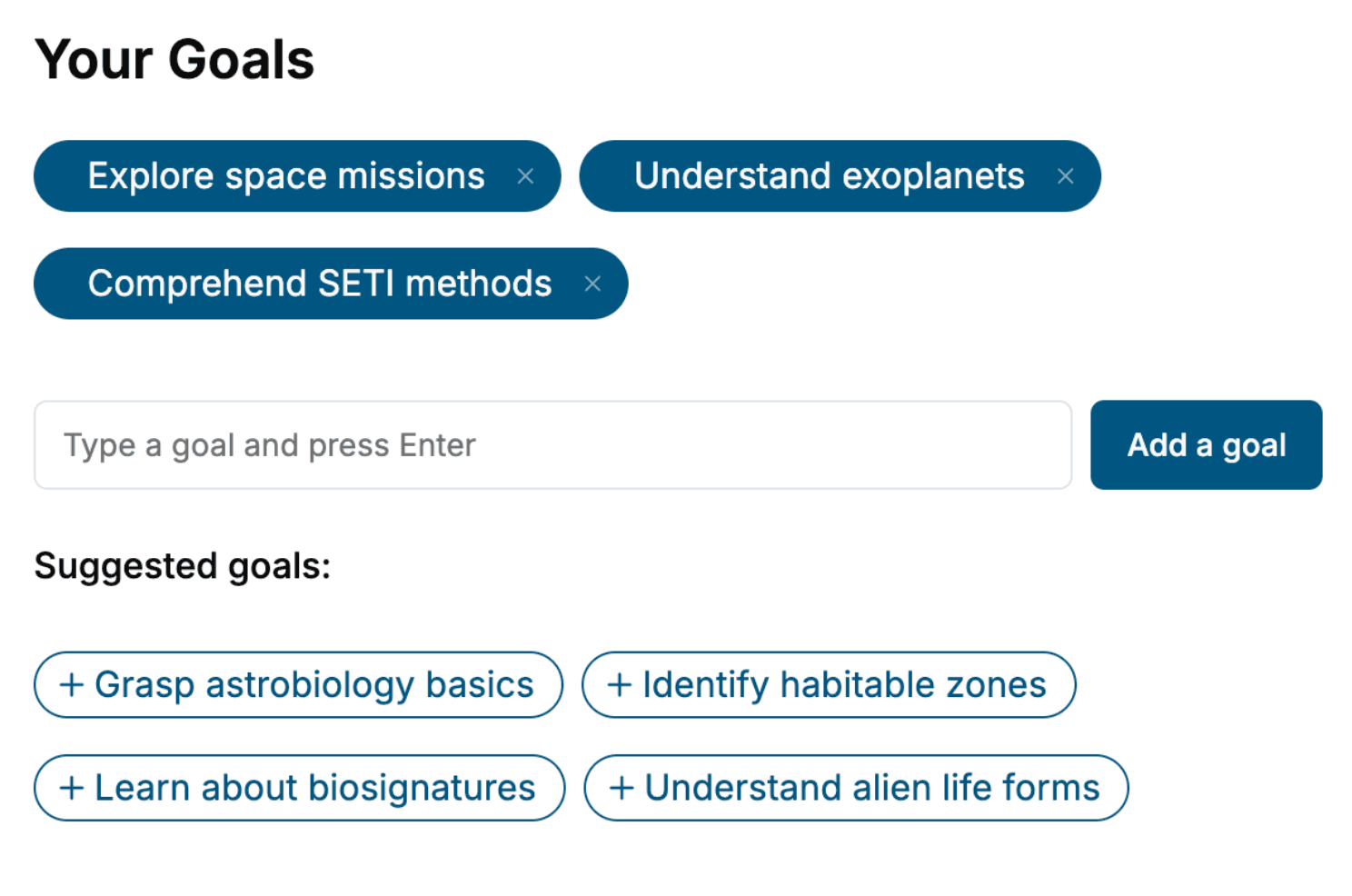
- tell us your goals, choose your topics, and the whole book is built around them.
- Learn effortlessly:
- Math book written for your specific background and expertise.
- Understand at a glance:
- includes charts, tables, timelines, checklists, decision trees, and more.
- Stay current:
- written the day you order it, not years ago.
- Trust what you read:
- every book is checked for accuracy, with real research when your subject needs it.
Create your unique book in 3 steps
- 1. Select your focus
Select the focus of your Math book and share your background
- 2. Personalize your book
Specify your goals and choose sub-topics to include
- 3. Get your tailored book
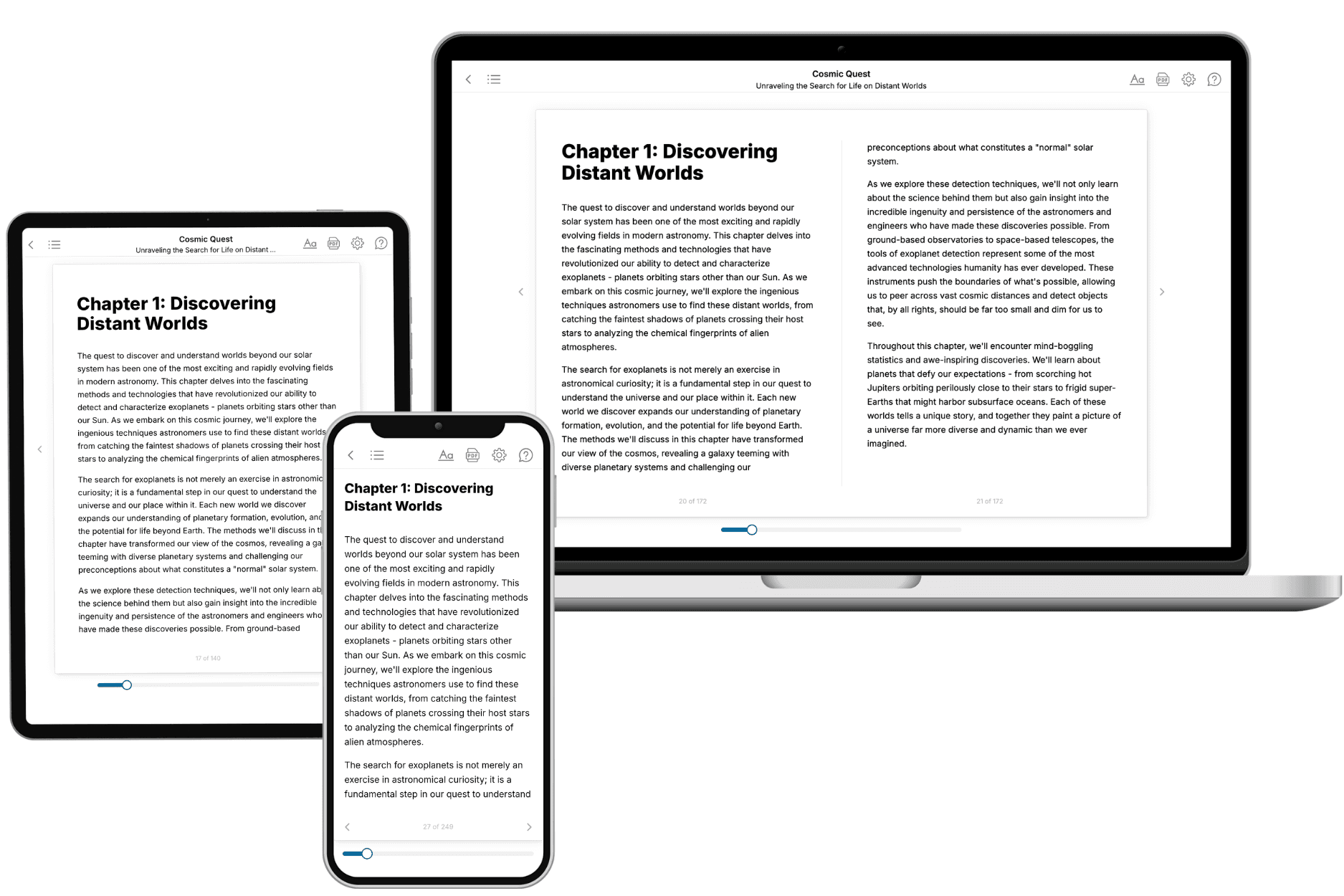
Your book is ready in 10 minutes. Read it online, download as EPUB or PDF, or send to Kindle.

Frequently asked questions
- What is TailoredRead?
TailoredRead creates complete, full-length nonfiction ebooks, written specifically for you. Tell us what you want to learn and why, and TailoredRead writes you a complete ebook on it, with charts, tables, and diagrams throughout. Read it online, on Kindle, or on any e-reader, or download it as a PDF or EPUB. Every book is written fresh the day you order it.
- How is the book tailored to me?
Before anything is written, you answer a few short questions about your goals, your background, and the topics you care about. Your book is then planned around your answers: written at your level, focused on your goals, and covering the topics you chose, instead of the one-size-fits-all book a store sells everyone.
- Will it read like generic AI content?
No. Your book isn't a chat transcript: it's planned chapter by chapter before a single word is written, told in a clear book voice, and explains ideas visually with charts, tables, and diagrams. After writing, every book goes through an editorial pass that polishes chapters so the book reads consistent from start to finish. Judge for yourself: browse thousands of sample books on our Explore Books page.
- How accurate is the content?
Our AI first checks whether your subject needs live research. Niche and fast-moving subjects are researched before writing, and the book plan and chapters are grounded in what it finds. After writing, every book goes through a quality pass that checks its facts and consistency, and researched books list their sources in a Notes section at the back.
- How long is the book?
You choose the length: Comprehensive (250-300 pages), Detailed (150-200 pages), Essential (70-100 pages), or Short (30-50 pages).
- Does the book include visuals?
Yes. Every book includes visual elements such as timelines, checklists, step-by-step guides, decision trees, comparison tables, and matrices, and many include bar charts. A typical book includes dozens of these visual elements.
- Can I read it on Kindle? What formats can I download?
Yes. Every book can be read in our online reader or downloaded as a PDF or EPUB. The EPUB can be opened with Kindle, Apple Books, Kobo, and any e-reader. The Commercial and Author licenses also include an editable Word (DOCX) and Markdown download.
- How much does it cost?
About the price of a regular ebook. The exact price depends on your book's length and complexity, from $2 for the shortest books to $35 for the most comprehensive, and it's shown when you review your book, before you commit to anything. Each book is a one-time purchase, yours to keep, no subscription. Licenses that let you share, teach, or publish your book range from $35.99 to $49.99.
- Can I preview the book before purchasing?
Before you pay, you'll see what your book will cover: the title, a detailed description, the estimated length, and the complete chapter-by-chapter table of contents, so you know what you're getting before you decide. The full text itself is written after you purchase.
- How long does it take to create a book?
About 10 minutes. You can start reading the opening chapters while the rest is still being written.