Asteroid Impact Simulation
Understanding Planetary Defense Through Computational Modeling
The possibility of an asteroid striking Earth can feel distant and abstract—until you understand the science behind it.
207 pages9 chaptersMay 28, 2026Asteroid Impact Theory
About this book
Most people don't realize that scientists can now simulate asteroid impacts with remarkable precision, predicting everything from crater size to global climate effects. This book demystifies the computational models and physics that drive these simulations, showing you how researchers assess planetary threats and develop defense strategies. You'll explore the fundamental principles of impact physics, learn how scientists gather data from past impacts and meteorite samples, and discover the cutting-edge simulation tools transforming planetary defense. Whether you're curious about how NASA prepares for potential threats or want to understand the science behind catastrophic events, this guide provides clear, practical insights into one of astronomy's most critical applications. Gain the knowledge to appreciate both the risks and the remarkable human ingenuity working to protect our planet.
Table of contents
- IntroductionWhy Impact Simulation Matters, What You'll Learn in This Book, How to Use This GuideRead below
- Chapter 1: Asteroid FundamentalsTypes of Asteroids and Their Characteristics, Understanding Asteroid Orbits and Trajectories, Near-Earth Objects: The Potential Threats
- Chapter 2: The Physics of ImpactCollision Mechanics and Energy Transfer, How Craters Form: From Impact to Excavation, Shock Waves and Material Deformation, Thermal Effects and Vaporization
- Chapter 3: Simulation Tools and TechnologiesComputational Methods in Impact Modeling, Major Simulation Software and Platforms, Essential Data Inputs for Accurate Simulations
- Chapter 4: Building and Running Impact ModelsDesigning Impact Scenarios, Selecting Parameters: Size, Speed, and Angle, Running Simulations and Interpreting Results, Validating Simulations Against Real Data
- Chapter 5: Environmental and Climate ConsequencesAtmospheric Disruption and Dust Clouds, Climate Effects and Long-Term Consequences, Ecosystem Disruption and Biological Effects
- Chapter 6: Learning from Past ImpactsThe Chicxulub Impact: Earth's Most Famous Collision, Recent Impacts and Modern Observations, Reading the Evidence: Craters and Geological Records
- Chapter 7: Planetary Defense StrategiesDetection and Tracking Systems, Deflection Methods and Their Simulated Effectiveness, Mitigation Planning and Response Protocols
- Chapter 8: Risk Assessment and ProbabilityCalculating Impact Probability and Frequency, Risk Scales: Torino Scale and Palermo Scale, Modeling Consequences and Societal Impact
- Chapter 9: The Future of Impact SimulationEmerging Technologies and Advanced Modeling, International Collaboration and Research Initiatives, Next-Generation Simulation Capabilities
- ConclusionKey Takeaways and What Comes Next
- Glossary of Terms
- Further Reading and Resources
Introduction
On February 15, 2013, a rock roughly the size of a six-story building screamed through Earth's atmosphere at about 19 kilometers per second. It exploded over Chelyabinsk, Russia, releasing energy equivalent to roughly 30 times the atomic bomb dropped on Hiroshima. The shockwave shattered windows across six cities, injured more than 1,500 people, and sent scientists scrambling to understand what had just happened. The remarkable part? Nobody saw it coming. No telescope had tracked it. No warning system had flagged it. And no simulation had predicted its arrival.[1]
That event changed the conversation around planetary defense in a fundamental way. It demonstrated, with uncomfortable clarity, that asteroid impacts are not just theoretical concerns reserved for science fiction films or distant geological history. They are real, they can happen without warning, and even a relatively modest-sized object can cause serious regional damage. The Chelyabinsk event also highlighted something else: the urgent need for better detection, better tracking, and above all, better simulation tools that can help scientists understand what happens when space rocks meet Earth.
This is where impact simulation enters the picture. Over the past few decades, scientists have developed increasingly sophisticated computational models that can predict, with remarkable accuracy, what happens when an asteroid collides with our planet. These simulations draw on physics, astronomy, geology, atmospheric science, and high-performance computing to reconstruct past impacts and forecast future ones. They can estimate crater dimensions, calculate energy release, model atmospheric shockwaves, and even project long-term climate consequences. In short, they give humanity a window into events that are too large, too fast, and too destructive to study any other way.
This book is designed to open that window for you. Whether you are a student of astronomy, a science enthusiast, or someone who simply wants to understand how scientists prepare for one of nature's most extreme events, the chapters ahead will walk you through the science, the tools, and the strategies that define modern planetary defense. The goal is not to alarm you, but to inform you. Understanding the science behind asteroid impacts is the first step toward appreciating both the genuine risks and the remarkable human ingenuity working to address them.
Why Impact Simulation Matters
At its core, impact simulation is about turning an uncontrollable natural event into something scientists can study, measure, and plan around. You cannot run a controlled experiment with a real asteroid. You cannot set up instruments at the exact moment of impact and collect clean data under laboratory conditions. What you can do is build a detailed mathematical model of the event, feed it the best available data, and let powerful computers work through the physics. The results tell you things that no telescope or field survey ever could.
Consider what a simulation can reveal about a single impact scenario. Given an asteroid's estimated size, composition, speed, and approach angle, a well-constructed model can predict:
- The total kinetic energy released at the moment of impact
- The diameter and depth of the resulting crater
- The intensity and reach of the shockwave traveling through the ground
- The volume of material ejected into the atmosphere
- The geographic spread of thermal radiation and fires
- The potential for tsunamis if the impact occurs in an ocean
- The long-term effects on global temperature and agriculture
Each of these outputs has direct implications for emergency planning, evacuation decisions, and international policy. When NASA or the European Space Agency assesses a newly discovered near-Earth object, simulations are not a supplementary tool. They are central to the entire risk assessment process. Without them, scientists would be left guessing at consequences that could affect millions of people.
Impact simulations also serve a critical historical function. Many of Earth's most significant geological features are the scars of ancient collisions. The Chicxulub crater buried beneath Mexico's Yucatán Peninsula, for example, is roughly 180 kilometers wide and was formed approximately 66 million years ago by an asteroid estimated at 10 to 15 kilometers in diameter. That impact is widely credited with triggering the mass extinction that wiped out the non-avian dinosaurs.[2] By simulating that event using modern tools, scientists can reconstruct the sequence of destruction and understand how a single collision reshaped life on Earth.
Beyond historical reconstruction, simulations play a forward-looking role in planetary defense planning. When scientists evaluate deflection strategies, such as nudging an asteroid off course using a kinetic impactor or a gravity tractor, they rely entirely on simulations to test whether those strategies would work. The DART mission, which successfully redirected the asteroid Dimorphos in September 2022, was preceded by years of simulation work that predicted how the spacecraft's impact would alter the asteroid's orbit.[3] The simulations were not just background science. They were the foundation of the entire mission design.
There is also a public communication dimension to impact simulation that often goes unappreciated. When scientists can show policymakers and the public a clear, data-driven picture of what a specific impact scenario would look like, it transforms abstract risk into something concrete and actionable. Simulations have been used to brief government agencies, inform international treaties on planetary defense, and guide the development of early warning systems. In this sense, the models are not just scientific tools. They are instruments of preparedness and policy.
Finally, impact simulation matters because it sits at the intersection of multiple scientific disciplines in a way that pushes all of them forward. Building an accurate impact model requires advances in computational fluid dynamics, materials science, atmospheric physics, and orbital mechanics. The challenges of simulating a hypervelocity collision at scales ranging from microscopic material deformation to global climate disruption have driven innovations that benefit science far beyond planetary defense. Understanding why simulation matters is, in many ways, understanding why interdisciplinary science matters.
What You'll Learn in This Book
This book is organized to take you from foundational concepts to advanced applications in a logical, progressive sequence. Each chapter builds on the one before it, so by the time you reach the later sections on planetary defense strategies and risk assessment, you will have the background needed to understand why those strategies work and what the simulations behind them actually show.
The journey begins with asteroid fundamentals. Before you can simulate an impact, you need to understand what asteroids are, how they differ from one another, and why some pose greater risks than others. Chapter 1 covers the major types of asteroids, from rocky S-type bodies to carbon-rich C-types and metallic M-types, and explains how their composition affects what happens when they hit. You will also learn how asteroid orbits are classified and why certain orbital families bring objects into Earth's neighborhood more frequently than others.
From there, the book moves into impact physics, which is the scientific heart of everything that follows. Chapter 2 explains the mechanics of a hypervelocity collision in clear, accessible terms. You will learn how kinetic energy scales with mass and velocity, why impact angle matters so much, and how the ground responds to pressures that exceed anything in ordinary engineering experience. This chapter also covers crater formation, shockwave propagation, and the thermal effects that can ignite fires hundreds of kilometers from the impact point.
Chapter 3 introduces the simulation tools and technologies that scientists actually use. This includes an overview of the major computational methods, such as smoothed-particle hydrodynamics and finite element analysis, as well as the specific software platforms that have become standard in the field. You will learn what data inputs are required to run a meaningful simulation and where scientists obtain that data, from meteorite samples and geological surveys to radar observations and spacecraft missions.
Chapters 4 and 5 take you through the practical process of building and running impact models and then interpreting their environmental outputs. You will see how scientists design scenarios, select parameters, and validate their results against real-world evidence. The environmental consequences chapter covers atmospheric disruption, climate effects, and ecosystem damage in detail, giving you a clear picture of how a single impact can cascade into a global crisis.
Chapter 6 grounds all of this in historical reality by examining what past impacts have taught scientists. The Chicxulub event receives detailed attention, but the chapter also covers more recent events like the Tunguska explosion of 1908 and the Chelyabinsk meteor of 2013. These case studies show how real-world evidence is used to calibrate and validate simulation models, creating a feedback loop between observation and computation.
The final chapters address planetary defense, risk assessment, and the future of the field. You will learn how detection systems work, what deflection methods are currently being developed, and how scientists calculate the probability and potential consequences of future impacts. The book closes with a look at emerging technologies and international collaboration efforts that are pushing simulation capabilities to new levels. By the end, you will have a comprehensive, practical understanding of how humanity is working to protect itself from one of nature's most powerful forces.
Throughout all of this, the emphasis is on clarity and practicality. Technical concepts are explained with concrete examples and real numbers wherever possible. Jargon is introduced only when it is genuinely necessary, and always with a clear explanation. The goal is not to make you a professional impact modeler, but to give you the knowledge to understand what those modelers are doing, why it matters, and how their work connects to the broader challenge of keeping Earth safe.
How to Use This Guide
This book is written for intermediate learners who already have some foundational knowledge of astronomy. You do not need to be a physicist or a professional scientist to follow along, but familiarity with basic concepts like orbital mechanics, the structure of the solar system, and the difference between asteroids and comets will help you get more out of the material. If any of those concepts feel shaky, a quick review of introductory astronomy resources before diving in will pay dividends throughout the book.
The chapters are designed to be read in order, and that sequence is strongly recommended for first-time readers. The physics concepts introduced in Chapter 2 are assumed knowledge in Chapter 3. The simulation methods explained in Chapter 3 are applied in Chapter 4. The environmental consequences covered in Chapter 5 are referenced throughout the planetary defense chapters. Reading out of order is possible, but you may find yourself needing to backtrack to fill in gaps. Think of the book as a structured course rather than a reference encyclopedia.
That said, if you already have solid grounding in a particular area, feel free to move through those sections more quickly. Each chapter opens with a brief overview of what it covers, which makes it easy to assess whether the content is new to you or a review. The subchapters are also relatively self-contained, so if you want to revisit a specific topic later, such as the mechanics of crater formation or the details of the Torino Scale, you can navigate directly to the relevant section without losing context.
Pay particular attention to the worked examples and case studies scattered throughout the text. These are not decorative additions. They are the places where abstract concepts become concrete and where the real power of simulation becomes visible. For instance, when Chapter 4 walks through the process of designing a scenario for a 500-meter asteroid striking the North Atlantic, it is not just illustrating a technique. It is showing you how every parameter choice, from impact velocity to water depth, ripples through the entire model and changes the output in specific, measurable ways.
The best way to understand impact simulation is to think like a scientist building one. At every stage, ask yourself: what data am I using here, where did it come from, and how confident am I in it? That habit of questioning assumptions is what separates a useful simulation from a misleading one.
The footnotes throughout the book point to primary research papers, mission reports, and authoritative scientific sources. These are worth exploring if a particular topic captures your interest. Planetary science is a fast-moving field, and the references will help you find the most current work on any given subject. The further reading section at the back of the book also provides a curated list of resources organized by topic, ranging from accessible popular science books to technical review articles.
A glossary at the end of the book defines all the key technical terms introduced in the text. When a term appears in bold for the first time in a chapter, that is a signal that it is defined in the glossary. If you encounter a term that feels unfamiliar mid-chapter, the glossary is the fastest way to get back on track without losing your place in the main narrative.
One practical suggestion: keep a notebook or digital document open as you read. Impact simulation involves a lot of interconnected variables, and sketching out the relationships between them, even in rough, informal diagrams, can significantly deepen your understanding. When you read that a 45-degree impact angle maximizes energy transfer to the target, for example, try drawing a quick diagram of how that compares to a shallow grazing angle or a near-vertical strike. Making the geometry visual helps the physics stick in a way that reading alone often does not.
Finally, approach this material with a sense of perspective. The science of asteroid impacts deals with events that range from the merely dramatic to the genuinely civilization-threatening. It is easy to read about extinction-level impacts and feel a creeping anxiety. But the scientific community's ability to simulate these events is itself a form of reassurance. The fact that researchers can model a Chicxulub-scale impact in detail, predict its consequences, and use those predictions to design detection and deflection systems means that humanity is not passive in the face of this risk. Understanding the science is the first step toward appreciating that active, ongoing effort. That is the spirit in which this book is written, and the spirit in which it is best read.
Notes
Introduction
- 1. P. Brown and others, "The February 15, 2013 Chelyabinsk meteor and its consequences," Nature, 2013
- 2. L. W. Alvarez and others, "Extraterrestrial cause for the Cretaceous-Paleogene extinction," Science, 1980
- 3. C. A. Thomas and others, "Ejecta and momentum transfer from the DART impact on Dimorphos," Nature, 2023
This is the end of the free sample. The full book has 9 chapters.
Want this book written for you?
Tell us your goals and background, and get your own version of this book, tailored by AI to you.


Benefits of AI-tailored books
- Read one book, not ten:
- all the Asteroid Impact Theory knowledge you need, gathered into a single book.
- Save days of learning:
- tell us your goals, choose your topics, and the whole book is built around them.
- Learn effortlessly:
- Asteroid Impact Theory book written for your specific background and expertise.
- Understand at a glance:
- includes charts, tables, timelines, checklists, decision trees, and more.
- Stay current:
- written the day you order it, not years ago.
- Trust what you read:
- every book is checked for accuracy, with real research when your subject needs it.
Create your unique book in 3 steps
- 1. Select your focus
Select the focus of your Asteroid Impact Theory book and share your background
- 2. Personalize your book
Specify your goals and choose sub-topics to include
- 3. Get your tailored book
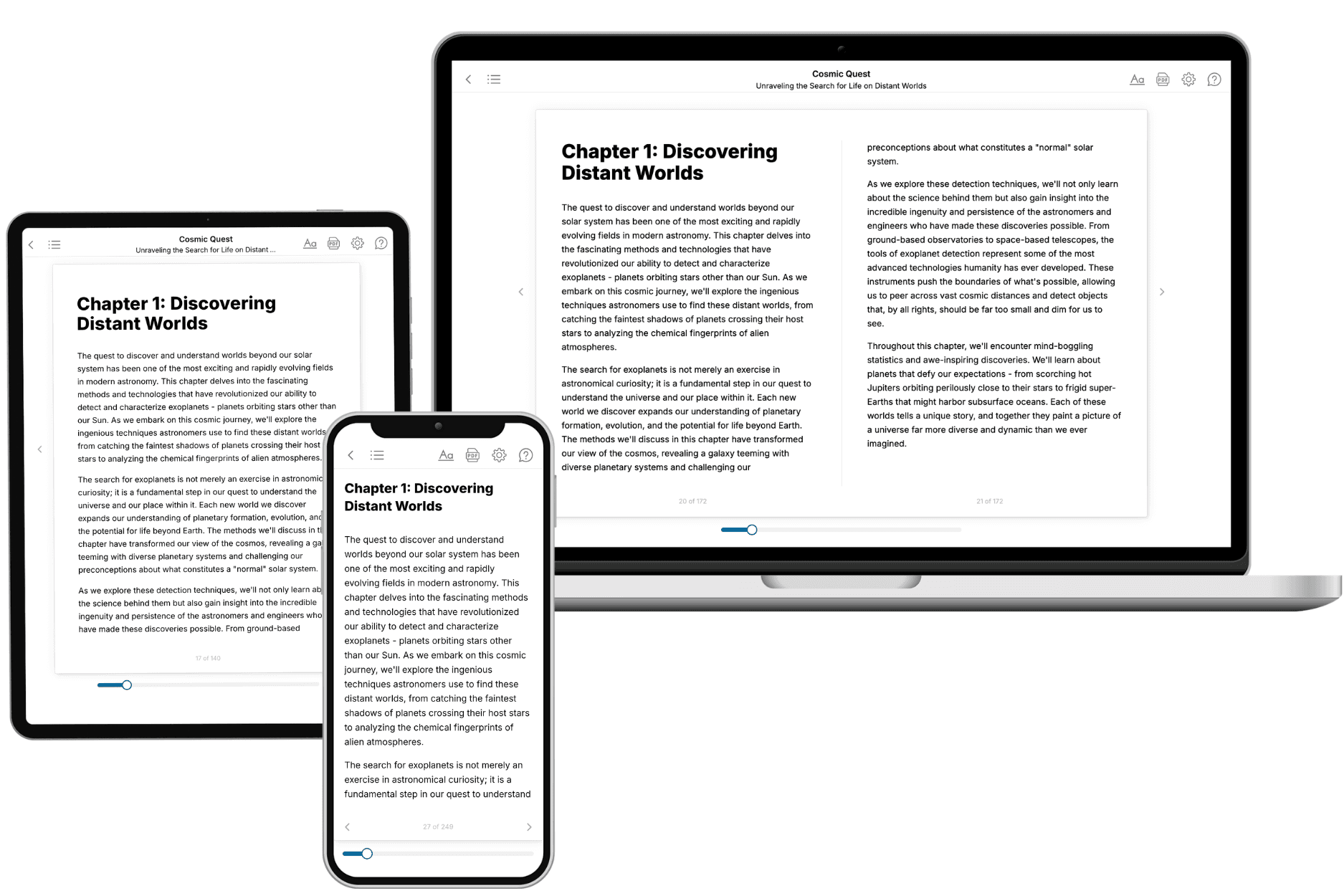
Your book is ready in 10 minutes. Read it online, download as EPUB or PDF, or send to Kindle.
Frequently asked questions
- What is TailoredRead?
TailoredRead creates complete, full-length nonfiction ebooks, written specifically for you. Tell us what you want to learn and why, and TailoredRead writes you a complete ebook on it, with charts, tables, and diagrams throughout. Read it online, on Kindle, or on any e-reader, or download it as a PDF or EPUB. Every book is written fresh the day you order it.
- How is the book tailored to me?
Before anything is written, you answer a few short questions about your goals, your background, and the topics you care about. Your book is then planned around your answers: written at your level, focused on your goals, and covering the topics you chose, instead of the one-size-fits-all book a store sells everyone.
- Will it read like generic AI content?
No. Your book isn't a chat transcript: it's planned chapter by chapter before a single word is written, told in a clear book voice, and explains ideas visually with charts, tables, and diagrams. After writing, every book goes through an editorial pass that polishes chapters so the book reads consistent from start to finish. Judge for yourself: browse thousands of sample books on our Explore Books page.
- How accurate is the content?
Our AI first checks whether your subject needs live research. Niche and fast-moving subjects are researched before writing, and the book plan and chapters are grounded in what it finds. After writing, every book goes through a quality pass that checks its facts and consistency, and researched books list their sources in a Notes section at the back.
- How long is the book?
You choose the length: Comprehensive (250-300 pages), Detailed (150-200 pages), Essential (70-100 pages), or Short (30-50 pages).
- Does the book include visuals?
Yes. Every book includes charts, tables, and diagrams: timelines, checklists, step-by-step guides, decision trees, comparison tables, matrices, and bar charts. A typical book includes dozens of these visual elements.
- Can I read it on Kindle? What formats can I download?
Yes. Every book can be read in our online reader or downloaded as a PDF or EPUB. The EPUB can be opened with Kindle, Apple Books, Kobo, and any e-reader. The Commercial and Author licenses also include an editable Word (DOCX) and Markdown download.
- How much does it cost?
About the price of a regular ebook. The exact price depends on your book's length and complexity, from $2 for the shortest books to $35 for the most comprehensive, and it's shown when you review your book, before you commit to anything. Each book is a one-time purchase, yours to keep, no subscription. Licenses that let you share, teach, or publish your book range from $35.99 to $49.99.
- Can I preview the book before purchasing?
Before you pay, you'll see what your book will cover: the title, a detailed description, the estimated length, and the complete chapter-by-chapter table of contents, so you know what you're getting before you decide. The full text itself is written after you purchase.
- How long does it take to create a book?
About 10 minutes. You can start reading the opening chapters while the rest is still being written.