Planetary Science Books
Explore tailored Planetary Science books created by our AI
Worlds of Possibility
Understanding Planetary Habitability in Our Solar System and Beyond
You'll gain a comprehensive understanding of what makes planets capable of supporting life, from the fundamental physics of habitable zones to the complex interplay of atmospheric, geological, and magnetic processes. This book takes you through the essential factors that determine planetary habitability, examining real examples from our solar system including Mars, Venus, Europa, and Enceladus. You'll discover how scientists evaluate the potential for life on distant worlds, learning to analyze atmospheric compositions, surface conditions, and energy sources that could sustain biological processes. The book explores both traditional Earth-like habitability and exotic environments where life might thrive under conditions vastly different from our home planet. Through detailed case studies and cutting-edge research, you'll understand how planetary size, orbital dynamics, and stellar relationships create the delicate balance necessary for habitable conditions. You'll also explore the latest discoveries about subsurface oceans, extremophile organisms, and the expanding definition of what constitutes a potentially habitable world. By the end, you'll possess the knowledge to evaluate any planetary system for its potential to harbor life, understanding both the limitations and possibilities that govern habitability throughout the cosmos.
Cosmic Crucibles
Unraveling the Mysteries of Planetary Formation and Evolution
Dive into the fascinating world of planetary science and unlock the secrets of our cosmic neighborhood. From the scorching surface of Venus to the icy plains of Pluto, you'll embark on a scientific journey through the solar system and beyond. Discover how planets form, evolve, and shape their unique environments. Explore the dynamic interiors of worlds, from Earth-like rocky planets to gas giants, and uncover the forces that drive their geological activity. Analyze diverse atmospheres, from the methane-rich skies of Titan to the tenuous exospheres of airless bodies. By the end of this book, you'll have a profound understanding of the processes that govern planetary bodies, equipping you with the knowledge to interpret new discoveries in this rapidly advancing field. Whether you're a student of astronomy or a curious mind yearning to comprehend the complexities of our celestial surroundings, this book will deepen your appreciation for the intricate systems that shape the worlds around us.
Most people assume planets simply condense from clouds of gas and dust, but the actual process is far more dynamic and fascinating. Planetary formation involves a complex interplay of gravity, chemistry, and physics that unfolds over millions of years. This book demystifies how planets are born, from the initial collapse of molecular clouds to the emergence of fully formed worlds orbiting distant stars. You'll discover why planets in different locations have different compositions, how collisions shape planetary systems, and why our solar system looks the way it does. By exploring both theoretical models and cutting-edge observations of young planetary systems, you'll gain a deeper appreciation for the cosmic processes that created the worlds we study today. Whether you're an astronomy enthusiast or simply curious about our place in the universe, this guide makes the science of planetary formation clear, engaging, and accessible.
You're about to discover how worlds are born, how they change over billions of years, and what makes each planet unique. This guide takes you from the basics of planetary science to understanding the sophisticated research that reveals the secrets of distant worlds. You'll learn how planets form from swirling disks of dust and gas, how their interiors differentiate into distinct layers, and why some planets have thick atmospheres while others have none. You'll explore the geological processes that shape planetary surfaces—from volcanic activity to erosion—and understand how planetary climates emerge from the interaction of atmosphere, geology, and stellar radiation. You'll discover how scientists detect and study exoplanets orbiting other stars, and how space missions like the Europa Clipper provide direct evidence that tests our theories. By connecting fundamental concepts to real observations and current research, you'll develop the knowledge and analytical skills to understand planetary science as an integrated discipline that reveals the story of how worlds form and evolve.
Planetary Transits
Understanding the Cosmic Dance of Planets Across Our Sky
Discover the celestial mechanics that govern one of astronomy's most captivating phenomena. This guide takes you beyond basic stargazing to reveal how planetary transits work, why they matter, and how to observe them with confidence. You'll learn the orbital geometry that creates these rare alignments, explore the historical significance of transit observations in measuring our universe, and understand how modern astronomers use transits to detect distant worlds. Whether you're tracking Venus crossing the Sun or searching for exoplanets, this book equips you with the knowledge to appreciate the precision and beauty of planetary motion. Packed with practical observation tips, detailed explanations of the physics involved, and insights into cutting-edge transit research, you'll gain a deeper understanding of how planets move through space and what their transits reveal about our place in the cosmos.
Worlds Beyond
A Complete Guide to Exoplanets and the Search for Life in the Universe
Picture yourself gazing up at the night sky with the profound knowledge that among those countless stars lie billions of worlds—some scorching hot, others frozen solid, and perhaps a few harboring the conditions necessary for life as we know it. You'll develop a sophisticated understanding of how astronomers detect these distant planets using ingenious methods, from watching stars dim as planets pass in front of them to measuring the tiny wobbles planets cause in their host stars. This comprehensive guide takes you through the fascinating diversity of exoplanets, from massive gas giants orbiting closer to their stars than Mercury does to our Sun, to rocky worlds that might have oceans and atmospheres. You'll explore the cutting-edge techniques scientists use to analyze the chemical composition of atmospheres trillions of miles away, and understand how these distant observations help us piece together the story of planetary formation and evolution. You'll gain insight into the most promising candidates for potentially habitable worlds and learn how researchers are pushing the boundaries of technology to search for signs of life beyond Earth. From the statistical patterns that emerge when studying thousands of exoplanets to the specific characteristics that make certain worlds particularly intriguing, you'll develop a nuanced appreciation for one of the most exciting frontiers in modern astronomy. By the end, you'll possess a thorough understanding of exoplanet science that will transform how you think about our place in the cosmos and the incredible diversity of worlds that populate our galaxy.
Worlds Beyond Worlds
The Complete Guide to Planetary Moons and Their Mysteries
Discover the hidden complexity and beauty of the celestial companions that orbit planets throughout our solar system and beyond. From the volcanic fury of Io to the icy oceans of Europa, from the methane lakes of Titan to the geysers of Enceladus, planetary moons represent some of the most fascinating and dynamic worlds in space. This comprehensive exploration takes you on a detailed journey through the diverse moon systems that populate our cosmic neighborhood. You'll understand how these remarkable worlds formed, evolved, and continue to change today. Learn about the intricate gravitational dances between planets and their moons, the surprising geological activity that shapes these distant surfaces, and the potential for life in the most unexpected places. Whether you're captivated by the massive moon systems of the gas giants or intrigued by the captured asteroids that serve as tiny moons, this book provides the scientific foundation and latest discoveries that illuminate these worlds beyond worlds. You'll gain insights into cutting-edge space missions, advanced observation techniques, and the ongoing search for moons around planets in other star systems. From fundamental concepts to the latest research findings, this guide equips you with a thorough understanding of why planetary moons are among the most scientifically important and awe-inspiring objects in the universe.
Many people assume Jupiter's Great Red Spot is a permanent, unchanging feature—a cosmic landmark frozen in time. In reality, this massive storm is a dynamic, evolving phenomenon that has captivated astronomers for over 350 years and continues to surprise us with its behavior. This book takes you on a journey through one of the solar system's most fascinating natural wonders, exploring how this colossal storm formed, why it persists, and what it reveals about planetary science. You'll discover the cutting-edge observations from space missions like Juno, learn how atmospheric physics on Jupiter differs radically from Earth, and understand why scientists consider the Great Red Spot essential to comprehending gas giants throughout the universe. Whether you're a casual stargazer or a dedicated astronomy enthusiast, you'll gain new appreciation for this iconic storm and the profound insights it offers about our place in the cosmos.
Asteroid Impact Simulation
Understanding Planetary Defense Through Computational Modeling
The possibility of an asteroid striking Earth can feel distant and abstract—until you understand the science behind it. Most people don't realize that scientists can now simulate asteroid impacts with remarkable precision, predicting everything from crater size to global climate effects. This book demystifies the computational models and physics that drive these simulations, showing you how researchers assess planetary threats and develop defense strategies. You'll explore the fundamental principles of impact physics, learn how scientists gather data from past impacts and meteorite samples, and discover the cutting-edge simulation tools transforming planetary defense. Whether you're curious about how NASA prepares for potential threats or want to understand the science behind catastrophic events, this guide provides clear, practical insights into one of astronomy's most critical applications. Gain the knowledge to appreciate both the risks and the remarkable human ingenuity working to protect our planet.
Discover the invisible forces that choreograph the dance of planets around our Sun. This book takes you on a journey through the fundamental principles of planetary orbits, revealing how celestial bodies maintain their paths through space with mathematical precision. You'll explore the elegant laws that govern motion, from the elliptical paths traced by Mercury to the distant orbit of Neptune, and understand why planets move at different speeds depending on their distance from the Sun. Through clear explanations and practical examples, you'll learn how gravity creates the cosmic architecture of our solar system and how scientists use orbital mechanics to launch spacecraft and predict planetary positions centuries into the future. Whether you're curious about why Earth's orbit keeps us at just the right distance for life, or fascinated by the physics underlying space exploration, this book provides the knowledge to appreciate the remarkable order underlying our cosmic neighborhood. By the end, you'll see the solar system not as a static arrangement, but as a dynamic, interconnected system governed by timeless physical laws.
The Chemistry of Cosmic Life
How Geochemistry Shapes the Search for Life in the Universe
Discover how the fundamental forces of chemistry and geology work together to create the conditions for life throughout the cosmos. This comprehensive exploration reveals the intricate chemical processes that govern habitability on Earth and beyond, from the formation of organic molecules in interstellar space to the complex geochemical cycles that sustain planetary environments. You'll explore how water, carbon, and other essential elements interact across different planetary systems, and learn to evaluate the chemical signatures that scientists use to identify potentially habitable worlds. The book examines real-world case studies from Mars, Europa, Enceladus, and other celestial bodies, showing how geochemical analysis guides our understanding of where life might exist. Through clear explanations of complex chemical processes, you'll gain insight into how extremophile organisms expand our definition of habitability, how atmospheric chemistry reveals planetary history, and how isotopic analysis can detect the subtle fingerprints of biological activity. Each chapter builds your understanding of the chemical toolkit that astrobiologists use to search for life, whether in our solar system or around distant stars. By the end, you'll possess a solid foundation in the chemical principles that drive astrobiology research and the ability to critically evaluate new discoveries in this rapidly evolving field. This knowledge will enhance your appreciation for both the rarity and the potential ubiquity of life in our chemically diverse universe.
The Multiplanetary Future
How Humanity Will Establish Permanent Settlements Beyond Earth
Most people imagine Mars colonization as a distant dream—something for the next century. The reality is far more immediate and complex. Right now, space agencies and private companies are building the technologies, infrastructure, and strategies to establish humanity's first permanent settlements beyond Earth within the next decade. This book cuts through the hype to show you what's actually happening: the real timelines, the engineering challenges being solved, the geopolitical competition unfolding, and the legal questions nobody's answering yet. You'll discover why the Moon matters more than Mars for the next 20 years, how we'll actually sustain human life on another planet, and what it really takes to make humanity multiplanetary. Whether you're fascinated by space exploration or concerned about humanity's future, this book provides the grounded, authoritative guide to understanding the most ambitious endeavor our species has ever undertaken.
Jupiter's Celestial Dance
Unraveling the Mysteries of Jovian Auroras
The vast, swirling storms of Jupiter have captivated astronomers for centuries, but hidden within its turbulent atmosphere lies an even more mesmerizing spectacle: the planet's awe-inspiring auroras. These celestial light shows dwarf those of Earth, yet their secrets remain tantalizingly out of reach. In "Jupiter's Celestial Dance: Unraveling the Mysteries of Jovian Auroras," you'll embark on a thrilling journey to the largest planet in our solar system. Discover how Jupiter's powerful magnetic field interacts with solar winds to create auroral displays that span areas larger than Earth itself. Delve into the latest findings from space missions and ground-based observations that are revolutionizing our understanding of these phenomena. From the basics of auroral formation to the cutting-edge technologies used to study them, this book offers a comprehensive look at one of the solar system's most captivating light shows. You'll gain insights into the similarities and differences between Earth's and Jupiter's auroras, the role of Jupiter's moons in shaping these displays, and the implications for our understanding of planetary magnetospheres throughout the universe. Whether you're an amateur astronomer looking to expand your knowledge or simply someone fascinated by the wonders of our cosmic neighborhood, "Jupiter's Celestial Dance" will deepen your appreciation for the intricate processes that create beauty on a planetary scale.
Celestial Mechanics Essentials
Understanding Orbital Dynamics and Dynamical Systems
What determines whether a satellite stays in orbit or crashes to Earth? How do planets maintain stable paths around stars despite countless gravitational influences? The answers lie at the intersection of celestial mechanics and dynamical systems—a field that transforms how we understand motion in space. This book bridges classical orbital mechanics with modern dynamical systems theory, revealing the mathematical structures that govern everything from planetary orbits to spacecraft trajectories. You'll discover how phase space analysis exposes hidden patterns in orbital behavior, why some orbits are stable while others spiral into chaos, and how perturbation theory helps us predict real-world motion. Whether you're studying physics, engineering, or applied mathematics, this guide provides the conceptual foundation and practical tools to analyze celestial motion with confidence and precision.
Asteroids and Comets
Understanding the Wanderers of Our Solar System
Imagine gazing at the night sky and truly understanding the ancient wanderers streaking across it—the asteroids and comets that have captivated humanity for millennia. This book transforms your perspective on these celestial bodies from distant curiosities into fascinating windows into our solar system's past and present. You'll discover how asteroids and comets formed alongside our planets, why they behave so differently, and what their movements reveal about the cosmos. From the dramatic tails of famous comets to the hidden threats and opportunities presented by near-Earth asteroids, you'll gain practical knowledge about detection systems, impact risks, and ongoing scientific missions. Whether you're curious about the asteroid that ended the dinosaurs, wondering about future space exploration, or simply wanting to understand what you're seeing in the night sky, this book provides the clarity and depth you need to appreciate these remarkable objects and their profound significance to our world.
Feeling overwhelmed by the vastness of space and the complexity of astrophysics? You're not alone. Many students struggle to connect abstract concepts like redshift, stellar evolution, and exoplanet detection into a coherent understanding of the cosmos. This handbook bridges that gap by breaking astrophysics into digestible, interconnected concepts that build naturally from one to the next. You'll start with the fundamental forces—light, gravity, and energy—then progress through telescopes, star lifecycles, galaxies, and the expanding universe. Each chapter includes practical applications, real-world examples, and opportunities to calculate cosmic distances yourself. Whether you're preparing for advanced coursework or simply curious about your place in the universe, this guide meets you where you are and takes you where you want to go. Learn at your own pace, master the concepts that matter, and develop the confidence to explore the cosmos with genuine understanding.
Many physicians assume astrobiology is purely theoretical—disconnected from clinical practice and grounded in speculation rather than science. In reality, astrobiology applies rigorous biochemistry, microbiology, and planetary science to answer one of humanity's most profound questions: Are we alone? This book bridges your medical expertise with cutting-edge astrobiology, revealing how extremophiles survive in Earth's harshest environments, how we detect biosignatures on distant exoplanets, and what the chemical building blocks of life tell us about its origins. You'll explore the habitable zone concept, understand why Mars and ocean worlds matter for human exploration, and learn how SETI scientists search for intelligent life. Written for physicians who want to grasp the science without oversimplification, this guide connects molecular biology, planetary atmospheres, and prebiotic chemistry into a coherent framework for understanding life's possibilities across the cosmos.
You've probably noticed the Moon in the night sky countless times, but understanding what you're actually looking at requires more than casual glances. Most beginners struggle with the basics: Why does the Moon look different every night? What causes tides? How do you actually observe lunar details with a telescope? This book breaks down lunar science into digestible, progressive lessons that build your knowledge step by step. You'll start with the fundamental cycles that govern the Moon's appearance, explore the gravitational mechanics that shape our planet, discover how ancient cultures interpreted the Moon through mythology, and develop practical stargazing skills using real observation techniques. Whether you're interested in the science, the history, or simply want to observe the Moon more meaningfully, this guide provides the foundation you need to move from casual observer to informed enthusiast.
The concept of centrifugal force creates confusion even among those with solid physics backgrounds. Is it real or fictitious? When does it apply? Why do some problems require it while others don't? These questions plague students and practitioners alike, leading to errors in analysis and misunderstandings about fundamental mechanics. This book cuts through the confusion by building a rigorous yet accessible framework for understanding centrifugal forces within classical mechanics. You'll discover why centrifugal force emerges naturally when analyzing motion from rotating reference frames, and learn the mathematical tools to confidently switch between inertial and non-inertial perspectives. Through clear explanations and practical examples, you'll master the relationship between centrifugal and Coriolis forces, understand their origins in coordinate transformations, and apply these concepts to real-world engineering problems. From the dynamics of rotating machinery to planetary motion, from vehicle handling to centrifuge design, you'll gain the analytical skills to tackle complex rotating systems with confidence. Each concept builds systematically on the last, ensuring you develop both intuitive understanding and mathematical proficiency in this essential area of mechanics.
The Silent Stars
Unraveling the Fermi Paradox and Our Place in the Cosmos
In "The Silent Stars: Unraveling the Fermi Paradox and Our Place in the Cosmos," you'll embark on a fascinating journey through one of the most perplexing questions in modern science and philosophy: If the universe is so vast and old, where is everybody? This book delves deep into the heart of the Fermi Paradox, exploring its origins, implications, and the myriad of proposed solutions. You'll discover how this simple question intersects with our understanding of physics, biology, sociology, and even our own human nature. From the Drake Equation to the Great Filter hypothesis, from panspermia to zoo theory, each chapter unveils a new layer of this cosmic mystery. As you progress through the book, you'll not only gain a solid understanding of the scientific principles behind the search for extraterrestrial intelligence but also confront profound philosophical questions about our place in the universe. Are we alone? Are we first? Or are we simply not looking in the right way? "The Silent Stars" doesn't just present theories; it challenges you to think critically about our cosmic significance and the future of humanity among the stars. Whether you're a science enthusiast, a philosophy buff, or simply someone who has ever looked up at the night sky and wondered, this book will expand your horizons and leave you with a new perspective on the silent cosmos that surrounds us.
Related books you may like:
Discover how advanced functional materials are reshaping industries and enabling solutions to humanity's greatest challenges. This comprehensive guide takes you beyond basic materials science to explore the cutting-edge world of engineered materials designed to perform specific, transformative functions. You'll learn how scientists and engineers manipulate atomic structures and processing conditions to create materials that respond to stimuli, conduct electricity with unprecedented efficiency, or heal themselves. From smart polymers that change properties on demand to nanomaterials with revolutionary capabilities, this book reveals the principles behind these innovations and their practical applications in healthcare, energy, electronics, and aerospace. Whether you're advancing your career, developing new products, or simply fascinated by the materials shaping our future, you'll gain the knowledge to understand, evaluate, and potentially contribute to this rapidly evolving field.
Most chemical reactions should happen instantly, yet they don't. The culprit? Activation energy—the invisible barrier that keeps reactants locked in place until enough energy arrives to break them free. Without understanding this fundamental concept, enzyme kinetics remains a mystery, and the elegant mechanisms by which life accelerates reactions seem like magic. This book demystifies activation energy and enzyme kinetics through clear explanations, practical examples, and visual frameworks. You'll discover how enzymes perform their catalytic miracles by lowering activation energy, explore the mathematics of reaction rates through the Arrhenius equation and Michaelis-Menten kinetics, and learn how inhibition mechanisms control biological processes. Whether you're studying biochemistry, developing pharmaceuticals, or optimizing industrial processes, this guide equips you with both the conceptual understanding and quantitative tools needed to predict, analyze, and manipulate enzyme-catalyzed reactions with confidence.
Achieve reliable, reproducible separations of complex chemical mixtures using adsorption chromatography. This practical guide bridges the gap between theoretical principles and real-world laboratory application, providing you with the knowledge and skills to design effective separation strategies for your specific analytical needs. You'll explore the fundamental science of how compounds interact with adsorbent materials, learn to select optimal stationary and mobile phases, and master the practical techniques that ensure consistent results. Whether you're working with thin-layer chromatography, column chromatography, or HPLC systems, this book equips you with systematic approaches to troubleshooting common problems, optimizing separations, and interpreting data with confidence. Packed with practical examples, decision-making frameworks, and evidence-based strategies, you'll develop the expertise to tackle challenging separation problems and advance your analytical capabilities in pharmaceutical, environmental, or materials research.
Many assume adipose tissue is simply inert fat to be minimized or removed. In reality, it's a sophisticated, metabolically active organ with remarkable regenerative potential. This book reveals how adipose tissue engineering is revolutionizing medicine by creating functional tissue solutions for reconstruction, regeneration, and therapeutic applications. You'll discover the biological foundations of adipose tissue, learn how scientists harvest and cultivate adipose-derived stem cells, and explore cutting-edge engineering strategies that transform these cells into viable tissue constructs. From scaffold design and bioreactor optimization to vascularization techniques and clinical translation, this guide provides practical insights into the science and engineering behind adipose tissue regeneration. Whether you're a researcher, student, or healthcare professional, you'll gain actionable knowledge about the current state of the field, emerging technologies, and the real-world challenges of bringing engineered tissues from the laboratory to clinical practice.
In the rapidly evolving world of ultra-high-speed communications, the challenge of designing secure and efficient chips has never been more daunting. As a Principal Architect, you face the complex task of integrating cutting-edge VLSI techniques with robust cryptographic solutions. This book is your comprehensive guide to conquering these challenges. "Advanced VLSI Design" delves deep into the intricacies of modern chip architecture, offering you practical insights into overcoming CMOS scaling limitations, harnessing the power of 3D IC integration, and implementing state-of-the-art FinFET technology. You'll explore innovative approaches to low-power design and high-speed SerDes, crucial for next-generation communication systems. This book doesn't just stop at performance; it equips you with the knowledge to build security from the ground up. From hardware Trojan detection to side-channel analysis resistance, you'll learn how to create chips that are not only fast but also fortified against modern security threats. Dive into advanced topics like quantum-dot cellular automata and EUV lithography, positioning yourself at the forefront of VLSI innovation.
Create a Planetary Science Book Tailored to You
Create an AI-crafted book tailored to your goals, interests, and background






Benefits of AI-tailored books
- Read one book, not ten:
- all the Planetary Science knowledge you need, gathered into a single book.
- Save days of learning:
- tell us your goals, choose your topics, and the whole book is built around them.
- Learn effortlessly:
- Planetary Science book written for your specific background and expertise.
- Understand at a glance:
- includes charts, tables, timelines, checklists, decision trees, and more.
- Stay current:
- written the day you order it, not years ago.
- Trust what you read:
- every book is checked for accuracy, with real research when your subject needs it.
Create your unique book in 3 steps
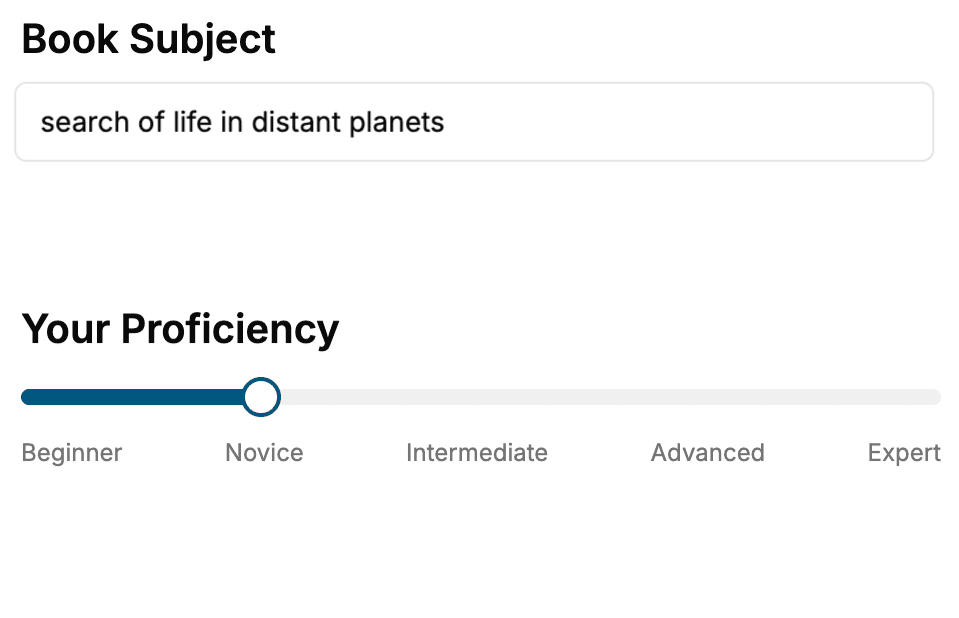
- 1. Select your focus
Select the focus of your Planetary Science book and share your background
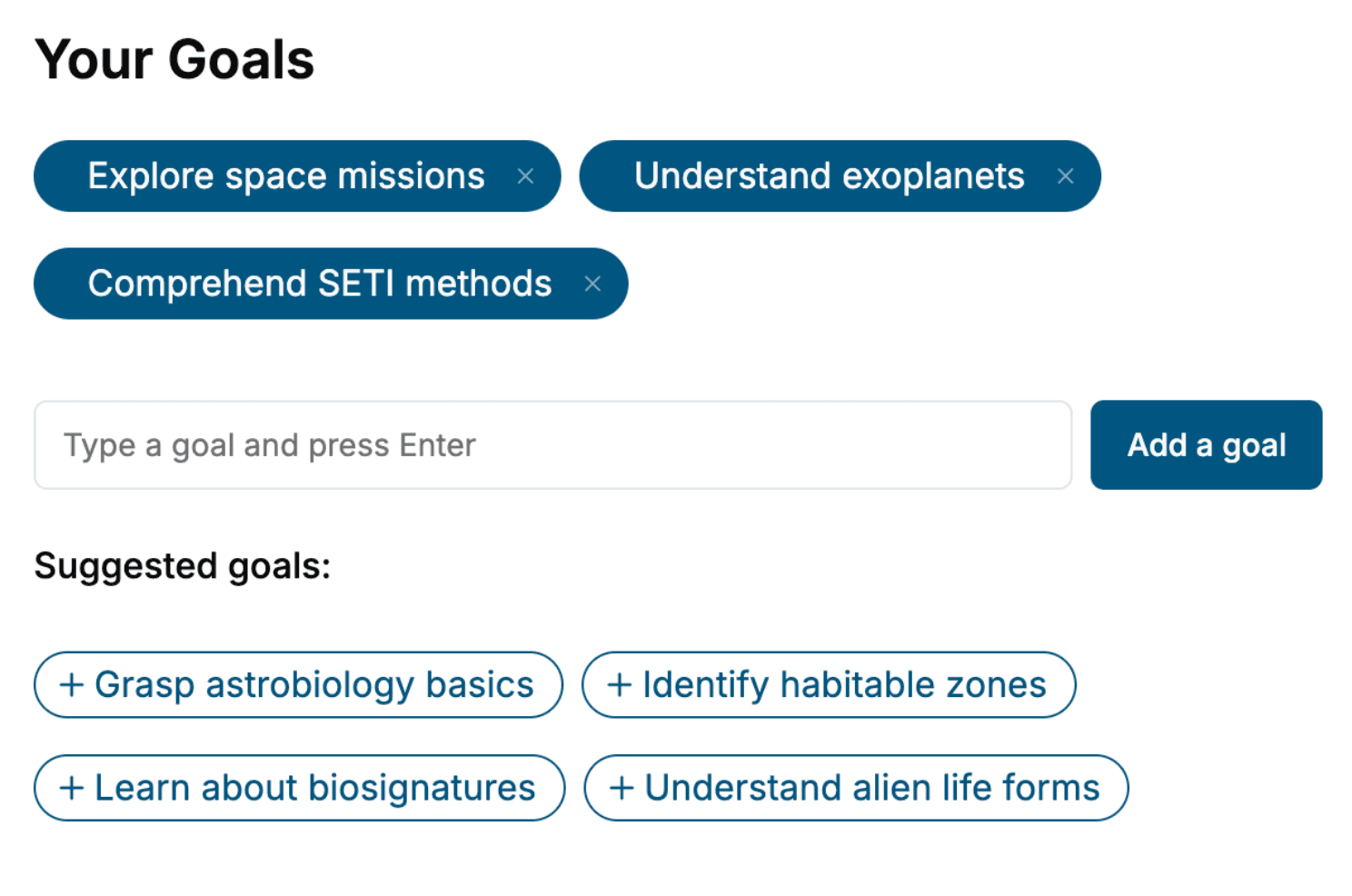
- 2. Personalize your book
Specify your goals and choose sub-topics to include
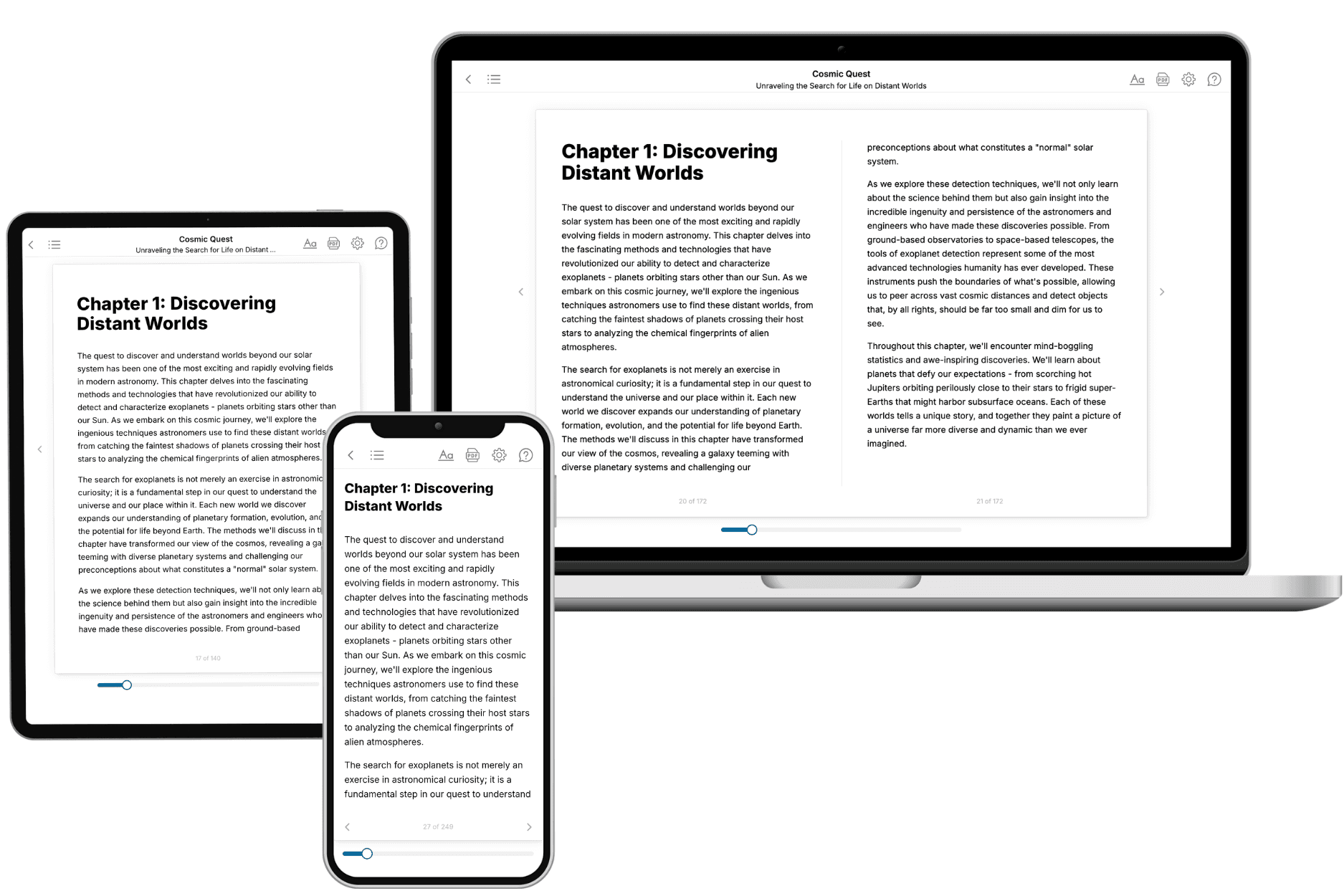
- 3. Get your tailored book
Your book is ready in 10 minutes. Read it online, download as EPUB or PDF, or send to Kindle.
Start from a template
Frequently asked questions
- What is TailoredRead?
TailoredRead creates complete, full-length nonfiction ebooks, written specifically for you. Tell us what you want to learn and why, and TailoredRead writes you a complete ebook on it, with charts, tables, and diagrams throughout. Read it online, on Kindle, or on any e-reader, or download it as a PDF or EPUB. Every book is written fresh the day you order it.
- How is the book tailored to me?
Before anything is written, you answer a few short questions about your goals, your background, and the topics you care about. Your book is then planned around your answers: written at your level, focused on your goals, and covering the topics you chose, instead of the one-size-fits-all book a store sells everyone.
- Will it read like generic AI content?
No. Your book isn't a chat transcript: it's planned chapter by chapter before a single word is written, told in a clear book voice, and explains ideas visually with charts, tables, and diagrams. After writing, every book goes through an editorial pass that polishes chapters so the book reads consistent from start to finish. Judge for yourself: browse thousands of sample books on our Explore Books page.
- How accurate is the content?
Our AI first checks whether your subject needs live research. Niche and fast-moving subjects are researched before writing, and the book plan and chapters are grounded in what it finds. After writing, every book goes through a quality pass that checks its facts and consistency, and researched books list their sources in a Notes section at the back.
- How long is the book?
You choose the length: Comprehensive (250-300 pages), Detailed (150-200 pages), Essential (70-100 pages), or Short (30-50 pages).
- Does the book include visuals?
Yes. Every book includes charts, tables, and diagrams: timelines, checklists, step-by-step guides, decision trees, comparison tables, matrices, and bar charts. A typical book includes dozens of these visual elements.
- Can I read it on Kindle? What formats can I download?
Yes. Every book can be read in our online reader or downloaded as a PDF or EPUB. The EPUB can be opened with Kindle, Apple Books, Kobo, and any e-reader. The Commercial and Author licenses also include an editable Word (DOCX) and Markdown download.
- How much does it cost?
About the price of a regular ebook. The exact price depends on your book's length and complexity, from $2 for the shortest books to $35 for the most comprehensive, and it's shown when you review your book, before you commit to anything. Each book is a one-time purchase, yours to keep, no subscription. Licenses that let you share, teach, or publish your book range from $35.99 to $49.99.
- Can I preview the book before purchasing?
Before you pay, you'll see what your book will cover: the title, a detailed description, the estimated length, and the complete chapter-by-chapter table of contents, so you know what you're getting before you decide. The full text itself is written after you purchase.
- How long does it take to create a book?
About 10 minutes. You can start reading the opening chapters while the rest is still being written.