Cosmology Books
Explore tailored Cosmology books created by our AI
The Cosmic Microwave Background
Decoding the Universe's First Light and Its Secrets
The universe's most ancient light holds the key to understanding everything we see around us today, yet this faint radiation remains one of the most challenging signals to detect and interpret. The Cosmic Microwave Background represents our most direct window into the early universe, but extracting meaningful information from this weak signal requires sophisticated techniques and deep theoretical understanding. This comprehensive guide takes you through the fascinating story of the CMB, from its accidental discovery to its role as the cornerstone of modern cosmology. You'll explore how tiny temperature variations in this ancient radiation reveal the seeds that grew into galaxies, clusters, and the cosmic web we observe today. The book demystifies complex concepts like blackbody radiation, polarization, and statistical analysis while showing how these tools unlock the universe's deepest secrets. You'll discover how cutting-edge experiments from the ground, balloons, and space work together to map the CMB with unprecedented precision. Learn how scientists separate the primordial signal from contaminating foregrounds and extract fundamental parameters that define our universe's age, composition, and fate. The book bridges theory and observation, showing how the CMB connects quantum mechanics to cosmology and provides our best evidence for cosmic inflation. Whether you're studying astronomy or simply fascinated by our cosmic origins, this book provides the knowledge and tools to understand one of science's greatest discoveries and its ongoing revelations about the universe we inhabit.
The Inflationary Universe
Understanding Cosmic Inflation and the Birth of Everything We See
You stand at the threshold of understanding one of the most profound discoveries in modern cosmology. This exploration takes you through the remarkable theory that explains how our universe transformed from a quantum speck into the vast cosmos we observe today. You'll discover how cosmic inflation—a brief but explosive period of expansion in the universe's first fraction of a second—solved fundamental puzzles that had perplexed scientists for decades. Your journey begins with the foundational concepts of the Big Bang and progresses through the elegant mathematics and physics that describe inflation. You'll learn how quantum fluctuations, smaller than subatomic particles, became the cosmic seeds that eventually grew into galaxies, stars, and planets. The book reveals how cutting-edge observations from space telescopes and cosmic microwave background missions have confirmed inflation's predictions with stunning accuracy. As you delve deeper, you'll explore the various models of inflation, from the original proposals to today's most sophisticated theories. You'll understand how this theory connects the smallest scales of quantum mechanics to the largest structures in the universe, and how it suggests our observable cosmos might be just one bubble in an infinite multiverse. Each chapter builds upon the previous, creating a comprehensive understanding that transforms abstract concepts into vivid, comprehensible insights. By the end, you'll possess a thorough grasp of how cosmic inflation reshaped our understanding of the universe's origins and why it stands as one of the most successful theories in modern physics. You'll appreciate both the elegant simplicity of inflation's core ideas and the profound implications they hold for our place in the cosmos.
Cosmic Frontiers
Exploring the Depths of Modern Cosmology
Embark on an intellectual journey through the most profound questions in modern cosmology with "Cosmic Frontiers: Exploring the Depths of Modern Cosmology." This book is tailored for the curious engineer and advanced physics enthusiast, offering a deep dive into the cutting-edge theories that shape our understanding of the universe. From the mind-bending concepts of cosmic inflation and the nature of dark matter to the enigmatic force of dark energy and the possibility of multiple universes, this book leaves no stone unturned. Each chapter builds upon a foundation of established physics to explore the frontiers of cosmological research, providing both theoretical insights and the latest observational evidence. Delve into the quantum realm of black holes, unravel the mysteries of the Big Bang, and contemplate the implications of parallel universes. With clear explanations of complex ideas and engaging discussions of current research, "Cosmic Frontiers" will challenge your perceptions and expand your cosmic horizons. Whether you're looking to reinforce your existing knowledge or push the boundaries of your understanding, this book offers a comprehensive guide to the most exciting and perplexing aspects of our universe. Prepare to have your mind expanded as you explore the very fabric of reality itself.
Cosmic Horizons
Unveiling the Mysteries of Our Universe
Discover the awe-inspiring wonders of our cosmos and gain a deep understanding of the universe's greatest mysteries. In "Cosmic Horizons: Unveiling the Mysteries of Our Universe," you'll embark on an enlightening journey through the vast expanse of space and time. This book breaks down complex cosmological concepts into easily digestible explanations, perfect for beginners eager to explore the field. From the mind-bending origins of the universe in the Big Bang to the formation of galaxies and the nature of exotic cosmic phenomena, you'll gain a solid foundation in the key principles of cosmology. Explore fascinating topics such as cosmic inflation, Hubble's Law, and the recent groundbreaking discovery of gravitational waves. Whether you're a curious newcomer to the field or someone looking to refresh their understanding of the cosmos, this book offers a clear and engaging exploration of the universe's most captivating aspects. By the end, you'll have a newfound appreciation for the vastness and complexity of our cosmic home, and the incredible scientific journey that has brought us to our current understanding of the universe.
Cosmos Essentials
A Physician's Guide to Understanding the Universe
Imagine having a clear, scientifically grounded understanding of how the universe works—from the physics governing stellar birth and death to the structure of galaxies and the nature of black holes. This book provides exactly that foundation, written specifically for someone with your medical background who appreciates rigorous science but needs accessible explanations. You'll explore the fundamental principles of cosmology and stellar physics, understanding how gravity shapes everything from planetary orbits to the fate of massive stars. Discover why stars explode, how neutron stars form, and what makes black holes so extraordinary. Learn about our solar system's place in the cosmos, the role of the interstellar medium in stellar formation, and how the Milky Way fits into the larger universe. Each chapter builds systematically on previous concepts, using clear language and practical examples. Whether you're driven by intellectual curiosity or simply want to understand the cosmos at a deeper level, this guide transforms complex astronomical concepts into knowledge you can truly grasp and retain.
Embark on an awe-inspiring journey through the cosmos with "Decoding the Cosmic Enigma." This captivating exploration of dark matter, dark energy, and the fundamental forces shaping our universe will transform your understanding of reality itself. Delve into the mysterious realm of dark matter as you uncover its elusive nature and the groundbreaking methods scientists use to detect it. Explore the mind-bending concept of dark energy and its role in the accelerating expansion of the universe. Along the way, you'll discover how these invisible cosmic players shape the intricate web of galaxies and influence the very fabric of space-time. From the birth of the universe to its potential fate, you'll gain insights into cosmic inflation, the timeline of our cosmos, and the cutting-edge simulations that help us visualize the unseeable. With a perfect blend of accessible explanations and thought-provoking concepts, this book will satisfy your curiosity about the greatest mysteries of our existence while challenging you to think beyond the boundaries of conventional understanding.
Determining whether the universe is spatially flat, open, or closed represents one of cosmology's most profound questions. Despite decades of theoretical predictions, achieving sub-percent precision on the curvature parameter Omega K demands sophisticated observational techniques and rigorous data analysis. This book provides a comprehensive technical treatment of how modern cosmological surveys converge on Omega K = 0.0007, demonstrating spatial flatness to extraordinary precision. You'll explore the physical principles underlying CMB temperature and polarization measurements, understand how gravitational lensing breaks geometric degeneracies, and master the baryon acoustic oscillation methodology as a standard ruler. Through detailed derivations grounded in Planck satellite observations and large-scale structure surveys, you'll learn how independent datasets achieve remarkable consistency. This work bridges theoretical predictions with observational reality, equipping you with the technical depth to evaluate curvature constraints, understand systematic uncertainties, and contribute to next-generation cosmological analyses.
The Expanding Universe
Understanding Cosmic Expansion Through Relativity and Modern Physics
Discover how the universe is fundamentally different from what we once believed. This book guides you through the revolutionary understanding that space itself is expanding, carrying galaxies away from each other at ever-increasing speeds. You'll explore how Einstein's groundbreaking theories of relativity transformed our comprehension of gravity, space, and time—providing the mathematical framework that makes cosmic expansion possible. From the early 20th-century observations that first revealed an expanding universe to today's puzzling discovery of accelerating expansion driven by mysterious dark energy, you'll learn the evidence, the physics, and the profound implications. Whether you're curious about the Big Bang's true nature, wondering what dark energy really is, or seeking to understand how scientists measure cosmic distances and velocities, this book demystifies these concepts without requiring advanced mathematics. Grounded in contemporary physics and observational astronomy, it connects fundamental principles to the cosmos we observe, revealing how the universe's expansion shapes everything from galaxy formation to our cosmic future.
Primordial Black Holes
The Universe's Hidden Architects and the Gravitational Wave Revolution
Discover how the universe's most extreme objects—primordial black holes—are reshaping our understanding of dark matter, gravitational waves, and the cosmos itself. This book guides you through the fascinating intersection of theoretical physics and cutting-edge observational astronomy, revealing how black holes formed mere fractions of a second after the Big Bang differ fundamentally from their stellar cousins. You'll explore the revolutionary gravitational wave detections that have transformed primordial black holes from theoretical curiosities into serious candidates for solving the dark matter mystery. Through clear explanations of complex physics, you'll understand how density perturbations during cosmic inflation seeded these objects, how modern detector networks capture their signatures across the universe, and what recent breakthroughs—including the November 2025 subsolar mass detection—tell us about the early universe. Whether you're fascinated by black holes, gravitational waves, or the deepest mysteries of cosmology, this book provides the knowledge to engage meaningfully with one of physics' most exciting frontiers.
Cosmic Architects
Unraveling the Mysteries of Galaxy Formation and Evolution
You're about to embark on a cosmic adventure that will reshape your understanding of the universe. "Cosmic Architects: Unraveling the Mysteries of Galaxy Formation and Evolution" takes you on a thrilling exploration of how the vast, swirling collections of stars, gas, and dark matter we call galaxies came to be. From the first flickering of light in the early universe to the majestic spiral and elliptical galaxies that populate our cosmic neighborhood, this book illuminates the processes that have shaped our galactic landscape. You'll delve into cutting-edge theories and observations that reveal the complex interplay of gravity, dark matter, and the cosmic web in sculpting these celestial cities. As you progress through the pages, you'll gain insights into the life cycles of galaxies, from their turbulent births in the cosmic dawn to their eventual fates in the far future. You'll explore the role of supermassive black holes, witness dramatic galactic collisions, and uncover the secrets hidden in the chemical makeup of stars. By the end, you'll have a profound appreciation for the cosmic forces that have shaped our universe and a solid foundation for further exploration in the field of galactic astronomy.
The Invisible Universe
Understanding Dark Matter and Dark Energy in Our Cosmos
Discover what makes up 95% of the universe—and why scientists still can't see it. This book takes you on a journey through the cosmos's greatest mysteries, revealing how dark matter and dark energy shape everything from distant galaxies to our own solar system. You'll learn why galaxies spin too fast to hold together, how invisible matter bends light across space, and why the universe's expansion is accelerating rather than slowing down. Through clear explanations and real observational evidence, you'll understand the detective work astronomers use to study the invisible, the competing theories that attempt to explain these phenomena, and what future discoveries might mean for physics. Whether you're fascinated by cosmology or simply curious about what lies beyond the stars, this book transforms abstract concepts into tangible understanding, revealing the hidden architecture of reality itself.
Many physicists understand general relativity conceptually but struggle to connect its mathematical framework to observable cosmological phenomena. This comprehensive guide bridges that gap by providing rigorous treatment of spacetime geometry and its physical implications. You'll develop mastery of the mathematical tools needed to work with curved spacetime, understand how geodesic equations govern motion in gravitational fields, and explore the profound implications for cosmology. The book addresses the cosmological constant problem—one of physics' deepest mysteries—examining why theoretical predictions diverge so dramatically from observations. Through careful development of tensor calculus, Einstein's field equations, and cosmological models, you'll gain the theoretical foundation to engage with cutting-edge research in gravitational physics and cosmology. This is not a popular science overview; it's a working physicist's resource designed to deepen your understanding of spacetime reality and equip you with the mathematical sophistication needed for advanced research.
The Cosmic Physician
Understanding the Universe Through Physics, Time, and Space
Imagine standing at the intersection of the infinitely small and infinitely large, where the laws governing atoms also shape galaxies, and where time itself bends under gravity's influence. As a physician, you understand how systems work—how cells communicate, how organs function, how life maintains order against entropy. The universe operates on similar principles, yet at scales and energies that challenge our intuition. This book guides you through the cosmos with the same rigor you apply to medicine, translating complex physics into concepts that resonate with your analytical mind. From the quantum foam underlying reality to the fate of galaxies billions of years hence, you'll discover how physicists decode the universe's architecture. You'll grasp why black holes fascinate scientists, how gravitational waves confirm Einstein's predictions, and what dark matter and dark energy reveal about reality's hidden dimensions. Written for someone with your background, this journey transforms abstract equations into profound insights about existence itself.
Cosmic Giants
Understanding Supermassive Black Holes and Their Role in Shaping the Universe
What if the most destructive forces in the universe are actually the architects of cosmic order? Supermassive black holes, containing millions to billions of times the mass of our Sun, lurk at the centers of galaxies and wield influence across unimaginable distances. Far from being simple cosmic destroyers, these giants orchestrate the birth and death of stars, regulate galactic evolution, and create some of the most spectacular phenomena observable in our universe. This comprehensive exploration takes you deep into the science of supermassive black holes, from their mysterious origins in the early universe to their role as cosmic engines powering quasars and active galactic nuclei. You'll discover how these invisible giants reveal themselves through their gravitational effects, accretion disks, and relativistic jets that stretch across millions of light-years. Through cutting-edge research and observations from the world's most advanced telescopes, you'll understand how supermassive black holes grow, merge, and interact with their galactic environments. From the groundbreaking images of the Event Horizon Telescope to the detection of gravitational waves from colliding black holes, modern astronomy is unveiling the secrets of these cosmic giants. Whether you're fascinated by the extreme physics near event horizons or curious about how these objects influence the large-scale structure of the universe, this book provides the knowledge and insights to appreciate one of astronomy's most captivating subjects.
The 30-Day Relativity Code
Master General Relativity Concepts and Applications in One Month
Accelerate your mastery of general relativity with a structured 30-day learning framework designed for technically sophisticated professionals. This guide bridges the gap between abstract mathematical formalism and practical astrophysical applications, providing you with the conceptual clarity and computational skills needed to work confidently with Einstein's theory. Each day builds systematically from foundational spacetime geometry through tensor calculus, Einstein equations, and cutting-edge applications in black holes, gravitational waves, and cosmology. You'll develop intuition for curved spacetime while mastering the mathematical tools that make relativity predictions testable and applicable. Designed for someone with your physics background, this book emphasizes the connections between theory and experiment, showing how general relativity's predictions have been validated through GPS systems, gravitational lensing observations, and gravitational wave detection. By month's end, you'll possess both the theoretical understanding and problem-solving capability to engage with current research and apply relativistic principles to engineering and scientific challenges.
You're about to discover why the greatest minds in physics have spent decades chasing a single equation that could explain everything. This book takes you through the fascinating landscape of quantum gravity—the frontier where Einstein's universe meets the quantum realm. You'll learn why our current physics breaks down at the smallest scales and highest energies, and explore the leading theories attempting to fix this cosmic puzzle. From string theory's extra dimensions to loop quantum gravity's discrete spacetime, you'll understand not just what these theories propose, but why physicists believe they might be on the right track. Along the way, you'll encounter black holes, the Big Bang, and the deepest questions about the nature of reality itself. Whether you're a science enthusiast or someone curious about the universe's fundamental rules, this exploration reveals how close—and how far—we remain from a complete understanding of nature.
Einstein's Revolution
How Relativity Reshaped Our Understanding of Space, Time, and Reality
Most people think relativity is an abstract mathematical theory disconnected from everyday life—something only physicists need to understand. In reality, relativity fundamentally changed how we comprehend space, time, matter, and energy, and its effects shape our world in countless ways. From the GPS in your phone to our understanding of black holes and the origin of the universe, relativity's influence is everywhere. This book traces the intellectual journey that led Einstein and his contemporaries to overturn centuries of Newtonian certainty. You'll discover how specific scientific puzzles of the 1890s sparked a revolution in thought, how relativity emerged from the work of multiple brilliant minds, and why its predictions—once considered impossible—have been repeatedly confirmed by evidence. More importantly, you'll understand what relativity actually means: not just the equations, but the profound insights about the nature of reality itself. Whether you're interested in the history of science, the philosophy of physics, or simply how humanity's greatest minds solved the universe's deepest mysteries, this book provides the context and clarity you need.
Feeling overwhelmed by the vastness of space and the complexity of astrophysics? You're not alone. Many students struggle to connect abstract concepts like redshift, stellar evolution, and exoplanet detection into a coherent understanding of the cosmos. This handbook bridges that gap by breaking astrophysics into digestible, interconnected concepts that build naturally from one to the next. You'll start with the fundamental forces—light, gravity, and energy—then progress through telescopes, star lifecycles, galaxies, and the expanding universe. Each chapter includes practical applications, real-world examples, and opportunities to calculate cosmic distances yourself. Whether you're preparing for advanced coursework or simply curious about your place in the universe, this guide meets you where you are and takes you where you want to go. Learn at your own pace, master the concepts that matter, and develop the confidence to explore the cosmos with genuine understanding.
Cosmic Connections
Unraveling the Universe from Particles to Galaxies
Discover the intricate tapestry of the cosmos, from the tiniest subatomic particles to the vast expanses of the universe. "Cosmic Connections: Unraveling the Universe from Particles to Galaxies" is your gateway to understanding the fundamental forces that shape our reality. As a science educator with a background in biomedical science and physics, you'll find this book bridges the gap between your existing knowledge and the latest theories in cosmology and particle physics. Delve into the mysteries of quantum mechanics, explore the enigmatic nature of dark matter and energy, and grasp the complexities of string theory and cosmic inflation. This comprehensive guide offers a unique perspective, connecting the realms of physics and biology to provide a holistic view of our universe. You'll gain insights into how particle accelerators unveil the secrets of matter, how gravitational waves reveal cosmic events, and how the study of antimatter asymmetry helps us understand the very fabric of existence. Whether you're looking to enhance your teaching repertoire or satisfy your own curiosity about the cosmos, "Cosmic Connections" provides the tools you need to navigate the intricate world of modern physics. Prepare to embark on an intellectual journey that will forever change your perspective on the universe and your place within it.
Most people assume planets simply condense from clouds of gas and dust, but the actual process is far more dynamic and fascinating. Planetary formation involves a complex interplay of gravity, chemistry, and physics that unfolds over millions of years. This book demystifies how planets are born, from the initial collapse of molecular clouds to the emergence of fully formed worlds orbiting distant stars. You'll discover why planets in different locations have different compositions, how collisions shape planetary systems, and why our solar system looks the way it does. By exploring both theoretical models and cutting-edge observations of young planetary systems, you'll gain a deeper appreciation for the cosmic processes that created the worlds we study today. Whether you're an astronomy enthusiast or simply curious about our place in the universe, this guide makes the science of planetary formation clear, engaging, and accessible.
Ripples in Spacetime
Understanding Gravitational Waves and Their Role in Our Solar System
Discover how ripples in the fabric of spacetime are revolutionizing our understanding of the cosmos. Gravitational waves represent one of the most profound discoveries in modern physics, confirming Einstein's century-old predictions and opening an entirely new window on the universe. This book takes you from the theoretical foundations of these cosmic ripples to their practical detection and what they reveal about our solar system and beyond. You'll explore how gravitational waves are generated by the most extreme events in the universe—colliding black holes, merging neutron stars, and supernovae—and how scientists have built instruments sensitive enough to detect vibrations smaller than a proton. Learn why gravitational wave astronomy matters for understanding planetary orbits, the fate of binary star systems, and the very nature of spacetime itself. Whether you're fascinated by cutting-edge physics or curious about how we observe the invisible universe, this book provides the clarity and depth you need to grasp one of science's greatest achievements.
Starlight and Science
How Humanity Discovered the Universe and Our Place in It
Imagine understanding not just where the stars are, but how humanity learned to read the cosmos like an open book. This exploration of astronomy's history reveals how each generation of observers and thinkers built upon previous discoveries to transform our understanding of the universe. From ancient Babylonian star-watchers tracking celestial patterns to modern astronomers detecting gravitational waves, you'll discover how astronomical breakthroughs repeatedly forced humanity to reconsider its place in the cosmos. You'll learn why the shift from Earth-centered to sun-centered models took centuries, how the telescope opened entirely new worlds of discovery, and why understanding the universe's age and expansion changed everything. This book shows how astronomy isn't just about distant stars—it's about how scientific thinking itself evolved, how evidence challenges belief, and how curiosity drives human progress. Whether you're fascinated by the night sky or interested in how science actually works, you'll gain insight into one of humanity's greatest intellectual achievements.
The gap between what we observe in the universe and what our best theories predict has long frustrated physicists. String theory emerged as an audacious attempt to bridge this gap—proposing that everything in existence, from light to gravity to matter itself, consists of infinitesimally small vibrating strings. This book traces string theory's remarkable intellectual journey from its accidental discovery in the 1960s through its evolution into one of the most ambitious scientific endeavors of our time. You'll discover how physicists overcame seemingly insurmountable mathematical obstacles, why the theory requires extra dimensions, and why it remains both celebrated and controversial. Rather than focusing on complex equations, this exploration emphasizes the historical context, key personalities, and conceptual breakthroughs that shaped string theory's development. Whether you're fascinated by the history of science, curious about cutting-edge physics, or interested in how humanity pursues ultimate truth, this book reveals how one revolutionary idea challenged everything we thought we knew about reality.
The Silent Stars
Unraveling the Fermi Paradox and Our Place in the Cosmos
In "The Silent Stars: Unraveling the Fermi Paradox and Our Place in the Cosmos," you'll embark on a fascinating journey through one of the most perplexing questions in modern science and philosophy: If the universe is so vast and old, where is everybody? This book delves deep into the heart of the Fermi Paradox, exploring its origins, implications, and the myriad of proposed solutions. You'll discover how this simple question intersects with our understanding of physics, biology, sociology, and even our own human nature. From the Drake Equation to the Great Filter hypothesis, from panspermia to zoo theory, each chapter unveils a new layer of this cosmic mystery. As you progress through the book, you'll not only gain a solid understanding of the scientific principles behind the search for extraterrestrial intelligence but also confront profound philosophical questions about our place in the universe. Are we alone? Are we first? Or are we simply not looking in the right way? "The Silent Stars" doesn't just present theories; it challenges you to think critically about our cosmic significance and the future of humanity among the stars. Whether you're a science enthusiast, a philosophy buff, or simply someone who has ever looked up at the night sky and wondered, this book will expand your horizons and leave you with a new perspective on the silent cosmos that surrounds us.
Imagine witnessing the collision of two neutron stars billions of light-years away—not through a telescope, but through ripples in spacetime itself. This book guides you through the fascinating intersection of gravitational waves and scattered light, two of the most powerful tools for understanding the universe's most violent events. You'll discover how light scattering reveals hidden details about cosmic collisions that gravitational wave detectors alone cannot capture, and how scientists combine these observations to paint a complete picture of stellar catastrophes. From the physics of light scattering in extreme environments to the real-world challenges of coordinating global observatories, you'll gain practical insight into how modern astronomy works. Whether you're curious about the latest discoveries in astrophysics or seeking to understand the technology behind breakthrough observations, this book makes complex concepts accessible without sacrificing scientific rigor.
Imagine confidently working through the mathematical framework that describes gravity not as a force, but as the geometry of spacetime itself. This comprehensive guide takes you from foundational tensor calculus through the sophisticated mathematics of black holes, gravitational waves, and cosmological models. Whether you're exploring the elegant Schwarzschild solution, mastering Einstein's field equations, or developing geometric intuition for curved spacetime, this book provides the rigorous yet accessible treatment you need. Each chapter builds systematically on previous concepts, combining theoretical foundations with practical problem-solving techniques. You'll work with Riemann geometry, differential forms, and advanced tensor methods while gaining deep insight into how mathematics reveals the universe's structure. Perfect for someone with strong mathematical background seeking to understand general relativity at the level of research and advanced applications, this book transforms abstract concepts into concrete understanding.
Discover what happens at the edge of physics where gravity becomes so extreme that the laws of nature itself break down. Black hole singularities represent the universe's most violent and mysterious phenomena—points where spacetime curves infinitely and our understanding of reality reaches its limits. This book takes you on a journey through the physics of these cosmic objects, explaining how massive stars collapse into black holes, what happens at the event horizon, and why singularities challenge everything we thought we knew about space and time. You'll explore the mathematics of spacetime curvature, learn about different types of black holes, and discover how quantum mechanics and gravity collide in ways that physicists are still struggling to understand. Whether you're fascinated by the cosmos or seeking to grasp one of modern physics' greatest mysteries, this accessible yet rigorous exploration reveals why black holes matter—not just for astronomy, but for fundamental physics itself.
Imagine mastering the mathematical framework that describes the universe itself—where gravity emerges not as a force, but as the geometry of spacetime. This comprehensive guide takes you from foundational manifold theory through the sophisticated mathematics of curved spacetime, building the rigorous understanding you need to work confidently with Einstein's field equations and advanced geometric physics. Written for someone with your mathematical background, this book bridges the gap between pure differential geometry and its profound physical applications. You'll develop deep proficiency with metric tensors, Christoffel symbols, curvature tensors, and geodesic equations—not just as abstract concepts, but as tools for solving real problems in general relativity and cosmology. Each chapter builds systematically, introducing Lie groups, parallel transport, and differential forms in ways that illuminate their geometric meaning and practical utility. Whether you're exploring the mathematics of black holes, understanding gravitational waves, or connecting topological properties to physical phenomena, you'll find the conceptual clarity and computational rigor needed to advance your mastery of this elegant mathematical landscape.
Worlds Beyond
A Complete Guide to Exoplanets and the Search for Life in the Universe
Picture yourself gazing up at the night sky with the profound knowledge that among those countless stars lie billions of worlds—some scorching hot, others frozen solid, and perhaps a few harboring the conditions necessary for life as we know it. You'll develop a sophisticated understanding of how astronomers detect these distant planets using ingenious methods, from watching stars dim as planets pass in front of them to measuring the tiny wobbles planets cause in their host stars. This comprehensive guide takes you through the fascinating diversity of exoplanets, from massive gas giants orbiting closer to their stars than Mercury does to our Sun, to rocky worlds that might have oceans and atmospheres. You'll explore the cutting-edge techniques scientists use to analyze the chemical composition of atmospheres trillions of miles away, and understand how these distant observations help us piece together the story of planetary formation and evolution. You'll gain insight into the most promising candidates for potentially habitable worlds and learn how researchers are pushing the boundaries of technology to search for signs of life beyond Earth. From the statistical patterns that emerge when studying thousands of exoplanets to the specific characteristics that make certain worlds particularly intriguing, you'll develop a nuanced appreciation for one of the most exciting frontiers in modern astronomy. By the end, you'll possess a thorough understanding of exoplanet science that will transform how you think about our place in the cosmos and the incredible diversity of worlds that populate our galaxy.
Many stargazers struggle to move beyond simply spotting Sirius in the night sky—they see a bright point of light but miss the fascinating science and rich history behind it. This book transforms your understanding of the brightest star visible from Earth, revealing why ancient Egyptians built temples aligned to its rising, how modern astronomers measure its properties, and what its binary companion tells us about stellar evolution. You'll discover the physics that makes Sirius shine so brilliantly, learn the mythology woven through human cultures, and gain practical skills for observing it throughout the year. Whether you're curious about the science of distant suns, the cultural significance of celestial objects, or simply want to appreciate the night sky with deeper knowledge, this guide provides the context and insights that transform casual stargazing into genuine astronomical understanding.
Gamma Rays Explained
Understanding the Universe's Most Powerful Radiation
Discover the science behind the universe's most energetic radiation. Gamma rays shape everything from medical treatments to our understanding of distant cosmic explosions, yet remain mysterious to many. This book takes you through the complete story of gamma radiation—from the quantum mechanics that produces it to the practical ways it's harnessed in hospitals and laboratories. You'll learn why gamma rays are simultaneously dangerous and life-saving, how scientists detect them across billions of light-years, and what they reveal about the most extreme events in the cosmos. Whether you're curious about the physics underlying nuclear medicine, want to understand radiation safety, or seek insight into how astronomers study supernovae and black holes, this guide provides clear explanations grounded in real science. Explore the detection methods that capture these elusive particles, the shielding strategies that protect us, and the cutting-edge applications transforming healthcare and industry. By the end, you'll possess a solid understanding of gamma ray physics and appreciate why these invisible rays matter to science and society.
Loop Quantum Gravity Essentials
Understanding the Quantum Structure of Spacetime
Discover how spacetime itself becomes quantized in loop quantum gravity, one of the most promising approaches to unifying quantum mechanics and general relativity. This book guides you through the essential concepts, mathematical frameworks, and physical implications of LQG without requiring advanced expertise. You'll learn how spin networks encode quantum geometry, why discreteness emerges at the Planck scale, and how this theory addresses fundamental problems in physics. Whether you're exploring alternatives to string theory or deepening your understanding of quantum gravity, this book provides the conceptual clarity and mathematical grounding needed to engage with cutting-edge research. Explore the elegant mathematics behind quantum spacetime, understand the theory's predictions for black holes and cosmology, and grasp why loop quantum gravity represents a fundamentally different vision of reality at its smallest scales.
Love Numbers
Understanding Gravitational Waves Through the Physics of Spacetime
Most people never consider how the universe speaks to us through invisible waves. Yet gravitational waves—ripples in the fabric of spacetime itself—carry messages from the most violent and distant cosmic events. The challenge is understanding what these waves reveal, particularly through a concept called "love numbers" that describes how celestial bodies respond to gravitational stress. This book makes that challenge surmountable. You'll discover how love numbers act as cosmic fingerprints, revealing the internal structure of neutron stars, black holes, and other exotic objects. Through clear explanations and intuitive examples, you'll learn why the 2015 detection of gravitational waves revolutionized astronomy and what scientists continue to learn from these cosmic messengers. Whether you're fascinated by physics, astronomy, or the cutting edge of scientific discovery, this book provides the conceptual foundation to understand one of humanity's greatest achievements in observing the universe.
Loop Quantum Gravity
Understanding the Quantum Structure of Spacetime
Discover how spacetime itself might be woven from quantum threads. Loop Quantum Gravity offers a revolutionary approach to one of physics' greatest unsolved problems: reconciling quantum mechanics with Einstein's theory of gravity. This book guides you through the essential concepts, mathematical foundations, and profound implications of this cutting-edge theory. You'll learn why physicists believe spacetime is quantized at the smallest scales, how loop quantum gravity differs from competing approaches like string theory, and what this means for black holes, the Big Bang, and the ultimate nature of reality. Written for those with intermediate physics knowledge, this exploration balances mathematical rigor with clear explanations, making complex ideas accessible without oversimplification. Whether you're a physics enthusiast, student, or professional seeking to understand the frontiers of theoretical physics, this book provides the conceptual framework and practical knowledge needed to grasp one of the most exciting developments in modern science.
Imagine having a comprehensive map of the most profound discoveries reshaping physics in 2025—one that honors both the mathematical rigor and philosophical implications of these breakthroughs. This guide is designed specifically for someone with your research background and philosophical training, offering deep dives into quantum field theory advances, cosmological revelations, and emerging theoretical models that are redefining our understanding of reality itself. You'll explore how recent experimental breakthroughs validate decades of theoretical work, examine the latest developments in string theory and quantum gravity, and understand the philosophical implications of discoveries that blur the line between observer and observed. Each chapter builds systematically from foundational concepts to cutting-edge research, integrating the mathematical frameworks with the conceptual insights that make these discoveries meaningful. Whether you're reconnecting with physics after years away or deepening your expertise in specific domains, this book provides the intellectual rigor and comprehensive coverage you need to master 2025's most significant advances and understand how they reshape our conception of the universe.
Most people assume that the three-dimensional world we perceive is all there is—a fundamental aspect of reality. But what if everything you see, touch, and experience is actually a projection from information encoded on a distant two-dimensional surface? The holographic principle suggests exactly this: that our entire universe might be a hologram. This groundbreaking concept emerged from string theory and quantum gravity research, fundamentally challenging how physicists understand space, time, and reality itself. This book guides you through the intellectual landscape of the holographic principle, from its origins in black hole thermodynamics to its mathematical formalization in the AdS/CFT correspondence. You'll discover how this principle connects quantum mechanics with gravity, why it matters for physics, and what it might mean for our understanding of existence. Whether you're fascinated by theoretical physics or simply curious about the deepest questions of reality, this exploration reveals how modern physics is rewriting the rules of what's possible.
Asteroids and Comets
Understanding the Wanderers of Our Solar System
Imagine gazing at the night sky and truly understanding the ancient wanderers streaking across it—the asteroids and comets that have captivated humanity for millennia. This book transforms your perspective on these celestial bodies from distant curiosities into fascinating windows into our solar system's past and present. You'll discover how asteroids and comets formed alongside our planets, why they behave so differently, and what their movements reveal about the cosmos. From the dramatic tails of famous comets to the hidden threats and opportunities presented by near-Earth asteroids, you'll gain practical knowledge about detection systems, impact risks, and ongoing scientific missions. Whether you're curious about the asteroid that ended the dinosaurs, wondering about future space exploration, or simply wanting to understand what you're seeing in the night sky, this book provides the clarity and depth you need to appreciate these remarkable objects and their profound significance to our world.
What if the shortest path between two points isn't actually a straight line? In curved spacetime, the geometry itself determines how objects move and how forces manifest. This book provides a rigorous, mathematically complete treatment of geodesic equations and curvature in general relativity, designed for someone with your physics and mathematics background who wants to move beyond introductory treatments. You'll master the derivation of Christoffel symbols from first principles, understand the Riemann curvature tensor's geometric meaning, and learn how covariant derivatives ensure physical laws remain valid across all coordinate systems. Each concept builds systematically from tensor calculus fundamentals through advanced applications like geodesic deviation equations and holonomy groups. Rather than relying on intuition alone, you'll work through detailed derivations that reveal why these mathematical structures are essential for describing gravity as curved spacetime. This is the mathematical foundation that makes general relativity not just a theory, but a precise geometric description of the universe.
You're about to discover how worlds are born, how they change over billions of years, and what makes each planet unique. This guide takes you from the basics of planetary science to understanding the sophisticated research that reveals the secrets of distant worlds. You'll learn how planets form from swirling disks of dust and gas, how their interiors differentiate into distinct layers, and why some planets have thick atmospheres while others have none. You'll explore the geological processes that shape planetary surfaces—from volcanic activity to erosion—and understand how planetary climates emerge from the interaction of atmosphere, geology, and stellar radiation. You'll discover how scientists detect and study exoplanets orbiting other stars, and how space missions like the Europa Clipper provide direct evidence that tests our theories. By connecting fundamental concepts to real observations and current research, you'll develop the knowledge and analytical skills to understand planetary science as an integrated discipline that reveals the story of how worlds form and evolve.
Most people assume that time flows at the same rate everywhere, that space is simply the empty stage where events occur, and that these are obvious truths about reality. Yet Einstein's special relativity reveals something startling: these assumptions are wrong. Time actually stretches and contracts depending on how fast you're moving. Space itself is not what it seems. This book explores how one of science's most revolutionary theories fundamentally challenges our understanding of reality itself. Rather than getting lost in complex mathematics, we'll examine the philosophical implications of special relativity—what it means for causality, free will, the nature of existence, and our place in the cosmos. You'll discover how Einstein's insights forced philosophers and scientists to reconsider what we can truly know about the universe, and why this matters far beyond the laboratory. Whether you're fascinated by physics, philosophy, or the intersection of both, this exploration will reshape how you think about time, space, and reality.
Unraveling the Fabric of Spacetime
A Journey Through Einstein's Universe and Beyond
Embark on an extraordinary voyage through the cosmos with "Unraveling the Fabric of Spacetime: A Journey Through Einstein's Universe and Beyond." This captivating exploration of the fundamental nature of our universe will transform your understanding of reality itself. From the mind-bending concepts of the spacetime continuum to the cutting-edge theories of quantum gravity, this book serves as your personal guide through the most profound ideas in modern physics. You'll discover how Einstein's revolutionary theories reshaped our understanding of gravity and the cosmos, and explore the latest developments that push the boundaries of human knowledge. Delve into the mysteries of black holes, wormholes, and the possibility of multiple universes. Visualize the intricate geometry of space and time, and grasp the significance of gravitational waves in our quest to understand the universe. With clear explanations and vivid analogies, complex ideas become accessible, allowing you to appreciate the beauty and elegance of the cosmos in ways you never thought possible.
The Great Red Spot
Jupiter's Storm and the Science of Gas Giant Atmospheres
Have you ever wondered how a storm can outlast the empires that first recorded it? For more than three hundred years, the Great Red Spot has churned across Jupiter's southern hemisphere, a vortex larger than Earth that defies simple intuition about weather. This book invites you to look at it anew, through the lens of fluid dynamics, cloud chemistry, and spectroscopy. You will find a careful account of how the Red Spot was first observed, how Voyager, Galileo, and Juno reshaped our picture of its depth and structure, and why its size has been shrinking. Along the way, you will explore the Coriolis effect on rotating gas, the internal heat that powers Jupiter's circulation, and the spectral fingerprints that reveal ammonia, ammonium hydrosulfide, and water ice in layered clouds. The discussion of Jupiter's magnetic field adds another dimension, and a final chapter shows how the same principles help astronomers detect storms on distant exoplanets. Written for readers with a strong scientific background who want depth without jargon, this book pairs rigorous physical reasoning with clear explanations. It is a book for anyone who wants to understand not only what the Great Red Spot is, but why it has endured, and what its endurance teaches us about planets beyond our own.
Related books you may like:
Discover how advanced functional materials are reshaping industries and enabling solutions to humanity's greatest challenges. This comprehensive guide takes you beyond basic materials science to explore the cutting-edge world of engineered materials designed to perform specific, transformative functions. You'll learn how scientists and engineers manipulate atomic structures and processing conditions to create materials that respond to stimuli, conduct electricity with unprecedented efficiency, or heal themselves. From smart polymers that change properties on demand to nanomaterials with revolutionary capabilities, this book reveals the principles behind these innovations and their practical applications in healthcare, energy, electronics, and aerospace. Whether you're advancing your career, developing new products, or simply fascinated by the materials shaping our future, you'll gain the knowledge to understand, evaluate, and potentially contribute to this rapidly evolving field.
Most chemical reactions should happen instantly, yet they don't. The culprit? Activation energy—the invisible barrier that keeps reactants locked in place until enough energy arrives to break them free. Without understanding this fundamental concept, enzyme kinetics remains a mystery, and the elegant mechanisms by which life accelerates reactions seem like magic. This book demystifies activation energy and enzyme kinetics through clear explanations, practical examples, and visual frameworks. You'll discover how enzymes perform their catalytic miracles by lowering activation energy, explore the mathematics of reaction rates through the Arrhenius equation and Michaelis-Menten kinetics, and learn how inhibition mechanisms control biological processes. Whether you're studying biochemistry, developing pharmaceuticals, or optimizing industrial processes, this guide equips you with both the conceptual understanding and quantitative tools needed to predict, analyze, and manipulate enzyme-catalyzed reactions with confidence.
Achieve reliable, reproducible separations of complex chemical mixtures using adsorption chromatography. This practical guide bridges the gap between theoretical principles and real-world laboratory application, providing you with the knowledge and skills to design effective separation strategies for your specific analytical needs. You'll explore the fundamental science of how compounds interact with adsorbent materials, learn to select optimal stationary and mobile phases, and master the practical techniques that ensure consistent results. Whether you're working with thin-layer chromatography, column chromatography, or HPLC systems, this book equips you with systematic approaches to troubleshooting common problems, optimizing separations, and interpreting data with confidence. Packed with practical examples, decision-making frameworks, and evidence-based strategies, you'll develop the expertise to tackle challenging separation problems and advance your analytical capabilities in pharmaceutical, environmental, or materials research.
Many assume adipose tissue is simply inert fat to be minimized or removed. In reality, it's a sophisticated, metabolically active organ with remarkable regenerative potential. This book reveals how adipose tissue engineering is revolutionizing medicine by creating functional tissue solutions for reconstruction, regeneration, and therapeutic applications. You'll discover the biological foundations of adipose tissue, learn how scientists harvest and cultivate adipose-derived stem cells, and explore cutting-edge engineering strategies that transform these cells into viable tissue constructs. From scaffold design and bioreactor optimization to vascularization techniques and clinical translation, this guide provides practical insights into the science and engineering behind adipose tissue regeneration. Whether you're a researcher, student, or healthcare professional, you'll gain actionable knowledge about the current state of the field, emerging technologies, and the real-world challenges of bringing engineered tissues from the laboratory to clinical practice.
In the rapidly evolving world of ultra-high-speed communications, the challenge of designing secure and efficient chips has never been more daunting. As a Principal Architect, you face the complex task of integrating cutting-edge VLSI techniques with robust cryptographic solutions. This book is your comprehensive guide to conquering these challenges. "Advanced VLSI Design" delves deep into the intricacies of modern chip architecture, offering you practical insights into overcoming CMOS scaling limitations, harnessing the power of 3D IC integration, and implementing state-of-the-art FinFET technology. You'll explore innovative approaches to low-power design and high-speed SerDes, crucial for next-generation communication systems. This book doesn't just stop at performance; it equips you with the knowledge to build security from the ground up. From hardware Trojan detection to side-channel analysis resistance, you'll learn how to create chips that are not only fast but also fortified against modern security threats. Dive into advanced topics like quantum-dot cellular automata and EUV lithography, positioning yourself at the forefront of VLSI innovation.
Create a Cosmology Book Tailored to You
Create an AI-crafted book tailored to your goals, interests, and background






Benefits of AI-tailored books
- Read one book, not ten:
- all the Cosmology knowledge you need, gathered into a single book.
- Save days of learning:
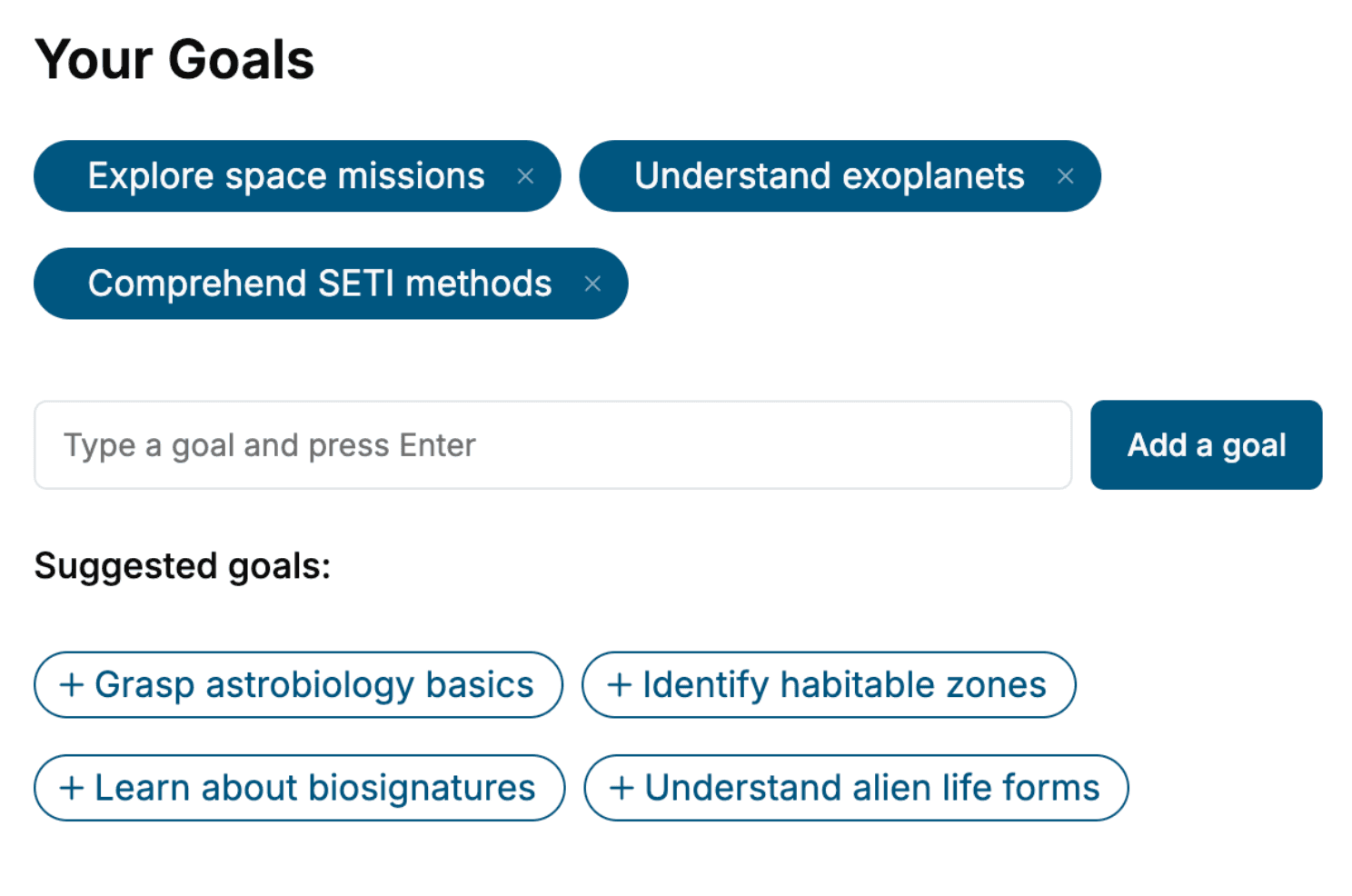
- tell us your goals, choose your topics, and the whole book is built around them.
- Learn effortlessly:
- Cosmology book written for your specific background and expertise.
- Understand at a glance:
- includes charts, tables, timelines, checklists, decision trees, and more.
- Stay current:
- written the day you order it, not years ago.
- Trust what you read:
- every book is checked for accuracy, with real research when your subject needs it.
Create your unique book in 3 steps
- 1. Select your focus
Select the focus of your Cosmology book and share your background
- 2. Personalize your book
Specify your goals and choose sub-topics to include
- 3. Get your tailored book
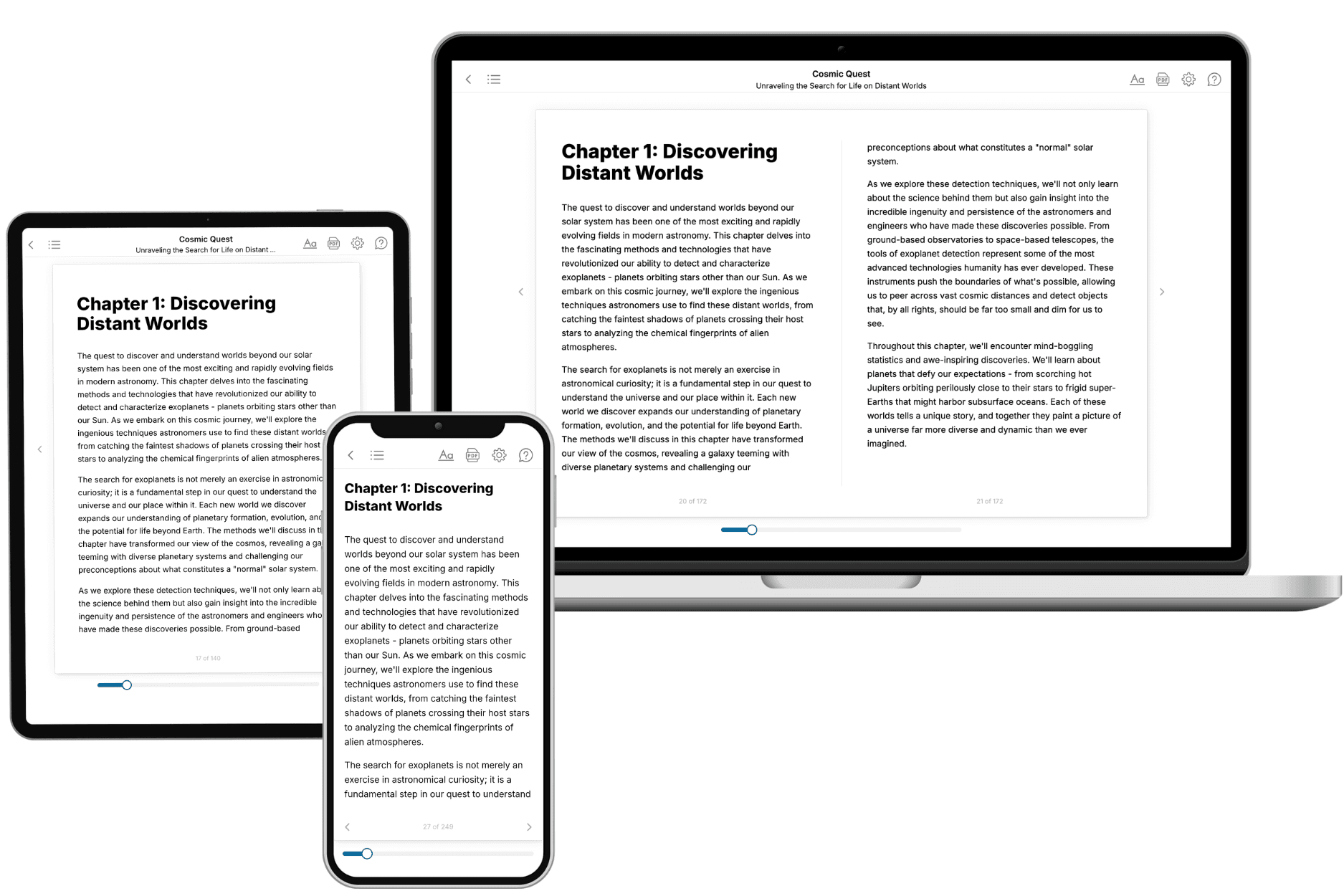
Your book is ready in 10 minutes. Read it online, download as EPUB or PDF, or send to Kindle.

Start from a template
Frequently asked questions
- What is TailoredRead?
TailoredRead creates complete, full-length nonfiction ebooks, written specifically for you. Tell us what you want to learn and why, and TailoredRead writes you a complete ebook on it, with charts, tables, and diagrams throughout. Read it online, on Kindle, or on any e-reader, or download it as a PDF or EPUB. Every book is written fresh the day you order it.
- How is the book tailored to me?
Before anything is written, you answer a few short questions about your goals, your background, and the topics you care about. Your book is then planned around your answers: written at your level, focused on your goals, and covering the topics you chose, instead of the one-size-fits-all book a store sells everyone.
- Will it read like generic AI content?
No. Your book isn't a chat transcript: it's planned chapter by chapter before a single word is written, told in a clear book voice, and explains ideas visually with charts, tables, and diagrams. After writing, every book goes through an editorial pass that polishes chapters so the book reads consistent from start to finish. Judge for yourself: browse thousands of sample books on our Explore Books page.
- How accurate is the content?
Our AI first checks whether your subject needs live research. Niche and fast-moving subjects are researched before writing, and the book plan and chapters are grounded in what it finds. After writing, every book goes through a quality pass that checks its facts and consistency, and researched books list their sources in a Notes section at the back.
- How long is the book?
You choose the length: Comprehensive (250-300 pages), Detailed (150-200 pages), Essential (70-100 pages), or Short (30-50 pages).
- Does the book include visuals?
Yes. Every book includes charts, tables, and diagrams: timelines, checklists, step-by-step guides, decision trees, comparison tables, matrices, and bar charts. A typical book includes dozens of these visual elements.
- Can I read it on Kindle? What formats can I download?
Yes. Every book can be read in our online reader or downloaded as a PDF or EPUB. The EPUB can be opened with Kindle, Apple Books, Kobo, and any e-reader. The Commercial and Author licenses also include an editable Word (DOCX) and Markdown download.
- How much does it cost?
About the price of a regular ebook. The exact price depends on your book's length and complexity, from $2 for the shortest books to $35 for the most comprehensive, and it's shown when you review your book, before you commit to anything. Each book is a one-time purchase, yours to keep, no subscription. Licenses that let you share, teach, or publish your book range from $35.99 to $49.99.
- Can I preview the book before purchasing?
Before you pay, you'll see what your book will cover: the title, a detailed description, the estimated length, and the complete chapter-by-chapter table of contents, so you know what you're getting before you decide. The full text itself is written after you purchase.
- How long does it take to create a book?
About 10 minutes. You can start reading the opening chapters while the rest is still being written.