Philosophy of Physics Books
Explore tailored Philosophy of Physics books created by our AI
Books readers created
18 Philosophy of Physics books, each written for the reader who ordered it. Read its introduction, then personalize it to get a book of your own.
Discover how science actually produces knowledge and why the methods scientists use matter more than you might think. This book moves beyond the popular image of science as a collection of facts to reveal the philosophical foundations that make scientific inquiry possible. You'll explore the major philosophical movements that have shaped scientific thinking—from the logical positivists who sought absolute certainty to Karl Popper's revolutionary falsificationism to Thomas Kuhn's paradigm-shifting insights. Understand the deep relationship between observation and theory, why the demarcation between science and pseudoscience remains contested, and how scientific knowledge evolves through both gradual progress and dramatic revolutions. By examining these philosophical questions, you'll gain the critical thinking tools to evaluate scientific claims, appreciate the provisional nature of knowledge, and recognize both the power and limitations of the scientific enterprise. This is essential reading for anyone who wants to think more deeply about how we know what we know.
Most people assume time is straightforward—it simply flows from past to future at a constant rate. Yet philosophers have spent centuries questioning this intuition, uncovering profound complexities beneath our everyday experience of temporality. This book traces how philosophical thought has fundamentally shaped our understanding of time from ancient Greece to the present day. You'll discover how Parmenides challenged the reality of change itself, how Augustine connected time to consciousness, and how Einstein's physics forced philosophers to reconsider time's very nature. Rather than presenting abstract theory divorced from reality, this exploration shows how these ideas directly impact how we understand causality, free will, memory, and mortality. Whether you're curious about why the present moment feels special, how the past can influence the future, or whether time truly flows, you'll find philosophical frameworks that illuminate these questions. This book bridges the gap between technical philosophy and lived experience, making complex ideas accessible without sacrificing depth or rigor.
Most people assume that time flows at the same rate everywhere, that space is simply the empty stage where events occur, and that these are obvious truths about reality. Yet Einstein's special relativity reveals something startling: these assumptions are wrong. Time actually stretches and contracts depending on how fast you're moving. Space itself is not what it seems. This book explores how one of science's most revolutionary theories fundamentally challenges our understanding of reality itself. Rather than getting lost in complex mathematics, we'll examine the philosophical implications of special relativity—what it means for causality, free will, the nature of existence, and our place in the cosmos. You'll discover how Einstein's insights forced philosophers and scientists to reconsider what we can truly know about the universe, and why this matters far beyond the laboratory. Whether you're fascinated by physics, philosophy, or the intersection of both, this exploration will reshape how you think about time, space, and reality.
You will deepen your understanding of why the universe must be structured as it is by integrating cutting-edge mathematics and physics with timeless philosophical insight. This book demonstrates that the 3+1 dimensional configuration of spacetime is not an arbitrary feature of reality but a metaphysically privileged condition for embodied rational existence. By synthesizing Aristotelian hylomorphism and Thomistic causality with contemporary findings in general relativity, topology, and quantum field theory, you'll discover how dimensional structure enables stable matter, causal interaction, and purposeful action. Rather than treating physics and metaphysics as competing frameworks, this work shows how they illuminate each other—revealing that the mathematical structures physicists describe are the very conditions that classical philosophy identified as necessary for beings capable of knowledge, love, and finality. Whether you're exploring the foundations of metaphysics or seeking to reconcile scientific discovery with philosophical realism, this book provides the rigorous integration you've been seeking.
Pilot Wave Theory
Understanding Reality Beyond Quantum Mechanics
Imagine a universe where particles follow definite paths, where reality exists independent of observation, and where quantum mechanics is just one way of describing a deeper deterministic order. Pilot wave theory offers exactly this vision—a radical reinterpretation of quantum mechanics that has profound implications for how we understand reality itself. This book guides you through the fascinating world of pilot wave theory, from its origins in de Broglie's groundbreaking work to Bohm's complete mathematical formulation. You'll discover how this theory resolves the measurement problem, eliminates the need for wave function collapse, and provides a clear picture of what's actually happening at the quantum level. Whether you're a physics enthusiast, philosophy student, or simply curious about alternative scientific frameworks, this exploration reveals why pilot wave theory remains one of the most compelling yet underappreciated interpretations of quantum mechanics, and what it tells us about the fundamental nature of existence.
Discover what randomness truly means and why it matters far more than you might think. This book cuts through confusion to reveal that randomness isn't simply "not knowing what happens next"—it's a profound philosophical and mathematical concept that shapes everything from quantum physics to artificial intelligence. You'll explore how mathematicians define randomness rigorously, why probability requires interpretation to make sense, and how deterministic systems can behave randomly. Learn why the distinction between true randomness and mere unpredictability matters for understanding free will, causality, and the nature of reality itself. Through clear explanations and compelling examples, you'll discover how randomness enables both the emergence of order and the limits of prediction. Whether you're interested in philosophy, mathematics, physics, or simply understanding uncertainty better, this book provides the conceptual tools to think more clearly about chance, probability, and the role of unpredictability in our universe.
Einstein's Revolution
How Relativity Reshaped Our Understanding of Space, Time, and Reality
Most people think relativity is an abstract mathematical theory disconnected from everyday life—something only physicists need to understand. In reality, relativity fundamentally changed how we comprehend space, time, matter, and energy, and its effects shape our world in countless ways. From the GPS in your phone to our understanding of black holes and the origin of the universe, relativity's influence is everywhere. This book traces the intellectual journey that led Einstein and his contemporaries to overturn centuries of Newtonian certainty. You'll discover how specific scientific puzzles of the 1890s sparked a revolution in thought, how relativity emerged from the work of multiple brilliant minds, and why its predictions—once considered impossible—have been repeatedly confirmed by evidence. More importantly, you'll understand what relativity actually means: not just the equations, but the profound insights about the nature of reality itself. Whether you're interested in the history of science, the philosophy of physics, or simply how humanity's greatest minds solved the universe's deepest mysteries, this book provides the context and clarity you need.
Imagine a universe where every possible outcome of every quantum event actually happens—not in theory, but in reality. Picture yourself existing across infinite parallel timelines, each one a branch of reality where different choices were made and different events unfolded. This isn't science fiction; it's the many-worlds interpretation of quantum mechanics, one of the most mind-bending yet scientifically grounded frameworks for understanding reality. This book takes you on a journey through the quantum realm, starting with the fundamental building blocks of quantum mechanics and gradually building toward the profound implications for consciousness, identity, and existence. You'll discover why observation changes reality, how particles can be in multiple places at once, and what quantum immortality might mean for your understanding of personal identity. Whether you're fascinated by parallel universes, curious about consciousness, or simply want to understand what physicists mean when they talk about superposition and entanglement, this book makes these complex ideas accessible without oversimplifying them. By the end, you'll have a solid grasp of quantum mechanics and be equipped to explore one of science's deepest mysteries: the nature of reality itself.
The biggest obstacle facing anyone trying to understand quantum mechanics is reconciling our everyday experience with the bizarre behavior of particles at the atomic scale. Why do electrons seem to exist in multiple places at once? How can measuring one property of a particle instantly affect another? The answers lie in one of physics' most profound discoveries: the Heisenberg Uncertainty Principle. This comprehensive guide takes you beyond the popular misconceptions and mathematical intimidation to reveal the elegant truth behind quantum uncertainty. You'll discover how Werner Heisenberg's groundbreaking insight fundamentally changed our understanding of reality, showing that uncertainty isn't a flaw in our measurements—it's woven into the very fabric of nature itself. Through clear explanations and practical examples, you'll explore how wave mechanics provides the mathematical foundation for understanding why particles behave so differently from the objects we encounter daily. From the wave-particle duality that governs light and matter to the quantum superposition that enables modern technologies, you'll gain the conceptual tools needed to navigate the quantum world with confidence. Whether you're a student grappling with quantum mechanics for the first time or a curious mind seeking deeper insights into the nature of reality, this book will transform your understanding of how the universe works at its most fundamental level.
The gap between what we observe in the universe and what our best theories predict has long frustrated physicists. String theory emerged as an audacious attempt to bridge this gap—proposing that everything in existence, from light to gravity to matter itself, consists of infinitesimally small vibrating strings. This book traces string theory's remarkable intellectual journey from its accidental discovery in the 1960s through its evolution into one of the most ambitious scientific endeavors of our time. You'll discover how physicists overcame seemingly insurmountable mathematical obstacles, why the theory requires extra dimensions, and why it remains both celebrated and controversial. Rather than focusing on complex equations, this exploration emphasizes the historical context, key personalities, and conceptual breakthroughs that shaped string theory's development. Whether you're fascinated by the history of science, curious about cutting-edge physics, or interested in how humanity pursues ultimate truth, this book reveals how one revolutionary idea challenged everything we thought we knew about reality.
The Conscious Universe
Understanding Panpsychism and the Nature of Mind in Reality
Discover how consciousness might be woven into the very fabric of reality itself. This comprehensive exploration of panpsychism reveals why leading philosophers and scientists are reconsidering one of humanity's oldest ideas about the nature of mind and matter. You'll explore how panpsychism addresses the fundamental mystery of how subjective experience arises from physical processes - a puzzle that has confounded thinkers for centuries. From ancient philosophical roots to cutting-edge contemporary theories, you'll understand how this bold hypothesis suggests that consciousness exists not just in humans and animals, but as a basic feature of all matter. Through clear explanations and rigorous analysis, you'll examine the strongest arguments for and against panpsychist theories, including the notorious combination problem and recent developments in neuroscience and physics. You'll discover how different versions of panpsychism - from the idea that electrons have primitive experiences to theories that the entire cosmos is conscious - attempt to bridge the explanatory gap between brain and mind. Whether you're grappling with questions about artificial intelligence, animal consciousness, or the fundamental nature of reality, this book provides the conceptual tools to think deeply about consciousness and its place in the natural world. You'll emerge with a nuanced understanding of one of philosophy's most intriguing and controversial theories.
You're about to discover why the greatest minds in physics have spent decades chasing a single equation that could explain everything. This book takes you through the fascinating landscape of quantum gravity—the frontier where Einstein's universe meets the quantum realm. You'll learn why our current physics breaks down at the smallest scales and highest energies, and explore the leading theories attempting to fix this cosmic puzzle. From string theory's extra dimensions to loop quantum gravity's discrete spacetime, you'll understand not just what these theories propose, but why physicists believe they might be on the right track. Along the way, you'll encounter black holes, the Big Bang, and the deepest questions about the nature of reality itself. Whether you're a science enthusiast or someone curious about the universe's fundamental rules, this exploration reveals how close—and how far—we remain from a complete understanding of nature.
Most people think quantum mechanics is an esoteric field reserved for physicists in laboratories, disconnected from everyday life and historical events. Nothing could be further from the truth. Every smartphone you touch, every medical scan you receive, every GPS direction you follow exists because of quantum physics—and the story of how we discovered these principles is inseparable from the rise and fall of empires, the outcome of wars, and the transformation of human society. This book reveals the hidden connections between physics breakthroughs and civilizational change. You'll discover how Newton's laws enabled the Industrial Revolution, how Einstein's relativity reshaped geopolitics, and how quantum mechanics birthed the digital age. From ancient astronomers to Manhattan Project scientists, from the steam engine to the silicon chip, you'll see how our understanding of the physical world has repeatedly rewritten the human story. This is not a textbook—it's the epic tale of how curiosity about nature's deepest secrets changed everything about how we live, work, and understand our place in the cosmos.
Master the foundational concepts of quantum field theory and develop genuine confidence in one of physics' most powerful frameworks. This book guides you through the essential principles that govern particle interactions and fundamental forces, building from classical field theory through to modern quantum electrodynamics. You'll learn how fields, not particles, form the basis of reality—and why this perspective revolutionizes our understanding of nature. Each chapter introduces concepts at a comfortable pace, with clear explanations that respect your philosophical background while developing practical problem-solving skills. You'll explore field quantization, gauge theories, path integrals, and Feynman diagrams through worked examples and intuitive reasoning. By the end, you'll understand how quantum field theory unifies quantum mechanics with relativity, interpret particle interactions with confidence, and possess the mathematical and conceptual tools to explore advanced topics independently. This is your pathway to genuine mastery of QFT's foundations.
Most people encounter Einstein's name in popular culture but struggle to understand what his theories actually mean. The gap between "E=mc²" and genuine comprehension feels insurmountable. This book bridges that gap by weaving together Einstein's life story with the mathematical and conceptual foundations of his revolutionary theories. You'll discover how a young patent clerk in Switzerland challenged the scientific establishment, why space and time aren't what you think they are, and how gravity actually works according to Einstein's vision. Rather than drowning you in equations, this book uses clear explanations, intuitive analogies, and historical context to make Relativity accessible. You'll understand not just what Einstein discovered, but why it matters and how it transformed our understanding of the universe. Whether you're fascinated by physics, biography, or the history of ideas, this exploration of Einstein's genius will reshape how you think about reality itself.
Loop Quantum Gravity
Understanding the Quantum Structure of Spacetime
Discover how spacetime itself might be woven from quantum threads. Loop Quantum Gravity offers a revolutionary approach to one of physics' greatest unsolved problems: reconciling quantum mechanics with Einstein's theory of gravity. This book guides you through the essential concepts, mathematical foundations, and profound implications of this cutting-edge theory. You'll learn why physicists believe spacetime is quantized at the smallest scales, how loop quantum gravity differs from competing approaches like string theory, and what this means for black holes, the Big Bang, and the ultimate nature of reality. Written for those with intermediate physics knowledge, this exploration balances mathematical rigor with clear explanations, making complex ideas accessible without oversimplification. Whether you're a physics enthusiast, student, or professional seeking to understand the frontiers of theoretical physics, this book provides the conceptual framework and practical knowledge needed to grasp one of the most exciting developments in modern science.
Your spiritual evolution is about to take a quantum leap. In "Quantum Spirituality," you'll discover how to harness the power of advanced mindfulness techniques and intuitive practices to elevate your consciousness to unprecedented levels. This comprehensive guide doesn't just scratch the surface; it delves deep into the realms of Kundalini awakening, transcendental states, and the intricate dance between quantum physics and spiritual consciousness. As you progress through the pages, you'll learn to master the art of mantra chanting, explore the transformative effects of spiritual fasting, and develop your intuition to levels you never thought possible. Each chapter builds upon the last, creating a cohesive pathway to spiritual mastery that integrates seamlessly into your daily life. "Quantum Spirituality" is not just another meditation guide; it's a roadmap to discovering your higher self and unlocking the vast potential of your consciousness. Whether you're seeking to cultivate inner peace, embrace profound spiritual growth, or achieve a state of spiritual balance, this book provides the advanced tools and insights you need. Prepare to transcend the ordinary and step into a realm of expanded awareness and spiritual fulfillment.
The Silent Stars
Unraveling the Fermi Paradox and Our Place in the Cosmos
In "The Silent Stars: Unraveling the Fermi Paradox and Our Place in the Cosmos," you'll embark on a fascinating journey through one of the most perplexing questions in modern science and philosophy: If the universe is so vast and old, where is everybody? This book delves deep into the heart of the Fermi Paradox, exploring its origins, implications, and the myriad of proposed solutions. You'll discover how this simple question intersects with our understanding of physics, biology, sociology, and even our own human nature. From the Drake Equation to the Great Filter hypothesis, from panspermia to zoo theory, each chapter unveils a new layer of this cosmic mystery. As you progress through the book, you'll not only gain a solid understanding of the scientific principles behind the search for extraterrestrial intelligence but also confront profound philosophical questions about our place in the universe. Are we alone? Are we first? Or are we simply not looking in the right way? "The Silent Stars" doesn't just present theories; it challenges you to think critically about our cosmic significance and the future of humanity among the stars. Whether you're a science enthusiast, a philosophy buff, or simply someone who has ever looked up at the night sky and wondered, this book will expand your horizons and leave you with a new perspective on the silent cosmos that surrounds us.
Related books you may like:
You're about to supercharge your animal advocacy efforts and nonprofit management skills with the power of AI. This groundbreaking guide is tailored specifically for leaders in the animal rights movement who are ready to harness cutting-edge technology to make a bigger impact. Discover how to leverage AI tools to streamline your operations, enhance your strategic planning, and amplify your advocacy campaigns. You'll learn practical techniques for automating administrative tasks, optimizing your workflow, and making data-driven decisions that will take your organization to the next level. From improving time management and task delegation to enhancing donor engagement and project tracking, this book offers a comprehensive roadmap for integrating AI into every aspect of your work. You'll gain insights into AI-driven research methods, problem-solving techniques, and productivity metrics that will revolutionize the way you approach animal advocacy.
Discover how air sign energy shapes your thinking, communication style, and approach to relationships. Whether you have a Gemini, Libra, or Aquarius placement in your birth chart, this guide reveals the intellectual and social gifts these signs bring—along with the blind spots worth understanding. You'll learn why air signs are natural communicators and idea-generators, how each sign expresses itself uniquely, and how your specific air sign placements influence your personality across different life areas. Through practical insights and real-world examples, you'll recognize air sign patterns in yourself and others, harness your natural strengths in connection and innovation, and navigate the challenges of overthinking and emotional detachment. Whether you're exploring your Sun, Moon, Rising, or other planetary placements, this book provides the clarity you need to work with your air sign energy authentically and effectively.
What if you could resolve years of trauma in just a handful of therapy sessions instead of months or years of traditional talk therapy? Accelerated Resolution Therapy (ART) offers a scientifically-grounded approach that harnesses your brain's natural healing capacity to process traumatic memories and emotional distress rapidly. This book demystifies how ART works at the neurological level, explains why it's so effective for conditions like PTSD, anxiety, and phobias, and explores how it differs from conventional therapeutic approaches. Whether you're a mental health professional considering adding ART to your practice, someone exploring treatment options for yourself or a loved one, or simply curious about innovative psychological interventions, this guide provides practical insights into one of the most promising developments in modern therapy. Discover how guided imagery and eye movement can facilitate profound emotional healing, what the research shows about its effectiveness, and whether ART might be the breakthrough approach you've been seeking.
The assumption that political parties are natural, inevitable, or even desirable features of democracy is surprisingly recent. For most of Western political history, the most sophisticated thinkers viewed organized factions as corrupting forces that distorted the pursuit of the common good. This book traces the genealogy of anti-party political thought from Plato's critique of democratic factionalism through contemporary populist movements, examining how philosophers, statesmen, and theorists have conceptualized the dangers of partisanship and imagined alternatives. You'll encounter Rousseau's vision of a general will transcending faction, the Federalist Papers' constitutional anxiety about party machinery, Tocqueville's ambivalent analysis of American partisanship, and the radical rejection of parties by socialist and anarchist movements. Rather than treating anti-party sentiment as mere nostalgia or populist demagoguery, this analysis reveals it as a coherent intellectual tradition grappling with enduring tensions between democratic participation and organized political competition. By understanding how different historical periods and ideological traditions have confronted the problem of faction, you gain critical perspective on contemporary debates about party reform, populism, and democratic alternatives.
Many people believe that behavior is determined either by our genetics or by direct rewards and punishments we experience. However, Albert Bandura's groundbreaking research revealed a more nuanced truth: we learn by watching others. This book explores the life and work of one of psychology's most influential figures and the revolutionary theory that transformed our understanding of human behavior. You'll discover how Bandura's concept of self-efficacy explains why some people persevere through challenges while others give up, how observational learning shapes everything from aggression to prosocial behavior, and why the environment, our thoughts, and our actions are constantly influencing each other. Whether you're an educator seeking to improve student outcomes, a professional interested in behavior change, or simply curious about the science of learning, this comprehensive guide illuminates the principles that govern human development and provides practical insights into how these theories apply to everyday life.
Create a Philosophy of Physics Book Tailored to You
Create an AI-crafted book tailored to your goals, interests, and background






Benefits of AI-tailored books
- Read one book, not ten:
- all the Philosophy of Physics knowledge you need, gathered into a single book.
- Save days of learning:
- tell us your goals, choose your topics, and the whole book is built around them.
- Learn effortlessly:
- Philosophy of Physics book written for your specific background and expertise.
- Understand at a glance:
- includes charts, tables, timelines, checklists, decision trees, and more.
- Stay current:
- written the day you order it, not years ago.
- Trust what you read:
- every book is checked for accuracy, with real research when your subject needs it.
Create your unique book in 3 steps
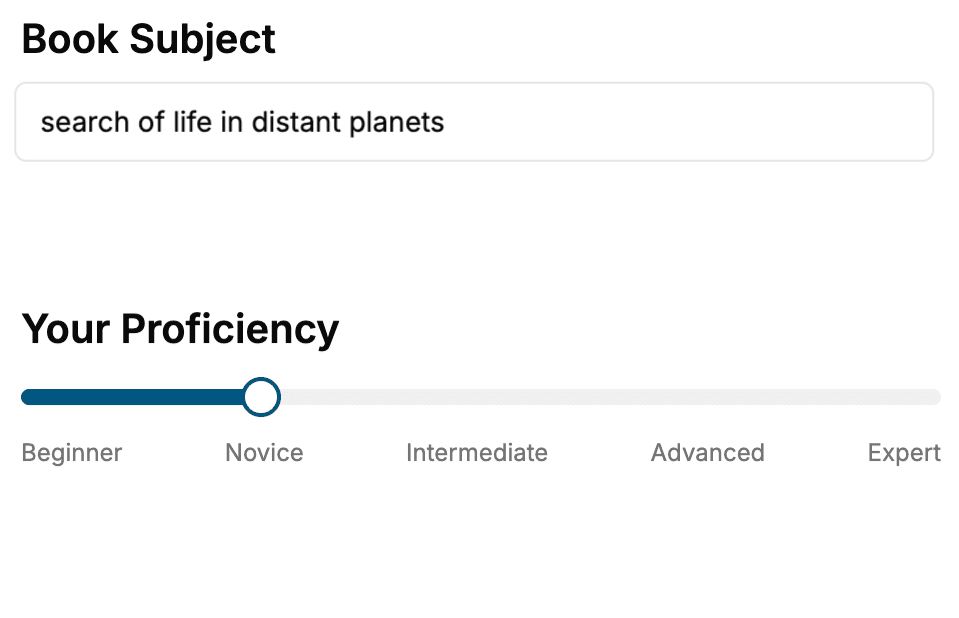
- 1. Select your focus
Select the focus of your Philosophy of Physics book and share your background
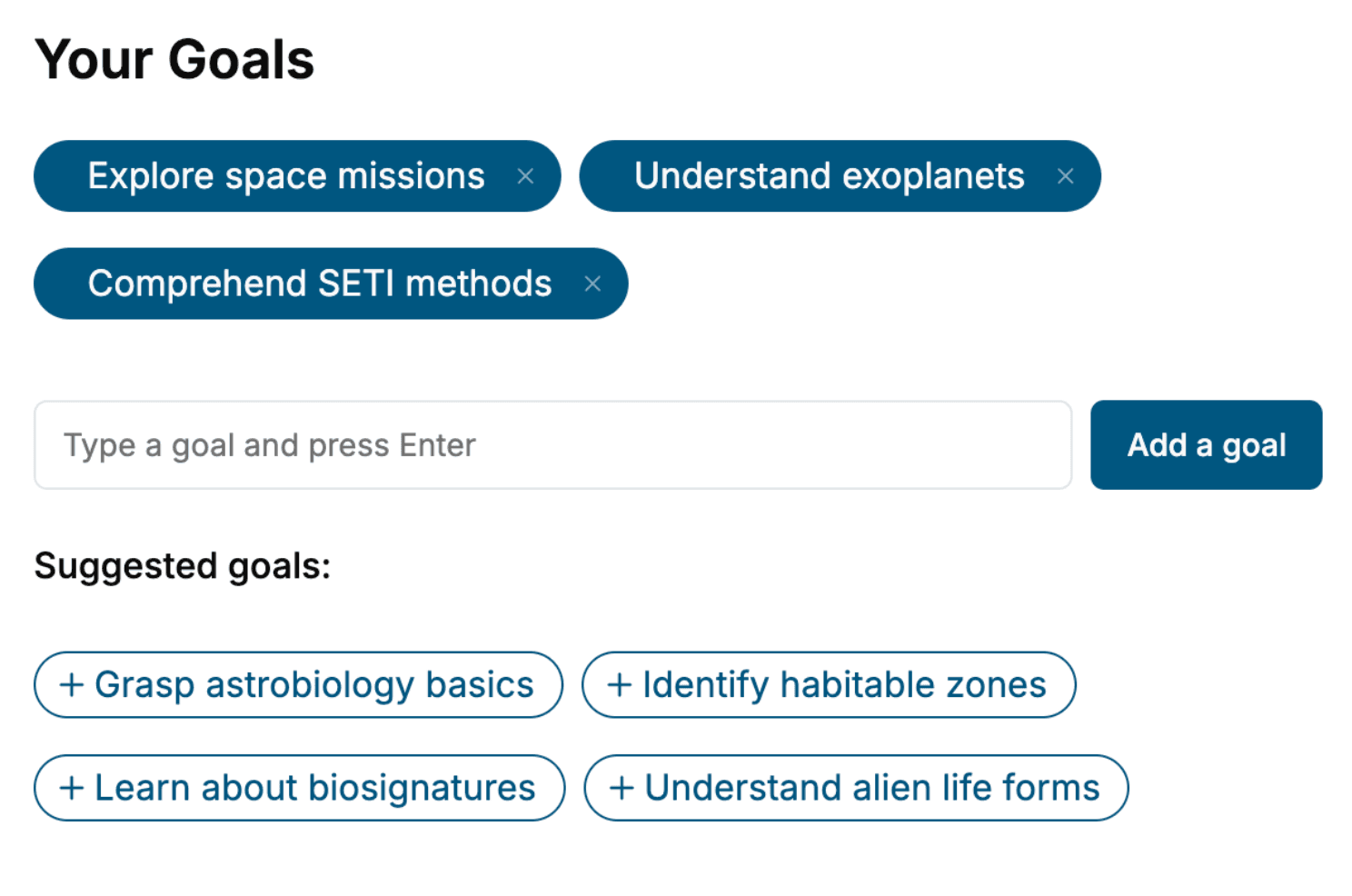
- 2. Personalize your book
Specify your goals and choose sub-topics to include
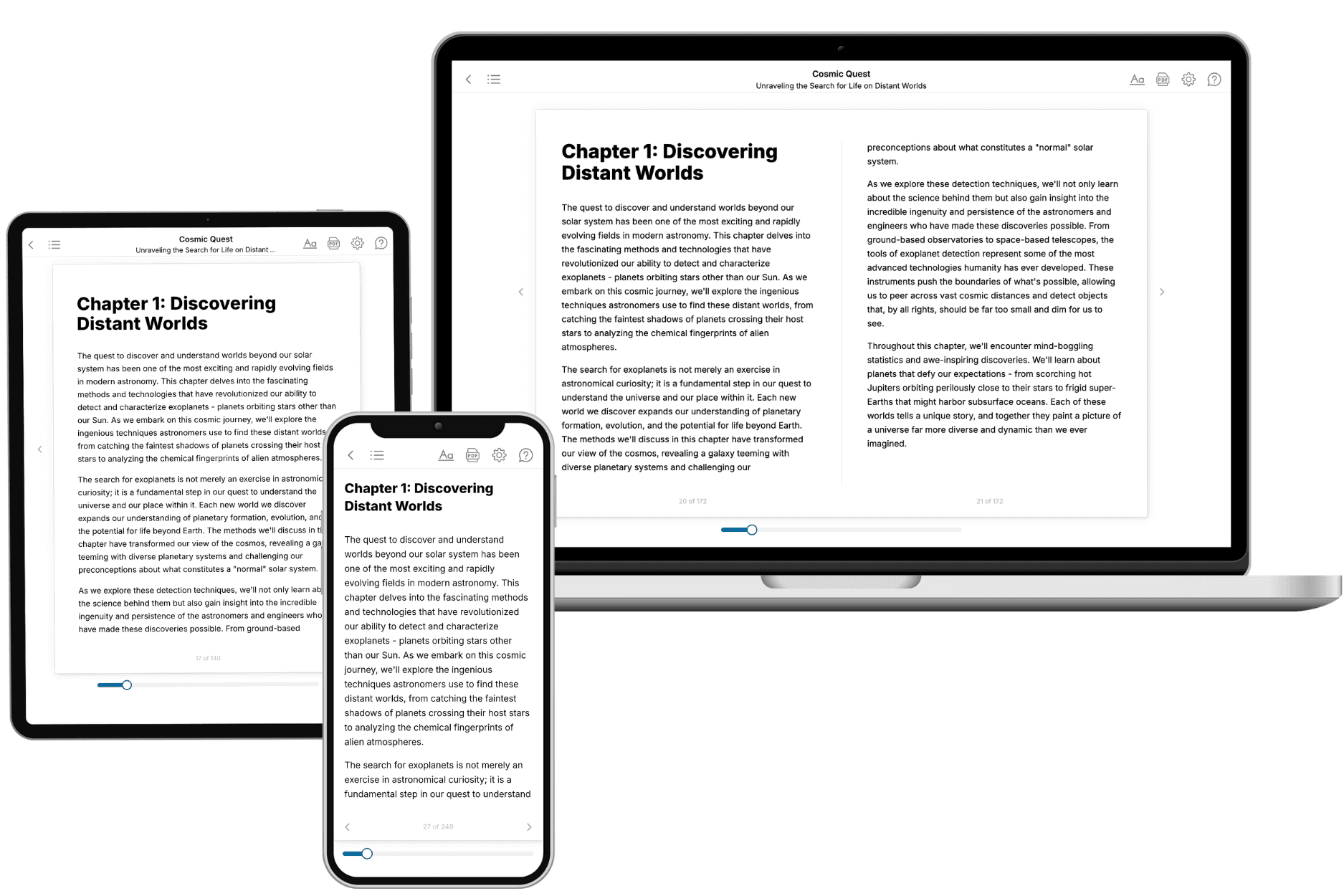
- 3. Get your tailored book
Your book is ready in 10 minutes. Read it online, download as EPUB or PDF, or send to Kindle.
Start from a template
Frequently asked questions
- What is TailoredRead?
TailoredRead creates complete, full-length nonfiction ebooks, written specifically for you. Tell us what you want to learn and why, and TailoredRead writes you a complete ebook on it, with charts, tables, and diagrams throughout. Read it online, on Kindle, or on any e-reader, or download it as a PDF or EPUB. Every book is written fresh the day you order it.
- How is the book tailored to me?
Before anything is written, you answer a few short questions about your goals, your background, and the topics you care about. Your book is then planned around your answers: written at your level, focused on your goals, and covering the topics you chose, instead of the one-size-fits-all book a store sells everyone.
- Will it read like generic AI content?
No. Your book isn't a chat transcript: it's planned chapter by chapter before a single word is written, told in a clear book voice, and explains ideas visually with charts, tables, and diagrams. After writing, every book goes through an editorial pass that polishes chapters so the book reads consistent from start to finish. Judge for yourself: browse thousands of sample books on our Explore Books page.
- How accurate is the content?
Our AI first checks whether your subject needs live research. Niche and fast-moving subjects are researched before writing, and the book plan and chapters are grounded in what it finds. After writing, every book goes through a quality pass that checks its facts and consistency, and researched books list their sources in a Notes section at the back.
- How long is the book?
You choose the length: Comprehensive (250-300 pages), Detailed (150-200 pages), Essential (70-100 pages), or Short (30-50 pages).
- Does the book include visuals?
Yes. Every book includes charts, tables, and diagrams: timelines, checklists, step-by-step guides, decision trees, comparison tables, matrices, and bar charts. A typical book includes dozens of these visual elements.
- Can I read it on Kindle? What formats can I download?
Yes. Every book can be read in our online reader or downloaded as a PDF or EPUB. The EPUB can be opened with Kindle, Apple Books, Kobo, and any e-reader. The Commercial and Author licenses also include an editable Word (DOCX) and Markdown download.
- How much does it cost?
About the price of a regular ebook. The exact price depends on your book's length and complexity, from $2 for the shortest books to $35 for the most comprehensive, and it's shown when you review your book, before you commit to anything. Each book is a one-time purchase, yours to keep, no subscription. Licenses that let you share, teach, or publish your book range from $35.99 to $49.99.
- Can I preview the book before purchasing?
Before you pay, you'll see what your book will cover: the title, a detailed description, the estimated length, and the complete chapter-by-chapter table of contents, so you know what you're getting before you decide. The full text itself is written after you purchase.
- How long does it take to create a book?
About 10 minutes. You can start reading the opening chapters while the rest is still being written.