The Quantum Revolution
How Physics Shaped Civilization and Changed the Course of Human History
Most people think quantum mechanics is an esoteric field reserved for physicists in laboratories, disconnected from everyday life and historical events.
222 pages12 chaptersEnglishOct 16, 2025Physics
About this book
Nothing could be further from the truth. Every smartphone you touch, every medical scan you receive, every GPS direction you follow exists because of quantum physics—and the story of how we discovered these principles is inseparable from the rise and fall of empires, the outcome of wars, and the transformation of human society. This book reveals the hidden connections between physics breakthroughs and civilizational change. You'll discover how Newton's laws enabled the Industrial Revolution, how Einstein's relativity reshaped geopolitics, and how quantum mechanics birthed the digital age. From ancient astronomers to Manhattan Project scientists, from the steam engine to the silicon chip, you'll see how our understanding of the physical world has repeatedly rewritten the human story. This is not a textbook—it's the epic tale of how curiosity about nature's deepest secrets changed everything about how we live, work, and understand our place in the cosmos.
Table of contents
- IntroductionThe Invisible Foundation of Modern Life, The Physics-Civilization Connection, A Roadmap Through Time and SpaceRead below
- Chapter 1: Ancient Observations and Early CivilizationsCelestial Patterns and Agricultural Societies, Greek Atomism and the Birth of Physical Theory, Practical Physics in Ancient Engineering, Astronomy and the Age of Navigation
- Chapter 2: The Classical RevolutionNewton's Laws and the Mechanistic Universe, How Physics Shaped Enlightenment Thinking, Thermodynamics and the Steam Engine, The Industrial Transformation
- Chapter 3: Electricity, Magnetism, and the Second Industrial AgeMaxwell's Equations and Electromagnetic Unity, Electric Power and Urban Transformation, Wireless Communication and Global Connectivity, The Electrification of Society
- Chapter 4: The Dawn of Quantum TheoryBlackbody Radiation and Planck's Constant, The Photoelectric Effect and Light Quanta, Bohr's Atom and Quantum Jumps, Wave-Particle Duality and the End of Certainty
- Chapter 5: Relativity and the Reshaping of RealitySpecial Relativity and the Nature of Time, General Relativity and Curved Spacetime, The Philosophical and Cultural Impact
- Chapter 6: The Complete Quantum Mechanics FrameworkHeisenberg, Schrödinger, and the Quantum Formalism, The Uncertainty Principle and Its Implications, Quantum Measurement and the Observer Problem, The Copenhagen Interpretation and Its Alternatives
- Chapter 7: The Atomic Age and Geopolitical PowerNuclear Fission and Chain Reactions, The Manhattan Project and World War II, The Cold War and Nuclear Deterrence, Nuclear Energy and Civilian Applications
- Chapter 8: The Semiconductor RevolutionQuantum Mechanics of Solids and Band Theory, The Invention of the Transistor, Integrated Circuits and Moore's Law, The Birth of Digital Civilization
- Chapter 9: Quantum Technologies in Modern LifeLasers and Their Countless Applications, Medical Imaging and Quantum Diagnostics, GPS and Relativistic Precision
- Chapter 10: The Information Age and Quantum ComputingInformation Theory and Digital Communication, Quantum Information and Entanglement, Quantum Computers and Future Possibilities, Quantum Cryptography and Security
- Chapter 11: Cultural and Philosophical TransformationsFrom Determinism to Probability, Physics and Religious Worldviews, Quantum Mechanics in Popular Culture
- Chapter 12: Future HorizonsQuantum Materials and Nanotechnology, The Future of Energy Production, Space Exploration and Physics Frontiers, The Next Scientific Revolution
- ConclusionPhysics and Human Destiny, The Continuing Story
Introduction
Every morning, billions of people wake to alarm clocks powered by quantum mechanics, check smartphones built on semiconductor physics, and navigate using GPS satellites that account for relativistic time dilation. Yet most remain unaware that these everyday conveniences exist only because of discoveries about the fundamental nature of reality made over the past few centuries. The physics revolution that began with Newton's apple and culminated in quantum computers represents far more than scientific progress—it marks the most profound transformation in human civilization since the invention of agriculture. This book tells the story of how our quest to understand the physical universe has repeatedly reshaped society, technology, culture, and the very trajectory of human history.
The connection between physics and civilization runs deeper than most people realize. When Isaac Newton formulated his laws of motion in the seventeenth century, he did more than describe how objects move—he provided the mathematical foundation that would enable the Industrial Revolution a century later. When James Clerk Maxwell unified electricity and magnetism in the 1860s, he unknowingly laid the groundwork for every electric motor, radio transmission, and wireless device that would follow. When quantum mechanics emerged in the early twentieth century, it seemed like abstract theory divorced from practical concerns, yet within decades it had given birth to nuclear energy, transistors, lasers, and the entire digital age. Each breakthrough in understanding nature's laws has cascaded through society, transforming how we live, work, communicate, and understand our place in the cosmos.
This introduction sets the stage for an epic journey through time and ideas. You'll discover how physics has served as the invisible architect of modernity, constructing the technological infrastructure of contemporary life while simultaneously challenging and reshaping human thought. The story ahead weaves together scientific discovery, technological innovation, geopolitical conflict, and cultural transformation. It reveals patterns that repeat across centuries: theoretical breakthroughs that initially seem impractical eventually revolutionize daily life, often in ways their discoverers never imagined. Understanding these connections illuminates not just where we've been, but where we're headed as quantum technologies continue to reshape the twenty-first century and beyond.
The narrative that follows is organized chronologically but structured thematically, tracing how each major physics revolution triggered corresponding civilizational shifts. You'll see how ancient observations of celestial patterns enabled agricultural societies and navigation, how classical mechanics powered industrialization, how electromagnetism created the modern city, and how quantum mechanics birthed the digital world. Along the way, you'll encounter the scientists whose curiosity changed history, the technologies that transformed society, and the philosophical upheavals that forced humanity to reconceptualize reality itself. This is not a textbook filled with equations—it's the human story of how we learned to decode nature's deepest secrets and used that knowledge to build the world we inhabit today.
The Invisible Foundation of Modern Life
Consider the device you might be reading this on—whether a tablet, e-reader, or smartphone. Its existence depends entirely on quantum mechanics, a theory that describes the bizarre behavior of matter at atomic scales. The semiconductor chips that process information rely on quantum tunneling, where electrons pass through barriers they classically shouldn't be able to cross. The touchscreen uses principles of capacitance and electric fields discovered through nineteenth-century electromagnetic research. The battery stores energy through electrochemical reactions governed by quantum mechanical principles of electron behavior. Even the light from the screen emerges from quantum processes in LED materials. Every component, every function, every capability traces back to physics discoveries made over the past three centuries.
This dependence on physics extends far beyond personal electronics. Modern medicine relies on technologies born from quantum mechanics and nuclear physics. MRI machines use quantum spin properties of atomic nuclei in powerful magnetic fields to image soft tissues inside the body. PET scans detect gamma rays from radioactive tracers to reveal metabolic activity. Laser surgery employs stimulated emission of radiation, a purely quantum phenomenon, to perform precise operations impossible with traditional scalpels. Radiation therapy for cancer treatment applies our understanding of how high-energy particles interact with biological tissue. Without twentieth-century physics, modern healthcare would be unrecognizable, and countless lives saved by these technologies would have been lost.
Transportation systems similarly depend on physics principles at every level. GPS navigation requires corrections for both special and general relativistic effects—satellites experience time differently than ground-based receivers due to their velocity and position in Earth's gravitational field. Without accounting for these relativistic time dilations, GPS coordinates would drift by kilometers within hours, rendering the system useless. Aircraft design relies on fluid dynamics and thermodynamics principles refined over centuries. Electric vehicles use motors based on electromagnetic induction discovered by Michael Faraday in the 1830s, powered by batteries whose chemistry depends on quantum mechanical electron behavior. Even traditional combustion engines operate according to thermodynamic principles first formulated to understand steam power during the Industrial Revolution.
The infrastructure of modern communication represents perhaps the most dramatic example of physics shaping civilization. The internet transmits information as light pulses through fiber optic cables, exploiting total internal reflection and the electromagnetic properties of light. Wireless communication—from radio to WiFi to cellular networks—uses electromagnetic waves whose existence Maxwell predicted mathematically before anyone had detected them experimentally. Satellites relay signals from orbit, their electronics hardened against radiation whose effects we understand through nuclear physics. Data centers process information using billions of transistors, each one a quantum mechanical device that controls electron flow through semiconductor materials. The global connectivity that defines contemporary life exists only because we learned to manipulate electromagnetic fields and quantum states.
Energy production and distribution systems reveal similar dependencies on physics knowledge. Nuclear power plants generate electricity through controlled fission reactions, splitting uranium atoms according to principles discovered in the 1930s and weaponized in the 1940s. Solar panels convert light to electricity through the photoelectric effect, the quantum phenomenon that earned Einstein his Nobel Prize. Wind turbines and hydroelectric dams harness mechanical energy according to classical physics principles, converting it to electrical energy through electromagnetic induction. The power grid itself distributes alternating current, a choice made possible by understanding how transformers can efficiently change voltage levels using electromagnetic principles. Every watt of power flowing through modern civilization does so because we learned to harness fundamental forces of nature.
Even entertainment and leisure activities rest on physics foundations. Digital photography captures images using charge-coupled devices or CMOS sensors, both quantum mechanical technologies that convert photons to electrical signals. Streaming video compresses and transmits data using algorithms optimized for the physics of signal processing and information theory. Video games render graphics using GPUs that perform billions of calculations per second, each calculation executed by transistors operating in quantum mechanical regimes. Music production uses digital signal processing based on Fourier analysis, a mathematical technique developed to solve heat flow problems in the nineteenth century. Virtual reality headsets track motion using accelerometers and gyroscopes based on classical mechanics, displaying images on screens using quantum mechanical light emission. The boundary between physics and daily experience has dissolved completely.
This pervasive dependence on physics remains largely invisible because the technologies work so reliably. You don't need to understand quantum tunneling to use a smartphone, just as you don't need to understand internal combustion to drive a car. But this invisibility obscures a profound truth: the modern world is built entirely on our accumulated understanding of physical principles. Every convenience, every capability, every technology that distinguishes contemporary life from that of our ancestors exists because someone, somewhere, figured out how nature works at a fundamental level and someone else figured out how to exploit that knowledge practically. The story of how this happened—how abstract theories became concrete technologies, how curiosity-driven research transformed civilization—is the story this book tells.
The Physics-Civilization Connection
The relationship between physics discoveries and civilizational change follows recognizable patterns across history. First comes observation—someone notices a phenomenon that existing theories cannot explain. Then comes theoretical breakthrough—a new framework emerges that accounts for the puzzling observations and makes testable predictions. Next comes experimental confirmation—careful measurements verify the theory's predictions, establishing it as reliable knowledge about nature. Finally comes technological application—engineers and inventors figure out how to exploit the newly understood principles for practical purposes. This cycle has repeated throughout history, each iteration building on previous knowledge and enabling capabilities that reshape society in fundamental ways.
Consider the trajectory from Maxwell's equations to modern telecommunications. In the 1860s, James Clerk Maxwell unified electricity and magnetism into a single theoretical framework, predicting that electromagnetic waves should exist and travel at the speed of light. This was pure theory, mathematical physics with no immediate practical application. In the 1880s, Heinrich Hertz experimentally confirmed Maxwell's predictions by generating and detecting radio waves in his laboratory. Still, this remained scientific curiosity with no obvious use. In the 1890s, Guglielmo Marconi and others developed practical wireless telegraphy systems, demonstrating that electromagnetic waves could transmit information across distances. By the early twentieth century, radio broadcasting had emerged, fundamentally changing how information spread through society. Today, electromagnetic wave transmission underpins virtually all wireless communication, from AM radio to 5G cellular networks.
This pattern—from theoretical prediction to experimental confirmation to technological revolution—typically spans decades or even generations. The lag between discovery and application means that scientists rarely foresee the practical consequences of their work. When Max Planck introduced the quantum of action in 1900 to solve a problem about blackbody radiation, he had no inkling that his constant would eventually enable transistors and computer chips. When Einstein explained the photoelectric effect in 1905, he wasn't thinking about solar panels or digital cameras. When Erwin Schrödinger formulated his wave equation in 1926, he couldn't have imagined MRI machines or quantum computers. The most transformative technologies often emerge from research pursued purely to satisfy curiosity about how nature works, with practical applications appearing only after the fundamental principles are thoroughly understood.
The physics-civilization connection also operates in reverse: practical problems often drive theoretical breakthroughs. The steam engine existed before thermodynamics—engineers built working engines through trial and error, and physicists then developed theories to explain why they worked and how to improve them. This theoretical understanding, in turn, enabled more efficient engine designs and eventually led to deeper insights about energy, entropy, and the fundamental limits of heat engines. Similarly, the development of radar during World War II drove advances in microwave physics and electronics that later enabled technologies from microwave ovens to satellite communication. The relationship between theory and application is bidirectional, with each domain pushing the other forward in an ongoing cycle of discovery and innovation.
Geopolitical factors have repeatedly accelerated physics research and its technological applications. The race to develop atomic weapons during World War II concentrated unprecedented resources on nuclear physics, compressing decades of potential research into a few years of intense effort. The Cold War competition between the United States and Soviet Union drove massive investments in physics research, from particle accelerators to space exploration. The desire for military advantage has funded research into everything from radar to cryptography to materials science, with civilian applications often emerging as byproducts. While the connection between physics and warfare is troubling, it's historically undeniable that geopolitical competition has been a major driver of scientific progress and technological development.
The civilizational impact of physics extends beyond technology to reshape philosophy, culture, and worldviews. Newton's mechanistic universe suggested a clockwork cosmos governed by deterministic laws, influencing Enlightenment thinking about reason, progress, and natural rights. Darwin's evolution by natural selection, while biological rather than physical, drew inspiration from geological time scales and physical processes. Einstein's relativity challenged intuitive notions of absolute time and space, contributing to modernist movements in art and literature that questioned traditional certainties. Quantum mechanics introduced fundamental uncertainty and observer-dependence into physics, sparking philosophical debates about reality, measurement, and consciousness that continue today. Each major physics revolution has forced humanity to reconceptualize its place in the universe and the nature of reality itself.
Understanding these connections illuminates why physics matters beyond the laboratory. When you grasp that GPS depends on relativity, that computers depend on quantum mechanics, that modern medicine depends on nuclear physics, you see that these theories aren't abstract mathematical games—they're accurate descriptions of how nature actually works, descriptions so accurate that we can build civilization-transforming technologies on them. The fact that quantum mechanics seems bizarre and counterintuitive becomes less important than the fact that it correctly predicts experimental results and enables functional devices. Physics succeeds not because it matches our intuitions about how nature should work, but because it matches how nature actually does work, as verified through countless experiments and demonstrated through countless technologies.
This book explores these connections systematically, showing how each major physics breakthrough triggered corresponding civilizational changes. You'll see how the same patterns repeat across different eras: initial resistance to counterintuitive ideas, gradual acceptance as experimental evidence accumulates, theoretical refinement and mathematical formalization, technological exploitation, and finally societal transformation as the new technologies become ubiquitous. You'll discover that the history of physics is inseparable from the history of civilization—not because physics determines everything about human society, but because our understanding of the physical world has consistently enabled new capabilities that reshape how we live. The quantum revolution of the twentieth century represents the most recent and perhaps most profound iteration of this ancient pattern.
A Roadmap Through Time and Space
The journey ahead begins in the ancient world, where early civilizations made systematic observations of celestial patterns and developed practical physics knowledge for engineering and navigation. You'll discover how Babylonian astronomers tracked planetary motions to create calendars, how Greek philosophers proposed atomic theories of matter, and how ancient engineers applied mechanical principles to build structures and machines. These early efforts established patterns that would repeat throughout history: careful observation, theoretical speculation, practical application, and gradual refinement of understanding. While ancient physics lacked the mathematical sophistication and experimental rigor of modern science, it laid conceptual foundations and demonstrated that systematic study of nature could yield useful knowledge.
The narrative then moves to the classical revolution of the seventeenth and eighteenth centuries, when Newton and his contemporaries established physics as a mathematical science. You'll see how Newton's laws of motion and universal gravitation provided a unified framework for understanding both terrestrial and celestial phenomena, how this mechanistic worldview influenced Enlightenment philosophy, and how thermodynamics emerged from efforts to improve steam engines. This era established the scientific method as we know it—mathematical theory tested against careful experiment—and demonstrated that nature follows precise, discoverable laws. The Industrial Revolution that followed was enabled by this new understanding of mechanics and thermodynamics, showing how theoretical physics could drive technological and economic transformation.
The book then explores the electromagnetic revolution of the nineteenth century, when researchers discovered the deep connections between electricity, magnetism, and light. You'll learn how Faraday's experiments revealed electromagnetic induction, how Maxwell's equations unified these phenomena and predicted electromagnetic waves, and how these discoveries enabled electric power generation, distribution, and wireless communication. This era saw the emergence of the modern research laboratory and the professionalization of physics as a discipline. The technologies that emerged—electric lighting, motors, generators, radio—transformed urban life and created the infrastructure of the Second Industrial Revolution. The world became connected in new ways as electromagnetic technologies enabled instant communication across vast distances.
Next comes the quantum revolution of the early twentieth century, when physicists discovered that nature behaves very differently at atomic scales than our everyday experience suggests. You'll encounter the key discoveries that forced this conceptual revolution:
- Planck's quantum of action and the resolution of the blackbody radiation problem
- Einstein's explanation of the photoelectric effect and the concept of light quanta
- Bohr's atomic model and the quantization of energy levels
- De Broglie's wave-particle duality and the dual nature of matter
- Heisenberg's uncertainty principle and the limits of measurement
- Schrödinger's wave equation and the probabilistic interpretation of quantum mechanics
Parallel to quantum mechanics, you'll explore Einstein's theories of relativity and their implications. Special relativity revealed that space and time are not absolute but depend on the observer's motion, while general relativity showed that gravity is the curvature of spacetime itself. These theories challenged basic intuitions about the nature of reality and had profound philosophical implications. They also had practical consequences: GPS systems must account for relativistic effects, and general relativity predicts phenomena from black holes to gravitational waves that have been experimentally confirmed. The relativistic revolution demonstrated that even our most basic concepts—space, time, simultaneity—are more subtle than everyday experience suggests.
The book then examines how quantum mechanics and nuclear physics shaped the mid-twentieth century through the development of atomic weapons and nuclear energy. You'll see how the Manhattan Project concentrated unprecedented scientific talent and resources to develop the first atomic bombs, how nuclear weapons altered geopolitical dynamics during the Cold War, and how nuclear energy emerged as a civilian power source. This era demonstrated both the power and the peril of physics knowledge—the same understanding that enabled nuclear power also enabled nuclear weapons. The atomic age forced humanity to confront the consequences of scientific knowledge and raised questions about the responsibility of scientists that remain relevant today.
Following the atomic age, you'll discover how quantum mechanics enabled the semiconductor revolution that created modern computing and telecommunications. The story includes:
- The development of quantum mechanical band theory explaining how electrons behave in solid materials
- The invention of the transistor at Bell Labs in 1947, replacing vacuum tubes with solid-state devices
- The development of integrated circuits that packed multiple transistors onto single chips
- Moore's Law and the exponential growth in computing power over decades
- The emergence of personal computers, the internet, and mobile devices
- The transformation of society through digital technologies
The narrative continues with an exploration of other quantum technologies that have become ubiquitous: lasers used in everything from barcode scanners to fiber optic communication to surgery; medical imaging technologies like MRI and PET scans; atomic clocks that enable GPS and synchronize global communication networks; and LED lighting that is replacing older technologies worldwide. You'll see how quantum mechanics, once considered abstract and impractical, now underpins technologies that billions of people use daily. The quantum revolution didn't just change physics—it changed everything about how modern society functions.
The book then examines the cultural and philosophical transformations triggered by physics discoveries. You'll explore how quantum mechanics challenged determinism and introduced fundamental uncertainty into our description of nature, how relativity reshaped concepts of space and time, and how these scientific revolutions influenced broader cultural movements. The discussion includes how physics has interacted with religious worldviews, how quantum concepts have been appropriated (and often misused) in popular culture, and how scientific discoveries have repeatedly forced humanity to reconceptualize its place in the cosmos. Physics has been not just a technological force but a philosophical and cultural one, shaping how we think about reality, causation, and knowledge itself.
Finally, the book looks toward future horizons, exploring emerging technologies and ongoing research that may trigger the next civilizational transformation. You'll learn about quantum computers that exploit superposition and entanglement to solve problems beyond the reach of classical computers, quantum cryptography that promises unbreakable security, new materials with exotic properties, and ongoing efforts to develop fusion energy and other advanced power sources. The discussion includes current frontiers in physics research—from dark matter and dark energy to quantum gravity—and speculates about how future breakthroughs might reshape civilization once again. The quantum revolution is not over; if anything, it's accelerating as we learn to manipulate quantum systems with increasing precision and sophistication.
Throughout this journey, you'll encounter recurring themes that connect different eras and discoveries. One is the power of mathematical description—physics succeeds because it expresses natural laws in precise mathematical language that enables quantitative predictions. Another is the importance of experimental verification—theories must be tested against careful measurements to establish their validity. A third is the unpredictability of applications—the most transformative technologies often emerge from research pursued for purely intellectual reasons. A fourth is the bidirectional relationship between theory and practice—practical problems drive theoretical research, and theoretical understanding enables new technologies. These patterns repeat across centuries, suggesting deep truths about how scientific knowledge accumulates and how it transforms society.
This book is written for you—someone curious about science and history, interested in understanding how the modern world came to be, and willing to engage with ideas that challenge everyday intuitions. You don't need advanced mathematics or prior physics knowledge to follow the narrative. Technical concepts are explained in accessible language, with emphasis on physical intuition rather than mathematical formalism. The focus is on the big picture: how physics discoveries have shaped civilization, why these discoveries matter beyond the laboratory, and what patterns connect different eras of scientific revolution. By the end, you'll see the modern world differently, recognizing the quantum mechanical and relativistic foundations underlying technologies you use daily and understanding how we got from Newton's apple to quantum computers.
The story that follows is ultimately a human story—about curiosity, creativity, persistence, and the drive to understand nature's deepest secrets. It's about scientists who challenged conventional wisdom, often facing resistance and skepticism before their ideas were accepted. It's about engineers and inventors who transformed abstract theories into practical technologies. It's about societies that were transformed by new capabilities, sometimes in ways that created new problems even as they solved old ones. And it's about you, living in a world shaped by quantum mechanics and relativity, using technologies that would seem like magic to people just a few generations ago. Understanding how we got here illuminates not just the past but the future, as the quantum revolution continues to unfold in ways we're only beginning to imagine.
This is the end of the free sample. The full book has 12 chapters.
Want this book written for you?
Tell us your goals and background, and get your own version of this book, tailored by AI to you.


Benefits of AI-tailored books
- Read one book, not ten:
- all the Physics knowledge you need, gathered into a single book.
- Save days of learning:
- tell us your goals, choose your topics, and the whole book is built around them.
- Learn effortlessly:
- Physics book written for your specific background and expertise.
- Understand at a glance:
- includes charts, tables, timelines, checklists, decision trees, and more.
- Stay current:
- written the day you order it, not years ago.
- Trust what you read:
- every book is checked for accuracy, with real research when your subject needs it.
Create your unique book in 3 steps
- 1. Select your focus
Select the focus of your Physics book and share your background
- 2. Personalize your book
Specify your goals and choose sub-topics to include
- 3. Get your tailored book
Your book is ready in 10 minutes. Read it online, download as EPUB or PDF, or send to Kindle.


Frequently asked questions
- What is TailoredRead?
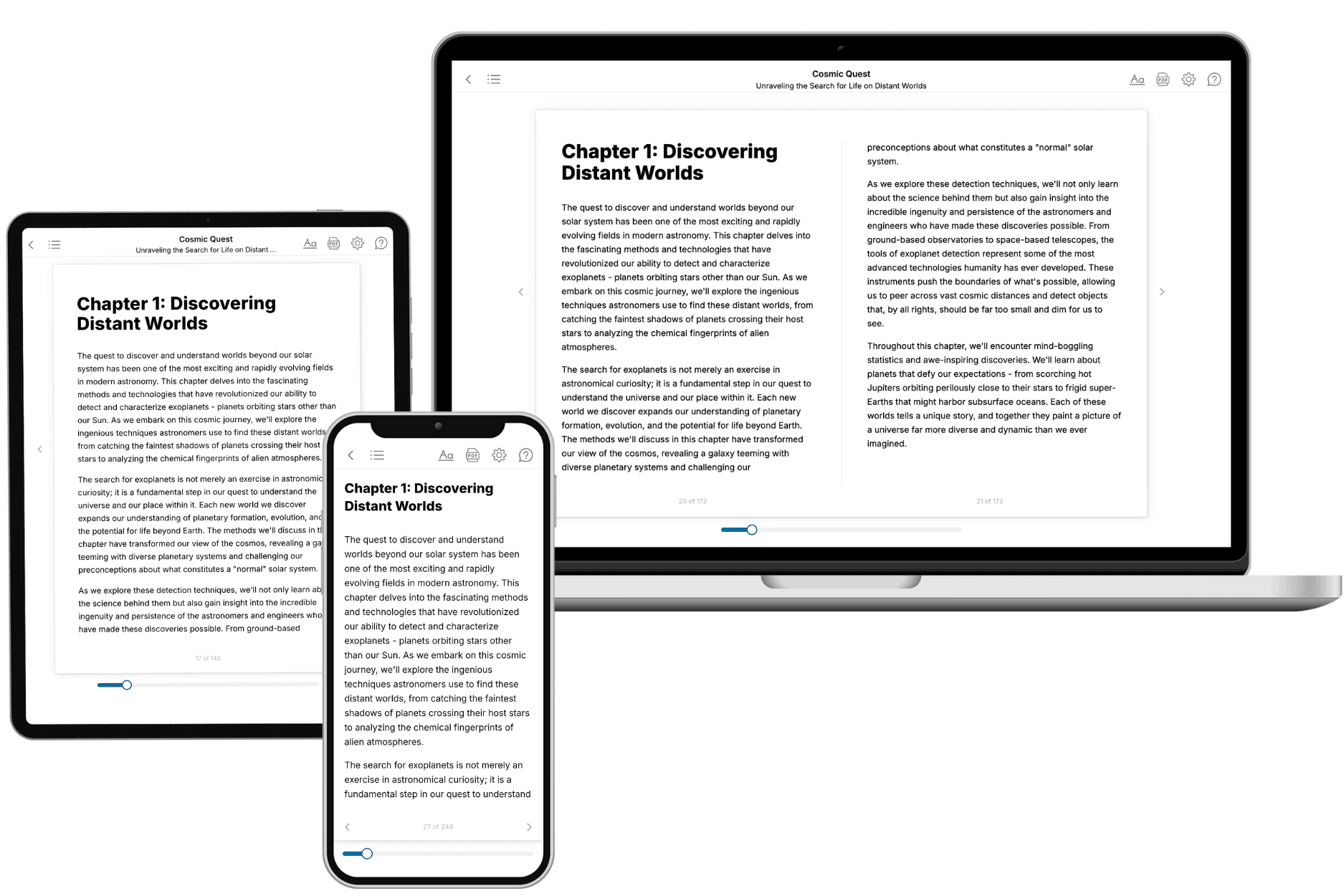
TailoredRead creates complete, full-length nonfiction ebooks, written specifically for you. Tell us what you want to learn and why, and TailoredRead writes you a complete ebook on it, with charts, tables, and diagrams throughout. Read it online, on Kindle, or on any e-reader, or download it as a PDF or EPUB. Every book is written fresh the day you order it.
- How is the book tailored to me?
Before anything is written, you answer a few short questions about your goals, your background, and the topics you care about. Your book is then planned around your answers: written at your level, focused on your goals, and covering the topics you chose, instead of the one-size-fits-all book a store sells everyone.
- Will it read like generic AI content?
No. Your book isn't a chat transcript: it's planned chapter by chapter before a single word is written, told in a clear book voice, and explains ideas visually with charts, tables, and diagrams. After writing, every book goes through an editorial pass that polishes chapters so the book reads consistent from start to finish. Judge for yourself: browse thousands of sample books on our Explore Books page.
- How accurate is the content?
Our AI first checks whether your subject needs live research. Niche and fast-moving subjects are researched before writing, and the book plan and chapters are grounded in what it finds. After writing, every book goes through a quality pass that checks its facts and consistency, and researched books list their sources in a Notes section at the back.
- How long is the book?
You choose the length: Comprehensive (250-300 pages), Detailed (150-200 pages), Essential (70-100 pages), or Short (30-50 pages).
- Does the book include visuals?
Yes. Every book includes charts, tables, and diagrams: timelines, checklists, step-by-step guides, decision trees, comparison tables, matrices, and bar charts. A typical book includes dozens of these visual elements.
- Can I read it on Kindle? What formats can I download?
Yes. Every book can be read in our online reader or downloaded as a PDF or EPUB. The EPUB can be opened with Kindle, Apple Books, Kobo, and any e-reader. The Commercial and Author licenses also include an editable Word (DOCX) and Markdown download.
- How much does it cost?
About the price of a regular ebook. The exact price depends on your book's length and complexity, from $2 for the shortest books to $35 for the most comprehensive, and it's shown when you review your book, before you commit to anything. Each book is a one-time purchase, yours to keep, no subscription. Licenses that let you share, teach, or publish your book range from $35.99 to $49.99.
- Can I preview the book before purchasing?
Before you pay, you'll see what your book will cover: the title, a detailed description, the estimated length, and the complete chapter-by-chapter table of contents, so you know what you're getting before you decide. The full text itself is written after you purchase.
- How long does it take to create a book?
About 10 minutes. You can start reading the opening chapters while the rest is still being written.