Phenomenology Books
Explore tailored Phenomenology books created by our AI
Husserl's Vision
Unveiling Phenomenology in the Light of Renaissance Thought
Discover the revolutionary ideas of Edmund Husserl and the profound impact of phenomenology on modern philosophy. This illuminating exploration takes you on an intellectual journey through the intricate web of Husserl's thought, seamlessly connecting it to the rich tapestry of Renaissance philosophy. You'll gain a deeper understanding of how consciousness shapes our perception of reality and how Husserl's methods continue to influence contemporary thinking. Delve into the core principles of phenomenology, from the concept of intentionality to the epoché (phenomenological reduction). You'll explore how these ideas both built upon and diverged from Renaissance philosophical traditions, offering a fresh perspective on the evolution of Western thought. Through clear explanations and engaging examples, you'll develop the tools to apply phenomenological insights to your own experiences and intellectual pursuits. Whether you're a philosophy enthusiast or a curious thinker seeking to expand your intellectual horizons, this book offers a accessible yet authoritative guide to one of the most influential philosophical movements of the 20th century. By the end, you'll possess a robust understanding of Husserl's contributions and be equipped to engage in meaningful discussions about consciousness, perception, and the nature of human experience.
The Poetics of Ethics
Aesthetic Resistance, Alterity, and the Ethical Limits of Language
How can poetry speak what philosophy cannot? This book challenges the assumption that ethics belongs exclusively to the domain of rational argument and systematic thought. By tracing the work of major continental philosophers—from Levinas and Heidegger to Deleuze, Derrida, and Butler—alongside poets like Celan, Artaud, and Weil, this study reveals how poetic language articulates ethical dimensions that exceed conventional moral categories. You'll discover how fragmentation, silence, and linguistic rupture become ethical strategies; how affect and emotion ground moral judgment; and how the encounter with alterity demands a poetics of resistance. This book integrates phenomenology, deconstruction, and aesthetic theory to show that ethics is fundamentally a question of form—how we write, speak, and create meaning in the face of suffering, precarity, and radical otherness. Whether examining tragedy's moral necessity, the ethics of memory, or the politics of aesthetic distribution, this work develops a philosophical methodology that treats poetry not as illustration but as essential to ethical thought itself.
Impossible Subjects
Genealogy, Ontology, and Resistance in the Limits of Subjectification
The greatest obstacle facing contemporary ethics is our inability to think beyond normative categories of subjectivity. We inherit frameworks that demand subjects conform to predetermined identities, rendering impossible those whose existence exceeds these boundaries—the mad, the precarious, the disabled, the nomadic. This book develops a rigorous philosophical approach to impossible subjects by integrating genealogical, ontological, and ethical dimensions of post-structuralist thought. Drawing on Nietzsche, Deleuze, Spinoza, Foucault, and Guattari, it demonstrates how subjectification operates as a biopolitical mechanism while simultaneously exploring how resistance emerges through singularity and becoming. Rather than seeking to include impossible subjects within existing frameworks, this work argues for a fundamental reconceptualization of subjectivity itself. By examining the limits of human agency, the ethics of exclusion, and the poetics of resistance, it offers tools for understanding how subjects form, resist, and persist at the margins of what is deemed recognizable or livable. This is essential reading for those committed to developing bioethical frameworks adequate to the complexity of human existence in its most vulnerable and singular forms.
The Art of Understanding
Hermeneutics and Its Impact on Philosophical Thought
The challenge of truly understanding texts, ideas, and philosophical arguments often feels overwhelming when you realize that interpretation itself is far more complex than it initially appears. Every time you engage with a philosophical work, you bring your own assumptions, cultural background, and historical context to the reading—but how do these factors shape what you understand, and how can you become more aware of this process? This comprehensive exploration of hermeneutics reveals how the art of interpretation has evolved from biblical scholarship into one of philosophy's most influential disciplines. You'll discover how major thinkers like Schleiermacher, Dilthey, Heidegger, and Gadamer revolutionized our understanding of what it means to interpret and comprehend. Through clear explanations and practical examples, you'll learn to recognize the hermeneutical dimensions present in all philosophical inquiry. The book guides you through the key concepts that define hermeneutical thinking: the hermeneutical circle, the fusion of horizons, the role of prejudgments, and the relationship between language and understanding. You'll explore how different philosophical movements—from phenomenology to existentialism to postmodernism—have incorporated hermeneutical insights into their approaches to knowledge and reality. By the end, you'll possess a sophisticated understanding of how interpretation works and why hermeneutics matters for anyone serious about philosophical thinking. You'll be equipped with conceptual tools that will enhance your ability to engage with complex texts and ideas while remaining aware of the interpretive processes at work in your own thinking.
Heidegger's Horizon
Unveiling the Depths of Being and Thought
Discover the profound insights of one of the 20th century's most influential philosophers. "Heidegger's Horizon: Unveiling the Depths of Being and Thought" offers you a comprehensive journey through Martin Heidegger's revolutionary ideas. This book illuminates Heidegger's complex concepts, from Being-in-the-world to his critique of modern technology, in clear, accessible language. You'll explore the intricacies of Heideggerian ontology, delve into the phenomenological method, and unravel the nuances of existential analytics. Gain a deeper understanding of authenticity, temporality, and the nature of Being itself. This book not only explains Heidegger's thoughts but also demonstrates their relevance to contemporary issues, enhancing your analytical skills and philosophical perspective. Whether you're grappling with Heidegger's seminal work "Being and Time" or exploring his later writings on art and language, this book serves as your trusted guide. It bridges the gap between abstract philosophy and practical application, allowing you to integrate Heidegger's insights into your own thinking and worldview.
Achieve a rigorous philosophical critique of medical authority that integrates epistemology, phenomenology, and disability justice into clinical practice. This book deconstructs how biomedical rationality operates as a system of power, examining epistemic injustice, hermeneutical violence, and the medicalization of human vulnerability. You'll explore how medical knowledge is socially constructed, how biopower shapes patient subjectivity, and how necropolitics determines whose suffering matters in healthcare systems. Through critical analysis of diagnosis, pain, disability, and healing, you'll develop frameworks for recognizing patients as epistemic agents, embracing medical pluralism, and resisting biomedical colonialism. Grounded in phenomenology, existentialism, and disability philosophy, this work challenges the limits of bioethical rationality and offers pathways toward more just, humble, and culturally competent medical practice that honors existential vulnerability and patient autonomy.
The Divergent Mind
Understanding Consciousness Beyond Neurotypical Frameworks
What if the way a divergent mind experiences the world isn't a malfunction to be corrected, but a fundamentally different mode of consciousness worth understanding on its own terms? This book bridges phenomenology and neuromedicine to explore how atypical minds—including those with autism, ADHD, dyslexia, and other neurodevelopmental variations—actually experience reality. Rather than viewing divergence through the lens of deficit, you'll discover how phenomenological analysis reveals the distinct intentional structures, perceptual patterns, and cognitive architectures that characterize these minds. Drawing on both clinical neuroscience and philosophical inquiry, this work examines the lived experience of divergent consciousness: how attention operates differently, how sensory information is processed and organized, and how meaning emerges through alternative cognitive pathways. You'll gain tools to understand your patients, yourself, or your own mind with greater depth and nuance, moving beyond diagnostic categories to appreciate the rich phenomenological reality of human consciousness in all its variations.
Impetus Ethicus
The Force of Becoming in Ethical Subjectivity
What if ethical responsibility doesn't emerge from rational deliberation or universal principles, but from the intensive forces that drive becoming itself? This book reconceives ethics not as a system of rules but as an impetus—a dynamic force that crystallizes through the fragmented, multiplicitous conditions of subjectivity. Drawing on Foucault's genealogical method, Spinoza's affective ontology, Deleuze's immanent critique, Bergson's temporal philosophy, and Nietzsche's affirmative ethics, this work develops a comprehensive theory of how ethical agency emerges within the constraints of biopower, how subjectification simultaneously enables and limits ethical action, and how ethical becoming operates through affective intensities and micropolitical resistance. You'll explore how ethical singularities actualize from potentiality, how collective subjects emerge through deterritorialization, and how ethical pluralism coexists with singular ethical responsibility. This is not ethics as transcendent ideal but as immanent force—the impetus that drives ethical rupture, creative resistance, and the continuous becoming-ethical of fragmented, impossible subjects navigating multiplicity.
Consciousness Unbound
Exploring Altered States and the Nature of Mind
Most of us experience consciousness in a narrow band of ordinary waking awareness, assuming this is the only "real" way the mind can function. But altered states of consciousness—whether induced through meditation, dreams, psychoactive substances, or neurological conditions—reveal something profound: our everyday perception is just one possible configuration of the mind. This book explores what altered states tell us about the fundamental nature of consciousness itself. You'll discover how these states challenge our assumptions about reality, perception, and the relationship between brain and mind. Rather than treating altered consciousness as merely abnormal or recreational, this exploration examines them as legitimate windows into how consciousness actually works. By understanding the philosophical implications of altered states, you'll gain deeper insight into your own mind, the nature of subjective experience, and what it means to be conscious at all.
Navigate the hidden genealogies and conceptual ruptures that define contemporary continental philosophy. This rigorous yet accessible guide maps the radical margins of Western thought from the seventeenth century to the present, tracing how philosophy's most transgressive voices—from Spinoza and Giordano Bruno through Derrida, Deleuze, and Foucault to contemporary thinkers like Braidotti, Mbembe, and Chakrabarty—have reshaped our understanding of being, ethics, and difference. You'll master genealogical methodology as a tool for exposing conceptual shifts, analyzing marginalized philosophical voices, and understanding how deconstruction, post-structuralism, and ontological turns have destabilized traditional frameworks. This book equips you to diagram philosophy's deviant genealogies, trace the evolution of alterity and vulnerability, and engage with contemporary debates in affect theory, disability studies, biopolitics, and digital ontology. Whether you're examining Derrida's trace, Deleuze's rhizomatic thinking, or Foucault's genealogical method, you'll develop the conceptual precision needed to analyze philosophy's most challenging and generative ideas.
Most people assume time is straightforward—it simply flows from past to future at a constant rate. Yet philosophers have spent centuries questioning this intuition, uncovering profound complexities beneath our everyday experience of temporality. This book traces how philosophical thought has fundamentally shaped our understanding of time from ancient Greece to the present day. You'll discover how Parmenides challenged the reality of change itself, how Augustine connected time to consciousness, and how Einstein's physics forced philosophers to reconsider time's very nature. Rather than presenting abstract theory divorced from reality, this exploration shows how these ideas directly impact how we understand causality, free will, memory, and mortality. Whether you're curious about why the present moment feels special, how the past can influence the future, or whether time truly flows, you'll find philosophical frameworks that illuminate these questions. This book bridges the gap between technical philosophy and lived experience, making complex ideas accessible without sacrificing depth or rigor.
What if the problem with screens isn't the time we spend on them, but how they've fundamentally altered what it means to be human? This book moves beyond productivity tips and screen-time statistics to explore the deeper philosophical questions that define our digital age. You'll discover how screens reshape your consciousness, fragment your attention, and redefine your relationships in ways you've never considered. Through the lens of philosophy—from phenomenology to existentialism—you'll examine the hidden mechanisms that keep you scrolling, the paradox of connection through isolation, and what authentic presence means in an increasingly digital world. This isn't about demonizing technology or advocating for a return to the past. Instead, it's about developing the philosophical wisdom to understand your relationship with screens and make choices that align with genuine human flourishing. Whether you're struggling with digital distraction, questioning the authenticity of online relationships, or simply wondering what we're losing in our rush to embrace the digital future, this exploration will fundamentally change how you think about the devices in your hands.
The Healing Canvas
Understanding Art Therapy Through Philosophy and Practice
Discover how philosophy illuminates the healing power of creative expression. This book bridges the gap between abstract philosophical thought and the tangible benefits of art therapy, showing you why making art addresses psychological wounds in ways that words cannot. You'll explore how existentialist philosophy explains authentic self-expression, how phenomenology reveals the transformative nature of the creative process, and how aesthetic theory justifies art's role in human flourishing. Whether you're curious about the theoretical underpinnings of art therapy or seeking to deepen your practice, this book provides the conceptual framework to understand creativity as a legitimate path to psychological and spiritual healing. By connecting philosophical traditions to real therapeutic applications, you'll gain new appreciation for how art engages the whole person—mind, body, and spirit—in the work of becoming more fully human.
Mind Mastery Blueprint
Personalized Pathways to Master Philosophy of Mind Concepts
The mind-body problem has puzzled philosophers and scientists for centuries: how does subjective experience arise from physical matter? With your background in rigorous analytical disciplines, you're positioned to engage deeply with this question, yet the fragmented landscape of competing theories—dualism, physicalism, emergentism, functionalism—can obscure rather than clarify. This book synthesizes philosophy of mind's most important frameworks, arguments, and contemporary neuroscience findings into a coherent, intellectually rigorous exploration. You'll examine consciousness theories from multiple angles, understand the hard problem and why it resists easy solutions, explore mental representation and qualia, and discover how philosophical analysis and empirical neuroscience inform each other. Rather than advocating for one position, this book equips you with the conceptual tools to evaluate competing views critically, recognize their strengths and limitations, and develop your own informed perspective on consciousness, mind, and the nature of subjective experience.
Many people experience a nagging sense of dread or unease that doesn't fit neatly into traditional anxiety categories—a deep concern about existence itself, mortality, freedom, and meaning. This isn't a disorder requiring medication; it's an existential awakening. This book explores the philosophical and psychological roots of existential anxiety, examining why humans uniquely grapple with questions of purpose and mortality. You'll discover how avoidance strategies backfire, why authentic living reduces existential dread, and how to construct personal meaning in an inherently uncertain world. Through practical frameworks and philosophical insights, you'll learn to transform existential anxiety from a source of paralysis into a catalyst for deeper self-understanding and purposeful living. Rather than eliminating this anxiety, you'll develop the capacity to live meaningfully alongside it.
Precarious Subjects
Vulnerability, Ethics, and the Politics of Interdependence
You will move through a rigorous examination of how vulnerability and precarity constitute the very fabric of human existence, challenging the myth of autonomous selfhood. This book guides you through relational ontologies that reveal subjectivity as fundamentally interdependent, shaped by material conditions, structural violence, and the constant exposure of living in precarious circumstances. You'll encounter disability justice ethics and crip theory as frameworks for understanding refusal and collective becoming. Through explorations of fragmented narrative forms, epistemic injustice, and the poetics of exposure, you'll discover how vulnerability functions as both ontology and knowledge. The text weaves together philosophical rigor with literary possibility, showing how precarity operates across bodies, systems, and language itself. By the conclusion, you'll possess a sophisticated vocabulary for theorizing survival as resistance, ethics beyond autonomy, and the political urgency of recognizing our shared vulnerability. This framework transforms how you understand both philosophical argumentation and narrative complexity.
The Unveiled Mystery
Understanding Divine Revelation and the Nature of Existence
Many people struggle with a fundamental tension: how can divine revelation be real and meaningful in a world that demands rational explanation? This book addresses that central conflict by exploring divine revelation not as a relic of ancient texts, but as a living philosophical and existential reality. You'll discover how revelation operates across multiple dimensions—through direct experience, intellectual insight, and the very fabric of existence itself. Rather than asking you to choose between faith and reason, this exploration shows how both are essential to understanding transcendent truth. By examining revelation through philosophical inquiry, spiritual traditions, and contemporary thought, you'll develop a more integrated understanding of how the divine communicates with human consciousness. This book equips you with frameworks for recognizing, interpreting, and living according to revelatory insights, while maintaining intellectual integrity and openness to mystery.
Sartre's Century
Existentialism, Freedom, and the Shaping of Modern France
Embark on a captivating journey through the life and times of one of the 20th century's most influential philosophers, Jean-Paul Sartre. "Sartre's Century" offers a rich tapestry of ideas, historical events, and personal anecdotes that bring the world of existentialism to life. From the bustling cafes of Paris to the tumultuous events of World War II, you'll explore how Sartre's philosophy of radical freedom and personal responsibility emerged from and responded to the challenges of his era. Discover how his ideas on existentialism, authenticity, and engagement shaped not only French intellectual life but also influenced global movements in literature, politics, and social thought. This book delves deep into Sartre's key works, illuminating complex philosophical concepts with clarity and insight. You'll gain a nuanced understanding of how Sartre's ideas evolved over time, influenced by his relationships, political commitments, and the rapidly changing world around him. By placing Sartre within the broader context of French and European history, you'll see how his thoughts both reflected and shaped the cultural landscape of the 20th century.
Discover how one of humanity's most profound concepts—the Trinity—illuminates the deepest questions about existence itself. This book moves beyond religious interpretation to explore the Trinity as a philosophical principle that reveals the fundamental structure of reality. You'll examine how the Trinity appears across diverse traditions, understand its relevance to consciousness and being, and learn how this ancient wisdom applies to modern philosophical inquiry. Through clear analysis and accessible explanations, you'll develop a richer understanding of how unity and multiplicity coexist, how consciousness operates, and how the Trinity principle offers a framework for comprehending existence that transcends traditional dualistic thinking. Whether you're exploring metaphysics, seeking deeper philosophical understanding, or curious about the universal patterns underlying reality, this book provides the conceptual tools to engage with one of humanity's most enduring and transformative ideas.
The Modern Philosophical Mind
Essential Ideas That Shaped Contemporary Thought
You'll journey through the transformative ideas that reshaped human thought from the 17th century to today. This book traces how philosophers moved away from inherited dogma toward systematic questioning, establishing reason and experience as the pillars of knowledge. You'll encounter the revolutionary thinkers who asked fundamental questions about what we can know, how we should live, and what gives life meaning. From Descartes' radical doubt to Nietzsche's revaluation of values, from Wittgenstein's language games to Sartre's radical freedom, you'll discover how modern philosophy emerged from crisis and continues to address the deepest challenges of human existence. Whether exploring consciousness, ethics, or the nature of reality itself, this book reveals how philosophical thinking remains essential to navigating our complex contemporary world and understanding ourselves more deeply.
Masters of Space and Form
The Lives and Legacies of Germany's Greatest Architects
Deepen your understanding of how German architects revolutionized the built environment by mastering the philosophical foundations and practical methodologies that defined modernism. This comprehensive exploration examines the lives, legacies, and design philosophies of Germany's greatest architects, revealing how they integrated form and function into coherent spatial experiences. You'll explore the Bauhaus movement's transformative impact, analyze geometric composition and structural rationalism as philosophical statements, and develop critical frameworks for understanding architecture's profound social role. Through detailed examination of master architects' methodologies, spatial theory, and cultural contexts, you'll gain the analytical tools to critique design decisions, understand phenomenological space, and recognize how architectural innovation shapes human consciousness and cultural identity. This book bridges philosophical inquiry with practical design knowledge, enabling you to engage with modernist architecture as both intellectual discipline and lived experience.
You will navigate the hidden genealogies of Western philosophy's most transgressive and marginalized voices, discovering how radical thinkers from Spinoza to contemporary theorists have fundamentally reshaped our understanding of ontology, ethics, and thought itself. This genealogical diagram traces the conceptual ruptures that separate dialectical from ontological thinking, exposing how deconstruction, schizoanalysis, and genealogical critique function as methods for exposing philosophy's hidden violences and contingencies. You will encounter the ethics of alterity, the affirmative excess of transgressive thought, and the revolutionary potential of marginalized epistemologies—from postcolonial and feminist philosophy to crip theory and biosemiotics. By mapping the plane of immanence, the body without organs, and smooth space as conceptual diagrams, you will learn to think beyond representation and capture. This book synthesizes 400 years of philosophical ruptures, revealing how vulnerability, madness, and impossible subjectivity become sites of philosophical innovation rather than exclusion, ultimately transforming how you understand the relationship between thought, ethics, and resistance.
Discover what out-of-body experiences reveal about consciousness, identity, and the nature of reality itself. This comprehensive exploration moves beyond sensationalism to examine OBEs through multiple lenses—neuroscience, philosophy, phenomenology, and personal testimony. You'll gain clarity on what OBEs actually are, how they differ from related phenomena, and why they matter to our understanding of human existence. Whether you're curious about the science, interested in the philosophical implications, or seeking to understand your own experiences, this book provides the intellectual framework and evidence-based perspective you need. Explore the cutting-edge research, examine competing theories, and engage with the profound questions OBEs raise about consciousness, identity, and what lies beyond our everyday perception. By the end, you'll understand why serious thinkers across disciplines consider OBEs essential to understanding the full spectrum of human consciousness.
Beyond the Conscious Mind
Exploring the Dimensions of Superconsciousness and Higher Awareness
Most people operate within the narrow bandwidth of ordinary consciousness, unaware that vast dimensions of awareness exist beyond their everyday perception. You likely sense there's something more—a deeper intelligence, a higher knowing that occasionally breaks through during moments of inspiration or profound insight. Yet you lack a coherent framework to understand, access, or integrate these experiences into your life. This book bridges that gap by mapping the territory of superconsciousness with philosophical rigor and practical clarity. You'll discover what superconsciousness actually is, how it differs from ordinary consciousness and the unconscious mind, and why accessing it matters for your growth and understanding. Through evidence-based exploration of contemplative traditions, neuroscience, and philosophy, you'll learn concrete methods to cultivate higher awareness and translate transcendent experiences into tangible benefits. Whether you're seeking deeper meaning, enhanced creativity, or a more complete understanding of human potential, this guide provides the conceptual tools and practical pathways to expand your consciousness and tap into the wisdom that lies beyond your ordinary mind.
Beyond the Gallery
The Philosophy and Practice of Land Art
What happens when art abandons the safety of museum walls and ventures into the raw, uncontrolled realm of nature itself? Land Art represents one of the most radical artistic movements of the 20th century, fundamentally challenging how we think about art, space, and our relationship with the natural world. This comprehensive exploration takes you deep into the philosophical foundations that drive artists to create monumental works in remote deserts, to carve spirals into salt lakes, and to build earthworks that will outlast civilizations. You'll discover how Land Art emerged as both an artistic rebellion against commercialized gallery culture and a profound philosophical statement about humanity's place in the natural order. Through careful analysis of iconic works and lesser-known pieces, you'll understand how these artists grapple with questions of permanence and impermanence, presence and absence, the sublime and the accessible. The book examines how Land Art's unique relationship with time, weather, and geological processes creates entirely new categories of aesthetic experience that traditional art theory struggles to contain. Whether you're drawn to the monumental scale of Michael Heizer's earthworks or the subtle interventions of Andy Goldsworthy, this book provides the philosophical tools to understand Land Art not just as spectacle, but as a sophisticated form of thinking about art, nature, and human experience in the contemporary world.
What if madness is not a pathology to be cured, but a complex phenomenon of consciousness that demands philosophical investigation and ethical recognition? This book offers a comprehensive framework for understanding madness through the intersecting lenses of phenomenology, disability justice, decolonial theory, and literary analysis. Rather than accepting psychiatric medicalization as the sole lens for understanding mental difference, you'll explore how historical narratives, poetic expression, and lived experience reveal alternative consciousness frameworks that challenge normative epistemologies. The book synthesizes critical disability philosophy with mad studies methodology, examining how psychiatric institutions functioned as mechanisms of power while demonstrating how narrative reconstruction and artistic creation become acts of resistance. You'll develop sophisticated tools for analyzing madness in literature and culture, understanding psychiatric colonialism, and constructing ethical frameworks that center embodied knowledge and epistemic justice. This work integrates phenomenological ethics with disability ontology, offering pathways toward decolonial approaches to mental health that honor spiritual dimensions and alternative ways of knowing. By engaging with this interdisciplinary synthesis, you'll be equipped to challenge medical model assumptions and contribute to transformative conversations about human consciousness, social justice, and the creative possibilities within mental difference.
Many assume modern architecture is simply about sleek glass towers and minimalist aesthetics. In reality, modernism represents a profound philosophical movement that fundamentally reimagined how humans inhabit space and how buildings can serve social progress. This book bridges theory and practice, guiding you through the intellectual foundations that shaped contemporary design while exploring how architectural choices impact communities and individuals. You'll discover how Bauhaus principles still influence design studios today, why Le Corbusier's mathematical systems matter beyond historical interest, and how phenomenology transforms the way architects think about human experience. Through examining brutalism's social ambitions, architectural semiotics' interpretive methods, and sustainable design ethics, you'll develop the critical vocabulary and analytical frameworks essential for both design practice and architectural criticism. Whether you're analyzing famous architects' portfolios, developing your personal design philosophy, or understanding how buildings shape urban form and community, this book provides the conceptual tools to think deeply about architecture's role in society. By studying modernism's triumphs and failures, you'll learn to evaluate design not just aesthetically, but as expressions of values, power, and human possibility.
Most psychologists still rely on consciousness frameworks developed decades ago, missing critical 2025 breakthroughs that fundamentally reshape how we understand awareness, cognition, and the mind-brain relationship. This comprehensive guide bridges the gap between cutting-edge neuroscience, quantum physics, and philosophical inquiry to present an integrated view of consciousness that's both scientifically rigorous and clinically applicable. You'll explore how integrated information theory provides measurable frameworks for consciousness, discover the quantum mechanisms potentially underlying subjective experience, and examine evidence supporting panpsychism as a serious scientific hypothesis. The book synthesizes emerging research on consciousness measurement techniques, consciousness-brain correlations, and the bidirectional relationship between awareness and cognition. Whether you're seeking to deepen your theoretical knowledge, evaluate new research methodologies, or integrate these discoveries into your clinical practice, this book provides the conceptual tools and empirical evidence you need. Each chapter builds systematically from foundational concepts to cutting-edge discoveries, ensuring you can confidently engage with 2025 consciousness research and apply these insights professionally.
Most medical education treats patients as cases to be solved rather than persons to be understood. This fragmentation—where clinical reasoning dominates and human narrative disappears—diminishes both care and healing. This book reclaims the ancient tradition of the tragic rhapsode for contemporary medicine and philosophy, showing how interstitial narrative, aesthetic ethics, and performance-based resistance can restore what biomedicine has lost: the patient's voice, dignity, and narrative agency. Drawing on philosophical traditions, literary theory, and medical humanities, this work demonstrates that ethical practice is fundamentally aesthetic—rooted in vulnerability, embodied presence, and the power of storytelling. You'll discover how to recognize interstitial spaces in medical discourse where resistance becomes possible, how to cultivate aesthetic moral philosophy in clinical settings, and how to honor patients as narrative persons whose stories matter. This is essential reading for those committed to transforming medicine from within, integrating humanistic values into pedagogy and practice, and understanding how philosophy, literature, and performance create meaningful resistance to dehumanizing systems.
Many assume sexuality is a private, biological matter—something natural and unchanging across history. Foucault's groundbreaking work shatters this illusion, revealing that sexuality is fundamentally shaped by power, language, and historical forces. This book unpacks his revolutionary analysis, showing how modern institutions—medicine, law, psychiatry—don't simply repress sexuality but actively construct it through discourse. You'll discover how the "homosexual" as a category didn't exist before the nineteenth century, how confession became a tool of social control, and how power operates not just through prohibition but through the production of knowledge and desire. By tracing sexuality's history from ancient Greece through the modern era, you'll gain critical insight into how your own identity and desires are shaped by forces operating beneath conscious awareness. This exploration equips you to question taken-for-granted assumptions about sex, identity, and freedom in contemporary society.
Related books you may like:
You're about to supercharge your animal advocacy efforts and nonprofit management skills with the power of AI. This groundbreaking guide is tailored specifically for leaders in the animal rights movement who are ready to harness cutting-edge technology to make a bigger impact. Discover how to leverage AI tools to streamline your operations, enhance your strategic planning, and amplify your advocacy campaigns. You'll learn practical techniques for automating administrative tasks, optimizing your workflow, and making data-driven decisions that will take your organization to the next level. From improving time management and task delegation to enhancing donor engagement and project tracking, this book offers a comprehensive roadmap for integrating AI into every aspect of your work. You'll gain insights into AI-driven research methods, problem-solving techniques, and productivity metrics that will revolutionize the way you approach animal advocacy.
Discover how air sign energy shapes your thinking, communication style, and approach to relationships. Whether you have a Gemini, Libra, or Aquarius placement in your birth chart, this guide reveals the intellectual and social gifts these signs bring—along with the blind spots worth understanding. You'll learn why air signs are natural communicators and idea-generators, how each sign expresses itself uniquely, and how your specific air sign placements influence your personality across different life areas. Through practical insights and real-world examples, you'll recognize air sign patterns in yourself and others, harness your natural strengths in connection and innovation, and navigate the challenges of overthinking and emotional detachment. Whether you're exploring your Sun, Moon, Rising, or other planetary placements, this book provides the clarity you need to work with your air sign energy authentically and effectively.
What if you could resolve years of trauma in just a handful of therapy sessions instead of months or years of traditional talk therapy? Accelerated Resolution Therapy (ART) offers a scientifically-grounded approach that harnesses your brain's natural healing capacity to process traumatic memories and emotional distress rapidly. This book demystifies how ART works at the neurological level, explains why it's so effective for conditions like PTSD, anxiety, and phobias, and explores how it differs from conventional therapeutic approaches. Whether you're a mental health professional considering adding ART to your practice, someone exploring treatment options for yourself or a loved one, or simply curious about innovative psychological interventions, this guide provides practical insights into one of the most promising developments in modern therapy. Discover how guided imagery and eye movement can facilitate profound emotional healing, what the research shows about its effectiveness, and whether ART might be the breakthrough approach you've been seeking.
The assumption that political parties are natural, inevitable, or even desirable features of democracy is surprisingly recent. For most of Western political history, the most sophisticated thinkers viewed organized factions as corrupting forces that distorted the pursuit of the common good. This book traces the genealogy of anti-party political thought from Plato's critique of democratic factionalism through contemporary populist movements, examining how philosophers, statesmen, and theorists have conceptualized the dangers of partisanship and imagined alternatives. You'll encounter Rousseau's vision of a general will transcending faction, the Federalist Papers' constitutional anxiety about party machinery, Tocqueville's ambivalent analysis of American partisanship, and the radical rejection of parties by socialist and anarchist movements. Rather than treating anti-party sentiment as mere nostalgia or populist demagoguery, this analysis reveals it as a coherent intellectual tradition grappling with enduring tensions between democratic participation and organized political competition. By understanding how different historical periods and ideological traditions have confronted the problem of faction, you gain critical perspective on contemporary debates about party reform, populism, and democratic alternatives.
Many people believe that behavior is determined either by our genetics or by direct rewards and punishments we experience. However, Albert Bandura's groundbreaking research revealed a more nuanced truth: we learn by watching others. This book explores the life and work of one of psychology's most influential figures and the revolutionary theory that transformed our understanding of human behavior. You'll discover how Bandura's concept of self-efficacy explains why some people persevere through challenges while others give up, how observational learning shapes everything from aggression to prosocial behavior, and why the environment, our thoughts, and our actions are constantly influencing each other. Whether you're an educator seeking to improve student outcomes, a professional interested in behavior change, or simply curious about the science of learning, this comprehensive guide illuminates the principles that govern human development and provides practical insights into how these theories apply to everyday life.
Create a Phenomenology Book Tailored to You
Create an AI-crafted book tailored to your goals, interests, and background






Benefits of AI-tailored books
- Read one book, not ten:
- all the Phenomenology knowledge you need, gathered into a single book.
- Save days of learning:
- tell us your goals, choose your topics, and the whole book is built around them.
- Learn effortlessly:
- Phenomenology book written for your specific background and expertise.
- Understand at a glance:
- includes charts, tables, timelines, checklists, decision trees, and more.
- Stay current:
- written the day you order it, not years ago.
- Trust what you read:
- every book is checked for accuracy, with real research when your subject needs it.
Create your unique book in 3 steps
- 1. Select your focus
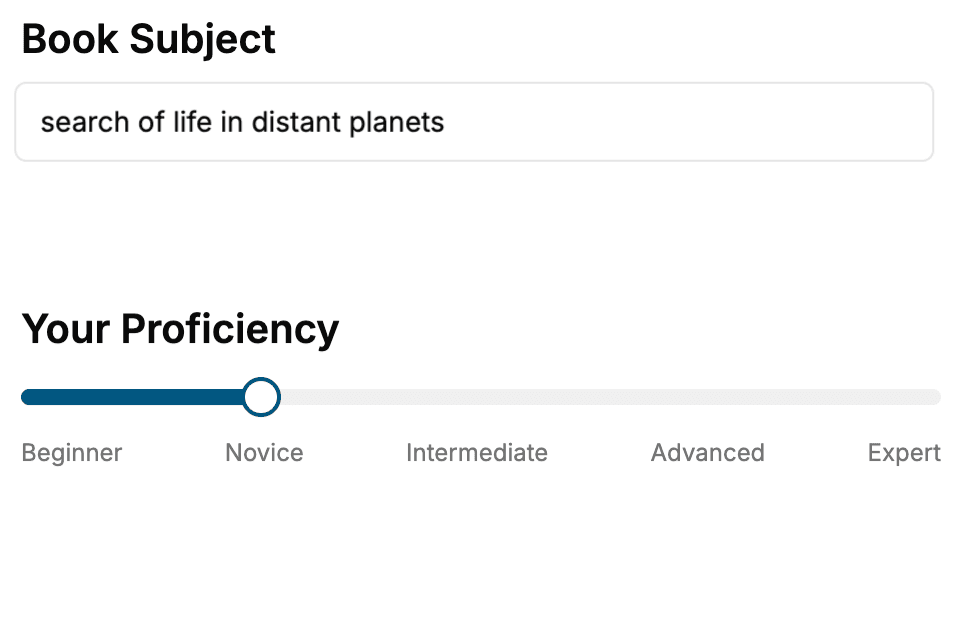
Select the focus of your Phenomenology book and share your background
- 2. Personalize your book
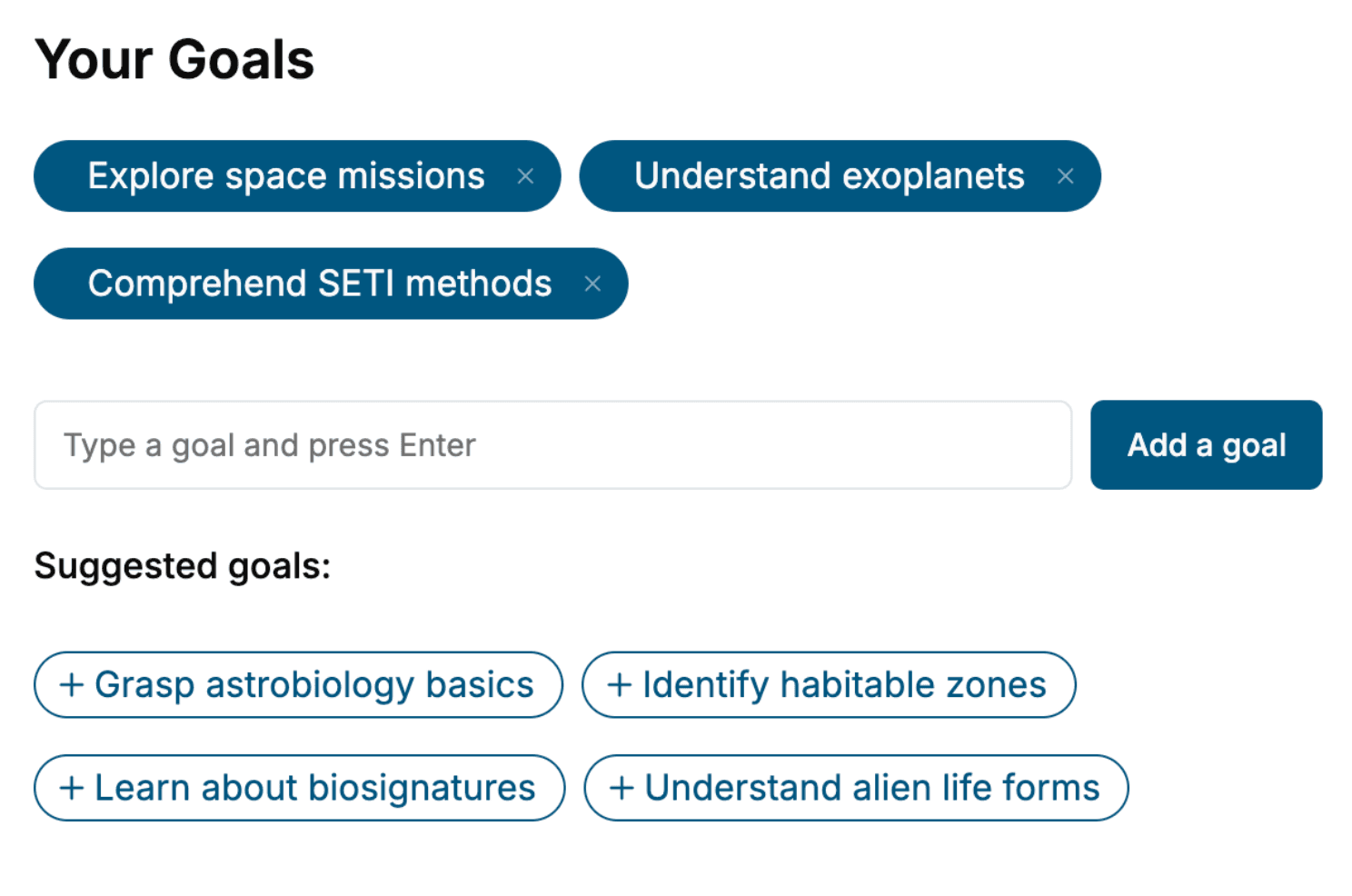
Specify your goals and choose sub-topics to include
- 3. Get your tailored book
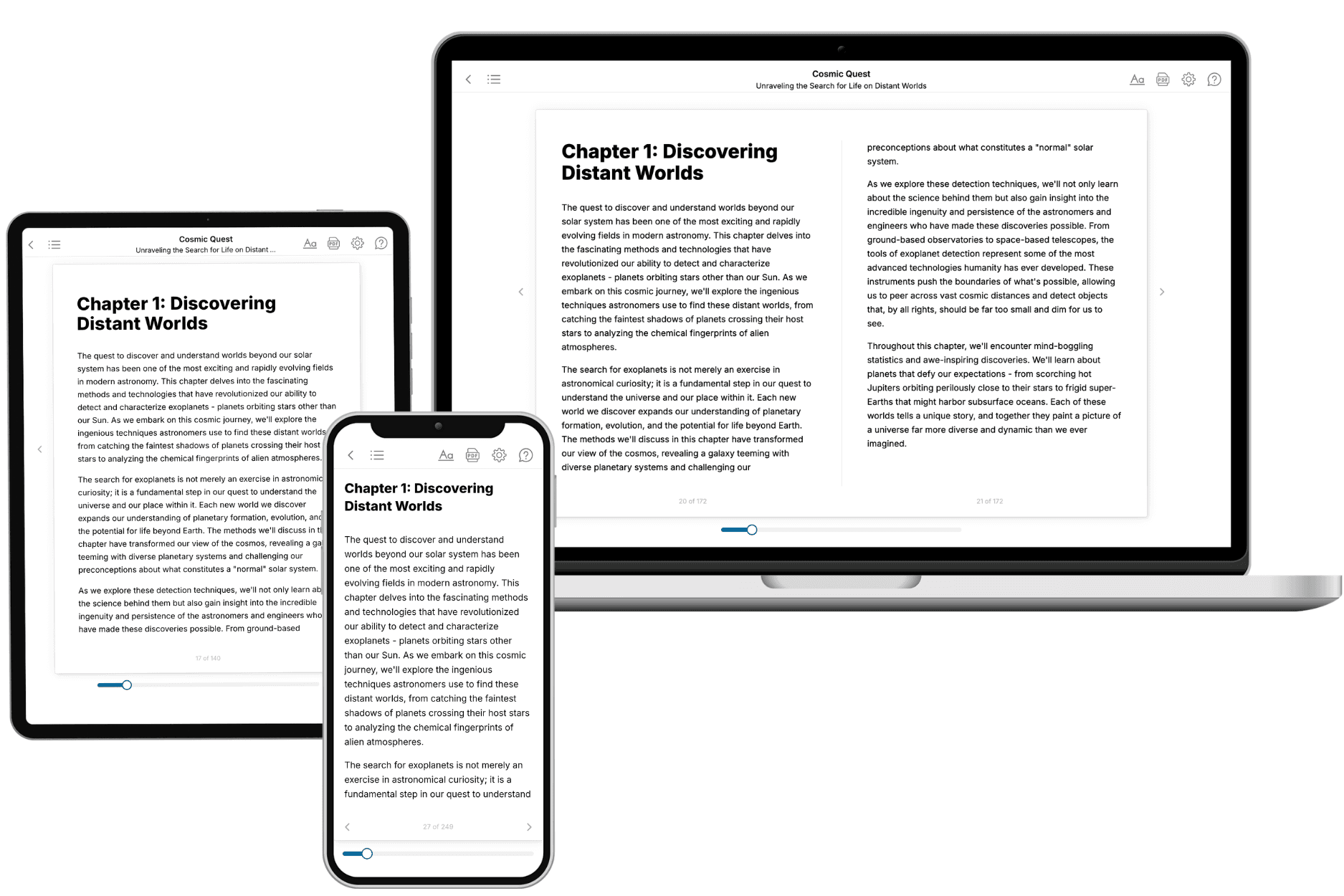
Your book is ready in 10 minutes. Read it online, download as EPUB or PDF, or send to Kindle.
Start from a template
Frequently asked questions
- What is TailoredRead?
TailoredRead creates complete, full-length nonfiction ebooks, written specifically for you. Tell us what you want to learn and why, and TailoredRead writes you a complete ebook on it, with charts, tables, and diagrams throughout. Read it online, on Kindle, or on any e-reader, or download it as a PDF or EPUB. Every book is written fresh the day you order it.
- How is the book tailored to me?
Before anything is written, you answer a few short questions about your goals, your background, and the topics you care about. Your book is then planned around your answers: written at your level, focused on your goals, and covering the topics you chose, instead of the one-size-fits-all book a store sells everyone.
- Will it read like generic AI content?
No. Your book isn't a chat transcript: it's planned chapter by chapter before a single word is written, told in a clear book voice, and explains ideas visually with charts, tables, and diagrams. After writing, every book goes through an editorial pass that polishes chapters so the book reads consistent from start to finish. Judge for yourself: browse thousands of sample books on our Explore Books page.
- How accurate is the content?
Our AI first checks whether your subject needs live research. Niche and fast-moving subjects are researched before writing, and the book plan and chapters are grounded in what it finds. After writing, every book goes through a quality pass that checks its facts and consistency, and researched books list their sources in a Notes section at the back.
- How long is the book?
You choose the length: Comprehensive (250-300 pages), Detailed (150-200 pages), Essential (70-100 pages), or Short (30-50 pages).
- Does the book include visuals?
Yes. Every book includes charts, tables, and diagrams: timelines, checklists, step-by-step guides, decision trees, comparison tables, matrices, and bar charts. A typical book includes dozens of these visual elements.
- Can I read it on Kindle? What formats can I download?
Yes. Every book can be read in our online reader or downloaded as a PDF or EPUB. The EPUB can be opened with Kindle, Apple Books, Kobo, and any e-reader. The Commercial and Author licenses also include an editable Word (DOCX) and Markdown download.
- How much does it cost?
About the price of a regular ebook. The exact price depends on your book's length and complexity, from $2 for the shortest books to $35 for the most comprehensive, and it's shown when you review your book, before you commit to anything. Each book is a one-time purchase, yours to keep, no subscription. Licenses that let you share, teach, or publish your book range from $35.99 to $49.99.
- Can I preview the book before purchasing?
Before you pay, you'll see what your book will cover: the title, a detailed description, the estimated length, and the complete chapter-by-chapter table of contents, so you know what you're getting before you decide. The full text itself is written after you purchase.
- How long does it take to create a book?
About 10 minutes. You can start reading the opening chapters while the rest is still being written.