Sartre's Century
Existentialism, Freedom, and the Shaping of Modern France
Embark on a captivating journey through the life and times of one of the 20th century's most influential philosophers, Jean-Paul Sartre.
269 pages13 chaptersNov 27, 2024Philosophy
About this book
"Sartre's Century" offers a rich tapestry of ideas, historical events, and personal anecdotes that bring the world of existentialism to life. From the bustling cafes of Paris to the tumultuous events of World War II, you'll explore how Sartre's philosophy of radical freedom and personal responsibility emerged from and responded to the challenges of his era. Discover how his ideas on existentialism, authenticity, and engagement shaped not only French intellectual life but also influenced global movements in literature, politics, and social thought. This book delves deep into Sartre's key works, illuminating complex philosophical concepts with clarity and insight. You'll gain a nuanced understanding of how Sartre's ideas evolved over time, influenced by his relationships, political commitments, and the rapidly changing world around him. By placing Sartre within the broader context of French and European history, you'll see how his thoughts both reflected and shaped the cultural landscape of the 20th century.
Table of contents
- IntroductionSartre's Enduring Legacy, Overview of the Book, Why Sartre Matters TodayRead below
- Chapter 1: The Making of a PhilosopherChildhood and Early Education, Years at the École Normale Supérieure, Early Philosophical Influences, Meeting Simone de Beauvoir
- Chapter 2: Sartre and PhenomenologyHusserl and Heidegger's Influence, The Imagination and Consciousness, Nausea: Philosophical Fiction, The Transcendence of the Ego
- Chapter 3: War and OccupationMobilization and Captivity, Intellectual Resistance, Writing 'Being and Nothingness', The Birth of Existentialism
- Chapter 4: The Heart of ExistentialismExistence Precedes Essence, Radical Freedom and Responsibility, Bad Faith and Authenticity, Being-for-Others: Sartre's Social Philosophy
- Chapter 5: Post-War ProminenceLiberation and Sudden Fame, Existentialism is a Humanism, Founding of 'Les Temps Modernes', The Concept of Engaged Literature
- Chapter 6: Sartre's Literary OeuvreNovels: Nausea and The Roads to Freedom, Plays: No Exit and The Flies, Short Stories and Literary Criticism, Autobiography: The Words
- Chapter 7: Political EngagementSartre's Engagement with Marxism, Navigating the Cold War, The Algerian War and Colonialism, May 1968 and Student Revolts
- Chapter 8: The Critique of Dialectical ReasonIndividual and Historical Praxis, Groups-in-Fusion and Seriality, Scarcity and Human Conflict, Reconciling Marxism and Existentialism
- Chapter 9: Sartre and BeauvoirAn Intellectual Partnership, Their Unconventional Relationship, Influence on Feminist Philosophy, Collaborative Works and Mutual Criticism
- Chapter 10: The Later SartreRefusing the Nobel Prize, The Family Idiot: Sartre on Flaubert, Continued Political Activism, Final Interviews and Legacy
- Chapter 11: Sartre in French CultureCafé Society and Intellectual Life, Media Presence and Public Intellectualism, Influence on French Arts and Cinema, Impact on French Academia
- Chapter 12: Sartre's Global InfluenceReception in the United States, Influence in the Third World, Sartre and Eastern European Dissidents, The Global Spread of Existentialism
- Chapter 13: Sartre's Contemporary RelevancePostmodern Critiques and Defenses, Freedom and Responsibility in the Digital Age, Existentialism and Environmental Ethics, Reading Sartre Today: New Perspectives
- ConclusionReviewing Sartre's Philosophical Legacy, The Future of Existentialist Thought
- Glossary of Key Terms
- Suggestions for Further Reading
Introduction
Jean-Paul Sartre stands as one of the most influential philosophers and intellectuals of the 20th century, whose ideas continue to resonate and challenge us in the 21st. As you embark on this exploration of Sartre's life, philosophy, and impact, you'll discover a thinker whose work transcended the boundaries of academia to permeate popular culture, literature, and political discourse. This introduction aims to set the stage for your journey through Sartre's world, providing context for the profound influence he exerted on modern thought and the enduring relevance of his ideas.
Sartre's philosophy of existentialism, with its emphasis on individual freedom and responsibility, emerged from the crucible of mid-20th century Europe. It was a time of immense social and political upheaval, marked by the horrors of World War II, the Cold War, and the struggles for decolonization. In this turbulent context, Sartre's ideas offered a radical perspective on human existence, challenging traditional notions of essence and destiny. His assertion that "existence precedes essence" became a rallying cry for those seeking to understand their place in a world that seemed to have lost its moral bearings.
Throughout this book, you'll encounter the key concepts that define Sartre's philosophical legacy. From the notion of radical freedom to the anguish of choice, from the critique of bad faith to the exploration of authenticity, Sartre's ideas provide a framework for examining the human condition in all its complexity. These concepts are not mere abstractions; they are tools for understanding our own lives and the choices we face every day. As you delve deeper into Sartre's thought, you may find yourself questioning your own assumptions about freedom, responsibility, and the nature of human relationships.
Sartre's Enduring Legacy
Jean-Paul Sartre's legacy extends far beyond the realm of philosophy. As a prolific writer, playwright, and public intellectual, he left an indelible mark on literature, theater, and political activism. His novels, such as "Nausea" and "The Roads to Freedom" trilogy, exemplify the fusion of philosophical ideas with literary narrative, creating a new genre of existentialist fiction. These works not only explored complex philosophical concepts but also captured the zeitgeist of post-war Europe, resonating with readers who found themselves grappling with questions of meaning and purpose in a world that seemed increasingly absurd.
Sartre's plays, including "No Exit" and "The Flies," brought existentialist themes to the stage, challenging audiences to confront the implications of freedom and responsibility in their own lives. His famous line from "No Exit," "Hell is other people," has become a cultural touchstone, often misunderstood but profoundly indicative of Sartre's views on human relationships and the gaze of the Other. These theatrical works continue to be performed and studied worldwide, testament to their enduring relevance and power to provoke thought and discussion.
In the realm of political engagement, Sartre's influence was equally significant. His concept of "engaged literature" argued for the responsibility of writers and intellectuals to address the social and political issues of their time. This idea had a profound impact on generations of writers and activists, inspiring them to use their work as a means of social critique and advocacy. Sartre's own political journey, from his resistance activities during World War II to his later engagement with Marxism and anti-colonial struggles, exemplifies the complex relationship between philosophy and political action.
The intellectual partnership between Sartre and Simone de Beauvoir represents another crucial aspect of his legacy. Their relationship challenged conventional notions of love and commitment, while their collaborative work laid the groundwork for modern feminist philosophy. Beauvoir's seminal work, "The Second Sex," while distinctly her own, was deeply influenced by existentialist concepts and her ongoing dialogue with Sartre. This interplay between their ideas continues to inform discussions on gender, equality, and human relationships.
Sartre's refusal of the Nobel Prize in Literature in 1964 stands as a testament to his complex relationship with institutions and recognition. This act of rejection, unprecedented at the time, sparked debate about the role of the intellectual in society and the potential compromises involved in accepting establishment honors. It remains a powerful symbol of Sartre's commitment to intellectual independence and his belief in the freedom of the individual to define their own values and commitments.
In the decades since Sartre's death in 1980, his ideas have continued to evolve and find new applications. Contemporary philosophers and thinkers have engaged with, critiqued, and built upon Sartre's work, ensuring its ongoing relevance in academic discourse. Moreover, existentialist concepts have permeated popular culture, influencing film, music, and literature in ways that continue to introduce new generations to Sartre's ideas, often without direct attribution.
The enduring nature of Sartre's legacy is perhaps best exemplified by the continued relevance of his core philosophical insights to contemporary issues. In an age of digital technology and social media, questions of authenticity, the gaze of others, and the nature of freedom take on new dimensions. Environmental ethics and the climate crisis prompt us to reconsider our responsibility not just to ourselves and others, but to the planet as a whole. The rise of artificial intelligence and biotechnology challenges us to reexamine what it means to be human and the nature of consciousness itself.
As you explore Sartre's ideas throughout this book, you'll discover that his legacy is not a static monument to past thought, but a living, evolving body of ideas that continues to challenge, inspire, and provoke. Whether you agree or disagree with Sartre's conclusions, engaging with his philosophy offers a powerful lens through which to examine your own life, choices, and place in the world. The questions Sartre grappled with—about freedom, responsibility, authenticity, and the nature of human existence—remain as urgent and relevant today as they were in his lifetime.
Sartre's enduring legacy, then, lies not just in the specific ideas he articulated, but in the way he encouraged us to think critically about our existence, our relationships, and our responsibilities to ourselves and others. As you delve deeper into his life and work in the chapters that follow, you're invited to engage actively with these ideas, to question them, and to consider their implications for your own life and the world around you. This engagement is, perhaps, the truest expression of Sartre's philosophical project—a call to embrace our freedom, confront the anguish of choice, and strive for authenticity in a complex and often challenging world.
Overview of the Book
"Sartre's Century: Existentialism, Freedom, and the Shaping of Modern France" is designed to provide you with a comprehensive exploration of Jean-Paul Sartre's life, philosophy, and impact on French and European thought. This book aims to deepen your understanding of existentialism and its historical context, offering insights into how Sartre's ideas emerged from and responded to the tumultuous events of the 20th century. As you progress through the chapters, you'll encounter a carefully structured narrative that weaves together biographical details, philosophical concepts, historical events, and cultural analysis to create a rich tapestry of Sartre's world and legacy.
The journey begins with an examination of Sartre's early life and education, tracing the formative experiences and intellectual influences that shaped his philosophical outlook. You'll explore his childhood in Paris, his years at the prestigious École Normale Supérieure, and his early encounters with phenomenology through the works of Edmund Husserl and Martin Heidegger. This foundation is crucial for understanding the development of Sartre's unique philosophical perspective and the origins of his existentialist thought.
As you delve deeper into the book, you'll encounter detailed analyses of Sartre's key philosophical works, including "Being and Nothingness," "Existentialism Is a Humanism," and "Critique of Dialectical Reason." These chapters aim to demystify complex philosophical concepts, presenting them in clear, accessible language while maintaining the depth and nuance of Sartre's original ideas. You'll explore central existentialist themes such as radical freedom, the anguish of choice, bad faith, and authenticity, understanding how these concepts apply not only to abstract philosophical debates but to everyday life and decision-making.
The book also places significant emphasis on the historical context in which Sartre's ideas developed and gained prominence. You'll gain insights into the impact of World War II on Sartre's thought, his experiences during the Nazi occupation of France, and his subsequent rise to fame in the post-war period. The cultural and intellectual milieu of post-war Paris comes to life in these pages, offering a vivid picture of the cafés, journals, and debates that shaped the existentialist movement and Sartre's role within it.
Sartre's literary output receives thorough attention, with chapters dedicated to his novels, plays, and autobiographical works. You'll discover how Sartre used fiction and drama as vehicles for exploring philosophical ideas, blurring the lines between literature and philosophy in innovative ways. Works such as "Nausea," "No Exit," and "The Words" are examined not only for their literary merit but for their role in popularizing existentialist concepts and challenging conventional narrative forms.
The book does not shy away from the complexities and contradictions in Sartre's life and thought. His evolving political engagement, from his early resistance activities to his later embrace of Marxism, is critically examined. You'll explore Sartre's stance on issues such as the Cold War, colonialism, and the student revolts of 1968, understanding how his philosophical principles informed his political activism and vice versa. The tensions and debates surrounding Sartre's political positions offer valuable insights into the challenges of applying philosophical ideals to real-world situations.
A significant portion of the book is dedicated to exploring Sartre's relationships and collaborations, particularly his lifelong partnership with Simone de Beauvoir. You'll gain an understanding of how their intellectual and personal bond shaped both of their philosophical outlooks, contributing to the development of existentialist and feminist thought. The book also examines Sartre's interactions with other key figures of his time, from Albert Camus to Maurice Merleau-Ponty, providing a rich picture of the intellectual networks and debates that characterized mid-20th century French philosophy.
As the narrative progresses, you'll encounter chapters that assess Sartre's impact on French culture and his global influence. From his role in shaping the concept of the public intellectual to his influence on literature, art, and cinema, Sartre's cultural significance is explored in depth. The book also examines how Sartre's ideas were received and interpreted in different parts of the world, from the United States to Eastern Europe and the developing world, offering a truly global perspective on his legacy.
In the final sections of the book, you'll engage with contemporary perspectives on Sartre's philosophy. These chapters explore how Sartre's ideas have been critiqued, defended, and reinterpreted in light of postmodern thought and current global challenges. You'll consider the relevance of existentialist concepts to issues such as digital technology, environmental ethics, and the nature of freedom in the 21st century. This forward-looking approach ensures that your engagement with Sartre's ideas extends beyond historical interest to active, contemporary application.
Throughout the book, you'll find that complex ideas are illustrated with concrete examples, case studies, and anecdotes, making abstract concepts more accessible and relatable. Quotes from Sartre's works and those of his contemporaries are woven into the narrative, allowing you to engage directly with primary sources while benefiting from expert analysis and context. The book also includes visual elements such as photographs, timelines, and concept maps to enhance your understanding and provide additional layers of information.
By the time you reach the conclusion, you'll have gained a comprehensive understanding of Sartre's life, philosophy, and legacy. You'll be equipped to engage critically with existentialist ideas and to consider their relevance to your own life and the contemporary world. Whether you're a newcomer to philosophy or a seasoned thinker, "Sartre's Century" offers a rich, nuanced exploration of one of the 20th century's most influential minds, inviting you to consider the enduring questions of freedom, responsibility, and human existence in a new light.
Why Sartre Matters Today
In an era characterized by rapid technological advancement, global interconnectedness, and shifting social paradigms, the question naturally arises: Why does Jean-Paul Sartre, a philosopher who wrote primarily in the mid-20th century, still matter today? The answer lies in the enduring relevance of his core ideas and the ways in which they continue to illuminate contemporary challenges and experiences. Sartre's philosophy, with its emphasis on individual freedom, responsibility, and authenticity, offers a powerful framework for navigating the complexities of modern life and grappling with the fundamental questions of human existence.
One of the most compelling reasons for Sartre's continued relevance is his insistence on the primacy of human freedom. In an age where deterministic explanations of human behavior—whether genetic, neurological, or social—often dominate discourse, Sartre's assertion that we are "condemned to be free" serves as a crucial counterpoint. This idea challenges you to confront the reality of your own agency and the responsibility that comes with it. In a world where it's easy to feel overwhelmed by forces beyond our control, from global pandemics to economic uncertainties, Sartre's philosophy reminds us of our capacity to choose our responses and shape our lives, even in the face of constraints.
The concept of authenticity, central to Sartre's existentialism, takes on new dimensions in the digital age. As social media platforms encourage the curation of online personas and the constant performance of identity, Sartre's call to live authentically becomes increasingly pertinent. His critique of bad faith—the self-deception by which people deny their fundamental freedom—offers a valuable lens through which to examine our online behaviors and the ways we present ourselves to the world. In an era of "fake news" and "alternative facts," Sartre's emphasis on confronting uncomfortable truths about ourselves and our situation provides a much-needed antidote to the temptations of self-delusion and societal conformity.
Sartre's insights into the nature of human relationships and the gaze of the Other remain profoundly relevant in our interconnected world. His famous assertion that "Hell is other people" is often misunderstood as misanthropic, but it actually points to the complex ways in which our sense of self is shaped by our interactions with others. In an age of social media and constant digital connectivity, where we are continually exposed to the judgments and expectations of others, Sartre's analysis of how we internalize these external perspectives offers valuable insights into the psychological challenges of modern life.
The political dimension of Sartre's thought continues to resonate in contemporary debates about social justice, human rights, and global inequality. His concept of "engaged literature" and his insistence on the responsibility of intellectuals to address the pressing issues of their time serve as a model for socially conscious scholarship and activism. In an era where the role of public intellectuals is often questioned, Sartre's example reminds us of the potential for philosophical ideas to contribute meaningfully to public discourse and social change.
Sartre's later engagement with Marxism and his attempts to reconcile existentialism with a broader social and historical perspective offer valuable insights for those grappling with the relationship between individual agency and systemic forces. As debates about economic inequality, racial justice, and climate change highlight the tension between personal responsibility and collective action, Sartre's efforts to bridge the gap between individual freedom and social determinism provide a nuanced framework for thinking through these complex issues.
In the realm of ethics, Sartre's insistence that we must create our own values in the absence of predetermined moral absolutes speaks to the ethical challenges of a pluralistic, globalized world. As traditional sources of moral authority are increasingly questioned, Sartre's call for individuals to take responsibility for their ethical choices and to act in accordance with their freely chosen values offers a compelling alternative to both moral relativism and dogmatic absolutism.
The existentialist emphasis on the absurdity of existence and the need to create meaning in a seemingly meaningless universe resonates with contemporary experiences of alienation and disenchantment. In a world where traditional narratives of progress and purpose have been called into question, Sartre's philosophy offers a way to confront the apparent meaninglessness of life without succumbing to nihilism. His insistence on the possibility of creating meaning through our choices and actions provides a powerful antidote to despair and apathy.
Sartre's exploration of consciousness and the nature of human reality continues to inform debates in cognitive science, artificial intelligence, and the philosophy of mind. As advances in neuroscience and AI challenge traditional notions of consciousness and free will, Sartre's phenomenological analyses of human experience offer important insights into the subjective dimensions of consciousness that resist reduction to purely materialist explanations.
Finally, Sartre's personal example as a public intellectual who engaged deeply with the political and social issues of his time serves as a model for how thinkers can contribute to public discourse in meaningful ways. In an era where academic specialization often leads to insularity, Sartre's willingness to address a broad audience and to apply philosophical ideas to real-world problems reminds us of the potential for philosophy to have a tangible impact on society.
As you delve deeper into Sartre's ideas throughout this book, you'll discover that their relevance extends far beyond academic philosophy. Whether you're grappling with personal decisions, navigating complex social relationships, or seeking to understand your place in a rapidly changing world, Sartre's insights offer valuable tools for reflection and action. His philosophy challenges you to confront the reality of your freedom, to question your assumptions, and to strive for authenticity in your choices and relationships.
In essence, Sartre matters today because the fundamental questions he grappled with—about the nature of human existence, freedom, responsibility, and meaning—remain as urgent and relevant as ever. His ideas provide not just a historical perspective on 20th-century thought, but a living, breathing framework for engaging with the challenges of the 21st century. As you explore Sartre's life and work in the chapters that follow, you're invited to consider how his ideas might illuminate your own experiences and choices, and to engage critically with a philosophical tradition that continues to shape our understanding of what it means to be human in a complex and often bewildering world.
This is the end of the free sample. The full book has 13 chapters.
Want this book written for you?
Tell us your goals and background, and get your own version of this book, tailored by AI to you.


Benefits of AI-tailored books
- Read one book, not ten:
- all the Philosophy knowledge you need, gathered into a single book.
- Save days of learning:
- tell us your goals, choose your topics, and the whole book is built around them.
- Learn effortlessly:
- Philosophy book written for your specific background and expertise.
- Understand at a glance:
- includes charts, tables, timelines, checklists, decision trees, and more.
- Stay current:
- written the day you order it, not years ago.
- Trust what you read:
- every book is checked for accuracy, with real research when your subject needs it.
Create your unique book in 3 steps
- 1. Select your focus
Select the focus of your Philosophy book and share your background
- 2. Personalize your book
Specify your goals and choose sub-topics to include
- 3. Get your tailored book
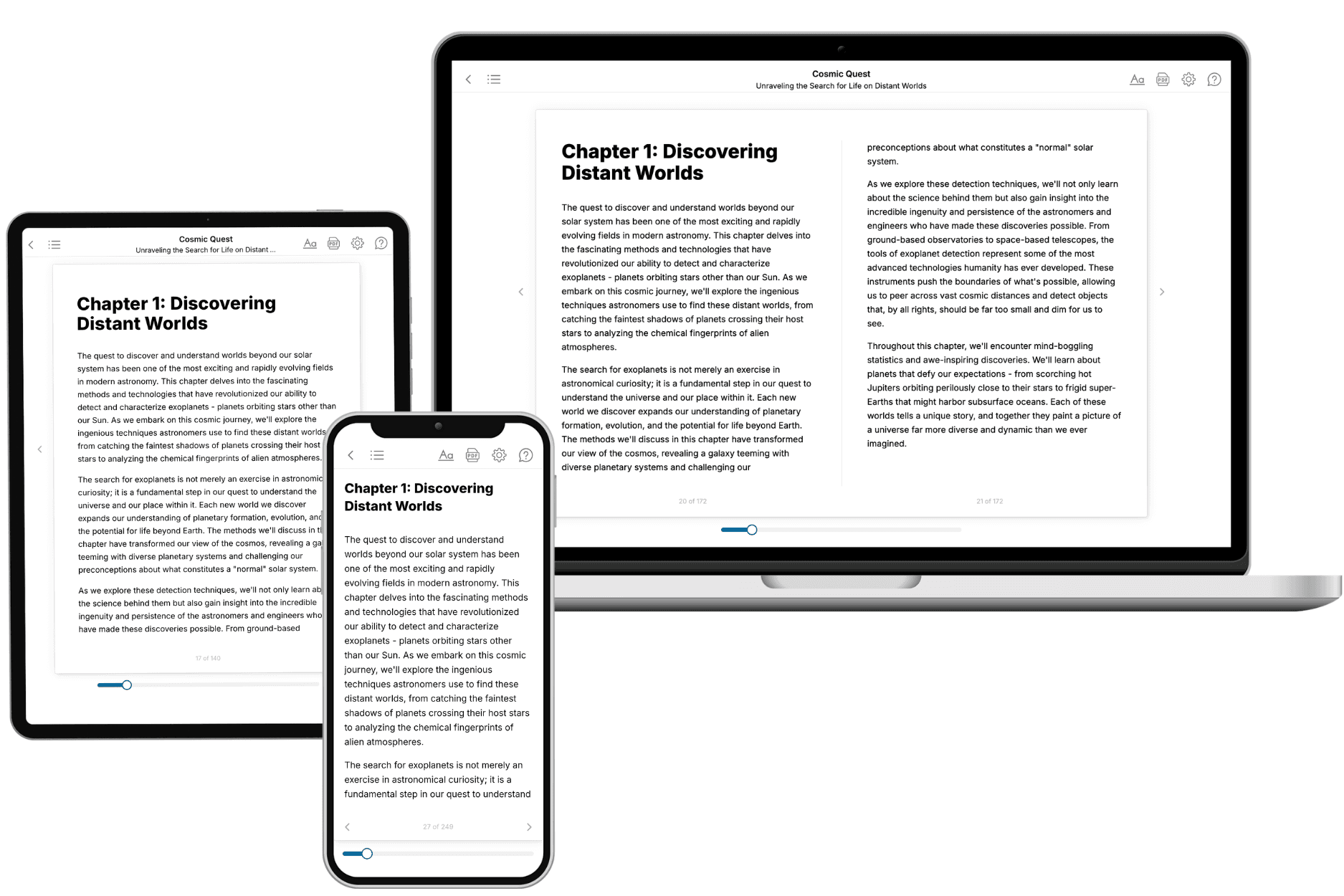
Your book is ready in 10 minutes. Read it online, download as EPUB or PDF, or send to Kindle.

Frequently asked questions
- What is TailoredRead?
TailoredRead creates complete, full-length nonfiction ebooks, written specifically for you. Tell us what you want to learn and why, and TailoredRead writes you a complete ebook on it, with charts, tables, and diagrams throughout. Read it online, on Kindle, or on any e-reader, or download it as a PDF or EPUB. Every book is written fresh the day you order it.
- How is the book tailored to me?
Before anything is written, you answer a few short questions about your goals, your background, and the topics you care about. Your book is then planned around your answers: written at your level, focused on your goals, and covering the topics you chose, instead of the one-size-fits-all book a store sells everyone.
- Will it read like generic AI content?
No. Your book isn't a chat transcript: it's planned chapter by chapter before a single word is written, told in a clear book voice, and explains ideas visually with charts, tables, and diagrams. After writing, every book goes through an editorial pass that polishes chapters so the book reads consistent from start to finish. Judge for yourself: browse thousands of sample books on our Explore Books page.
- How accurate is the content?
Our AI first checks whether your subject needs live research. Niche and fast-moving subjects are researched before writing, and the book plan and chapters are grounded in what it finds. After writing, every book goes through a quality pass that checks its facts and consistency, and researched books list their sources in a Notes section at the back.
- How long is the book?
You choose the length: Comprehensive (250-300 pages), Detailed (150-200 pages), Essential (70-100 pages), or Short (30-50 pages).
- Does the book include visuals?
Yes. Every book includes visual elements such as timelines, checklists, step-by-step guides, decision trees, comparison tables, and matrices, and many include bar charts. A typical book includes dozens of these visual elements.
- Can I read it on Kindle? What formats can I download?
Yes. Every book can be read in our online reader or downloaded as a PDF or EPUB. The EPUB can be opened with Kindle, Apple Books, Kobo, and any e-reader. The Commercial and Author licenses also include an editable Word (DOCX) and Markdown download.
- How much does it cost?
About the price of a regular ebook. The exact price depends on your book's length and complexity, from $2 for the shortest books to $35 for the most comprehensive, and it's shown when you review your book, before you commit to anything. Each book is a one-time purchase, yours to keep, no subscription. Licenses that let you share, teach, or publish your book range from $35.99 to $49.99.
- Can I preview the book before purchasing?
Before you pay, you'll see what your book will cover: the title, a detailed description, the estimated length, and the complete chapter-by-chapter table of contents, so you know what you're getting before you decide. The full text itself is written after you purchase.
- How long does it take to create a book?
About 10 minutes. You can start reading the opening chapters while the rest is still being written.