Cosmic Connections
Unraveling the Universe from Particles to Galaxies
Discover the intricate tapestry of the cosmos, from the tiniest subatomic particles to the vast expanses of the universe.
300 pages15 chaptersJan 23, 2025Physics
About this book
"Cosmic Connections: Unraveling the Universe from Particles to Galaxies" is your gateway to understanding the fundamental forces that shape our reality. As a science educator with a background in biomedical science and physics, you'll find this book bridges the gap between your existing knowledge and the latest theories in cosmology and particle physics. Delve into the mysteries of quantum mechanics, explore the enigmatic nature of dark matter and energy, and grasp the complexities of string theory and cosmic inflation. This comprehensive guide offers a unique perspective, connecting the realms of physics and biology to provide a holistic view of our universe. You'll gain insights into how particle accelerators unveil the secrets of matter, how gravitational waves reveal cosmic events, and how the study of antimatter asymmetry helps us understand the very fabric of existence. Whether you're looking to enhance your teaching repertoire or satisfy your own curiosity about the cosmos, "Cosmic Connections" provides the tools you need to navigate the intricate world of modern physics. Prepare to embark on an intellectual journey that will forever change your perspective on the universe and your place within it.
Table of contents
- IntroductionA Cosmic Overview: From Particles to Galaxies, The Intersection of Physics and Biology, Your Journey Through This BookRead below
- Chapter 1: Foundations of Modern PhysicsFrom Classical to Quantum Physics, Einstein's Relativity: Special and General, Quantum Mechanics: The Bizarre Subatomic World, Particle-Wave Duality: The Double-Slit Experiment
- Chapter 2: The World of Particle PhysicsThe Standard Model: A Particle Zoo, Fundamental Forces and Their Carriers, The Higgs Boson: Giving Mass to the Universe, Beyond the Standard Model: New Horizons
- Chapter 3: Quantum Field TheoryFields and Particles: A New Perspective, Virtual Particles and Quantum Fluctuations, Feynman Diagrams: Visualizing Particle Interactions, Applications of Quantum Field Theory
- Chapter 4: Fundamentals of CosmologyThe Observable Universe: What We Can See, Measuring Cosmic Distances, The Expanding Universe and Hubble's Law, Cosmic Microwave Background: Echo of the Big Bang
- Chapter 5: The Big Bang TheoryThe Early Universe: The First Three Minutes, Primordial Nucleosynthesis: Forging the First Elements, Cosmic Inflation: Solving the Horizon Problem, Evidence Supporting the Big Bang Theory
- Chapter 6: The Dark UniverseDark Matter: The Cosmic Scaffold, Dark Energy: Driving Cosmic Acceleration, Detection Methods for Dark Matter and Energy, Implications for Cosmic Structure and Fate
- Chapter 7: Black Holes: Cosmic EnigmasFormation and Types of Black Holes, Event Horizons and Singularities, Hawking Radiation: Black Holes Aren't So Black, Black Hole Thermodynamics
- Chapter 8: Gravitational Waves: Ripples in SpacetimeEinstein's Prediction and LIGO's Discovery, Sources of Gravitational Waves, Detection Methods and Challenges, Gravitational Wave Astronomy: A New Window
- Chapter 9: Particle Accelerators: Cosmic Labs on EarthTypes of Particle Accelerators, The Large Hadron Collider: A Marvel of Engineering, Particle Detector Technologies, Major Discoveries at Particle Accelerators
- Chapter 10: Quantum Entanglement and Non-localityUnderstanding Quantum Entanglement, Bell's Theorem and Experimental Verification, Applications of Quantum Entanglement, Quantum Teleportation: Fact or Fiction?
- Chapter 11: Antimatter: The Mirror UniverseDiscovery and Properties of Antimatter, Matter-Antimatter Asymmetry in the Universe, Creating and Studying Antimatter on Earth, Potential Applications of Antimatter
- Chapter 12: String Theory: A Theory of Everything?Basic Concepts of String Theory, Extra Dimensions and Branes, M-Theory: Unifying String Theories, Challenges and Criticisms of String Theory
- Chapter 13: The Quest for Quantum GravityWhy Gravity Resists Quantization, Loop Quantum Gravity: A Rival to String Theory, The AdS/CFT Correspondence, Future Prospects in Quantum Gravity Research
- Chapter 14: Multiverse TheoriesTypes of Multiverse Theories, Eternal Inflation and the Multiverse, The Many-Worlds Interpretation of Quantum Mechanics, Philosophical and Scientific Implications
- Chapter 15: The Cosmic Web: Large-Scale StructureGalaxies and Galaxy Clusters, Cosmic Filaments and Voids, Structure Formation in the Universe, Computer Simulations of Cosmic Structure
- ConclusionFuture Directions in Cosmology and Particle Physics, Unresolved Questions and Ongoing Debates
- Glossary
- Further Reading
Introduction
Welcome to a journey that will take you from the infinitesimal world of subatomic particles to the vast expanses of the cosmos. As a science educator with a background in biomedical science and physics, you are about to embark on an exploration that will bridge the gap between your existing knowledge and the cutting-edge theories in cosmology and particle physics. This book is designed to provide you with a comprehensive understanding of the universe, from its smallest constituents to its largest structures, and to equip you with the knowledge to enhance your teaching capabilities in these fascinating fields.
The universe is a tapestry of interconnected phenomena, where the laws governing the tiniest particles have profound implications for the behavior of galaxies and the evolution of the cosmos itself. Throughout this book, we will unravel these connections, showing how the study of particle physics informs our understanding of cosmology, and vice versa. We will explore how the fundamental forces that shape our reality operate on both quantum and cosmic scales, often with surprising and counterintuitive results.
As we delve into the depths of modern physics, we will encounter concepts that challenge our classical intuitions about the nature of reality. From the bizarre world of quantum mechanics, where particles can exist in multiple states simultaneously, to the mind-bending implications of Einstein's theories of relativity, where time and space are malleable and interconnected, we will confront ideas that push the boundaries of human understanding. Yet, it is precisely these challenging concepts that have led to some of the most profound discoveries in the history of science and continue to drive our exploration of the universe.
A Cosmic Overview: From Particles to Galaxies
Our cosmic journey begins with an overview of the universe as we currently understand it. From the smallest scales of subatomic particles to the largest structures in the observable universe, we will lay the groundwork for the detailed explorations to come. At the heart of our current understanding of particle physics lies the Standard Model, a remarkably successful theory that describes the fundamental particles and forces that govern the behavior of matter and energy. The Standard Model has been tested to extraordinary precision and has predicted the existence of particles before they were discovered experimentally, such as the Higgs boson, which was finally observed in 2012 at the Large Hadron Collider[1].
However, as powerful as the Standard Model is, it does not provide a complete picture of the universe. It does not account for gravity, one of the four fundamental forces, nor does it explain the existence of dark matter, which appears to make up about 85% of the matter in the universe[2]. These gaps in our understanding point to the need for new theories and experimental approaches, which we will explore throughout this book.
Moving from the subatomic to the cosmic scale, we encounter the realm of cosmology, the study of the origin, evolution, and large-scale structure of the universe. The cornerstone of modern cosmology is the Big Bang theory, which posits that the universe began in an extremely hot and dense state about 13.8 billion years ago and has been expanding ever since. This theory is supported by a wealth of observational evidence, including the cosmic microwave background radiation, the abundance of light elements in the universe, and the large-scale distribution of galaxies[3].
Yet, just as with particle physics, our understanding of cosmology is far from complete. The nature of dark energy, a mysterious force that appears to be accelerating the expansion of the universe, remains one of the biggest puzzles in modern physics. Similarly, the exact mechanisms behind cosmic inflation, a period of rapid expansion in the very early universe, are still debated among cosmologists. These open questions highlight the dynamic and evolving nature of our understanding of the cosmos.
As we navigate through the scales of the universe, from particles to galaxies, we will encounter a series of interconnected phenomena that bridge these vastly different realms. For instance, the study of particle physics in the early universe helps us understand how the first elements formed during the process of Big Bang nucleosynthesis. Conversely, observations of large-scale cosmic structures provide clues about the properties of dark matter particles. This interplay between the very small and the very large is a recurring theme in modern physics and will be a central focus of our exploration.
Throughout this cosmic overview, we will also touch upon some of the most exciting recent developments in physics and astronomy. The detection of gravitational waves, first observed in 2015, has opened up an entirely new way of observing the universe, allowing us to "hear" the collisions of black holes and neutron stars across vast cosmic distances[4]. The ongoing search for dark matter particles, both in underground detectors and particle accelerators, continues to push the boundaries of our experimental techniques. And the development of new theories, such as string theory and loop quantum gravity, aims to unify our understanding of quantum mechanics and general relativity, potentially providing a "theory of everything" that could explain all fundamental forces and particles.
As we embark on this journey from particles to galaxies, it's important to remember that our current understanding, impressive as it is, represents just a snapshot in the ongoing process of scientific discovery. The history of physics is filled with paradigm shifts and unexpected revelations, and it's likely that some of the ideas we discuss in this book will be refined or even overturned by future discoveries. This constant evolution is not a weakness of science, but rather its greatest strength – the ability to adapt and improve our models based on new evidence and insights.
In the following chapters, we will delve deeper into each of these areas, exploring the theoretical frameworks, experimental evidence, and ongoing research that shape our understanding of the universe. From the quantum realm of particle physics to the cosmic expanses of cosmology, we will uncover the intricate connections that tie together the very fabric of reality. As we progress, you will gain not only a deeper understanding of these fascinating fields but also valuable insights that you can incorporate into your teaching, inspiring the next generation of scientists to continue unraveling the mysteries of the cosmos.
The Intersection of Physics and Biology
While this book primarily focuses on cosmology and particle physics, it's important to recognize the growing intersection between these fields and biology, particularly given your background in biomedical science. The convergence of physics and biology has led to remarkable insights in both fields and has given rise to exciting new areas of research. This interdisciplinary approach not only enhances our understanding of life at its most fundamental level but also provides new perspectives on the physical laws that govern the universe.
One of the most prominent areas where physics and biology intersect is in the study of the origin of life. The principles of thermodynamics and statistical mechanics play a crucial role in understanding how complex, self-organizing systems like living organisms could have emerged from simpler chemical precursors. Research in this field draws on concepts from quantum mechanics to explain the stability of DNA molecules and the mechanisms of enzyme catalysis[5]. By applying the rigorous mathematical frameworks of physics to biological systems, scientists are gaining new insights into the fundamental processes that underpin life itself.
Another fascinating area of overlap is the field of biophysics, which applies physical principles and methods to biological systems. This discipline has led to the development of powerful imaging techniques such as magnetic resonance imaging (MRI) and positron emission tomography (PET), which have revolutionized medical diagnostics and our understanding of brain function. At the molecular level, techniques like X-ray crystallography and cryo-electron microscopy, which rely on principles from quantum mechanics and electromagnetism, have allowed us to visualize the three-dimensional structures of complex biomolecules, providing crucial insights into their functions and interactions[6].
The study of quantum biology is a particularly exciting frontier that explores how quantum mechanical phenomena might play a role in biological processes. For example, research suggests that quantum coherence may be involved in photosynthesis, allowing plants to efficiently capture and transfer energy from sunlight. Similarly, it has been proposed that quantum effects could play a role in bird navigation, enzyme catalysis, and even our sense of smell. While these ideas are still being debated and investigated, they highlight the potential for quantum physics to provide new explanations for long-standing biological mysteries[7].
The principles of self-organization and emergence, which are central to understanding complex biological systems, also have parallels in physics. The way in which simple physical laws can give rise to complex, organized structures – from crystals to galaxies – mirrors the emergence of complex behaviors in biological systems. This conceptual bridge between physics and biology is leading to new ways of thinking about both fields and is inspiring interdisciplinary research that blurs the traditional boundaries between disciplines.
In the realm of cosmology, the concept of fine-tuning – the observation that many physical constants seem to be precisely calibrated to allow for the existence of life – has led to fascinating discussions at the intersection of physics, biology, and philosophy. The anthropic principle, which suggests that our observations of the universe are necessarily biased by the fact that we exist to make those observations, raises profound questions about the nature of physical laws and the possibility of multiple universes[8].
As we explore the cosmos, the search for extraterrestrial life brings together principles from astronomy, planetary science, and biology. Understanding the conditions necessary for life as we know it, and potentially for forms of life very different from our own, requires a synthesis of knowledge from across the scientific spectrum. The field of astrobiology, which investigates the origin, evolution, and distribution of life in the universe, is inherently interdisciplinary, combining insights from physics, chemistry, and biology to address some of the most fundamental questions about our place in the cosmos.
The tools and techniques developed for particle physics and cosmology are also finding applications in biological research. For instance, particle accelerators are being used to produce medical isotopes for cancer treatment and to study the effects of cosmic radiation on living organisms. Advanced data analysis techniques developed for processing the vast amounts of data from particle physics experiments are being applied to genomics and proteomics, helping to unravel the complexities of biological systems.
As we delve into the world of particle physics and cosmology in this book, it's worth keeping in mind these connections to biology. The fundamental laws that govern the behavior of subatomic particles and the evolution of the universe also underpin the complex phenomena of life. By understanding these laws, we gain deeper insights not only into the cosmos but also into the intricate workings of living systems.
Throughout this book, we will occasionally highlight these intersections between physics and biology, providing you with a broader context for the concepts we discuss. This interdisciplinary perspective will not only enrich your understanding of cosmology and particle physics but also provide you with valuable connections to your background in biomedical science. As a science educator, these links between different scientific disciplines can serve as powerful teaching tools, helping your students to see the interconnectedness of scientific knowledge and inspiring them to think across traditional subject boundaries.
Your Journey Through This Book
As you embark on this exploration of cosmology and particle physics, it's important to understand the structure of the journey ahead. This book is designed to take you on a logical progression through the fundamental concepts, theories, and discoveries that shape our current understanding of the universe. Each chapter builds upon the knowledge gained in previous sections, gradually constructing a comprehensive picture of the cosmos from its smallest constituents to its largest structures.
We begin our journey with the foundations of modern physics in Chapter 1. Here, we'll trace the evolution of physical theories from classical mechanics to the revolutionary ideas of quantum mechanics and relativity. This chapter will provide the essential background needed to understand the more advanced concepts that follow. We'll explore how these fundamental theories changed our perception of space, time, and the nature of reality itself, setting the stage for the developments in particle physics and cosmology that form the core of this book.
In Chapter 2, we delve into the world of particle physics, introducing you to the Standard Model – the current framework that describes all known elementary particles and their interactions. You'll learn about the various types of particles, from familiar electrons and protons to more exotic entities like quarks and bosons. We'll explore the four fundamental forces of nature and how they are mediated by particles, culminating in a discussion of the Higgs boson and its crucial role in giving mass to other particles. This chapter will also touch on the limitations of the Standard Model and the ongoing search for physics beyond this well-established framework.
Chapter 3 takes us deeper into the theoretical underpinnings of particle physics with an exploration of Quantum Field Theory (QFT). This powerful mathematical framework unifies quantum mechanics with special relativity and forms the basis for our understanding of particle interactions. We'll discuss how QFT describes particles as excitations of underlying fields, explore the concept of virtual particles, and introduce Feynman diagrams as a tool for visualizing and calculating particle interactions. This chapter will provide you with a more profound understanding of the quantum nature of reality and its implications for our view of the universe.
With Chapters 4 and 5, we shift our focus to the larger scales of the universe, introducing the fundamentals of cosmology and the Big Bang theory. You'll learn about the observable universe, how we measure cosmic distances, and the evidence for an expanding universe. We'll explore the cosmic microwave background radiation and how it provides crucial evidence for the Big Bang model. These chapters will take you through the early moments of the universe, from the era of cosmic inflation to the formation of the first elements, providing a comprehensive overview of our current understanding of cosmic origins.
Chapter 6 introduces one of the most mysterious aspects of modern cosmology: the dark universe. Here, we'll explore the evidence for dark matter and dark energy, which together make up about 95% of the energy content of the universe. You'll learn about the various detection methods being used to study these elusive components and their profound implications for the structure and fate of the cosmos. This chapter will highlight some of the most pressing questions in contemporary physics and astronomy.
In Chapter 7, we turn our attention to one of the most enigmatic objects in the universe: black holes. We'll explore their formation, properties, and the mind-bending physics that occurs near their event horizons. This chapter will also introduce you to Hawking radiation and the thermodynamics of black holes, concepts that bridge the gap between quantum mechanics and general relativity.
Chapter 8 focuses on one of the most exciting recent developments in astronomy: the detection of gravitational waves. You'll learn about Einstein's prediction of these ripples in spacetime, the incredible engineering feat that made their detection possible, and the new era of multi-messenger astronomy that has been ushered in by this discovery.
In Chapter 9, we'll explore the tools that make much of modern particle physics possible: particle accelerators and detectors. You'll gain an understanding of how these massive machines work, with a particular focus on the Large Hadron Collider (LHC) at CERN. We'll discuss the major discoveries made at particle accelerators and their implications for our understanding of fundamental physics.
Chapter 10 delves into the strange world of quantum entanglement and non-locality. These phenomena, which Einstein famously referred to as "spooky action at a distance," challenge our classical intuitions about reality and have profound implications for our understanding of information and causality in the universe. We'll explore the experimental verifications of quantum entanglement and its potential applications in quantum computing and communication.
In Chapter 11, we'll explore the fascinating world of antimatter. You'll learn about the discovery of antimatter, its properties, and the ongoing mystery of why there appears to be so much more matter than antimatter in the observable universe. We'll also discuss how antimatter is created and studied in laboratories and its potential future applications.
Chapters 12 and 13 introduce you to some of the most speculative areas of modern theoretical physics. We'll explore string theory and its attempt to unify all fundamental forces and particles into a single framework. We'll also discuss the ongoing quest for a theory of quantum gravity that could reconcile general relativity with quantum mechanics. These chapters will give you a glimpse into the cutting edge of theoretical physics and the challenges that lie ahead in our quest to understand the fundamental nature of reality.
In Chapter 14, we'll venture into the realm of multiverse theories, exploring the various ways in which our universe might be part of a larger cosmic structure. We'll discuss the implications of eternal inflation, the many-worlds interpretation of quantum mechanics, and the philosophical and scientific debates surrounding these ideas.
Chapter 15 brings us back to the large-scale structure of the universe, exploring the cosmic web of galaxies, clusters, and filaments that form the largest known structures in the cosmos. We'll discuss how these structures formed and evolved over cosmic time and how computer simulations are helping us to understand these processes.
Finally, we'll conclude the book by reflecting on the future directions of cosmology and particle physics, discussing the unresolved questions and ongoing debates that continue to drive research in these fields. This final section will provide you with a roadmap for further exploration and a sense of the exciting discoveries that may lie ahead.
Throughout this journey, you'll find that each chapter is designed to be both comprehensive and accessible. Key concepts are explained in clear, straightforward language, with analogies and examples to help illustrate complex ideas. Mathematical formulas are included where necessary, but the focus is on building intuitive understanding rather than mathematical rigor. Each chapter also includes references to current research and experimental results, ensuring that you're getting the most up-to-date information available.
As you progress through the book, you'll notice recurring themes and connections between different areas of physics. The interplay between theory and experiment, the search for unifying principles, and the constant push to test the boundaries of our understanding are threads that run throughout the narrative. By the end of this journey, you'll have gained not just a wealth of knowledge about cosmology and particle physics, but also a deeper appreciation for the scientific process and the interconnectedness of physical phenomena across all scales of the universe.
Remember, this book is not just a collection of facts, but a guide to thinking about the universe in new and profound ways. As you read, try to connect the concepts to your own experiences and knowledge. Reflect on how these ideas might inform your teaching and inspire your students. And above all, maintain a sense of wonder at the incredible universe we inhabit and our ever-growing ability to understand it. Let's begin our cosmic journey!
Notes
Introduction
- 1. CERN, CERN experiments observe particle consistent with long-sought Higgs boson, Press Release, 2012
- 2. Planck Collaboration, Planck 2018 results, VI. Cosmological parameters. Astronomy & Astrophysics, 641, A6, 2018
- 3. P. J. E. Peebles and others, Finding the Big Bang, Cambridge University Press, 2009
- 4. Abbott and others, "Observation of Gravitational Waves from a Binary Black Hole Merger," Physical Review Letters, 2016
- 5. J. Al-Khalili and J. McFadden, Life on the Edge, Crown Publishers, 2014
- 6. R. Phillips and others, "Physical Biology of the Cell," Garland Science, 2012
- 7. J. Cao and others, "Quantum biology revisited," Science Advanceseaaz4888, 2020
- 8. J. D. Barrow and F. J. Tipler, The Anthropic Cosmological Principle, Oxford University Press, 1988
This is the end of the free sample. The full book has 15 chapters.
Want this book written for you?
Tell us your goals and background, and get your own version of this book, tailored by AI to you.


Benefits of AI-tailored books
- Read one book, not ten:
- all the Physics knowledge you need, gathered into a single book.
- Save days of learning:
- tell us your goals, choose your topics, and the whole book is built around them.
- Learn effortlessly:
- Physics book written for your specific background and expertise.
- Understand at a glance:
- includes charts, tables, timelines, checklists, decision trees, and more.
- Stay current:
- written the day you order it, not years ago.
- Trust what you read:
- every book is checked for accuracy, with real research when your subject needs it.
Create your unique book in 3 steps
- 1. Select your focus
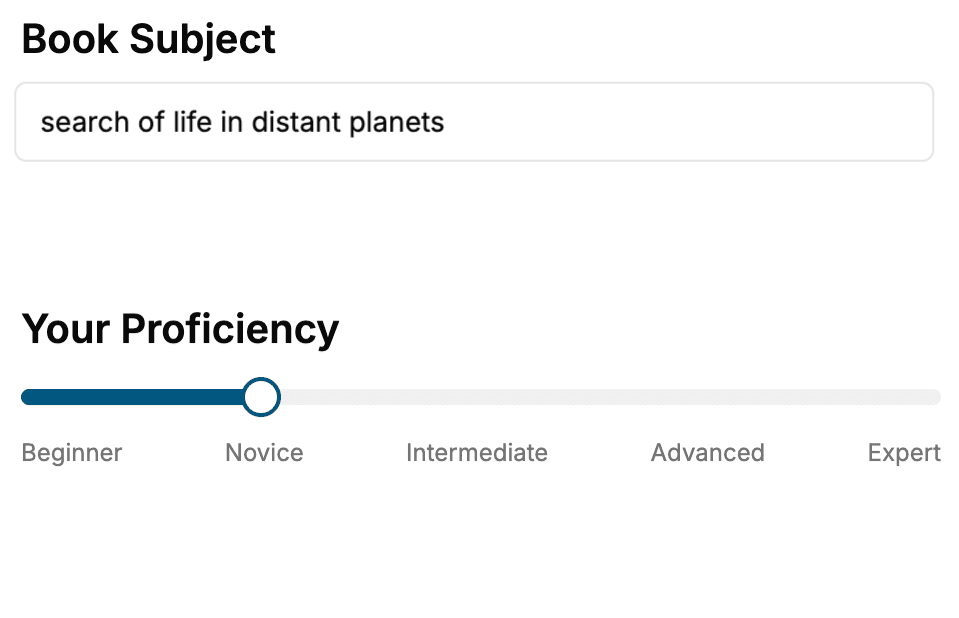
Select the focus of your Physics book and share your background
- 2. Personalize your book
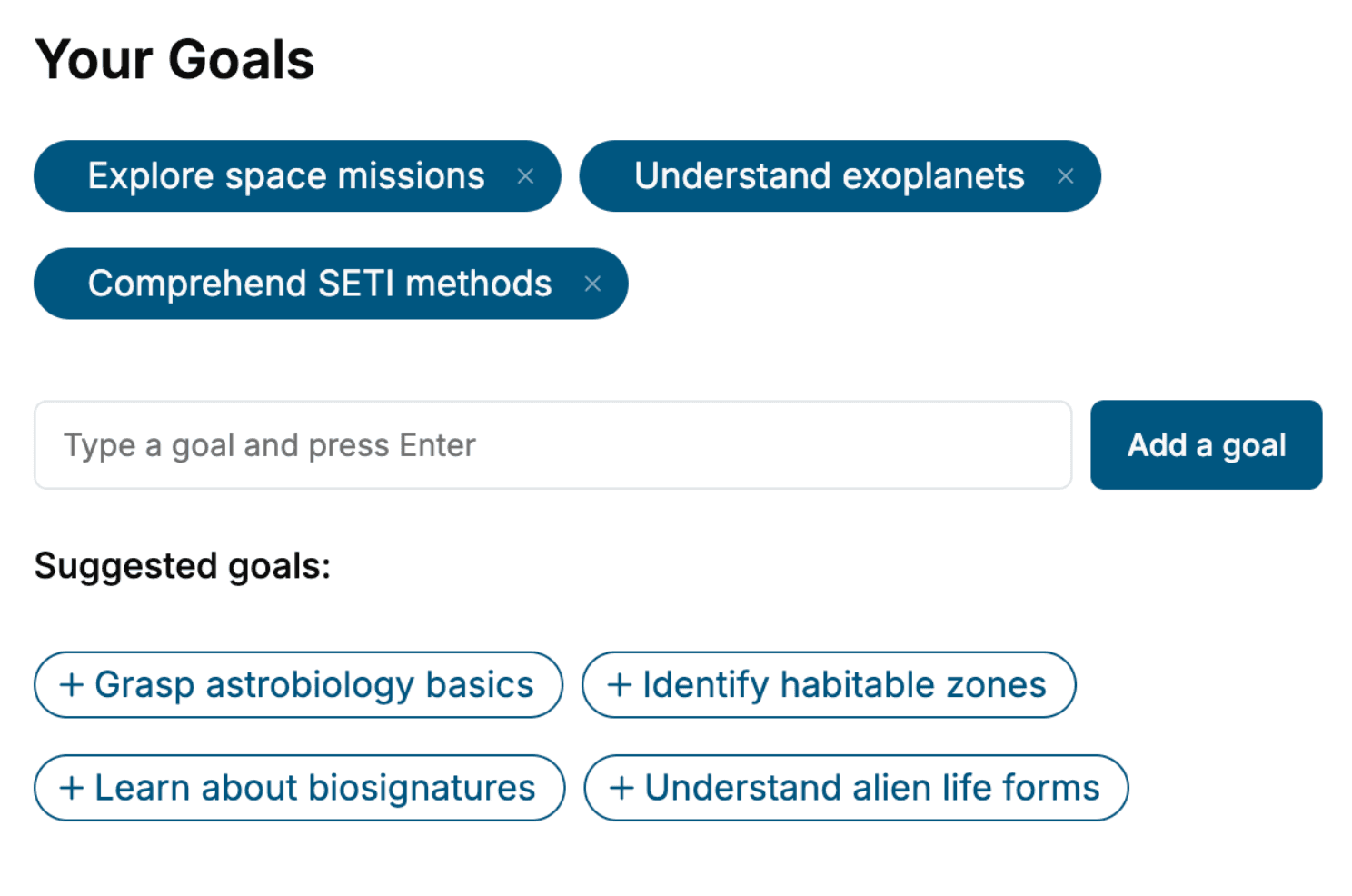
Specify your goals and choose sub-topics to include
- 3. Get your tailored book
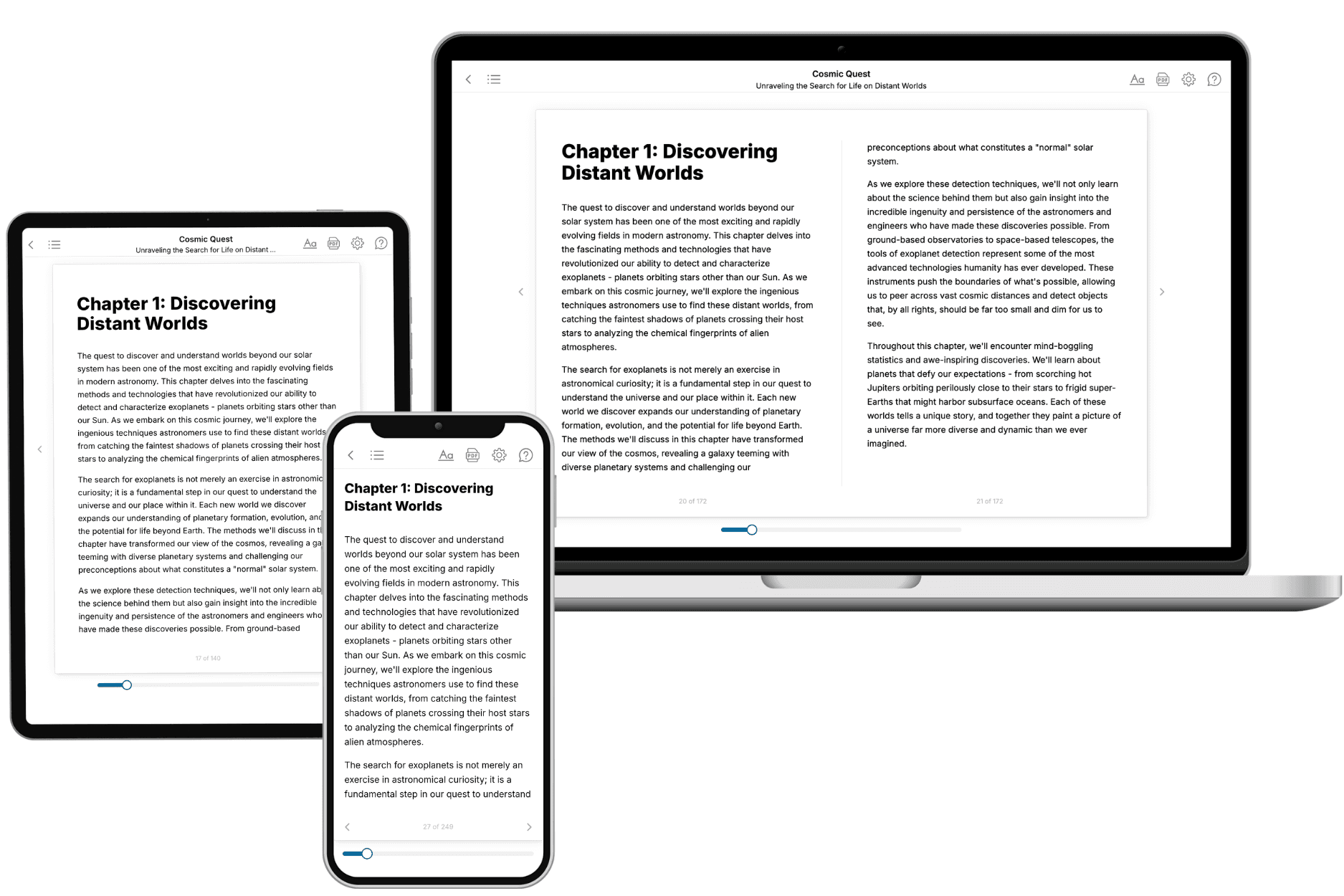
Your book is ready in 10 minutes. Read it online, download as EPUB or PDF, or send to Kindle.
Frequently asked questions
- What is TailoredRead?
TailoredRead creates complete, full-length nonfiction ebooks, written specifically for you. Tell us what you want to learn and why, and TailoredRead writes you a complete ebook on it, with charts, tables, and diagrams throughout. Read it online, on Kindle, or on any e-reader, or download it as a PDF or EPUB. Every book is written fresh the day you order it.
- How is the book tailored to me?
Before anything is written, you answer a few short questions about your goals, your background, and the topics you care about. Your book is then planned around your answers: written at your level, focused on your goals, and covering the topics you chose, instead of the one-size-fits-all book a store sells everyone.
- Will it read like generic AI content?
No. Your book isn't a chat transcript: it's planned chapter by chapter before a single word is written, told in a clear book voice, and explains ideas visually with charts, tables, and diagrams. After writing, every book goes through an editorial pass that polishes chapters so the book reads consistent from start to finish. Judge for yourself: browse thousands of sample books on our Explore Books page.
- How accurate is the content?
Our AI first checks whether your subject needs live research. Niche and fast-moving subjects are researched before writing, and the book plan and chapters are grounded in what it finds. After writing, every book goes through a quality pass that checks its facts and consistency, and researched books list their sources in a Notes section at the back.
- How long is the book?
You choose the length: Comprehensive (250-300 pages), Detailed (150-200 pages), Essential (70-100 pages), or Short (30-50 pages).
- Does the book include visuals?
Yes. Every book includes charts, tables, and diagrams: timelines, checklists, step-by-step guides, decision trees, comparison tables, matrices, and bar charts. A typical book includes dozens of these visual elements.
- Can I read it on Kindle? What formats can I download?
Yes. Every book can be read in our online reader or downloaded as a PDF or EPUB. The EPUB can be opened with Kindle, Apple Books, Kobo, and any e-reader. The Commercial and Author licenses also include an editable Word (DOCX) and Markdown download.
- How much does it cost?
About the price of a regular ebook. The exact price depends on your book's length and complexity, from $2 for the shortest books to $35 for the most comprehensive, and it's shown when you review your book, before you commit to anything. Each book is a one-time purchase, yours to keep, no subscription. Licenses that let you share, teach, or publish your book range from $35.99 to $49.99.
- Can I preview the book before purchasing?
Before you pay, you'll see what your book will cover: the title, a detailed description, the estimated length, and the complete chapter-by-chapter table of contents, so you know what you're getting before you decide. The full text itself is written after you purchase.
- How long does it take to create a book?
About 10 minutes. You can start reading the opening chapters while the rest is still being written.