Riemannian Geometry for Advanced Learners
From Manifolds to Einstein's Universe: A Rigorous Mathematical Foundation
Imagine mastering the mathematical framework that describes the universe itself—where gravity emerges not as a force, but as the geometry of spacetime.
269 pages14 chaptersSep 10, 2026Differential Geometry
About this book
This comprehensive guide takes you from foundational manifold theory through the sophisticated mathematics of curved spacetime, building the rigorous understanding you need to work confidently with Einstein's field equations and advanced geometric physics. Written for someone with your mathematical background, this book bridges the gap between pure differential geometry and its profound physical applications. You'll develop deep proficiency with metric tensors, Christoffel symbols, curvature tensors, and geodesic equations—not just as abstract concepts, but as tools for solving real problems in general relativity and cosmology. Each chapter builds systematically, introducing Lie groups, parallel transport, and differential forms in ways that illuminate their geometric meaning and practical utility. Whether you're exploring the mathematics of black holes, understanding gravitational waves, or connecting topological properties to physical phenomena, you'll find the conceptual clarity and computational rigor needed to advance your mastery of this elegant mathematical landscape.
Table of contents
- IntroductionWhy Riemannian Geometry Matters, Scope and Structure of This Book, Mathematical Prerequisites and Notation, How to Use This Book EffectivelyRead below
- Chapter 1: Manifold Theory BasicsTopological Manifolds and Smooth Structures, Tangent Spaces and Differential Maps, Key Examples: Spheres, Tori, and Projective Spaces
- Chapter 2: Tensor Calculus RigorTensors as Multilinear Maps, Tensor Operations and Index Notation, Tensor Fields on Manifolds
- Chapter 3: Metric Tensor FundamentalsDefining Metrics and Riemannian Structures, Properties of the Metric Tensor, Computing Distances and Volumes
- Chapter 4: Covariant DifferentiationChristoffel Symbol Computation, The Covariant Derivative Operator, Levi-Civita Connection and Metric Compatibility
- Chapter 5: Parallel Transport MechanicsDefining Parallel Transport Along Curves, Parallel Transport on Curved Surfaces, Holonomy and Path Dependence
- Chapter 6: Riemann Curvature TensorDefining the Riemann Curvature Tensor, Symmetries and Properties of Riemann Curvature, Computing Riemann Curvature Components
- Chapter 7: Ricci Curvature Tensor AnalysisRicci Tensor as Curvature Contraction, Scalar Curvature and Geometric Meaning, Ricci Curvature in Standard Geometries
- Chapter 8: Weyl Curvature TensorWeyl Tensor and Conformal Geometry, Properties and Physical Significance, Conformal Geometry Concepts
- Chapter 9: Geodesic Equation SolutionsDeriving and Solving Geodesic Equations, Geodesics on Standard Manifolds, Geodesic Deviation Equations
- Chapter 10: Differential Forms MethodsIntroduction to Differential Forms, Exterior Derivative and Hodge Star Operator, Applications to Geometry and Physics
- Chapter 11: Lie Groups In GeometryLie Groups and Lie Algebras Fundamentals, Lie Algebra Representations, Isometry Groups Symmetries
- Chapter 12: Einstein Field EquationsDeriving Einstein's Field Equations, The Stress-Energy Tensor, Solutions and Physical Interpretation
- Chapter 13: Curved Spacetime GeometrySchwarzschild Geometry and Black Holes, Kerr Metric Solutions, Cosmological Metric Models
- Chapter 14: Advanced Topics and ExtensionsSpin Connections Formalism, Fiber Bundle Structures, Kähler Geometry Foundations, Gravitational Wave Propagation
- ConclusionSynthesis: From Geometry to Physics, Future Directions and Further Study
- Appendix: Reference MaterialsNotation and Conventions, Essential Mathematical Tools, Further Reading and Resources
Introduction
A retired physicist sitting down with Einstein's field equations for the first time in decades faces a peculiar problem. The physical content is familiar: mass and energy tell spacetime how to curve, and curved spacetime tells matter how to move. But the equation itself, Gμν = 8πG/c4 Tμν, hides an enormous machine behind that compact notation. Every symbol on the left side depends on a tower of definitions built from manifolds, tensors, metrics, connections, and curvature, each one resting on the one before it. Without that tower, the equation is a slogan. With it, the equation becomes something you can actually compute with, check, and extend.
This book exists to build that tower carefully, from the ground up, without skipping the steps that make the difference between reciting formulas and understanding them. Many treatments of general relativity introduce the Riemann tensor and Christoffel symbols as ready-made tools, borrowed just long enough to write down a metric and move on to astrophysics. That approach works for a physics course with limited time, but it leaves gaps that resurface the moment you try to derive something new, extend a result to a Kähler manifold, or make sense of a gravitational wave calculation from first principles. The aim here is different: to give the mathematics the same rigor a mathematician would demand, while keeping physical motivation constantly in view.
Consider a concrete illustration of why this matters. Suppose you want to know how a satellite's orbit shifts because it passes near a rotating body such as the Earth, an effect called frame dragging. Explaining that effect qualitatively is easy. Deriving the actual precession rate requires the Kerr metric, which in turn requires understanding sectional curvature, the Ricci decomposition, and how to solve the Einstein field equations for an axially symmetric, rotating source. Each of those pieces is a chapter in this book, and each depends on tensor algebra developed even earlier. The chain of dependencies is long, but it is not arbitrary. It reflects how the physics itself is structured.
The four subchapters that follow lay out the reasoning behind this approach in more detail. The first makes the case for why Riemannian geometry, specifically, is the right language for gravitational physics and much else besides. The second maps the architecture of the book, chapter by chapter, so the destination is visible from the start. The third states plainly what mathematical background is assumed and fixes the notational conventions used throughout, since inconsistent notation is one of the most common sources of confusion in this subject. The fourth offers concrete guidance on how to work through the material, including how much time to spend on computation versus conceptual reading.
Why Riemannian Geometry Matters
Bernhard Riemann's 1854 lecture on the hypotheses that underlie geometry proposed something radical for its time: that space need not be flat, and that curvature could be measured intrinsically, without ever stepping outside the space to look at it from some higher-dimensional vantage point[1]. That single idea, that curvature is a property a space carries within itself, later became the mathematical backbone of general relativity. Einstein needed a framework in which gravity could be described as geometry rather than as a force transmitted through space, and Riemannian geometry, extended to the pseudo-Riemannian case, supplied exactly that framework. Understanding this history clarifies why the subject is built the way it is: every definition is designed to work without reference to any embedding space.
The practical payoff of this intrinsic viewpoint is that the same mathematics applies whether you are studying the surface of a sphere, the geometry of a black hole, or the shape of an abstract space that has nothing to do with physical spacetime at all. A geometer studying a two-dimensional sphere and a physicist studying a four-dimensional spacetime manifold are, formally, doing the same kind of calculation. Both compute a metric tensor, both derive Christoffel symbols from it, and both build a Riemann curvature tensor to quantify how the space bends. The physics enters only when you interpret the metric as encoding gravitational time dilation and spatial distortion rather than ordinary surface distance.
A useful way to see the reach of this framework is to list where it shows up outside its most famous application.
- General relativity and cosmology: the Schwarzschild, Kerr, and FLRW metrics all describe specific curved geometries solving the Einstein field equations.
- Gravitational wave astronomy: detecting a gravitational wave means measuring a tiny, time-varying distortion of the Weyl curvature passing through a detector.
- Gauge theory and particle physics: fiber bundles and connections, direct generalizations of the Levi-Civita connection, describe the electromagnetic, weak, and strong forces.
- Pure mathematics: Kähler geometry and de Rham cohomology connect curvature to topology, an interplay central to modern research in geometric analysis.
Each of these applications depends on the same conceptual core, which is worth stating as a guiding principle before the technical chapters begin.
A manifold's intrinsic geometry, encoded entirely in its metric tensor and the curvature derived from it, determines everything about how vectors change, how particles move, and how distances and volumes behave, without any need to imagine the manifold sitting inside a larger space.
This intrinsic character explains why the mathematics can feel abstract at first. There is no picture of curved four-dimensional spacetime floating in some fifth dimension to check your intuition against, because none is needed and, for most purposes, none exists. Instead, intuition is rebuilt from smaller, verifiable pieces: the way lengths of vectors change under parallel transport, the way the Riemann tensor measures the failure of derivatives to commute, the way geodesic deviation captures tidal stretching. Each of these has a two-dimensional or three-dimensional analogue you can visualize, and the book leans on those analogues repeatedly.
The Ricci tensor and scalar curvature, obtained by contracting the Riemann tensor, isolate the part of curvature responsible for volume distortion, which is precisely the part that appears on the geometric side of the Einstein field equations. The Weyl tensor captures the remaining, trace-free part, responsible for tidal stretching and squeezing without any change in volume, the effect at the heart of gravitational wave detection. Separating curvature into these two pieces is not a mathematical convenience invented for physics. It is a structural fact about the Riemann tensor called the Ricci decomposition, discovered independently of any physical application, that turned out to map exactly onto the two physical roles curvature plays in general relativity.
None of this diminishes the difficulty of the subject, but it does explain why the difficulty is worth working through. A reader with a physics background often arrives already fluent in tensor manipulation for specific calculations, computing a Christoffel symbol here or a curvature component there, without having built the underlying logical structure that guarantees those manipulations are coordinate-independent and geometrically meaningful. Riemannian geometry, treated rigorously, supplies that structure. It converts a collection of useful formulas into a coherent theory, one where every object, from the tangent space at a point to the Riemann tensor built from an entire connection, has a precise definition and a provable set of properties.
By the end of this book, the goal is for the Einstein field equations to look less like a physicist's shorthand and more like the natural conclusion of a chain of geometric reasoning that started with the humble notion of a topological manifold. That transformation, from formula to understanding, is the entire justification for the length and rigor of what follows.
Scope and Structure of This Book
The fourteen numbered chapters that follow this introduction are arranged so that each one supplies exactly the tools the next chapter needs, with almost no forward references to undefined concepts. Chapter 1 begins with the topological manifold, the smooth structure, and the atlas of charts and transition maps that make calculus possible on a space with no global coordinate system. Chapter 2 develops tensors as multilinear maps and fixes the Einstein summation convention used everywhere afterward. Chapter 3 introduces the metric tensor, the object that turns a bare manifold into a space where distances, angles, and volumes can actually be measured. These first three chapters form the foundation layer, and skipping any of them tends to cause trouble two or three chapters later, when their definitions are assumed without restatement.
Chapters 4 through 8 build the differential and curvature machinery that most readers associate with the subject. Chapter 4 constructs the Levi-Civita connection and Christoffel symbols, the unique torsion-free, metric-compatible way to differentiate vectors on a curved manifold. Chapter 5 studies parallel transport and holonomy, showing concretely how moving a vector around a closed loop on a curved surface returns a rotated vector, a phenomenon with no counterpart in flat space. Chapters 6 through 8 then define the Riemann curvature tensor, derive the Ricci tensor and scalar curvature from it, and isolate the Weyl tensor as the conformally invariant remainder. This sequence, connection to curvature to decomposition, is the mathematical heart of the book.
Chapters 9 and 10 shift toward the tools used to extract physical predictions from a given geometry. Chapter 9 derives the geodesic equation, the differential equation whose solutions describe the straightest possible paths through curved space, and studies geodesic deviation, the equation governing how nearby geodesics converge or diverge, which is the mathematical origin of tidal forces. Chapter 10 introduces differential forms, the exterior derivative, and the Hodge star operator, an alternative and often more elegant language for expressing many of the same ideas covered with tensor indices in earlier chapters. Some readers find this coordinate-free formalism clarifies structural relationships, such as the generalized Stokes theorem, that get obscured by index-heavy notation.
Chapter 11 introduces Lie groups and Lie algebras, tools for analyzing continuous symmetry. A Killing vector field, for instance, identifies a direction along which a metric does not change, and the collection of all such directions forms the isometry group of a manifold, the group of transformations that preserve all distances. This chapter matters more than its position in the outline might suggest, because symmetry arguments are what make the Schwarzschild and Kerr solutions tractable at all. Without recognizing that the Schwarzschild metric is spherically symmetric and static, solving the Einstein field equations for it by brute force would be far harder than it needs to be.
Chapters 12 and 13 are where the geometric machinery meets physics directly. Chapter 12 derives the Einstein field equations from a variational principle applied to the Einstein-Hilbert action, and examines the stress-energy tensor, the object encoding how matter and energy source spacetime curvature. Chapter 13 applies the full toolkit to specific exact solutions: the Schwarzschild metric describing a nonrotating black hole, the Kerr metric describing a rotating one, and the FLRW metric describing an expanding, homogeneous universe. These are the payoff chapters, where every earlier definition earns its keep by producing a concrete, checkable physical prediction, such as the location of a Schwarzschild radius or the structure of a cosmological model's expansion history.
Chapter 14 looks past general relativity toward structures used in more advanced or more modern contexts. Spin connections and vierbeins reformulate general relativity in a way compatible with spinor fields, needed to describe fermions in curved spacetime. Fiber bundles and principal bundles generalize the tangent bundle used throughout the earlier chapters and connect Riemannian geometry to gauge theory. Kähler geometry adds a compatible complex structure to a Riemannian manifold, a combination central to string theory and algebraic geometry. Gravitational waves close the chapter by applying linearized gravity, a perturbative approximation to the full Einstein field equations, to the propagation of small ripples in spacetime curvature, connecting directly back to the Weyl tensor discussion in Chapter 8.
The concluding chapter and appendix serve different but complementary purposes. The conclusion steps back to synthesize how the geometric formalism and the physical theory reinforce each other, and points toward directions for further study, including topics this book only briefly touches, such as spinor calculus in full generality or the geometry of higher-dimensional supergravity theories. The appendix is designed for lookup rather than sequential reading: a table of notation and conventions, a compressed reference of essential mathematical tools such as index gymnastics and common integral identities, and a further reading list organized by topic. Keeping the appendix separate from the main narrative preserves the pacing of the core chapters while still providing a quick reference when a specific formula needs to be checked mid-calculation.
One structural choice deserves explicit mention: physical motivation is introduced early and repeated throughout, rather than saved entirely for the final chapters. Each geometric object, once defined rigorously, is immediately connected to a physical interpretation where one exists, even if the full physical application does not arrive until much later. The metric tensor, for example, is connected to proper time and spacetime intervals as soon as it is introduced in Chapter 3, long before the Einstein field equations appear in Chapter 12. This choice reflects a judgment that abstract definitions are easier to retain and manipulate correctly when they are anchored to a physical picture from the outset, rather than treated as pure formalism until a physics chapter arrives to retroactively explain their purpose.
Cross-references between chapters are kept explicit rather than implicit. When Chapter 9 uses the Levi-Civita connection from Chapter 4, that dependency is named directly rather than assumed silently. This is partly a courtesy to a reader who may not proceed strictly in order, and partly a discipline that keeps the logical structure of the subject visible rather than buried in unstated assumptions, a habit that mirrors how a careful mathematical text should be read and written.
Mathematical Prerequisites and Notation
This book assumes comfort with multivariable calculus, linear algebra, and the basic language of point-set topology, at roughly the level of an undergraduate mathematics or physics degree. Specifically, you should be able to work with partial derivatives, Jacobian matrices, eigenvalues and eigenvectors, vector spaces and their duals, and basic topological notions such as open sets, continuity, and compactness. None of these topics is re-derived from scratch here, though key facts are restated when first used. A background that includes some prior exposure to special relativity, classical mechanics in Lagrangian or Hamiltonian form, or an introductory course in differential geometry will make the early chapters move faster, but is not strictly required, since Chapter 1 builds the manifold concept from the topological manifold upward.
Index notation, and specifically the Einstein summation convention, is used throughout without further comment after its introduction in Chapter 2. Under this convention, a repeated index appearing once as a subscript and once as a superscript in the same term is automatically summed over, so an expression like AiBi means Σi AiBi, with the summation symbol suppressed entirely. This convention, introduced by Einstein himself as a notational shortcut, saves enormous amounts of writing in tensor calculations and becomes second nature within a chapter or two of consistent use[2]. Upper indices denote contravariant components and lower indices denote covariant components, a distinction that becomes essential once the metric tensor is used to raise and lower indices via the musical isomorphism.
Several notational choices are fixed here so they never need restating later. Greek indices such as μ, ν, and ρ typically run over all spacetime dimensions, including time, while Latin indices such as i, j, and k are reserved for purely spatial components when a distinction between space and time is useful. The metric tensor is written gμν, and its inverse, satisfying gμνgνρ = δμρ, is written with upper indices. The signature convention adopted for pseudo-Riemannian metrics in the relativity chapters is the mostly-plus convention, (-,+,+,+), chosen because it is the more common convention in contemporary general relativity textbooks, though the alternative mostly-minus convention appears in some classic references and is flagged wherever a formula's sign might otherwise seem inconsistent.
Christoffel symbols are written Γλμν, and the covariant derivative of a vector field is written ∇μVν, expanding to the coordinate expression ∂μVν + ΓνμλVλ. The Riemann curvature tensor is written Rρσμν, with the specific index ordering and sign convention stated explicitly in Chapter 6, since sign conventions for the Riemann tensor vary between authors and are a frequent source of error when comparing formulas across different textbooks. The Ricci tensor, obtained by contracting the first and third indices of the Riemann tensor, is written Rμν, and the scalar curvature, obtained by a further contraction with the inverse metric, is written simply R. Keeping the same symbol R for three related but distinct objects, the full Riemann tensor, the Ricci tensor, and the scalar curvature, is standard practice, and the number of indices attached always disambiguates which one is meant.
The following table collects the core notational conventions used from Chapter 1 onward, gathered in one place for quick reference rather than scattered across individual chapters.
| Symbol | Meaning |
|---|---|
| g_μν | Metric tensor components |
| Γ ᵘ_μν | Christoffel symbols of the Levi-Civita connection |
| ∇_μ | Covariant derivative |
| R ᵖ_σμν | Riemann curvature tensor |
| R_μν | Ricci tensor |
| R | Scalar curvature |
| G_μν | Einstein tensor |
| T_μν | Stress-energy tensor |
Physical units are handled with a light touch. Most derivations in the geometric chapters are done in geometrized units where the speed of light c and Newton's gravitational constant G are both set equal to one, a standard convention in general relativity that removes distracting conversion factors from equations whose content is purely geometric. When a specific physical quantity, such as the Schwarzschild radius of a particular astrophysical object, is computed with actual units restored, that restoration is done explicitly and the conversion factors are stated, so there is never ambiguity about which convention is in force at a given point in the text.
Finally, a note on rigor versus computability. Definitions are stated with full precision, matching the standard set in modern differential geometry references, but proofs are generally sketched or outlined rather than presented with the complete epsilon-delta detail a pure mathematics monograph would include[3]. The judgment behind this choice is that a reader with a strong physics and mathematics background benefits more from seeing why a result is true and how to use it, than from working through every technical lemma needed for full mathematical completeness. Where a complete proof is unusually illuminating, such as the derivation of the geodesic equation from a variational principle, it is included in full. Where a proof is long but routine, such as verifying all the symmetries of the Riemann tensor by direct calculation, the key steps are shown and the reader is invited to complete the verification independently.
How to Use This Book Effectively
The chapters are written to be read in order at least once, since later chapters lean heavily on earlier definitions without restating them in full. That said, a reader returning to specific material after an initial pass can use the book as a reference, jumping directly to, say, the Kerr metric discussion in Chapter 13, provided the connection and curvature machinery from Chapters 4 through 8 is already familiar. A useful test of readiness before moving into the relativity-focused chapters (12, 13, and 14) is whether you can, from memory, sketch the definition of the Riemann tensor from the covariant derivative commutator and explain in one sentence what the Ricci decomposition separates. If either of those feels shaky, revisiting Chapters 6 through 8 before continuing will save time later.
Active computation matters more in this subject than passive reading. Christoffel symbols, curvature components, and geodesic equations are all quantities you learn to compute correctly only by computing them yourself, repeatedly, on a handful of standard examples: the two-sphere, the hyperbolic plane, and eventually the Schwarzschild metric. Each computational chapter includes worked examples, but the real test is redoing those computations independently, without looking at the worked solution, and only checking against it afterward. A useful habit is to compute the Christoffel symbols for a new metric you encounter, such as a specific cosmological model, even when the chapter does not explicitly ask you to, simply as a way of keeping the computational muscle active.
The following steps outline a practical routine for working through each computational chapter, rather than reading it passively.
A working routine for computational chapters
- Read the definitions once through - Move through the chapter's core definitions without stopping to verify every claim, to get the overall shape of the argument.
- Reread with pencil and paper - Go back through the same material, deriving each formula yourself rather than just reading it, especially index manipulations.
- Rework every example independently - Cover the worked solution, redo the calculation from the stated problem, and only then compare your answer to the text.
- Test on an unfamiliar metric - Apply the chapter's method to a metric not used in the text, such as a simple two-dimensional metric you construct yourself.
- Summarize the chapter's result in one sentence - State the chapter's main geometric result in plain language, without symbols, to check the concept has actually transferred.
For a reader with a strong physics background but less recent exposure to formal proof-based mathematics, the biggest early obstacle tends to be Chapter 1's treatment of manifolds, atlases, and transition maps, which can feel unmotivated compared to the more familiar territory of tensor calculus and metrics later on. Resist the temptation to skim this chapter to reach the more physically resonant material faster. The precise definition of a smooth manifold is what guarantees that every later construction, from the tangent space to the Riemann tensor, is well-defined independent of any particular choice of coordinates. Skipping this foundation tends to produce a nagging uncertainty later about why a given tensor formula is coordinate-independent, an uncertainty that is often traceable directly back to an underappreciated Chapter 1.
Conversely, a reader whose background is stronger in pure mathematics than in physics may find the physical motivation sections, particularly in Chapters 12 through 14, move quickly through material a physics course would spend much longer developing, such as the physical meaning of the stress-energy tensor's components or the observational history behind gravitational wave detection. For that reader, supplementing this book with a standard general relativity textbook focused on physical applications, used alongside this book's geometric treatment, often produces a more complete picture than either book alone. The further reading list in the appendix suggests specific pairings for exactly this purpose.
Notation consistency is worth actively maintaining in personal notes. Because index placement (upper versus lower) and specific sign conventions vary between textbooks, keeping your own worked calculations consistent with the conventions fixed in the previous subchapter avoids a common and frustrating source of errors: introducing a sign discrepancy midway through a long calculation because a formula was copied from a source using a different curvature sign convention. When consulting an outside reference alongside this book, a quick check of that reference's sign convention for the Riemann tensor, usually stated explicitly near its definition, is worth doing before combining formulas from the two sources.
The checklist below summarizes habits that tend to separate a reader who develops genuine fluency with this material from one who accumulates a collection of memorized formulas without the underlying structure to connect them.
Habits for building lasting fluency
- Derive each new formula by hand at least once, rather than only reading the derivation
- Keep a single personal notation sheet and check every external source against it
- Revisit the manifold and tensor foundations in Chapters 1 and 2 whenever a later chapter feels shaky
- Work every example in a chapter independently before checking the provided solution
- Connect each new geometric object to a physical interpretation as soon as one exists
- Test understanding by explaining a chapter's central result in plain language, without equations
Finally, treat the pace of this book as a suggestion rather than a fixed schedule. Some chapters, particularly Chapter 6 on the Riemann curvature tensor and Chapter 12 on the Einstein field equations, carry enough conceptual weight that spending considerably more time on them than on shorter chapters is entirely appropriate. The subject rewards patience more than speed, and a slower pass through the curvature chapters that leaves you able to reconstruct the Riemann tensor's definition from memory will serve the later relativity chapters far better than a fast pass through all fourteen chapters that leaves those definitions half-remembered.
This is the end of the free sample. The full book has 14 chapters.
Want this book written for you?
Tell us your goals and background, and get your own version of this book, tailored by AI to you.


Benefits of AI-tailored books
- Read one book, not ten:
- all the Differential Geometry knowledge you need, gathered into a single book.
- Save days of learning:
- tell us your goals, choose your topics, and the whole book is built around them.
- Learn effortlessly:
- Differential Geometry book written for your specific background and expertise.
- Understand at a glance:
- includes charts, tables, timelines, checklists, decision trees, and more.
- Stay current:
- written the day you order it, not years ago.
- Trust what you read:
- every book is checked for accuracy, with real research when your subject needs it.
Create your unique book in 3 steps
- 1. Select your focus
Select the focus of your Differential Geometry book and share your background
- 2. Personalize your book
Specify your goals and choose sub-topics to include
- 3. Get your tailored book
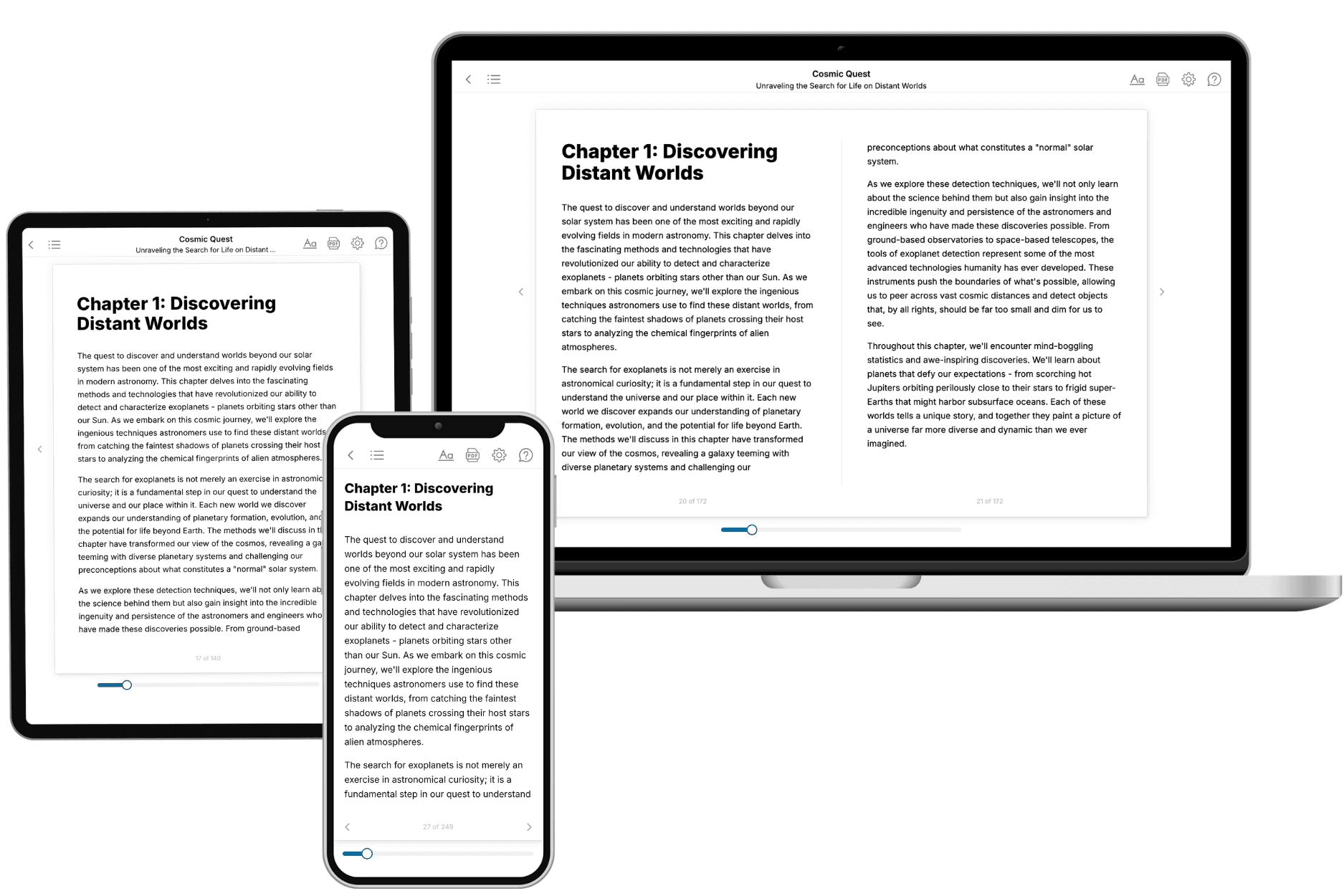
Your book is ready in 10 minutes. Read it online, download as EPUB or PDF, or send to Kindle.

Frequently asked questions
- What is TailoredRead?
TailoredRead creates complete, full-length nonfiction ebooks, written specifically for you. Tell us what you want to learn and why, and TailoredRead writes you a complete ebook on it, with charts, tables, and diagrams throughout. Read it online, on Kindle, or on any e-reader, or download it as a PDF or EPUB. Every book is written fresh the day you order it.
- How is the book tailored to me?
Before anything is written, you answer a few short questions about your goals, your background, and the topics you care about. Your book is then planned around your answers: written at your level, focused on your goals, and covering the topics you chose, instead of the one-size-fits-all book a store sells everyone.
- Will it read like generic AI content?
No. Your book isn't a chat transcript: it's planned chapter by chapter before a single word is written, told in a clear book voice, and explains ideas visually with charts, tables, and diagrams. After writing, every book goes through an editorial pass that polishes chapters so the book reads consistent from start to finish. Judge for yourself: browse thousands of sample books on our Explore Books page.
- How accurate is the content?
Our AI first checks whether your subject needs live research. Niche and fast-moving subjects are researched before writing, and the book plan and chapters are grounded in what it finds. After writing, every book goes through a quality pass that checks its facts and consistency, and researched books list their sources in a Notes section at the back.
- How long is the book?
You choose the length: Comprehensive (250-300 pages), Detailed (150-200 pages), Essential (70-100 pages), or Short (30-50 pages).
- Does the book include visuals?
Yes. Every book includes charts, tables, and diagrams: timelines, checklists, step-by-step guides, decision trees, comparison tables, matrices, and bar charts. A typical book includes dozens of these visual elements.
- Can I read it on Kindle? What formats can I download?
Yes. Every book can be read in our online reader or downloaded as a PDF or EPUB. The EPUB can be opened with Kindle, Apple Books, Kobo, and any e-reader. The Commercial and Author licenses also include an editable Word (DOCX) and Markdown download.
- How much does it cost?
About the price of a regular ebook. The exact price depends on your book's length and complexity, from $2 for the shortest books to $35 for the most comprehensive, and it's shown when you review your book, before you commit to anything. Each book is a one-time purchase, yours to keep, no subscription. Licenses that let you share, teach, or publish your book range from $35.99 to $49.99.
- Can I preview the book before purchasing?
Before you pay, you'll see what your book will cover: the title, a detailed description, the estimated length, and the complete chapter-by-chapter table of contents, so you know what you're getting before you decide. The full text itself is written after you purchase.
- How long does it take to create a book?
About 10 minutes. You can start reading the opening chapters while the rest is still being written.