Topology Books
Explore tailored Topology books created by our AI
Books readers created
27 Topology books, each written for the reader who ordered it. Read its introduction, then personalize it to get a book of your own.
Unraveling Spaces
A Guide to Topology and Geometry in Mathematical Problem Solving
Struggling to visualize complex mathematical structures? You're not alone. Many math enthusiasts find themselves tangled in the intricate web of topology and geometry when tackling advanced problems. "Unraveling Spaces" is your compass in the fascinating world of shapes, surfaces, and spatial relationships. This book bridges the gap between abstract concepts and practical problem-solving techniques, making topology and geometry accessible and applicable. You'll journey through the foundations of these fields, exploring everything from basic topological properties to advanced geometric theorems. With each chapter, you'll gain powerful tools to approach mathematical challenges from new angles, quite literally. By the end of this book, you'll have a robust toolkit for tackling complex mathematical problems. Whether you're preparing for advanced studies or simply passionate about understanding the shape of mathematics, "Unraveling Spaces" will elevate your problem-solving skills to new dimensions.
Topology Foundations
Building Spatial Understanding from Algebraic Concepts
Develop a deep understanding of how shapes, spaces, and continuous transformations work in mathematics. This comprehensive guide bridges the gap between your intermediate algebra knowledge and the fascinating world of topology, where rubber sheets can be transformed into coffee cups and distance takes on entirely new meanings. You'll discover how topological concepts emerge naturally from algebraic foundations, learning to visualize and work with spaces that stretch, bend, and deform while preserving essential properties. Through carefully structured explanations and practical examples, you'll master the fundamental ideas of open and closed sets, continuity, compactness, and connectedness that form the backbone of modern mathematical analysis. Each concept builds systematically on your existing mathematical knowledge, using familiar algebraic tools to explore unfamiliar topological territories. You'll learn to recognize topological invariants, understand homeomorphisms, and develop the spatial reasoning skills that connect abstract mathematical concepts to concrete geometric intuition. By the end of this book, you'll possess a solid foundation in topology that opens doors to advanced mathematics, from differential geometry to algebraic topology, while gaining a new perspective on the mathematical structures you already know.
Topological Data Analysis
Understanding Shape, Structure, and Patterns in Complex Data
Most data analysis assumes your data fits neatly into standard statistical distributions. But what if the true structure of your data is fundamentally about its shape—the way points cluster, connect, and form patterns across multiple scales? Topological Data Analysis (TDA) offers a revolutionary perspective that reveals hidden geometric structures in complex datasets that traditional methods overlook. This book demystifies TDA by building from fundamental topological concepts through practical computational techniques. You'll discover how persistent homology identifies meaningful patterns, how simplicial complexes transform point clouds into analyzable structures, and how the mapper algorithm creates intuitive visualizations of data topology. Whether you're working with high-dimensional datasets, biological networks, or complex systems, TDA provides tools to uncover the intrinsic shape of your data. This guide bridges mathematical rigor with practical application, showing you not just how TDA works, but when and why to use it alongside traditional analytics.
What if the shapes of living organisms follow mathematical laws as precise as those governing planetary motion? This book reveals how differential geometry, topology, and advanced algorithms decode the hidden mathematics of biological growth. You'll discover why fractal patterns appear across scales in nature, how entropy quantifies complexity in living systems, and why symmetry groups constrain evolutionary possibilities. Moving beyond abstract theory, you'll learn to apply manifold learning algorithms to biological networks, use topological invariants to predict system behavior, and implement computational methods that transform raw biological data into actionable insights. Whether analyzing tumor growth dynamics, understanding neural network organization, or predicting protein folding patterns, these mathematical frameworks provide the precision tools needed for 21st-century biological research. This book integrates recent 2025 discoveries with established theory, offering both the conceptual depth mathematicians demand and the practical applications biologists require.
Unraveling Algebraic Topology
A Journey Through Spaces, Shapes, and Mathematical Structures
Elevate your mathematical prowess as you delve into the fascinating world of algebraic topology. This book serves as your trusted guide, taking you on an exhilarating exploration of the intricate relationships between algebra and geometry. You'll discover how seemingly abstract concepts translate into powerful tools for understanding complex spatial structures. From the foundations of point-set topology to the intricacies of homology theory, you'll gradually build your expertise in this captivating field. Each chapter unfolds with clarity, presenting key ideas through intuitive explanations and carefully crafted examples. You'll learn to see the world through a new mathematical lens, recognizing topological invariants in everyday objects and grasping the significance of homotopy groups in analyzing spaces. Whether you're a mathematics student seeking to expand your horizons or an enthusiast eager to tackle advanced concepts, this book caters to your curiosity and ambition. By the end, you'll possess a robust toolkit for tackling complex topological problems and a deep appreciation for the elegant interplay between algebra and geometry that defines this field.
Riemannian Geometry and Graphs
A Comprehensive Guide for Urban Planners and Spatial Analysts
Embark on a transformative journey into the world of Riemannian geometry and its applications to graph theory with this groundbreaking book. Tailored for urban planners, spatial analysts, and interdisciplinary researchers, this comprehensive guide bridges the gap between abstract mathematical concepts and real-world applications. You'll start with the fundamentals of manifolds and metric tensors, gradually progressing to more advanced topics such as spectral graph theory, Ricci flow, and differential forms. Each chapter builds upon the last, providing you with a solid foundation in Riemannian geometry while simultaneously exploring its connections to graph theory and urban planning. Through clear explanations, intuitive examples, and practical exercises, you'll gain the tools to enhance your spatial analysis skills, improve your research methods, and integrate sophisticated mathematical concepts into your work. Whether you're looking to collaborate with experts in the field or teach advanced concepts, this book will equip you with the knowledge and confidence to excel in your professional endeavors.
Imagine standing at the edge of mathematical discovery, where abstract concepts crystallize into profound insights and centuries-old conjectures yield to modern techniques. This book guides you through the most exciting frontiers of contemporary mathematics, from cutting-edge topology research to breakthrough developments in number theory and computational methods. You'll explore how advanced proof techniques—including category theory, homological algebra, and homotopy type theory—are reshaping mathematical practice. Discover how topological data analysis and spectral methods are revolutionizing data science, and understand why the Riemann Hypothesis remains mathematics' greatest unsolved challenge. Whether you're investigating chaos theory, mastering differential geometry, or exploring noncommutative geometry, this comprehensive exploration connects theory to application. Designed for self-taught mathematicians ready to engage with contemporary research, each chapter builds your abstract thinking skills while revealing how modern mathematics synthesizes insights across topology, algebra, analysis, and computation. Engage with the methods, concepts, and breakthroughs that define mathematical research today.
Spherical Horizons
Navigating the Curves of Non-Euclidean Space
You're about to venture into a world where straight lines curve and triangles defy familiar rules. In "Spherical Horizons," you'll discover the fascinating realm of spherical geometry, where the surface of a sphere becomes your playground for mathematical exploration. As you progress through this book, you'll unravel the mysteries of great circles, learn to calculate distances across globes, and understand how spherical trigonometry shapes our understanding of navigation and astronomy. You'll see how the concepts you've known in planar geometry transform when applied to a curved surface, opening up new perspectives on shape, distance, and angle. This book doesn't just present abstract concepts; it connects spherical geometry to real-world applications. You'll explore how these principles are used in global positioning systems, understand their role in map projections, and see their influence in fields ranging from astronomy to computer graphics. By the end, you'll have a robust toolkit for thinking in three dimensions, ready to apply your knowledge to complex problems in science, engineering, and beyond.
Embark on a fascinating journey through the intricate world of Differential Geometry with "Navigating Curves and Spaces: A Self-Learner's Guide to Differential Geometry and Its Applications." This comprehensive guide is tailored for the curious mind, bridging the gap between foundational mathematics and advanced geometric concepts. Written with the self-learner in mind, this book offers a clear and accessible approach to complex topics such as manifold theory, Riemannian metrics, and differential forms. Each chapter builds upon the last, gradually introducing you to the beautiful interplay between geometry, topology, and physics. From the basics of tangent spaces to the intricacies of the Gauss-Bonnet theorem, you'll discover how these mathematical tools shape our understanding of the physical world. The book emphasizes practical applications, making abstract concepts tangible through real-world examples and connections to physics. Whether you're a student looking to expand your mathematical horizons or a professional seeking to deepen your understanding of geometric principles, "Navigating Curves and Spaces" provides the perfect roadmap for your journey into the fascinating realm of Differential Geometry.
Curves and Spaces
A Practical Introduction to Riemannian Geometry
Master the elegant mathematics of curved spaces and discover how geometry shapes our understanding of the universe. This book takes you from the basics of manifolds and metrics through the sophisticated concepts of curvature and connections, building your intuition at every step. You'll learn why geodesics matter, how to calculate curvature in practical examples, and understand the deep connection between geometry and physics. With clear explanations, worked examples, and visual intuition throughout, you'll develop the confidence to tackle advanced topics and apply Riemannian geometry to real problems. Whether you're preparing for advanced mathematics, exploring differential geometry, or curious about the geometric foundations of relativity, this book provides the essential knowledge and practical skills you need to think geometrically about curved spaces.
The Discrete-Continuous Nexus
Bridging Advanced Mathematical Concepts for Graduate Success
Struggling to connect the dots between discrete and continuous mathematics as you prepare for graduate studies? The world of advanced mathematics can seem like an insurmountable challenge, filled with abstract concepts and complex proofs that often feel disconnected from one another. The Discrete-Continuous Nexus is your comprehensive guide to mastering the intricate relationships between discrete and continuous mathematics. This book bridges the gap between undergraduate foundations and graduate-level thinking, providing you with the tools to tackle complex problems and develop a deeper mathematical intuition. From exploring the fascinating interplay between graph theory and topology to unraveling the connections between number theory and complex analysis, you'll discover how seemingly disparate areas of mathematics are intricately linked. Each chapter builds upon your existing knowledge, gradually introducing more advanced concepts while reinforcing the fundamental principles that tie them together. By the time you finish this book, you'll have developed the problem-solving skills, proof techniques, and abstract thinking abilities necessary to excel in graduate-level mathematics courses and beyond. Whether you're aiming to become a professional mathematician, pursue mathematical research, or simply deepen your understanding of advanced mathematical concepts, The Discrete-Continuous Nexus will be your indispensable companion on this intellectual journey.
Imagine mastering the mathematical framework that describes the universe itself—where gravity emerges not as a force, but as the geometry of spacetime. This comprehensive guide takes you from foundational manifold theory through the sophisticated mathematics of curved spacetime, building the rigorous understanding you need to work confidently with Einstein's field equations and advanced geometric physics. Written for someone with your mathematical background, this book bridges the gap between pure differential geometry and its profound physical applications. You'll develop deep proficiency with metric tensors, Christoffel symbols, curvature tensors, and geodesic equations—not just as abstract concepts, but as tools for solving real problems in general relativity and cosmology. Each chapter builds systematically, introducing Lie groups, parallel transport, and differential forms in ways that illuminate their geometric meaning and practical utility. Whether you're exploring the mathematics of black holes, understanding gravitational waves, or connecting topological properties to physical phenomena, you'll find the conceptual clarity and computational rigor needed to advance your mastery of this elegant mathematical landscape.
Beyond Parallel Lines
Navigating the Curved Spaces of Non-Euclidean Geometry
Prepare to bend your mind as you venture into the captivating realm of non-Euclidean geometry. In "Beyond Parallel Lines," you'll discover a world where the rules of flat surfaces no longer apply and new mathematical vistas open up before your eyes. This book will guide you through the curved spaces of hyperbolic and elliptic geometries, revealing how these alternative systems challenge our intuitions and expand our understanding of shape and space. You'll explore the historical context that led to the development of non-Euclidean geometries, from the ancient Greeks' attempts to prove Euclid's parallel postulate to the revolutionary ideas of 19th-century mathematicians. Through clear explanations and engaging examples, you'll grasp the fundamental concepts of these alternative geometries and see how they apply to real-world phenomena, from the curvature of spacetime in Einstein's theory of relativity to the design of modern navigation systems. As you progress through the book, you'll develop a deeper appreciation for the beauty and complexity of mathematics. You'll learn to visualize curved spaces, understand the properties of triangles on spheres, and explore the mind-bending implications of parallel lines that meet. By the end, you'll have gained not just knowledge, but a new perspective on the nature of space itself, forever changing the way you see the world around you.
Measure Theory Blueprint
From Foundational Concepts to Confident Mastery
This book guides you through measure theory's essential landscape, building from concrete set-theoretic foundations to the abstract concepts that underpin modern probability and analysis. You'll start with set theory fundamentals, then progress systematically through sigma-algebras, measurable functions, and Lebesgue measure—each concept carefully scaffolded to build on previous understanding. Rather than overwhelming you with abstraction, each chapter connects theory to intuition, showing why these structures matter and how they solve problems that classical approaches cannot. You'll develop problem-solving skills through progressive examples, master Borel sigma-algebras, understand integration theory from first principles, and explore convergence theorems that justify exchanging limits with integrals. By the end, you'll have the conceptual confidence and technical foundation needed for advanced study in functional analysis, probability theory, or mathematical statistics—customized to your pace and learning style.
Most mathematicians encounter elliptic curves as isolated examples—a special case here, a useful tool there. But elliptic curves aren't special because they're convenient; they're special because they occupy a rare equilibrium that doesn't exist anywhere else in mathematics. This book reveals why elliptic curves achieve perfect balance: enough algebraic structure to support group operations and symmetries, enough analytic flexibility to deform in families, enough rigidity to permit complete classification, and enough transcendental power to connect to number theory through modular forms. You'll discover why this balance shatters in higher dimensions and why simpler curves lack the necessary complexity. By understanding genus, uniformization, and the convergence of algebraic and analytic perspectives, you'll gain insight into one of mathematics' most profound equilibria—and why dimension one is genuinely unique. This book bridges the gap between abstract theory and concrete understanding, making the deep mathematics of elliptic curves accessible to educators and serious students.
Geometric Deep Learning
Harnessing the Power of Structure in Neural Networks
Discover how geometric principles can revolutionize your approach to neural network design and dramatically improve model performance. This comprehensive guide reveals why the structure of your data matters as much as the data itself, and how recognizing geometric properties leads to networks that learn faster, generalize better, and require fewer parameters. You'll explore the mathematical foundations that unify seemingly different architectures—from convolutional networks to graph neural networks—and learn practical techniques for applying these insights to real-world problems. Whether you're working with images, molecular structures, social networks, or any complex data, understanding geometric deep learning will enable you to build more efficient and interpretable models. This book bridges the gap between abstract mathematical theory and practical implementation, providing both the conceptual understanding and concrete examples needed to apply these powerful techniques in your research and projects.
Functional Analysis Essentials
Building Intuition and Mastery in Classical Mathematics
Functional analysis can feel abstract and disconnected from practical mathematics, leaving many students struggling to see how these concepts fit into the broader mathematical landscape. This book bridges that gap by building your intuition from the ground up, starting with why we need functional analysis and progressing through its essential concepts with clarity and purpose. You'll discover how infinite-dimensional spaces extend classical analysis, master the fundamental structures like Banach and Hilbert spaces, and understand the powerful theorems that make functional analysis indispensable. Each concept is presented with concrete examples, visual explanations, and connections to classical mathematics. Whether you're preparing for advanced study, seeking to strengthen your mathematical foundation, or exploring applications in physics and engineering, this book provides the conceptual clarity and technical depth you need to truly understand functional analysis rather than simply memorize definitions.
This comprehensive treatment develops the mathematical formalism of classical mechanics from first principles, guiding you through the geometric structures that underlie dynamical systems. Beginning with the calculus of variations on manifolds, you'll establish the Lagrangian framework on tangent bundles and discover how symmetries generate conservation laws. The text then transitions to Hamiltonian mechanics, where symplectic geometry becomes your primary tool for understanding phase space dynamics. You'll master canonical transformations, Hamilton-Jacobi theory, and the momentum map—tools that reveal hidden symmetries and enable systematic reduction of complex systems. As you progress, you'll explore completely integrable systems and their action-angle variables, then venture into perturbation theory and KAM theory to understand stability in nearly-integrable regimes. The final sections address Hamiltonian chaos through ergodic theory, extend mechanics to time-dependent systems via contact geometry, and introduce infinite-dimensional systems and geometric quantization. Throughout, rigorous mathematical development is balanced with physical intuition, preparing you for advanced research in dynamical systems, mathematical physics, and geometric analysis.
Real Analysis Unveiled
From Foundations to Frontiers in Mathematical Research
Think Real Analysis is just about limits and continuity? Think again. This book shatters the misconception that Real Analysis is an isolated branch of mathematics with little practical application. "Real Analysis Unveiled: From Foundations to Frontiers in Mathematical Research" is your comprehensive guide to mastering this fundamental field of mathematics. You'll journey from the basic principles to the cutting-edge applications in modern mathematical research. Through clear explanations, intuitive examples, and challenging exercises, you'll develop a deep understanding of concepts like topology, measure theory, and functional analysis. You'll see how these abstract ideas form the backbone of many areas in mathematics and even find applications in fields like physics and computer science. Whether you're a student looking to excel in your studies or a researcher aiming to strengthen your mathematical foundation, this book will equip you with the tools to tackle complex problems and contribute to the forefront of mathematical research.
Algebraic Geometry Essentials
From Abstract Algebra to Geometric Intuition
Imagine confidently navigating the elegant intersection of algebra and geometry, where polynomial equations reveal hidden geometric structures. This book transforms algebraic geometry from an intimidating abstraction into an accessible, intuitive discipline that builds naturally from concepts you already understand. Starting with concrete examples and visual intuition, you'll discover how algebraic structures encode geometric information. You'll learn to visualize varieties as solution sets, understand the deep connection between coordinate rings and geometric properties, and master the tools that make algebraic geometry powerful. Each concept builds systematically, with clear explanations that honor both mathematical rigor and practical understanding. Whether you're pursuing advanced mathematics, applying these ideas to cryptography or computer vision, or simply deepening your mathematical knowledge, this book provides the conceptual foundation and technical skills you need. You'll move from foundational ideas through sophisticated techniques, always grounded in examples that illuminate why these concepts matter. By the end, algebraic geometry won't feel like abstract theory—it will be a natural extension of your mathematical thinking.
The relationship between classical and quantum mechanics has puzzled physicists and mathematicians for over a century. Star products offer an elegant solution: they show how quantum mechanics emerges naturally from classical mechanics through a continuous deformation of algebraic structures. This book guides you through the mathematical landscape of star products in symplectic geometry, starting from foundational concepts and building toward sophisticated applications. You'll discover how symplectic manifolds encode classical mechanics, how Poisson brackets generalize to star products, and how deformation quantization bridges two seemingly incompatible worlds. Through carefully constructed examples—from simple Euclidean spaces to complex manifolds—you'll develop intuition for abstract concepts. Whether you're preparing for advanced research or seeking deeper understanding of quantum-classical correspondence, this book provides the rigorous yet accessible foundation you need to master star products and their profound implications for modern mathematics and physics.
What if the shortest path between two points isn't actually a straight line? In curved spacetime, the geometry itself determines how objects move and how forces manifest. This book provides a rigorous, mathematically complete treatment of geodesic equations and curvature in general relativity, designed for someone with your physics and mathematics background who wants to move beyond introductory treatments. You'll master the derivation of Christoffel symbols from first principles, understand the Riemann curvature tensor's geometric meaning, and learn how covariant derivatives ensure physical laws remain valid across all coordinate systems. Each concept builds systematically from tensor calculus fundamentals through advanced applications like geodesic deviation equations and holonomy groups. Rather than relying on intuition alone, you'll work through detailed derivations that reveal why these mathematical structures are essential for describing gravity as curved spacetime. This is the mathematical foundation that makes general relativity not just a theory, but a precise geometric description of the universe.
Imagine confidently working through the mathematical framework that describes gravity not as a force, but as the geometry of spacetime itself. This comprehensive guide takes you from foundational tensor calculus through the sophisticated mathematics of black holes, gravitational waves, and cosmological models. Whether you're exploring the elegant Schwarzschild solution, mastering Einstein's field equations, or developing geometric intuition for curved spacetime, this book provides the rigorous yet accessible treatment you need. Each chapter builds systematically on previous concepts, combining theoretical foundations with practical problem-solving techniques. You'll work with Riemann geometry, differential forms, and advanced tensor methods while gaining deep insight into how mathematics reveals the universe's structure. Perfect for someone with strong mathematical background seeking to understand general relativity at the level of research and advanced applications, this book transforms abstract concepts into concrete understanding.
You will deepen your understanding of why the universe must be structured as it is by integrating cutting-edge mathematics and physics with timeless philosophical insight. This book demonstrates that the 3+1 dimensional configuration of spacetime is not an arbitrary feature of reality but a metaphysically privileged condition for embodied rational existence. By synthesizing Aristotelian hylomorphism and Thomistic causality with contemporary findings in general relativity, topology, and quantum field theory, you'll discover how dimensional structure enables stable matter, causal interaction, and purposeful action. Rather than treating physics and metaphysics as competing frameworks, this work shows how they illuminate each other—revealing that the mathematical structures physicists describe are the very conditions that classical philosophy identified as necessary for beings capable of knowledge, love, and finality. Whether you're exploring the foundations of metaphysics or seeking to reconcile scientific discovery with philosophical realism, this book provides the rigorous integration you've been seeking.
The Strategic Mind
Mastering Game Theory for Mathematical Research
Embark on a fascinating journey into the world of game theory with "The Strategic Mind: Mastering Game Theory for Mathematical Research." This comprehensive guide is tailored for mathematics enthusiasts and students who are ready to elevate their understanding of this powerful analytical tool. In this book, you'll discover how game theory serves as a bridge between abstract mathematical concepts and real-world strategic decision-making. You'll explore the fundamental principles that underpin game theory, from the basics of player interactions to advanced equilibrium concepts. Each chapter builds upon the last, gradually expanding your knowledge and intuition about strategic thinking in mathematics. Whether you're interested in pure mathematics or its applications, "The Strategic Mind" offers invaluable insights into how game theory can enhance your problem-solving skills and research capabilities. By the end of this book, you'll have a robust framework for analyzing complex interactions, predicting outcomes, and optimizing strategies across various mathematical domains.
Imagine seeing the hidden architecture that connects seemingly disparate areas of mathematics—where groups, rings, and fields aren't just abstract definitions but living structures that breathe meaning into number theory, geometry, and beyond. This book takes you beyond the computational mechanics of abstract algebra into the conceptual landscape where mathematical research happens. You'll develop the structural intuition that distinguishes those who merely know algebra from those who think algebraically. Through carefully constructed explorations, you'll discover why homomorphisms matter more than you thought, how representation theory makes the abstract concrete, and why category theory isn't just abstraction for its own sake. Each chapter builds your capacity to recognize patterns, construct meaningful examples, and see connections that transform isolated facts into coherent understanding. Whether you're preparing for graduate-level research, seeking deeper insight into algebraic structures, or simply curious about how mathematicians actually think about algebra, this book provides the conceptual tools and perspectives that textbooks often leave implicit. You'll emerge with not just knowledge, but mathematical maturity.
Algebraic Geometry Unveiled
A Step-by-Step Journey Through Mathematical Landscapes
Your mathematical odyssey begins as you step into the fascinating world of Algebraic Geometry. This book guides you through the intricate tapestry of curves, polynomials, and abstract algebra, gradually revealing the beauty and power of this mathematical discipline. You'll start by building a solid foundation, exploring the essential prerequisites and basic concepts that form the bedrock of Algebraic Geometry. As you progress, you'll delve into more complex territories, discovering affine varieties, algebraic groups, and the interplay between topology and geometry. Your journey will take you through the realms of commutative algebra, cohomology, and the captivating world of Riemann surfaces and elliptic curves. By the end of this intellectual adventure, you'll have gained a comprehensive understanding of Algebraic Geometry's core principles and its connections to other mathematical domains. This book equips you with the knowledge and tools to confidently explore more advanced topics in this rich and rewarding field.
Related books you may like:
Discover how advanced functional materials are reshaping industries and enabling solutions to humanity's greatest challenges. This comprehensive guide takes you beyond basic materials science to explore the cutting-edge world of engineered materials designed to perform specific, transformative functions. You'll learn how scientists and engineers manipulate atomic structures and processing conditions to create materials that respond to stimuli, conduct electricity with unprecedented efficiency, or heal themselves. From smart polymers that change properties on demand to nanomaterials with revolutionary capabilities, this book reveals the principles behind these innovations and their practical applications in healthcare, energy, electronics, and aerospace. Whether you're advancing your career, developing new products, or simply fascinated by the materials shaping our future, you'll gain the knowledge to understand, evaluate, and potentially contribute to this rapidly evolving field.
Most chemical reactions should happen instantly, yet they don't. The culprit? Activation energy—the invisible barrier that keeps reactants locked in place until enough energy arrives to break them free. Without understanding this fundamental concept, enzyme kinetics remains a mystery, and the elegant mechanisms by which life accelerates reactions seem like magic. This book demystifies activation energy and enzyme kinetics through clear explanations, practical examples, and visual frameworks. You'll discover how enzymes perform their catalytic miracles by lowering activation energy, explore the mathematics of reaction rates through the Arrhenius equation and Michaelis-Menten kinetics, and learn how inhibition mechanisms control biological processes. Whether you're studying biochemistry, developing pharmaceuticals, or optimizing industrial processes, this guide equips you with both the conceptual understanding and quantitative tools needed to predict, analyze, and manipulate enzyme-catalyzed reactions with confidence.
Achieve reliable, reproducible separations of complex chemical mixtures using adsorption chromatography. This practical guide bridges the gap between theoretical principles and real-world laboratory application, providing you with the knowledge and skills to design effective separation strategies for your specific analytical needs. You'll explore the fundamental science of how compounds interact with adsorbent materials, learn to select optimal stationary and mobile phases, and master the practical techniques that ensure consistent results. Whether you're working with thin-layer chromatography, column chromatography, or HPLC systems, this book equips you with systematic approaches to troubleshooting common problems, optimizing separations, and interpreting data with confidence. Packed with practical examples, decision-making frameworks, and evidence-based strategies, you'll develop the expertise to tackle challenging separation problems and advance your analytical capabilities in pharmaceutical, environmental, or materials research.
Many assume adipose tissue is simply inert fat to be minimized or removed. In reality, it's a sophisticated, metabolically active organ with remarkable regenerative potential. This book reveals how adipose tissue engineering is revolutionizing medicine by creating functional tissue solutions for reconstruction, regeneration, and therapeutic applications. You'll discover the biological foundations of adipose tissue, learn how scientists harvest and cultivate adipose-derived stem cells, and explore cutting-edge engineering strategies that transform these cells into viable tissue constructs. From scaffold design and bioreactor optimization to vascularization techniques and clinical translation, this guide provides practical insights into the science and engineering behind adipose tissue regeneration. Whether you're a researcher, student, or healthcare professional, you'll gain actionable knowledge about the current state of the field, emerging technologies, and the real-world challenges of bringing engineered tissues from the laboratory to clinical practice.
In the rapidly evolving world of ultra-high-speed communications, the challenge of designing secure and efficient chips has never been more daunting. As a Principal Architect, you face the complex task of integrating cutting-edge VLSI techniques with robust cryptographic solutions. This book is your comprehensive guide to conquering these challenges. "Advanced VLSI Design" delves deep into the intricacies of modern chip architecture, offering you practical insights into overcoming CMOS scaling limitations, harnessing the power of 3D IC integration, and implementing state-of-the-art FinFET technology. You'll explore innovative approaches to low-power design and high-speed SerDes, crucial for next-generation communication systems. This book doesn't just stop at performance; it equips you with the knowledge to build security from the ground up. From hardware Trojan detection to side-channel analysis resistance, you'll learn how to create chips that are not only fast but also fortified against modern security threats. Dive into advanced topics like quantum-dot cellular automata and EUV lithography, positioning yourself at the forefront of VLSI innovation.
Create a Topology Book Tailored to You
Create an AI-crafted book tailored to your goals, interests, and background






Benefits of AI-tailored books
- Read one book, not ten:
- all the Topology knowledge you need, gathered into a single book.
- Save days of learning:
- tell us your goals, choose your topics, and the whole book is built around them.
- Learn effortlessly:
- Topology book written for your specific background and expertise.
- Understand at a glance:
- includes charts, tables, timelines, checklists, decision trees, and more.
- Stay current:
- written the day you order it, not years ago.
- Trust what you read:
- every book is checked for accuracy, with real research when your subject needs it.
Create your unique book in 3 steps
- 1. Select your focus
Select the focus of your Topology book and share your background
- 2. Personalize your book
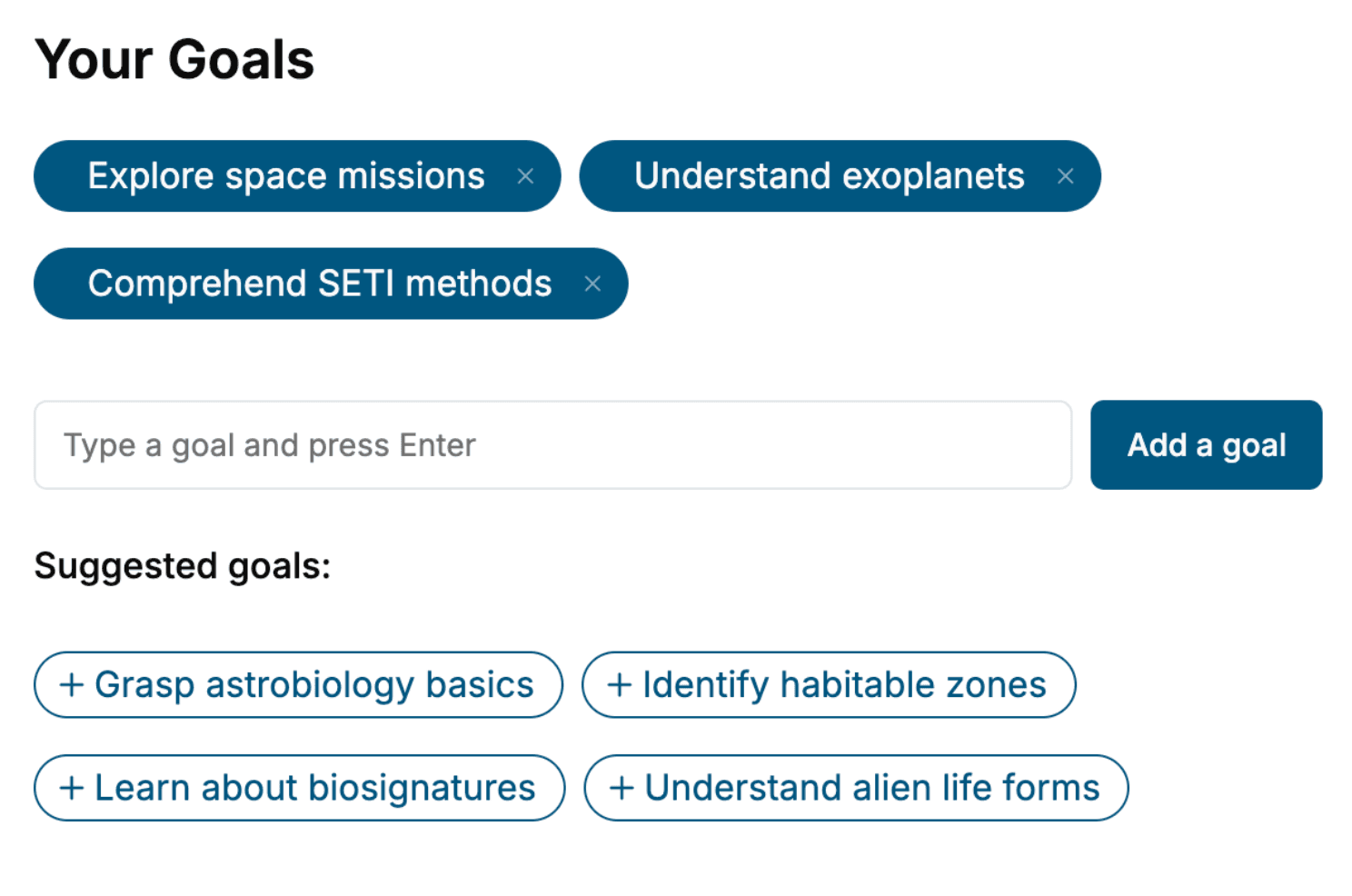
Specify your goals and choose sub-topics to include
- 3. Get your tailored book
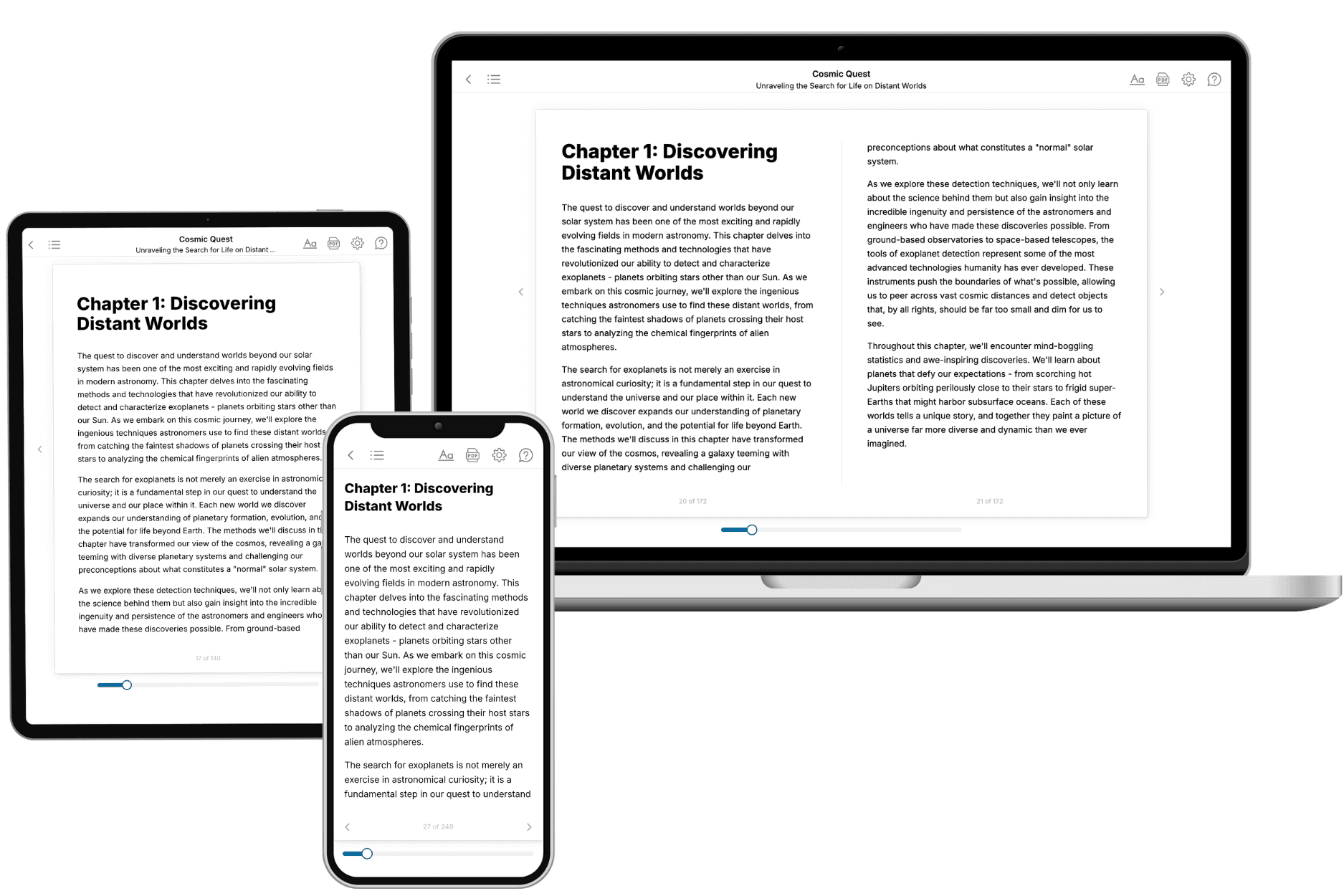
Your book is ready in 10 minutes. Read it online, download as EPUB or PDF, or send to Kindle.

Start from a template
Frequently asked questions
- What is TailoredRead?
TailoredRead creates complete, full-length nonfiction ebooks, written specifically for you. Tell us what you want to learn and why, and TailoredRead writes you a complete ebook on it, with charts, tables, and diagrams throughout. Read it online, on Kindle, or on any e-reader, or download it as a PDF or EPUB. Every book is written fresh the day you order it.
- How is the book tailored to me?
Before anything is written, you answer a few short questions about your goals, your background, and the topics you care about. Your book is then planned around your answers: written at your level, focused on your goals, and covering the topics you chose, instead of the one-size-fits-all book a store sells everyone.
- Will it read like generic AI content?
No. Your book isn't a chat transcript: it's planned chapter by chapter before a single word is written, told in a clear book voice, and explains ideas visually with charts, tables, and diagrams. After writing, every book goes through an editorial pass that polishes chapters so the book reads consistent from start to finish. Judge for yourself: browse thousands of sample books on our Explore Books page.
- How accurate is the content?
Our AI first checks whether your subject needs live research. Niche and fast-moving subjects are researched before writing, and the book plan and chapters are grounded in what it finds. After writing, every book goes through a quality pass that checks its facts and consistency, and researched books list their sources in a Notes section at the back.
- How long is the book?
You choose the length: Comprehensive (250-300 pages), Detailed (150-200 pages), Essential (70-100 pages), or Short (30-50 pages).
- Does the book include visuals?
Yes. Every book includes charts, tables, and diagrams: timelines, checklists, step-by-step guides, decision trees, comparison tables, matrices, and bar charts. A typical book includes dozens of these visual elements.
- Can I read it on Kindle? What formats can I download?
Yes. Every book can be read in our online reader or downloaded as a PDF or EPUB. The EPUB can be opened with Kindle, Apple Books, Kobo, and any e-reader. The Commercial and Author licenses also include an editable Word (DOCX) and Markdown download.
- How much does it cost?
About the price of a regular ebook. The exact price depends on your book's length and complexity, from $2 for the shortest books to $35 for the most comprehensive, and it's shown when you review your book, before you commit to anything. Each book is a one-time purchase, yours to keep, no subscription. Licenses that let you share, teach, or publish your book range from $35.99 to $49.99.
- Can I preview the book before purchasing?
Before you pay, you'll see what your book will cover: the title, a detailed description, the estimated length, and the complete chapter-by-chapter table of contents, so you know what you're getting before you decide. The full text itself is written after you purchase.
- How long does it take to create a book?
About 10 minutes. You can start reading the opening chapters while the rest is still being written.