Geometric Mechanics: The Mathematical Foundation of Classical Dynamics
From Lagrangian Formalism to Hamiltonian Dynamics, Symmetries, and Chaos
This comprehensive treatment develops the mathematical formalism of classical mechanics from first principles, guiding you through the geometric structures that underlie dynamical systems.
253 pages12 chaptersJun 25, 2026Classical Mechanics
About this book
Beginning with the calculus of variations on manifolds, you'll establish the Lagrangian framework on tangent bundles and discover how symmetries generate conservation laws. The text then transitions to Hamiltonian mechanics, where symplectic geometry becomes your primary tool for understanding phase space dynamics. You'll master canonical transformations, Hamilton-Jacobi theory, and the momentum map—tools that reveal hidden symmetries and enable systematic reduction of complex systems. As you progress, you'll explore completely integrable systems and their action-angle variables, then venture into perturbation theory and KAM theory to understand stability in nearly-integrable regimes. The final sections address Hamiltonian chaos through ergodic theory, extend mechanics to time-dependent systems via contact geometry, and introduce infinite-dimensional systems and geometric quantization. Throughout, rigorous mathematical development is balanced with physical intuition, preparing you for advanced research in dynamical systems, mathematical physics, and geometric analysis.
Table of contents
- IntroductionWhy Geometric Formalism Matters, Scope and Roadmap of This Book, Mathematical Prerequisites and Notation, How to Use This Book EffectivelyRead below
- Chapter 1: Foundations: Manifolds, Tangent Bundles, and Variational CalculusSmooth Manifolds and Differential Forms, Tangent and Cotangent Bundles, Calculus of Variations on Manifolds
- Chapter 2: Lagrangian Mechanics on Tangent BundlesThe Lagrangian Function and Euler-Lagrange Equations, Geometric Interpretation of Lagrangian Dynamics, The Legendre Transform and Transition to Hamiltonian Mechanics
- Chapter 3: Symmetries and Conservation Laws in Lagrangian MechanicsNoether's Theorem and Conserved Quantities, Lie Groups and Group Actions on Configuration Space, Cyclic Coordinates and Reduction
- Chapter 4: Symplectic Geometry and Hamiltonian DynamicsSymplectic Manifolds and the Symplectic Form, Hamiltonian Vector Fields and Phase Flow, Poisson Brackets and Observables
- Chapter 5: Canonical Transformations and Hamilton-Jacobi TheorySymplectomorphisms and Canonical Transformations, Generating Functions and Canonical Coordinates, The Hamilton-Jacobi Equation and Complete Solutions, Lagrangian Submanifolds and Action-Angle Variables
- Chapter 6: Momentum Maps and Hamiltonian Group ActionsDefinition and Properties of the Momentum Map, Equivariance and Conservation of Momentum, Coadjoint Orbits and Geometric Quantization
- Chapter 7: Symplectic Reduction and Constrained SystemsThe Symplectic Reduction Theorem, Poisson Manifolds and Singular Reduction, Constraints and Dirac's Formalism
- Chapter 8: Integrable Systems and Action-Angle VariablesCompletely Integrable Systems and Liouville's Theorem, Construction of Action-Angle Variables, Torus Dynamics and Quasi-Periodic Motion
- Chapter 9: Perturbation Theory, KAM Theory, and StabilityCanonical Perturbation Theory and Normal Forms, The KAM Theorem and Persistence of Tori, Stability Analysis and Lyapunov Exponents
- Chapter 10: Hamiltonian Chaos and Ergodic TheoryEmergence of Chaos in Hamiltonian Systems, Ergodic Theory and Statistical Mechanics, Mixing Properties and Entropy
- Chapter 11: Time-Dependent Mechanics and Contact GeometryContact Manifolds and Contact Forms, Time-Dependent Hamiltonian Systems, Dissipative Systems and Non-Conservative Dynamics
- Chapter 12: Infinite-Dimensional Hamiltonian Systems and Geometric QuantizationInfinite-Dimensional Hamiltonian Systems and PDEs, Introduction to Geometric Quantization, Bridging Classical and Quantum Mechanics
- ConclusionSynthesis of Geometric Mechanics, Future Directions and Advanced Topics
- Appendix: Essential BackgroundDifferential Geometry Review, Lie Theory Reference, Notation and Conventions
- Further Reading and References
Introduction
Classical mechanics is one of the oldest and most thoroughly studied branches of physics, yet its deepest mathematical structure remained largely hidden for centuries. Newton's laws, written in the language of forces and accelerations, describe motion with remarkable accuracy. But they do not reveal the geometric skeleton that underlies all of classical dynamics. That skeleton is the subject of this book. Geometric mechanics is the discipline that exposes this structure, translating the familiar equations of motion into the language of manifolds, differential forms, and symplectic geometry. The result is not merely a reformulation. It is a profound shift in perspective that unlocks tools unavailable in the Newtonian framework.
The transition from Newtonian to geometric mechanics is not just an aesthetic preference for abstraction. It is a practical necessity when dealing with constrained systems, systems with symmetry, or systems that live on curved configuration spaces. A rigid body rotating freely in space, a particle constrained to move on a sphere, a coupled oscillator network with conserved quantities: each of these systems becomes dramatically more tractable when analyzed through the geometric lens. The configuration space is a manifold, the velocities live on its tangent bundle, and the momenta live on the cotangent bundle. These are not just convenient metaphors. They are precise mathematical statements that carry real computational and conceptual weight.
This book is written for graduate mathematics students who already have a working knowledge of differential geometry and classical mechanics at the advanced undergraduate level. The goal is not to introduce mechanics from scratch, but to rebuild it on rigorous geometric foundations and then push well beyond the standard curriculum. You will encounter Lagrangian and Hamiltonian mechanics reformulated on smooth manifolds, symplectic geometry as the natural language of phase space, Noether's theorem in its full geometric generality, canonical transformations, the momentum map, symplectic reduction, integrable systems, KAM theory, Hamiltonian chaos, contact geometry, and a first look at geometric quantization. Each of these topics connects to the others through a coherent geometric framework, and that coherence is one of the central themes of the entire text.
The organization of the book reflects a deliberate pedagogical strategy. The early chapters build the geometric scaffolding carefully, ensuring that the later, more advanced material rests on solid foundations. The middle chapters develop the core machinery of Hamiltonian mechanics and its symmetry theory. The final chapters venture into territory that is genuinely at the frontier of mathematical physics, including infinite-dimensional systems and the bridge to quantum mechanics. Throughout, the emphasis is on understanding why the formalism is structured the way it is, not just how to apply it mechanically. Geometric mechanics rewards this kind of deep engagement, and the payoff is a unified view of dynamics that extends naturally into modern research.
Why Geometric Formalism Matters
The most immediate reason to adopt geometric formalism is coordinate independence. In Newtonian mechanics, the equations of motion are written in a specific coordinate system, and changing coordinates requires careful bookkeeping. In the Lagrangian framework on a manifold, the Euler-Lagrange equations hold in any coordinate chart. This is not a minor convenience. It means that the physics is encoded in the geometry of the configuration manifold, not in any particular way of labeling its points. When the configuration space is a Lie group, a sphere, or some other curved space, this coordinate independence becomes essential rather than optional.
Symplectic geometry provides an even deeper reason for the geometric approach. The phase space of a Hamiltonian system carries a natural symplectic structure, a closed, non-degenerate two-form ω that encodes the fundamental Poisson bracket relations between positions and momenta. This structure is preserved by the time evolution of any Hamiltonian system, a fact known as Liouville's theorem in its geometric form. The preservation of ω is not just a mathematical curiosity. It has direct physical consequences, including the incompressibility of phase space flow and the existence of conserved quantities associated with symmetries.[1]
Noether's theorem is perhaps the most celebrated result in all of theoretical mechanics, and its geometric formulation is far more powerful than the version typically presented in physics courses. In the geometric setting, every continuous symmetry of a Lagrangian system corresponds to a conserved quantity, and this correspondence is mediated by the momentum map. The momentum map is a smooth function from phase space to the dual of the Lie algebra of the symmetry group. It packages all conserved quantities associated with a group action into a single geometric object. This level of organization is simply not visible in the coordinate-based formulation.
The geometric framework also makes the relationship between different mechanical systems transparent. Two systems that look completely different in coordinates may be related by a symplectomorphism, a diffeomorphism that preserves the symplectic form. If such a map exists, the two systems are mechanically equivalent in a deep sense. This is the geometric content of canonical transformations, and it is the key idea behind Hamilton-Jacobi theory. Finding a canonical transformation that simplifies a system to the point of trivial solvability is the central strategy of classical integrability theory.
Beyond classical mechanics itself, the geometric formalism provides the natural language for several adjacent fields. Geometric quantization, which is introduced in the final chapter, uses the symplectic structure of phase space as the starting point for constructing quantum mechanical Hilbert spaces. The Poisson bracket on classical observables becomes the commutator bracket on quantum operators. This connection is not just formal. It reflects a genuine structural relationship between classical and quantum mechanics that is only visible from the geometric vantage point. Similarly, the study of Hamiltonian PDEs, including the Korteweg-de Vries equation and the nonlinear Schrödinger equation, relies on infinite-dimensional symplectic geometry in an essential way.
There is also a practical argument for geometric mechanics that is easy to overlook. Modern computational methods for simulating Hamiltonian systems, including symplectic integrators, are designed explicitly to preserve the symplectic structure of phase space. Algorithms like the Störmer-Verlet method and its higher-order generalizations maintain the geometric properties of the exact flow, leading to dramatically better long-time behavior than non-symplectic integrators.[2] Understanding why these methods work requires understanding the geometry they are designed to preserve.
The geometric approach to mechanics is not an abstraction for its own sake. It is the correct language for the subject, in the same way that Riemannian geometry is the correct language for general relativity. Once you learn to think geometrically, the coordinate-based formulations appear as special cases of a much richer structure.
Finally, the geometric perspective cultivates a style of mathematical thinking that is valuable far beyond mechanics. The interplay between local and global properties, the role of topology in constraining dynamics, the use of symmetry to reduce complexity: these are themes that appear throughout modern mathematics and mathematical physics. Mastering geometric mechanics is, in part, mastering a way of thinking that transfers to many other domains.
Scope and Roadmap of This Book
The book is organized into twelve chapters, grouped loosely into four thematic blocks. The first block, covering Chapters 1 through 3, establishes the geometric foundations and develops Lagrangian mechanics in full generality. The second block, Chapters 4 through 7, introduces symplectic geometry and builds the complete apparatus of Hamiltonian mechanics, including canonical transformations, the momentum map, and symplectic reduction. The third block, Chapters 8 through 10, addresses integrable systems, perturbation theory, KAM theory, and Hamiltonian chaos. The fourth block, Chapters 11 and 12, extends the framework to time-dependent systems via contact geometry and introduces infinite-dimensional systems and geometric quantization.
Chapter 1 reviews smooth manifolds, differential forms, and the calculus of variations on manifolds. Even if you are comfortable with differential geometry, this chapter is worth reading carefully because it establishes the specific conventions and notation used throughout the book. The treatment of the calculus of variations is more geometric than is typical in physics texts, emphasizing the role of the action functional as a map between function spaces and deriving the Euler-Lagrange equations as the condition for a critical point.
Chapter 2 develops Lagrangian mechanics on tangent bundles. The Lagrangian function is defined as a smooth function on the tangent bundle TQ of the configuration manifold Q, and the Euler-Lagrange equations are derived geometrically. The Legendre transform is presented as a fiber-preserving map from TQ to the cotangent bundle T*Q, setting up the transition to Hamiltonian mechanics. Chapter 3 then develops the theory of symmetries and conservation laws, culminating in a geometric proof of Noether's theorem and an introduction to reduction by cyclic coordinates.
Chapter 4 is the pivot of the book. It introduces symplectic manifolds, the symplectic form, Hamiltonian vector fields, and Poisson brackets. The cotangent bundle T*Q is shown to carry a canonical symplectic structure, and Hamilton's equations are derived as the flow of the Hamiltonian vector field. Chapter 5 develops canonical transformations through the theory of symplectomorphisms and generating functions, then presents the Hamilton-Jacobi equation as a method for finding canonical transformations that trivialize the dynamics. The chapter concludes with Lagrangian submanifolds and a first look at action-angle variables.
Chapter 6 gives a thorough treatment of the momentum map, including its definition, equivariance properties, and relationship to conservation laws. Coadjoint orbits are introduced as the natural geometric objects associated with Lie group symmetries. Chapter 7 then uses the momentum map to develop symplectic reduction, showing how symmetries can be used to reduce the dimension of a Hamiltonian system. Poisson manifolds and Dirac's formalism for constrained systems are also covered here.
Chapters 8 and 9 form the core of the integrability and perturbation theory material. Chapter 8 presents completely integrable systems, the Liouville-Arnold theorem, and the construction of action-angle variables. Chapter 9 develops canonical perturbation theory, normal forms, and the celebrated KAM theorem, which guarantees the persistence of quasi-periodic motion under small perturbations. Chapter 10 then examines what happens when integrability breaks down, introducing Hamiltonian chaos through the lens of ergodic theory, Lyapunov exponents, and mixing properties.
Chapter 11 extends the framework to time-dependent systems using contact geometry. Contact manifolds are the odd-dimensional analogs of symplectic manifolds, and they provide the natural setting for systems where energy is not conserved. Chapter 12 concludes the main text with an introduction to infinite-dimensional Hamiltonian systems, including field theories and Hamiltonian PDEs, and a first look at geometric quantization. The appendices provide reference material on differential geometry, Lie theory, and the notation conventions used throughout the book.
Mathematical Prerequisites and Notation
This book assumes a solid working knowledge of several areas of mathematics. The most important prerequisite is differential geometry at the level of a standard graduate course. You should be comfortable with smooth manifolds, tangent and cotangent spaces, vector fields, differential forms, the exterior derivative, Lie derivatives, and the basics of Riemannian geometry. If any of these topics feel unfamiliar, the appendix on differential geometry provides a concise review with references to standard texts for deeper study.
A second essential prerequisite is classical mechanics at the advanced undergraduate or beginning graduate level. You should already know the Lagrangian and Hamiltonian formulations of mechanics, including the Euler-Lagrange equations, Hamilton's equations, Poisson brackets, and the basic theory of canonical transformations. The goal of this book is not to introduce these topics for the first time, but to reconstruct them on rigorous geometric foundations and extend them significantly. Readers who encounter Hamiltonian mechanics here for the first time will likely find the pace too fast in the middle chapters.
Linear algebra and multilinear algebra are used extensively throughout. You should be comfortable with dual spaces, tensor products, alternating multilinear forms, and the relationship between a vector space and its dual. The symplectic form is a non-degenerate alternating bilinear form, and much of the early symplectic geometry material is essentially multilinear algebra on smooth manifolds. Familiarity with Lie groups and Lie algebras at the level of a first graduate course is also assumed, though the appendix on Lie theory provides a reference summary.
The notation used in this book follows conventions that are standard in the mathematical mechanics literature, though there are some choices worth flagging explicitly. Configuration manifolds are typically denoted Q, with local coordinates (q^1, ..., q^n). The tangent bundle is TQ with fiber coordinates (q^i, \dot{q}^i), and the cotangent bundle is T*Q with fiber coordinates (q^i, p_i). The symplectic form on T*Q is ω = dq^i ∧ dp_i, using the Einstein summation convention. Lie groups are denoted by capital Roman letters such as G, with corresponding Lie algebras in lowercase Fraktur: 𝔤.
A few notational conventions deserve special attention because they differ from what you may have seen in physics texts. The Poisson bracket of two functions f and g on a symplectic manifold is defined as {f, g} = ω(X_f, X_g), where X_f and X_g are the Hamiltonian vector fields of f and g respectively. This sign convention is consistent with the mathematical literature but differs from some physics conventions by a sign. The Legendre transform is treated as a map between bundles rather than as a pointwise operation, which is the correct geometric formulation but may look unfamiliar at first.
Throughout the book, theorems, propositions, lemmas, and corollaries are numbered consecutively within each chapter. Definitions are also numbered and set apart from the surrounding text. Examples are interspersed throughout and are intended to be worked through carefully, not skimmed. Many of the most important insights in geometric mechanics are best conveyed through specific examples, and the examples in this book are chosen to illuminate the general theory rather than to provide computational practice for its own sake.
- Manifolds:
Q(configuration),M(general),(P, ω)(symplectic) - Bundles:
TQ(tangent),T*Q(cotangent),π: E → B(general fiber bundle) - Coordinates:
(q^i, \dot{q}^i)onTQ;(q^i, p_i)onT*Q - Lie theory:
G(Lie group),𝔤(Lie algebra),𝔤*(dual of Lie algebra) - Forms:
ω(symplectic form),θ(tautological one-form),α(contact form) - Maps:
J: P → 𝔤*(momentum map),𝕃: TQ → T*Q(Legendre transform)
Footnotes are used throughout to provide references to the primary literature and to standard textbooks. The further reading section at the end of the book provides a curated list of references organized by topic. The most important references for the core material are Arnold's Mathematical Methods of Classical Mechanics, Abraham and Marsden's Foundations of Mechanics, and Marsden and Ratiu's Introduction to Mechanics and Symmetry.[3] These texts are complementary to the present book and are recommended as parallel reading.
How to Use This Book Effectively
Geometric mechanics is a subject where the details matter enormously. A casual reading of the theorems without working through the proofs and examples will leave you with a superficial understanding that breaks down quickly when you try to apply the ideas. The most effective way to use this book is to read actively, with pencil and paper at hand, verifying calculations, filling in steps that are left to the reader, and working through the exercises at the end of each chapter. This is not a book to be read on a train. It is a book to be studied at a desk.
The chapters are designed to be read in order, because each one builds on the previous ones in specific ways. However, readers who are already comfortable with Lagrangian mechanics and differential geometry may be able to move through Chapters 1 through 3 quickly, using them primarily as a reference for notation and conventions. The material becomes genuinely new for most readers around Chapter 4, where symplectic geometry takes center stage. From that point on, a slower and more careful pace is strongly recommended.
Each chapter contains several types of content that serve different purposes. The main text develops the theory in a linear, logical sequence. The examples illustrate the theory with specific systems, and these should be treated as integral parts of the exposition rather than optional supplements. The exercises at the end of each chapter range from straightforward computations to open-ended problems that require genuine mathematical creativity. A selection of exercises is marked with a star to indicate that they are particularly important or particularly challenging.
Here is a suggested approach for working through each chapter effectively:
- Read the chapter once through at a moderate pace, focusing on the main ideas and not getting stuck on details.
- Go back and read carefully, working through every calculation in the main text and verifying each step.
- Work through all the examples independently before reading the solutions provided in the text.
- Attempt the exercises, starting with the unstarred ones and then tackling the starred problems.
- Review the chapter summary and make sure you can state the main theorems in your own words.
For readers using this book as part of a graduate course, a reasonable pace is roughly one chapter per week for the first six chapters, with more time allocated to Chapters 7 through 10, which contain the most technically demanding material. Chapters 11 and 12 can be covered more quickly if time is limited, as they are somewhat more self-contained and serve partly as an introduction to further study rather than as core material. The appendices should be consulted as needed rather than read sequentially.
The exercises deserve special comment. They are not merely computational drills. Many of them develop important results that are used later in the book, and some of them point toward research-level questions. When an exercise result is used later, this is noted explicitly in the text. It is therefore important not to skip exercises entirely, even if you do not complete every one. At minimum, read each exercise carefully and think about the approach before moving on. For the starred exercises, it is worth spending significant time before consulting hints or references.
Several chapters contain extended examples that trace a single mechanical system through multiple levels of analysis. The spherical pendulum, the rigid body, and the Kepler problem appear repeatedly in different chapters, each time illuminated by new geometric tools. This repetition is intentional. Seeing the same system analyzed through the lens of Lagrangian mechanics, then Hamiltonian mechanics, then symmetry reduction, and finally integrability theory is one of the most effective ways to understand what each layer of the formalism contributes. Pay particular attention to these recurring examples and notice how the geometric perspective deepens with each revisit.
The spherical pendulum, for instance, first appears in Chapter 2 as a Lagrangian system on the two-sphere
S². By Chapter 6, it reappears as a system withSO(2)symmetry and a well-defined momentum map. In Chapter 7, the symmetry is used to reduce the system to a one-dimensional problem. And in Chapter 8, the reduced system is shown to be completely integrable. Each step reveals structure that was invisible at the previous level.
For readers who want to go deeper into specific topics, each chapter ends with a set of bibliographic notes that point to the primary literature and to more advanced treatments. The field of geometric mechanics is active and growing, and the bibliographic notes are intended to serve as entry points into the research literature rather than as exhaustive surveys. Topics that are touched on briefly in the main text, such as geometric quantization and infinite-dimensional systems, have extensive literatures of their own, and the notes will help you find your way into them.
Finally, a word about the relationship between rigor and intuition. This book aims to be mathematically rigorous throughout, meaning that theorems are stated precisely and proofs are given in full or with clearly identified gaps that are left as exercises. But rigor without intuition is sterile, and every major result is accompanied by an explanation of what it means geometrically and physically. When a proof is long or technical, the key idea is always identified and explained before the details are worked out. The goal is for you to finish each chapter with both a precise understanding of the formal results and a clear geometric picture of what those results are saying. These two kinds of understanding reinforce each other, and both are necessary for genuine mastery of the subject.
Notes
Introduction
- 1. V. I. Arnold, Mathematical Methods of Classical Mechanics, 2nd ed. Springer-Verlag, New York, Chapter 8, 1989
- 2. B. Leimkuhler and S. Reich, Simulating Hamiltonian Dynamics, Cambridge University Press. Chapter 4, 2004
- 3. R. Abraham and J. E. Marsden, Foundations of Mechanics, 2nd ed. Benjamin/Cummings, Marsden, J.E. and Ratiu, T.S. (1999), 1978
This is the end of the free sample. The full book has 12 chapters.
Want this book written for you?
Tell us your goals and background, and get your own version of this book, tailored by AI to you.


Benefits of AI-tailored books
- Read one book, not ten:
- all the Classical Mechanics knowledge you need, gathered into a single book.
- Save days of learning:
- tell us your goals, choose your topics, and the whole book is built around them.
- Learn effortlessly:
- Classical Mechanics book written for your specific background and expertise.
- Understand at a glance:
- includes charts, tables, timelines, checklists, decision trees, and more.
- Stay current:
- written the day you order it, not years ago.
- Trust what you read:
- every book is checked for accuracy, with real research when your subject needs it.
Create your unique book in 3 steps
- 1. Select your focus
Select the focus of your Classical Mechanics book and share your background
- 2. Personalize your book
Specify your goals and choose sub-topics to include
- 3. Get your tailored book
Your book is ready in 10 minutes. Read it online, download as EPUB or PDF, or send to Kindle.


Frequently asked questions
- What is TailoredRead?
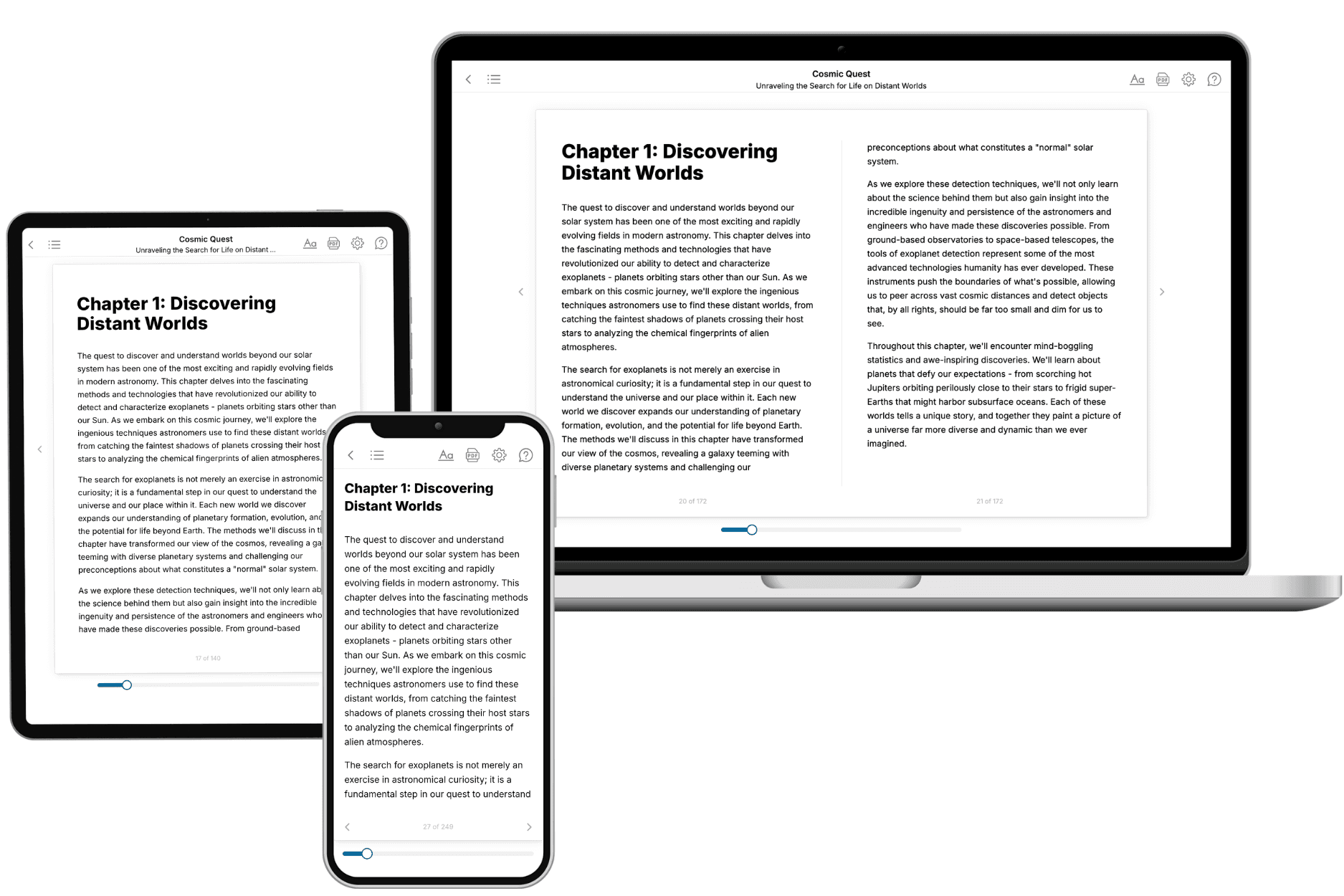
TailoredRead creates complete, full-length nonfiction ebooks, written specifically for you. Tell us what you want to learn and why, and TailoredRead writes you a complete ebook on it, with charts, tables, and diagrams throughout. Read it online, on Kindle, or on any e-reader, or download it as a PDF or EPUB. Every book is written fresh the day you order it.
- How is the book tailored to me?
Before anything is written, you answer a few short questions about your goals, your background, and the topics you care about. Your book is then planned around your answers: written at your level, focused on your goals, and covering the topics you chose, instead of the one-size-fits-all book a store sells everyone.
- Will it read like generic AI content?
No. Your book isn't a chat transcript: it's planned chapter by chapter before a single word is written, told in a clear book voice, and explains ideas visually with charts, tables, and diagrams. After writing, every book goes through an editorial pass that polishes chapters so the book reads consistent from start to finish. Judge for yourself: browse thousands of sample books on our Explore Books page.
- How accurate is the content?
Our AI first checks whether your subject needs live research. Niche and fast-moving subjects are researched before writing, and the book plan and chapters are grounded in what it finds. After writing, every book goes through a quality pass that checks its facts and consistency, and researched books list their sources in a Notes section at the back.
- How long is the book?
You choose the length: Comprehensive (250-300 pages), Detailed (150-200 pages), Essential (70-100 pages), or Short (30-50 pages).
- Does the book include visuals?
Yes. Every book includes visual elements such as timelines, checklists, step-by-step guides, decision trees, comparison tables, and matrices, and many include bar charts. A typical book includes dozens of these visual elements.
- Can I read it on Kindle? What formats can I download?
Yes. Every book can be read in our online reader or downloaded as a PDF or EPUB. The EPUB can be opened with Kindle, Apple Books, Kobo, and any e-reader. The Commercial and Author licenses also include an editable Word (DOCX) and Markdown download.
- How much does it cost?
About the price of a regular ebook. The exact price depends on your book's length and complexity, from $2 for the shortest books to $35 for the most comprehensive, and it's shown when you review your book, before you commit to anything. Each book is a one-time purchase, yours to keep, no subscription. Licenses that let you share, teach, or publish your book range from $35.99 to $49.99.
- Can I preview the book before purchasing?
Before you pay, you'll see what your book will cover: the title, a detailed description, the estimated length, and the complete chapter-by-chapter table of contents, so you know what you're getting before you decide. The full text itself is written after you purchase.
- How long does it take to create a book?
About 10 minutes. You can start reading the opening chapters while the rest is still being written.