Abstract Algebra Books
Explore tailored Abstract Algebra books created by our AI
Category Theory Illuminated
A Guided Journey Through Abstract Mathematical Structures
Elevate your mathematical thinking with "Category Theory Illuminated: A Guided Journey Through Abstract Mathematical Structures." This book is your compass in navigating the fascinating world of category theory, a powerful framework that unifies various branches of mathematics. You'll start with the fundamentals and progressively build your understanding of abstract concepts, learning to see connections between seemingly disparate mathematical ideas. Through clear explanations, intuitive examples, and carefully crafted exercises, you'll develop a deep appreciation for the elegance and utility of category theory. Whether you're a mathematics student, a researcher, or simply curious about advanced mathematical concepts, this book will equip you with the tools to think more abstractly and see patterns across different mathematical structures. By the end, you'll have a solid foundation in category theory, enabling you to approach complex mathematical problems with newfound insight and confidence.
Group Theory Essentials
From Abstract Algebra to Quantum Mechanics and Crystallography
Discover how the elegant mathematics of group theory illuminates the symmetries underlying quantum mechanics, crystallography, and molecular physics. This book bridges the gap between abstract algebra and physical applications, designed specifically for those with physics expertise seeking to master group theory's practical power. You'll progress from fundamental group concepts through cyclic structures, then explore how symmetry operations organize crystal lattices and molecular geometries. Learn how quantum mechanical systems exploit symmetries to determine energy levels and selection rules, and understand why point groups and space groups completely characterize physical systems. Each concept connects directly to real physics problems, showing you how abstract mathematical structures translate into measurable phenomena. Whether you're revisiting group theory with fresh perspective or building deeper intuition for its applications, this book provides the conceptual clarity and practical examples needed to confidently apply group theory to your physics interests.
Quantum Groups
A Practical Introduction to Noncommutative Algebra and Ring Theory
Imagine mastering a mathematical framework that unifies symmetry, algebra, and quantum mechanics—one that reveals hidden structures in both classical and noncommutative spaces. Quantum groups represent one of the most significant developments in modern mathematics, yet they remain mysterious to many. This book demystifies quantum groups by building systematically from familiar ring-theoretic foundations to sophisticated noncommutative structures. You'll discover how classical groups transform into quantum versions, explore the Hopf algebra machinery that makes it all work, and see why physicists and algebraists alike find these structures indispensable. Through clear explanations, worked examples, and progressive complexity, you'll develop genuine understanding rather than mere familiarity. Whether you're preparing for advanced research, seeking to deepen your algebraic knowledge, or exploring connections between mathematics and physics, this book provides the conceptual clarity and technical depth you need to engage confidently with quantum groups and their applications.
Imagine seeing the hidden architecture that connects seemingly disparate areas of mathematics—where groups, rings, and fields aren't just abstract definitions but living structures that breathe meaning into number theory, geometry, and beyond. This book takes you beyond the computational mechanics of abstract algebra into the conceptual landscape where mathematical research happens. You'll develop the structural intuition that distinguishes those who merely know algebra from those who think algebraically. Through carefully constructed explorations, you'll discover why homomorphisms matter more than you thought, how representation theory makes the abstract concrete, and why category theory isn't just abstraction for its own sake. Each chapter builds your capacity to recognize patterns, construct meaningful examples, and see connections that transform isolated facts into coherent understanding. Whether you're preparing for graduate-level research, seeking deeper insight into algebraic structures, or simply curious about how mathematicians actually think about algebra, this book provides the conceptual tools and perspectives that textbooks often leave implicit. You'll emerge with not just knowledge, but mathematical maturity.
Imagine having a complete understanding of the mathematical structures that underpin modern cryptography, geometric symmetry, and abstract algebra—all presented in a way that builds naturally from familiar concepts to sophisticated applications. This book guides you through the elegant world of groups, rings, and fields, revealing how these abstract structures connect to real-world problems you can actually solve. Starting with symmetry groups in geometry and progressing through homomorphisms, quotient structures, and polynomial rings, each chapter builds your intuition alongside rigorous mathematics. You'll discover how modular arithmetic powers RSA encryption, how field extensions unlock Galois theory, and how the Euclidean algorithm works in abstract rings. Whether you're exploring cryptography applications, mastering polynomial factorization, or deepening your understanding of algebraic structures, this book provides both the theoretical foundations and practical insights needed to see abstract algebra not as isolated theorems, but as a coherent, powerful framework for understanding mathematical reality.
Symmetry and Solvability
A Modern Approach to Galois Theory Through Ring Theory
What if the impossibility of solving certain equations reveals more beauty than their solutions ever could? For centuries, mathematicians sought formulas to solve polynomial equations, only to discover that some equations resist such methods entirely. Galois Theory explains why, connecting the symmetries of polynomial roots to deep algebraic structures. This book guides you through Galois Theory with ring theory as your foundation, building from familiar algebraic concepts to profound insights about field extensions and automorphism groups. You'll discover how the Fundamental Theorem creates an elegant correspondence between subgroups and subfields, why quintic equations cannot be solved by radicals, and how these abstract ideas connect to concrete computations. Through clear explanations and carefully structured examples, you'll develop both theoretical understanding and practical problem-solving skills. Whether you're preparing for advanced study or deepening your mathematical knowledge, this book provides the conceptual framework and technical tools you need to master one of algebra's most elegant theories.
Algebraic Geometry Essentials
From Abstract Algebra to Geometric Intuition
Imagine confidently navigating the elegant intersection of algebra and geometry, where polynomial equations reveal hidden geometric structures. This book transforms algebraic geometry from an intimidating abstraction into an accessible, intuitive discipline that builds naturally from concepts you already understand. Starting with concrete examples and visual intuition, you'll discover how algebraic structures encode geometric information. You'll learn to visualize varieties as solution sets, understand the deep connection between coordinate rings and geometric properties, and master the tools that make algebraic geometry powerful. Each concept builds systematically, with clear explanations that honor both mathematical rigor and practical understanding. Whether you're pursuing advanced mathematics, applying these ideas to cryptography or computer vision, or simply deepening your mathematical knowledge, this book provides the conceptual foundation and technical skills you need. You'll move from foundational ideas through sophisticated techniques, always grounded in examples that illuminate why these concepts matter. By the end, algebraic geometry won't feel like abstract theory—it will be a natural extension of your mathematical thinking.
This book guides you through the essential concepts of field theory as they relate to linear algebra, starting with the fundamental properties that define fields and progressing to their sophisticated applications. You'll discover why fields matter beyond abstract mathematics—they're the backbone of vector spaces, the foundation of cryptography, and the key to understanding algebraic structures. Each chapter builds systematically on previous concepts, using clear explanations and concrete examples to make abstract ideas tangible. You'll explore how fields extend, how they relate to one another through homomorphisms, and how Galois theory reveals hidden symmetries in algebraic equations. Whether you're preparing for advanced mathematics, exploring applications in computer science, or simply deepening your mathematical literacy, this book provides the conceptual clarity and practical insights you need to master field theory and apply it confidently.
Imagine standing at the intersection of pure mathematics and the physical world, armed with the power to unravel the symmetries that govern the universe. In "Symmetry and Structure," you'll embark on an intellectual journey that transforms abstract mathematical concepts into powerful tools for understanding the fundamental laws of nature and engineering principles. This comprehensive guide illuminates the intricate world of set and group theory, revealing their profound connections to physics and engineering. You'll develop a deep understanding of algebraic structures, from the foundational Zermelo-Fraenkel axioms to the elegant simplicity of Lie groups. As you progress, you'll discover how these abstract ideas manifest in the real world, from the symmetries in quantum mechanics to the design of efficient algorithms in computer science. "Symmetry and Structure" is not just a textbook; it's a bridge between theory and application. You'll enhance your problem-solving skills, cultivate abstract thinking, and develop a robust logical framework that will serve you in all areas of scientific inquiry. Whether you're grappling with complex physical systems or designing cutting-edge technologies, the insights gained from this book will provide you with a powerful toolkit for innovation and discovery.
Gröbner Bases Demystified
A Practical Guide to Computational Algebra and Ring Theory
What if you could systematically solve polynomial equations that have stumped mathematicians for centuries? Gröbner bases provide exactly that capability—a revolutionary computational framework that transforms complex algebraic problems into solvable forms. This book guides you through the essential theory and practical techniques of Gröbner bases, starting from foundational concepts and building toward sophisticated applications. You'll discover how the Buchberger algorithm works, why monomial orderings matter, and how to leverage these tools to solve real polynomial systems. Whether you're working in symbolic computation, cryptography, or pure mathematics, this guide equips you with both the conceptual understanding and hands-on skills needed to apply Gröbner bases effectively. Clear explanations, worked examples, and computational insights make this advanced topic accessible without sacrificing mathematical rigor.
Group Dynamics
Mastering the Foundations of Group Theory in Linear Algebra
Elevate your mathematical prowess with "Group Dynamics: Mastering the Foundations of Group Theory in Linear Algebra." This comprehensive guide takes you on an exhilarating journey through the intricate world of group theory, seamlessly connecting it to your existing knowledge of linear algebra. You'll discover how group theory serves as a powerful lens for understanding complex mathematical structures. From the basics of group operations to advanced applications in linear transformations, this book equips you with the tools to tackle sophisticated mathematical problems with confidence. Through clear explanations, engaging examples, and challenging exercises, you'll develop a deep intuition for abstract algebraic concepts. By the end of this book, you'll be able to effortlessly navigate the landscape of symmetries, permutations, and algebraic structures that form the backbone of modern mathematics and its applications in physics, chemistry, and computer science.
Master the intricacies of number theory and algebra, elevating your mathematical prowess to new heights. This comprehensive guide takes you on an exhilarating exploration of the fundamental concepts that form the backbone of advanced mathematics. You'll delve into the fascinating world of prime numbers, uncover the secrets of polynomial equations, and discover the elegant connections between abstract algebra and real-world applications. With each chapter, you'll build a deeper understanding of mathematical structures, honing your analytical skills and developing a more intuitive grasp of complex mathematical ideas. Whether you're a student looking to excel in your studies or a curious mind seeking to unravel the mysteries of numbers, this book provides the tools and insights you need to navigate the beautiful landscape of number theory and algebra with confidence and clarity.
The Mathematics of Cryptography
A Rigorous Analysis of Modern Cryptographic Systems
What if the security of your digital communications depended on mathematical concepts you've never fully understood? In our interconnected world, cryptography protects everything from your online banking to private messages, yet the mathematical foundations underlying these systems remain mysterious to many. This comprehensive guide bridges the gap between abstract mathematical theory and practical cryptographic applications. You'll discover how number theory, abstract algebra, and probability theory combine to create unbreakable codes and secure communication channels. Through clear explanations and rigorous analysis, you'll understand why certain mathematical problems are considered computationally intractable and how this difficulty forms the basis of cryptographic security. From the elegant mathematics of elliptic curves to the quantum-resistant properties of lattice-based systems, you'll gain deep insights into both classical and cutting-edge cryptographic methods. Each mathematical concept is presented with practical context, showing how theoretical principles translate into real-world security guarantees. By the end of this exploration, you'll possess a solid mathematical foundation for understanding, analyzing, and implementing cryptographic systems with confidence. You'll be equipped to evaluate the security of existing protocols and contribute to the development of next-generation cryptographic solutions.
Imagine standing at the edge of mathematical discovery, where abstract concepts crystallize into profound insights and centuries-old conjectures yield to modern techniques. This book guides you through the most exciting frontiers of contemporary mathematics, from cutting-edge topology research to breakthrough developments in number theory and computational methods. You'll explore how advanced proof techniques—including category theory, homological algebra, and homotopy type theory—are reshaping mathematical practice. Discover how topological data analysis and spectral methods are revolutionizing data science, and understand why the Riemann Hypothesis remains mathematics' greatest unsolved challenge. Whether you're investigating chaos theory, mastering differential geometry, or exploring noncommutative geometry, this comprehensive exploration connects theory to application. Designed for self-taught mathematicians ready to engage with contemporary research, each chapter builds your abstract thinking skills while revealing how modern mathematics synthesizes insights across topology, algebra, analysis, and computation. Engage with the methods, concepts, and breakthroughs that define mathematical research today.
Elliptic Enigmas
Unraveling the Mysteries of Elliptic Curves in Number Theory
You'll begin by exploring the geometric and algebraic foundations of elliptic curves, starting with the simple cubic equations that define them and the elegant group structure that emerges from adding points on these curves. As you progress, you'll discover how the Mordell-Weil theorem reveals the finite generation of rational points, and how this connects to solving ancient Diophantine problems. The book guides you through the deep mathematical machinery—from torsion subgroups to the rank of elliptic curves—showing why these objects are so remarkably powerful. You'll see how elliptic curves bridge algebra, geometry, and number theory, and explore their surprising applications in cryptography and computational number theory. By the end, you'll understand not just the mechanics of elliptic curves, but the profound reasons why mathematicians consider them among the most important objects in modern mathematics. This knowledge will enable you to teach these concepts with genuine understanding and help your students appreciate their significance.
Master the sophisticated linear algebra techniques that power cutting-edge mathematical research. This comprehensive guide takes you beyond basic matrix operations to explore the deep theoretical foundations and practical applications that drive modern mathematical discovery. You'll develop a robust understanding of vector spaces, linear transformations, and spectral theory while learning how these concepts apply directly to research scenarios. From eigenvalue problems that appear in differential equations to matrix decompositions used in computational mathematics, each chapter builds your expertise systematically. The book emphasizes both theoretical rigor and practical insight, showing you how linear algebra serves as the backbone for advanced topics in analysis, geometry, and applied mathematics. You'll explore multilinear algebra, tensor products, and other sophisticated tools that researchers use to tackle complex mathematical problems. Whether you're preparing for graduate-level research or seeking to strengthen your mathematical foundation, this book provides the depth and clarity needed to excel in mathematical research environments.
Algebraic Number Theory Unveiled
From Foundations to Frontiers
Imagine yourself confidently navigating the intricate world of algebraic number theory, where abstract concepts become powerful tools for solving complex mathematical problems. Your journey through this fascinating field is about to begin. Algebraic Number Theory Unveiled: From Foundations to Frontiers is your gateway to mastering this essential branch of mathematics. This book bridges the gap between basic number theory and advanced algebraic concepts, providing you with a solid foundation and gradually building your expertise. You'll explore the rich tapestry of algebraic number theory, from its historical roots to its modern applications. Through clear explanations, engaging examples, and carefully crafted exercises, you'll develop a deep understanding of algebraic integers, ideal theory, and the fascinating properties of number fields. Whether you're a mathematics student looking to expand your knowledge or an enthusiast eager to delve into the beauty of abstract algebra, this book will equip you with the tools and insights needed to appreciate the elegance and power of algebraic number theory.
Modular Arithmetic Mastery
Essential Techniques for Factoring and Cryptographic Applications
The gap between understanding basic arithmetic and grasping how modern cryptography actually works can feel insurmountable. You know the basics, but the mathematical machinery behind RSA encryption, digital signatures, and factoring algorithms remains frustratingly opaque. This book bridges that gap by building your expertise in modular arithmetic from solid foundations to sophisticated applications. You'll discover how congruences simplify complex calculations, why Fermat's and Euler's theorems are indispensable for cryptographic protocols, and how the Chinese Remainder Theorem enables parallel computation. Through clear explanations and practical examples, you'll explore the algorithms that secure digital communications—from primality testing to the discrete logarithm problem. You'll understand why factoring large numbers is hard enough to protect your data, yet tractable enough for specialized algorithms like Pollard's rho and the quadratic sieve. By the end, you'll possess the mathematical toolkit to analyze cryptographic systems, implement efficient algorithms, and appreciate the elegant mathematics that safeguards the digital world.
The Discrete-Continuous Nexus
Bridging Advanced Mathematical Concepts for Graduate Success
Struggling to connect the dots between discrete and continuous mathematics as you prepare for graduate studies? The world of advanced mathematics can seem like an insurmountable challenge, filled with abstract concepts and complex proofs that often feel disconnected from one another. The Discrete-Continuous Nexus is your comprehensive guide to mastering the intricate relationships between discrete and continuous mathematics. This book bridges the gap between undergraduate foundations and graduate-level thinking, providing you with the tools to tackle complex problems and develop a deeper mathematical intuition. From exploring the fascinating interplay between graph theory and topology to unraveling the connections between number theory and complex analysis, you'll discover how seemingly disparate areas of mathematics are intricately linked. Each chapter builds upon your existing knowledge, gradually introducing more advanced concepts while reinforcing the fundamental principles that tie them together. By the time you finish this book, you'll have developed the problem-solving skills, proof techniques, and abstract thinking abilities necessary to excel in graduate-level mathematics courses and beyond. Whether you're aiming to become a professional mathematician, pursue mathematical research, or simply deepen your understanding of advanced mathematical concepts, The Discrete-Continuous Nexus will be your indispensable companion on this intellectual journey.
The Infinite Hotel Paradox
Understanding Infinity, Countability, and the Limits of Logic
Discover how an imaginary hotel with infinitely many rooms reveals the hidden architecture of mathematics itself. You'll move beyond surface-level confusion to grasp why infinity doesn't behave like ordinary numbers, and why mathematicians consider some infinities genuinely larger than others. This book breaks down the Infinite Hotel Paradox into digestible concepts, starting with foundational ideas about sets and cardinality before building toward sophisticated insights about countability and uncountability. Through clear explanations, intuitive examples, and step-by-step reasoning, you'll understand not just what the paradox is, but why it matters for mathematics, logic, and how we understand the universe. Whether you're a student seeking clarity, a curious mind exploring mathematical philosophy, or someone who wants to finally understand what mathematicians mean by "infinity," this book transforms a bewildering paradox into an elegant gateway to mathematical thinking.
Logic in Linear Spaces
Master Mathematical Logic Through Linear Algebra Foundations
Many students struggle with mathematical rigor, treating linear algebra as a collection of procedures rather than a coherent logical system. This book bridges that gap by showing how mathematical logic underpins every concept in linear algebra, from basic vector operations to advanced transformations. You'll discover that logic isn't abstract philosophy—it's the essential framework that makes mathematics work. Through clear explanations, practical examples, and progressive complexity, you'll learn how propositional logic, predicate logic, and proof techniques directly apply to understanding vectors, matrices, and linear transformations. Whether you're preparing for advanced mathematics, computer science, or engineering, this book equips you with the logical thinking skills that separate surface-level understanding from genuine mathematical mastery. By the end, you'll see linear algebra not as isolated formulas, but as a logical system built on solid foundations.
Discover how harmonic analysis transforms your approach to number theory by revealing the mathematical structures hidden within integers and primes. This book guides you through the essential connections between these two powerful fields, showing you how Fourier analysis, character sums, and spectral methods solve problems that seem intractable through classical approaches alone. You'll learn to recognize when harmonic techniques apply, master the fundamental tools like the Poisson summation formula and Gauss sums, and understand how modern number theorists use these methods to tackle distribution problems, additive combinatorics, and prime number theory. With clear explanations, worked examples, and progressive complexity, this book equips you with both the theoretical foundations and practical intuition needed to apply harmonic analysis confidently to your own number-theoretic investigations. Whether you're preparing for advanced study or seeking to expand your mathematical toolkit, you'll gain the conceptual clarity and technical skills to see numbers in a new light.
Have you ever wondered why discrete mathematics and linear algebra are often taught separately when they share such profound connections? This comprehensive guide reveals the hidden relationships between these mathematical domains, showing you how concepts from one field illuminate and strengthen your understanding of the other. You'll discover how matrix operations can solve complex graph problems, how vector spaces provide elegant frameworks for discrete structures, and how algebraic thinking bridges the gap between finite and infinite mathematical systems. Through carefully crafted explanations and practical examples, you'll develop a unified mathematical perspective that enhances your problem-solving abilities across both discrete and continuous domains. Whether you're strengthening your mathematical foundation or seeking deeper insights into computational applications, this book provides the conceptual tools and practical techniques you need to master these interconnected fields with confidence and clarity.
Discover how number theory has transformed in 2025 with groundbreaking advances that reshape your understanding of primes, equations, and algebraic structures. This comprehensive exploration guides you through the latest theorems, emerging computational techniques, and modern analytical methods that are redefining the field. You'll explore elliptic curves and p-adic analysis as powerful tools for solving Diophantine equations, examine Richard Ryan's influential research, and understand how contemporary mathematicians synthesize classical theory with cutting-edge computation. Each chapter builds your mastery of advanced proofs, modular arithmetic, and transcendental number theory while connecting abstract concepts to practical applications. Whether you're investigating recent discoveries or seeking to deepen your algebraic knowledge, this book provides the intellectual rigor and contemporary insights you need to engage meaningfully with modern number theory research and enhance your problem-solving capabilities in this rapidly evolving discipline.
Many students believe that mathematical proofs are mysterious rituals reserved for advanced mathematicians, or that success in algebra means simply getting the right answer. This misconception leaves you unprepared for higher mathematics and unable to truly understand why mathematical statements are true. This book bridges that gap by teaching you how to construct rigorous mathematical arguments using the algebraic concepts you already know. You'll discover how to think like a mathematician, moving beyond computational skills to develop the logical reasoning that underlies all mathematical truth. Through carefully structured explanations and progressive examples, you'll learn to recognize proof patterns, choose appropriate strategies, and communicate your mathematical ideas with clarity and precision. Whether you're preparing for advanced coursework, strengthening your analytical abilities, or simply curious about the foundations of mathematical truth, this book provides the tools and confidence you need to master the art of proof-writing in algebra and beyond.
Topology Foundations
Building Spatial Understanding from Algebraic Concepts
Develop a deep understanding of how shapes, spaces, and continuous transformations work in mathematics. This comprehensive guide bridges the gap between your intermediate algebra knowledge and the fascinating world of topology, where rubber sheets can be transformed into coffee cups and distance takes on entirely new meanings. You'll discover how topological concepts emerge naturally from algebraic foundations, learning to visualize and work with spaces that stretch, bend, and deform while preserving essential properties. Through carefully structured explanations and practical examples, you'll master the fundamental ideas of open and closed sets, continuity, compactness, and connectedness that form the backbone of modern mathematical analysis. Each concept builds systematically on your existing mathematical knowledge, using familiar algebraic tools to explore unfamiliar topological territories. You'll learn to recognize topological invariants, understand homeomorphisms, and develop the spatial reasoning skills that connect abstract mathematical concepts to concrete geometric intuition. By the end of this book, you'll possess a solid foundation in topology that opens doors to advanced mathematics, from differential geometry to algebraic topology, while gaining a new perspective on the mathematical structures you already know.
Vector Spaces Mastery
A Complete Guide to Linear Algebra's Foundation
Develop deep mathematical intuition and practical mastery of vector spaces, the cornerstone of modern linear algebra. This comprehensive guide transforms abstract concepts into clear, understandable principles that you can confidently apply across mathematics, engineering, and science. Starting with fundamental definitions and building systematically toward advanced applications, you'll discover how vector spaces provide the elegant framework underlying countless mathematical and scientific phenomena. Through carefully crafted explanations, illuminating examples, and progressive exercises, you'll master linear independence, basis and dimension, linear transformations, and eigenvalue theory. Whether you're advancing your mathematical education, preparing for graduate studies, or applying linear algebra in your professional work, this book provides the conceptual clarity and practical tools you need. You'll gain the confidence to tackle complex problems and recognize vector space structures in diverse contexts, from differential equations to quantum mechanics. By the end of this journey, you'll possess not just computational skills, but the deep understanding that distinguishes true mathematical mastery from mere technique memorization.
As a physics scientist, you understand that rigorous reasoning is the foundation of credible research. This book guides you through the essential principles of mathematical proof and logical reasoning—the tools that transform intuition into certainty. You'll progress from mastering fundamental logical concepts and mathematical notation to constructing sophisticated proofs using induction, contradiction, and case analysis. Each chapter builds systematically, introducing formal verification methods, set theory, and axiomatic systems while developing your abstract thinking abilities. You'll learn to identify logical fallacies, validate scientific claims with precision, and communicate mathematical ideas with clarity and authority. By the end, you'll possess the proof-writing expertise and mathematical confidence needed to strengthen your theoretical physics foundation and enhance your scientific argumentation. This is not abstract theory disconnected from practice—every concept connects directly to how you reason about physical systems and validate experimental claims.
You'll develop the ability to construct rigorous mathematical proofs and think like a mathematician by mastering systematic proof techniques grounded in logic and set theory. This book bridges the gap between computational mathematics and proof-based reasoning, providing you with a complete framework for understanding how mathematical arguments work and how to build them yourself. Through clear explanations of direct proof, contradiction, induction, and contrapositive methods, combined with practical applications in set theory, functions, and sequences, you'll gain the confidence to tackle advanced mathematics. Each technique is presented with concrete examples, worked problems, and strategic guidance on when and how to apply different approaches. You'll learn not just the mechanics of proof writing, but the underlying logical principles that make proofs work. By the end, you'll have internalized the patterns of mathematical reasoning and developed the articulation skills needed to communicate complex ideas with precision and clarity—essential preparation for higher mathematics courses and advanced problem-solving.
The Architecture of Numbers
A Journey Through Number Theory and Its Analytical Foundations
What if the secrets of whole numbers could only be fully understood by venturing into the continuous realm of analysis? Number theory has captivated mathematicians for millennia, yet its deepest truths emerge when we apply the tools of mathematical analysis. This book bridges these two worlds, showing you how calculus, complex analysis, and infinite processes illuminate the behavior of integers and primes. You'll discover why the distribution of prime numbers connects to complex functions, how generating functions transform difficult counting problems into tractable equations, and why asymptotic methods reveal patterns invisible to elementary approaches. Through carefully structured explanations and illuminating examples, you'll develop the analytical intuition needed to see numbers in a new light. Whether you're strengthening your mathematical foundation or preparing for advanced study, this book provides the conceptual framework and technical tools to understand where discrete mathematics meets continuous analysis, opening doors to some of mathematics' most beautiful and profound results.
Master the elegant mathematics behind one of number theory's most fascinating topics. Integer partitions—the ways of writing a positive integer as a sum of positive integers—reveal patterns and structures that have captivated mathematicians for centuries. This comprehensive guide takes you from fundamental definitions through classical results to modern developments, building your understanding systematically while maintaining mathematical rigor. You'll explore generating functions that transform partition problems into tractable algebraic forms, discover visual tools like Ferrers diagrams that illuminate hidden symmetries, and encounter the profound identities discovered by Euler, Ramanujan, and Rogers. Each concept is presented with clear explanations, worked examples, and connections to broader mathematical themes. Whether you're strengthening your foundation in combinatorics, preparing for advanced study, or simply curious about the beautiful patterns within integers, this book provides the depth and clarity you need. You'll gain practical techniques for solving partition problems, understand the asymptotic behavior of partition functions, and appreciate how this classical subject connects to modern areas like modular forms and q-series. By the end, you'll possess both the theoretical knowledge and problem-solving skills to engage confidently with partition theory.
Mathematics speaks a language unlike any other. While we use words to describe the world around us, mathematics employs symbols, logic, and abstraction to reveal patterns and truths that transcend everyday experience. This book explores the philosophical foundations of mathematical language—examining how symbols gain meaning, why mathematical communication is so precise, and what this tells us about the nature of reality itself. You'll discover how mathematical language evolved, why certain notations became standard, and how the structure of mathematical systems both enables and constrains what we can express. Through accessible explanations and concrete examples, you'll gain insight into one of humanity's most powerful intellectual tools. Whether you're curious about why mathematics works so well at describing nature, interested in the philosophy of mathematics, or simply want to understand how mathematical thinking differs from everyday reasoning, this book provides a comprehensive exploration of the language that underlies science, technology, and abstract thought.
Related books you may like:
Discover how advanced functional materials are reshaping industries and enabling solutions to humanity's greatest challenges. This comprehensive guide takes you beyond basic materials science to explore the cutting-edge world of engineered materials designed to perform specific, transformative functions. You'll learn how scientists and engineers manipulate atomic structures and processing conditions to create materials that respond to stimuli, conduct electricity with unprecedented efficiency, or heal themselves. From smart polymers that change properties on demand to nanomaterials with revolutionary capabilities, this book reveals the principles behind these innovations and their practical applications in healthcare, energy, electronics, and aerospace. Whether you're advancing your career, developing new products, or simply fascinated by the materials shaping our future, you'll gain the knowledge to understand, evaluate, and potentially contribute to this rapidly evolving field.
Most chemical reactions should happen instantly, yet they don't. The culprit? Activation energy—the invisible barrier that keeps reactants locked in place until enough energy arrives to break them free. Without understanding this fundamental concept, enzyme kinetics remains a mystery, and the elegant mechanisms by which life accelerates reactions seem like magic. This book demystifies activation energy and enzyme kinetics through clear explanations, practical examples, and visual frameworks. You'll discover how enzymes perform their catalytic miracles by lowering activation energy, explore the mathematics of reaction rates through the Arrhenius equation and Michaelis-Menten kinetics, and learn how inhibition mechanisms control biological processes. Whether you're studying biochemistry, developing pharmaceuticals, or optimizing industrial processes, this guide equips you with both the conceptual understanding and quantitative tools needed to predict, analyze, and manipulate enzyme-catalyzed reactions with confidence.
Achieve reliable, reproducible separations of complex chemical mixtures using adsorption chromatography. This practical guide bridges the gap between theoretical principles and real-world laboratory application, providing you with the knowledge and skills to design effective separation strategies for your specific analytical needs. You'll explore the fundamental science of how compounds interact with adsorbent materials, learn to select optimal stationary and mobile phases, and master the practical techniques that ensure consistent results. Whether you're working with thin-layer chromatography, column chromatography, or HPLC systems, this book equips you with systematic approaches to troubleshooting common problems, optimizing separations, and interpreting data with confidence. Packed with practical examples, decision-making frameworks, and evidence-based strategies, you'll develop the expertise to tackle challenging separation problems and advance your analytical capabilities in pharmaceutical, environmental, or materials research.
Many assume adipose tissue is simply inert fat to be minimized or removed. In reality, it's a sophisticated, metabolically active organ with remarkable regenerative potential. This book reveals how adipose tissue engineering is revolutionizing medicine by creating functional tissue solutions for reconstruction, regeneration, and therapeutic applications. You'll discover the biological foundations of adipose tissue, learn how scientists harvest and cultivate adipose-derived stem cells, and explore cutting-edge engineering strategies that transform these cells into viable tissue constructs. From scaffold design and bioreactor optimization to vascularization techniques and clinical translation, this guide provides practical insights into the science and engineering behind adipose tissue regeneration. Whether you're a researcher, student, or healthcare professional, you'll gain actionable knowledge about the current state of the field, emerging technologies, and the real-world challenges of bringing engineered tissues from the laboratory to clinical practice.
In the rapidly evolving world of ultra-high-speed communications, the challenge of designing secure and efficient chips has never been more daunting. As a Principal Architect, you face the complex task of integrating cutting-edge VLSI techniques with robust cryptographic solutions. This book is your comprehensive guide to conquering these challenges. "Advanced VLSI Design" delves deep into the intricacies of modern chip architecture, offering you practical insights into overcoming CMOS scaling limitations, harnessing the power of 3D IC integration, and implementing state-of-the-art FinFET technology. You'll explore innovative approaches to low-power design and high-speed SerDes, crucial for next-generation communication systems. This book doesn't just stop at performance; it equips you with the knowledge to build security from the ground up. From hardware Trojan detection to side-channel analysis resistance, you'll learn how to create chips that are not only fast but also fortified against modern security threats. Dive into advanced topics like quantum-dot cellular automata and EUV lithography, positioning yourself at the forefront of VLSI innovation.
Create an Abstract Algebra Book Tailored to You
Create an AI-crafted book tailored to your goals, interests, and background






Benefits of AI-tailored books
- Read one book, not ten:
- all the Abstract Algebra knowledge you need, gathered into a single book.
- Save days of learning:
- tell us your goals, choose your topics, and the whole book is built around them.
- Learn effortlessly:
- Abstract Algebra book written for your specific background and expertise.
- Understand at a glance:
- includes charts, tables, timelines, checklists, decision trees, and more.
- Stay current:
- written the day you order it, not years ago.
- Trust what you read:
- every book is checked for accuracy, with real research when your subject needs it.
Create your unique book in 3 steps
- 1. Select your focus
Select the focus of your Abstract Algebra book and share your background
- 2. Personalize your book
Specify your goals and choose sub-topics to include
- 3. Get your tailored book
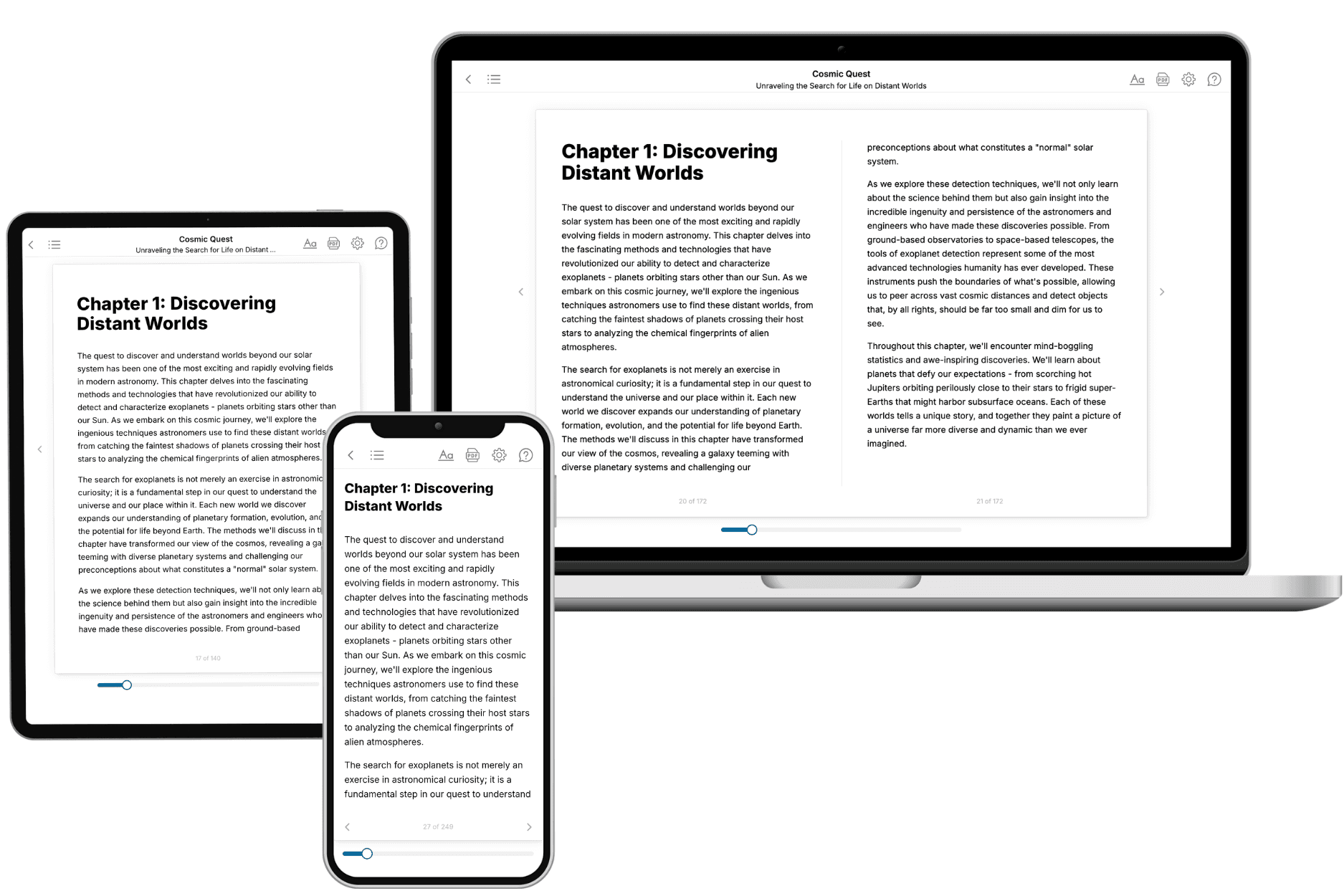
Your book is ready in 10 minutes. Read it online, download as EPUB or PDF, or send to Kindle.

Start from a template
Frequently asked questions
- What is TailoredRead?
TailoredRead creates complete, full-length nonfiction ebooks, written specifically for you. Tell us what you want to learn and why, and TailoredRead writes you a complete ebook on it, with charts, tables, and diagrams throughout. Read it online, on Kindle, or on any e-reader, or download it as a PDF or EPUB. Every book is written fresh the day you order it.
- How is the book tailored to me?
Before anything is written, you answer a few short questions about your goals, your background, and the topics you care about. Your book is then planned around your answers: written at your level, focused on your goals, and covering the topics you chose, instead of the one-size-fits-all book a store sells everyone.
- Will it read like generic AI content?
No. Your book isn't a chat transcript: it's planned chapter by chapter before a single word is written, told in a clear book voice, and explains ideas visually with charts, tables, and diagrams. After writing, every book goes through an editorial pass that polishes chapters so the book reads consistent from start to finish. Judge for yourself: browse thousands of sample books on our Explore Books page.
- How accurate is the content?
Our AI first checks whether your subject needs live research. Niche and fast-moving subjects are researched before writing, and the book plan and chapters are grounded in what it finds. After writing, every book goes through a quality pass that checks its facts and consistency, and researched books list their sources in a Notes section at the back.
- How long is the book?
You choose the length: Comprehensive (250-300 pages), Detailed (150-200 pages), Essential (70-100 pages), or Short (30-50 pages).
- Does the book include visuals?
Yes. Every book includes charts, tables, and diagrams: timelines, checklists, step-by-step guides, decision trees, comparison tables, matrices, and bar charts. A typical book includes dozens of these visual elements.
- Can I read it on Kindle? What formats can I download?
Yes. Every book can be read in our online reader or downloaded as a PDF or EPUB. The EPUB can be opened with Kindle, Apple Books, Kobo, and any e-reader. The Commercial and Author licenses also include an editable Word (DOCX) and Markdown download.
- How much does it cost?
About the price of a regular ebook. The exact price depends on your book's length and complexity, from $2 for the shortest books to $35 for the most comprehensive, and it's shown when you review your book, before you commit to anything. Each book is a one-time purchase, yours to keep, no subscription. Licenses that let you share, teach, or publish your book range from $35.99 to $49.99.
- Can I preview the book before purchasing?
Before you pay, you'll see what your book will cover: the title, a detailed description, the estimated length, and the complete chapter-by-chapter table of contents, so you know what you're getting before you decide. The full text itself is written after you purchase.
- How long does it take to create a book?
About 10 minutes. You can start reading the opening chapters while the rest is still being written.