Real Analysis Unveiled
From Foundations to Frontiers in Mathematical Research
Think Real Analysis is just about limits and continuity?
269 pages13 chaptersJan 2, 2025Mathematics
About this book
Think again. This book shatters the misconception that Real Analysis is an isolated branch of mathematics with little practical application. "Real Analysis Unveiled: From Foundations to Frontiers in Mathematical Research" is your comprehensive guide to mastering this fundamental field of mathematics. You'll journey from the basic principles to the cutting-edge applications in modern mathematical research. Through clear explanations, intuitive examples, and challenging exercises, you'll develop a deep understanding of concepts like topology, measure theory, and functional analysis. You'll see how these abstract ideas form the backbone of many areas in mathematics and even find applications in fields like physics and computer science. Whether you're a student looking to excel in your studies or a researcher aiming to strengthen your mathematical foundation, this book will equip you with the tools to tackle complex problems and contribute to the forefront of mathematical research.
Table of contents
- IntroductionThe Importance of Real Analysis in Mathematics, Overview of the Book's Structure, Prerequisites and Suggested Background, How to Use This Book EffectivelyRead below
- Chapter 1: Foundations of Real AnalysisThe Real Number System, Sequences and Series, Limits and Continuity, Differentiation
- Chapter 2: Topology of Metric SpacesIntroduction to Metric Spaces, Open and Closed Sets, Compactness, Connectedness
- Chapter 3: Advanced Concepts in ContinuityUniform Continuity, Lipschitz Continuity, Fixed Point Theorems, Applications of Continuity in Analysis
- Chapter 4: Advanced Differentiation TechniquesMean Value Theorems, Taylor's Theorem and Applications, Implicit and Inverse Function Theorems, Introduction to Differential Forms
- Chapter 5: Integration TheoryThe Riemann Integral Revisited, Introduction to the Lebesgue Integral, Comparison of Riemann and Lebesgue Integrals, Advanced Integration Techniques
- Chapter 6: Measure TheoryMeasure Spaces and Measurable Functions, Lebesgue Measure on R^n, Integration on Measure Spaces, Product Measures and Fubini's Theorem
- Chapter 7: Introduction to Functional AnalysisNormed Spaces and Banach Spaces, Hilbert Spaces, Linear Operators, Introduction to Spectral Theory
- Chapter 8: Function SpacesL^p Spaces, Sobolev Spaces, Hölder and Lipschitz Spaces, Applications of Function Spaces
- Chapter 9: Fourier AnalysisFourier Series, The Fourier Transform, Distributions and Generalized Functions, Applications of Fourier Analysis
- Chapter 10: Complex Analysis and Real AnalysisComplex Differentiation, Cauchy's Theorem and Its Consequences, Residue Theory, Connections Between Complex and Real Analysis
- Chapter 11: Differential Equations and Real AnalysisExistence and Uniqueness Theorems, Linear Systems of Differential Equations, Stability Theory, Introduction to Partial Differential Equations
- Chapter 12: Calculus of VariationsThe Euler-Lagrange Equation, Variational Principles in Physics, Introduction to Optimal Control Theory, Applications of Calculus of Variations
- Chapter 13: Advanced Topics in Real AnalysisIntroduction to Harmonic Analysis, Geometric Measure Theory, Nonlinear Functional Analysis, Fractal Geometry and Analysis, Current Research Frontiers in Real Analysis
- Conclusion
- AppendixCommon Proof Techniques in Real Analysis, Notation Guide
- Further Reading
Introduction
Welcome to "Real Analysis Unveiled: From Foundations to Frontiers in Mathematical Research." This book is designed to be your comprehensive guide through the fascinating world of Real Analysis, a fundamental branch of mathematics that underpins many advanced concepts and has far-reaching applications across various scientific disciplines. As you embark on this journey, you'll discover that Real Analysis is not merely an abstract field of study, but a powerful tool that provides deep insights into the nature of mathematical structures and processes.
Real Analysis extends the concepts of calculus to a more rigorous and general setting, providing a solid foundation for understanding complex mathematical ideas. It deals with the properties of real numbers, sequences and series, limits, continuity, differentiation, and integration. However, it goes far beyond these basic concepts, delving into advanced topics such as measure theory, functional analysis, and the theory of differential equations. By mastering Real Analysis, you'll gain the ability to think abstractly, construct rigorous proofs, and develop a deeper understanding of mathematical concepts that are crucial in many areas of pure and applied mathematics.
Throughout this book, you'll encounter a blend of theory and practice. We'll explore fundamental theorems and their proofs, but we'll also examine how these abstract concepts apply to real-world problems in physics, engineering, economics, and other fields. You'll see how the rigorous foundations laid by Real Analysis provide the tools necessary to tackle complex problems in mathematical research and various scientific disciplines.
As we progress through the chapters, we'll build upon your existing knowledge, gradually introducing more advanced concepts. We'll start with a review of the foundations, ensuring you have a solid grasp of the basics before moving on to more challenging material. By the end of this book, you'll have developed a comprehensive understanding of Real Analysis, from its fundamental principles to its cutting-edge applications in modern mathematical research.
The Importance of Real Analysis in Mathematics
Real Analysis holds a central position in the landscape of modern mathematics. Its importance cannot be overstated, as it provides the rigorous foundation upon which much of advanced mathematics is built. The concepts and techniques developed in Real Analysis permeate numerous branches of mathematics and find applications in various scientific fields. Understanding the significance of Real Analysis is crucial for anyone seeking to delve deeper into mathematical research or apply advanced mathematical concepts in their work.
At its core, Real Analysis is concerned with the properties of real numbers and functions defined on the real line or in real vector spaces. This focus on the real number system might seem narrow at first glance, but it opens up a world of profound mathematical insights. The rigorous treatment of concepts like limits, continuity, and differentiability in Real Analysis provides a solid foundation for understanding more complex mathematical structures and processes. These fundamental ideas are essential not only in pure mathematics but also in applied fields such as physics, engineering, and economics.
One of the key strengths of Real Analysis lies in its ability to provide a framework for precise mathematical reasoning. The emphasis on rigorous proofs and logical deduction cultivates critical thinking skills that are invaluable in all areas of mathematics. As you progress through this book, you'll develop the ability to construct clear, logical arguments and to analyze complex mathematical statements with precision. These skills are transferable to many other areas of study and research, making Real Analysis an excellent training ground for mathematical thinking in general.
Real Analysis also serves as a bridge between different areas of mathematics. Its concepts and techniques find applications in diverse fields such as complex analysis, functional analysis, probability theory, and differential equations. For instance, the theory of measure and integration developed in Real Analysis is fundamental to modern probability theory. Similarly, the study of function spaces in Real Analysis lays the groundwork for functional analysis, which in turn is crucial for understanding quantum mechanics and other areas of theoretical physics.
In the realm of pure mathematics, Real Analysis provides the tools necessary for tackling advanced topics in topology, differential geometry, and abstract algebra. The notion of a metric space, introduced in Real Analysis, generalizes to topological spaces, which are fundamental in modern geometry and topology. The theory of differentiation developed in Real Analysis extends to manifolds, forming the basis of differential geometry. Even in areas that might seem far removed from analysis, such as number theory, techniques from Real Analysis often play a crucial role in proving deep results.
For applied mathematicians and scientists, Real Analysis offers a rigorous foundation for understanding and developing mathematical models. The theory of differential equations, which is central to modeling physical phenomena, relies heavily on concepts from Real Analysis. Whether you're studying the motion of planets, the spread of diseases, or the behavior of economic systems, a solid grounding in Real Analysis will enhance your ability to create and analyze mathematical models.
Real Analysis also plays a vital role in numerical analysis and computational mathematics. While computers have revolutionized the way we solve mathematical problems, understanding the theoretical foundations provided by Real Analysis is crucial for developing efficient algorithms and assessing their accuracy. Concepts such as convergence of sequences and series, error estimation, and stability of numerical methods all have their roots in Real Analysis.
In the field of mathematical optimization, which has numerous applications in operations research and machine learning, Real Analysis provides the theoretical underpinnings for understanding the behavior of functions and developing optimization algorithms. The study of convexity, differentiability, and continuity in Real Analysis directly informs the design and analysis of optimization techniques used in various industries.
As you progress in your mathematical journey, you'll find that Real Analysis is not just a subject to be studied in isolation, but a powerful set of tools and concepts that will enhance your understanding of mathematics as a whole. It provides a language and framework for expressing complex mathematical ideas with precision and clarity. The rigor and depth of thought cultivated by studying Real Analysis will serve you well in all your mathematical endeavors, whether you're pursuing pure mathematics, applied mathematics, or using mathematical tools in other scientific disciplines.
In conclusion, the importance of Real Analysis in mathematics cannot be overstated. It provides a rigorous foundation for calculus and advanced mathematical analysis, develops critical thinking and proof-writing skills, bridges different areas of mathematics, underpins many applied mathematical techniques, and offers insights that are valuable across a wide range of scientific disciplines. As you delve into the chapters of this book, keep in mind that you're not just learning a set of abstract concepts, but acquiring a powerful toolkit that will enhance your mathematical abilities and open up new avenues for exploration and discovery in the vast world of mathematics.
Overview of the Book's Structure
"Real Analysis Unveiled: From Foundations to Frontiers in Mathematical Research" is structured to provide a comprehensive and logical progression through the key concepts of Real Analysis. The book is designed to take you from the foundational principles to advanced topics at the forefront of mathematical research. Each chapter builds upon the knowledge gained in previous sections, gradually increasing in complexity and depth. This structure allows you to develop a solid understanding of the fundamentals before tackling more challenging material.
The book begins with a thorough review of the foundations of Real Analysis in Chapter 1. This chapter covers the real number system, sequences and series, limits, and continuity. Even if you're familiar with these concepts from your calculus courses, this review is crucial as it introduces the level of rigor and precision that characterizes Real Analysis. You'll revisit familiar ideas from a more advanced perspective, laying the groundwork for the more complex topics to come.
Chapter 2 introduces the topology of metric spaces, a fundamental concept that generalizes many ideas from Real Analysis to more abstract settings. This chapter covers open and closed sets, compactness, and connectedness. Understanding these topological concepts is crucial for grasping many of the advanced topics in later chapters. The ideas introduced here will change the way you think about spaces and functions, providing a more general and powerful framework for analysis.
Chapters 3 and 4 delve deeper into continuity and differentiation, exploring advanced concepts and techniques. You'll study uniform continuity, Lipschitz continuity, and fixed point theorems. The chapter on differentiation covers mean value theorems, Taylor's theorem, and introduces differential forms. These chapters will significantly enhance your understanding of the behavior of functions and their derivatives, providing tools that are essential in many areas of mathematics and its applications.
Integration theory is the focus of Chapter 5, where you'll revisit the Riemann integral before being introduced to the more powerful Lebesgue integral. This chapter lays the groundwork for the measure theory covered in Chapter 6, which extends the concept of length to more complex sets and functions. These chapters represent a significant leap in abstraction and generality, providing a framework for integration that overcomes many limitations of the Riemann integral.
Chapter 7 introduces functional analysis, a branch of mathematics that extends methods from linear algebra to infinite-dimensional spaces. This chapter covers normed spaces, Banach spaces, Hilbert spaces, and linear operators. Functional analysis is a powerful tool with applications in many areas of mathematics and physics, particularly in quantum mechanics and partial differential equations.
The subsequent chapters explore various advanced topics in Real Analysis. Chapter 8 focuses on function spaces, including L^p spaces and Sobolev spaces, which are crucial in the study of partial differential equations. Chapter 9 covers Fourier analysis, a powerful tool with applications ranging from signal processing to quantum mechanics. Chapter 10 explores the connections between complex analysis and Real Analysis, demonstrating how techniques from one field can illuminate problems in the other.
Chapters 11 and 12 apply the tools of Real Analysis to the study of differential equations and the calculus of variations, respectively. These chapters demonstrate how the abstract concepts you've learned can be applied to solve concrete problems in physics and engineering. The final chapter, Chapter 13, introduces you to several advanced topics in Real Analysis, including harmonic analysis, geometric measure theory, and fractal geometry. This chapter also discusses current research frontiers in Real Analysis, giving you a glimpse of the exciting developments at the cutting edge of the field.
Throughout the book, you'll find numerous examples, exercises, and applications that illustrate the concepts being discussed. These are not mere add-ons but integral parts of the learning process. Working through these exercises will deepen your understanding and develop your problem-solving skills. The applications demonstrate the relevance of Real Analysis to other areas of mathematics and science, showing how abstract concepts can lead to powerful real-world insights.
The book concludes with an appendix covering common proof techniques in Real Analysis and a comprehensive notation guide. These resources will be valuable references as you work through the material. There's also a section on further reading, pointing you towards additional resources for deepening your knowledge in specific areas of interest.
This structure is designed to provide a coherent and comprehensive journey through Real Analysis. By the time you reach the end of the book, you'll have developed a deep understanding of the subject, from its foundations to its frontiers. You'll be well-equipped to pursue further study in advanced mathematics or to apply these powerful analytical tools in your own research or professional work.
Prerequisites and Suggested Background
While "Real Analysis Unveiled" is designed to be a comprehensive guide to the subject, it does assume a certain level of mathematical maturity and background knowledge. Understanding these prerequisites will help you gauge your readiness for the material and identify any areas you might need to review before diving in. That said, don't be discouraged if you find some gaps in your knowledge – the book is structured to build understanding progressively, and with dedication and effort, you can overcome initial challenges.
The primary prerequisite for this book is a solid foundation in calculus. You should be comfortable with the concepts of limits, continuity, differentiation, and integration of functions of one and several variables. Familiarity with sequences and series, including tests for convergence, is also essential. These topics are typically covered in a standard undergraduate calculus sequence. While we will revisit these concepts from a more rigorous perspective, having an intuitive understanding of them will greatly facilitate your learning.
In addition to calculus, a basic understanding of linear algebra is highly beneficial. Concepts such as vector spaces, linear transformations, and matrices will be useful, particularly when we delve into functional analysis and the study of function spaces. If you've taken an introductory course in linear algebra, you should be well-prepared for these sections. If not, you might find it helpful to review these topics as you encounter them in the book.
Some familiarity with basic set theory and logic is also important. You should be comfortable with concepts such as sets, functions, relations, and basic logical operations. Understanding quantifiers (∀ for "for all" and ∃ for "there exists") and being able to negate statements involving them is crucial for following and constructing proofs. If you've taken a course in discrete mathematics or mathematical reasoning, you likely have the necessary background in these areas.
While not strictly necessary, prior exposure to proof-writing can be extremely helpful. Real Analysis is a proof-heavy subject, and much of your learning will involve reading, understanding, and constructing mathematical proofs. If you haven't had much experience with proofs, don't worry – the book includes an appendix on common proof techniques, and you'll develop these skills as you work through the material. However, if you find yourself struggling with the proofs, it might be worth spending some time studying introductory proof techniques before proceeding.
A basic understanding of complex numbers is also beneficial, particularly for the chapters dealing with complex analysis and Fourier analysis. You should be familiar with the complex plane, polar form of complex numbers, and basic operations with complex numbers. These topics are typically covered in precalculus or early calculus courses.
In terms of mathematical maturity, this book assumes that you are comfortable with abstract thinking and are willing to grapple with challenging concepts. Real Analysis often deals with abstract and general ideas, and it requires patience and persistence to fully grasp these concepts. A willingness to think deeply about mathematical ideas and to approach problems from multiple angles will serve you well.
If you find that you're lacking in some of these areas, don't be discouraged. The book is designed to be self-contained, and many concepts are introduced from first principles. However, you may find it helpful to review certain topics as you encounter them. There are many excellent resources available online and in textbooks for brushing up on calculus, linear algebra, or proof techniques.
Remember, learning Real Analysis is a journey, and everyone starts from a different place. What's most important is your willingness to engage with the material, to think critically, and to persevere when faced with challenging concepts. With dedication and effort, you can develop a deep understanding of Real Analysis, regardless of your starting point.
Finally, it's worth noting that while this book covers advanced mathematical concepts, it assumes no prior knowledge of Real Analysis itself. If you've already taken a course in Real Analysis, you'll find that this book offers a deeper and more comprehensive treatment of the subject. If you're new to Real Analysis, rest assured that the book is designed to guide you through the material step by step, building your understanding from the ground up.
How to Use This Book Effectively
To get the most out of "Real Analysis Unveiled," it's important to approach your study with a clear strategy. This book is designed to be more than just a passive reading experience – it's a tool for active learning and deep understanding. Here are some suggestions on how to use this book effectively to maximize your learning and comprehension of Real Analysis.
First and foremost, approach the material with an active mindset. Real Analysis is not a subject that can be mastered through mere memorization or cursory reading. It requires deep engagement with the concepts, careful thought, and plenty of practice. As you read each section, try to anticipate where the discussion is going. Ask yourself questions about the material: Why is this concept important? How does it relate to what I've learned before? What might be some applications or consequences of this theorem?
Take your time with each section. Real Analysis is a dense subject, and rushing through the material is likely to lead to confusion and frustration. Read each section carefully, making sure you understand each step in the arguments presented. If you encounter a concept or proof that you don't fully grasp, don't hesitate to reread it multiple times. Often, understanding dawns gradually as you revisit difficult material.
Make use of the examples provided throughout the book. These are carefully chosen to illustrate key concepts and techniques. Don't just read through the examples – work through them yourself. Cover up the solution and try to solve the problem on your own before looking at the provided solution. This active engagement will help solidify your understanding and develop your problem-solving skills.
The exercises at the end of each section and chapter are an integral part of the learning process. Don't skip them! These exercises are designed to reinforce your understanding, challenge you to apply the concepts in new ways, and develop your mathematical thinking. Try to solve as many exercises as you can. Even if you can't solve a problem completely, the process of grappling with it will deepen your understanding.
Take notes as you read. Writing down key definitions, theorems, and your own observations can help reinforce your learning. Try to summarize each section in your own words – this process of articulating the ideas yourself is a powerful learning tool. Creating your own examples or coming up with potential exam questions can also be very beneficial.
Don't hesitate to use additional resources. While this book is designed to be comprehensive, you may find it helpful to consult other textbooks, online resources, or video lectures for alternative explanations of difficult concepts. Sometimes, seeing an idea presented in a different way can lead to a breakthrough in understanding.
Pay special attention to the proofs presented in the book. Understanding and constructing proofs is a crucial skill in Real Analysis. As you read each proof, try to understand not just the individual steps, but the overall strategy. What is the main idea of the proof? How does it leverage the definitions and previous results? Try to reconstruct the proofs yourself without looking at the book. This will help you internalize the proof techniques and develop your own proof-writing skills.
Make connections between different topics. Real Analysis is not a collection of isolated facts, but a coherent body of knowledge with many interconnections. As you progress through the book, try to see how new concepts relate to what you've learned before. How does the theory of metric spaces generalize ideas from real-valued functions? How do concepts from measure theory apply to probability?
Don't be discouraged by difficulty. Real Analysis is a challenging subject, and it's normal to struggle with some concepts. Remember that understanding often comes gradually, and concepts that seem opaque at first often become clear with time and practice. Persistence is key – keep working at it, and you'll find your understanding deepening over time.
Consider forming a study group or finding a study partner. Discussing the material with others can provide new perspectives and help clarify difficult concepts. Explaining ideas to others is also an excellent way to solidify your own understanding.
Make use of the book's structure. The chapters are designed to build on each other, so try to work through them in order. However, don't be afraid to jump ahead if you're curious about a particular topic, or to revisit earlier chapters if you need to review foundational concepts.
Finally, try to appreciate the beauty and power of Real Analysis. While the subject can be challenging, it's also incredibly rewarding. Take time to marvel at elegant proofs, to appreciate the generality and abstraction of the concepts, and to consider how these ideas apply in other areas of mathematics and science.
By approaching "Real Analysis Unveiled" with these strategies, you'll be well-positioned to develop a deep and lasting understanding of Real Analysis. Remember, the goal is not just to get through the book, but to develop your mathematical thinking and problem-solving skills. With dedication and the right approach, you'll find that Real Analysis opens up a fascinating world of mathematical ideas and techniques.
This is the end of the free sample. The full book has 13 chapters.
Want this book written for you?
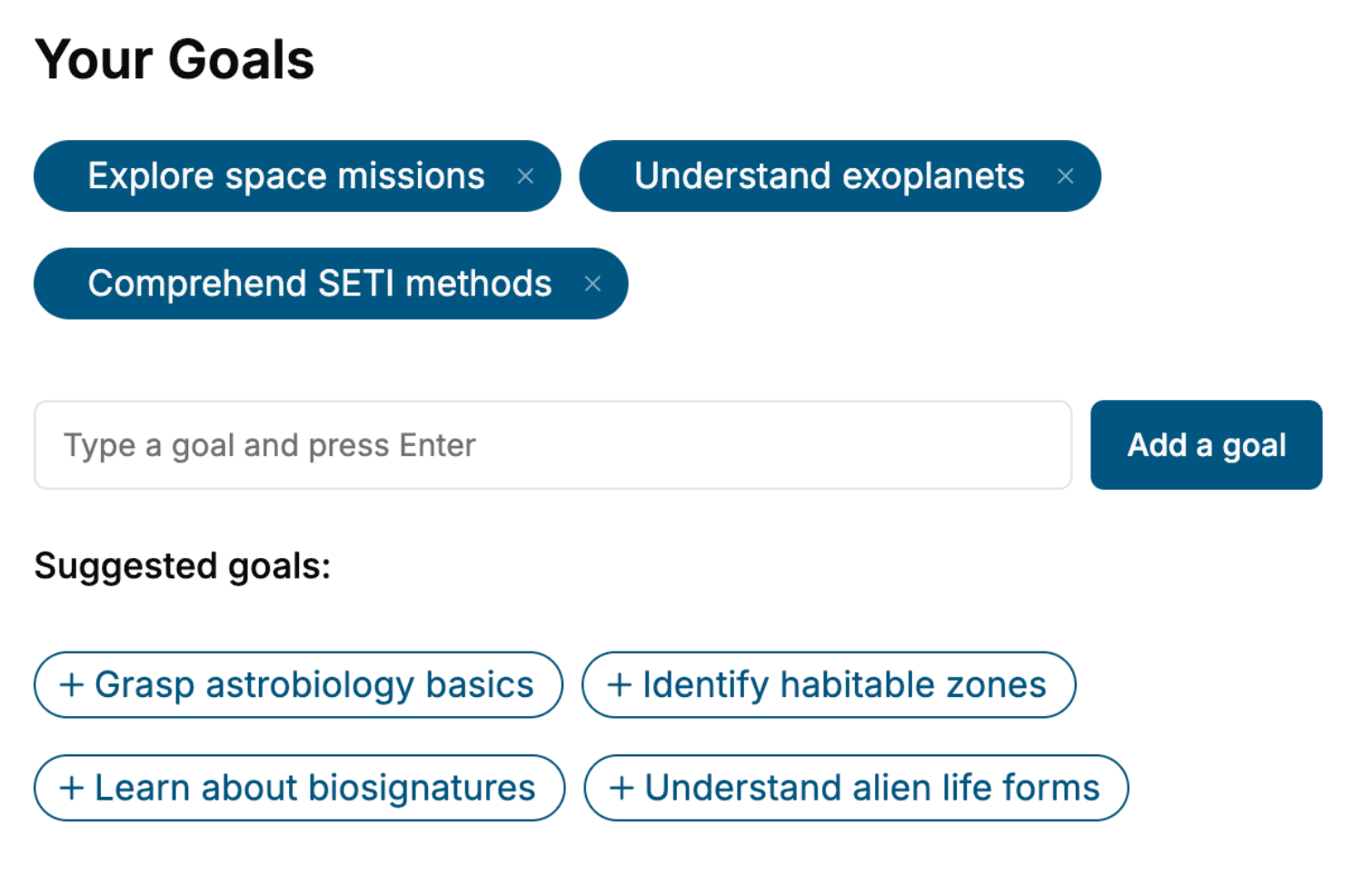
Tell us your goals and background, and get your own version of this book, tailored by AI to you.


Benefits of AI-tailored books
- Read one book, not ten:
- all the Mathematics knowledge you need, gathered into a single book.
- Save days of learning:
- tell us your goals, choose your topics, and the whole book is built around them.
- Learn effortlessly:
- Mathematics book written for your specific background and expertise.
- Understand at a glance:
- includes charts, tables, timelines, checklists, decision trees, and more.
- Stay current:
- written the day you order it, not years ago.
- Trust what you read:
- every book is checked for accuracy, with real research when your subject needs it.
Create your unique book in 3 steps
- 1. Select your focus
Select the focus of your Mathematics book and share your background
- 2. Personalize your book
Specify your goals and choose sub-topics to include
- 3. Get your tailored book
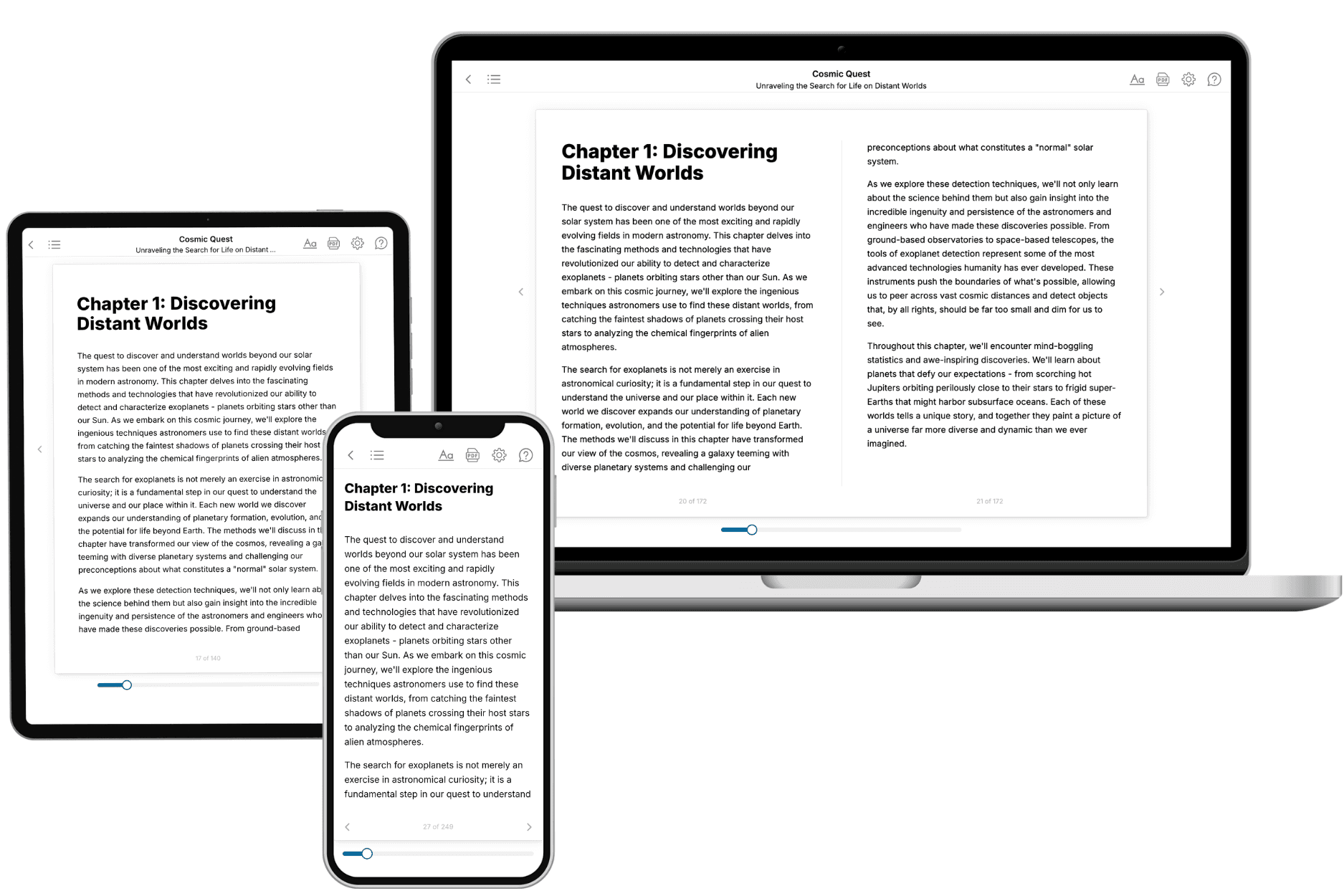
Your book is ready in 10 minutes. Read it online, download as EPUB or PDF, or send to Kindle.

Frequently asked questions
- What is TailoredRead?
TailoredRead creates complete, full-length nonfiction ebooks, written specifically for you. Tell us what you want to learn and why, and TailoredRead writes you a complete ebook on it, with charts, tables, and diagrams throughout. Read it online, on Kindle, or on any e-reader, or download it as a PDF or EPUB. Every book is written fresh the day you order it.
- How is the book tailored to me?
Before anything is written, you answer a few short questions about your goals, your background, and the topics you care about. Your book is then planned around your answers: written at your level, focused on your goals, and covering the topics you chose, instead of the one-size-fits-all book a store sells everyone.
- Will it read like generic AI content?
No. Your book isn't a chat transcript: it's planned chapter by chapter before a single word is written, told in a clear book voice, and explains ideas visually with charts, tables, and diagrams. After writing, every book goes through an editorial pass that polishes chapters so the book reads consistent from start to finish. Judge for yourself: browse thousands of sample books on our Explore Books page.
- How accurate is the content?
Our AI first checks whether your subject needs live research. Niche and fast-moving subjects are researched before writing, and the book plan and chapters are grounded in what it finds. After writing, every book goes through a quality pass that checks its facts and consistency, and researched books list their sources in a Notes section at the back.
- How long is the book?
You choose the length: Comprehensive (250-300 pages), Detailed (150-200 pages), Essential (70-100 pages), or Short (30-50 pages).
- Does the book include visuals?
Yes. Every book includes visual elements such as timelines, checklists, step-by-step guides, decision trees, comparison tables, and matrices, and many include bar charts. A typical book includes dozens of these visual elements.
- Can I read it on Kindle? What formats can I download?
Yes. Every book can be read in our online reader or downloaded as a PDF or EPUB. The EPUB can be opened with Kindle, Apple Books, Kobo, and any e-reader. The Commercial and Author licenses also include an editable Word (DOCX) and Markdown download.
- How much does it cost?
About the price of a regular ebook. The exact price depends on your book's length and complexity, from $2 for the shortest books to $35 for the most comprehensive, and it's shown when you review your book, before you commit to anything. Each book is a one-time purchase, yours to keep, no subscription. Licenses that let you share, teach, or publish your book range from $35.99 to $49.99.
- Can I preview the book before purchasing?
Before you pay, you'll see what your book will cover: the title, a detailed description, the estimated length, and the complete chapter-by-chapter table of contents, so you know what you're getting before you decide. The full text itself is written after you purchase.
- How long does it take to create a book?
About 10 minutes. You can start reading the opening chapters while the rest is still being written.