Nuclear Physics Books
Explore tailored Nuclear Physics books created by our AI
Many people assume uranium enrichment is a simple chemical process, but it's actually a sophisticated application of physics that separates isotopes based on their minute mass differences. This book demystifies how nuclear fuel is produced by exploring the fundamental physics principles that make enrichment possible. You'll discover why uranium-235 is so valuable, how different enrichment methods exploit physics to separate isotopes, and why this process is central to both nuclear energy and international security. From the behavior of uranium hexafluoride gas to the mechanics of high-speed centrifuges, each chapter builds your understanding of the technology that powers nuclear reactors worldwide. Whether you're studying nuclear science, working in the energy sector, or simply curious about how nuclear fuel is made, this book provides the clarity and depth you need to grasp this complex but fascinating field.
Discover how the nucleus—that tiny, dense core at the heart of every atom—holds the key to understanding matter itself. This book takes you on a guided exploration of nuclear physics, revealing the invisible forces and particles that govern atomic behavior and power everything from stars to nuclear reactors. You'll learn why some nuclei are stable while others spontaneously decay, how scientists unlock the enormous energy stored within atoms, and why nuclear physics transformed our understanding of the universe. Through clear explanations and real-world examples, you'll grasp the quantum mechanical principles that make nuclear behavior possible, explore the difference between fission and fusion, and understand how this knowledge shapes modern medicine, energy production, and our comprehension of cosmic processes. Whether you're fascinated by the fundamental nature of matter or curious about the science behind nuclear technology, this book provides the conceptual foundation you need to understand one of physics' most powerful and consequential fields.
What if everything you thought you knew about nuclear waste was incomplete? Most people fear nuclear radiation without understanding what it actually is or how it behaves. This book cuts through the confusion by explaining the physics of radioactivity, the science of nuclear waste generation, and the engineering solutions that safely manage it. You'll discover why radiation exists naturally all around us, how half-life determines storage timelines, and what makes modern containment systems effective. Rather than relying on fear or blind reassurance, you'll learn to evaluate nuclear waste management through the lens of actual physics and evidence-based safety data. Whether you're concerned about environmental impact, curious about energy policy, or simply want to understand one of modern civilization's most debated challenges, this book provides the scientific foundation you need to think critically about nuclear waste and radiation.
Gamma Rays Explained
Understanding the Universe's Most Powerful Radiation
Discover the science behind the universe's most energetic radiation. Gamma rays shape everything from medical treatments to our understanding of distant cosmic explosions, yet remain mysterious to many. This book takes you through the complete story of gamma radiation—from the quantum mechanics that produces it to the practical ways it's harnessed in hospitals and laboratories. You'll learn why gamma rays are simultaneously dangerous and life-saving, how scientists detect them across billions of light-years, and what they reveal about the most extreme events in the cosmos. Whether you're curious about the physics underlying nuclear medicine, want to understand radiation safety, or seek insight into how astronomers study supernovae and black holes, this guide provides clear explanations grounded in real science. Explore the detection methods that capture these elusive particles, the shielding strategies that protect us, and the cutting-edge applications transforming healthcare and industry. By the end, you'll possess a solid understanding of gamma ray physics and appreciate why these invisible rays matter to science and society.
Radiation affects living tissue in ways that go far beyond simple energy transfer. The same absorbed dose of different radiation types can produce dramatically different biological outcomes—a critical distinction that medical physicists, radiobiologists, and radiation safety professionals must understand. This book demystifies Relative Biological Effectiveness (RBE), the quantitative framework that explains why a proton beam damages cancer cells more effectively than an X-ray beam, or why alpha particles pose greater health risks than beta particles. You'll learn how radiation interacts with biological systems at the molecular level, how to interpret RBE values in clinical and research contexts, and how this knowledge shapes modern cancer treatment and radiation protection strategies. Whether you're optimizing radiotherapy protocols, assessing occupational radiation risks, or advancing your expertise in radiation physics, this guide provides the conceptual foundation and practical insights you need to make informed decisions about radiation safety and effectiveness.
Discover the scientific reality of nuclear weapon effects and understand the true scale of destruction these weapons can inflict. This comprehensive guide breaks down the complex physics behind nuclear detonations into clear, accessible explanations of blast waves, thermal radiation, and nuclear radiation. You'll learn how these effects interact with the environment and human physiology, why certain areas face greater risk, and what long-term consequences extend far beyond the initial explosion. Whether you're seeking to understand nuclear policy, prepare for potential scenarios, or simply grasp the science behind these weapons, this book provides the factual, detailed knowledge you need. Grounded in physics and supported by historical data from past detonations, it presents the sobering reality of nuclear weapons without sensationalism—just clear science and evidence.
This book takes you through the complex history and science of nuclear weapons testing, from the first Trinity test in 1945 through the modern era of international verification. You'll discover why nations conducted thousands of tests, how scientists used testing to understand nuclear physics and weapon effects, and what happened to the environments and populations affected by radioactive fallout. The narrative explores the strategic competition between superpowers, the shift from atmospheric to underground testing, and the international agreements that ultimately restricted this practice. By examining declassified data, historical records, and scientific findings, this book reveals how nuclear testing shaped Cold War geopolitics, influenced arms control treaties, and left lasting environmental legacies. You'll gain insight into the scientific methodology behind testing programs, the health impacts on test site workers and nearby communities, and how modern monitoring systems have made future testing detectable. This comprehensive examination helps you understand one of the most consequential scientific and military endeavors of the twentieth century.
Many researchers struggle to bridge the gap between theoretical understanding of nuclear resonance and practical application of these powerful techniques at synchrotron facilities. This comprehensive guide demystifies nuclear resonance spectroscopy with synchrotron radiation, providing both the conceptual foundation and practical knowledge needed to conduct cutting-edge research. You'll explore the quantum mechanical principles underlying nuclear resonance, discover how synchrotron radiation uniquely enables these measurements, and learn proven experimental strategies used by leading scientists worldwide. From sample preparation through data interpretation, this book equips you with actionable techniques for materials characterization, magnetic property investigation, and fundamental physics research. Whether you're designing your first experiment or optimizing advanced protocols, you'll gain the confidence and expertise to leverage these sophisticated tools for scientific discovery.
Imagine having the ability to peer into the atomic structure of materials and understand their magnetic properties, oxidation states, and electronic environments with unprecedented clarity. Mössbauer spectroscopy offers exactly that capability—a window into the quantum world that reveals secrets hidden from conventional analytical methods. This comprehensive guide takes you from fundamental principles through practical applications, demystifying the physics behind nuclear resonance absorption and showing you how to extract meaningful data from your measurements. Whether you're characterizing iron oxides, studying catalysts, investigating archaeological artifacts, or exploring novel materials, you'll discover how Mössbauer spectroscopy can answer your most pressing research questions. With clear explanations, real-world examples, and practical guidance on instrumentation and data interpretation, this book equips you with the knowledge to confidently design experiments, troubleshoot problems, and contribute to cutting-edge scientific discoveries.
Many people think atomic physics is impossibly abstract, filled with equations that have no connection to reality. The truth is that atomic physics explains everything from why the sun shines to how your smartphone works, and the mathematics simply describes patterns you can visualize and understand. This book bridges the gap between introductory chemistry and advanced quantum mechanics. You'll discover how quantum numbers organize electrons, why atoms emit specific colors of light, and how radioactive decay follows predictable patterns. Through clear explanations and worked examples, you'll master half-life calculations, electron configurations, and the photoelectric effect that launched the quantum revolution. You'll explore the wave-particle duality that defines our universe, understand how the Heisenberg Uncertainty Principle limits what we can know, and see how nuclear binding energy powers both stars and reactors. From emission spectra to quantum tunneling, from the Schrödinger equation to spin-orbit coupling, you'll build genuine understanding of the quantum world. Whether you're preparing for advanced studies or simply curious about how matter really works, this book provides the clarity and depth you need to truly grasp atomic physics.
Stellar Alchemy
How Stars Create the Elements That Build Our Universe
What if the iron in your blood and the carbon in your cells were forged in the nuclear furnaces of dying stars? This book reveals how stellar evolution and nucleosynthesis create the chemical elements that comprise everything in the universe. Written for someone with your chemical engineering background, this exploration bridges terrestrial chemistry with astrophysical processes, showing how stars operate as massive reactors governed by thermodynamic principles you already understand. You'll discover how the Hertzsprung-Russell diagram maps stellar lifecycles, how the proton-proton chain and CNO cycle generate energy, and how neutron capture processes build heavy elements. Explore the physics of hydrostatic equilibrium, radiative transport, and convective zones that determine stellar structure. Learn how the Chandrasekhar mass limit dictates stellar fate, how binary systems create Type Ia supernovae, and how spectroscopic analysis reveals stellar composition and age. This comprehensive guide connects fundamental physics with observable phenomena, providing both theoretical depth and practical applications for understanding stellar processes.
Nuclear Thermal Rockets
Advanced Propulsion Systems for the Next Era of Space Exploration
Picture yourself confidently designing propulsion systems that could cut Mars transit times in half, or evaluating advanced rocket technologies that promise to revolutionize deep space exploration. You'll master the intricate physics behind nuclear thermal propulsion, from reactor core dynamics to nozzle optimization, gaining the technical expertise that aerospace leaders demand. This comprehensive guide takes you deep into the world's most promising advanced propulsion technology. You'll explore the fundamental principles that make nuclear thermal rockets twice as efficient as chemical systems, understand the engineering challenges that shaped historical programs like NERVA, and discover how modern materials science is overcoming past limitations. Each chapter builds your expertise systematically, from basic thermodynamics to complex system integration. You'll gain practical knowledge of reactor design principles, propellant management systems, and safety protocols that govern nuclear propulsion development. The book covers everything from neutron physics and heat transfer to mission planning and spacecraft integration, providing the technical foundation you need to contribute meaningfully to next-generation space programs. By the final page, you'll possess the comprehensive understanding necessary to evaluate nuclear thermal rocket designs, contribute to advanced propulsion projects, and help shape the future of interplanetary travel. Your enhanced expertise will position you at the forefront of the most exciting developments in aerospace engineering.
Atoms and Revolution
How Nuclear Science Emerged from the Ashes of the French Revolution
Discover how one of history's most violent upheavals gave birth to the science that would define the modern world. The French Revolution didn't just topple a monarchy—it shattered the old order of scientific patronage and opened the door to revolutionary thinking about matter itself. This book traces the fascinating connection between the chaos of 1789 and the discovery of nuclear energy, showing how the Enlightenment ideals that sparked revolution directly enabled scientists to unlock the secrets of the atom. You'll explore how France's scientific institutions were rebuilt from rubble, how the pursuit of reason became a national obsession, and how the dream of progress through science became inseparable from French identity. From the laboratories of post-revolutionary Paris to the cutting-edge physics of the 19th century, witness how political transformation and scientific breakthrough became intertwined, ultimately positioning France as a global leader in nuclear science and energy.
The Manhattan Project
How Science, Secrecy, and Strategy Converged to End World War II
Imagine understanding one of history's most consequential scientific and military endeavors with clarity and depth—grasping not just what happened, but why it mattered then and continues to shape our world today. The Manhattan Project stands as a pivotal moment when scientific discovery, industrial might, and wartime desperation converged to create weapons that would end World War II and define the nuclear age. This book takes you beyond the surface narrative to explore the intricate web of scientific challenges, strategic decisions, and human stories that made the impossible possible. You'll discover how theoretical physics transformed into practical weapons, how secret cities emerged in the American desert and mountains, and how thousands of people worked on pieces of a puzzle most never fully understood. From the initial fears of Nazi atomic weapons to the final decisions about deployment against Japan, you'll gain insight into the complex interplay of science, strategy, and ethics. Whether you're deepening your existing knowledge or seeking a comprehensive understanding of this watershed moment, you'll find the context, analysis, and perspective to truly comprehend how the Manhattan Project changed everything.
The Atomic Revolution
Rutherford's Model and the Birth of Modern Physics
Embark on a fascinating journey through the history of atomic theory with "The Atomic Revolution: Rutherford's Model and the Birth of Modern Physics." This captivating book delves deep into the groundbreaking work of Ernest Rutherford, whose revolutionary atomic model forever changed our understanding of the fundamental building blocks of matter. As you explore the pages of this book, you'll be transported to the early 20th century, a time of rapid scientific advancement and paradigm-shifting discoveries. You'll witness the intellectual climate that gave rise to Rutherford's pioneering experiments and follow the step-by-step process that led to his revolutionary insights. "The Atomic Revolution" not only explains the intricacies of Rutherford's atomic model but also places it in the broader context of scientific progress. You'll gain a clear understanding of how this model built upon previous theories and paved the way for future developments in quantum mechanics and particle physics. Through engaging narratives and clear explanations, you'll discover how Rutherford's work continues to influence our understanding of the universe today.
Most people think quantum mechanics is an esoteric field reserved for physicists in laboratories, disconnected from everyday life and historical events. Nothing could be further from the truth. Every smartphone you touch, every medical scan you receive, every GPS direction you follow exists because of quantum physics—and the story of how we discovered these principles is inseparable from the rise and fall of empires, the outcome of wars, and the transformation of human society. This book reveals the hidden connections between physics breakthroughs and civilizational change. You'll discover how Newton's laws enabled the Industrial Revolution, how Einstein's relativity reshaped geopolitics, and how quantum mechanics birthed the digital age. From ancient astronomers to Manhattan Project scientists, from the steam engine to the silicon chip, you'll see how our understanding of the physical world has repeatedly rewritten the human story. This is not a textbook—it's the epic tale of how curiosity about nature's deepest secrets changed everything about how we live, work, and understand our place in the cosmos.
Many people assume nuclear waste is an unsolvable problem destined for permanent burial. In reality, advanced recycling technologies are transforming spent fuel from a liability into a valuable resource. This book reveals how modern nuclear waste recycling works, why it matters for energy sustainability, and where the technology is headed. You'll discover the science behind fuel reprocessing, explore the different recycling methods being deployed globally, and understand the real trade-offs between recycling and traditional disposal. Learn how countries like France have operated successful recycling programs for decades, why the U.S. is now investing billions in domestic recycling capacity, and what role these technologies play in meeting future energy demands. Whether you're concerned about nuclear safety, interested in clean energy solutions, or simply curious about how the nuclear industry is evolving, this book provides the facts, context, and insights you need to understand one of energy's most important frontiers.
You've heard the headlines: fusion energy is finally becoming real. But what does that actually mean, and why should you care? The challenge most people face is separating hype from reality when it comes to nuclear fusion—understanding what's genuinely possible versus what's still decades away. This book cuts through the confusion by explaining how fusion actually works, why the recent breakthroughs matter, and what the realistic timeline looks like for fusion power in your lifetime. You'll discover the science behind the technology, meet the organizations and companies driving it forward, and understand the engineering obstacles that still need solving. Whether you're interested in energy's future, climate solutions, or the next technological revolution, this book provides the clarity you need to understand one of humanity's most ambitious scientific endeavors and its potential to reshape how we power civilization.
Deep Time and Nuclear Waste
Understanding Geological Time Scales for Safe Energy Storage
You'll gain a comprehensive understanding of how geological time scales fundamentally reshape our approach to nuclear waste management and energy storage. This book bridges the gap between abstract geological concepts and practical energy policy, showing you why storing radioactive materials safely requires thinking in terms of millions of years rather than decades. You'll explore how scientists assess geological stability, evaluate repository sites, and predict the behavior of rock formations across incomprehensible timescales. Learn the science behind deep geological repositories, understand radioisotope decay and its timeline implications, and discover how natural geological processes provide the ultimate containment strategy. Whether you're evaluating energy policy, working in environmental management, or simply seeking to understand one of modern civilization's greatest challenges, this book provides the knowledge to grasp why geological time is not just relevant—it's essential to our energy future.
Marie Curie faced an impossible barrier: a world that told women they had no place in science. Yet she became the first woman to win a Nobel Prize, the only person to win Nobel Prizes in two different scientific fields, and the architect of our modern understanding of radioactivity. This biography traces her remarkable journey from a young girl in Warsaw dreaming of scientific discovery to a world-renowned researcher whose work fundamentally changed physics, chemistry, and medicine. You'll discover how she navigated the male-dominated scientific establishment, conducted groundbreaking experiments in a converted shed, and made discoveries that seemed almost magical to her contemporaries. Beyond the accolades and achievements, this book reveals the personal struggles—her exile from Poland, her partnership with Pierre, her battles against prejudice, and the tragic consequences of her exposure to radiation. Curie's story is one of extraordinary courage, intellectual brilliance, and an unshakeable commitment to understanding the natural world, offering inspiration for anyone who has ever felt like an outsider pursuing an impossible dream.
Deepen your grasp of one of physics' most elegant and powerful theories. This book takes you through the complete landscape of quantum chromodynamics, starting with the fundamental concepts of color charge and the strong force, then progressing to advanced topics like asymptotic freedom, confinement, and computational methods. You'll discover how QCD explains the internal structure of hadrons, why quarks can never be isolated, and how physicists use sophisticated mathematical techniques to extract predictions from this complex theory. With clear explanations, intuitive analogies, and practical examples from particle physics experiments, you'll gain the conceptual foundation and technical knowledge needed to engage with modern theoretical physics research. Whether you're preparing for advanced studies or seeking to understand the quantum world at its most fundamental level, this comprehensive guide makes QCD accessible without sacrificing rigor.
Discover how magnetic resonance imaging transforms invisible atomic behavior into detailed medical images that save lives. This comprehensive guide takes you from the quantum mechanical foundations of nuclear magnetism through the sophisticated engineering that makes modern MRI possible. You'll learn why certain nuclei respond to magnetic fields, how radiofrequency pulses excite tissue, and what determines image quality and contrast. Whether you're a student entering the field, a healthcare professional seeking deeper knowledge, or a technical specialist optimizing imaging protocols, this book provides the conceptual framework and practical insights you need. Each chapter builds systematically on previous concepts, using clear explanations and real-world examples to make complex physics accessible. By the end, you'll understand not just how MRI works, but why specific design choices matter for clinical outcomes.
Many nuclear medicine physicians plateau in their practice, relying on established protocols without fully optimizing their diagnostic capabilities or understanding the science behind each imaging decision. This comprehensive guide bridges the gap between foundational knowledge and expert-level mastery, providing you with advanced clinical techniques, evidence-based protocols, and systematic frameworks for excellence in nuclear imaging. You'll master advanced PET/CT fusion imaging, learn sophisticated radiopharmaceutical selection strategies, and develop standardized diagnostic reporting approaches that enhance clinical communication. The book covers specialized oncology protocols, including lung cancer nodule assessment, while emphasizing radiation safety optimization and quality assurance excellence. Through systematic exploration of image interpretation, therapeutic applications, and neuroimaging specialization, you'll build the clinical confidence and technical expertise needed to deliver superior diagnostic accuracy and drive better patient outcomes. This is your personalized roadmap to becoming a recognized expert in nuclear medicine imaging.
Related books you may like:
Discover how advanced functional materials are reshaping industries and enabling solutions to humanity's greatest challenges. This comprehensive guide takes you beyond basic materials science to explore the cutting-edge world of engineered materials designed to perform specific, transformative functions. You'll learn how scientists and engineers manipulate atomic structures and processing conditions to create materials that respond to stimuli, conduct electricity with unprecedented efficiency, or heal themselves. From smart polymers that change properties on demand to nanomaterials with revolutionary capabilities, this book reveals the principles behind these innovations and their practical applications in healthcare, energy, electronics, and aerospace. Whether you're advancing your career, developing new products, or simply fascinated by the materials shaping our future, you'll gain the knowledge to understand, evaluate, and potentially contribute to this rapidly evolving field.
Most chemical reactions should happen instantly, yet they don't. The culprit? Activation energy—the invisible barrier that keeps reactants locked in place until enough energy arrives to break them free. Without understanding this fundamental concept, enzyme kinetics remains a mystery, and the elegant mechanisms by which life accelerates reactions seem like magic. This book demystifies activation energy and enzyme kinetics through clear explanations, practical examples, and visual frameworks. You'll discover how enzymes perform their catalytic miracles by lowering activation energy, explore the mathematics of reaction rates through the Arrhenius equation and Michaelis-Menten kinetics, and learn how inhibition mechanisms control biological processes. Whether you're studying biochemistry, developing pharmaceuticals, or optimizing industrial processes, this guide equips you with both the conceptual understanding and quantitative tools needed to predict, analyze, and manipulate enzyme-catalyzed reactions with confidence.
Achieve reliable, reproducible separations of complex chemical mixtures using adsorption chromatography. This practical guide bridges the gap between theoretical principles and real-world laboratory application, providing you with the knowledge and skills to design effective separation strategies for your specific analytical needs. You'll explore the fundamental science of how compounds interact with adsorbent materials, learn to select optimal stationary and mobile phases, and master the practical techniques that ensure consistent results. Whether you're working with thin-layer chromatography, column chromatography, or HPLC systems, this book equips you with systematic approaches to troubleshooting common problems, optimizing separations, and interpreting data with confidence. Packed with practical examples, decision-making frameworks, and evidence-based strategies, you'll develop the expertise to tackle challenging separation problems and advance your analytical capabilities in pharmaceutical, environmental, or materials research.
Many assume adipose tissue is simply inert fat to be minimized or removed. In reality, it's a sophisticated, metabolically active organ with remarkable regenerative potential. This book reveals how adipose tissue engineering is revolutionizing medicine by creating functional tissue solutions for reconstruction, regeneration, and therapeutic applications. You'll discover the biological foundations of adipose tissue, learn how scientists harvest and cultivate adipose-derived stem cells, and explore cutting-edge engineering strategies that transform these cells into viable tissue constructs. From scaffold design and bioreactor optimization to vascularization techniques and clinical translation, this guide provides practical insights into the science and engineering behind adipose tissue regeneration. Whether you're a researcher, student, or healthcare professional, you'll gain actionable knowledge about the current state of the field, emerging technologies, and the real-world challenges of bringing engineered tissues from the laboratory to clinical practice.
In the rapidly evolving world of ultra-high-speed communications, the challenge of designing secure and efficient chips has never been more daunting. As a Principal Architect, you face the complex task of integrating cutting-edge VLSI techniques with robust cryptographic solutions. This book is your comprehensive guide to conquering these challenges. "Advanced VLSI Design" delves deep into the intricacies of modern chip architecture, offering you practical insights into overcoming CMOS scaling limitations, harnessing the power of 3D IC integration, and implementing state-of-the-art FinFET technology. You'll explore innovative approaches to low-power design and high-speed SerDes, crucial for next-generation communication systems. This book doesn't just stop at performance; it equips you with the knowledge to build security from the ground up. From hardware Trojan detection to side-channel analysis resistance, you'll learn how to create chips that are not only fast but also fortified against modern security threats. Dive into advanced topics like quantum-dot cellular automata and EUV lithography, positioning yourself at the forefront of VLSI innovation.
Create a Nuclear Physics Book Tailored to You
Create an AI-crafted book tailored to your goals, interests, and background






Benefits of AI-tailored books
- Read one book, not ten:
- all the Nuclear Physics knowledge you need, gathered into a single book.
- Save days of learning:
- tell us your goals, choose your topics, and the whole book is built around them.
- Learn effortlessly:
- Nuclear Physics book written for your specific background and expertise.
- Understand at a glance:
- includes charts, tables, timelines, checklists, decision trees, and more.
- Stay current:
- written the day you order it, not years ago.
- Trust what you read:
- every book is checked for accuracy, with real research when your subject needs it.
Create your unique book in 3 steps
- 1. Select your focus
Select the focus of your Nuclear Physics book and share your background
- 2. Personalize your book
Specify your goals and choose sub-topics to include
- 3. Get your tailored book
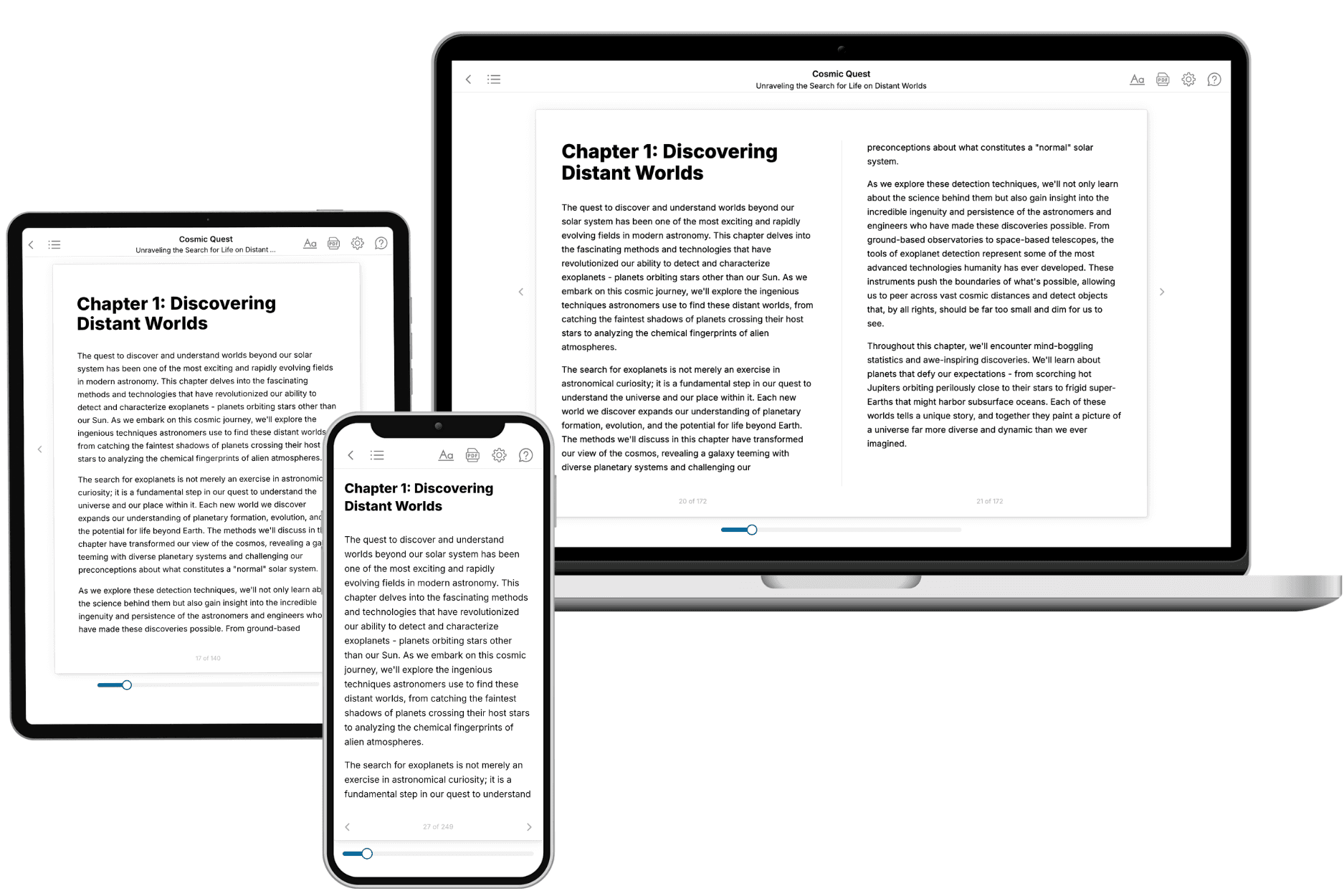
Your book is ready in 10 minutes. Read it online, download as EPUB or PDF, or send to Kindle.

Start from a template
Frequently asked questions
- What is TailoredRead?
TailoredRead creates complete, full-length nonfiction ebooks, written specifically for you. Tell us what you want to learn and why, and TailoredRead writes you a complete ebook on it, with charts, tables, and diagrams throughout. Read it online, on Kindle, or on any e-reader, or download it as a PDF or EPUB. Every book is written fresh the day you order it.
- How is the book tailored to me?
Before anything is written, you answer a few short questions about your goals, your background, and the topics you care about. Your book is then planned around your answers: written at your level, focused on your goals, and covering the topics you chose, instead of the one-size-fits-all book a store sells everyone.
- Will it read like generic AI content?
No. Your book isn't a chat transcript: it's planned chapter by chapter before a single word is written, told in a clear book voice, and explains ideas visually with charts, tables, and diagrams. After writing, every book goes through an editorial pass that polishes chapters so the book reads consistent from start to finish. Judge for yourself: browse thousands of sample books on our Explore Books page.
- How accurate is the content?
Our AI first checks whether your subject needs live research. Niche and fast-moving subjects are researched before writing, and the book plan and chapters are grounded in what it finds. After writing, every book goes through a quality pass that checks its facts and consistency, and researched books list their sources in a Notes section at the back.
- How long is the book?
You choose the length: Comprehensive (250-300 pages), Detailed (150-200 pages), Essential (70-100 pages), or Short (30-50 pages).
- Does the book include visuals?
Yes. Every book includes charts, tables, and diagrams: timelines, checklists, step-by-step guides, decision trees, comparison tables, matrices, and bar charts. A typical book includes dozens of these visual elements.
- Can I read it on Kindle? What formats can I download?
Yes. Every book can be read in our online reader or downloaded as a PDF or EPUB. The EPUB can be opened with Kindle, Apple Books, Kobo, and any e-reader. The Commercial and Author licenses also include an editable Word (DOCX) and Markdown download.
- How much does it cost?
About the price of a regular ebook. The exact price depends on your book's length and complexity, from $2 for the shortest books to $35 for the most comprehensive, and it's shown when you review your book, before you commit to anything. Each book is a one-time purchase, yours to keep, no subscription. Licenses that let you share, teach, or publish your book range from $35.99 to $49.99.
- Can I preview the book before purchasing?
Before you pay, you'll see what your book will cover: the title, a detailed description, the estimated length, and the complete chapter-by-chapter table of contents, so you know what you're getting before you decide. The full text itself is written after you purchase.
- How long does it take to create a book?
About 10 minutes. You can start reading the opening chapters while the rest is still being written.