Atomic Physics Books
Explore tailored Atomic Physics books created by our AI
Many people think atomic physics is impossibly abstract, filled with equations that have no connection to reality. The truth is that atomic physics explains everything from why the sun shines to how your smartphone works, and the mathematics simply describes patterns you can visualize and understand. This book bridges the gap between introductory chemistry and advanced quantum mechanics. You'll discover how quantum numbers organize electrons, why atoms emit specific colors of light, and how radioactive decay follows predictable patterns. Through clear explanations and worked examples, you'll master half-life calculations, electron configurations, and the photoelectric effect that launched the quantum revolution. You'll explore the wave-particle duality that defines our universe, understand how the Heisenberg Uncertainty Principle limits what we can know, and see how nuclear binding energy powers both stars and reactors. From emission spectra to quantum tunneling, from the Schrödinger equation to spin-orbit coupling, you'll build genuine understanding of the quantum world. Whether you're preparing for advanced studies or simply curious about how matter really works, this book provides the clarity and depth you need to truly grasp atomic physics.
Discover how the nucleus—that tiny, dense core at the heart of every atom—holds the key to understanding matter itself. This book takes you on a guided exploration of nuclear physics, revealing the invisible forces and particles that govern atomic behavior and power everything from stars to nuclear reactors. You'll learn why some nuclei are stable while others spontaneously decay, how scientists unlock the enormous energy stored within atoms, and why nuclear physics transformed our understanding of the universe. Through clear explanations and real-world examples, you'll grasp the quantum mechanical principles that make nuclear behavior possible, explore the difference between fission and fusion, and understand how this knowledge shapes modern medicine, energy production, and our comprehension of cosmic processes. Whether you're fascinated by the fundamental nature of matter or curious about the science behind nuclear technology, this book provides the conceptual foundation you need to understand one of physics' most powerful and consequential fields.
What if everything you thought you knew about nuclear waste was incomplete? Most people fear nuclear radiation without understanding what it actually is or how it behaves. This book cuts through the confusion by explaining the physics of radioactivity, the science of nuclear waste generation, and the engineering solutions that safely manage it. You'll discover why radiation exists naturally all around us, how half-life determines storage timelines, and what makes modern containment systems effective. Rather than relying on fear or blind reassurance, you'll learn to evaluate nuclear waste management through the lens of actual physics and evidence-based safety data. Whether you're concerned about environmental impact, curious about energy policy, or simply want to understand one of modern civilization's most debated challenges, this book provides the scientific foundation you need to think critically about nuclear waste and radiation.
Quantum Realms
Unraveling the Mysteries of Atomic and Molecular Physics
Elevate your understanding of the microscopic world to new heights with "Quantum Realms: Unraveling the Mysteries of Atomic and Molecular Physics." This captivating exploration takes you on a thrilling adventure through the fundamental building blocks of matter and the forces that govern them. You'll delve into the fascinating world of quantum mechanics, discovering how it shapes the behavior of atoms and molecules. From the elegant simplicity of the hydrogen atom to the complex interactions in multi-electron systems, you'll gain a deep appreciation for the underlying principles that drive our physical reality. As you progress through the book, you'll master essential concepts such as spectroscopy, molecular bonding, and quantum states. You'll explore cutting-edge topics like laser cooling, Bose-Einstein condensates, and quantum computing, seeing how atomic and molecular physics connects to broader fields of scientific inquiry. By the end, you'll possess a robust toolkit for understanding and analyzing atomic and molecular systems, empowering you to engage with advanced physics literature and contribute to discussions in this exciting field.
The Atomic Revolution
Rutherford's Model and the Birth of Modern Physics
Embark on a fascinating journey through the history of atomic theory with "The Atomic Revolution: Rutherford's Model and the Birth of Modern Physics." This captivating book delves deep into the groundbreaking work of Ernest Rutherford, whose revolutionary atomic model forever changed our understanding of the fundamental building blocks of matter. As you explore the pages of this book, you'll be transported to the early 20th century, a time of rapid scientific advancement and paradigm-shifting discoveries. You'll witness the intellectual climate that gave rise to Rutherford's pioneering experiments and follow the step-by-step process that led to his revolutionary insights. "The Atomic Revolution" not only explains the intricacies of Rutherford's atomic model but also places it in the broader context of scientific progress. You'll gain a clear understanding of how this model built upon previous theories and paved the way for future developments in quantum mechanics and particle physics. Through engaging narratives and clear explanations, you'll discover how Rutherford's work continues to influence our understanding of the universe today.
Many people assume uranium enrichment is a simple chemical process, but it's actually a sophisticated application of physics that separates isotopes based on their minute mass differences. This book demystifies how nuclear fuel is produced by exploring the fundamental physics principles that make enrichment possible. You'll discover why uranium-235 is so valuable, how different enrichment methods exploit physics to separate isotopes, and why this process is central to both nuclear energy and international security. From the behavior of uranium hexafluoride gas to the mechanics of high-speed centrifuges, each chapter builds your understanding of the technology that powers nuclear reactors worldwide. Whether you're studying nuclear science, working in the energy sector, or simply curious about how nuclear fuel is made, this book provides the clarity and depth you need to grasp this complex but fascinating field.
Potassium-Argon Dating
Unlocking Earth's Timeline Through Radioactive Decay
Discover how scientists determine the age of rocks, minerals, and archaeological artifacts using one of nature's most reliable clocks. This book walks you through the fascinating world of potassium-argon dating, starting with the fundamental physics of radioactive decay and building toward practical applications that have shaped our understanding of Earth's history. You'll learn why potassium-40 decays into argon-40 at a predictable rate, how scientists measure this decay in laboratory settings, and why this technique has become indispensable in geology and archaeology. Explore the challenges researchers face—from argon loss to contamination—and discover how modern refinements have made K-Ar dating even more powerful. Whether you're curious about how we know the age of volcanic rocks or how this method helps us trace human evolution, this book provides clear explanations, practical examples, and insights into one of science's most important dating techniques.
Quantum Chemistry Essentials
Master the Molecular World Through Quantum Mechanics
Imagine confidently explaining why certain molecules bond the way they do, predicting chemical reactivity with precision, and understanding the quantum mechanical principles that govern the molecular world. This book bridges the gap between abstract quantum theory and practical chemistry, making complex concepts accessible without sacrificing rigor. You'll discover how the Schrödinger equation reveals molecular structure, why orbitals matter more than orbits, and how quantum mechanics explains everything from chemical bonding to spectroscopic data. Through clear explanations, intuitive analogies, and real-world applications, you'll develop the conceptual foundation needed to tackle advanced chemistry problems. Whether you're preparing for advanced coursework, enhancing your professional expertise, or simply curious about the quantum nature of matter, this guide transforms quantum chemistry from intimidating theory into understandable, applicable knowledge.
Discover how rare earth elements and synchrotron radiation work together to revolutionize modern physics research. This book bridges the gap between fundamental physics principles and practical applications, showing you how these two powerful fields intersect. You'll gain a deeper understanding of the lanthanide series elements and their unique properties, learn how synchrotron facilities generate and utilize intense radiation beams, and explore real-world applications from materials characterization to medical imaging. Whether you're advancing your career in physics, materials science, or engineering, this guide provides the knowledge you need to understand and work with these transformative technologies. Through clear explanations, practical examples, and accessible science, you'll master the concepts that drive innovation in high-energy research and advanced materials development.
Many researchers struggle with X-ray absorption spectroscopy because they view it as an intimidating black box—complex equipment producing cryptic data. In reality, XAS is a powerful, elegant technique that directly reveals what elements are present in your sample and how they're arranged at the atomic level. This guide demystifies the science behind X-ray absorption, walking you through the physics of how X-rays interact with matter, the practical realities of conducting experiments at synchrotron facilities, and the systematic approach to analyzing your data. Whether you're characterizing catalysts, studying environmental contaminants, or investigating novel materials, you'll learn how to design experiments that answer your specific questions, collect high-quality data, and extract meaningful insights. With clear explanations, real-world examples, and practical troubleshooting advice, this book transforms XAS from mysterious to manageable—giving you the confidence to leverage this technique for breakthrough discoveries in your research.
Quantum Foundations
Essential Particle Physics for Researchers and Biologists
Master the quantum mechanics and particle physics principles that govern the subatomic world and increasingly appear relevant to biological research. This guide bridges the gap between abstract quantum theory and practical understanding, designed specifically for researchers with microbiology backgrounds who want to grasp how particles behave, why observation matters, and how quantum effects manifest in biological systems. You'll progress from foundational concepts like wave-particle duality and superposition through advanced topics including entanglement, quantum tunneling, and the Schrödinger equation. Each chapter builds systematically on previous knowledge, with clear explanations of why classical intuition fails at quantum scales and how to develop quantum thinking. Discover how biophotons, biofield mechanisms, and molecular quantum behavior connect to fundamental physics principles. By the end, you'll interpret foundational experiments with confidence, visualize particle interactions, and understand how quantum models apply to your research—whether exploring quantum effects in microbiology or investigating biofield phenomena.
Spin-Orbit Coupling Essentials
Mastering the Quantum Mechanics Behind Magnetic Materials
You'll navigate the fascinating world of spin-orbit coupling, starting from its quantum mechanical foundations and progressing to its transformative role in modern magnetic materials. This guide bridges the gap between abstract theory and practical application, showing how the relativistic interaction between electron spin and orbital motion fundamentally reshapes magnetic behavior. Through clear explanations, illustrative examples, and real-world case studies, you'll discover how spin-orbit coupling creates magnetic anisotropy, enables exotic magnetic states, and powers cutting-edge technologies. By the end, you'll understand not just what spin-orbit coupling is, but how to leverage it for designing materials with precisely controlled magnetic properties—whether for next-generation data storage, quantum computing, or spintronics applications. This book equips you with both the conceptual framework and practical knowledge needed to work confidently with spin-orbit coupling in research and development.
You'll develop a profound understanding of one of physics' most fascinating concepts: wave-particle duality. This book guides you through the quantum revolution that reshaped our understanding of reality, from the classical physics that preceded it to the modern quantum framework that defines contemporary science. You'll explore the pivotal experiments that revealed nature's dual character—from the photoelectric effect that puzzled Einstein to the electron diffraction that confirmed de Broglie's radical hypothesis. Through clear explanations and visual thinking, you'll grasp why particles behave like waves and waves like particles, and why this isn't a contradiction but a deeper truth about nature. You'll master the mathematical language of wave functions while building physical intuition for quantum behavior. The complementarity principle, uncertainty relations, and measurement problem become accessible as you see how they emerge naturally from wave-particle duality. Real-world applications—from electron microscopes to quantum computers—demonstrate how this abstract concept powers modern technology. By the end, you'll think like a quantum physicist, comfortable with the counterintuitive reality that underlies our universe.
Atoms and Revolution
How Nuclear Science Emerged from the Ashes of the French Revolution
Discover how one of history's most violent upheavals gave birth to the science that would define the modern world. The French Revolution didn't just topple a monarchy—it shattered the old order of scientific patronage and opened the door to revolutionary thinking about matter itself. This book traces the fascinating connection between the chaos of 1789 and the discovery of nuclear energy, showing how the Enlightenment ideals that sparked revolution directly enabled scientists to unlock the secrets of the atom. You'll explore how France's scientific institutions were rebuilt from rubble, how the pursuit of reason became a national obsession, and how the dream of progress through science became inseparable from French identity. From the laboratories of post-revolutionary Paris to the cutting-edge physics of the 19th century, witness how political transformation and scientific breakthrough became intertwined, ultimately positioning France as a global leader in nuclear science and energy.
You stand at the threshold of understanding one of physics' most fascinating realms—where individual atoms and molecules come together to create the rich tapestry of materials that surround us. This comprehensive exploration takes you from the quantum mechanical behavior of electrons and atoms to the emergence of macroscopic properties in solids and liquids. You'll discover how the same fundamental forces that govern molecular interactions scale up to determine whether a material conducts electricity, exhibits magnetism, or transforms between different phases. Through clear explanations and practical examples, you'll learn to connect the microscopic world of quantum mechanics with the tangible properties of metals, semiconductors, insulators, and exotic quantum materials. Your understanding will deepen as you explore how crystal structures, electronic bands, and many-body interactions work together to create phenomena like superconductivity, magnetism, and phase transitions. You'll gain insight into how defects and surfaces influence material behavior, and why these seemingly imperfect features often control the most important technological applications. By the end of this journey, you'll possess a solid foundation for understanding how the molecular world shapes the materials that define our technological civilization, from the silicon in computer chips to the exotic quantum materials driving tomorrow's innovations.
Related books you may like:
Discover how advanced functional materials are reshaping industries and enabling solutions to humanity's greatest challenges. This comprehensive guide takes you beyond basic materials science to explore the cutting-edge world of engineered materials designed to perform specific, transformative functions. You'll learn how scientists and engineers manipulate atomic structures and processing conditions to create materials that respond to stimuli, conduct electricity with unprecedented efficiency, or heal themselves. From smart polymers that change properties on demand to nanomaterials with revolutionary capabilities, this book reveals the principles behind these innovations and their practical applications in healthcare, energy, electronics, and aerospace. Whether you're advancing your career, developing new products, or simply fascinated by the materials shaping our future, you'll gain the knowledge to understand, evaluate, and potentially contribute to this rapidly evolving field.
Most chemical reactions should happen instantly, yet they don't. The culprit? Activation energy—the invisible barrier that keeps reactants locked in place until enough energy arrives to break them free. Without understanding this fundamental concept, enzyme kinetics remains a mystery, and the elegant mechanisms by which life accelerates reactions seem like magic. This book demystifies activation energy and enzyme kinetics through clear explanations, practical examples, and visual frameworks. You'll discover how enzymes perform their catalytic miracles by lowering activation energy, explore the mathematics of reaction rates through the Arrhenius equation and Michaelis-Menten kinetics, and learn how inhibition mechanisms control biological processes. Whether you're studying biochemistry, developing pharmaceuticals, or optimizing industrial processes, this guide equips you with both the conceptual understanding and quantitative tools needed to predict, analyze, and manipulate enzyme-catalyzed reactions with confidence.
Achieve reliable, reproducible separations of complex chemical mixtures using adsorption chromatography. This practical guide bridges the gap between theoretical principles and real-world laboratory application, providing you with the knowledge and skills to design effective separation strategies for your specific analytical needs. You'll explore the fundamental science of how compounds interact with adsorbent materials, learn to select optimal stationary and mobile phases, and master the practical techniques that ensure consistent results. Whether you're working with thin-layer chromatography, column chromatography, or HPLC systems, this book equips you with systematic approaches to troubleshooting common problems, optimizing separations, and interpreting data with confidence. Packed with practical examples, decision-making frameworks, and evidence-based strategies, you'll develop the expertise to tackle challenging separation problems and advance your analytical capabilities in pharmaceutical, environmental, or materials research.
Many assume adipose tissue is simply inert fat to be minimized or removed. In reality, it's a sophisticated, metabolically active organ with remarkable regenerative potential. This book reveals how adipose tissue engineering is revolutionizing medicine by creating functional tissue solutions for reconstruction, regeneration, and therapeutic applications. You'll discover the biological foundations of adipose tissue, learn how scientists harvest and cultivate adipose-derived stem cells, and explore cutting-edge engineering strategies that transform these cells into viable tissue constructs. From scaffold design and bioreactor optimization to vascularization techniques and clinical translation, this guide provides practical insights into the science and engineering behind adipose tissue regeneration. Whether you're a researcher, student, or healthcare professional, you'll gain actionable knowledge about the current state of the field, emerging technologies, and the real-world challenges of bringing engineered tissues from the laboratory to clinical practice.
In the rapidly evolving world of ultra-high-speed communications, the challenge of designing secure and efficient chips has never been more daunting. As a Principal Architect, you face the complex task of integrating cutting-edge VLSI techniques with robust cryptographic solutions. This book is your comprehensive guide to conquering these challenges. "Advanced VLSI Design" delves deep into the intricacies of modern chip architecture, offering you practical insights into overcoming CMOS scaling limitations, harnessing the power of 3D IC integration, and implementing state-of-the-art FinFET technology. You'll explore innovative approaches to low-power design and high-speed SerDes, crucial for next-generation communication systems. This book doesn't just stop at performance; it equips you with the knowledge to build security from the ground up. From hardware Trojan detection to side-channel analysis resistance, you'll learn how to create chips that are not only fast but also fortified against modern security threats. Dive into advanced topics like quantum-dot cellular automata and EUV lithography, positioning yourself at the forefront of VLSI innovation.
Create an Atomic Physics Book Tailored to You
Create an AI-crafted book tailored to your goals, interests, and background






Benefits of AI-tailored books
- Read one book, not ten:
- all the Atomic Physics knowledge you need, gathered into a single book.
- Save days of learning:
- tell us your goals, choose your topics, and the whole book is built around them.
- Learn effortlessly:
- Atomic Physics book written for your specific background and expertise.
- Understand at a glance:
- includes charts, tables, timelines, checklists, decision trees, and more.
- Stay current:
- written the day you order it, not years ago.
- Trust what you read:
- every book is checked for accuracy, with real research when your subject needs it.
Create your unique book in 3 steps
- 1. Select your focus
Select the focus of your Atomic Physics book and share your background
- 2. Personalize your book
Specify your goals and choose sub-topics to include
- 3. Get your tailored book
Your book is ready in 10 minutes. Read it online, download as EPUB or PDF, or send to Kindle.


Start from a template
Frequently asked questions
- What is TailoredRead?
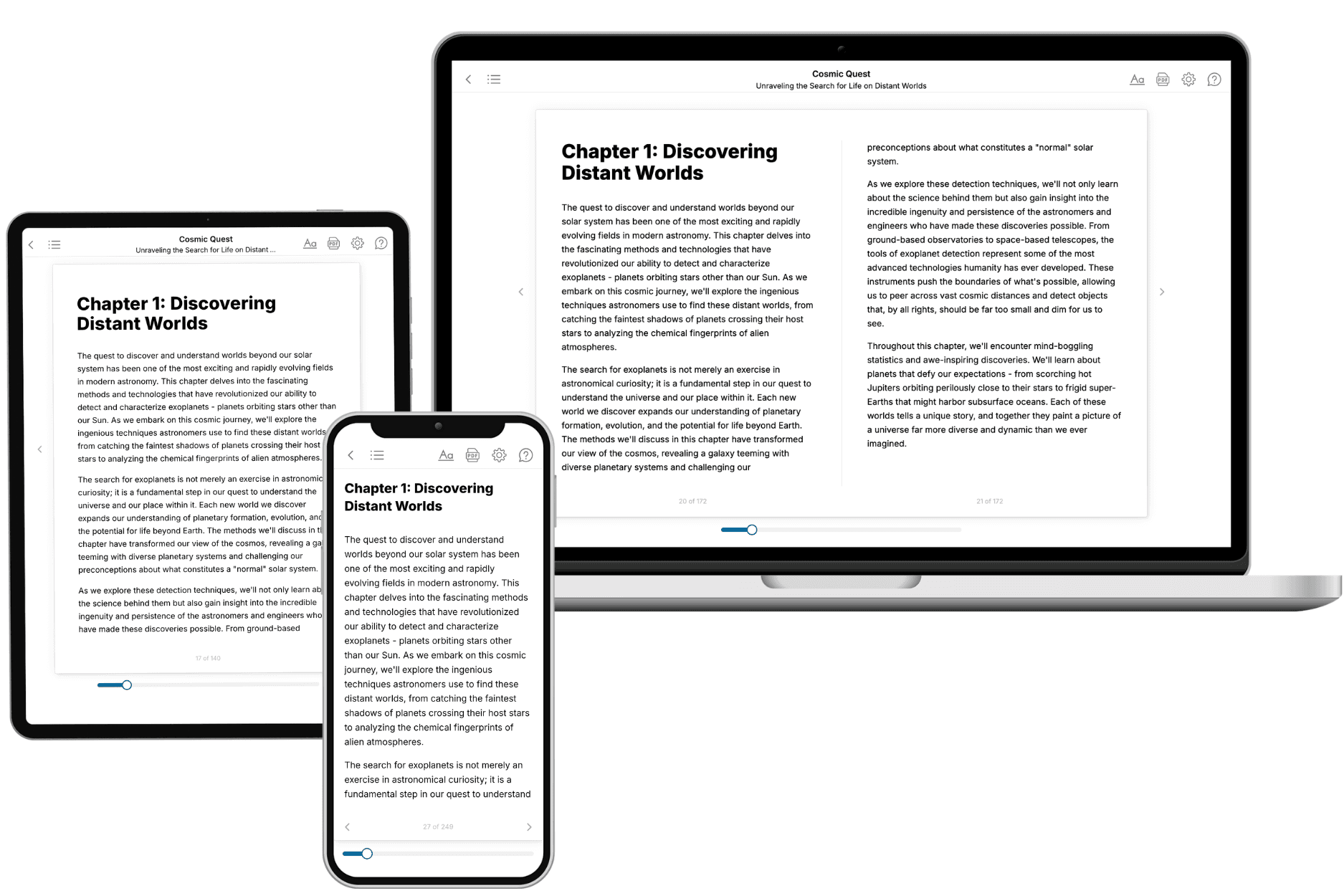
TailoredRead creates complete, full-length nonfiction ebooks, written specifically for you. Tell us what you want to learn and why, and TailoredRead writes you a complete ebook on it, with charts, tables, and diagrams throughout. Read it online, on Kindle, or on any e-reader, or download it as a PDF or EPUB. Every book is written fresh the day you order it.
- How is the book tailored to me?
Before anything is written, you answer a few short questions about your goals, your background, and the topics you care about. Your book is then planned around your answers: written at your level, focused on your goals, and covering the topics you chose, instead of the one-size-fits-all book a store sells everyone.
- Will it read like generic AI content?
No. Your book isn't a chat transcript: it's planned chapter by chapter before a single word is written, told in a clear book voice, and explains ideas visually with charts, tables, and diagrams. After writing, every book goes through an editorial pass that polishes chapters so the book reads consistent from start to finish. Judge for yourself: browse thousands of sample books on our Explore Books page.
- How accurate is the content?
Our AI first checks whether your subject needs live research. Niche and fast-moving subjects are researched before writing, and the book plan and chapters are grounded in what it finds. After writing, every book goes through a quality pass that checks its facts and consistency, and researched books list their sources in a Notes section at the back.
- How long is the book?
You choose the length: Comprehensive (250-300 pages), Detailed (150-200 pages), Essential (70-100 pages), or Short (30-50 pages).
- Does the book include visuals?
Yes. Every book includes charts, tables, and diagrams: timelines, checklists, step-by-step guides, decision trees, comparison tables, matrices, and bar charts. A typical book includes dozens of these visual elements.
- Can I read it on Kindle? What formats can I download?
Yes. Every book can be read in our online reader or downloaded as a PDF or EPUB. The EPUB can be opened with Kindle, Apple Books, Kobo, and any e-reader. The Commercial and Author licenses also include an editable Word (DOCX) and Markdown download.
- How much does it cost?
About the price of a regular ebook. The exact price depends on your book's length and complexity, from $2 for the shortest books to $35 for the most comprehensive, and it's shown when you review your book, before you commit to anything. Each book is a one-time purchase, yours to keep, no subscription. Licenses that let you share, teach, or publish your book range from $35.99 to $49.99.
- Can I preview the book before purchasing?
Before you pay, you'll see what your book will cover: the title, a detailed description, the estimated length, and the complete chapter-by-chapter table of contents, so you know what you're getting before you decide. The full text itself is written after you purchase.
- How long does it take to create a book?
About 10 minutes. You can start reading the opening chapters while the rest is still being written.