Quantum Realms
Unraveling the Mysteries of Atomic and Molecular Physics
Elevate your understanding of the microscopic world to new heights with "Quantum Realms: Unraveling the Mysteries of Atomic and Molecular Physics." This captivating exploration takes you on a thrilling adventure through the fundamental building blocks of matter and the forces that govern them.
269 pages13 chaptersMar 6, 2025Physics
About this book
You'll delve into the fascinating world of quantum mechanics, discovering how it shapes the behavior of atoms and molecules. From the elegant simplicity of the hydrogen atom to the complex interactions in multi-electron systems, you'll gain a deep appreciation for the underlying principles that drive our physical reality. As you progress through the book, you'll master essential concepts such as spectroscopy, molecular bonding, and quantum states. You'll explore cutting-edge topics like laser cooling, Bose-Einstein condensates, and quantum computing, seeing how atomic and molecular physics connects to broader fields of scientific inquiry. By the end, you'll possess a robust toolkit for understanding and analyzing atomic and molecular systems, empowering you to engage with advanced physics literature and contribute to discussions in this exciting field.
Table of contents
- IntroductionThe Importance of Atomic and Molecular Physics, Historical Context and Key Discoveries, Overview of the Book's Structure, Learning Objectives and OutcomesRead below
- Chapter 1: Foundations of Quantum MechanicsFrom Classical to Quantum Physics, Wave-Particle Duality, The Uncertainty Principle, The Schrödinger Equation
- Chapter 2: Quantum States and WavefunctionsInterpreting the Wavefunction, Normalization and Orthogonality, The Superposition Principle, Quantum Operators and Observables
- Chapter 3: The Hydrogen AtomThe Bohr Model, Quantum Numbers and Orbitals, Hydrogen Atom Wavefunctions, Selection Rules and Transitions
- Chapter 4: Multi-Electron AtomsElectron Configuration, The Pauli Exclusion Principle, Hund's Rule and Atomic Structure, The Periodic Table and Atomic Properties
- Chapter 5: Atomic Spectra and TransitionsEmission and Absorption Spectra, Selection Rules for Complex Atoms, Fine Structure and Spin-Orbit Coupling, The Zeeman Effect
- Chapter 6: Molecular Structure and BondingCovalent Bonding, Molecular Orbitals, Hybridization and Molecular Geometry, Intermolecular Forces
- Chapter 7: Molecular SpectraRotational Spectra, Vibrational Spectra, Electronic Spectra of Molecules, Raman Spectroscopy
- Chapter 8: Quantum Entanglement and SuperpositionThe EPR Paradox, Bell's Theorem and Inequalities, Applications of Quantum Entanglement, Quantum Teleportation
- Chapter 9: Laser Physics and ApplicationsPrinciples of Laser Operation, Types of Lasers, Laser Spectroscopy, Laser Cooling and Trapping
- Chapter 10: Atomic Clocks and Precision MeasurementsPrinciples of Atomic Clocks, Cesium Fountain Clocks, Optical Lattice Clocks, Applications in Timekeeping and Navigation
- Chapter 11: Bose-Einstein CondensatesTheory of Bose-Einstein Condensation, Experimental Realization of BECs, Properties of Bose-Einstein Condensates, Applications and Future Prospects
- Chapter 12: Quantum Computing and InformationQubits and Quantum Gates, Quantum Algorithms, Quantum Error Correction, Physical Implementations of Quantum Computers
- Chapter 13: Applications of Atomic and Molecular PhysicsMaterials Science and Nanotechnology, Quantum Sensors and Metrology, Astrophysics and Cosmology, Future Directions and Challenges
- ConclusionKey Takeaways, Future Prospects in Atomic and Molecular Physics
- Glossary
- Further Reading
Introduction
Welcome to the fascinating world of atomic and molecular physics, a realm where the fundamental building blocks of matter reveal their intricate dance and the laws of quantum mechanics reign supreme. This introduction serves as your gateway to understanding the microscopic universe that underpins the macroscopic world we experience every day. As you embark on this journey through "Quantum Realms: Unraveling the Mysteries of Atomic and Molecular Physics," you'll discover how the behavior of atoms and molecules shapes the very fabric of our reality, from the air we breathe to the stars that light up the night sky.
In this chapter, we'll lay the groundwork for your exploration of atomic and molecular physics. We'll discuss why this field is so crucial to our understanding of nature and how it impacts various aspects of science and technology. You'll gain insight into the historical context that led to our current understanding, tracing the path from classical physics to the quantum revolution. We'll also provide an overview of what lies ahead in this book, outlining the key concepts and discoveries you'll encounter. By the end of this introduction, you'll be equipped with a roadmap for your journey into the quantum realm and a clear set of learning objectives to guide your studies.
As you progress through this book, you'll find that atomic and molecular physics is not just a theoretical construct but a vibrant field with practical applications that touch nearly every aspect of modern life. From the development of new materials to the creation of ultra-precise atomic clocks, the principles you'll learn here have far-reaching consequences. So, prepare to challenge your intuitions, expand your understanding of the physical world, and gain a deeper appreciation for the elegant complexity that exists at the atomic scale.
The Importance of Atomic and Molecular Physics
Atomic and molecular physics stands as a cornerstone of modern scientific understanding, bridging the gap between the microscopic world of quantum mechanics and the macroscopic realm of classical physics. Its importance cannot be overstated, as it provides the fundamental knowledge necessary to explain and predict the behavior of matter at its most basic level. This field of study is not merely an academic pursuit; it has profound implications for a wide array of scientific disciplines and technological advancements that shape our world today.
At its core, atomic and molecular physics deals with the structure, properties, and interactions of atoms and molecules. These fundamental units of matter are the building blocks from which all substances are composed, from the simplest gases to the most complex biological systems. By understanding the behavior of atoms and molecules, scientists can explain phenomena ranging from chemical reactions to the properties of materials, and even the processes occurring in the hearts of stars[1].
One of the most significant contributions of atomic and molecular physics is its role in the development of quantum mechanics. The study of atomic spectra and the behavior of electrons in atoms led to the formulation of quantum theory, which revolutionized our understanding of the physical world. This quantum mechanical framework not only explains the stability of atoms and the periodic table of elements but also underpins our understanding of solid-state physics, which is crucial for the development of modern electronics and computing technologies.
In the realm of chemistry, atomic and molecular physics provides the theoretical foundation for understanding chemical bonding and reactions. The concepts of molecular orbitals, hybridization, and intermolecular forces, all rooted in atomic physics, are essential for predicting and explaining chemical behavior. This knowledge is invaluable in fields such as drug design, where understanding molecular interactions is crucial for developing new pharmaceuticals.
The impact of atomic and molecular physics extends far beyond the laboratory. In materials science, insights from this field have led to the development of new materials with tailored properties, such as semiconductors for electronic devices, high-temperature superconductors, and advanced polymers. These materials have revolutionized industries ranging from electronics to aerospace, enabling technological advancements that were once thought impossible.
Environmental science also benefits greatly from atomic and molecular physics. Spectroscopic techniques derived from our understanding of atomic and molecular energy levels allow for the precise detection and measurement of pollutants in air, water, and soil. This capability is crucial for monitoring environmental quality and developing strategies for pollution control and remediation.
In the field of energy research, atomic and molecular physics plays a vital role in the quest for sustainable energy sources. From improving the efficiency of solar cells to understanding the processes involved in nuclear fusion, the principles of atomic physics are at the forefront of efforts to address global energy challenges.
The medical field has also been transformed by applications of atomic and molecular physics. Medical imaging techniques such as Magnetic Resonance Imaging (MRI) and Positron Emission Tomography (PET) rely on principles derived from atomic physics. These non-invasive diagnostic tools have revolutionized the detection and treatment of various medical conditions, saving countless lives[2].
Furthermore, the study of atomic and molecular physics has opened up new frontiers in quantum technology. Quantum computing, which promises to revolutionize information processing, is based on manipulating quantum states of atoms or atomic-like systems. Similarly, quantum cryptography, which offers unbreakable encryption methods, relies on the quantum properties of photons understood through atomic physics.
In the realm of metrology, atomic clocks based on the precise transitions of atoms have redefined our standards of time measurement. These ultra-precise clocks are not only crucial for scientific experiments but also play a vital role in global positioning systems (GPS) and telecommunications networks.
As we look to the future, the importance of atomic and molecular physics only grows. Emerging fields such as quantum biology, which seeks to understand quantum effects in biological systems, and attosecond science, which studies processes occurring on incredibly short time scales, promise to push the boundaries of our knowledge even further. The insights gained from these areas could lead to breakthroughs in fields as diverse as artificial photosynthesis and quantum computing.
In conclusion, atomic and molecular physics serves as a fundamental pillar of modern science, providing the theoretical framework and practical tools to explore and manipulate matter at its most basic level. Its importance spans across disciplines, driving innovation in technology, medicine, environmental science, and beyond. As you delve deeper into this field, you'll gain not only a profound understanding of the physical world but also the keys to unlocking future technological and scientific advancements that will shape our world for generations to come.
Historical Context and Key Discoveries
The journey to our current understanding of atomic and molecular physics is a testament to human curiosity and ingenuity, spanning centuries of scientific inquiry and marked by revolutionary discoveries that have reshaped our view of the physical world. This historical context is crucial for appreciating the depth and significance of the field, as well as for understanding how various concepts in atomic and molecular physics have evolved over time.
The concept of the atom dates back to ancient Greek philosophers such as Democritus and Leucippus, who proposed that matter was composed of indivisible particles. However, it wasn't until the 19th century that the modern scientific understanding of atoms began to take shape. In 1808, John Dalton proposed his atomic theory, which laid the groundwork for modern chemistry by suggesting that all matter is composed of indivisible particles called atoms, each element consists of a unique type of atom, and chemical reactions involve the rearrangement of these atoms[3].
A significant breakthrough came in 1897 when J.J. Thomson discovered the electron, the first subatomic particle to be identified. This discovery shattered the notion of atoms as indivisible units and led to Thomson's "plum pudding" model of the atom, which envisioned electrons embedded in a positively charged sphere. This model, while ultimately incorrect, was an important step in the development of atomic theory.
The next major advancement came in 1911 with Ernest Rutherford's gold foil experiment. By observing how alpha particles scattered when fired at a thin gold foil, Rutherford concluded that atoms must consist of a small, dense, positively charged nucleus surrounded by electrons. This nuclear model of the atom overturned Thomson's plum pudding model and laid the foundation for our modern understanding of atomic structure.
In 1913, Niels Bohr built upon Rutherford's model by proposing that electrons orbit the nucleus in discrete energy levels. Bohr's model could explain the spectral lines of hydrogen and introduced the concept of quantized energy states, a crucial step towards quantum mechanics. While the Bohr model was later superseded, its introduction of quantization was a revolutionary idea that persists in modern atomic physics.
The early 20th century saw a rapid succession of discoveries that would lead to the development of quantum mechanics. In 1924, Louis de Broglie proposed the wave-particle duality of matter, suggesting that particles could exhibit wave-like properties. This concept was crucial in understanding the behavior of electrons in atoms. Shortly after, in 1925, Werner Heisenberg developed matrix mechanics, one of the first mathematical formulations of quantum mechanics. In the same year, Erwin Schrödinger introduced wave mechanics and his famous equation, which describes how the quantum state of a system changes over time.
The Schrödinger equation proved to be a powerful tool for describing atomic systems, leading to a more complete understanding of atomic structure and spectra. It also provided a theoretical foundation for understanding chemical bonding and molecular structure. In 1926, Max Born provided the probabilistic interpretation of the wavefunction, a key concept in quantum mechanics that explains the inherent uncertainty in quantum systems.
Another crucial development was Wolfgang Pauli's exclusion principle, proposed in 1925, which states that no two electrons in an atom can have the same set of quantum numbers. This principle explains the electron configuration of atoms and is fundamental to understanding the periodic table of elements. In 1927, Heisenberg formulated his uncertainty principle, which sets fundamental limits on the precision with which certain pairs of physical properties can be determined.
The 1930s saw further refinements in atomic theory. In 1932, James Chadwick discovered the neutron, completing the basic picture of atomic structure. The development of quantum electrodynamics (QED) in the 1940s and 1950s, primarily by Richard Feynman, Julian Schwinger, and Sin-Itiro Tomonaga, provided a quantum theory of the electromagnetic interaction and explained phenomena such as the Lamb shift in atomic spectra.
The latter half of the 20th century brought numerous experimental techniques that allowed for direct manipulation and observation of individual atoms and molecules. The invention of the laser in 1960 revolutionized spectroscopy and led to new fields such as laser cooling and trapping of atoms. Techniques like atomic force microscopy (AFM) and scanning tunneling microscopy (STM), developed in the 1980s, allowed scientists to image and manipulate individual atoms and molecules.
In recent decades, the field of atomic and molecular physics has continued to advance rapidly. The creation of Bose-Einstein condensates in 1995 opened up new avenues for studying quantum many-body systems. The development of femtosecond and attosecond laser pulses has allowed for the study of electron dynamics on incredibly short time scales. Quantum information science, including quantum computing and quantum cryptography, has emerged as a major field of research, leveraging the principles of atomic and molecular physics for information processing and secure communication.
The historical journey of atomic and molecular physics is marked by a continuous interplay between theory and experiment. Theoretical predictions have often led to experimental discoveries, while unexpected experimental results have frequently necessitated new theoretical frameworks. This dynamic has driven the field forward, constantly refining our understanding of the atomic and molecular world.
As you delve deeper into the topics covered in this book, it's important to appreciate that each concept and principle you encounter is the result of this rich historical tapestry of scientific inquiry. The theories and models we use today are the culmination of centuries of observation, experimentation, and intellectual struggle. By understanding this historical context, you'll gain a deeper appreciation for the elegance and power of modern atomic and molecular physics, as well as an awareness of how scientific knowledge evolves over time.
Overview of the Book's Structure
"Quantum Realms: Unraveling the Mysteries of Atomic and Molecular Physics" is designed to take you on a comprehensive journey through the fascinating world of atomic and molecular physics. The book is structured to build your understanding progressively, starting from fundamental concepts and moving towards more advanced topics and applications. This overview will provide you with a roadmap of what to expect in the chapters ahead, helping you navigate the complex terrain of quantum physics with confidence.
The book begins with Chapter 1, "Foundations of Quantum Mechanics," which lays the groundwork for understanding the quantum nature of atoms and molecules. This chapter bridges the gap between classical and quantum physics, introducing key concepts such as wave-particle duality, the uncertainty principle, and the Schrödinger equation. These fundamental principles are crucial for understanding the behavior of particles at the atomic scale and will serve as the foundation for all subsequent chapters.
Chapter 2, "Quantum States and Wavefunctions," delves deeper into the mathematical framework of quantum mechanics. You'll explore the interpretation of wavefunctions, learn about normalization and orthogonality, and understand the superposition principle. This chapter also introduces quantum operators and observables, providing you with the tools to describe and analyze quantum systems mathematically.
In Chapter 3, "The Hydrogen Atom," we apply the principles of quantum mechanics to the simplest atomic system. Starting with the Bohr model, we progress to a full quantum mechanical treatment of the hydrogen atom, including quantum numbers, orbitals, and selection rules. This chapter serves as a crucial link between basic quantum theory and more complex atomic systems.
Chapter 4, "Multi-Electron Atoms," expands our focus to more complex atomic systems. You'll learn about electron configurations, the Pauli exclusion principle, and Hund's rule. This chapter also explores how these principles give rise to the structure of the periodic table, providing a quantum mechanical explanation for chemical properties.
Chapter 5, "Atomic Spectra and Transitions," builds on the previous chapters to explain how atoms interact with light. You'll study emission and absorption spectra, selection rules for complex atoms, and phenomena such as fine structure and the Zeeman effect. This chapter connects theoretical concepts to observable phenomena, illustrating how quantum mechanics explains the discrete spectra of atoms.
Moving from atoms to molecules, Chapter 6, "Molecular Structure and Bonding," introduces the principles of molecular physics. You'll explore covalent bonding, molecular orbitals, hybridization, and the forces that hold molecules together. This chapter provides the foundation for understanding chemical bonding from a quantum mechanical perspective.
Chapter 7, "Molecular Spectra," extends the spectroscopic concepts from atomic physics to molecular systems. You'll learn about rotational, vibrational, and electronic spectra of molecules, as well as Raman spectroscopy. This chapter demonstrates how spectroscopy serves as a powerful tool for probing molecular structure and dynamics.
Chapter 8, "Quantum Entanglement and Superposition," introduces you to some of the more counterintuitive aspects of quantum mechanics. You'll explore the EPR paradox, Bell's theorem, and the concept of quantum entanglement. This chapter also discusses potential applications of these phenomena, including quantum teleportation.
Chapter 9, "Laser Physics and Applications," focuses on the principles and applications of lasers. You'll learn about laser operation, different types of lasers, and their use in spectroscopy. The chapter also covers advanced topics such as laser cooling and trapping of atoms.
Chapter 10, "Atomic Clocks and Precision Measurements," explores how the principles of atomic physics are applied to create incredibly precise timekeeping devices. You'll learn about different types of atomic clocks and their applications in navigation and fundamental physics.
Chapter 11, "Bose-Einstein Condensates," introduces you to a state of matter that exists at extremely low temperatures. You'll learn about the theory behind Bose-Einstein condensation, how these condensates are created in the lab, and their unique properties and potential applications.
Chapter 12, "Quantum Computing and Information," bridges atomic physics with information science. You'll explore the concepts of qubits and quantum gates, learn about quantum algorithms, and understand the challenges and potential of quantum computing.
The final chapter, Chapter 13, "Applications of Atomic and Molecular Physics," showcases how the principles you've learned throughout the book are applied in various fields. From materials science and nanotechnology to astrophysics and cosmology, this chapter demonstrates the far-reaching impact of atomic and molecular physics.
Throughout the book, you'll find numerous examples, illustrations, and thought experiments to help solidify your understanding. Each chapter concludes with a summary of key points and a set of problems to test your comprehension and apply your knowledge. Additionally, the book includes a comprehensive glossary of terms and suggestions for further reading to support your continued exploration of the field.
By structuring the book in this way, we aim to provide you with a logical progression through the field of atomic and molecular physics. Each chapter builds upon the knowledge gained in previous sections, allowing you to develop a deep and interconnected understanding of the subject matter. As you work through the book, you'll not only learn about the fundamental principles of atomic and molecular physics but also gain insight into how these principles are applied in cutting-edge research and technology.
Learning Objectives and Outcomes
As you embark on your journey through "Quantum Realms: Unraveling the Mysteries of Atomic and Molecular Physics," it's important to have a clear understanding of what you can expect to learn and achieve. This section outlines the key learning objectives and outcomes for the book, providing you with a roadmap for your studies and a set of goals to strive towards. By the end of this book, you will have gained a comprehensive understanding of atomic and molecular physics, along with the ability to apply this knowledge to a wide range of scientific and technological contexts.
The primary objective of this book is to provide you with a solid foundation in the principles of atomic and molecular physics, bridging the gap between basic quantum mechanics and advanced applications in modern physics. To achieve this, we have set out several specific learning objectives that will guide your progress through the material:
1. Understand the fundamental principles of quantum mechanics as they apply to atomic and molecular systems. By the end of the book, you should be able to:
- Explain the concept of wave-particle duality and its implications for atomic physics
- Articulate the meaning and significance of the uncertainty principle
- Solve basic problems using the Schrödinger equation
- Interpret wavefunctions and their probabilistic nature
- Apply quantum mechanical operators to calculate observables
2. Develop a comprehensive understanding of atomic structure and spectra. After studying the relevant chapters, you will be able to:
- Describe the quantum mechanical model of the hydrogen atom
- Explain the significance of quantum numbers in describing atomic states
- Analyze the electron configurations of multi-electron atoms
- Interpret atomic spectra and explain the origin of spectral lines
- Understand and apply selection rules for atomic transitions
3. Gain insight into molecular structure and bonding from a quantum mechanical perspective. By the end of the relevant sections, you should be able to:
- Explain the formation of covalent bonds using molecular orbital theory
- Describe the concept of hybridization and its role in molecular geometry
- Analyze the vibrational and rotational spectra of molecules
- Understand the principles behind various spectroscopic techniques used to study molecules
4. Explore advanced concepts in quantum physics and their applications. After completing the book, you will be able to:
- Explain the concept of quantum entanglement and its implications
- Describe the principles of laser operation and applications
- Understand the workings of atomic clocks and their importance in precision measurements
- Discuss the properties of Bose-Einstein condensates and their significance in quantum physics
- Explain the basic principles of quantum computing and information
5. Appreciate the wide-ranging applications of atomic and molecular physics in various fields. By the end of the book, you should be able to:
- Identify how atomic and molecular physics principles are applied in materials science and nanotechnology
- Understand the role of atomic physics in astrophysics and cosmology
- Discuss the applications of atomic and molecular physics in developing quantum sensors and metrology tools
- Recognize the potential future directions and challenges in the field
6. Develop problem-solving skills in the context of atomic and molecular physics. Throughout the book, you will:
- Learn to approach complex problems by breaking them down into manageable steps
- Gain experience in applying mathematical techniques to physical problems
- Develop the ability to interpret physical results and understand their implications
- Enhance your critical thinking skills by analyzing case studies and real-world applications
7. Cultivate scientific literacy and communication skills. By engaging with the material in this book, you will:
- Become familiar with the terminology and concepts used in modern atomic and molecular physics
- Improve your ability to read and understand scientific literature in the field
- Develop skills in explaining complex scientific concepts to both technical and non-technical audiences
- Gain an appreciation for the historical development of atomic and molecular physics and its impact on scientific thought
8. Connect theoretical concepts with experimental techniques. Throughout the book, you will:
- Learn about key experimental methods used in atomic and molecular physics
- Understand how theoretical predictions are tested and verified through experiments
- Appreciate the interplay between theory and experiment in advancing scientific knowledge
By achieving these learning objectives, you will not only gain a deep understanding of atomic and molecular physics but also develop valuable skills that are applicable across various scientific disciplines. You'll be equipped to engage with current research in the field, understand the principles behind cutting-edge technologies, and appreciate the fundamental role that atomic and molecular physics plays in our understanding of the natural world.
Remember that learning is an active process. To get the most out of this book, engage deeply with the material, work through the problems and exercises provided, and seek out additional resources when needed. Don't hesitate to revisit earlier chapters as you progress, as many concepts in atomic and molecular physics are interconnected and build upon each other.
As you work through "Quantum Realms," keep these learning objectives in mind. They will serve as guideposts for your journey, helping you to focus your efforts and measure your progress. By the time you reach the end of this book, you will have gained not just knowledge, but also the skills and perspective needed to appreciate and contribute to the exciting field of atomic and molecular physics.
Notes
Introduction
This is the end of the free sample. The full book has 13 chapters.
Want this book written for you?
Tell us your goals and background, and get your own version of this book, tailored by AI to you.


Benefits of AI-tailored books
- Read one book, not ten:
- all the Physics knowledge you need, gathered into a single book.
- Save days of learning:
- tell us your goals, choose your topics, and the whole book is built around them.
- Learn effortlessly:
- Physics book written for your specific background and expertise.
- Understand at a glance:
- includes charts, tables, timelines, checklists, decision trees, and more.
- Stay current:
- written the day you order it, not years ago.
- Trust what you read:
- every book is checked for accuracy, with real research when your subject needs it.
Create your unique book in 3 steps
- 1. Select your focus
Select the focus of your Physics book and share your background
- 2. Personalize your book
Specify your goals and choose sub-topics to include
- 3. Get your tailored book
Your book is ready in 10 minutes. Read it online, download as EPUB or PDF, or send to Kindle.


Frequently asked questions
- What is TailoredRead?
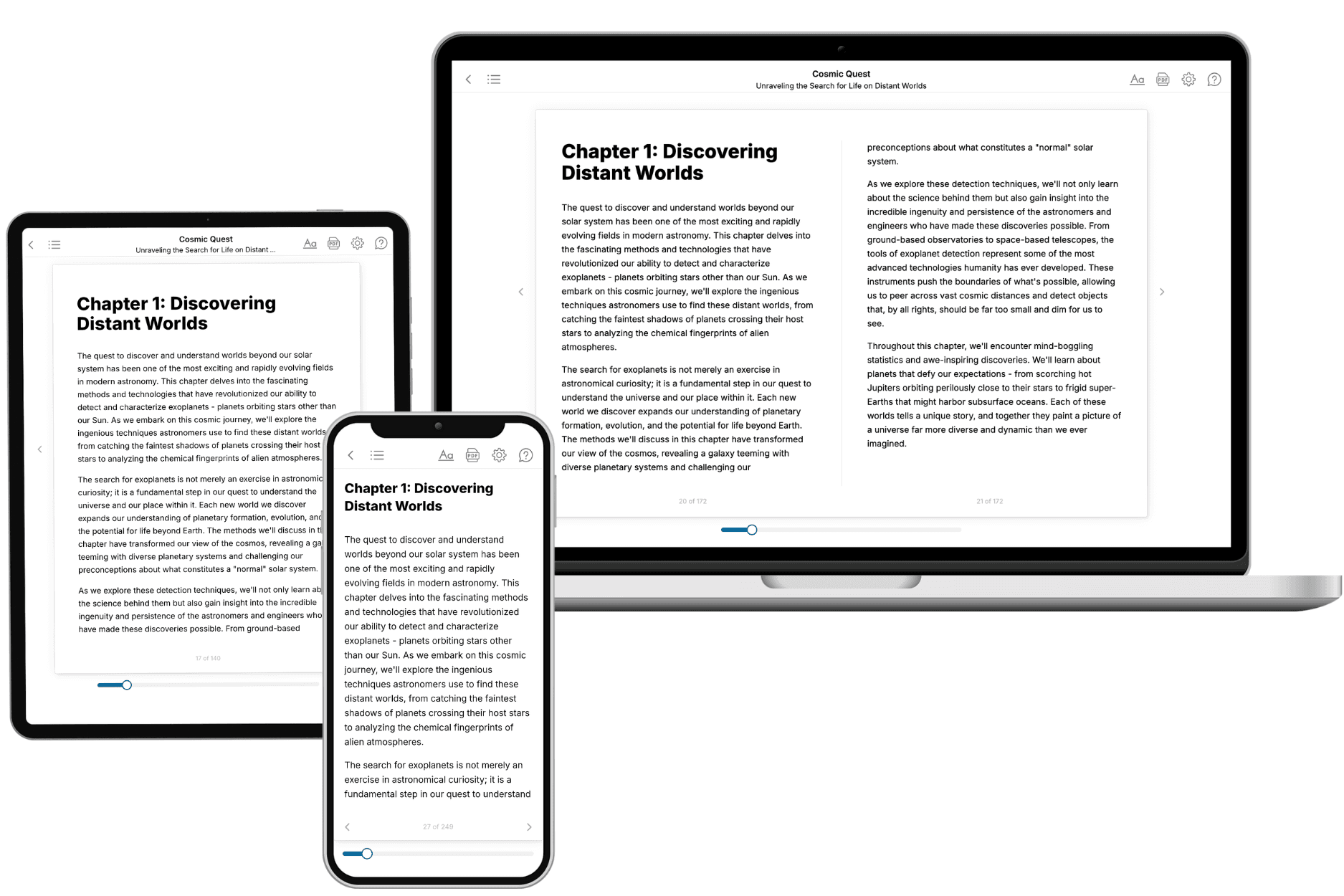
TailoredRead creates complete, full-length nonfiction ebooks, written specifically for you. Tell us what you want to learn and why, and TailoredRead writes you a complete ebook on it, with charts, tables, and diagrams throughout. Read it online, on Kindle, or on any e-reader, or download it as a PDF or EPUB. Every book is written fresh the day you order it.
- How is the book tailored to me?
Before anything is written, you answer a few short questions about your goals, your background, and the topics you care about. Your book is then planned around your answers: written at your level, focused on your goals, and covering the topics you chose, instead of the one-size-fits-all book a store sells everyone.
- Will it read like generic AI content?
No. Your book isn't a chat transcript: it's planned chapter by chapter before a single word is written, told in a clear book voice, and explains ideas visually with charts, tables, and diagrams. After writing, every book goes through an editorial pass that polishes chapters so the book reads consistent from start to finish. Judge for yourself: browse thousands of sample books on our Explore Books page.
- How accurate is the content?
Our AI first checks whether your subject needs live research. Niche and fast-moving subjects are researched before writing, and the book plan and chapters are grounded in what it finds. After writing, every book goes through a quality pass that checks its facts and consistency, and researched books list their sources in a Notes section at the back.
- How long is the book?
You choose the length: Comprehensive (250-300 pages), Detailed (150-200 pages), Essential (70-100 pages), or Short (30-50 pages).
- Does the book include visuals?
Yes. Every book includes visual elements such as timelines, checklists, step-by-step guides, decision trees, comparison tables, and matrices, and many include bar charts. A typical book includes dozens of these visual elements.
- Can I read it on Kindle? What formats can I download?
Yes. Every book can be read in our online reader or downloaded as a PDF or EPUB. The EPUB can be opened with Kindle, Apple Books, Kobo, and any e-reader. The Commercial and Author licenses also include an editable Word (DOCX) and Markdown download.
- How much does it cost?
About the price of a regular ebook. The exact price depends on your book's length and complexity, from $2 for the shortest books to $35 for the most comprehensive, and it's shown when you review your book, before you commit to anything. Each book is a one-time purchase, yours to keep, no subscription. Licenses that let you share, teach, or publish your book range from $35.99 to $49.99.
- Can I preview the book before purchasing?
Before you pay, you'll see what your book will cover: the title, a detailed description, the estimated length, and the complete chapter-by-chapter table of contents, so you know what you're getting before you decide. The full text itself is written after you purchase.
- How long does it take to create a book?
About 10 minutes. You can start reading the opening chapters while the rest is still being written.