Solid-State Physics Books
Explore tailored Solid-State Physics books created by our AI
Why does copper conduct electricity so much better than rubber, and what happens to resistance when you cool a material to near absolute zero? This book reveals the fascinating physics behind electrical resistance in condensed matter systems—the materials that power modern technology. Rather than treating resistance as a simple obstacle, you'll discover how it emerges from the quantum mechanical dance between electrons and atoms. You'll explore how temperature, impurities, and crystal structure shape a material's ability to conduct electricity, and learn why some materials suddenly lose all resistance at critical temperatures. Through clear explanations, intuitive analogies, and real-world examples, this book builds your understanding from fundamental principles to cutting-edge applications. Whether you're studying physics, working in materials science, or simply curious about how the materials around you work, you'll gain practical insight into one of the most important phenomena in condensed matter physics.
You stand at the threshold of understanding one of physics' most fascinating realms—where individual atoms and molecules come together to create the rich tapestry of materials that surround us. This comprehensive exploration takes you from the quantum mechanical behavior of electrons and atoms to the emergence of macroscopic properties in solids and liquids. You'll discover how the same fundamental forces that govern molecular interactions scale up to determine whether a material conducts electricity, exhibits magnetism, or transforms between different phases. Through clear explanations and practical examples, you'll learn to connect the microscopic world of quantum mechanics with the tangible properties of metals, semiconductors, insulators, and exotic quantum materials. Your understanding will deepen as you explore how crystal structures, electronic bands, and many-body interactions work together to create phenomena like superconductivity, magnetism, and phase transitions. You'll gain insight into how defects and surfaces influence material behavior, and why these seemingly imperfect features often control the most important technological applications. By the end of this journey, you'll possess a solid foundation for understanding how the molecular world shapes the materials that define our technological civilization, from the silicon in computer chips to the exotic quantum materials driving tomorrow's innovations.
What determines whether a material is hard or soft, conductive or insulating, transparent or opaque? The answer lies in solid state chemistry—the science of how atoms arrange themselves in crystalline solids and how these arrangements create the properties we observe. This book demystifies the atomic world of solids, showing you how the invisible architecture of materials directly shapes their behavior and applications. From the semiconductors powering your devices to the ceramics in your kitchen, solid state chemistry is everywhere. You'll discover how scientists use X-ray diffraction to "see" atomic arrangements, why tiny defects can dramatically change material properties, and how understanding crystal structures enables the design of better batteries, stronger alloys, and more efficient solar cells. Whether you're a student building foundational knowledge or a professional seeking deeper insight into materials science, this book provides the conceptual framework and practical understanding needed to grasp why materials behave the way they do.
This book guides you through the fascinating world of Fermi-Dirac statistics, starting with the classical foundations you already understand and progressively building toward quantum insights. You'll discover why identical particles behave so differently from classical objects, how the Pauli exclusion principle shapes the structure of matter, and why this seemingly abstract mathematics determines whether materials conduct electricity or block it entirely. Through clear explanations and practical examples, you'll learn how Fermi energy levels control electron behavior in metals and semiconductors, how temperature affects particle distributions, and why these principles matter for everything from smartphone chips to neutron stars. By the end, you'll possess a working knowledge of quantum statistics that connects abstract theory to real-world technology, enabling you to understand modern physics and engineering at a deeper level.
Quantum Lattices
Unraveling the Mysteries of Solid State Physics
Are you ready to dive deep into the fascinating world of solid state physics? "Quantum Lattices: Unraveling the Mysteries of Solid State Physics" takes you on an exhilarating exploration of the fundamental principles that govern the behavior of solids. From crystal structures to electronic properties, this book demystifies complex concepts and presents them in a clear, engaging manner. You'll discover how quantum mechanics and statistical physics come together to explain the macroscopic properties of materials. Through carefully crafted explanations and real-world examples, you'll gain a profound understanding of topics such as band theory, superconductivity, and magnetism. Whether you're a graduate student looking to solidify your knowledge or a researcher seeking a comprehensive reference, this book will equip you with the tools to tackle advanced problems in solid state physics. By the time you finish, you'll have a robust framework for understanding the quantum world of solids and be prepared to contribute to cutting-edge research in this exciting field.
Spintronics Essentials
Mastering Electron Spin for Next-Generation Technology
Spintronics represents one of the most exciting frontiers in physics and materials science, yet many find the field intimidating due to its quantum mechanical foundations and complex terminology. This book bridges that gap by presenting spintronics in a way that builds naturally from fundamental concepts to cutting-edge applications. You'll discover how electron spin—a quantum property once considered merely academic—has become the basis for technologies that store your data, power your devices, and promise revolutionary advances in computing. Starting with the essential physics of spin and progressing through magnetic materials, spin transport, and practical devices, each chapter builds your understanding systematically. Whether you're a student preparing for advanced coursework, a professional entering the field, or a curious learner wanting to understand tomorrow's technology, this book provides the clarity and depth you need to grasp spintronics without oversimplification.
The Physics of Materials
Understanding How Materials Work at the Atomic and Molecular Level
Most people think materials science is just about selecting the right material for a job—but the real story is far more fascinating. Every material's strength, flexibility, conductivity, and durability stems from physics happening at the atomic scale. This book reveals how the invisible world of atoms and electrons creates the visible properties of the materials around you. You'll discover why steel is stronger than aluminum, how semiconductors enable modern electronics, and what makes ceramics both brittle and heat-resistant. By connecting fundamental physics principles to real materials, you'll gain the knowledge to understand material selection, predict how materials will perform, and appreciate the engineering decisions behind everyday products. Whether you're curious about why materials behave as they do or need practical understanding for technical work, this book provides the physics foundation that explains it all.
Mechanical Properties of Matter
Understanding How Materials Behave Under Stress and Strain
Materials fail in unexpected ways. A bridge collapses under cyclic loading, a smartphone screen shatters from a small drop, or a metal component breaks after years of reliable service. These failures aren't random—they're governed by mechanical properties rooted in the atomic structure of matter. This book demystifies how materials respond to forces, deform under stress, and ultimately fail. You'll discover why some materials bend without breaking while others shatter instantly, how temperature and defects change material behavior, and what determines whether a structure will last decades or fail in days. By connecting atomic-scale physics to real-world engineering challenges, you'll gain the knowledge to understand material selection, predict performance, and appreciate the physics behind everyday objects. Whether you're studying materials science, working in engineering, or simply curious about why things break, this book provides the insights you need to see the hidden mechanics in the world around you.
Many researchers struggle with Raman scattering because they view it as just another spectroscopic technique without understanding the elegant physics underlying it. This book bridges that gap by explaining how photons interact with matter to reveal hidden information about crystal structures, molecular vibrations, and electronic properties. You'll discover why Raman scattering is fundamentally different from absorption spectroscopy, how quantum mechanics governs which vibrational modes appear in spectra, and why symmetry considerations matter more than you might think. Through clear explanations, practical examples, and real-world applications in condensed matter physics, you'll gain the conceptual foundation and practical skills needed to design experiments, interpret complex spectra, and apply Raman techniques to your own research. Whether you're analyzing semiconductors, studying phase transitions, or characterizing novel materials, this book equips you with the knowledge to extract maximum insight from Raman data.
Thermal Conductivity Essentials
Understanding Heat Transport in Condensed Matter Systems
Understanding how heat moves through materials is crucial for designing everything from efficient electronics to advanced insulation systems, yet thermal conductivity remains one of the most misunderstood properties in condensed matter physics. This book cuts through the complexity to reveal the fundamental mechanisms driving heat transport in solids. You'll discover how electrons and phonons work together to conduct heat, why some materials are excellent conductors while others are exceptional insulators, and how temperature and material structure influence thermal behavior. Through clear explanations, practical examples, and visual frameworks, you'll gain the knowledge to predict thermal conductivity in different materials and understand its role in modern technology. Whether you're studying physics, developing new materials, or optimizing thermal management systems, this guide provides the essential foundation needed to master this critical property of matter.
You'll gain a solid grasp of spin-orbit coupling—one of the most important yet challenging concepts in modern physics. This book bridges the gap between theoretical foundations and practical applications, making this complex phenomenon accessible without sacrificing rigor. Starting with the quantum mechanical origins of spin-orbit coupling, you'll progress through the key effects that drive spintronics technology, including Rashba and Dresselhaus mechanisms, spin Hall effects, and topological phenomena. Each concept is explained through clear physical intuition, mathematical frameworks, and real-world examples from cutting-edge research. You'll understand how spin-orbit coupling enables spin-to-charge conversion, powers next-generation memory devices, and opens doors to topological quantum computing. Whether you're preparing for advanced coursework, conducting research, or developing spintronic technologies, this book provides the conceptual clarity and technical depth needed to master this transformative field.
Advance your technical mastery of semiconductor manufacturing by building a cohesive understanding of how physics, chemistry, and engineering converge to transform silicon into functional devices. This comprehensive guide connects semiconductor fundamentals—band structure, doping, carrier transport—directly to manufacturing processes and equipment. You'll understand why specific materials, chemicals, and process parameters are used, how individual manufacturing steps integrate into complete technology flows, and how frontend and backend operations work together. Explore CMOS, Bipolar, DMOS, and BCD technologies; master MOSFET and power device physics; and learn how MEMS principles extend semiconductor manufacturing into mechanical domains. Discover the complete 300mm fab ecosystem—from cleanroom infrastructure and wafer handling to metrology, inspection, and final test. Designed for process control engineers, this book provides the technical vocabulary and integrated knowledge needed to communicate effectively with colleagues, understand process interdependencies, and make informed decisions in advanced manufacturing environments.
Many researchers struggle to bridge the gap between theoretical understanding of nuclear resonance and practical application of these powerful techniques at synchrotron facilities. This comprehensive guide demystifies nuclear resonance spectroscopy with synchrotron radiation, providing both the conceptual foundation and practical knowledge needed to conduct cutting-edge research. You'll explore the quantum mechanical principles underlying nuclear resonance, discover how synchrotron radiation uniquely enables these measurements, and learn proven experimental strategies used by leading scientists worldwide. From sample preparation through data interpretation, this book equips you with actionable techniques for materials characterization, magnetic property investigation, and fundamental physics research. Whether you're designing your first experiment or optimizing advanced protocols, you'll gain the confidence and expertise to leverage these sophisticated tools for scientific discovery.
Superconducting materials represent one of the most exciting frontiers in materials science, yet their complexity often keeps them out of reach for those without advanced physics backgrounds. This guide demystifies superconductivity and equips you with the knowledge to understand, evaluate, and work with these remarkable materials. You'll discover what happens when materials lose all electrical resistance, explore the quantum mechanics that make superconductivity possible, and learn how superconductors are revolutionizing medical imaging, power systems, transportation, and quantum computing. Whether you're an engineer evaluating superconductors for a project, a materials scientist expanding your expertise, or a curious professional seeking to understand cutting-edge technology, this book provides the practical insights and foundational knowledge you need. From the basics of critical temperature to advanced manufacturing techniques, you'll gain a complete picture of superconducting materials and their transformative potential in shaping our technological future.
What if the future of energy infrastructure depended on materials that conduct electricity with zero resistance? High-temperature superconductors hold that promise, yet their potential remains largely untapped due to processing complexities that few truly understand. This book cuts through the technical jargon to reveal how materials processing directly determines whether HTS technology succeeds or fails in real-world applications. You'll discover the precise relationship between processing parameters and superconducting properties, learn why grain boundaries matter more than you might think, and understand the practical trade-offs between performance and manufacturability. Whether you're optimizing production methods, troubleshooting performance issues, or evaluating HTS for new applications, this guide provides the actionable insights and technical depth you need. Explore the latest thin-film deposition techniques, master thermal processing strategies, and understand how different HTS families respond to various processing approaches. This is not theoretical speculation—it's the practical knowledge that separates successful HTS implementations from costly failures.
Most people think of computer memory as either fast but volatile (like RAM) or slow but permanent (like hard drives). MRAM challenges this fundamental trade-off by combining the speed of traditional RAM with the permanence of flash storage—all through the elegant physics of magnetism. This book demystifies magnetoresistive random access memory by building from core spintronic principles to real-world applications. You'll discover how electrons' spin property enables a completely different approach to storing information, why magnetic tunnel junctions are revolutionary, and how MRAM is poised to reshape computing architecture. Whether you're a physics student, engineer, or technology enthusiast, this guide provides the conceptual foundation and practical insights needed to understand why MRAM matters and how it works at both the quantum and device levels.
High-Temperature Superconductors
Unlocking the Future of Electronics and Energy
Imagine a world where electricity flows through power lines without any loss, where medical imaging devices operate with unprecedented clarity, and where computing systems achieve speeds previously thought impossible. High-temperature superconductors are making this vision increasingly real. This book demystifies one of the most exciting frontiers in materials science and electronics, explaining how these remarkable materials work and why they matter for your future. You'll discover the physics behind zero resistance, explore how superconductors are already transforming industries from healthcare to transportation, and understand the challenges researchers are solving to bring this technology into everyday life. Whether you're curious about cutting-edge science, considering a career in materials engineering, or simply want to understand the technologies shaping tomorrow, this guide provides the clarity and depth you need. Written for those with some scientific background but no specialized expertise, it bridges the gap between popular science and technical detail, making complex concepts accessible without oversimplifying the remarkable physics at work.
Measuring the Invisible
How Biomedical Instrumentation Reveals What We Cannot See
You've probably heard that extraordinary scientific breakthroughs happen overnight—a researcher announces a room-temperature superconductor, the world takes notice, and everything changes. But what if the measurement itself was misleading? The LK-99 case of 2023 revealed a critical gap in how we evaluate scientific claims: most people cannot distinguish between genuine physical phenomena and measurement artifacts. This book teaches you how biomedical instrumentation actually works—from the transducers that capture biological signals to the circuits that amplify and filter them. You'll learn why signal conditioning matters, how to spot false positives, and why reproducibility isn't optional. Whether you're an engineer, student, or curious observer of science, this guide demystifies the tools that measure the invisible and shows you how to think critically about claims that seem too good to be true. Understand the physics, the electronics, and the verification processes that separate real discoveries from compelling illusions.
Navigate the sophisticated world of High Electron Mobility Transistors and discover how these remarkable devices power the fastest, most efficient electronics in the world. This comprehensive guide takes you from fundamental physics principles through practical design and implementation strategies. You'll explore the heterostructure engineering that makes HEMTs possible, understand the two-dimensional electron gas that gives these transistors their exceptional speed, and learn how to select the right material systems for your specific application. Whether you're designing RF amplifiers, power converters, or millimeter-wave circuits, this book provides the technical depth and practical insights needed to optimize HEMT performance. Discover real-world challenges including thermal management, parasitic effects, and reliability considerations that separate theoretical knowledge from successful implementation. With clear explanations of complex concepts and actionable guidance for device design and fabrication, you'll gain the expertise to leverage HEMT technology for cutting-edge applications.
Scanning the Quantum World
A Practical Guide to Tunneling Microscopy and Atomic-Scale Imaging
Imagine being able to see individual atoms on a material's surface—to visualize the precise arrangement of matter at scales a million times smaller than the width of a human hair. Tunneling microscopy makes this possible, revealing the atomic architecture that determines material properties. This book demystifies the quantum mechanics and engineering behind this transformative technology, guiding you from fundamental principles through practical implementation. Whether you're preparing for laboratory work, deepening your understanding of condensed matter physics, or exploring how scientists map the nanoscale world, you'll discover how tunneling microscopy works, what it can reveal, and how to interpret the remarkable images it produces. With clear explanations, real-world examples, and practical insights, this guide equips you to engage confidently with one of modern physics' most powerful investigative tools.
Quantum cascade lasers represent a breakthrough in infrared light generation, yet their unique physics and engineering requirements often confuse even experienced engineers. Unlike conventional lasers, QCLs operate through quantum mechanical transitions within engineered semiconductor structures, demanding a fundamentally different design approach. This book bridges the gap between quantum physics theory and practical hardware engineering, providing you with the knowledge to design, build, and optimize QCL systems. You'll explore the quantum mechanics underlying QCL operation, master the epitaxial growth and fabrication techniques required for precision manufacturing, and learn the electrical and thermal engineering principles that determine real-world performance. Whether you're developing infrared sensing systems, building spectroscopy instruments, or pushing into terahertz applications, this comprehensive guide equips you with both the theoretical foundation and practical expertise needed to succeed with quantum cascade laser technology.
Molecular Architecture
Understanding Structure, Bonding, and Properties in Physical Chemistry
Master the fundamental principles that govern how atoms combine to form molecules and how molecular structure determines chemical behavior. This comprehensive guide takes you beyond basic bonding concepts to explore the sophisticated relationships between molecular geometry, electronic structure, and physical properties. You'll discover how quantum mechanics shapes molecular orbitals, how symmetry principles simplify complex molecular analysis, and how spectroscopic techniques reveal structural details invisible to the naked eye. Through clear explanations and practical examples, you'll learn to predict molecular behavior, understand intermolecular interactions, and apply structural knowledge to real-world chemical problems. From simple diatomic molecules to complex crystalline structures, this book provides the tools you need to analyze molecular systems with confidence. You'll explore computational methods that complement experimental techniques, understand how temperature and pressure affect molecular arrangements, and gain insights into the structure-property relationships that drive modern materials science. Whether you're advancing your studies or applying chemistry in professional settings, this book will strengthen your ability to think molecularly and solve problems through structural analysis.
Quantum Dots Explained
From Atomic Behavior to Real-World Applications in Molecular Physics
Most people think quantum physics is purely theoretical—disconnected from everyday technology. Yet quantum dots, tiny semiconductor particles just nanometers in size, are already revolutionizing displays, medical imaging, and solar energy. This book reveals how these remarkable structures work and why they matter. You'll discover how quantum confinement transforms ordinary semiconductor materials into particles with extraordinary properties, why size becomes the ultimate control knob for light emission, and how scientists manufacture these nanoscale wonders with precision. Whether you're curious about the physics behind next-generation displays, interested in quantum computing applications, or simply want to understand one of the most exciting frontiers in molecular physics, this guide makes quantum dots accessible without oversimplifying the science. Explore the elegant principles that govern these particles and see how fundamental physics translates into technologies reshaping our world.
Related books you may like:
Discover how advanced functional materials are reshaping industries and enabling solutions to humanity's greatest challenges. This comprehensive guide takes you beyond basic materials science to explore the cutting-edge world of engineered materials designed to perform specific, transformative functions. You'll learn how scientists and engineers manipulate atomic structures and processing conditions to create materials that respond to stimuli, conduct electricity with unprecedented efficiency, or heal themselves. From smart polymers that change properties on demand to nanomaterials with revolutionary capabilities, this book reveals the principles behind these innovations and their practical applications in healthcare, energy, electronics, and aerospace. Whether you're advancing your career, developing new products, or simply fascinated by the materials shaping our future, you'll gain the knowledge to understand, evaluate, and potentially contribute to this rapidly evolving field.
Most chemical reactions should happen instantly, yet they don't. The culprit? Activation energy—the invisible barrier that keeps reactants locked in place until enough energy arrives to break them free. Without understanding this fundamental concept, enzyme kinetics remains a mystery, and the elegant mechanisms by which life accelerates reactions seem like magic. This book demystifies activation energy and enzyme kinetics through clear explanations, practical examples, and visual frameworks. You'll discover how enzymes perform their catalytic miracles by lowering activation energy, explore the mathematics of reaction rates through the Arrhenius equation and Michaelis-Menten kinetics, and learn how inhibition mechanisms control biological processes. Whether you're studying biochemistry, developing pharmaceuticals, or optimizing industrial processes, this guide equips you with both the conceptual understanding and quantitative tools needed to predict, analyze, and manipulate enzyme-catalyzed reactions with confidence.
Achieve reliable, reproducible separations of complex chemical mixtures using adsorption chromatography. This practical guide bridges the gap between theoretical principles and real-world laboratory application, providing you with the knowledge and skills to design effective separation strategies for your specific analytical needs. You'll explore the fundamental science of how compounds interact with adsorbent materials, learn to select optimal stationary and mobile phases, and master the practical techniques that ensure consistent results. Whether you're working with thin-layer chromatography, column chromatography, or HPLC systems, this book equips you with systematic approaches to troubleshooting common problems, optimizing separations, and interpreting data with confidence. Packed with practical examples, decision-making frameworks, and evidence-based strategies, you'll develop the expertise to tackle challenging separation problems and advance your analytical capabilities in pharmaceutical, environmental, or materials research.
Many assume adipose tissue is simply inert fat to be minimized or removed. In reality, it's a sophisticated, metabolically active organ with remarkable regenerative potential. This book reveals how adipose tissue engineering is revolutionizing medicine by creating functional tissue solutions for reconstruction, regeneration, and therapeutic applications. You'll discover the biological foundations of adipose tissue, learn how scientists harvest and cultivate adipose-derived stem cells, and explore cutting-edge engineering strategies that transform these cells into viable tissue constructs. From scaffold design and bioreactor optimization to vascularization techniques and clinical translation, this guide provides practical insights into the science and engineering behind adipose tissue regeneration. Whether you're a researcher, student, or healthcare professional, you'll gain actionable knowledge about the current state of the field, emerging technologies, and the real-world challenges of bringing engineered tissues from the laboratory to clinical practice.
In the rapidly evolving world of ultra-high-speed communications, the challenge of designing secure and efficient chips has never been more daunting. As a Principal Architect, you face the complex task of integrating cutting-edge VLSI techniques with robust cryptographic solutions. This book is your comprehensive guide to conquering these challenges. "Advanced VLSI Design" delves deep into the intricacies of modern chip architecture, offering you practical insights into overcoming CMOS scaling limitations, harnessing the power of 3D IC integration, and implementing state-of-the-art FinFET technology. You'll explore innovative approaches to low-power design and high-speed SerDes, crucial for next-generation communication systems. This book doesn't just stop at performance; it equips you with the knowledge to build security from the ground up. From hardware Trojan detection to side-channel analysis resistance, you'll learn how to create chips that are not only fast but also fortified against modern security threats. Dive into advanced topics like quantum-dot cellular automata and EUV lithography, positioning yourself at the forefront of VLSI innovation.
Create a Solid-State Physics Book Tailored to You
Create an AI-crafted book tailored to your goals, interests, and background






Benefits of AI-tailored books
- Read one book, not ten:
- all the Solid-State Physics knowledge you need, gathered into a single book.
- Save days of learning:
- tell us your goals, choose your topics, and the whole book is built around them.
- Learn effortlessly:
- Solid-State Physics book written for your specific background and expertise.
- Understand at a glance:
- includes charts, tables, timelines, checklists, decision trees, and more.
- Stay current:
- written the day you order it, not years ago.
- Trust what you read:
- every book is checked for accuracy, with real research when your subject needs it.
Create your unique book in 3 steps
- 1. Select your focus
Select the focus of your Solid-State Physics book and share your background
- 2. Personalize your book
Specify your goals and choose sub-topics to include
- 3. Get your tailored book
Your book is ready in 10 minutes. Read it online, download as EPUB or PDF, or send to Kindle.


Start from a template
Frequently asked questions
- What is TailoredRead?
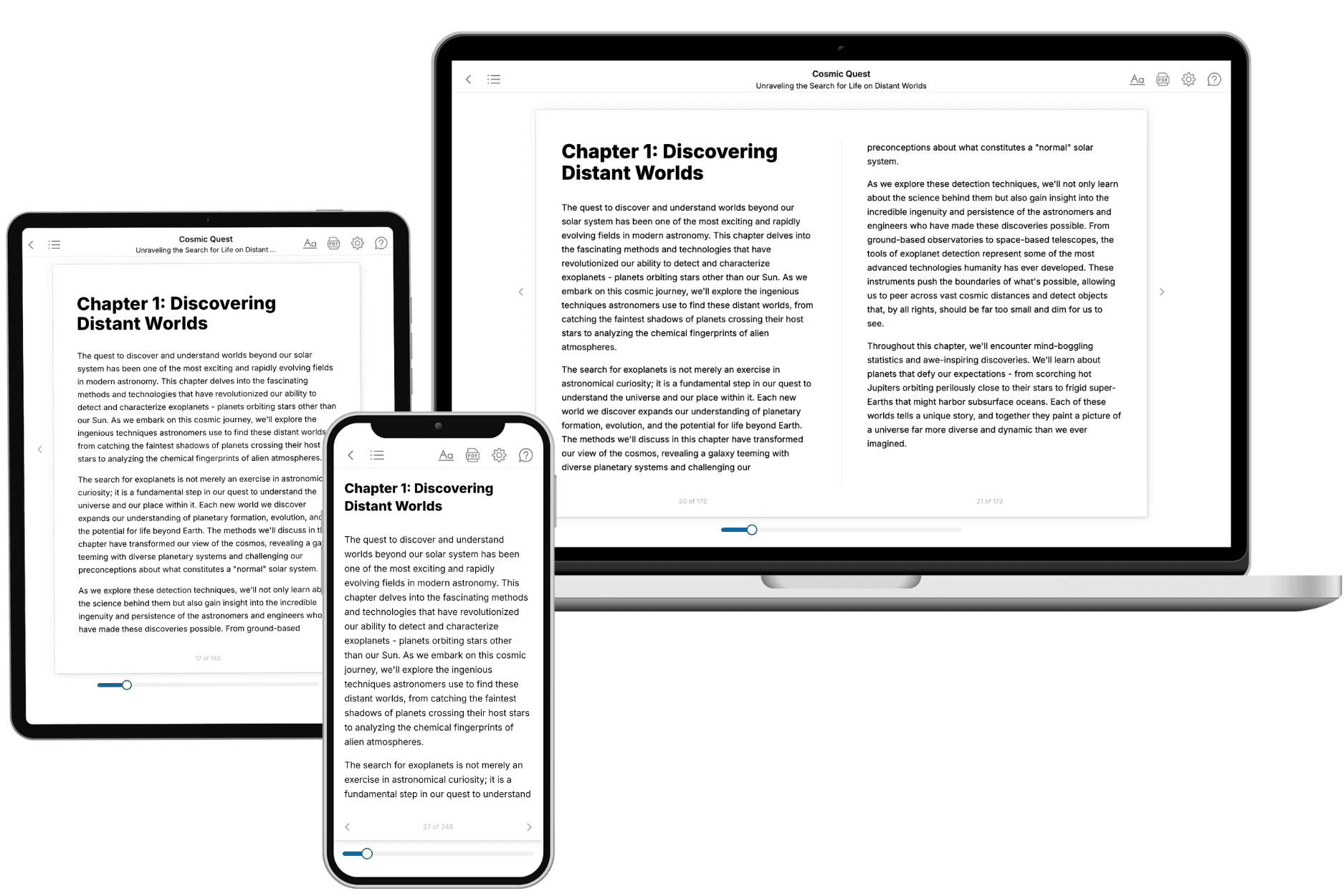
TailoredRead creates complete, full-length nonfiction ebooks, written specifically for you. Tell us what you want to learn and why, and TailoredRead writes you a complete ebook on it, with charts, tables, and diagrams throughout. Read it online, on Kindle, or on any e-reader, or download it as a PDF or EPUB. Every book is written fresh the day you order it.
- How is the book tailored to me?
Before anything is written, you answer a few short questions about your goals, your background, and the topics you care about. Your book is then planned around your answers: written at your level, focused on your goals, and covering the topics you chose, instead of the one-size-fits-all book a store sells everyone.
- Will it read like generic AI content?
No. Your book isn't a chat transcript: it's planned chapter by chapter before a single word is written, told in a clear book voice, and explains ideas visually with charts, tables, and diagrams. After writing, every book goes through an editorial pass that polishes chapters so the book reads consistent from start to finish. Judge for yourself: browse thousands of sample books on our Explore Books page.
- How accurate is the content?
Our AI first checks whether your subject needs live research. Niche and fast-moving subjects are researched before writing, and the book plan and chapters are grounded in what it finds. After writing, every book goes through a quality pass that checks its facts and consistency, and researched books list their sources in a Notes section at the back.
- How long is the book?
You choose the length: Comprehensive (250-300 pages), Detailed (150-200 pages), Essential (70-100 pages), or Short (30-50 pages).
- Does the book include visuals?
Yes. Every book includes charts, tables, and diagrams: timelines, checklists, step-by-step guides, decision trees, comparison tables, matrices, and bar charts. A typical book includes dozens of these visual elements.
- Can I read it on Kindle? What formats can I download?
Yes. Every book can be read in our online reader or downloaded as a PDF or EPUB. The EPUB can be opened with Kindle, Apple Books, Kobo, and any e-reader. The Commercial and Author licenses also include an editable Word (DOCX) and Markdown download.
- How much does it cost?
About the price of a regular ebook. The exact price depends on your book's length and complexity, from $2 for the shortest books to $35 for the most comprehensive, and it's shown when you review your book, before you commit to anything. Each book is a one-time purchase, yours to keep, no subscription. Licenses that let you share, teach, or publish your book range from $35.99 to $49.99.
- Can I preview the book before purchasing?
Before you pay, you'll see what your book will cover: the title, a detailed description, the estimated length, and the complete chapter-by-chapter table of contents, so you know what you're getting before you decide. The full text itself is written after you purchase.
- How long does it take to create a book?
About 10 minutes. You can start reading the opening chapters while the rest is still being written.