Quantum Lattices
Unraveling the Mysteries of Solid State Physics
Are you ready to dive deep into the fascinating world of solid state physics?
300 pages15 chaptersJan 17, 2025Physics
About this book
"Quantum Lattices: Unraveling the Mysteries of Solid State Physics" takes you on an exhilarating exploration of the fundamental principles that govern the behavior of solids. From crystal structures to electronic properties, this book demystifies complex concepts and presents them in a clear, engaging manner. You'll discover how quantum mechanics and statistical physics come together to explain the macroscopic properties of materials. Through carefully crafted explanations and real-world examples, you'll gain a profound understanding of topics such as band theory, superconductivity, and magnetism. Whether you're a graduate student looking to solidify your knowledge or a researcher seeking a comprehensive reference, this book will equip you with the tools to tackle advanced problems in solid state physics. By the time you finish, you'll have a robust framework for understanding the quantum world of solids and be prepared to contribute to cutting-edge research in this exciting field.
Table of contents
- IntroductionThe Importance of Solid State Physics, Historical Overview of Solid State Physics, Structure of the Book, Prerequisites and Mathematical FoundationsRead below
- Chapter 1: Crystal Structures and SymmetriesBravais Lattices and Crystal Systems, Miller Indices and Crystal Planes, The Reciprocal Lattice, Symmetry Operations and Point Groups
- Chapter 2: Quantum Mechanics in Periodic StructuresThe Schrödinger Equation in Solids, Bloch's Theorem and Wave Functions in Crystals, Brillouin Zones and k-space, Tight-Binding Approximation
- Chapter 3: Electronic Band StructureFundamentals of Band Theory, Nearly Free Electron Model, Origin of Band Gaps, Effective Mass and Hole Concept, Density of States
- Chapter 4: Semiconductors and DopingIntrinsic Semiconductors, n-type and p-type Doping, Carrier Statistics and the Fermi Level, p-n Junctions and Basic Devices
- Chapter 5: Lattice Vibrations and PhononsClassical Theory of Lattice Vibrations, Quantization of Lattice Vibrations: Phonons, Phonon Dispersion Relations, Thermal Properties of Solids
- Chapter 6: Electron-Phonon InteractionsElectron-Phonon Coupling Mechanisms, Polaron Formation, Optical Properties and Excitons, Transport Phenomena in Solids
- Chapter 7: Magnetism in SolidsOrigins of Atomic Magnetism, Exchange Interactions and Ordering, Types of Magnetic Structures, Band Magnetism and Itinerant Electrons, Magnetic Domains and Hysteresis
- Chapter 8: SuperconductivityBasic Properties of Superconductors, Cooper Pairs and BCS Theory, Type I and Type II Superconductors, High-Temperature Superconductivity
- Chapter 9: Dielectric and Optical PropertiesPolarization Mechanisms in Solids, The Dielectric Function, Optical Absorption and Emission, Nonlinear Optical Effects
- Chapter 10: Surface Physics and InterfacesSurface States and Reconstruction, Work Function and Electron Emission, Semiconductor Heterostructures, Two-Dimensional Materials
- Chapter 11: Defects and Impurities in SolidsPoint Defects and Their Effects, Dislocations and Plastic Deformation, Grain Boundaries and Interfaces, Defect Engineering in Materials
- Chapter 12: Many-Body Physics in SolidsSecond Quantization and Many-Body Hamiltonians, Green's Functions and Feynman Diagrams, Screening and Plasmons, Strongly Correlated Electron Systems
- Chapter 13: Topological MaterialsBerry Phase and Topological Invariants, Topological Insulators, Weyl and Dirac Semimetals, Quantum Hall Effect and Chern Insulators
- Chapter 14: Experimental Techniques in Solid State PhysicsX-ray Diffraction and Crystallography, Spectroscopy Techniques, Scanning Probe Microscopy, Neutron Scattering, Angle-Resolved Photoemission Spectroscopy (ARPES)
- Chapter 15: Computational Methods in Solid State PhysicsDensity Functional Theory, Monte Carlo Simulations, Molecular Dynamics, Machine Learning in Materials Science
- Conclusion
- Glossary
- Further Reading
Introduction
Welcome to the fascinating world of solid state physics, a field that lies at the heart of modern technology and scientific discovery. As you embark on this journey through "Quantum Lattices: Unraveling the Mysteries of Solid State Physics," you are about to delve into a realm where the principles of quantum mechanics and the orderly structure of crystalline materials converge to create a tapestry of remarkable phenomena. This introduction serves as your gateway to understanding the fundamental concepts, historical context, and mathematical foundations that will guide your exploration of solid state physics.
Solid state physics is a discipline that seeks to explain and predict the properties of solid materials, from the commonplace to the exotic. It is a field that has not only revolutionized our understanding of matter but has also paved the way for countless technological innovations that shape our daily lives. From the semiconductors that power your electronic devices to the superconductors that enable magnetic resonance imaging (MRI) machines, the principles of solid state physics are at work all around us.
As you progress through this book, you will uncover the intricate dance of electrons and atoms within crystals, explore the quantum mechanical principles that govern their behavior, and learn how these microscopic interactions give rise to the macroscopic properties of materials. Whether you're a graduate student looking to deepen your understanding or an early-career researcher seeking to broaden your knowledge, this book is designed to bridge the gap between your foundational physics education and the cutting-edge concepts at the forefront of solid state research.
The Importance of Solid State Physics
Solid state physics stands as a cornerstone of modern physics, with far-reaching implications that extend well beyond the confines of academic research. Its significance can be appreciated through multiple lenses: scientific, technological, and societal. At its core, solid state physics provides us with a fundamental understanding of how matter behaves in its solid form, which constitutes the majority of matter we encounter in our everyday lives. This understanding is crucial not only for advancing our knowledge of the physical world but also for developing new materials and technologies that can address some of the most pressing challenges facing humanity.
From a scientific perspective, solid state physics serves as a fertile ground for testing and refining quantum mechanical theories. The regular, periodic structure of crystalline solids provides an ideal laboratory for observing quantum phenomena on a macroscopic scale. For instance, the discovery of superconductivity—a phenomenon where certain materials conduct electricity with zero resistance—challenged our understanding of electron behavior and led to the development of new quantum theories. Similarly, the study of topological insulators, materials that are insulators in their interior but conduct electricity on their surface, has opened up new avenues for exploring fundamental physics and potential applications in quantum computing[1].
Technologically, the impact of solid state physics is ubiquitous and transformative. The field has been instrumental in the development of semiconductor technology, which forms the backbone of modern electronics. The transistor, arguably one of the most important inventions of the 20th century, was a direct result of solid state research. Today, integrated circuits containing billions of transistors power everything from smartphones to supercomputers. Beyond electronics, solid state physics principles underpin advancements in energy technologies, such as photovoltaic cells for solar energy conversion and materials for energy storage in batteries. The development of new magnetic materials has led to dramatic increases in data storage capacities, enabling the information age we now live in.
From a societal standpoint, the applications of solid state physics have revolutionized numerous aspects of our lives. Medical imaging techniques like MRI, which rely on the principles of nuclear magnetic resonance in solids, have dramatically improved diagnostic capabilities in healthcare. The development of light-emitting diodes (LEDs) has transformed lighting technology, offering energy-efficient alternatives that are crucial for reducing global energy consumption. Moreover, ongoing research in areas such as quantum computing and spintronics promises to usher in new paradigms of information processing that could solve complex problems beyond the reach of classical computers.
The economic impact of solid state physics cannot be overstated. The semiconductor industry alone, which is fundamentally based on solid state principles, was valued at over $500 billion globally in 2021 and is projected to grow significantly in the coming years[2]. This industry not only drives technological innovation but also creates millions of jobs worldwide and plays a crucial role in global economic development.
Furthermore, solid state physics is at the forefront of addressing global challenges. Research into novel materials is crucial for developing more efficient renewable energy technologies, which are essential for combating climate change. The search for room-temperature superconductors could revolutionize energy transmission, potentially solving issues of energy loss in power grids. Additionally, advances in materials science, rooted in solid state physics, are critical for developing sustainable alternatives to scarce or environmentally harmful materials used in current technologies.
As you delve deeper into the subject matter of this book, keep in mind that each concept you encounter, from crystal structures to band theory, from phonons to magnetism, contributes to this broader picture of solid state physics' importance. The principles you will learn are not just abstract theories but powerful tools that have the potential to shape the future of technology and scientific understanding. By mastering these concepts, you are equipping yourself with the knowledge to potentially contribute to groundbreaking discoveries and innovations that could have far-reaching impacts on science, technology, and society as a whole.
Historical Overview of Solid State Physics
The journey of solid state physics from its nascent stages to its current status as a cornerstone of modern physics is a testament to human curiosity and ingenuity. This historical overview will trace the key developments, pivotal discoveries, and paradigm shifts that have shaped the field, providing you with a contextual framework for the concepts you will encounter throughout this book.
The roots of solid state physics can be traced back to the late 19th and early 20th centuries, coinciding with the revolutionary developments in quantum mechanics and our understanding of atomic structure. However, the study of solids has a much longer history, dating back to ancient civilizations that worked with metals and crystals. The systematic study of crystals, which laid the groundwork for modern crystallography, began in the 17th century with the work of scientists like Robert Hooke and Nicolaus Steno, who observed the consistent angles between faces of quartz crystals[3].
A significant milestone in the prehistory of solid state physics was the discovery of X-rays by Wilhelm Röntgen in 1895. This discovery paved the way for X-ray diffraction experiments, which would become a crucial tool in studying crystal structures. In 1912, Max von Laue demonstrated that X-rays could be diffracted by crystals, providing direct evidence for the periodic arrangement of atoms in solids. Shortly after, in 1913, William Henry Bragg and his son William Lawrence Bragg developed Bragg's law, which relates the wavelength of incident X-rays to the spacing between crystal planes. This work not only earned them the Nobel Prize in Physics in 1915 but also established X-ray crystallography as a powerful method for determining crystal structures, a technique that remains fundamental to solid state physics and materials science to this day.
The early 20th century saw rapid advancements in quantum mechanics, which would prove instrumental in understanding the behavior of electrons in solids. In 1900, Paul Drude proposed the first model of electrical conduction in metals, treating electrons as a gas of free particles. While this classical model had limitations, it laid the groundwork for future theories. In 1928, Arnold Sommerfeld refined Drude's model by incorporating quantum mechanical principles, leading to the Drude-Sommerfeld model, which could explain many properties of metals more accurately.
A major breakthrough came in 1926 when Erwin Schrödinger formulated his famous wave equation, providing a mathematical framework for describing quantum mechanical systems. This equation would prove crucial for understanding electron behavior in periodic potentials, such as those found in crystalline solids. In the same year, Enrico Fermi and Paul Dirac independently developed the Fermi-Dirac statistics, which describe the distribution of fermions (including electrons) in systems at thermal equilibrium. These developments set the stage for a more comprehensive understanding of electronic properties in solids.
The concept of energy bands in solids, a cornerstone of modern solid state physics, began to take shape in the late 1920s and early 1930s. In 1928, Felix Bloch developed the theory of electrons in periodic potentials, introducing what are now known as Bloch waves. This work was fundamental in explaining the behavior of electrons in crystalline solids. Building on this, Alan Herries Wilson in 1931 and Nevill Mott and Harry Jones in 1936 developed the band theory of solids, which could explain the difference between metals, semiconductors, and insulators based on their electronic structure.
The 1930s also saw significant developments in the understanding of collective excitations in solids. In 1932, Leon Brillouin introduced the concept of the Brillouin zone, a fundamental construct in the theory of solids. Igor Tamm in 1932 and Ralph Kronig and William Penney in 1931 developed models for electron behavior in one-dimensional periodic potentials, providing insights into band structure formation. In 1935, Hans Bethe introduced the concept of crystal field theory, important for understanding the electronic structure of transition metal complexes.
The discovery of superconductivity by Heike Kamerlingh Onnes in 1911 opened up an entirely new area of research in solid state physics. However, it wasn't until 1957 that John Bardeen, Leon Cooper, and Robert Schrieffer proposed their BCS theory, providing a microscopic explanation for superconductivity. This theory, which earned them the Nobel Prize in Physics in 1972, remains one of the crowning achievements of solid state physics.
The field of semiconductor physics, which would revolutionize technology in the latter half of the 20th century, began to take shape in the 1940s and 1950s. The invention of the transistor by John Bardeen, Walter Brattain, and William Shockley at Bell Labs in 1947 marked a turning point, earning them the Nobel Prize in Physics in 1956 and ushering in the age of modern electronics. This was followed by the development of the p-n junction theory by William Shockley in 1949, providing a theoretical foundation for semiconductor devices.
The latter half of the 20th century saw an explosion of discoveries and applications in solid state physics. The development of advanced experimental techniques, such as neutron scattering, electron microscopy, and various spectroscopic methods, allowed for more detailed investigations of solid state phenomena. Theoretical advancements, including the development of density functional theory by Walter Kohn and Lu Jeu Sham in the 1960s, provided powerful tools for calculating electronic structures of materials.
The discovery of new materials and phenomena continued to drive the field forward. High-temperature superconductivity, discovered by Georg Bednorz and Alex Müller in 1986, challenged existing theories and sparked intense research efforts. The isolation of graphene by Andre Geim and Konstantin Novoselov in 2004 opened up the field of two-dimensional materials, leading to their Nobel Prize in Physics in 2010. More recently, the discovery of topological insulators in the mid-2000s has led to new understanding of electronic states in solids and potential applications in quantum computing.
As you embark on your journey through this book, remember that you are following in the footsteps of these pioneers. The concepts you will learn have been developed and refined over more than a century of scientific inquiry. Each chapter builds upon this rich history, connecting the fundamental principles discovered by early researchers to the cutting-edge developments shaping the future of solid state physics. By understanding this historical context, you will gain a deeper appreciation for the interconnectedness of ideas in solid state physics and be better equipped to contribute to its ongoing evolution.
Structure of the Book
"Quantum Lattices: Unraveling the Mysteries of Solid State Physics" is designed to provide you with a comprehensive and logical progression through the fundamental concepts and advanced topics in solid state physics. The book is structured to build your understanding systematically, starting from the basic principles and gradually advancing to more complex phenomena. This section will give you an overview of the book's organization, helping you navigate the material effectively and understand how different topics interconnect.
The book begins with this introduction, which you are currently reading. It sets the stage by emphasizing the importance of solid state physics, providing a historical context, and outlining the prerequisites and mathematical foundations necessary for a deep understanding of the subject. This introduction serves as a roadmap for your journey through the world of solid state physics, highlighting the key concepts you will encounter and their significance in both theoretical understanding and practical applications.
Following the introduction, the book is divided into 15 chapters, each focusing on a specific aspect of solid state physics. The chapters are arranged in a logical sequence, with each building upon the knowledge gained in previous chapters. Here's an overview of the main sections and their contents:
1. Crystal Structures and Symmetries: This chapter lays the foundation for understanding the ordered arrangement of atoms in solids. You'll learn about Bravais lattices, crystal systems, Miller indices, and the concept of the reciprocal lattice. The chapter also covers symmetry operations and point groups, which are crucial for understanding the properties of crystals.
2. Quantum Mechanics in Periodic Structures: Here, you'll explore how quantum mechanics applies to electrons in the periodic potential of a crystal. The chapter introduces the Schrödinger equation in solids, Bloch's theorem, and the concept of Brillouin zones. You'll also learn about the tight-binding approximation, a powerful method for calculating electronic band structures.
3. Electronic Band Structure: Building on the previous chapter, this section delves into the formation of energy bands in solids. You'll study the fundamentals of band theory, the nearly free electron model, and the origin of band gaps. The concepts of effective mass and density of states are also introduced, which are crucial for understanding electronic properties of materials.
4. Semiconductors and Doping: This chapter focuses on the physics of semiconductors, including intrinsic and extrinsic semiconductors, doping effects, and carrier statistics. You'll learn about p-n junctions and basic semiconductor devices, providing a link between fundamental physics and technological applications.
5. Lattice Vibrations and Phonons: Here, you'll transition from electronic properties to vibrational properties of solids. The chapter covers the classical theory of lattice vibrations, the concept of phonons as quantized lattice vibrations, phonon dispersion relations, and how these concepts relate to the thermal properties of solids.
6. Electron-Phonon Interactions: This chapter explores the crucial interplay between electrons and lattice vibrations. You'll learn about electron-phonon coupling mechanisms, polaron formation, and how these interactions affect optical properties and transport phenomena in solids.
7. Magnetism in Solids: Here, you'll delve into the origins of magnetism at the atomic level and how it manifests in solid materials. The chapter covers exchange interactions, different types of magnetic ordering, band magnetism, and the concept of magnetic domains.
8. Superconductivity: This chapter introduces you to the fascinating world of superconductors. You'll learn about the basic properties of superconductors, the BCS theory of superconductivity, and the distinctions between Type I and Type II superconductors. The chapter also touches on high-temperature superconductivity, an area of ongoing research and potential technological breakthroughs.
9. Dielectric and Optical Properties: Here, you'll explore how solids interact with electromagnetic fields. The chapter covers polarization mechanisms, the dielectric function, optical absorption and emission processes, and nonlinear optical effects in solids.
10. Surface Physics and Interfaces: This chapter shifts focus to the physics of surfaces and interfaces between different materials. You'll learn about surface states, work functions, semiconductor heterostructures, and the unique properties of two-dimensional materials.
11. Defects and Impurities in Solids: Here, you'll study how imperfections in the crystal structure can dramatically affect material properties. The chapter covers point defects, dislocations, grain boundaries, and how these defects can be engineered to create materials with desired properties.
12. Many-Body Physics in Solids: This chapter introduces more advanced concepts in solid state physics, including second quantization, Green's functions, and the treatment of strongly correlated electron systems. These tools are essential for understanding complex phenomena in solids that can't be explained by single-particle theories.
13. Topological Materials: Here, you'll explore one of the most exciting recent developments in solid state physics. The chapter covers the concept of topological invariants, topological insulators, Weyl and Dirac semimetals, and the quantum Hall effect.
14. Experimental Techniques in Solid State Physics: This chapter provides an overview of the key experimental methods used to study solids, including X-ray diffraction, various spectroscopy techniques, scanning probe microscopy, neutron scattering, and angle-resolved photoemission spectroscopy (ARPES).
15. Computational Methods in Solid State Physics: The final chapter introduces you to the computational tools used in modern solid state research, including density functional theory, Monte Carlo simulations, molecular dynamics, and the emerging role of machine learning in materials science.
Each chapter is designed to be self-contained to a large extent, but they also build upon each other, reinforcing key concepts and demonstrating how different aspects of solid state physics are interconnected. Throughout the book, you'll find examples, case studies, and references to current research that illustrate how the fundamental principles you're learning apply to real-world scenarios and cutting-edge discoveries.
The book concludes with a glossary of key terms, providing quick reference definitions for important concepts, and a section on further reading, which will guide you to additional resources for deepening your understanding of specific topics.
As you progress through the book, you'll notice that certain themes recur and interconnect across different chapters. For example, the concept of periodicity, introduced in the context of crystal structures, reappears in discussions of electronic band structure, phonons, and many other topics. Similarly, the interplay between quantum mechanics and the macroscopic properties of materials is a recurring theme throughout the book.
By the time you reach the end of this book, you will have gained a comprehensive understanding of solid state physics, from its fundamental principles to its most recent developments. You'll be equipped with the knowledge and tools to understand current research in the field and potentially contribute to future discoveries. Remember, solid state physics is a vast and ever-evolving field, and this book serves as your foundation for further exploration and specialization.
Prerequisites and Mathematical Foundations
Before delving into the intricacies of solid state physics, it's important to ensure that you have a solid foundation in certain prerequisite areas of physics and mathematics. This section will outline the key concepts and skills you should be familiar with to fully appreciate and understand the material presented in this book. While "Quantum Lattices" is designed to be as self-contained as possible, having a strong background in these areas will significantly enhance your learning experience and enable you to grasp the more advanced concepts more readily.
First and foremost, a firm grounding in classical mechanics is essential. You should be comfortable with concepts such as Newton's laws of motion, conservation laws (energy, momentum, angular momentum), and Hamiltonian and Lagrangian formulations. These principles form the basis for understanding the behavior of particles in potential wells and the classical treatment of lattice vibrations, which are crucial in solid state physics.
Electromagnetism is another cornerstone of solid state physics. You should have a good understanding of Maxwell's equations, electrostatics and magnetostatics, electromagnetic waves, and the behavior of charged particles in electromagnetic fields. These concepts are fundamental to understanding the electronic and magnetic properties of solids, as well as their interaction with light and other electromagnetic radiation.
Quantum mechanics is perhaps the most critical prerequisite for solid state physics. You should be familiar with the basic postulates of quantum mechanics, the Schrödinger equation (both time-dependent and time-independent forms), operators and observables, wave functions and probability densities, and the concepts of quantization and uncertainty. A solid understanding of quantum mechanical systems such as the particle in a box, the harmonic oscillator, and the hydrogen atom will be particularly useful. Familiarity with perturbation theory and the variational method is also beneficial, as these techniques are often applied in solid state problems.
Statistical mechanics provides the bridge between microscopic quantum mechanical descriptions and macroscopic thermodynamic properties. You should be comfortable with concepts such as microstates and macrostates, statistical ensembles (particularly the canonical and grand canonical ensembles), partition functions, and the statistical treatment of ideal gases. An understanding of Fermi-Dirac and Bose-Einstein statistics is crucial for dealing with electrons and phonons in solids.
In terms of mathematics, a strong foundation in linear algebra is essential. You should be comfortable with matrix operations, eigenvalue problems, and vector spaces. These concepts are fundamental to many aspects of solid state physics, from crystal symmetries to quantum mechanical calculations.
Differential equations, both ordinary and partial, are ubiquitous in solid state physics. You should be familiar with techniques for solving common types of differential equations, including separation of variables and series solutions. The ability to recognize and solve the Schrödinger equation in various contexts is particularly important.
Complex analysis is another valuable tool in solid state physics. While not all topics require an in-depth knowledge of complex variables, being comfortable with complex numbers, Euler's formula, and basic complex functions will be beneficial, particularly when dealing with wave functions and Fourier analysis.
Fourier analysis is a crucial mathematical technique in solid state physics. You should understand the concepts of Fourier series and Fourier transforms, and be able to apply them to periodic functions. The ability to move between real space and reciprocal space representations is fundamental to many solid state concepts, including crystal structure analysis and band theory.
Group theory, while not always explicitly used, underlies many concepts in solid state physics, particularly in the study of crystal symmetries. While this book will introduce relevant group theoretical concepts as needed, prior exposure to basic group theory can be helpful.
Finally, some familiarity with computational methods can be beneficial. While not strictly necessary for understanding the theoretical concepts, many modern solid state physics problems involve numerical calculations or simulations. Basic programming skills and familiarity with scientific computing tools can enhance your ability to apply the concepts you learn to practical problems.
If you find that your knowledge in any of these areas needs refreshing, don't be discouraged. The book will provide brief reviews of key concepts as they become relevant, and you're encouraged to consult additional resources as needed. Remember, learning is an ongoing process, and solid state physics offers an excellent opportunity to deepen your understanding of these fundamental areas of physics and mathematics.
As you progress through the book, you'll find that these prerequisite topics are not isolated but are intricately connected within the framework of solid state physics. For example, the quantum mechanical treatment of electrons in a periodic potential (drawing on quantum mechanics and differential equations) leads to the concept of energy bands (utilizing Fourier analysis and complex variables), which in turn explains the electronic properties of materials (connecting to statistical mechanics and electromagnetism).
By building on this foundation, "Quantum Lattices" will take you on a journey from the fundamental principles to the frontiers of solid state physics research. The goal is not just to impart knowledge but to develop your intuition and problem-solving skills in this rich and diverse field. As you encounter new concepts and techniques throughout the book, don't hesitate to revisit this section and review the relevant prerequisites. With dedication and perseverance, you'll find that solid state physics offers a deeply rewarding synthesis of fundamental physics principles and practical applications, opening doors to understanding the quantum world of solids and its profound implications for technology and our understanding of nature.
This is the end of the free sample. The full book has 15 chapters.
Want this book written for you?
Tell us your goals and background, and get your own version of this book, tailored by AI to you.


Benefits of AI-tailored books
- Read one book, not ten:
- all the Physics knowledge you need, gathered into a single book.
- Save days of learning:
- tell us your goals, choose your topics, and the whole book is built around them.
- Learn effortlessly:
- Physics book written for your specific background and expertise.
- Understand at a glance:
- includes charts, tables, timelines, checklists, decision trees, and more.
- Stay current:
- written the day you order it, not years ago.
- Trust what you read:
- every book is checked for accuracy, with real research when your subject needs it.
Create your unique book in 3 steps
- 1. Select your focus
Select the focus of your Physics book and share your background
- 2. Personalize your book
Specify your goals and choose sub-topics to include
- 3. Get your tailored book
Your book is ready in 10 minutes. Read it online, download as EPUB or PDF, or send to Kindle.


Frequently asked questions
- What is TailoredRead?
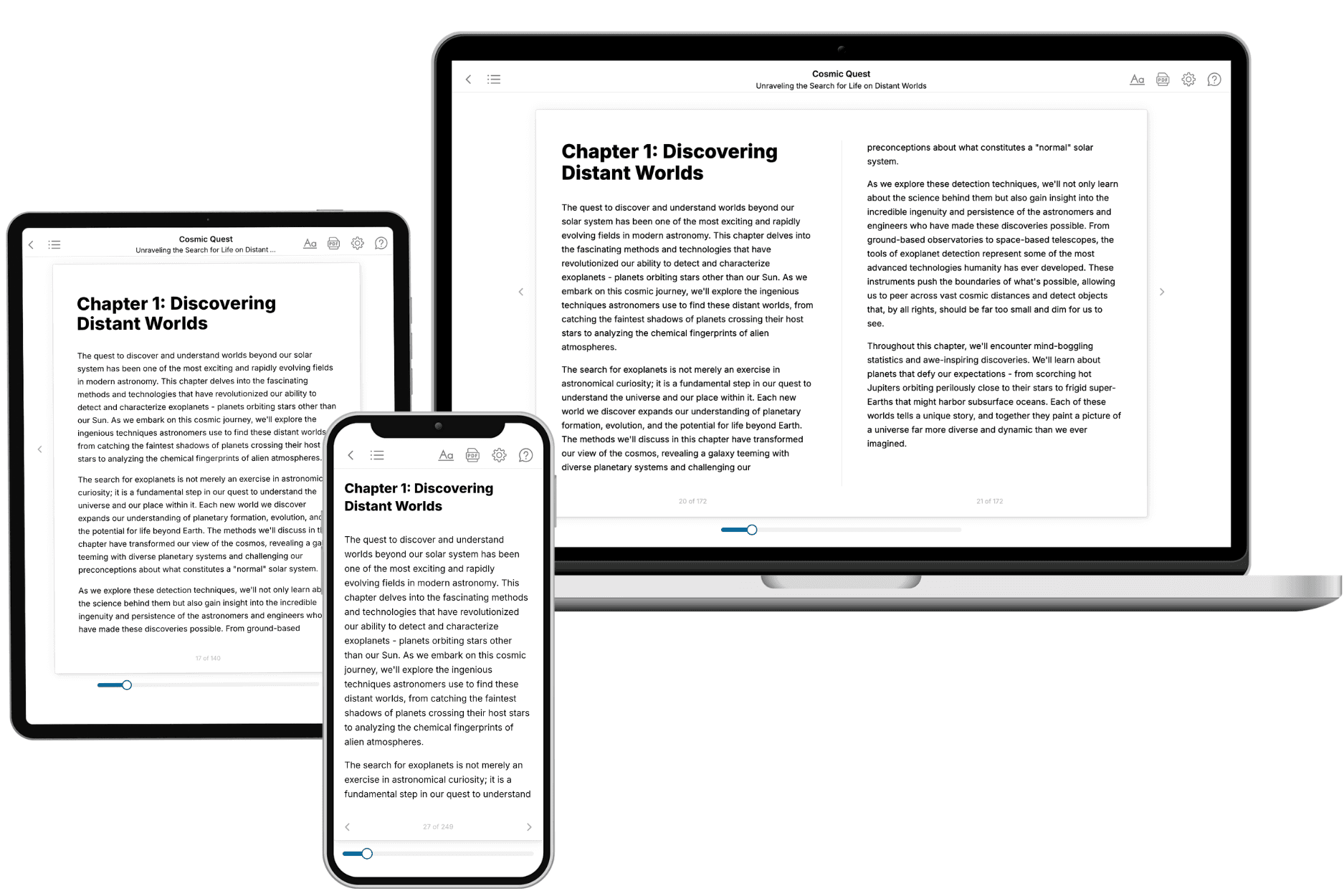
TailoredRead creates complete, full-length nonfiction ebooks, written specifically for you. Tell us what you want to learn and why, and TailoredRead writes you a complete ebook on it, with charts, tables, and diagrams throughout. Read it online, on Kindle, or on any e-reader, or download it as a PDF or EPUB. Every book is written fresh the day you order it.
- How is the book tailored to me?
Before anything is written, you answer a few short questions about your goals, your background, and the topics you care about. Your book is then planned around your answers: written at your level, focused on your goals, and covering the topics you chose, instead of the one-size-fits-all book a store sells everyone.
- Will it read like generic AI content?
No. Your book isn't a chat transcript: it's planned chapter by chapter before a single word is written, told in a clear book voice, and explains ideas visually with charts, tables, and diagrams. After writing, every book goes through an editorial pass that polishes chapters so the book reads consistent from start to finish. Judge for yourself: browse thousands of sample books on our Explore Books page.
- How accurate is the content?
Our AI first checks whether your subject needs live research. Niche and fast-moving subjects are researched before writing, and the book plan and chapters are grounded in what it finds. After writing, every book goes through a quality pass that checks its facts and consistency, and researched books list their sources in a Notes section at the back.
- How long is the book?
You choose the length: Comprehensive (250-300 pages), Detailed (150-200 pages), Essential (70-100 pages), or Short (30-50 pages).
- Does the book include visuals?
Yes. Every book includes charts, tables, and diagrams: timelines, checklists, step-by-step guides, decision trees, comparison tables, matrices, and bar charts. A typical book includes dozens of these visual elements.
- Can I read it on Kindle? What formats can I download?
Yes. Every book can be read in our online reader or downloaded as a PDF or EPUB. The EPUB can be opened with Kindle, Apple Books, Kobo, and any e-reader. The Commercial and Author licenses also include an editable Word (DOCX) and Markdown download.
- How much does it cost?
About the price of a regular ebook. The exact price depends on your book's length and complexity, from $2 for the shortest books to $35 for the most comprehensive, and it's shown when you review your book, before you commit to anything. Each book is a one-time purchase, yours to keep, no subscription. Licenses that let you share, teach, or publish your book range from $35.99 to $49.99.
- Can I preview the book before purchasing?
Before you pay, you'll see what your book will cover: the title, a detailed description, the estimated length, and the complete chapter-by-chapter table of contents, so you know what you're getting before you decide. The full text itself is written after you purchase.
- How long does it take to create a book?
About 10 minutes. You can start reading the opening chapters while the rest is still being written.