How Planets Form
From Cosmic Dust to Worlds—Understanding the Science Behind Planetary Systems
Most people assume planets simply condense from clouds of gas and dust, but the actual process is far more dynamic and fascinating.
222 pages10 chaptersMar 15, 2026Astronomy
About this book
Planetary formation involves a complex interplay of gravity, chemistry, and physics that unfolds over millions of years. This book demystifies how planets are born, from the initial collapse of molecular clouds to the emergence of fully formed worlds orbiting distant stars. You'll discover why planets in different locations have different compositions, how collisions shape planetary systems, and why our solar system looks the way it does. By exploring both theoretical models and cutting-edge observations of young planetary systems, you'll gain a deeper appreciation for the cosmic processes that created the worlds we study today. Whether you're an astronomy enthusiast or simply curious about our place in the universe, this guide makes the science of planetary formation clear, engaging, and accessible.
Table of contents
- IntroductionWhy Understanding Planetary Formation Matters, What You'll Learn in This Book, How Modern Science Reveals Planetary SecretsRead below
- Chapter 1: The Cosmic Beginning: From Molecular Clouds to Protoplanetary DisksWhat Are Molecular Clouds?, The Collapse That Starts It All, How Rotating Disks Form Around Young Stars, Understanding Protoplanetary Disk Structure
- Chapter 2: The Building Blocks: Dust, Gas, and the First SolidsWhat Is Cosmic Dust Made Of?, How Dust Grains Stick Together, The Birth of Planetesimals, Overcoming Growth Barriers
- Chapter 3: Planetary Embryos: From Planetesimals to Planetary CoresRunaway Growth and Planetary Embryos, Building Planetary Cores, Collisions and Mergers in the Disk, How Long Does This Take?
- Chapter 4: Location Determines Destiny: The Frost Line and Planetary CompositionWhat Is the Frost Line?, Why Rocky Planets Form Close to Stars, How Gas Giants Form Beyond the Frost Line, Why Planetary Composition Varies
- Chapter 5: Gas Accretion: How Planets Capture AtmospheresThe Race to Capture Hydrogen and Helium, The Critical Core Mass, Runaway Gas Accretion and Giant Formation, Why Some Planets Lose Their Atmospheres
- Chapter 6: Planetary Migration: Planets on the MoveThe Discovery That Changed Everything, Type I Migration: Small Planets Moving, Type II Migration: Giant Planets Reshaping Systems, How Migration Reshapes Planetary Systems
- Chapter 7: Chaos and Order: Gravitational Interactions and System ArchitectureWhen Multiple Planets Interact, Orbital Resonances and Their Effects, Dynamical Instability and System Rearrangement, How Systems Reach Their Final Configuration
- Chapter 8: Our Solar System: A Case Study in Planetary FormationHow Our Solar System Formed, The Grand Tack Hypothesis, The Late Heavy Bombardment and System Evolution, What Makes Our System Unique?
- Chapter 9: Observing Planetary Birth: Evidence from Protoplanetary DisksHow We Observe Protoplanetary Disks, Gaps and Rings: Signs of Forming Planets, Revolutionary Discoveries from Modern Telescopes, Directly Imaging Young Planets
- Chapter 10: Exoplanetary Systems: Diversity Beyond Our Solar SystemThe Surprising Variety of Exoplanetary Systems, Hot Jupiters and Other Surprises, Compact Multi-Planet Systems, What Exoplanets Tell Us About Formation
- ConclusionBringing It All Together, Open Questions and Future Discoveries, Your New Understanding of Planetary Systems
- Glossary
- Further Reading and Resources
Introduction
Look up at the night sky on a clear evening, and you'll see points of light scattered across the darkness. Some of those lights are stars much like our own Sun, and many of them are orbited by planets. In fact, astronomers now estimate that virtually every star in the Milky Way hosts at least one planet, meaning there are hundreds of billions of worlds in our galaxy alone.[1] That number is staggering, and it raises a question that scientists have wrestled with for centuries: where do all these planets come from?
The short answer is that planets are born from the same raw material as the stars they orbit. A swirling cloud of gas and dust collapses under its own gravity, a star ignites at the center, and the leftover material flattens into a spinning disk. Over millions of years, tiny dust grains collide and stick together, growing from microscopic particles into pebbles, then boulders, then objects the size of mountains, and eventually into full-sized worlds. It sounds almost simple when described that way, but the actual process is anything but. It involves a remarkable interplay of physics, chemistry, and chance that scientists are still working to fully understand.
This book is your guide to that process. Whether you've spent years reading about astronomy or you're just beginning to explore the science of the cosmos, the story of planetary formation is one of the most compelling in all of science. It connects the smallest scales of chemistry to the grandest scales of cosmic structure. It explains why Earth is rocky while Jupiter is a gas giant, why some planets orbit their stars in a matter of days while others take centuries, and why our solar system looks the way it does. By the time you finish this book, you'll have a clear, grounded understanding of how planets come to exist, backed by the latest science and observations from telescopes that are watching new planets form right now.
The science of planetary formation has advanced dramatically in recent decades. The discovery of thousands of planets orbiting other stars, combined with powerful new telescopes capable of imaging the disks where planets are born, has transformed this field from a largely theoretical exercise into an observationally rich science. Researchers can now compare their models against real data from dozens of young planetary systems, testing ideas and refining theories in ways that were impossible just a generation ago. This book draws on that modern understanding, presenting the current scientific consensus while also highlighting the open questions that researchers are still actively investigating.
Why Understanding Planetary Formation Matters
Planetary formation might seem like a purely academic subject, something interesting to think about but disconnected from everyday life. In reality, understanding how planets form is deeply connected to some of the most profound questions humans have ever asked. Chief among them is whether life exists elsewhere in the universe. To answer that question, scientists first need to understand what kinds of planets exist, how they form, and whether the conditions that allowed life to emerge on Earth are common or rare across the cosmos.
The connection between planetary formation and habitability is direct and concrete. A planet's ability to support life depends heavily on where it formed in its planetary system, what it's made of, whether it retained an atmosphere, and whether liquid water can exist on its surface. All of these factors trace back to the formation process. Rocky planets that form close to their stars can hold onto liquid water if they're in the right temperature zone. Gas giants that form far out and then migrate inward can disrupt the orbits of smaller planets, potentially making systems less hospitable. Understanding formation is the foundation for understanding habitability.
There's also a deeper philosophical dimension to this subject. Every atom in your body was forged in a star and later incorporated into the disk of gas and dust that became our solar system. The carbon in your cells, the iron in your blood, the calcium in your bones: all of it passed through the same formation process described in this book. Understanding how planets form is, in a very real sense, understanding part of your own origin story. That's not a metaphor. It's astrophysics.
From a scientific standpoint, planetary formation also serves as a testing ground for fundamental physics. The processes involved, including gravitational collapse, fluid dynamics, particle collisions, and orbital mechanics, are governed by the same laws that operate everywhere in the universe. When scientists build models of planet formation and test them against observations, they're not just learning about planets. They're stress-testing their understanding of physics itself. Discrepancies between models and observations have historically led to important new discoveries, including the realization that planets migrate, which was one of the most surprising findings in modern planetary science.
Practically speaking, understanding planetary formation also informs how we search for planets that might harbor life. Space missions like NASA's Kepler and TESS telescopes have catalogued thousands of exoplanets, and future missions will characterize their atmospheres in search of biosignatures. Knowing which types of planetary systems are most likely to produce Earth-like worlds helps scientists prioritize targets and design better instruments. Formation science isn't just theoretical background. It actively shapes the strategy of the search for life beyond Earth.
Finally, there's the simple matter of intellectual curiosity. Humans have always looked at the sky and wondered. The question of how worlds come to exist is one of the oldest in human thought, appearing in creation myths from cultures around the world long before the tools of modern science existed. Today, for the first time in history, we have the instruments, the data, and the theoretical frameworks to answer that question with real precision. That's an extraordinary moment to be alive, and this book is an invitation to be part of it.
What You'll Learn in This Book
This book follows the story of planetary formation from beginning to end, tracing the journey from a cold, dark cloud of interstellar gas to a fully formed planetary system. Each chapter builds on the previous one, so by the time you reach the later chapters, you'll have the context needed to appreciate the more complex dynamics at play. Here's a brief map of the journey ahead.
The first part of the book focuses on the earliest stages of formation. You'll learn what molecular clouds are and why they collapse, how a spinning disk of gas and dust forms around a young star, and what that disk looks like in terms of temperature, density, and composition. This sets the stage for everything that follows, because the structure of the disk determines what kinds of planets can form and where.
From there, the book moves into the mechanics of how solid material grows within the disk. This is one of the most fascinating and technically challenging parts of planetary science, because growing from a microscopic dust grain to a planet-sized object requires overcoming several serious physical barriers. You'll learn about the processes that allow dust grains to stick together, how the first kilometer-sized bodies called planetesimals form, and how those planetesimals eventually grow into planetary embryos through a process called runaway accretion.
The middle chapters address one of the most important concepts in planetary science: the idea that a planet's location in the disk determines its composition and character. You'll explore the concept of the frost line, the boundary beyond which water and other volatile compounds freeze into solid ice, and understand why this boundary separates rocky planets from gas and ice giants. You'll also learn how gas giants capture their massive atmospheres and why some planets lose their atmospheres entirely.
One of the most surprising discoveries in modern planetary science is that planets don't necessarily stay where they form. The book dedicates a full chapter to planetary migration, explaining how gravitational interactions between a forming planet and the surrounding disk can cause the planet to spiral inward or outward over time. This process has profound consequences for the architecture of planetary systems and helps explain some of the most puzzling observations astronomers have made about exoplanetary systems.
The later chapters zoom out to look at the big picture. You'll examine how gravitational interactions between multiple planets can lead to dramatic instabilities that reshape entire systems. You'll take a detailed look at our own solar system as a case study, exploring specific hypotheses like the Grand Tack model that attempt to explain why our solar system looks the way it does. And you'll survey the remarkable diversity of exoplanetary systems discovered in recent decades, from hot Jupiters orbiting impossibly close to their stars to tightly packed systems of super-Earths with no analog in our own solar system.
Throughout the book, the emphasis is on connecting theory to observation. Planetary formation is not just a set of abstract models. It's a science grounded in real data from real telescopes. The final observational chapters show you how astronomers actually study protoplanetary disks, what the stunning images from the ALMA telescope have revealed about planet formation in action, and how direct imaging of young planets is beginning to provide snapshots of the formation process itself. By the end, you'll have both the conceptual framework and the observational context to understand planetary formation as a living, active field of scientific inquiry.
How Modern Science Reveals Planetary Secrets
One of the most remarkable things about planetary science today is the sheer variety of tools scientists use to study how planets form. No single telescope or technique tells the whole story. Instead, researchers piece together a picture from multiple lines of evidence, each one illuminating a different aspect of the formation process. Understanding how this science works will help you appreciate why scientists are confident in some conclusions and still uncertain about others.
The most direct evidence comes from observations of protoplanetary disks around young stars. These are the actual birthplaces of planets, and modern telescopes can image them in remarkable detail. The Atacama Large Millimeter/submillimeter Array, known as ALMA, has been particularly transformative. Located in the high-altitude Atacama Desert in Chile, ALMA can detect the faint radio emissions from dust grains in disks around stars hundreds of light-years away. In 2014, ALMA produced its first high-resolution image of the disk around a young star called HL Tauri, revealing a stunning pattern of concentric rings and gaps that many scientists interpreted as evidence of planets already forming within the disk.[2] That image changed how scientists think about the timescale of planet formation.
Complementing direct disk observations is the study of meteorites here on Earth. Meteorites are fragments of the early solar system that have survived largely unchanged for 4.5 billion years. By analyzing their chemical and isotopic composition, scientists can reconstruct the conditions that existed in the solar nebula when our own planets were forming. Certain types of meteorites, called chondrites, contain tiny spherical structures called chondrules that formed when molten droplets of rock rapidly cooled in the early disk. These ancient objects are essentially fossils of the planet-formation process, and they provide invaluable constraints on theoretical models.
Computer simulations play an equally central role in modern planetary science. Because planet formation unfolds over millions of years and involves processes spanning enormous ranges of scale, from microscopic dust grains to planet-sized bodies, no single observation can capture the full picture. Simulations allow scientists to model the entire process from start to finish, testing how changes in initial conditions affect the final outcome. Modern simulations can track the gravitational interactions of thousands of planetesimals simultaneously, model the flow of gas through a protoplanetary disk, and simulate the chaotic late stages of planetary assembly when giant impacts were common.
A useful way to think about how planetary science works is to imagine a detective piecing together a crime scene. The meteorites are physical evidence left at the scene. The disk observations are photographs taken while the event was still unfolding. The simulations are reconstructions of what must have happened to produce the evidence found. No single piece of evidence is sufficient on its own, but together they build a compelling and increasingly detailed picture.
The discovery of exoplanets has added an entirely new dimension to planetary science. Before the 1990s, scientists had only one planetary system to study: our own. The first confirmed detection of a planet orbiting a Sun-like star came in 1995, when Michel Mayor and Didier Queloz discovered 51 Pegasi b, a gas giant orbiting its star in just four days.[3] That discovery, which earned Mayor and Queloz the Nobel Prize in Physics in 2019, was deeply puzzling because no existing theory predicted that a gas giant could exist so close to its star. It forced scientists to fundamentally revise their models of planetary formation and migration. Since then, the catalog of known exoplanets has grown to more than five thousand confirmed worlds, each one a data point that constrains and challenges formation theories.
It's worth being honest about the limits of current knowledge. Planetary formation science has made enormous strides, but significant uncertainties remain. The exact mechanism by which planetesimals first form is still debated. The conditions that determine whether a planetary system ends up looking like ours or something completely different are not fully understood. And the role of chance versus determinism in shaping planetary systems is an open question with profound implications for the prevalence of Earth-like planets in the universe. This book presents the current scientific consensus where it exists, clearly flags areas of active debate, and distinguishes between well-established findings and more speculative hypotheses. Science is a process, not a finished product, and the story of planetary formation is still being written.
Throughout this book, the goal is to give you not just the conclusions of planetary science but also a sense of how those conclusions were reached. Understanding the methods and evidence behind scientific claims is what separates genuine knowledge from mere belief. When you finish this book, you won't just know that planets form from protoplanetary disks. You'll understand why scientists believe that, what evidence supports it, and what questions remain open. That kind of deep, evidence-based understanding is the most valuable thing any science book can offer, and it's exactly what the chapters ahead are designed to provide.
One practical note before you dive in: this book assumes you have a basic familiarity with astronomy concepts like stars, galaxies, and the general structure of the solar system. You don't need a physics degree or advanced mathematics to follow along. Where technical concepts are introduced, they're explained clearly with concrete examples and analogies. A glossary at the back of the book provides quick definitions for key terms, and suggestions for further reading point you toward more advanced resources if you want to go deeper on any topic. The science of planetary formation is genuinely fascinating, and the goal here is to make that fascination accessible to anyone willing to look up at the sky and ask how it all came to be.
Notes
Introduction
- 1. A. Cassan and others, "One or more bound planets per Milky Way star from microlensing observations," Nature, 2012
- 2. ALMA Partnership and others, "The 2014 ALMA Long Baseline Campaign: First Results from High Angular Resolution Observations of the HL Tau Region," The Astrophysical Journal Letters, 808, L3, 2015
- 3. M. Mayor and D. Queloz, "A Jupiter-mass companion to a solar-type star," Nature, 1995
This is the end of the free sample. The full book has 10 chapters.
Want this book written for you?
Tell us your goals and background, and get your own version of this book, tailored by AI to you.


Benefits of AI-tailored books
- Read one book, not ten:
- all the Astronomy knowledge you need, gathered into a single book.
- Save days of learning:
- tell us your goals, choose your topics, and the whole book is built around them.
- Learn effortlessly:
- Astronomy book written for your specific background and expertise.
- Understand at a glance:
- includes charts, tables, timelines, checklists, decision trees, and more.
- Stay current:
- written the day you order it, not years ago.
- Trust what you read:
- every book is checked for accuracy, with real research when your subject needs it.
Create your unique book in 3 steps
- 1. Select your focus
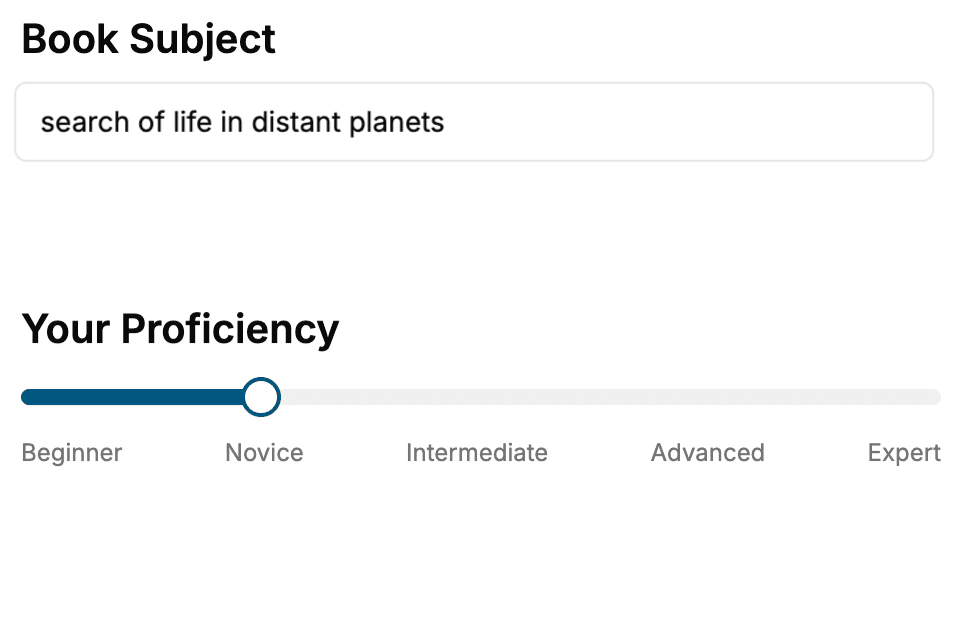
Select the focus of your Astronomy book and share your background
- 2. Personalize your book
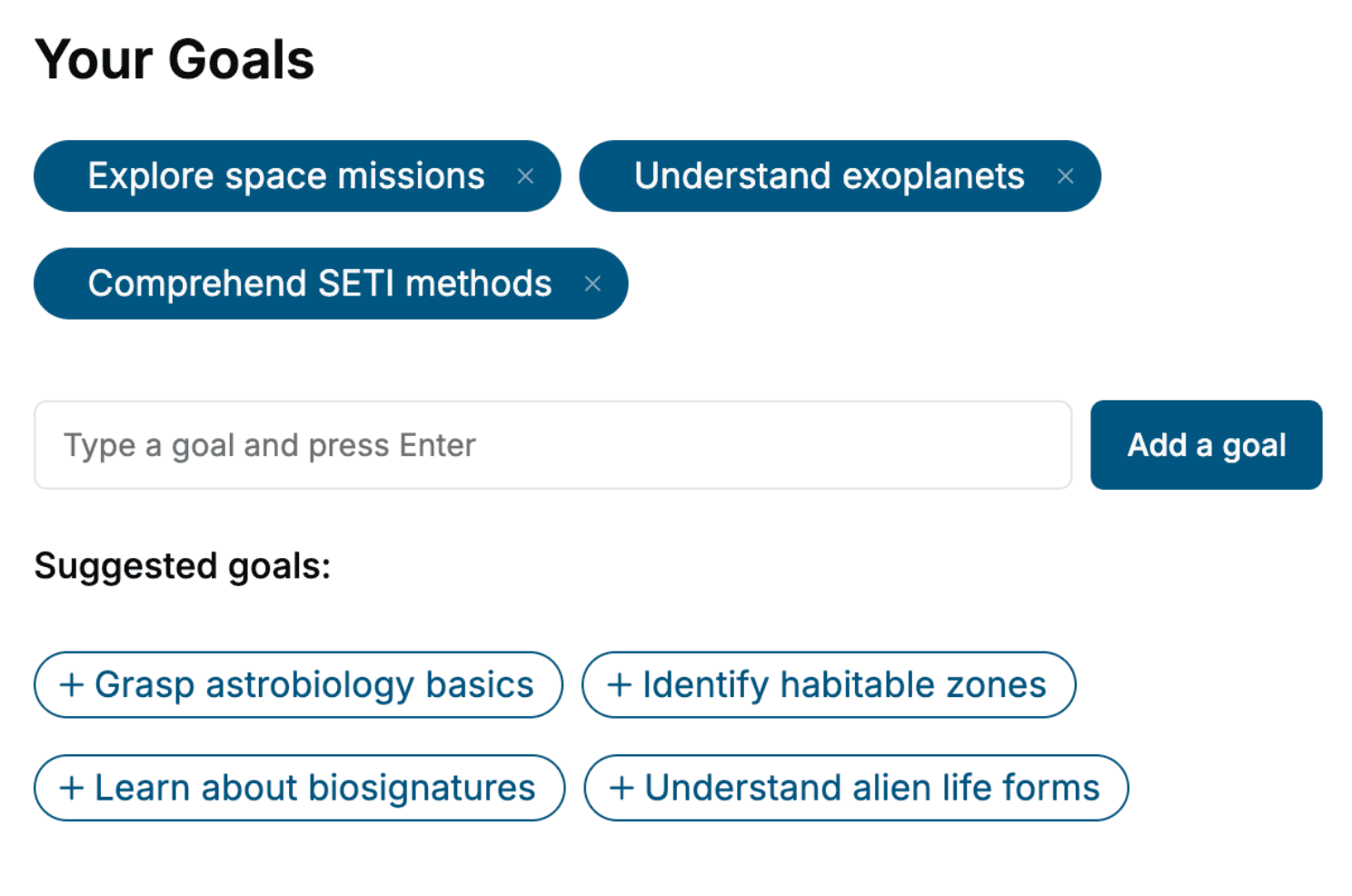
Specify your goals and choose sub-topics to include
- 3. Get your tailored book
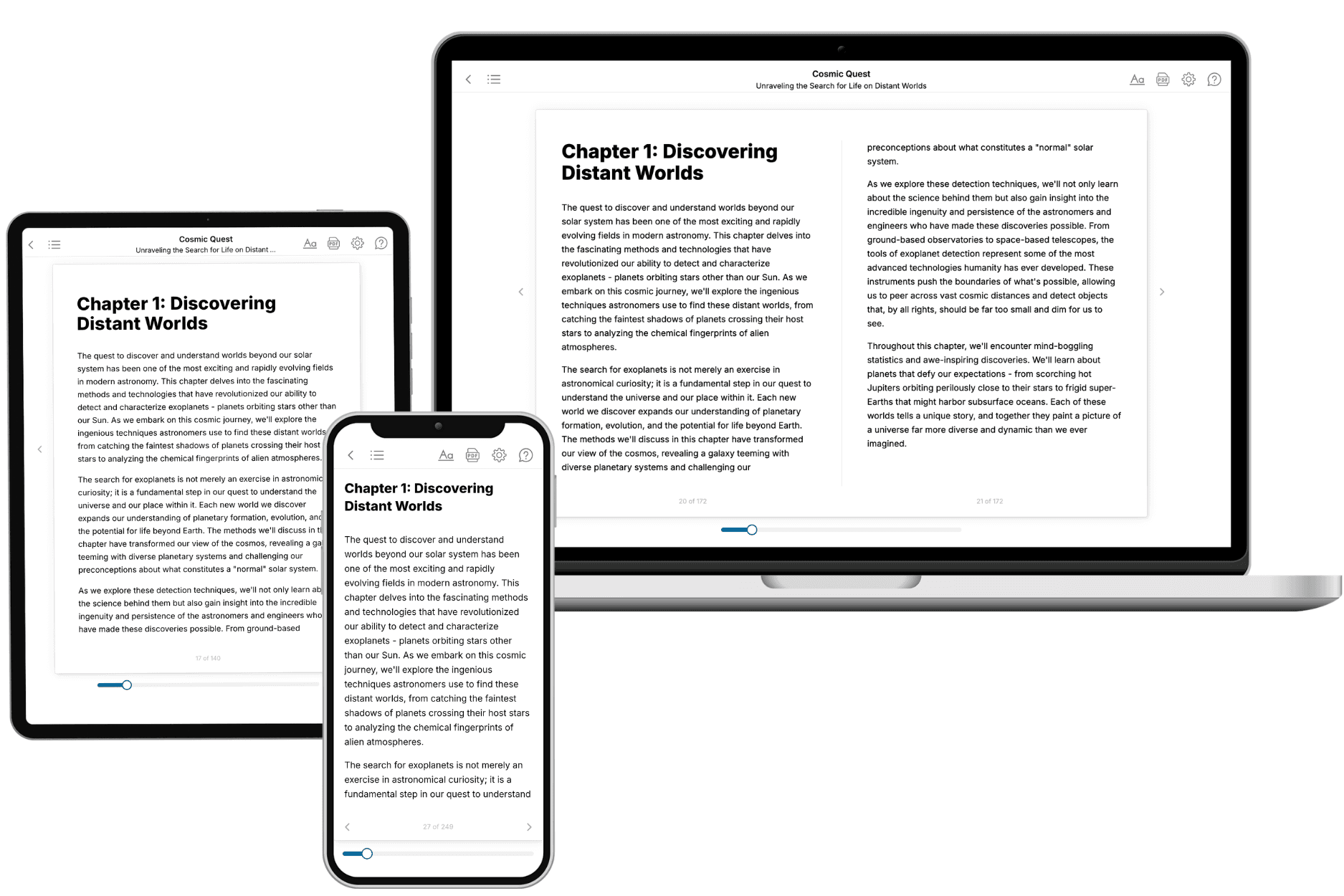
Your book is ready in 10 minutes. Read it online, download as EPUB or PDF, or send to Kindle.
Frequently asked questions
- What is TailoredRead?
TailoredRead creates complete, full-length nonfiction ebooks, written specifically for you. Tell us what you want to learn and why, and TailoredRead writes you a complete ebook on it, with charts, tables, and diagrams throughout. Read it online, on Kindle, or on any e-reader, or download it as a PDF or EPUB. Every book is written fresh the day you order it.
- How is the book tailored to me?
Before anything is written, you answer a few short questions about your goals, your background, and the topics you care about. Your book is then planned around your answers: written at your level, focused on your goals, and covering the topics you chose, instead of the one-size-fits-all book a store sells everyone.
- Will it read like generic AI content?
No. Your book isn't a chat transcript: it's planned chapter by chapter before a single word is written, told in a clear book voice, and explains ideas visually with charts, tables, and diagrams. After writing, every book goes through an editorial pass that polishes chapters so the book reads consistent from start to finish. Judge for yourself: browse thousands of sample books on our Explore Books page.
- How accurate is the content?
Our AI first checks whether your subject needs live research. Niche and fast-moving subjects are researched before writing, and the book plan and chapters are grounded in what it finds. After writing, every book goes through a quality pass that checks its facts and consistency, and researched books list their sources in a Notes section at the back.
- How long is the book?
You choose the length: Comprehensive (250-300 pages), Detailed (150-200 pages), Essential (70-100 pages), or Short (30-50 pages).
- Does the book include visuals?
Yes. Every book includes charts, tables, and diagrams: timelines, checklists, step-by-step guides, decision trees, comparison tables, matrices, and bar charts. A typical book includes dozens of these visual elements.
- Can I read it on Kindle? What formats can I download?
Yes. Every book can be read in our online reader or downloaded as a PDF or EPUB. The EPUB can be opened with Kindle, Apple Books, Kobo, and any e-reader. The Commercial and Author licenses also include an editable Word (DOCX) and Markdown download.
- How much does it cost?
About the price of a regular ebook. The exact price depends on your book's length and complexity, from $2 for the shortest books to $35 for the most comprehensive, and it's shown when you review your book, before you commit to anything. Each book is a one-time purchase, yours to keep, no subscription. Licenses that let you share, teach, or publish your book range from $35.99 to $49.99.
- Can I preview the book before purchasing?
Before you pay, you'll see what your book will cover: the title, a detailed description, the estimated length, and the complete chapter-by-chapter table of contents, so you know what you're getting before you decide. The full text itself is written after you purchase.
- How long does it take to create a book?
About 10 minutes. You can start reading the opening chapters while the rest is still being written.