Planetary Transits
Understanding the Cosmic Dance of Planets Across Our Sky
Discover the celestial mechanics that govern one of astronomy's most captivating phenomena.
207 pages9 chaptersJun 2, 2026Astronomy
About this book
This guide takes you beyond basic stargazing to reveal how planetary transits work, why they matter, and how to observe them with confidence. You'll learn the orbital geometry that creates these rare alignments, explore the historical significance of transit observations in measuring our universe, and understand how modern astronomers use transits to detect distant worlds. Whether you're tracking Venus crossing the Sun or searching for exoplanets, this book equips you with the knowledge to appreciate the precision and beauty of planetary motion. Packed with practical observation tips, detailed explanations of the physics involved, and insights into cutting-edge transit research, you'll gain a deeper understanding of how planets move through space and what their transits reveal about our place in the cosmos.
Table of contents
- IntroductionWhat Are Planetary Transits?, Why Transits Matter to Astronomy, How to Use This BookRead below
- Chapter 1: Orbital Mechanics and Planetary MotionKepler's Laws of Planetary Motion, Understanding Orbital Elements, The Geometry of Planetary Orbits
- Chapter 2: The Geometry of TransitsAlignment Requirements for Transits, Inclination and Nodes: The Keys to Transit Prediction, Calculating Transit Timing and Duration
- Chapter 3: Transits Across the SunVenus Transits: History and Significance, Mercury Transits and Observational Challenges, The Physics of Solar Transits
- Chapter 4: Historical Importance of Transit ObservationsUsing Transits to Measure the Astronomical Unit, Great Transit Expeditions and Scientific Discovery, The Legacy of Transit Science
- Chapter 5: Transits and Exoplanet DiscoveryThe Transit Method for Finding Exoplanets, Analyzing Planetary Atmospheres Through Transits, The Kepler Mission and Transit Discoveries
- Chapter 6: Equipment and Preparation for Observing TransitsChoosing Telescopes and Solar Filters, Safety Precautions for Solar Observations, Selecting Location and Timing
- Chapter 7: Practical Observation TechniquesVisual Observation Methods, Photography and Digital Imaging, Recording and Documenting Your Observations
- Chapter 8: Predicting and Calculating TransitsUsing Transit Tables and Ephemerides, Software Tools for Transit Prediction, Manual Calculation Methods
- Chapter 9: Upcoming Transits and Future ObservationsNotable Transits in the Coming Years, Rare and Exceptional Transit Events, Planning Your Transit Observation Campaign
- ConclusionKey Takeaways, Continuing Your Journey in Transit Astronomy
- Glossary of Terms
- Further Reading and Resources
Introduction
There are moments in astronomy when the universe seems to slow down and show you something precise, deliberate, and almost impossibly elegant. A planetary transit is one of those moments. When a planet passes directly between you and a distant light source, whether that's our own Sun or a star hundreds of light-years away, it traces a path that follows rules laid down by physics billions of years ago. That tiny silhouette crossing a blazing disk is not just beautiful. It carries information about distance, size, atmosphere, and the architecture of entire solar systems.
Planetary transits have shaped the history of science in ways that few other astronomical events can match. Eighteenth-century astronomers sailed to the far corners of the Earth, enduring months at sea and brutal conditions, just to time the passage of Venus across the Sun with a stopwatch and a telescope. Their goal was to measure the scale of the solar system, a number that had eluded humanity for centuries. They succeeded, and the method they used was elegant in its simplicity: geometry, timing, and the predictable motion of planets. That same spirit of careful observation drives transit science today, now applied to worlds orbiting stars we can barely see with the naked eye.
Modern transit astronomy has expanded far beyond our solar system. Space telescopes like Kepler and TESS have used the transit method to identify thousands of exoplanets, revealing that planetary systems are common throughout the galaxy. When a planet crosses its host star, it dims the starlight by a tiny but measurable fraction. That dip in brightness tells astronomers the planet's size, orbital period, and sometimes even hints at what its atmosphere is made of. The same physical principle that sent Captain Cook to Tahiti in 1769 is now helping scientists search for worlds that might support life.
This book is designed for astronomy enthusiasts who already have a foundation in the subject and want to go deeper. You won't find basic stargazing tips here. Instead, you'll find a thorough exploration of the mechanics, history, physics, and observational practice of planetary transits. Each chapter builds on the last, moving from the orbital geometry that makes transits possible to the practical techniques you can use to observe and record them yourself. Along the way, you'll encounter the science behind some of astronomy's most important discoveries and gain the tools to appreciate what you're seeing when a planet crosses the face of the Sun.
What Are Planetary Transits?
A planetary transit occurs when a planet passes directly in front of a larger, more distant body as seen from a specific vantage point. In our solar system, this means watching Mercury or Venus cross the face of the Sun as viewed from Earth. In the broader universe, it means detecting the moment when an exoplanet moves between its host star and our telescopes. The key requirement in both cases is alignment: the planet, the light source, and the observer must fall along nearly the same line in space.
It's worth distinguishing a transit from two related phenomena that are easy to confuse. An occultation happens when a nearer body completely blocks a more distant one, such as the Moon covering a star. An eclipse involves a body passing through another's shadow, like a lunar eclipse. A transit is different because the transiting body is much smaller than the background object, so it appears as a small dark dot rather than blocking the light entirely. When Venus transits the Sun, it covers less than 0.1% of the solar disk, producing a subtle but measurable dimming.
The geometry required for a transit is surprisingly strict. Planets orbit the Sun in slightly tilted planes relative to Earth's orbital plane, which is called the ecliptic. Most of the time, an inner planet passes above or below the Sun from Earth's perspective. A transit only happens when the planet crosses the ecliptic at the same moment it lines up between Earth and the Sun. These crossing points are called nodes, and transits can only occur when a planet is near a node during its inferior conjunction (the moment it passes between Earth and the Sun).
This geometric constraint explains why transits are rare. Mercury transits happen roughly 13 or 14 times per century, typically in May or November when Earth is near Mercury's nodal points. Venus transits are even rarer, occurring in pairs separated by 8 years, with gaps of over a century between each pair. The most recent Venus transit took place in June 2012, and the next won't occur until December 2117.[1] That rarity is part of what makes transits so scientifically and culturally significant.
For exoplanet transits, the same geometric logic applies, but the scale is vastly different. A planet orbiting a distant star must pass across the star's disk as seen from Earth's direction. Because we're observing from a fixed point in space, only a fraction of all exoplanets will have orbits aligned favorably for transit detection. Astronomers estimate that for an Earth-like planet orbiting a Sun-like star, there's roughly a 0.5% chance the geometry will be right for us to detect a transit.[2] That's why large-scale surveys observing hundreds of thousands of stars simultaneously are necessary to find them in meaningful numbers.
Understanding what a transit actually is, at its most physical level, means thinking about light. When a planet moves in front of a star, it blocks a portion of the star's light from reaching the observer. The amount of light blocked depends on the ratio of the planet's area to the star's area. For a Jupiter-sized planet crossing a Sun-sized star, the dip in brightness is about 1%. For an Earth-sized planet, it's closer to 0.01%. These are small numbers, but modern photometric instruments can detect brightness changes far smaller than that, which is why the transit method has become one of the most powerful tools in exoplanet science.
Key concept: A transit is defined by three things working together: the relative sizes of the bodies involved, the precise geometric alignment of their positions, and the sensitivity of the observer's instruments. Change any one of these, and the transit either doesn't happen or can't be detected.
Transits also have a characteristic shape when plotted as a light curve, a graph of brightness over time. As the planet begins to cross the stellar disk, brightness drops gradually during what's called ingress. It then holds at a roughly constant lower level during the main transit, and finally recovers during egress. The shape, depth, and duration of this curve encode a remarkable amount of information about the planet's size, orbital speed, and even the limb darkening of the star itself. Learning to read a light curve is one of the core skills of modern transit astronomy.
Why Transits Matter to Astronomy
Transits are not just visually striking events. They are among the most scientifically productive phenomena in all of observational astronomy. Their value comes from a combination of factors: they are predictable, they are geometrically precise, and they provide direct measurements of physical quantities that are otherwise very difficult to determine. From measuring the size of the solar system to detecting the atmospheres of distant worlds, transits have repeatedly opened new windows on the universe.
The most historically significant application of transit science was the measurement of the astronomical unit (AU), the average distance between Earth and the Sun. In the 17th century, the astronomer Edmond Halley proposed that by timing a Venus transit from widely separated locations on Earth, observers could use the principle of parallax to calculate the Sun's distance with unprecedented accuracy.[3] This idea drove some of the most ambitious scientific expeditions of the 18th century and ultimately produced the first reliable value for the AU, a number that underpins all of modern astronomy.
Today, transits matter most in the context of exoplanet science. The transit method is responsible for the majority of confirmed exoplanet discoveries. Here's why it's so powerful compared to other detection methods:
- Direct size measurement: The depth of the transit dip gives the planet's radius relative to the star's radius, a direct geometric measurement.
- Orbital period: Repeated transits reveal the planet's orbital period with high precision.
- Atmospheric characterization: During transit, starlight filters through the planet's atmosphere, leaving spectral fingerprints of its chemical composition.
- Mass estimation: Combined with radial velocity data, transit measurements allow calculation of a planet's density and bulk composition.
- Habitability assessment: Orbital period and stellar properties together determine whether a planet lies in the habitable zone.
The Kepler Space Telescope, launched in 2009, demonstrated just how transformative the transit method could be. Over its nine-year mission, Kepler monitored more than 150,000 stars and confirmed over 2,600 exoplanets, with thousands more candidates awaiting confirmation.[4] Before Kepler, astronomers had confirmed fewer than 400 exoplanets using all methods combined. The transit method, applied systematically from space, changed the field almost overnight.
Transits also serve as natural laboratories for testing fundamental physics. The precise timing of transits can reveal gravitational interactions between planets in the same system, a technique called transit timing variation (TTV). When a planet's transit arrives slightly earlier or later than predicted, it suggests the gravitational pull of another planet is perturbing its orbit. This method has been used to discover planets that don't transit at all, inferred entirely from their gravitational effect on a planet that does. It's a remarkable example of how one measurement technique can cascade into entirely new discoveries.
Closer to home, solar transits of Mercury and Venus continue to provide valuable data. Mercury transits allow precise measurements of the planet's diameter and help refine models of its orbital dynamics. Venus transits have been used to study the planet's atmosphere, including the famous aureole effect, where sunlight refracts through Venus's thick atmosphere and creates a bright arc around the planet's limb just before and after transit. This effect was first observed in 1761 and remains a subject of scientific study today.[5]
There's also a broader cultural and philosophical dimension to why transits matter. They remind us that the universe operates according to precise, knowable laws. The fact that astronomers can predict a transit centuries in advance, down to the minute, is a testament to the power of mathematics and careful observation. When you watch Venus cross the Sun, you're participating in a tradition of scientific inquiry that stretches back over 350 years, connecting you to every observer who has ever pointed a telescope at that tiny black dot and wondered what it could tell us about our place in the cosmos.
Transits also highlight the importance of perspective. The same event looks different from different locations on Earth, and that difference is scientifically useful. From a planet orbiting another star, our own solar system's transits would be detectable. Earth transits the Sun as seen from certain directions in space, and astronomers have actually identified the directions from which an alien observer could detect Earth's transit.[6] That perspective shift, from observer to observed, is one of the most thought-provoking ideas in modern astronomy.
How to Use This Book
This book is organized to take you from foundational concepts to practical application in a logical sequence. Each chapter builds on what came before, so reading from start to finish will give you the most complete understanding. That said, if you already have a strong grasp of orbital mechanics or the history of transit science, you can jump to the chapters most relevant to your current interests. Each chapter is designed to stand on its own as a reference, with key terms defined and concepts explained in context.
Here's a brief map of what each part of the book covers:
- Chapters 1 and 2 cover the physics and geometry underlying all transit phenomena. Chapter 1 reviews Kepler's laws and orbital elements, while Chapter 2 focuses specifically on the geometric conditions that make transits possible. These chapters are the theoretical foundation for everything that follows.
- Chapter 3 examines solar transits of Venus and Mercury in detail, including the physics of what happens when a planet crosses the Sun's disk. This is where theory meets the most accessible real-world examples.
- Chapter 4 explores the rich history of transit observations, from the first recorded Mercury transit in 1631 to the great Venus transit expeditions of the 18th and 19th centuries. Understanding this history deepens your appreciation for the science.
- Chapter 5 shifts to exoplanet science, explaining how the transit method works for detecting distant worlds, how atmospheric analysis is performed, and what missions like Kepler have revealed about the galaxy's planetary population.
- Chapters 6 and 7 are the practical core of the book. Chapter 6 covers equipment selection and safety, while Chapter 7 walks through observation techniques, photography, and data recording. These chapters are designed to be used in the field.
- Chapter 8 explains how to predict and calculate transits, including the use of ephemerides, software tools, and manual calculation methods. This chapter is for those who want to go beyond looking up dates and understand the math behind the predictions.
- Chapter 9 looks ahead to upcoming transit events and helps you plan your own observation campaigns, including rare and exceptional events worth preparing for well in advance.
Throughout the book, you'll find several recurring features designed to make the content more useful and engaging. Key concept boxes summarize the most important ideas in each section. Worked examples walk through calculations and observational scenarios step by step. Footnotes point to primary sources and further reading for those who want to go deeper on specific topics. And practical checklists in the observation chapters give you concrete, actionable steps to follow before, during, and after a transit event.
A note on the level of mathematics in this book: the goal is to give you genuine understanding, not just surface familiarity. That means some equations are unavoidable, particularly in the chapters on orbital mechanics and transit prediction. Every equation is explained in plain language, and the focus is always on what the math tells you physically, not on mathematical derivation for its own sake. If you're comfortable with basic algebra and can follow the logic of a geometric argument, you'll have no trouble with the quantitative content here.
For solar transit observations specifically, safety is a recurring theme throughout the book. Observing the Sun without proper equipment can cause permanent eye damage or blindness within seconds. Every chapter that touches on solar observation includes explicit safety guidance, and Chapter 6 covers the topic in full detail. Please read that chapter before attempting any solar observation, even if you feel confident in your existing knowledge. The risks are real, and the precautions are straightforward once you understand them.
The glossary at the back of the book defines all technical terms used throughout the text. If you encounter an unfamiliar word or concept, the glossary is your first stop. The further reading section lists key papers, books, and online resources organized by chapter topic, giving you a clear path to explore any area in greater depth. These resources range from accessible popular science writing to peer-reviewed research papers, so there's something useful regardless of how deep you want to go.
One of the most rewarding aspects of transit astronomy is that it connects individual observers to a global scientific community. Amateur astronomers have contributed meaningful data to transit science for centuries, and that tradition continues today. Organizations like the American Association of Variable Star Observers (AAVSO) and the British Astronomical Association (BAA) coordinate amateur transit observations and incorporate the data into professional research programs. As you develop your skills and equipment, contributing your own observations to these networks is a genuinely valuable way to participate in ongoing science.
Finally, approach this subject with patience and curiosity. Transits are rare events, and the preparation required to observe them well is part of what makes the experience meaningful. The next Mercury transit visible from most of the Northern Hemisphere won't occur until 2032. The next Venus transit won't happen until 2117. But the knowledge you build in the meantime, understanding the geometry, the history, the physics, and the technique, will make every transit you do observe far richer than it would be for someone who simply pointed a telescope at the Sun and hoped for the best. The universe rewards those who take the time to understand what they're looking at.
Notes
Introduction
- 1. NASA Eclipse Web Site: Transits of Venus, Fred Espenak, NASA/GSFC, "," 2012
- 2. J. N. Winn, "Exoplanet Transits and Occultations," Exoplanets, ed. S. Seager. University of Arizona Press, 2010
- 3. E. Halley, "A new method of determining the parallax of the Sun," Philosophical Transactions of the Royal Society, 1716
- 4. NASA Exoplanet Archive, Kepler Mission Summary
- 5. P. Tanga and others, The 2004 transit of Venus: New results on the aureole and the solar limb, Astronomy & Astrophysics, 539, A50, 2012
- 6. L. Kaltenegger and W. A. Traub, "Transits of Earth-like planets," The Astrophysical Journal, 2009
This is the end of the free sample. The full book has 9 chapters.
Want this book written for you?
Tell us your goals and background, and get your own version of this book, tailored by AI to you.


Benefits of AI-tailored books
- Read one book, not ten:
- all the Astronomy knowledge you need, gathered into a single book.
- Save days of learning:
- tell us your goals, choose your topics, and the whole book is built around them.
- Learn effortlessly:
- Astronomy book written for your specific background and expertise.
- Understand at a glance:
- includes charts, tables, timelines, checklists, decision trees, and more.
- Stay current:
- written the day you order it, not years ago.
- Trust what you read:
- every book is checked for accuracy, with real research when your subject needs it.
Create your unique book in 3 steps
- 1. Select your focus
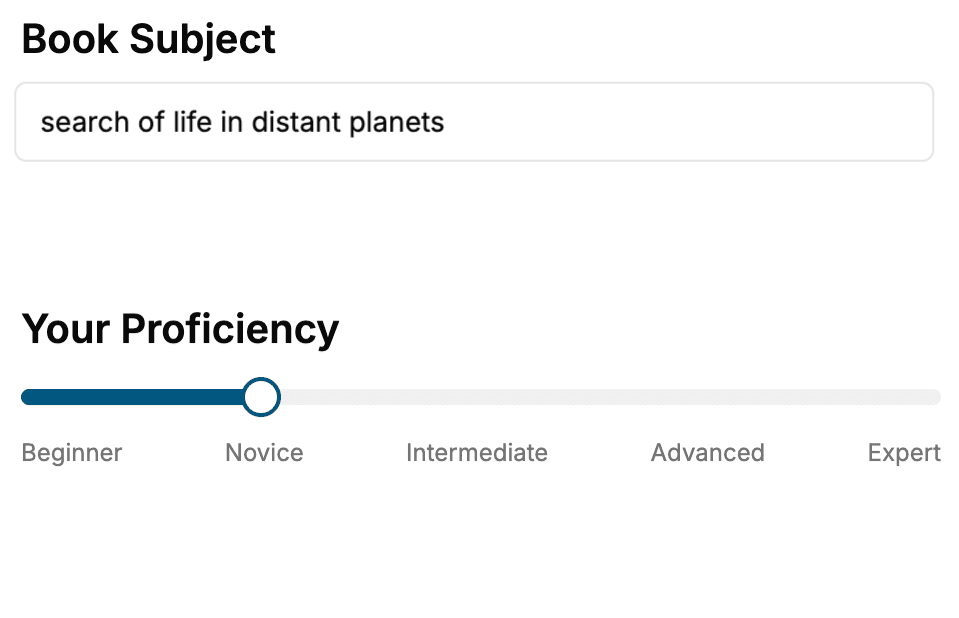
Select the focus of your Astronomy book and share your background
- 2. Personalize your book
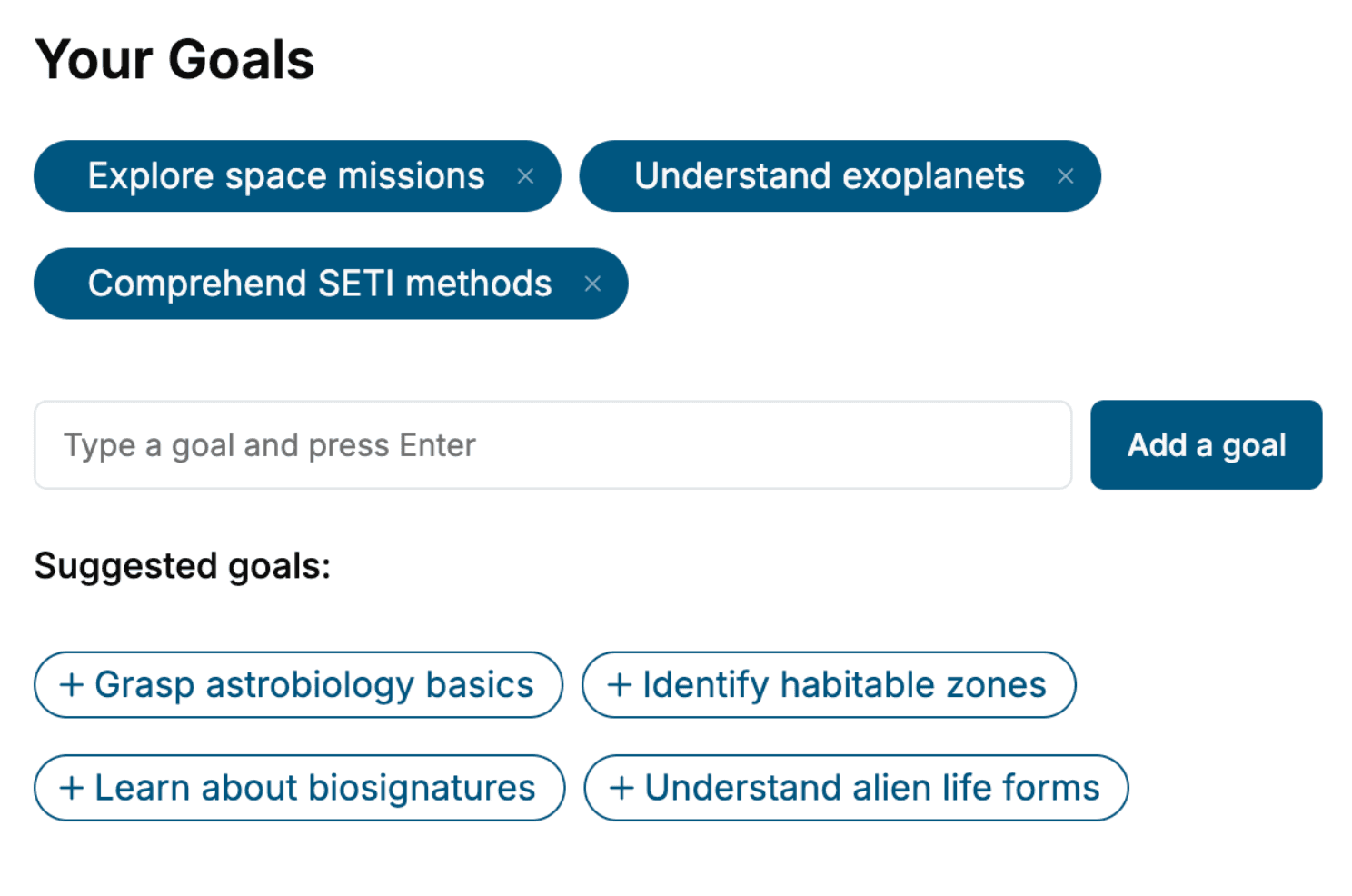
Specify your goals and choose sub-topics to include
- 3. Get your tailored book
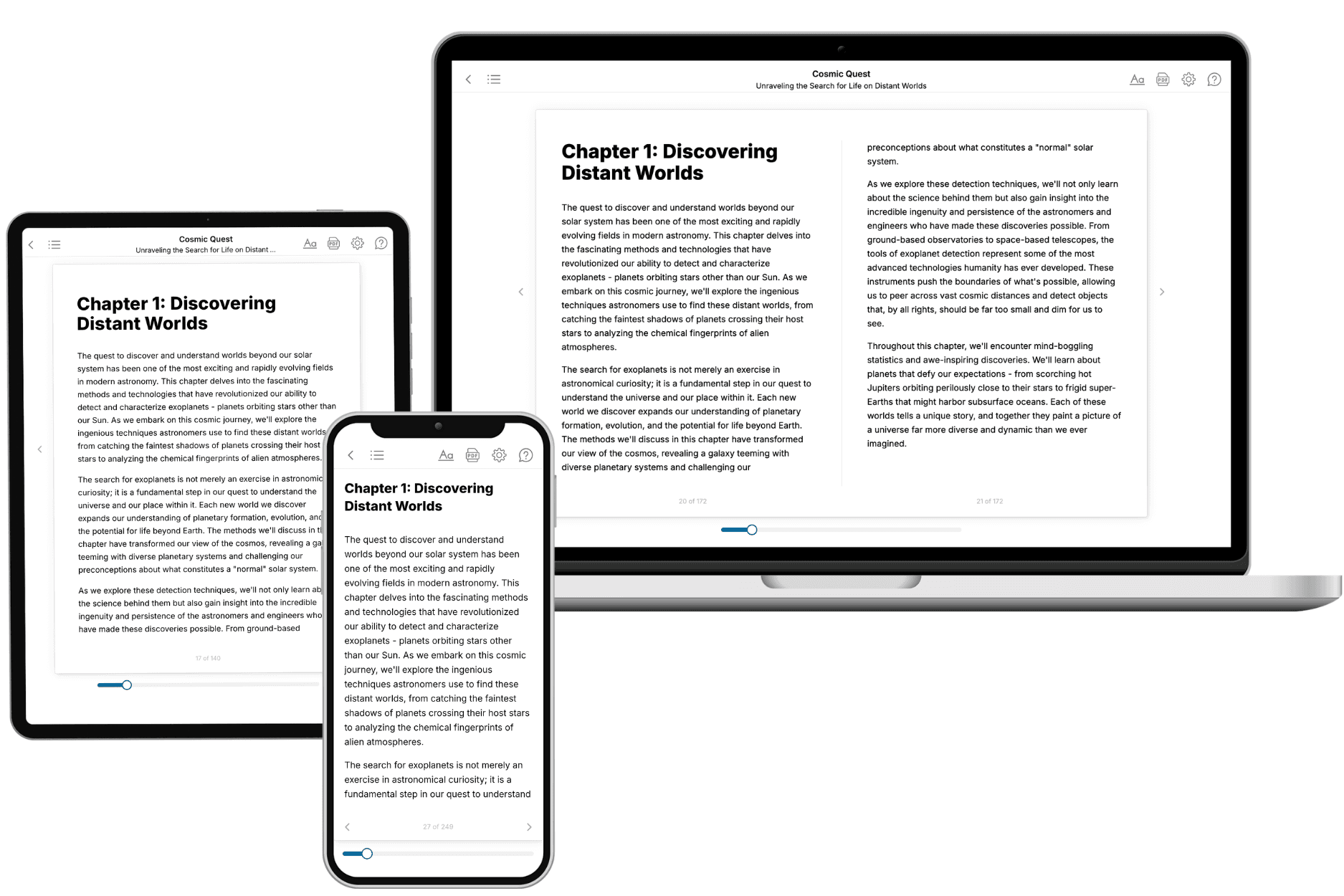
Your book is ready in 10 minutes. Read it online, download as EPUB or PDF, or send to Kindle.
Frequently asked questions
- What is TailoredRead?
TailoredRead creates complete, full-length nonfiction ebooks, written specifically for you. Tell us what you want to learn and why, and TailoredRead writes you a complete ebook on it, with charts, tables, and diagrams throughout. Read it online, on Kindle, or on any e-reader, or download it as a PDF or EPUB. Every book is written fresh the day you order it.
- How is the book tailored to me?
Before anything is written, you answer a few short questions about your goals, your background, and the topics you care about. Your book is then planned around your answers: written at your level, focused on your goals, and covering the topics you chose, instead of the one-size-fits-all book a store sells everyone.
- Will it read like generic AI content?
No. Your book isn't a chat transcript: it's planned chapter by chapter before a single word is written, told in a clear book voice, and explains ideas visually with charts, tables, and diagrams. After writing, every book goes through an editorial pass that polishes chapters so the book reads consistent from start to finish. Judge for yourself: browse thousands of sample books on our Explore Books page.
- How accurate is the content?
Our AI first checks whether your subject needs live research. Niche and fast-moving subjects are researched before writing, and the book plan and chapters are grounded in what it finds. After writing, every book goes through a quality pass that checks its facts and consistency, and researched books list their sources in a Notes section at the back.
- How long is the book?
You choose the length: Comprehensive (250-300 pages), Detailed (150-200 pages), Essential (70-100 pages), or Short (30-50 pages).
- Does the book include visuals?
Yes. Every book includes charts, tables, and diagrams: timelines, checklists, step-by-step guides, decision trees, comparison tables, matrices, and bar charts. A typical book includes dozens of these visual elements.
- Can I read it on Kindle? What formats can I download?
Yes. Every book can be read in our online reader or downloaded as a PDF or EPUB. The EPUB can be opened with Kindle, Apple Books, Kobo, and any e-reader. The Commercial and Author licenses also include an editable Word (DOCX) and Markdown download.
- How much does it cost?
About the price of a regular ebook. The exact price depends on your book's length and complexity, from $2 for the shortest books to $35 for the most comprehensive, and it's shown when you review your book, before you commit to anything. Each book is a one-time purchase, yours to keep, no subscription. Licenses that let you share, teach, or publish your book range from $35.99 to $49.99.
- Can I preview the book before purchasing?
Before you pay, you'll see what your book will cover: the title, a detailed description, the estimated length, and the complete chapter-by-chapter table of contents, so you know what you're getting before you decide. The full text itself is written after you purchase.
- How long does it take to create a book?
About 10 minutes. You can start reading the opening chapters while the rest is still being written.