Bauhaus: The Architecture That Changed Everything
From Weimar Ideals to Modern Design Principles That Still Shape Our World
Imagine walking through a building where every element serves a purpose, where beauty emerges naturally from function, and where the design speaks to both your practical needs and your aesthetic sensibilities.
222 pages10 chaptersFeb 16, 2026Architecture
About this book
This is the Bauhaus legacy—a revolutionary approach to architecture and design that emerged in 1920s Germany and fundamentally transformed how we build, create, and inhabit spaces. This book takes you on a comprehensive journey through Bauhaus architecture, from its idealistic beginnings in Weimar to its global influence today. You'll discover how visionary educators and designers rejected ornamental excess in favor of honest materials and geometric clarity. You'll meet the pioneering figures who shaped the movement and understand the philosophical principles that made Bauhaus so radical for its time—and so relevant now. Whether you're an architecture student, a design professional, or simply curious about how the spaces around you came to be, this exploration reveals why Bauhaus remains the foundation of modern design thinking. Learn how a school that existed for just 14 years created principles that continue to guide architects, designers, and creators worldwide, proving that great ideas transcend time and circumstance.
Table of contents
- IntroductionWhy Bauhaus Matters Today, What You'll Learn in This Book, How to Use This GuideRead below
- Chapter 1: The World Before Bauhaus19th Century Design and Ornamentation, The Industrial Revolution's Challenge to Craftsmanship, Weimar Germany: A Nation Seeking Renewal
- Chapter 2: The Birth of BauhausWalter Gropius and the Founding Vision, The School's Revolutionary Structure, The Early Years: 1919-1923
- Chapter 3: Core Principles and PhilosophyForm Follows Function: The Central Tenet, Uniting Art, Craft, and Industry, Design for Everyone: Accessibility and Democracy, Honest Use of Materials
- Chapter 4: The Visionary TeachersLudwig Mies van der Rohe: Less is More, Paul Klee and Artistic Innovation, Other Influential Masters and Their Contributions
- Chapter 5: Bauhaus Architecture in PracticeGeometric Forms and Clean Lines, Material Expression and Structural Honesty, Spatial Organization and Functionality, Iconic Bauhaus Buildings and Their Significance
- Chapter 6: Design Disciplines Beyond ArchitectureFurniture Design: Objects for Living, Graphic Design and Typography, Industrial Design and Mass Production
- Chapter 7: The School's Evolution and ChallengesThe Dessau Years: Expansion and Refinement, Political Pressures and Nazi Opposition, The Final Years and Closure
- Chapter 8: Global Diaspora and LegacyThe Emigration: Spreading Bauhaus Worldwide, Bauhaus in America: New Beginnings, International Influence and Adaptation
- Chapter 9: Bauhaus and Contemporary ArchitectureBauhaus Principles in Modern Design, The Relationship Between Bauhaus and Minimalism, Bauhaus Thinking in the Digital Age
- Chapter 10: Learning from Bauhaus: Practical ApplicationsApplying Bauhaus Design Thinking, Contemporary Case Studies and Examples, Bringing Bauhaus Principles Into Your Own Spaces
- ConclusionThe Enduring Relevance of Bauhaus, The Future of Design Thinking
- Glossary of Key Terms
- Further Reading and Resources
Introduction
Look around the space where you're sitting right now. Notice the clean lines of your furniture, the unadorned walls, the way natural light enters through large windows, or perhaps the simple geometric shapes that define the objects around you. Whether you realize it or not, you're experiencing the legacy of Bauhaus—a design movement that fundamentally transformed how we create, build, and inhabit our world. From the smartphone in your pocket to the chair supporting you, from the typography on street signs to the architecture of office buildings, Bauhaus principles have become so deeply embedded in modern design that they're practically invisible. Yet understanding this movement isn't just an academic exercise in architectural history. It's about recognizing the ideas that shape your daily environment and learning to see the world through the eyes of designers who believed that good design could improve human life.
The Bauhaus school existed for only fourteen years, from 1919 to 1933, in three different German cities. This brief existence might suggest a limited impact, but the opposite is true. Those fourteen years produced a revolution in thinking about design, architecture, and the relationship between art and everyday life that continues to influence creators worldwide nearly a century later. The school brought together some of the most innovative minds of the early twentieth century—architects, painters, sculptors, designers, and craftspeople—who collaborated to reimagine everything from teacups to skyscrapers. They rejected the ornamental excess of previous eras and asked a radical question: What if design served human needs first, and beauty emerged naturally from that service? This question, and the answers the Bauhaus community developed, created the foundation for what we now call modern design.
This book invites you into the world of Bauhaus architecture and design, not as a distant historical curiosity, but as a living tradition that continues to evolve and inspire. You'll discover how economic hardship, political upheaval, and technological change in post-World War I Germany created the conditions for radical innovation. You'll meet the visionary teachers and students who transformed abstract philosophical ideas into concrete objects and buildings. You'll learn to recognize Bauhaus principles in contemporary architecture and understand why these ideas remain relevant in an age of digital design and sustainable building practices. Most importantly, you'll gain practical knowledge that can inform your own understanding of design, whether you're an architecture student beginning your studies, a professional seeking deeper historical context, or simply someone who wants to understand why the built environment looks the way it does.
The story of Bauhaus is ultimately a story about possibility—about what happens when creative people collaborate across disciplines, when they prioritize human needs over tradition, and when they believe that design can be both beautiful and accessible to everyone. It's also a story about resilience. When the Nazi regime forced the school to close in 1933, dismissing its work as degenerate, the ideas didn't die. Instead, they spread globally as faculty and students emigrated, carrying Bauhaus principles to America, Israel, and beyond. This diaspora ensured that a school rooted in a specific time and place became a universal language of modern design. Understanding this journey helps you appreciate not just what Bauhaus was, but what it continues to be—a set of principles and approaches that adapt to new contexts while maintaining their core commitment to functional beauty and democratic design.
Why Bauhaus Matters Today
In an era of rapid technological change and environmental crisis, you might wonder why a design school from 1920s Germany deserves your attention. The answer lies in how Bauhaus approached fundamental questions that remain urgent today. How do we create buildings and objects that serve human needs without wasting resources? How do we balance aesthetic beauty with practical function? How do we make good design accessible rather than exclusive? How do we train designers to think across disciplines rather than in isolated specializations? These questions weren't unique to Weimar Germany—they're timeless challenges that every generation of designers must address. Bauhaus matters because it developed systematic approaches to these questions that proved remarkably durable and adaptable. The movement demonstrated that design thinking could be taught, that principles could be articulated and refined, and that collaboration across disciplines produced better results than isolated expertise.
Consider the contemporary emphasis on sustainable design and environmental responsibility. Bauhaus architects pioneered the honest use of materials, celebrating rather than concealing the inherent properties of steel, glass, concrete, and wood. They designed buildings that maximized natural light and ventilation, reducing energy consumption long before climate change became a global concern. Their commitment to form following function meant eliminating unnecessary ornamentation that consumed materials and labor without serving human needs. These weren't environmental principles in the modern sense—the Bauhaus community didn't have our vocabulary of sustainability—but their design philosophy aligned remarkably well with contemporary concerns about resource efficiency and environmental impact. When you study Bauhaus architecture, you're learning approaches that remain relevant to today's most pressing design challenges, from affordable housing to climate-responsive buildings.
The digital revolution has transformed design practice in ways the Bauhaus founders couldn't have imagined, yet their principles translate surprisingly well to digital contexts. User experience designers speak of intuitive interfaces and user-centered design—concepts that echo Bauhaus commitments to functionality and accessibility. Graphic designers working with digital typography still reference the clean, geometric typefaces developed at the Bauhaus. Architects using parametric modeling software apply the same geometric thinking that Bauhaus designers explored with physical materials. The movement's interdisciplinary approach, which broke down barriers between fine art, craft, and industrial design, prefigures contemporary design thinking that emphasizes collaboration between designers, engineers, and users. Understanding Bauhaus helps you recognize that good design principles transcend specific technologies or materials—they're about how humans interact with their environment, regardless of whether that environment is physical or digital.
Bauhaus also matters because it represents a particular vision of design's social role. The founders believed that good design shouldn't be a luxury for the wealthy but a right for everyone. They imagined mass production not as a threat to quality but as an opportunity to bring well-designed objects to broader audiences. This democratic vision of design challenges the elitism that often characterizes architectural practice, where signature buildings by celebrity architects serve primarily as monuments to wealth and status. When you encounter contemporary discussions about affordable housing, inclusive design, or architecture's social responsibility, you're engaging with questions that Bauhaus placed at the center of design education. The movement demonstrated that serving ordinary human needs could be just as creatively challenging and aesthetically rewarding as designing palaces for the privileged. This lesson remains vital in an era of growing inequality and housing crises in cities worldwide.
The educational model that Bauhaus developed continues to influence design schools globally. Before Bauhaus, architectural education typically emphasized historical styles and ornamental drawing. Students learned to copy classical orders and apply decorative elements according to established conventions. Bauhaus revolutionized this approach by emphasizing experimentation, material exploration, and collaborative learning. The famous preliminary course, or Vorkurs, introduced students to fundamental principles of form, color, and material through hands-on experimentation rather than rote copying. Students worked in workshops alongside master craftspeople, learning through making rather than just drawing. This pedagogical approach, which treats design as a discipline with teachable principles rather than an innate talent, shaped how design is taught worldwide. If you've attended a design school that emphasizes studio work, material experimentation, and interdisciplinary collaboration, you're experiencing the legacy of Bauhaus educational philosophy.
Perhaps most importantly, Bauhaus matters because it demonstrates that design movements can have profound cultural impact even when they face political opposition and institutional closure. The Nazi regime viewed Bauhaus as culturally threatening precisely because it represented internationalism, modernism, and social progressivism—values antithetical to fascist ideology. The school's closure in 1933 could have ended its influence, but instead, the forced diaspora of its faculty and students spread Bauhaus principles globally. This history reminds us that good ideas prove resilient even under political pressure, and that cultural movements can transcend national boundaries and historical moments. In contemporary contexts where design and architecture sometimes face political interference or commercial pressures that compromise quality and social responsibility, the Bauhaus story offers both warning and inspiration. It shows what can be lost when political ideology overrides creative freedom, but also how powerful ideas survive and adapt even in hostile conditions.
Understanding Bauhaus also provides essential context for recognizing and evaluating contemporary architecture and design. When you encounter a building with a flat roof, ribbon windows, and an asymmetrical facade, you're seeing Bauhaus influence. When you use furniture with tubular steel frames and simple geometric forms, you're experiencing Bauhaus design legacy. When you read text set in sans-serif typefaces with clean, geometric letterforms, you're engaging with Bauhaus typography principles. This recognition isn't just about identifying historical influences—it's about developing visual literacy that helps you understand why certain design choices work and others don't. Bauhaus provides a vocabulary and framework for discussing design quality, for distinguishing between minimalism that serves function and minimalism that's merely fashionable, for recognizing when contemporary design genuinely engages with modernist principles versus when it simply mimics modernist aesthetics without understanding their purpose.
Finally, Bauhaus matters because it represents a moment when designers believed they could change the world through their work. This optimism might seem naive from our contemporary perspective, after decades of postmodern critique and awareness of design's complicity in consumerism and environmental degradation. Yet that idealism also produced remarkable innovations and established principles that continue to guide thoughtful design practice. Studying Bauhaus means engaging with both the achievements and the limitations of modernist design thinking. You'll discover what worked, what didn't, and why certain principles proved more durable than others. This critical engagement with design history helps you develop your own design philosophy, informed by historical precedent but adapted to contemporary contexts and challenges. Whether you ultimately embrace, critique, or move beyond Bauhaus principles, understanding them provides essential foundation for participating in ongoing conversations about design's purpose and potential.
What You'll Learn in This Book
This book provides a comprehensive exploration of Bauhaus architecture and design, structured to build your understanding progressively from historical context through core principles to contemporary applications. You'll begin by examining the world that preceded Bauhaus—the ornamental excess of nineteenth-century design, the disruptions of industrialization, and the particular conditions of post-World War I Germany that made radical innovation possible. This historical foundation helps you understand why Bauhaus emerged when and where it did, and why its ideas seemed so revolutionary to contemporaries. You'll discover how economic crisis, political upheaval, and technological change created both the necessity and the opportunity for reimagining design from first principles. This context prevents the common mistake of viewing Bauhaus as simply an aesthetic style that could have emerged anywhere, anytime, helping you appreciate it as a specific response to specific historical conditions that nonetheless produced principles with lasting relevance.
The book then guides you through the founding and evolution of the Bauhaus school itself, introducing you to Walter Gropius and his founding vision of uniting art, craft, and industry. You'll learn about the school's revolutionary structure, which organized education around workshops where students learned by making rather than just studying. You'll discover how the curriculum evolved through three distinct periods—Weimar, Dessau, and Berlin—as the school refined its philosophy and responded to changing political pressures. This institutional history isn't just biographical detail; it reveals how educational structures shape creative outcomes and how design philosophies develop through practice and debate rather than emerging fully formed. You'll see how conflicts between different visions of Bauhaus—between expressionist and rationalist approaches, between craft tradition and industrial production—ultimately strengthened the movement by forcing its practitioners to articulate and defend their principles.
A substantial portion of the book explores the core principles and philosophy that define Bauhaus thinking. You'll examine the famous dictum that form follows function, learning what this means in practice and how it differs from mere utilitarianism. You'll discover how Bauhaus designers approached materials, celebrating their inherent properties rather than concealing them beneath ornament. You'll understand the commitment to geometric forms and clean lines not as arbitrary aesthetic preferences but as expressions of clarity and honesty in design. You'll explore the democratic vision that motivated Bauhaus designers to create objects and buildings accessible to everyone, not just wealthy patrons. Each principle is explained not just theoretically but through specific examples of buildings, furniture, and objects that demonstrate these ideas in practice. This approach helps you develop the ability to recognize Bauhaus principles in action and to apply similar thinking to your own design challenges.
The book dedicates significant attention to the visionary teachers who shaped Bauhaus philosophy and practice. You'll meet Ludwig Mies van der Rohe, whose famous principle less is more
captured an essential Bauhaus commitment to clarity and restraint. You'll discover Paul Klee's contributions to color theory and artistic innovation, and how his teaching helped students understand fundamental principles of visual composition. You'll learn about other influential masters including Marcel Breuer, whose furniture designs revolutionized modern interiors, and László Moholy-Nagy, whose experiments with photography and new media expanded Bauhaus thinking beyond traditional design disciplines. These biographical explorations aren't just historical portraits—they reveal how individual creative visions contributed to collective innovation, and how the Bauhaus model of collaborative teaching produced results that no single designer could have achieved alone. You'll see how these figures' ideas evolved through their teaching practice and how their later careers spread Bauhaus influence globally.
You'll gain detailed understanding of Bauhaus architecture in practice, learning to recognize and analyze the specific formal strategies that define the movement's buildings. The book explains how Bauhaus architects used geometric forms—cubes, cylinders, planes—to create compositions that were both visually striking and functionally efficient. You'll discover how they expressed materials honestly, allowing steel, glass, and concrete to appear as themselves rather than imitating traditional materials like stone or wood. You'll learn about spatial organization strategies that prioritized functionality and flexibility, creating spaces that could adapt to different uses rather than imposing rigid hierarchies. Most importantly, you'll examine specific iconic buildings—the Bauhaus school building in Dessau, the Fagus Factory, residential projects—learning to read these structures as expressions of design philosophy. This architectural analysis develops your ability to understand buildings not just as aesthetic objects but as solutions to specific functional and social challenges.
The book extends beyond architecture to explore design disciplines where Bauhaus principles proved equally influential. You'll discover how furniture designers like Marcel Breuer and Mies van der Rohe created chairs, tables, and storage systems that remain in production today, nearly a century after their initial design. You'll learn about Bauhaus contributions to graphic design and typography, including the development of sans-serif typefaces and asymmetrical layouts that broke with traditional centered compositions. You'll explore how Bauhaus thinking influenced industrial design, shaping everything from kitchen appliances to lighting fixtures. This interdisciplinary exploration demonstrates one of Bauhaus's most important lessons: that design principles apply across scales and media, and that designers benefit from understanding multiple disciplines rather than specializing narrowly. You'll see how the same commitment to functional clarity and honest materials that shaped buildings also informed the design of everyday objects.
You'll learn about the political pressures and challenges that ultimately forced the school's closure, understanding how the Nazi regime viewed Bauhaus as culturally threatening and how the school's faculty and students responded to increasing persecution. This difficult history reveals design's inevitable entanglement with politics and ideology, challenging any notion that design can be purely aesthetic or apolitical. You'll discover how the school's closure in 1933 led to a global diaspora that paradoxically expanded Bauhaus influence, as emigrating faculty established new schools and practices in America, Israel, and elsewhere. This history of forced migration and adaptation demonstrates both the fragility of institutions and the resilience of ideas, showing how design principles can transcend their original context and adapt to new cultural and geographical settings.
The book's later chapters examine Bauhaus legacy and contemporary relevance, tracing how the movement's principles influenced subsequent design movements and continue to shape contemporary practice. You'll explore the relationship between Bauhaus and minimalism, understanding both continuities and differences between these approaches. You'll discover how Bauhaus thinking applies to digital design, user experience, and contemporary challenges like sustainable architecture and affordable housing. You'll examine specific contemporary case studies that demonstrate Bauhaus principles in action, learning to recognize when contemporary designers genuinely engage with modernist ideas versus when they simply mimic modernist aesthetics. This contemporary focus ensures that your understanding of Bauhaus isn't purely historical but provides practical frameworks for evaluating and creating design today. You'll develop the ability to apply Bauhaus principles to your own projects while also recognizing their limitations and the ways contemporary designers have extended or critiqued modernist thinking.
How to Use This Guide
This book is designed to serve multiple purposes and reading approaches, depending on your background, interests, and goals. If you're an architecture student encountering Bauhaus for the first time, consider reading the book sequentially from beginning to end. This approach allows you to build understanding progressively, starting with historical context that explains why Bauhaus emerged, moving through core principles and key figures, and concluding with contemporary applications that connect historical knowledge to current practice. The sequential structure ensures that later chapters build on concepts introduced earlier, creating a comprehensive understanding of the movement. Take time with the examples and case studies, using them to develop your ability to recognize Bauhaus principles in actual buildings and objects. Consider supplementing your reading with visual research, seeking out photographs of the buildings and objects discussed, or even better, visiting Bauhaus buildings if you have the opportunity. Architecture is ultimately a spatial and material art that can't be fully understood through text alone.
If you're a design professional seeking to deepen your historical knowledge or refresh your understanding of modernist principles, you might approach the book more selectively. The chapter on core principles and philosophy provides concentrated exploration of fundamental Bauhaus ideas that you can apply immediately to your practice. The chapters on specific design disciplines—furniture, graphic design, industrial design—offer focused examinations of how Bauhaus thinking shaped particular fields. The contemporary applications chapter provides frameworks for connecting historical principles to current challenges like sustainable design and digital interfaces. You might read these chapters in whatever order matches your immediate interests or professional needs, using the book as a reference resource rather than a linear narrative. The detailed examples and case studies throughout the book provide concrete illustrations that can inform your own design decisions and help you articulate design principles to clients or colleagues.
For readers approaching Bauhaus primarily out of general interest rather than professional necessity, the book offers multiple entry points and reading paths. You might begin with the chapter on iconic buildings, using specific architectural examples to ground your understanding before exploring the more abstract philosophical principles. Or you might start with the biographical chapters on key figures, using individual stories to make the movement more personal and accessible. The book is written to be engaging and accessible to non-specialists while still providing the depth and rigor that architecture students and professionals require. Don't feel obligated to master every technical detail—focus instead on developing general understanding of Bauhaus principles and recognizing their influence in the built environment around you. The goal is to enhance your visual literacy and deepen your appreciation for thoughtful design, not to turn you into an architectural historian.
Throughout the book, pay special attention to the practical examples and case studies that illustrate abstract principles in concrete terms. When the text describes how Bauhaus architects used geometric forms, look at the accompanying examples to see exactly what this means in practice. When discussing material honesty, examine how specific buildings express steel, glass, or concrete. These examples aren't just illustrations—they're essential to understanding how design principles translate into actual buildings and objects. Try to develop the habit of active looking, analyzing examples before reading the accompanying explanation, testing your ability to recognize principles in action. This practice develops the visual analysis skills that distinguish knowledgeable observers from casual viewers. Over time, you'll find yourself recognizing Bauhaus influence in buildings and objects you encounter in daily life, understanding not just that something looks modern but why it looks that way and what principles inform its design.
The book includes footnotes and citations that provide sources for specific claims and point you toward additional resources for deeper exploration. These aren't just academic formalities—they're invitations to extend your learning beyond this single volume. When a particular topic interests you, follow the citations to discover more detailed treatments in specialized sources. The further reading section at the book's end provides curated recommendations organized by topic, helping you identify next steps for continued learning. Consider this book as a foundation and framework for ongoing exploration rather than a comprehensive encyclopedia. Bauhaus scholarship continues to evolve as historians discover new archival materials and as contemporary designers find new applications for modernist principles. Your understanding of Bauhaus should similarly evolve through continued reading, observation, and reflection.
As you read, consider keeping a design journal where you record observations, questions, and connections to your own experience. When you encounter a principle that resonates, write about how you've seen it applied or how you might apply it yourself. When you disagree with a Bauhaus approach or recognize its limitations, articulate your critique. When you notice Bauhaus influence in contemporary design, document it with photographs or sketches. This active engagement transforms passive reading into active learning, helping you develop your own design philosophy informed by but not limited to Bauhaus principles. The goal isn't to become a Bauhaus purist who applies 1920s principles unchanged to contemporary contexts, but rather to understand these principles deeply enough that you can adapt, extend, or thoughtfully critique them based on your own values and the specific challenges you face.
The book's structure includes several features designed to enhance your learning and make information easily accessible:
- Chapter summaries at the end of each major section that distill key points and help you review essential concepts
- Glossary of key terms that defines technical vocabulary and architectural concepts, providing quick reference when you encounter unfamiliar terms
- Visual analysis frameworks that provide systematic approaches to examining buildings and objects, helping you develop structured observation skills
- Contemporary case studies that demonstrate how Bauhaus principles apply to current design challenges, bridging historical knowledge and present practice
- Further reading recommendations organized by topic and level, guiding your continued exploration based on your interests and expertise
Finally, remember that understanding Bauhaus isn't about memorizing dates, names, and buildings—it's about developing a way of seeing and thinking about design. The movement's lasting value lies not in specific aesthetic preferences that might feel dated, but in fundamental questions about design's purpose and principles that remain relevant regardless of changing styles. As you read, continually ask yourself: What problem was this design trying to solve? How do form and function relate in this example? What values does this design express? How might these principles apply to contemporary challenges? This questioning approach, which treats design as a form of problem-solving rather than arbitrary aesthetic choice, embodies the Bauhaus spirit more authentically than any attempt to copy Bauhaus style. Your goal should be to think like a Bauhaus designer—rigorously, creatively, with commitment to both beauty and utility—rather than simply to recognize Bauhaus buildings or reproduce Bauhaus aesthetics.
This is the end of the free sample. The full book has 10 chapters.
Want this book written for you?
Tell us your goals and background, and get your own version of this book, tailored by AI to you.


Benefits of AI-tailored books
- Read one book, not ten:
- all the Architecture knowledge you need, gathered into a single book.
- Save days of learning:
- tell us your goals, choose your topics, and the whole book is built around them.
- Learn effortlessly:
- Architecture book written for your specific background and expertise.
- Understand at a glance:
- includes charts, tables, timelines, checklists, decision trees, and more.
- Stay current:
- written the day you order it, not years ago.
- Trust what you read:
- every book is checked for accuracy, with real research when your subject needs it.
Create your unique book in 3 steps
- 1. Select your focus
Select the focus of your Architecture book and share your background
- 2. Personalize your book
Specify your goals and choose sub-topics to include
- 3. Get your tailored book
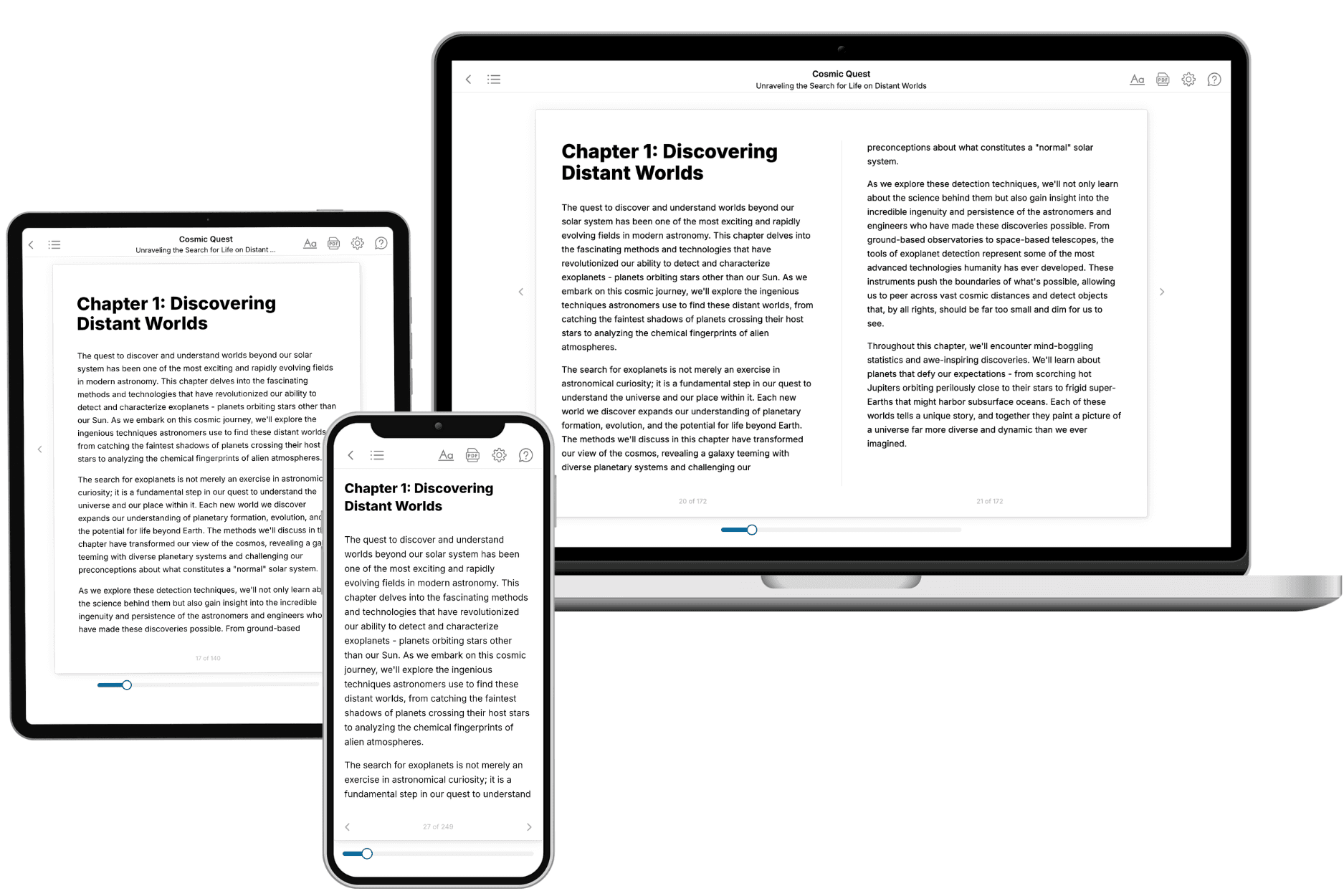
Your book is ready in 10 minutes. Read it online, download as EPUB or PDF, or send to Kindle.

Frequently asked questions
- What is TailoredRead?
TailoredRead creates complete, full-length nonfiction ebooks, written specifically for you. Tell us what you want to learn and why, and TailoredRead writes you a complete ebook on it, with charts, tables, and diagrams throughout. Read it online, on Kindle, or on any e-reader, or download it as a PDF or EPUB. Every book is written fresh the day you order it.
- How is the book tailored to me?
Before anything is written, you answer a few short questions about your goals, your background, and the topics you care about. Your book is then planned around your answers: written at your level, focused on your goals, and covering the topics you chose, instead of the one-size-fits-all book a store sells everyone.
- Will it read like generic AI content?
No. Your book isn't a chat transcript: it's planned chapter by chapter before a single word is written, told in a clear book voice, and explains ideas visually with charts, tables, and diagrams. After writing, every book goes through an editorial pass that polishes chapters so the book reads consistent from start to finish. Judge for yourself: browse thousands of sample books on our Explore Books page.
- How accurate is the content?
Our AI first checks whether your subject needs live research. Niche and fast-moving subjects are researched before writing, and the book plan and chapters are grounded in what it finds. After writing, every book goes through a quality pass that checks its facts and consistency, and researched books list their sources in a Notes section at the back.
- How long is the book?
You choose the length: Comprehensive (250-300 pages), Detailed (150-200 pages), Essential (70-100 pages), or Short (30-50 pages).
- Does the book include visuals?
Yes. Every book includes charts, tables, and diagrams: timelines, checklists, step-by-step guides, decision trees, comparison tables, matrices, and bar charts. A typical book includes dozens of these visual elements.
- Can I read it on Kindle? What formats can I download?
Yes. Every book can be read in our online reader or downloaded as a PDF or EPUB. The EPUB can be opened with Kindle, Apple Books, Kobo, and any e-reader. The Commercial and Author licenses also include an editable Word (DOCX) and Markdown download.
- How much does it cost?
About the price of a regular ebook. The exact price depends on your book's length and complexity, from $2 for the shortest books to $35 for the most comprehensive, and it's shown when you review your book, before you commit to anything. Each book is a one-time purchase, yours to keep, no subscription. Licenses that let you share, teach, or publish your book range from $35.99 to $49.99.
- Can I preview the book before purchasing?
Before you pay, you'll see what your book will cover: the title, a detailed description, the estimated length, and the complete chapter-by-chapter table of contents, so you know what you're getting before you decide. The full text itself is written after you purchase.
- How long does it take to create a book?
About 10 minutes. You can start reading the opening chapters while the rest is still being written.