Binary Decoded
Mastering the Art of Binary to Decimal Conversions
Are you ready to unlock the secrets of binary code?
269 pages13 chaptersDec 20, 2024Binary
About this book
"Binary Decoded: Mastering the Art of Binary to Decimal Conversions" is your gateway to understanding the fundamental language of computers. This comprehensive guide takes you on a fascinating exploration of binary arithmetic, revealing its intricate connections to the decimal system we use every day. From the basics of binary representation to advanced conversion techniques, this book equips you with the knowledge and skills to navigate the binary world with confidence. You'll discover how binary underpins modern computing and learn to effortlessly translate between binary and decimal systems. Whether you're a student, a tech enthusiast, or a professional looking to deepen your understanding of computer science fundamentals, "Binary Decoded" offers clear, accessible explanations and practical exercises to solidify your grasp of this essential concept. By the end of this journey, you'll see numbers in a whole new light and appreciate the elegant simplicity of binary arithmetic.
Table of contents
- IntroductionThe Importance of Binary in the Digital Age, Overview of the Book's Contents, Learning Objectives and OutcomesRead below
- Chapter 1: Understanding Binary BasicsWhat is Binary?, A Brief History of Binary, Binary's Role in Computing, Binary Representation of Data
- Chapter 2: The Decimal System RevisitedDecimal System Basics, Understanding Place Values, Decimal Arithmetic Operations, Limitations of the Decimal System
- Chapter 3: The Structure of Binary NumbersBinary Digits: 0 and 1, Binary Place Values, Counting in Binary, Recognizing Binary Patterns
- Chapter 4: Converting Binary to DecimalUnderstanding Positional Notation, Step-by-Step Conversion Process, Practice Exercises, Mental Math Techniques for Binary to Decimal
- Chapter 5: Converting Decimal to BinaryThe Division Method, The Subtraction Method, Tricks for Quick Conversions, Decimal to Binary Exercises
- Chapter 6: Dealing with Fractional NumbersBinary Fractions, Converting Fractional Decimals to Binary, Precision and Rounding Issues, Fractional Conversion Exercises
- Chapter 7: Binary Arithmetic OperationsBinary Addition, Binary Subtraction, Binary Multiplication, Binary Division
- Chapter 8: Bitwise OperationsAND Operation, OR Operation, XOR Operation, NOT Operation, Shift Operations
- Chapter 9: Representing Signed NumbersSign-Magnitude Representation, One's Complement, Two's Complement, Converting Signed Numbers
- Chapter 10: Practical Applications of BinaryBinary in Computer Memory, Digital Logic and Circuits, Data Compression Techniques, Error Detection and Correction
- Chapter 11: Advanced Binary TopicsFloating-Point Representation, Binary Codes (Gray, BCD), Algorithms Using Binary, Binary in Quantum Computing
- Chapter 12: Optimizing Binary ConversionsUsing Lookup Tables, Bitwise Conversion Tricks, Parallel Conversion Techniques, Hardware Acceleration Methods
- Chapter 13: The Future of BinaryBeyond Binary: Ternary and Other Systems, Quantum Bits and Superposition, Binary in Neuromorphic Computing, Ethical Considerations in Binary Systems
- Conclusion
- Glossary
- Further Reading
Introduction
Welcome to the fascinating world of binary numbers and their relationship to the decimal system. In this digital age, understanding binary is more than just a mathematical curiosity—it's a fundamental skill that underpins the entire field of computer science and digital technology. This introduction will set the stage for your journey into the realm of binary, providing you with a solid foundation to build upon as you progress through the book.
Binary, at its core, is a base-2 number system that uses only two digits: 0 and 1. This simplicity belies its power and versatility, as binary forms the basis for all digital computation and data storage. As you delve deeper into this subject, you'll discover how this seemingly basic concept has revolutionized technology and continues to shape the future of computing.
Throughout this book, you'll gain a comprehensive understanding of binary to decimal conversions, enhancing your proficiency in binary arithmetic and its practical applications. Whether you're a student looking to solidify your grasp of computer science fundamentals, a professional seeking to deepen your technical knowledge, or simply a curious individual fascinated by the inner workings of digital systems, this book will equip you with the knowledge and skills to navigate the binary world with confidence.
The Importance of Binary in the Digital Age
In today's digital landscape, binary is omnipresent, forming the foundation of all digital systems and technologies. From the smartphone in your pocket to the most powerful supercomputers, every digital device operates on the principles of binary. Understanding binary is not just about learning a different number system; it's about gaining insight into the very language of computers and digital technology.
The importance of binary in the digital age cannot be overstated. At its most fundamental level, binary represents the on/off states of electronic switches, which are the building blocks of all digital circuits. This simple representation allows for the creation of complex logical operations that drive all computational processes. By mastering binary, you'll gain a deeper appreciation for how computers process and store information, enabling you to understand and potentially optimize digital systems at their most basic level.
Moreover, binary plays a crucial role in data representation and storage. Every piece of digital information—be it text, images, audio, or video—is ultimately stored and processed as a series of binary digits. Understanding how this data is encoded and manipulated in binary form is essential for anyone working with digital systems, from software developers to hardware engineers. This knowledge can lead to more efficient data compression techniques, improved error detection and correction methods, and optimized algorithms for data processing.
In the field of computer networking, binary is equally important. Network protocols, IP addresses, and data packets all rely on binary representations. A solid grasp of binary can help you understand network configurations, troubleshoot connectivity issues, and even enhance network security measures. For instance, understanding subnet masks and IP addressing schemes becomes much more intuitive when you're comfortable working with binary numbers.
Binary also forms the basis for more advanced concepts in computer science, such as Boolean algebra and digital logic design. These areas are fundamental to the creation of computer hardware and the development of efficient algorithms. By mastering binary, you'll be better equipped to understand and work with these advanced topics, opening up new possibilities in fields like hardware design, cryptography, and artificial intelligence.
In the realm of software development, a strong foundation in binary can lead to more efficient and optimized code. Many programming languages offer bitwise operations that work directly on the binary representation of data. These operations can be incredibly fast and memory-efficient when used correctly. Understanding binary allows you to leverage these powerful tools, potentially leading to significant performance improvements in your software applications.
As we move into the era of quantum computing, understanding binary becomes even more crucial. While quantum computers operate on qubits, which can exist in superpositions of states, classical binary computation remains the foundation upon which quantum algorithms are built and their results are interpreted. A solid grasp of binary will be essential for anyone looking to work with or understand these cutting-edge technologies.
Furthermore, the principles of binary extend beyond just computing. In fields like genetics, binary-like systems are used to represent DNA sequences. In signal processing, binary codes are used for error correction in digital communications. Even in fields like finance, binary options represent a type of financial instrument. The ubiquity of binary concepts across various disciplines underscores its importance in the modern world.
As we continue to push the boundaries of technology, the importance of binary only grows. From the Internet of Things (IoT) to artificial intelligence and machine learning, binary underpins the technologies that are shaping our future. By mastering binary, you're not just learning about a number system—you're gaining the keys to understand and potentially influence the direction of technological progress.
In conclusion, binary is far more than just a curiosity or a niche topic for computer scientists. It's a fundamental concept that permeates all aspects of our digital world. By embarking on this journey to master binary to decimal conversions and understand binary arithmetic, you're equipping yourself with knowledge that will prove invaluable in navigating and shaping the digital landscape of the present and future.
Overview of the Book's Contents
This book is designed to take you on a comprehensive journey through the world of binary numbers, their relationship to the decimal system, and their applications in computing and beyond. Each chapter builds upon the previous ones, gradually increasing in complexity while reinforcing core concepts. This structured approach ensures that you develop a solid foundation before tackling more advanced topics.
We begin with the fundamentals in Chapter 1, "Understanding Binary Basics." This chapter introduces you to the concept of binary, its historical context, and its crucial role in computing. You'll learn about the binary number system, its advantages, and how it compares to other number systems. This foundational knowledge will set the stage for the more detailed explorations that follow.
Chapter 2, "The Decimal System Revisited," takes a step back to examine the familiar decimal system. By understanding the principles of the decimal system more deeply, you'll be better prepared to grasp the similarities and differences when working with binary. This chapter covers place values, arithmetic operations, and the limitations of the decimal system, providing a comparative framework for your study of binary.
In Chapter 3, "The Structure of Binary Numbers," we delve into the heart of binary representation. You'll learn about binary digits, place values in binary, and how to count in binary. This chapter also introduces you to common binary patterns, helping you develop an intuitive understanding of binary numbers. By the end of this chapter, you'll be comfortable reading and interpreting binary numbers.
Chapters 4 and 5 form the core of the book, focusing on the critical skills of converting between binary and decimal. "Converting Binary to Decimal" in Chapter 4 introduces you to positional notation and provides a step-by-step process for converting binary numbers to their decimal equivalents. You'll practice with numerous exercises and learn mental math techniques to speed up your conversions. Chapter 5, "Converting Decimal to Binary," covers the reverse process, teaching you methods like the division method and the subtraction method. You'll also learn tricks for quick conversions and have ample opportunity to practice through exercises.
Chapter 6, "Dealing with Fractional Numbers," extends your knowledge to handle numbers beyond integers. You'll learn about binary fractions, how to convert fractional decimals to binary, and understand the precision issues that can arise in these conversions. This chapter is crucial for developing a complete understanding of binary representation.
In Chapter 7, "Binary Arithmetic Operations," you'll learn how to perform addition, subtraction, multiplication, and division in binary. This chapter builds on your conversion skills and introduces the unique aspects of arithmetic in a base-2 system. Understanding these operations is fundamental to grasping how computers perform calculations.
Chapter 8 introduces you to "Bitwise Operations," a powerful set of tools for manipulating binary numbers. You'll learn about AND, OR, XOR, and NOT operations, as well as bit shifting. These operations are crucial in many areas of computing, from low-level system programming to cryptography.
Chapter 9, "Representing Signed Numbers," addresses the important topic of how negative numbers are handled in binary. You'll explore different representation methods, including sign-magnitude, one's complement, and two's complement. This knowledge is essential for understanding how computers handle negative numbers and perform arithmetic with them.
In Chapter 10, "Practical Applications of Binary," we explore how binary is used in real-world scenarios. From computer memory and digital logic to data compression and error detection, you'll see how the principles you've learned are applied in various aspects of computing and digital technology.
Chapter 11, "Advanced Binary Topics," takes you into more specialized areas. You'll learn about floating-point representation, various binary codes, algorithms that leverage binary properties, and even get a glimpse of how binary concepts extend into the realm of quantum computing.
Chapter 12, "Optimizing Binary Conversions," focuses on efficiency. You'll learn advanced techniques for speeding up binary conversions, including the use of lookup tables, bitwise tricks, parallel conversion techniques, and even hardware acceleration methods. This chapter is particularly valuable for those looking to optimize performance in computational systems.
Finally, Chapter 13, "The Future of Binary," looks ahead to emerging technologies and concepts. You'll explore alternatives to binary systems, learn about quantum bits and superposition, and consider how binary principles apply in cutting-edge fields like neuromorphic computing. This chapter also touches on ethical considerations related to binary systems and their impact on society.
Throughout the book, you'll find numerous examples, practice exercises, and real-world applications to reinforce your learning. By the time you reach the conclusion, you'll have a comprehensive understanding of binary numbers, their relationship to the decimal system, and their wide-ranging applications in the world of computing and beyond.
Learning Objectives and Outcomes
As you embark on this journey through the world of binary numbers and their relationship to the decimal system, it's important to have a clear understanding of what you'll achieve by the end of this book. The following learning objectives and outcomes have been carefully crafted to ensure that you gain a comprehensive and practical understanding of binary arithmetic and its applications.
By the time you complete this book, you will be able to:
- Understand and explain the fundamental concepts of binary numbers and their importance in digital systems.
- Compare and contrast the binary and decimal number systems, articulating the advantages and limitations of each.
- Confidently read, write, and interpret binary numbers of varying lengths.
- Convert numbers between binary and decimal systems quickly and accurately, using both manual methods and mental math techniques.
- Perform basic arithmetic operations (addition, subtraction, multiplication, and division) in binary.
- Handle fractional numbers in binary, including converting between binary and decimal fractions.
- Apply bitwise operations to manipulate binary numbers for various computational tasks.
- Understand and use different methods for representing signed (positive and negative) numbers in binary.
- Recognize and explain common binary patterns and their significance in computing.
- Describe and apply practical applications of binary in areas such as computer memory, digital logic, and data compression.
- Understand advanced topics like floating-point representation and various binary codes.
- Optimize binary conversion processes using techniques such as lookup tables and bitwise tricks.
- Discuss emerging trends and future directions in binary and alternative number systems, including quantum computing concepts.
These learning objectives are designed to provide you with both theoretical knowledge and practical skills. By achieving these objectives, you'll not only understand the concepts but also be able to apply them in real-world scenarios. Let's break down these objectives further to understand their significance and how they contribute to your overall mastery of binary arithmetic.
Understanding the fundamental concepts of binary numbers is crucial as it forms the foundation for all subsequent learning. This includes grasping why binary is used in digital systems and how it relates to the physical properties of electronic components. By comparing binary with the decimal system, you'll develop a deeper appreciation for the strengths and limitations of each, enabling you to choose the appropriate system for different tasks.
The ability to read, write, and interpret binary numbers is a core skill that you'll develop early in the book. This proficiency will allow you to work comfortably with binary data in various contexts, from reading memory addresses to understanding binary file formats. As you progress, you'll build on this skill to perform more complex operations.
Converting between binary and decimal systems is perhaps the most practical skill you'll acquire. This ability is essential for anyone working with digital systems, as it allows you to translate between the human-readable decimal system and the computer-friendly binary system. The mental math techniques you'll learn will prove invaluable in quickly estimating and verifying conversions without relying on calculators or computers.
Performing arithmetic operations in binary is fundamental to understanding how computers process numerical data. By mastering these operations, you'll gain insight into the inner workings of arithmetic logic units (ALUs) in processors and be better equipped to optimize algorithms that involve numerical computations.
The section on fractional numbers extends your knowledge beyond integers, which is crucial for working with real-world data that often involves decimal points. This understanding is particularly important in fields like computer graphics, scientific computing, and financial calculations where precision is key.
Bitwise operations are powerful tools in binary manipulation, often used in low-level programming, cryptography, and data compression. By learning these operations, you'll be able to perform efficient manipulations of binary data, opening up new possibilities in algorithm design and optimization.
Understanding signed number representation is essential for working with a full range of integers in computing. This knowledge will help you avoid common pitfalls related to integer overflow and underflow, which can lead to subtle bugs in software systems.
Recognizing common binary patterns will develop your intuition for binary numbers, making you more efficient in working with and debugging binary data. This skill is particularly useful in areas like network addressing, where certain bit patterns have specific meanings.
The practical applications covered in the book will help you connect theoretical knowledge with real-world scenarios. This understanding is crucial for applying your skills in professional contexts, whether you're working on low-level system programming, developing compression algorithms, or designing digital circuits.
Advanced topics like floating-point representation and binary codes will broaden your understanding of how binary is used in specialized areas of computing. This knowledge will prepare you for more advanced studies in computer architecture and numerical computing.
Learning to optimize binary conversions will enhance your ability to write efficient code and design fast algorithms. These skills are particularly valuable in performance-critical applications where every CPU cycle counts.
Finally, exploring emerging trends and future directions will give you a perspective on how binary concepts are evolving and being applied in cutting-edge technologies. This forward-looking approach will help you stay ahead of the curve in the rapidly changing field of computing.
By achieving these learning objectives, you'll not only gain a deep understanding of binary arithmetic but also develop a set of practical skills that are highly valued in the fields of computer science, software engineering, and digital technology. Whether you're aiming to excel in your studies, advance your career, or simply satisfy your curiosity about the fundamental workings of digital systems, mastering these objectives will provide you with a solid foundation for success.
This is the end of the free sample. The full book has 13 chapters.
Want this book written for you?
Tell us your goals and background, and get your own version of this book, tailored by AI to you.


Benefits of AI-tailored books
- Read one book, not ten:
- all the Binary knowledge you need, gathered into a single book.
- Save days of learning:
- tell us your goals, choose your topics, and the whole book is built around them.
- Learn effortlessly:
- Binary book written for your specific background and expertise.
- Understand at a glance:
- includes charts, tables, timelines, checklists, decision trees, and more.
- Stay current:
- written the day you order it, not years ago.
- Trust what you read:
- every book is checked for accuracy, with real research when your subject needs it.
Create your unique book in 3 steps
- 1. Select your focus
Select the focus of your Binary book and share your background
- 2. Personalize your book
Specify your goals and choose sub-topics to include
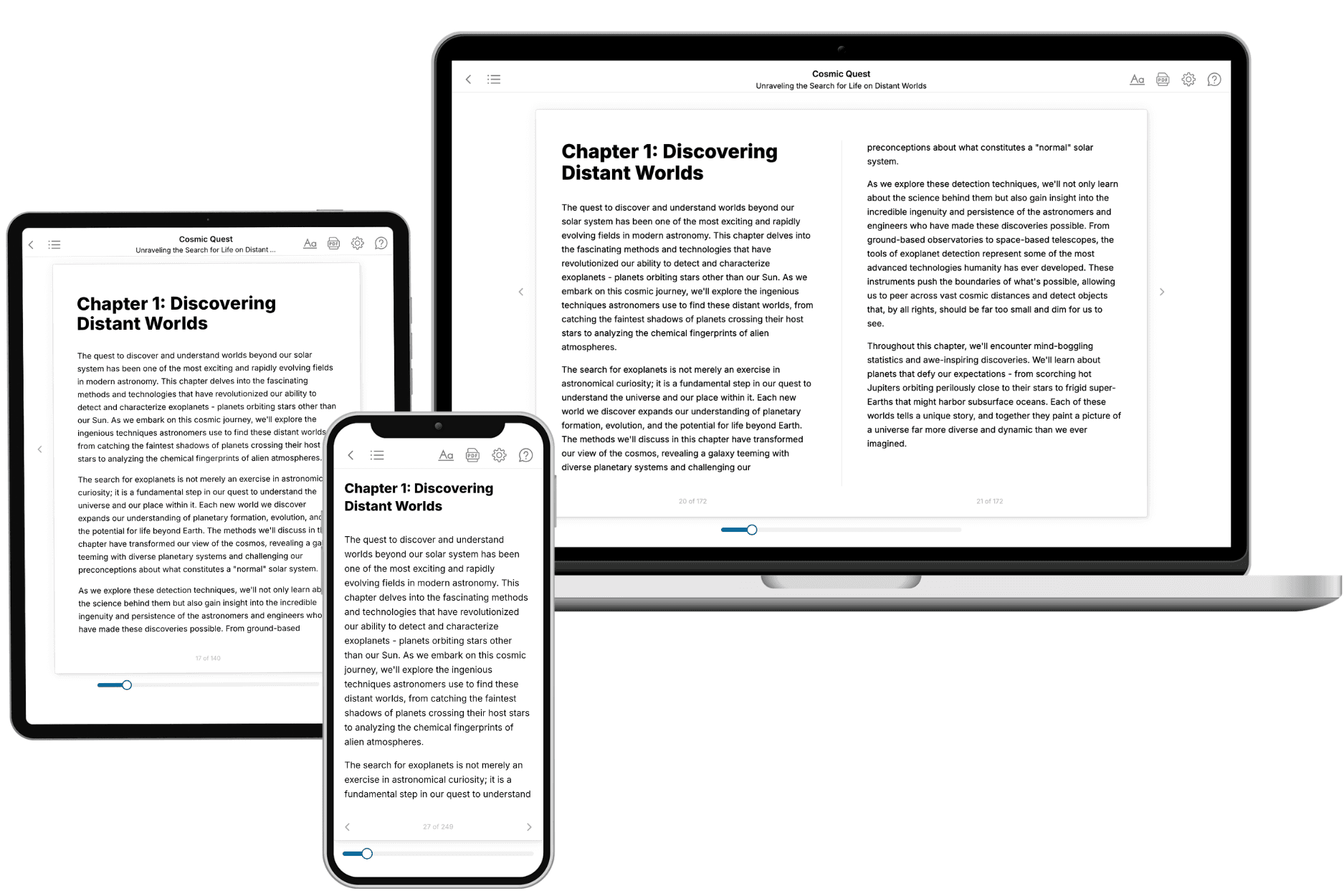
- 3. Get your tailored book
Your book is ready in 10 minutes. Read it online, download as EPUB or PDF, or send to Kindle.
Frequently asked questions
- What is TailoredRead?
TailoredRead creates complete, full-length nonfiction ebooks, written specifically for you. Tell us what you want to learn and why, and TailoredRead writes you a complete ebook on it, with charts, tables, and diagrams throughout. Read it online, on Kindle, or on any e-reader, or download it as a PDF or EPUB. Every book is written fresh the day you order it.
- How is the book tailored to me?
Before anything is written, you answer a few short questions about your goals, your background, and the topics you care about. Your book is then planned around your answers: written at your level, focused on your goals, and covering the topics you chose, instead of the one-size-fits-all book a store sells everyone.
- Will it read like generic AI content?
No. Your book isn't a chat transcript: it's planned chapter by chapter before a single word is written, told in a clear book voice, and explains ideas visually with charts, tables, and diagrams. After writing, every book goes through an editorial pass that polishes chapters so the book reads consistent from start to finish. Judge for yourself: browse thousands of sample books on our Explore Books page.
- How accurate is the content?
Our AI first checks whether your subject needs live research. Niche and fast-moving subjects are researched before writing, and the book plan and chapters are grounded in what it finds. After writing, every book goes through a quality pass that checks its facts and consistency, and researched books list their sources in a Notes section at the back.
- How long is the book?
You choose the length: Comprehensive (250-300 pages), Detailed (150-200 pages), Essential (70-100 pages), or Short (30-50 pages).
- Does the book include visuals?
Yes. Every book includes visual elements such as timelines, checklists, step-by-step guides, decision trees, comparison tables, and matrices, and many include bar charts. A typical book includes dozens of these visual elements.
- Can I read it on Kindle? What formats can I download?
Yes. Every book can be read in our online reader or downloaded as a PDF or EPUB. The EPUB can be opened with Kindle, Apple Books, Kobo, and any e-reader. The Commercial and Author licenses also include an editable Word (DOCX) and Markdown download.
- How much does it cost?
About the price of a regular ebook. The exact price depends on your book's length and complexity, from $2 for the shortest books to $35 for the most comprehensive, and it's shown when you review your book, before you commit to anything. Each book is a one-time purchase, yours to keep, no subscription. Licenses that let you share, teach, or publish your book range from $35.99 to $49.99.
- Can I preview the book before purchasing?
Before you pay, you'll see what your book will cover: the title, a detailed description, the estimated length, and the complete chapter-by-chapter table of contents, so you know what you're getting before you decide. The full text itself is written after you purchase.
- How long does it take to create a book?
About 10 minutes. You can start reading the opening chapters while the rest is still being written.