Building Compilers from Scratch
Master the Art of Translating Code into Machine Instructions
Most developers use compilers daily without understanding how they work.
191 pages9 chaptersJan 12, 2026Compiler Design
About this book
You write code, hit compile, and executable programs magically appear—but the process behind that magic remains a mystery. This gap in knowledge limits your ability to debug complex issues, optimize performance, and understand the languages you depend on. This book demystifies compiler design by walking you through each phase of compilation with clear explanations and practical examples. You'll learn how lexical analyzers tokenize source code, how parsers build syntax trees, how semantic analysis validates correctness, and how code generators produce efficient machine instructions. Rather than abstract theory, you'll see real algorithms and techniques used in production compilers, with concrete examples you can study and implement. Whether you're building a domain-specific language, optimizing a compiler for your platform, or simply want to deepen your technical expertise, this book provides the knowledge and confidence to tackle compiler design challenges. By the end, you'll understand not just how compilers work, but why they're designed the way they are.
Table of contents
- IntroductionWhy Compilers Matter in Modern Computing, What You'll Learn in This Book, How to Use This Book Effectively, Prerequisites and AssumptionsRead below
- Chapter 1: Foundations of Compiler DesignWhat Is a Compiler and Why Does It Matter?, The Seven Phases of Compilation, Understanding Compiler Architecture and Design Patterns
- Chapter 2: Formal Languages and GrammarsIntroduction to Formal Language Theory, Chomsky Hierarchy: Regular, Context-Free, and Context-Sensitive Grammars, Backus-Naur Form and Grammar Notation, Ambiguity, Associativity, and Precedence in Grammars
- Chapter 3: Lexical Analysis: Tokenizing Source CodeLexemes, Tokens, and Lexical Patterns, Finite Automata and Regular Expressions, Building Scanners and Lexical Analyzers, Lexer Generation Tools: Lex and Flex
- Chapter 4: Syntax Analysis: Parsing and Abstract Syntax TreesParsing Fundamentals and Parse Trees, Recursive Descent Parsing: Hand-Written Parsers, LL Parsing: Top-Down Predictive Parsing, LR Parsing: Bottom-Up Shift-Reduce Parsing
- Chapter 5: Semantic Analysis and Type CheckingSemantic Analysis: Beyond Syntax, Symbol Tables and Scope Management, Type Systems and Type Checking Algorithms, Error Detection and Recovery Strategies
- Chapter 6: Intermediate Code GenerationIntermediate Representations and Their Benefits, Three-Address Code and Quadruples, Generating Intermediate Code from Abstract Syntax Trees, Real-World Intermediate Representations: LLVM IR and Java Bytecode
- Chapter 7: Code Optimization TechniquesOptimization Goals and Trade-offs, Local Optimizations: Constant Folding and Algebraic Simplification, Global Optimizations: Loop Optimization and Dead Code Elimination, Data Flow Analysis and Optimization Frameworks
- Chapter 8: Code Generation and Target Machine ConsiderationsCode Generation Fundamentals, Register Allocation and Assignment Algorithms, Instruction Selection and Scheduling, Handling Target-Specific Features and Calling Conventions
- Chapter 9: Building a Complete Compiler: Practical ImplementationDesigning Your Compiler Project Architecture, Step-by-Step Implementation of a Simple Language Compiler, Testing, Debugging, and Validating Your Compiler
- ConclusionKey Takeaways and Core Principles, Next Steps: Advanced Topics and Further Learning
- Appendix: Quick Reference and ResourcesCommon Grammar Patterns and Examples, Algorithm Reference Guide, Compiler Tools, Frameworks, and Learning Resources
Introduction
Every time you write code and press compile, a sophisticated transformation occurs behind the scenes. Your high-level source code—readable and expressive—becomes low-level machine instructions that processors can execute directly. This transformation isn't magic, though it might seem that way. It's the work of compilers, complex programs that bridge the gap between human thought and machine execution. Understanding how compilers work fundamentally changes how you think about programming languages, performance optimization, and software design.
Most developers treat compilers as black boxes. You feed them source code, wait a few seconds, and receive executable programs or error messages. This abstraction serves you well for everyday programming tasks, but it limits your potential. When compilation fails with cryptic error messages, when your code runs slower than expected, or when you need to extend a language with new features, that black box becomes an obstacle. The knowledge inside remains inaccessible, leaving you dependent on tools you don't fully understand.
This book opens that black box. You'll learn how compilers systematically transform source code through distinct phases: lexical analysis breaks text into tokens, syntax analysis builds structural representations, semantic analysis validates correctness, and code generation produces executable output. Each phase solves specific problems using well-established algorithms and data structures. By understanding these phases and their interactions, you gain insight into language design decisions, performance characteristics, and debugging strategies that remain invisible to most programmers.
The journey from source code to machine instructions involves more than just translation. Compilers optimize your code, sometimes dramatically improving performance beyond what you wrote. They detect errors early, preventing bugs from reaching production. They enable portability, allowing the same source code to run on different hardware architectures. These capabilities emerge from careful design choices and algorithmic techniques that you'll explore throughout this book. Whether you're building domain-specific languages, contributing to open-source compiler projects, or simply seeking deeper technical knowledge, understanding compiler design provides invaluable perspective on how software systems work.
Why Compilers Matter in Modern Computing
Compilers form the foundation of modern software development. Every programming language you use—whether Python, Java, C++, Rust, or JavaScript—depends on compilers or interpreters to execute your code. These tools don't just translate syntax; they shape what's possible in each language. Features like type safety, memory management, and concurrency models exist because compiler designers created mechanisms to implement them. When you understand compilers, you understand why languages behave the way they do and what trade-offs their designers made.
Performance optimization represents one of the most compelling reasons to study compilers. Modern compilers perform transformations that would be impractical to write by hand. They eliminate redundant calculations, reorder instructions for better processor utilization, and allocate registers efficiently. Consider a simple loop that sums array elements: a compiler might unroll the loop, vectorize operations to use SIMD instructions, and prefetch memory to hide latency. These optimizations can improve performance by factors of ten or more, yet they happen automatically. Understanding how compilers optimize code helps you write programs that benefit from these transformations rather than fighting against them.
The rise of domain-specific languages (DSLs) makes compiler knowledge increasingly practical. Organizations build specialized languages for configuration management, data processing pipelines, business rules, and scientific computing. These languages provide syntax and semantics tailored to specific problems, making solutions more concise and maintainable than general-purpose alternatives. Building a DSL requires compiler skills: you need to define syntax, parse input, validate semantics, and generate output. Companies like Netflix, Facebook, and Google have built internal DSLs that improve developer productivity and system reliability[1].
A compiler for a simple language might take a few thousand lines of code, while production compilers like GCC or LLVM contain millions of lines. Yet both follow the same fundamental architecture and phases. The principles scale from toy languages to industrial-strength implementations.
Debugging and tooling represent another practical application of compiler knowledge. Modern development environments provide features like syntax highlighting, code completion, refactoring tools, and static analysis. These features rely on compiler techniques: lexical analysis for syntax highlighting, parsing for code structure, and semantic analysis for understanding variable scopes and types. Language servers that power editor integrations are essentially compiler front-ends that expose intermediate representations to tools. Understanding these mechanisms helps you build better development tools and debug issues when tools misbehave.
Security and correctness increasingly depend on compiler technology. Static analysis tools detect bugs, security vulnerabilities, and performance problems by analyzing code without executing it. These tools use compiler techniques to build program representations, track data flow, and identify problematic patterns. Formal verification systems prove program correctness using compiler-like analysis. As software systems grow more complex and security threats more sophisticated, compiler-based analysis becomes essential for building reliable systems.
The evolution of hardware architectures makes compiler expertise valuable for systems programming. Modern processors feature complex instruction sets, multiple cores, vector units, and deep memory hierarchies. Graphics processors (GPUs) and specialized accelerators add further complexity. Compilers must target these diverse architectures efficiently, generating code that exploits available parallelism and manages memory hierarchies effectively. Understanding how compilers handle these challenges helps you write code that performs well across different hardware platforms.
Career opportunities in compiler development continue to grow. Technology companies invest heavily in compiler infrastructure to support new languages, improve performance, and enable new hardware. Projects like LLVM, GCC, Rust, Swift, and TypeScript employ compiler engineers to advance language implementations. Specialized domains like machine learning, quantum computing, and high-performance computing need compiler experts to bridge the gap between high-level frameworks and efficient execution. The skills you develop studying compilers transfer to these opportunities and many others in systems programming and language design.
What You'll Learn in This Book
This book guides you through the complete compilation process, from source code to executable output. You'll start with formal language theory, learning how grammars define programming language syntax and how mathematical models enable automated parser construction. These foundations might seem abstract initially, but they provide the theoretical basis for practical compiler construction. Regular expressions and context-free grammars aren't just academic concepts—they're tools you'll use to specify lexical and syntactic structure precisely.
Lexical analysis forms your first hands-on compiler phase. You'll learn how scanners break source code into tokens using finite automata and regular expressions. The chapter covers practical implementation techniques, including handling keywords, operators, identifiers, and literals. You'll see how tools like Lex and Flex automate scanner generation from regular expression specifications. By the end, you'll understand how to build efficient lexical analyzers that handle real programming language requirements like nested comments, string escapes, and whitespace handling.
Parsing techniques receive extensive coverage because they're central to compiler construction. You'll explore multiple parsing approaches with different trade-offs:
- Recursive descent parsing: Hand-written parsers that directly implement grammar rules as functions, offering simplicity and control
- LL parsing: Top-down predictive parsing that uses lookahead to choose grammar productions, suitable for many programming languages
- LR parsing: Bottom-up shift-reduce parsing that handles a broader class of grammars, used in parser generators like Yacc and Bison
- Abstract syntax trees: Simplified tree representations that capture program structure without syntactic details
Semantic analysis and type checking ensure program correctness beyond syntax. You'll learn how symbol tables track variable declarations, function signatures, and type information across different scopes. Type checking algorithms verify that operations receive compatible operands and that function calls match signatures. The chapter covers both simple type systems with basic types and more sophisticated systems with generics, type inference, and subtyping. You'll see how semantic analysis catches errors like undefined variables, type mismatches, and scope violations before code generation.
Intermediate representations (IR) decouple language-specific front-ends from machine-specific back-ends. You'll learn why compilers use intermediate forms like three-address code, static single assignment (SSA) form, and control flow graphs. These representations simplify optimization and code generation by providing uniform interfaces between compilation phases. The chapter examines real-world IRs including LLVM IR and Java bytecode, showing how production compilers structure intermediate code for analysis and transformation.
Code optimization techniques improve program performance and resource usage. You'll explore multiple optimization categories:
- Local optimizations: Constant folding, algebraic simplification, and strength reduction within basic blocks
- Global optimizations: Common subexpression elimination, dead code elimination, and code motion across basic blocks
- Loop optimizations: Loop invariant code motion, loop unrolling, and loop fusion for better performance
- Data flow analysis: Reaching definitions, live variable analysis, and available expressions for optimization opportunities
Code generation translates intermediate representations into target machine instructions. You'll learn how compilers select appropriate instructions, allocate registers efficiently, and schedule instructions for optimal processor utilization. The chapter covers calling conventions, stack frame management, and handling target-specific features like addressing modes and instruction set extensions. You'll see how register allocation algorithms like graph coloring assign variables to limited hardware registers while minimizing memory accesses.
A complete implementation chapter ties everything together. You'll follow the step-by-step construction of a compiler for a simple but realistic programming language. This practical project demonstrates how compilation phases integrate, how data structures connect different stages, and how to test and debug compiler implementations. The implementation uses clear, readable code that prioritizes understanding over optimization, making it suitable for study and experimentation.
The compiler you'll build handles variable declarations, arithmetic expressions, control flow statements, and function definitions. While simpler than production compilers, it demonstrates all essential compilation phases and produces working executable code.
How to Use This Book Effectively
This book follows a progressive structure that builds knowledge systematically. Early chapters establish theoretical foundations and introduce concepts that later chapters apply in practical contexts. While you might be tempted to skip ahead to implementation chapters, the foundational material provides essential context for understanding why compilers work the way they do. Formal language theory might seem abstract, but it directly informs parser design and grammar specification. Investing time in these foundations pays dividends when you encounter complex parsing problems or need to debug grammar ambiguities.
Each chapter includes concrete examples that illustrate concepts with specific code and transformations. Don't just read these examples passively—work through them yourself. Trace how lexical analyzers tokenize input strings, follow how parsers build syntax trees, and verify how optimizations transform code. Active engagement with examples deepens understanding far more than passive reading. Consider keeping a notebook or digital document where you work through examples, noting questions and insights as they arise.
The implementation chapter provides a complete compiler project that you should build alongside your reading. This hands-on experience transforms abstract concepts into concrete skills. You'll encounter challenges that the text doesn't explicitly address, forcing you to apply principles creatively. Debugging your implementation teaches lessons that reading alone cannot provide. Consider these approaches for maximizing learning from the implementation project:
- Build the compiler incrementally, testing each phase before moving to the next
- Create a comprehensive test suite with both valid and invalid inputs
- Experiment with language extensions beyond the base implementation
- Compare your implementation with the provided code, noting differences in approach
- Profile your compiler to understand performance characteristics of different phases
Supplementary resources enhance your learning beyond this book's content. The compiler construction community maintains excellent open-source projects, documentation, and educational materials. Study production compiler source code like LLVM, GCC, or language-specific compilers for languages you know. These codebases demonstrate how theoretical concepts scale to industrial implementations. Start with well-documented subsystems like lexical analyzers or specific optimization passes rather than trying to understand entire compilers at once.
Online communities provide valuable support when you encounter difficulties. Forums like Stack Overflow, Reddit's programming communities, and language-specific discussion groups include experienced compiler developers who can answer questions and provide guidance. When asking questions, provide specific details about your problem: include code snippets, describe what you expected versus what happened, and explain what you've already tried. Well-formulated questions receive better responses and help you develop problem-solving skills.
Consider forming a study group with others learning compiler design. Discussing concepts with peers reveals different perspectives and helps identify gaps in understanding. Working through problems together provides motivation and accountability. You might divide implementation tasks, with different people building different compiler phases, then integrating your work. This collaborative approach mirrors how real compiler projects operate and develops teamwork skills alongside technical knowledge.
Pace yourself appropriately—compiler design involves substantial complexity that takes time to absorb. Don't expect to master everything in a single reading. Plan to revisit chapters as you progress, since later material often clarifies earlier concepts. You might read the book once for overview understanding, then return to specific chapters when implementing related functionality. This iterative approach builds deeper comprehension than trying to memorize everything linearly.
Many successful compiler engineers report that concepts "clicked" only after implementing them. The gap between understanding an algorithm description and making it work in code reveals subtleties that text alone cannot convey. Embrace this learning process rather than expecting immediate mastery.
Keep a list of questions and topics for deeper exploration. Compiler design connects to many computer science areas: algorithms, data structures, formal languages, computer architecture, and software engineering. When you encounter concepts that interest you particularly, note them for further study. The appendix includes resources for advanced topics beyond this book's scope, providing pathways for continued learning after you complete the main content.
Prerequisites and Assumptions
This book assumes you have solid programming experience in at least one language. You should be comfortable with fundamental programming concepts: variables, functions, control flow, data structures, and basic algorithms. The specific language matters less than your general programming maturity. Examples in this book use pseudocode and occasionally C-like syntax for clarity, but you can implement concepts in any language that supports the necessary features. Languages like Python, Java, C++, or Rust all work well for compiler implementation projects.
Data structures and algorithms form essential prerequisites for compiler construction. You should understand these fundamental concepts:
- Trees: Binary trees, tree traversal algorithms, and tree manipulation operations
- Graphs: Graph representation, traversal algorithms like depth-first and breadth-first search
- Hash tables: Hash functions, collision resolution, and performance characteristics
- Stacks and queues: Stack-based algorithms and queue operations
- Recursion: Recursive algorithms and their iterative equivalents
- Algorithm analysis: Big-O notation and complexity analysis basics
Basic discrete mathematics helps with formal language theory chapters. You should understand sets, functions, relations, and basic proof techniques. Mathematical induction appears in several proofs about grammar properties and algorithm correctness. Regular expressions and finite automata involve set theory and formal notation. While the book explains these concepts as needed, prior exposure makes the material more accessible. Don't let mathematical notation intimidate you—the underlying ideas are often simpler than the formal presentation suggests.
Computer architecture knowledge enhances your understanding of code generation and optimization, though it's not strictly required for earlier chapters. Familiarity with assembly language, processor registers, memory hierarchies, and instruction execution helps you appreciate why compilers make certain optimization decisions. If you've never written assembly code, consider working through a basic assembly language tutorial. Understanding how processors execute instructions provides valuable context for code generation techniques.
No prior compiler experience is assumed. This book starts from first principles and builds up to complete compiler implementation. If you've used compilers but never looked inside them, you're the target audience. Previous exposure to parsing, regular expressions, or language design helps but isn't necessary. The book explains all compiler-specific concepts from the ground up, assuming only general programming knowledge.
Software engineering practices improve your implementation experience. Version control systems like Git help you track changes and experiment safely. Testing frameworks enable systematic validation of compiler components. Debugging tools help you diagnose issues in your implementation. While these tools aren't strictly required, they make compiler development more manageable and professional. Consider setting up a proper development environment with version control and testing infrastructure before starting implementation work.
Time commitment varies based on your goals and background. Reading the book thoroughly takes perhaps 30-40 hours. Implementing the complete compiler project adds another 40-60 hours, depending on your programming speed and how extensively you test and extend the base implementation. Spreading this work over several weeks or months allows time for concepts to sink in and for you to experiment with variations. Don't rush—compiler design rewards careful study and hands-on experimentation.
Your learning style affects how you should approach the material. If you learn best by doing, start implementing early and refer back to theoretical chapters as needed. If you prefer understanding concepts before applying them, read several chapters before beginning implementation. Some readers benefit from alternating between reading and coding, implementing each phase immediately after studying it. Experiment to find the approach that works best for you, and don't hesitate to adjust your strategy as you progress through the book.
Notes
Introduction
- 1. Martin Fowler, Domain-Specific Languages, Addison-Wesley Professional, 2010
This is the end of the free sample. The full book has 9 chapters.
Want this book written for you?
Tell us your goals and background, and get your own version of this book, tailored by AI to you.


Benefits of AI-tailored books
- Read one book, not ten:
- all the Compiler Design knowledge you need, gathered into a single book.
- Save days of learning:
- tell us your goals, choose your topics, and the whole book is built around them.
- Learn effortlessly:
- Compiler Design book written for your specific background and expertise.
- Understand at a glance:
- includes charts, tables, timelines, checklists, decision trees, and more.
- Stay current:
- written the day you order it, not years ago.
- Trust what you read:
- every book is checked for accuracy, with real research when your subject needs it.
Create your unique book in 3 steps
- 1. Select your focus
Select the focus of your Compiler Design book and share your background
- 2. Personalize your book
Specify your goals and choose sub-topics to include
- 3. Get your tailored book
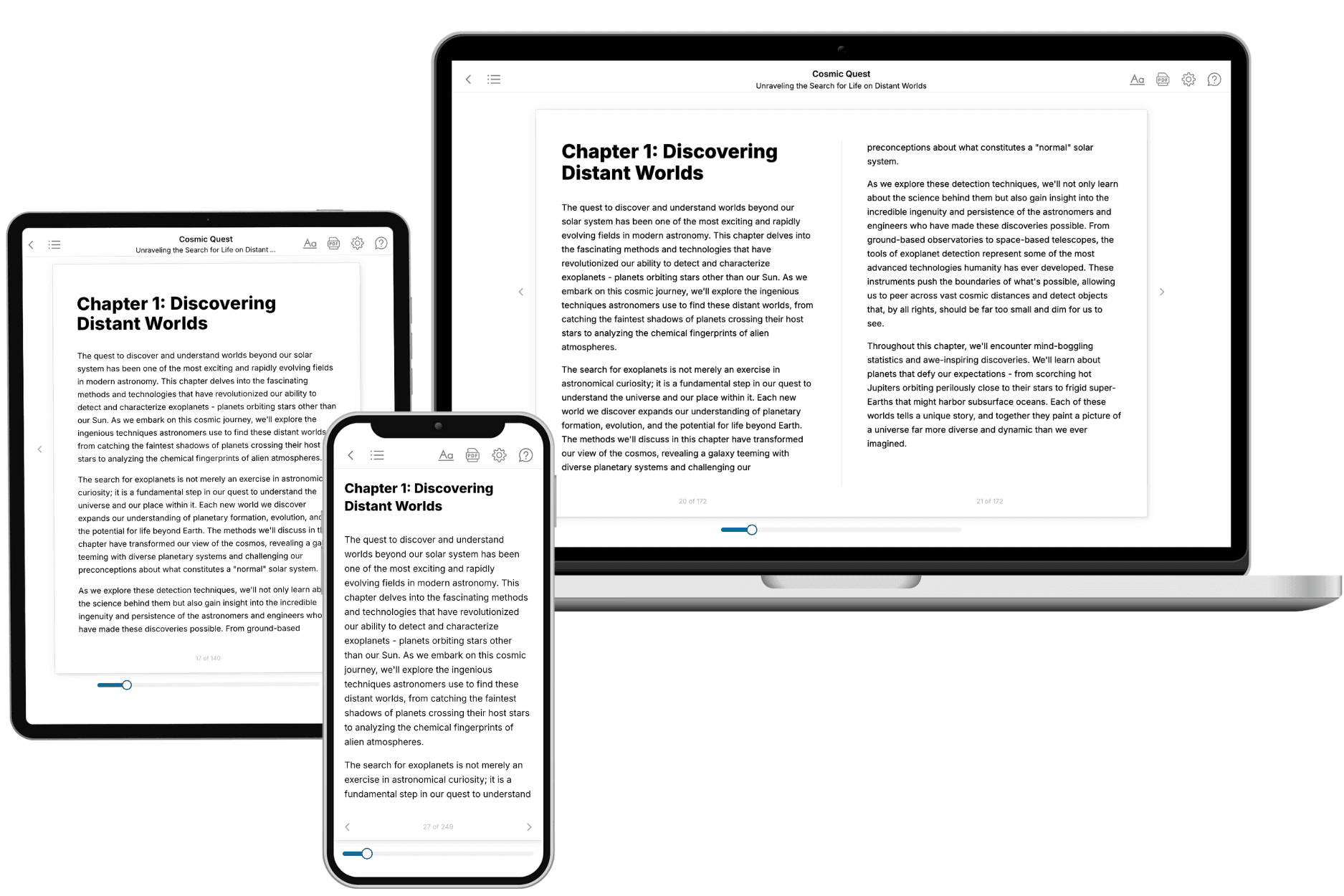
Your book is ready in 10 minutes. Read it online, download as EPUB or PDF, or send to Kindle.
Frequently asked questions
- What is TailoredRead?
TailoredRead creates complete, full-length nonfiction ebooks, written specifically for you. Tell us what you want to learn and why, and TailoredRead writes you a complete ebook on it, with charts, tables, and diagrams throughout. Read it online, on Kindle, or on any e-reader, or download it as a PDF or EPUB. Every book is written fresh the day you order it.
- How is the book tailored to me?
Before anything is written, you answer a few short questions about your goals, your background, and the topics you care about. Your book is then planned around your answers: written at your level, focused on your goals, and covering the topics you chose, instead of the one-size-fits-all book a store sells everyone.
- Will it read like generic AI content?
No. Your book isn't a chat transcript: it's planned chapter by chapter before a single word is written, told in a clear book voice, and explains ideas visually with charts, tables, and diagrams. After writing, every book goes through an editorial pass that polishes chapters so the book reads consistent from start to finish. Judge for yourself: browse thousands of sample books on our Explore Books page.
- How accurate is the content?
Our AI first checks whether your subject needs live research. Niche and fast-moving subjects are researched before writing, and the book plan and chapters are grounded in what it finds. After writing, every book goes through a quality pass that checks its facts and consistency, and researched books list their sources in a Notes section at the back.
- How long is the book?
You choose the length: Comprehensive (250-300 pages), Detailed (150-200 pages), Essential (70-100 pages), or Short (30-50 pages).
- Does the book include visuals?
Yes. Every book includes charts, tables, and diagrams: timelines, checklists, step-by-step guides, decision trees, comparison tables, matrices, and bar charts. A typical book includes dozens of these visual elements.
- Can I read it on Kindle? What formats can I download?
Yes. Every book can be read in our online reader or downloaded as a PDF or EPUB. The EPUB can be opened with Kindle, Apple Books, Kobo, and any e-reader. The Commercial and Author licenses also include an editable Word (DOCX) and Markdown download.
- How much does it cost?
About the price of a regular ebook. The exact price depends on your book's length and complexity, from $2 for the shortest books to $35 for the most comprehensive, and it's shown when you review your book, before you commit to anything. Each book is a one-time purchase, yours to keep, no subscription. Licenses that let you share, teach, or publish your book range from $35.99 to $49.99.
- Can I preview the book before purchasing?
Before you pay, you'll see what your book will cover: the title, a detailed description, the estimated length, and the complete chapter-by-chapter table of contents, so you know what you're getting before you decide. The full text itself is written after you purchase.
- How long does it take to create a book?
About 10 minutes. You can start reading the opening chapters while the rest is still being written.