The Chartist Movement
Britain's First Mass Working-Class Political Campaign and Its Legacy
Discover how ordinary working people in 19th-century Britain organized to demand a voice in their own governance.
207 pages10 chaptersFeb 4, 2026British History
About this book
The Chartist Movement stands as one of history's most significant yet often overlooked campaigns for democratic rights. This book traces the movement from its emergence in the 1830s through its peak in the 1840s, examining the economic conditions, political exclusions, and social aspirations that drove millions to petition for change. You'll explore the lives of key figures like Feargus O'Connor and William Lovett, understand the strategic debates between moral force and physical force advocates, and see how regional communities adapted Chartist principles to their local circumstances. Rather than viewing Chartism as a failure, this account reveals how the movement fundamentally transformed British politics and democracy itself. By understanding this pivotal moment in working-class history, you'll gain insight into how ordinary people challenge entrenched power and how social movements create lasting change.
Table of contents
- IntroductionWhy Chartism Matters Today, What You Will Learn in This Book, How to Use This BookRead below
- Chapter 1: Britain Before Chartism: The Industrial Revolution and Political ExclusionThe Industrial Transformation of Britain, The Emergence of the Working Class, The 1832 Reform Act and Working-Class Disappointment
- Chapter 2: The Birth of Chartism: Origins and Early OrganizationThe Six Points of the People's Charter, Early Leaders and Organizing Efforts, The First National Petition and Mass Mobilization
- Chapter 3: Moral Force vs. Physical Force: Strategic Debates Within ChartismThe Moral Force Philosophy and William Lovett, Physical Force Advocates and Feargus O'Connor, Tensions and Conflicts Over Strategy
- Chapter 4: Regional Variations: How Chartism Took Root Across BritainThe Northern Industrial Heartland, Welsh Chartism and Local Grievances, London and Southern Chartism
- Chapter 5: The Chartist Press and Public CommunicationNewspapers and Publications as Movement Tools, Mass Meetings and Public Gatherings, Spreading the Message Across Communities
- Chapter 6: Key Figures and Personalities in the Chartist MovementFeargus O'Connor: The Charismatic Leader, William Lovett: The Moral Force Advocate, Other Notable Chartist Leaders and Activists
- Chapter 7: The Chartist Petitions: Campaigns for Parliamentary AttentionThe First Petition of 1839, The Second Petition of 1842, The Third Petition of 1848 and Final Efforts
- Chapter 8: Conflict and Repression: Government Response and Chartist ResistanceGovernment Opposition and Legal Restrictions, Arrests, Trials, and Imprisonment of Leaders, Violent Incidents and Military Confrontations
- Chapter 9: The Decline of Chartism: Internal Divisions and Changing CircumstancesEconomic Recovery and Changing Conditions, Internal Fragmentation and Leadership Disputes, The Movement's Gradual Dissolution
- Chapter 10: Chartism's Legacy: Democratic Reforms and Political ChangeImplementation of Chartist Demands in Subsequent Reforms, Influence on the Labor Movement and Socialism, Chartism's Impact on European Democratic Movements
- ConclusionThe Historical Significance of Chartism, Lessons for Modern Activism and Democratic Participation
- Further Reading and Resources
Introduction
In the spring of 1839, a procession stretched for miles through the streets of London. Working men and women carried a massive petition, reportedly weighing over six hundred pounds, containing more than 1.2 million signatures. They were demanding something that seems obvious today but was revolutionary then: the right to vote regardless of property ownership, secret ballots to protect voters from intimidation, and payment for Members of Parliament so that ordinary people could serve. This was the Chartist Movement, Britain's first mass working-class political campaign, and it would fundamentally reshape how we think about democracy itself. The petition was rejected by Parliament with contempt, yet the ideas it contained would eventually become the foundation of modern democratic governance across the Western world.
The Chartist Movement emerged during a period of profound transformation in British society. The Industrial Revolution had created new forms of wealth and new concentrations of poverty, bringing millions of people into crowded cities where they worked in factories under conditions that shocked even contemporary observers. These working people found themselves excluded from political power by property qualifications that restricted voting rights to a small minority of wealthy men. The 1832 Reform Act, which had promised democratic progress, had actually reinforced their exclusion by explicitly denying them representation while extending the franchise to middle-class property owners. This betrayal created the conditions for an unprecedented political mobilization that would span more than a decade and involve millions of participants across Britain.
Understanding Chartism means understanding how ordinary people organize to challenge entrenched power structures. The movement developed sophisticated communication networks through newspapers and public meetings, debated strategy with remarkable sophistication, and maintained momentum despite government repression and internal disagreements. Chartists didn't simply demand change—they created alternative institutions, from cooperative stores to educational societies, that demonstrated their capacity for self-governance. They experimented with different tactics, from peaceful petitioning to more confrontational approaches, and their debates about moral force versus physical force continue to resonate in contemporary social movements. The story of Chartism is not just about what happened in the past; it's about the fundamental questions of how change occurs and how excluded groups gain political voice.
This book examines the Chartist Movement from its origins in the economic and political conditions of the 1830s through its decline in the early 1850s, and traces its lasting influence on democratic development. You'll encounter the movement's key figures, from the charismatic Feargus O'Connor to the principled William Lovett, and see how their different visions shaped Chartist strategy. You'll explore how the movement varied across different regions of Britain, adapting to local conditions while maintaining a shared national identity. Most importantly, you'll discover how a movement that failed to achieve its immediate goals nevertheless succeeded in transforming political consciousness and laying the groundwork for reforms that would eventually implement nearly all of its demands. The Chartist legacy extends far beyond Britain, influencing democratic and labor movements across Europe and establishing patterns of working-class political organization that persist to this day.
Why Chartism Matters Today
The Chartist Movement speaks directly to contemporary concerns about political representation, economic inequality, and the power of grassroots organizing. In an era when many people feel disconnected from political institutions and question whether their voices matter, Chartism demonstrates both the possibilities and challenges of democratic participation from below. The movement emerged when working people were explicitly excluded from formal politics, yet they created a political force that Parliament could not ignore. They built a mass movement without the internet, social media, or modern communication technology, relying instead on newspapers, public meetings, and face-to-face organizing. Their methods and debates offer valuable lessons for anyone interested in how social movements develop, maintain momentum, and create lasting change even when they don't achieve immediate victory.
Chartism matters because it fundamentally redefined what democracy means. Before the Chartist Movement, democracy was widely viewed as dangerous and impractical—even many reformers believed that only property owners had sufficient stake in society to vote responsibly. Chartists challenged this assumption by arguing that working people had the greatest stake in good governance because they suffered most from bad policies. They articulated a vision of democracy based on universal rights rather than property ownership, and they demonstrated through their own organizations that ordinary people could engage in sophisticated political debate and decision-making. This ideological shift was perhaps Chartism's greatest achievement, creating the intellectual foundation for democratic expansion throughout the nineteenth and twentieth centuries. Five of the six points of the People's Charter were eventually implemented in Britain, and similar demands shaped democratic reforms across Europe and beyond.
The movement's internal debates about strategy remain remarkably relevant to contemporary activism. Chartists disagreed passionately about whether to pursue change through peaceful persuasion or more confrontational tactics, whether to work within existing institutions or build alternative structures, and whether to focus on single-issue demands or broader social transformation. These weren't abstract philosophical discussions—they had real consequences for how the movement organized and how the government responded. The tension between moral force and physical force advocates, for example, reflected genuine strategic dilemmas about how excluded groups can effectively challenge power. Modern social movements face similar questions about tactics, and Chartist experiences offer historical perspective on the trade-offs involved in different approaches. Understanding how Chartists navigated these debates can inform contemporary discussions about effective activism.
Chartism also illuminates the relationship between economic conditions and political mobilization. The movement's support rose and fell with economic cycles, gaining strength during periods of hardship and declining when conditions improved. This pattern raises important questions about what sustains political movements beyond immediate grievances. Chartists tried to build lasting institutions that could maintain momentum regardless of economic fluctuations, with varying degrees of success. Their experiences demonstrate both the power of economic distress to motivate political action and the challenge of transforming that motivation into sustained organizational capacity. For anyone interested in understanding how social movements develop and why they sometimes fade, Chartism provides a rich historical case study with clear parallels to contemporary movement dynamics.
The regional diversity of Chartism offers insights into how national movements adapt to local contexts. Chartism looked different in the industrial towns of Lancashire than in the mining valleys of Wales or the streets of London. Local leaders emphasized different aspects of the Charter based on their communities' specific grievances and circumstances. This regional variation was both a strength and a weakness—it allowed the movement to resonate with diverse constituencies but also created coordination challenges and strategic disagreements. Understanding this geographic dimension of Chartism helps explain how movements can be simultaneously unified and fragmented, and how local and national organizing interact. It also reveals how working-class communities in different regions developed distinct political cultures that would shape British politics for generations.
Finally, Chartism matters because it demonstrates that movements can succeed even when they appear to fail. The three great Chartist petitions were all rejected by Parliament, leaders were imprisoned, and the movement eventually dissolved without achieving its stated goals. Yet within decades, most Chartist demands had been implemented, and the movement's ideas had become mainstream. This delayed success raises important questions about how we evaluate social movements and understand historical change. Chartists shifted public discourse, created organizational templates that later movements would use, and trained a generation of working-class leaders who would continue advocating for reform through other channels. Their story challenges simplistic narratives of success and failure, showing instead how movements plant seeds that may take years or decades to bear fruit. This perspective is particularly valuable for contemporary activists who may not see immediate results from their efforts but are nevertheless contributing to longer-term transformations.
The Chartist Movement also established the principle that working people have the right to organize politically and demand representation. This may seem obvious now, but it was genuinely radical in the 1830s and 1840s. Governments and elites viewed working-class political organization as inherently threatening and often responded with repression. Chartists persisted despite arrests, surveillance, and legal restrictions, asserting their right to participate in political life. Their determination helped normalize the idea that democracy requires including all social classes, not just property owners. This normalization was a crucial precursor to the development of labor parties, trade union rights, and the welfare state. By studying Chartism, you gain insight into how rights that seem natural and inevitable were actually won through sustained struggle and sacrifice. This historical perspective can inform contemporary debates about political participation and representation.
What You Will Learn in This Book
This book provides a comprehensive examination of the Chartist Movement from multiple perspectives, combining political history with social and cultural analysis. You'll begin by exploring the conditions that made Chartism possible—the Industrial Revolution's transformation of British society, the emergence of a distinct working class, and the political exclusions that created widespread grievances. Chapter 1 examines Britain before Chartism, showing how industrialization created new forms of inequality and how the 1832 Reform Act disappointed working-class hopes for political inclusion. Understanding this context is essential for grasping why Chartism emerged when and how it did, and why it took the particular forms it did. You'll see how economic transformation and political exclusion combined to create a revolutionary situation that demanded new forms of political organization.
The book then traces the movement's development from its origins through its peak and eventual decline. You'll learn about the creation of the People's Charter and its six demands, understanding both what each point meant in its historical context and why these particular demands became the movement's focus. Chapter 2 examines how early leaders brought together various radical traditions and local grievances into a coherent national movement, and how they organized the first great petition campaign. You'll discover the practical challenges of building a mass movement in an era before modern communication technology, and the innovative solutions Chartists developed. This section reveals the organizational sophistication behind what might appear to be spontaneous popular protest, showing how Chartists created structures that could coordinate action across the entire country.
A substantial portion of the book explores the strategic debates that shaped Chartist tactics and ultimately influenced the movement's trajectory. Chapter 3 examines the fundamental division between moral force and physical force advocates, showing how this wasn't simply a disagreement about violence but reflected different theories of political change and different assessments of what strategies might succeed. You'll encounter the key figures on both sides of this debate—William Lovett's principled commitment to peaceful persuasion and education, Feargus O'Connor's more confrontational approach and willingness to threaten force. These debates had real consequences for how the movement organized, how the government responded, and how different constituencies related to Chartism. Understanding these strategic disagreements helps explain both the movement's strengths and its eventual fragmentation.
The book pays careful attention to regional variations in Chartist support and organization, recognizing that the movement looked different in different parts of Britain. Chapter 4 explores how Chartism took root in the industrial North, where factory workers faced particular grievances about working conditions and economic insecurity. You'll learn about Welsh Chartism and its connection to local issues, including the dramatic Newport Rising of 1839. The chapter also examines Chartism in London and southern England, where the movement had different social bases and emphasized different aspects of the Charter. This regional analysis reveals the movement's complexity and shows how national political demands intersected with local concerns. You'll see how Chartist leaders had to balance maintaining a unified national message with allowing regional flexibility and responsiveness to local conditions.
Communication and public engagement were central to Chartist strategy, and Chapter 5 examines how the movement spread its message and maintained cohesion. You'll learn about the Chartist press, including newspapers like the Northern Star that reached hundreds of thousands of readers and served as organizational tools as much as information sources. The chapter explores how Chartists used mass meetings and public gatherings to demonstrate their support and create collective identity, with some meetings attracting tens of thousands of participants. You'll discover how the movement developed a distinctive political culture through songs, symbols, and rituals that reinforced commitment and created solidarity. This examination of Chartist communication strategies offers insights into how movements build and maintain support, and how they create shared identity among diverse participants.
Chapter 6 provides detailed portraits of key Chartist figures, moving beyond simple biography to examine how individual personalities and ideas shaped the movement's development. You'll encounter Feargus O'Connor's charismatic leadership style and his complex legacy—he mobilized thousands but also contributed to internal divisions. William Lovett's commitment to education and moral improvement represented a different vision of working-class advancement, one that emphasized self-improvement alongside political reform. The chapter also introduces other important figures, including women activists whose contributions have often been overlooked in traditional histories. These biographical sketches reveal the human dimension of political movements, showing how individual choices and conflicts influenced collective outcomes. You'll see how movements depend on leadership but can also be constrained by leaders' limitations and disagreements.
The three great petition campaigns form the narrative spine of Chartist history, and Chapter 7 examines each in detail. You'll learn how Chartists organized the collection of signatures, the logistics of presenting petitions weighing hundreds of pounds to Parliament, and the debates that occurred when Parliament considered (and rejected) these massive expressions of popular will. The 1839 petition with 1.2 million signatures, the 1842 petition with over 3 million signatures, and the controversial 1848 petition all represented enormous organizational achievements and revealed both the movement's strength and its limitations. This chapter shows how Chartists used petitioning as both a practical political tactic and a symbolic demonstration of popular support. You'll understand why Parliament's repeated rejections were so devastating to the movement, and how Chartists responded to these setbacks.
Government repression played a crucial role in shaping Chartist development, and Chapter 8 examines the state's response to working-class political mobilization. You'll learn about the legal restrictions placed on meetings and publications, the surveillance of Chartist leaders, and the arrests and trials that sent hundreds of activists to prison or transportation to Australia. The chapter explores violent confrontations, including the Newport Rising and other incidents where Chartists clashed with authorities. This examination of repression reveals the stakes involved in working-class political organizing and shows how state power was deployed to maintain existing hierarchies. You'll see how repression both weakened the movement by removing leaders and strengthened it by creating martyrs and demonstrating the government's fear of popular democracy.
Understanding why Chartism declined is as important as understanding why it emerged, and Chapter 9 examines the multiple factors that led to the movement's dissolution. Economic recovery in the late 1840s reduced some of the immediate pressures that had driven people to Chartism, while internal divisions over strategy and leadership weakened organizational cohesion. The chapter explores how the movement fragmented into competing factions and how some Chartists redirected their energies into other causes like cooperation, trade unionism, or emigration schemes. You'll learn why the 1848 petition, occurring during a year of revolutions across Europe, marked the movement's last major campaign rather than a new beginning. This analysis of decline reveals the challenges all social movements face in sustaining momentum and adapting to changing circumstances.
The book concludes by examining Chartism's lasting legacy and influence on subsequent democratic development. Chapter 10 traces how five of the six Charter demands were eventually implemented through reform acts in the later nineteenth and early twentieth centuries. You'll learn how Chartist ideas and organizational models influenced the development of trade unions, the cooperative movement, and eventually the Labour Party. The chapter also explores Chartism's impact beyond Britain, showing how the movement inspired democratic activists across Europe and contributed to broader nineteenth-century struggles for political rights. This examination of legacy demonstrates that movements can succeed in transforming society even when they fail to achieve immediate goals, and it reveals the long-term processes through which radical demands become accepted norms. You'll understand how Chartism fundamentally changed British political culture and established principles that continue to shape democratic governance today.
How to Use This Book
This book is designed to be read in sequence, as each chapter builds on previous material to create a comprehensive understanding of the Chartist Movement. The chronological structure allows you to follow the movement's development from origins through peak activity to decline and legacy. However, the book is also organized so that individual chapters can stand alone if you're particularly interested in specific aspects of Chartism. If you're primarily interested in strategic debates, for example, you could focus on Chapter 3 on moral force versus physical force, though you'll gain deeper understanding by also reading the contextual chapters. The regional analysis in Chapter 4 can be read independently if you're researching Chartism in a particular area, but it will make more sense in the context of the national movement described in earlier chapters.
Each chapter includes specific examples, case studies, and concrete details that bring the historical narrative to life. Rather than presenting only abstract analysis, the book grounds its arguments in particular events, individuals, and documents. When discussing Chartist newspapers, for instance, you'll encounter specific articles and editorial debates, not just general descriptions of the press. When examining mass meetings, you'll read about particular gatherings with details about attendance, speeches, and outcomes. This approach allows you to engage with primary evidence and develop your own interpretations alongside the analysis provided. You can use these examples as starting points for further research if particular aspects of Chartism capture your interest. The book aims to provide enough detail to be substantive while remaining accessible to readers without specialized historical training.
The book assumes you have intermediate knowledge of British history—you should be familiar with basic concepts like the Industrial Revolution, parliamentary government, and the general outline of nineteenth-century British development. However, it doesn't assume detailed knowledge of the 1830s and 1840s or of working-class history specifically. Key terms and concepts are explained when first introduced, and the book provides sufficient context to understand Chartism's significance even if you're not an expert in the period. If you encounter unfamiliar terms or want deeper background on particular topics, the Further Reading section at the end of the book provides guidance for additional research. The footnotes throughout the text also direct you to primary sources and scholarly works where you can explore specific points in greater depth.
Pay particular attention to the connections between different aspects of Chartism explored in separate chapters. The strategic debates in Chapter 3, for example, connect to the regional variations in Chapter 4, as different areas of Britain tended toward different tactical approaches. The biographical portraits in Chapter 6 illuminate the strategic debates, as individual leaders embodied different visions of how the movement should proceed. The petition campaigns in Chapter 7 were shaped by the communication strategies discussed in Chapter 5 and influenced by the government repression examined in Chapter 8. Chartism was a complex movement with multiple dimensions, and understanding how these dimensions interacted is crucial for grasping the full picture. As you read, consider how the material in each chapter relates to what you've learned in previous chapters and what you'll encounter in subsequent ones.
The book includes several features designed to enhance your understanding and facilitate further exploration:
- Footnotes provide citations for specific claims and direct you to primary sources and scholarly works for deeper investigation
- Blockquotes present important statements from Chartist documents, speeches, and contemporary observers, allowing you to engage directly with historical voices
- Concrete examples throughout each chapter illustrate general points with specific cases, making abstract concepts tangible
- Regional analysis shows how Chartism varied across Britain, revealing the movement's diversity and local adaptations
- Biographical details humanize the movement by showing the individuals behind political developments
- Strategic analysis examines the debates and decisions that shaped Chartist tactics and outcomes
Consider using this book as a foundation for exploring primary sources directly. The Chartist Movement generated an enormous documentary record—newspapers, pamphlets, speeches, letters, trial transcripts, and government reports. Many of these sources are now available in digital archives and can be accessed online. After reading about the Chartist press in Chapter 5, for example, you might explore digitized issues of the Northern Star to see how Chartists presented their arguments in their own words. After learning about the petition campaigns in Chapter 7, you might examine parliamentary debates about the petitions to see how MPs responded to Chartist demands. This book provides the context and framework you need to make sense of primary sources, but engaging with those sources directly will deepen your understanding and allow you to develop your own interpretations of this crucial historical movement.
The book's analysis of Chartism's legacy in Chapter 10 and the Conclusion invites you to think about connections between historical and contemporary politics. As you read about Chartist debates and strategies, consider parallels to modern social movements and political campaigns. How do contemporary activists address the same strategic dilemmas that Chartists faced? What has changed about political organizing since the 1840s, and what remains similar? How do movements today build support, maintain momentum, and respond to repression? These questions can help you see Chartism not just as a historical curiosity but as a case study with ongoing relevance. The book occasionally highlights these connections explicitly, but you'll gain most by actively thinking about contemporary parallels as you read about nineteenth-century events.
Finally, approach this book with an understanding that historical interpretation involves judgment and perspective. The Chartist Movement has been interpreted differently by different historians, and debates continue about its significance, its successes and failures, and its legacy. This book presents a particular interpretation based on extensive research and engagement with scholarly literature, but it's not the only possible interpretation. The Further Reading section introduces you to other perspectives and ongoing scholarly debates. As you read, think critically about the arguments presented and consider alternative explanations for the events and patterns described. History is not simply a collection of facts but an ongoing conversation about what happened, why it happened, and what it means. This book aims to equip you to participate in that conversation about the Chartist Movement and its significance for understanding democracy, social movements, and working-class politics.
This is the end of the free sample. The full book has 10 chapters.
Want this book written for you?
Tell us your goals and background, and get your own version of this book, tailored by AI to you.


Benefits of AI-tailored books
- Read one book, not ten:
- all the British History knowledge you need, gathered into a single book.
- Save days of learning:
- tell us your goals, choose your topics, and the whole book is built around them.
- Learn effortlessly:
- British History book written for your specific background and expertise.
- Understand at a glance:
- includes charts, tables, timelines, checklists, decision trees, and more.
- Stay current:
- written the day you order it, not years ago.
- Trust what you read:
- every book is checked for accuracy, with real research when your subject needs it.
Create your unique book in 3 steps
- 1. Select your focus
Select the focus of your British History book and share your background
- 2. Personalize your book
Specify your goals and choose sub-topics to include
- 3. Get your tailored book
Your book is ready in 10 minutes. Read it online, download as EPUB or PDF, or send to Kindle.


Frequently asked questions
- What is TailoredRead?
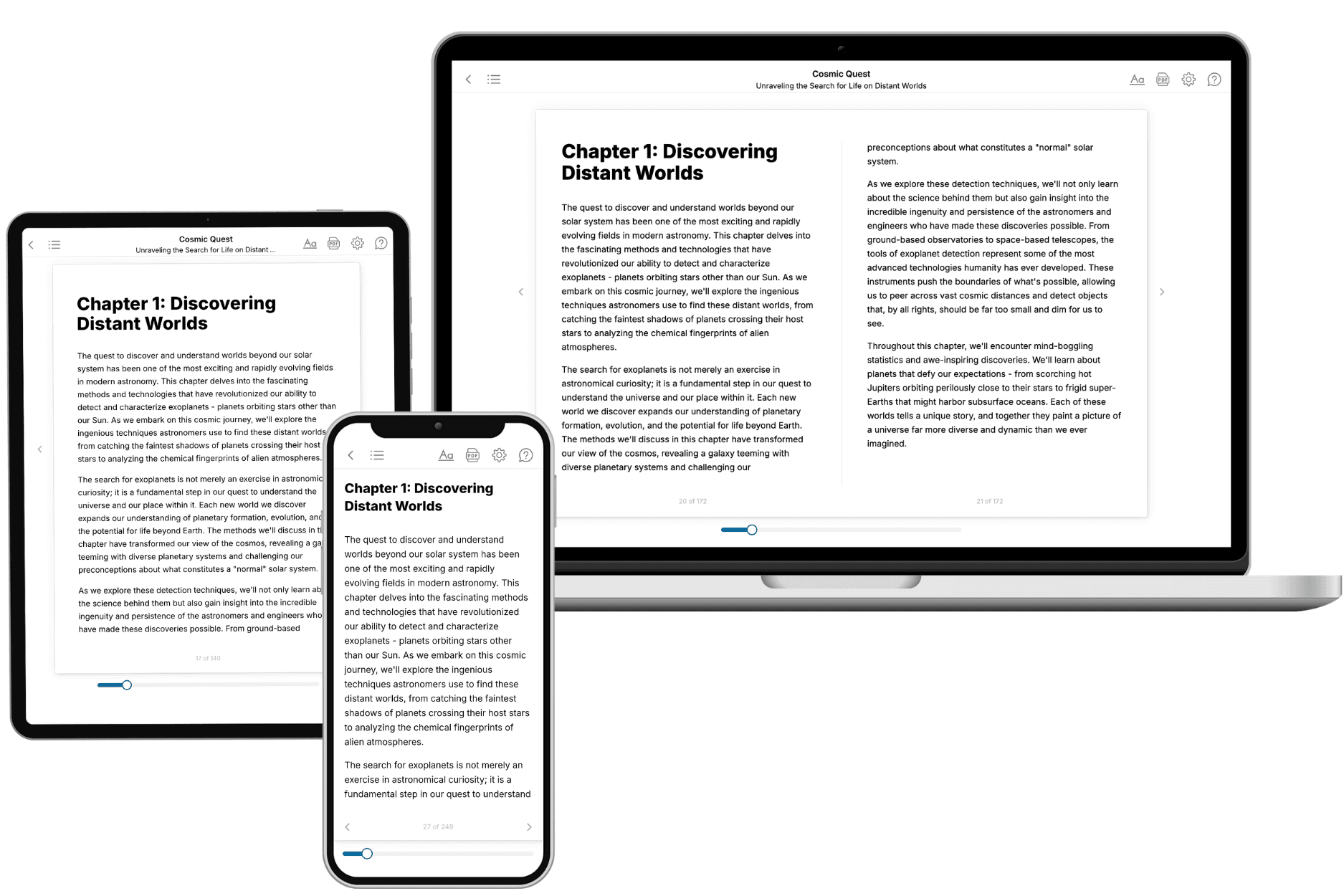
TailoredRead creates complete, full-length nonfiction ebooks, written specifically for you. Tell us what you want to learn and why, and TailoredRead writes you a complete ebook on it, with charts, tables, and diagrams throughout. Read it online, on Kindle, or on any e-reader, or download it as a PDF or EPUB. Every book is written fresh the day you order it.
- How is the book tailored to me?
Before anything is written, you answer a few short questions about your goals, your background, and the topics you care about. Your book is then planned around your answers: written at your level, focused on your goals, and covering the topics you chose, instead of the one-size-fits-all book a store sells everyone.
- Will it read like generic AI content?
No. Your book isn't a chat transcript: it's planned chapter by chapter before a single word is written, told in a clear book voice, and explains ideas visually with charts, tables, and diagrams. After writing, every book goes through an editorial pass that polishes chapters so the book reads consistent from start to finish. Judge for yourself: browse thousands of sample books on our Explore Books page.
- How accurate is the content?
Our AI first checks whether your subject needs live research. Niche and fast-moving subjects are researched before writing, and the book plan and chapters are grounded in what it finds. After writing, every book goes through a quality pass that checks its facts and consistency, and researched books list their sources in a Notes section at the back.
- How long is the book?
You choose the length: Comprehensive (250-300 pages), Detailed (150-200 pages), Essential (70-100 pages), or Short (30-50 pages).
- Does the book include visuals?
Yes. Every book includes charts, tables, and diagrams: timelines, checklists, step-by-step guides, decision trees, comparison tables, matrices, and bar charts. A typical book includes dozens of these visual elements.
- Can I read it on Kindle? What formats can I download?
Yes. Every book can be read in our online reader or downloaded as a PDF or EPUB. The EPUB can be opened with Kindle, Apple Books, Kobo, and any e-reader. The Commercial and Author licenses also include an editable Word (DOCX) and Markdown download.
- How much does it cost?
About the price of a regular ebook. The exact price depends on your book's length and complexity, from $2 for the shortest books to $35 for the most comprehensive, and it's shown when you review your book, before you commit to anything. Each book is a one-time purchase, yours to keep, no subscription. Licenses that let you share, teach, or publish your book range from $35.99 to $49.99.
- Can I preview the book before purchasing?
Before you pay, you'll see what your book will cover: the title, a detailed description, the estimated length, and the complete chapter-by-chapter table of contents, so you know what you're getting before you decide. The full text itself is written after you purchase.
- How long does it take to create a book?
About 10 minutes. You can start reading the opening chapters while the rest is still being written.